
Market Report · July 31, 2026

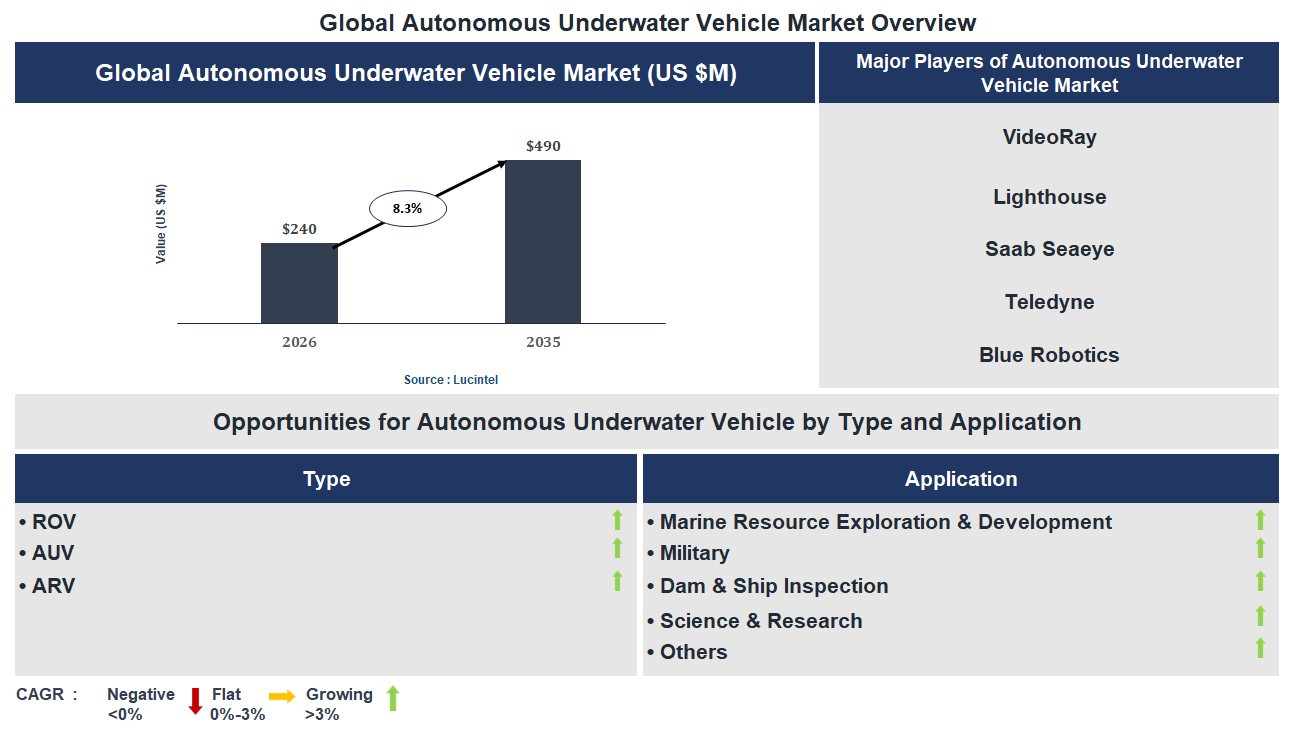
Key data points: The market size in 2035 = $490 million, growth forecast = 8.3% annually for the next 8 years. Scroll below to get more insights. This market report covers trends, opportunities and forecasts in autonomous underwater vehicle market to 2035 by type (ROV, AUV, and ARV), application (marine resource exploration & development, military, dam & ship inspection, science & research, and others), and region (North America, Europe, Asia Pacific, and the Rest of the World)
We'll send your sample report shortly.
• Lucintel forecasts that, within the type category, AUV is expected to witness the highest growth over the forecast period.
• Within the application category, military is expected to witness the highest growth.
• In terms of region, APAC is expected to witness the highest growth over the forecast period. Gain valuable insights for your business decisions with our comprehensive 150+ page report. Sample figures with some insights are shown below.
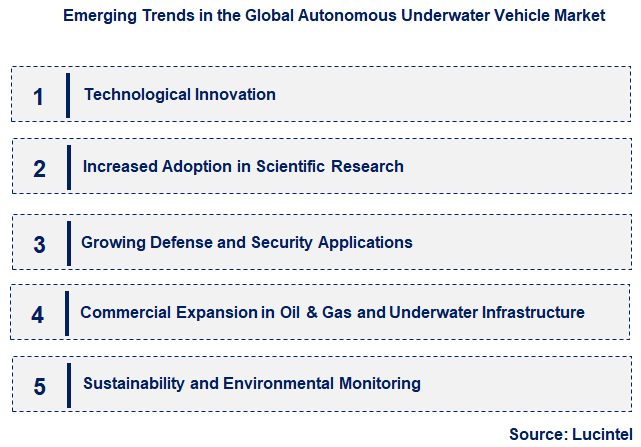
• Technological Innovation: The integration of advanced sensors, AI, and machine learning is revolutionizing AUV capabilities. These innovations enable real-time data processing, autonomous decision-making, and improved navigation accuracy. As a result, AUVs can perform complex tasks with minimal human intervention, increasing operational efficiency and safety. This trend is fostering the development of more sophisticated vehicles capable of handling diverse underwater environments, thus broadening their application scope across scientific, commercial, and defense sectors.
• Increased Adoption in Scientific Research: AUVs are becoming essential tools for oceanographic and environmental studies. Their ability to access hard-to-reach areas and collect high-resolution data is invaluable for climate research, marine biology, and seabed mapping. The trend towards deploying AUVs in scientific missions is driven by the need for detailed, cost-effective, and non-intrusive data collection methods. This shift is accelerating discoveries about marine ecosystems and climate change impacts, ultimately contributing to sustainable ocean management.
• Growing Defense and Security Applications: Governments and military organizations are increasingly deploying AUVs for surveillance, mine detection, and underwater reconnaissance. The trend is fueled by the need for covert, persistent, and versatile underwater assets that can operate in hostile environments. Advances in stealth technology, endurance, and payload capacity are making AUVs more effective for defense purposes. This trend is expected to boost market growth as nations seek to enhance their underwater security capabilities without risking human lives.
• Commercial Expansion in Oil & Gas and Underwater Infrastructure: The oil and gas industry relies heavily on AUVs for pipeline inspection, subsea asset monitoring, and exploration activities. Additionally, the rise of underwater infrastructure projects, such as communication cables and renewable energy installations, is increasing demand for autonomous inspection solutions. This trend is driven by the need for safer, faster, and more cost-efficient operations in challenging underwater environments, leading to increased market penetration and technological advancements tailored to commercial needs.
• Sustainability and Environmental Monitoring: The focus on marine conservation and environmental protection is propelling the use of AUVs for monitoring pollution, coral reefs, and marine habitats. These vehicles provide critical data for assessing environmental health and informing policy decisions. The trend towards sustainable practices is encouraging the development of eco-friendly, energy-efficient AUVs equipped with sensors for long-term monitoring. This shift is fostering collaborations between technology providers and environmental agencies, positioning AUVs as vital tools for sustainable ocean stewardship. These emerging trends are fundamentally reshaping the autonomous underwater vehicle market by enhancing technological capabilities, expanding application areas, and emphasizing sustainability. The market is moving towards more intelligent, versatile, and environmentally conscious solutions, which will drive innovation, increase adoption, and open new opportunities across scientific, commercial, and defense sectors.
• Growing Demand for Underwater Exploration: The increasing need for oceanographic research, resource exploration, and environmental monitoring is driving the adoption of AUVs. These vehicles enable detailed seabed mapping, marine life studies, and resource assessments without risking human lives. As industries seek sustainable and efficient exploration methods, AUVs are becoming essential tools, leading to market growth. Enhanced capabilities and reduced costs are making AUVs accessible to a broader range of users, further expanding their application scope.
• Technological Advancements in Battery and Power Systems: Innovations in battery technology, such as lithium-ion and solid-state batteries, are significantly extending AUV operational endurance. Longer battery life allows for extended missions, deeper dives, and increased data collection. These advancements reduce the need for frequent recharging or vehicle retrieval, improving operational efficiency. As power systems become more reliable and compact, AUVs can undertake more complex and longer missions, boosting their utility across various sectors.
• Integration of Artificial Intelligence and Autonomous Navigation: The incorporation of AI and advanced navigation systems enhances AUV autonomy, enabling real-time decision-making and obstacle avoidance. These improvements allow for more precise and efficient missions, even in complex underwater environments. AI-driven data processing accelerates analysis, providing faster insights. This technological leap reduces human intervention, lowers operational costs, and increases mission success rates, making AUVs more attractive for commercial, scientific, and defense applications.
• Expansion of Commercial and Defense Applications: AUVs are increasingly used in commercial sectors like oil & gas, underwater infrastructure inspection, and maritime security. Defense agencies utilize them for surveillance, mine detection, and reconnaissance. The versatility of AUVs in diverse applications is expanding market opportunities. As industries recognize their benefits, investments in AUV technology are rising. This diversification is fueling innovation, creating new business models, and driving overall market growth.
• Increasing Focus on Data Collection and Environmental Monitoring: The demand for high-quality underwater data is rising for climate research, pollution tracking, and marine biodiversity assessments. AUVs equipped with advanced sensors provide critical data for environmental management and policy-making. Their ability to operate in challenging conditions and cover large areas efficiently makes them indispensable. This focus on environmental applications is opening new markets, encouraging technological improvements, and fostering collaborations between governments, research institutions, and private companies. The overall impact of these developments is a robust expansion of the Autonomous Underwater Vehicle market, driven by technological innovation and increasing application diversity. Enhanced capabilities and broader adoption are making AUVs more integral to underwater exploration, environmental monitoring, and defense. This growth is fostering a competitive landscape, encouraging further R&D, and promising sustained market expansion in the coming years.
• Growing Demand for Underwater Exploration and Research: The increasing need for oceanographic research, environmental monitoring, and resource exploration is fueling the adoption of AUVs. These vehicles offer autonomous, cost-effective solutions for deep-sea exploration, enabling scientists and researchers to access previously unreachable areas. Advancements in sensor technology and data collection capabilities further enhance their utility, driving market growth as organizations seek reliable tools for underwater data acquisition and analysis.
• Expansion of Defense and Military Applications: Governments and defense agencies are investing heavily in AUV technology for surveillance, mine detection, and reconnaissance missions. The ability of AUVs to operate in hazardous or inaccessible underwater environments makes them invaluable for national security. As military strategies evolve to include autonomous systems, the demand for sophisticated, durable, and long-endurance AUVs is expected to rise, significantly contributing to market expansion.
• Increasing Commercial Use in Oil & Gas and Infrastructure Inspection: The oil and gas industry relies on AUVs for subsea pipeline inspection, asset monitoring, and seabed mapping, reducing operational costs and enhancing safety. Similarly, infrastructure inspection of underwater cables, turbines, and ports benefits from autonomous vehicles that can perform detailed surveys efficiently. Growing offshore activities and the need for regular maintenance are expected to propel the commercial application segment, boosting overall market growth.
• Technological Innovations Enhancing AUV Capabilities: Continuous advancements in battery technology, navigation systems, and artificial intelligence are improving AUV performance. Enhanced endurance, precision, and autonomous decision-making capabilities are expanding their operational scope. These innovations enable AUVs to undertake complex missions with minimal human intervention, opening new markets and applications, and fostering competitive differentiation among manufacturers, thus accelerating overall market development.
• Rising Investment and Strategic Collaborations: Increased funding from government agencies, private investors, and industry players is supporting AUV research and development. Strategic partnerships between technology providers and end-users facilitate customized solutions and faster deployment. Such collaborations promote innovation, reduce costs, and expand application areas, ultimately driving market growth. The focus on sustainable and environmentally friendly underwater solutions further encourages investments, positioning the AUV market for sustained expansion. The overall impact of these opportunities is a robust, innovative, and expanding market for autonomous underwater vehicles. As technological, commercial, and defense applications grow, the industry is poised for significant advancements, increased adoption, and global market penetration. Strategic focus on innovation and collaboration will be crucial in unlocking the full potential of AUVs, shaping the future of underwater exploration and operations.
• Technological Innovation: The continuous evolution of robotics, AI, and sensor technologies enhances AUV capabilities, enabling more precise navigation, data collection, and autonomous operation. These advancements reduce human intervention, improve safety, and expand application scope, making AUVs more attractive for commercial and military uses. As technology becomes more affordable and reliable, market adoption accelerates, fostering growth across sectors such as scientific research, defense, and offshore industries.
• Increasing Defense and Security Spending: Governments worldwide are investing heavily in underwater surveillance, mine detection, and maritime security. AUVs offer a cost-effective and efficient solution for these applications, reducing risks to human personnel. The rising geopolitical tensions and the need for maritime domain awareness drive defense agencies to adopt advanced underwater vehicles, significantly contributing to market expansion.
• Growing Oil & Gas Exploration Activities: The offshore oil and gas industry relies on AUVs for seabed mapping, pipeline inspection, and environmental monitoring. As offshore exploration ventures into deeper and more challenging waters, the demand for autonomous underwater solutions increases. The need for efficient, safe, and cost-effective exploration methods propels the adoption of AUVs, supporting market growth.
• Environmental Monitoring and Scientific Research: AUVs are increasingly used for oceanographic data collection, climate change studies, and marine biodiversity assessments. Their ability to operate in harsh and inaccessible environments provides valuable insights, aiding environmental conservation efforts. The rising focus on sustainable ocean management and scientific research funding further boosts demand for advanced AUVs. The challenges in the autonomous underwater vehicle market are:
• Regulatory and Legal Constraints: The deployment of AUVs is subject to strict maritime regulations, environmental laws, and safety standards. Navigating complex legal frameworks across different regions can delay deployment and increase compliance costs. Additionally, concerns over underwater privacy and security may restrict certain applications, hindering market growth.
• High Operational and Maintenance Costs: Developing, deploying, and maintaining AUVs involve significant expenses, including sophisticated hardware, specialized personnel, and ongoing servicing. These costs can limit adoption, especially among smaller organizations or in regions with limited budgets. The high cost of technology also impacts the scalability and widespread deployment of AUVs.
• Technological Limitations and Reliability Issues: Despite advancements, AUVs face challenges related to battery life, communication in deep waters, and obstacle avoidance. These technical limitations can compromise mission success and safety. Ensuring reliability in extreme underwater conditions remains a significant hurdle, requiring ongoing research and development investments. The autonomous underwater vehicle market is driven by rapid technological innovations, increased defense and offshore exploration investments, and a focus on environmental research. However, regulatory complexities, high costs, and technological challenges pose notable barriers. These factors collectively shape the market landscape, influencing growth trajectories and strategic decisions. Stakeholders must navigate these drivers and challenges carefully to leverage opportunities and mitigate risks, ensuring sustainable development and competitive advantage in this dynamic industry.
• VideoRay
• Lighthouse
• Saab Seaeye
• Teledyne
• Blue Robotics
• Nido Robotics
• Deep Trekker
• Kongsberg
• ECA Group
• SEAMOR Marine
• ROV
• AUV
• ARV
• Marine Resource Exploration & Development
• Military
• Dam & Ship Inspection
• Science & Research
• Others
• North America
• Europe
• Asia Pacific
• The Rest of the World
• United States: The US leads in AUV technology development, with major investments from government agencies like NOAA and the Department of Defense. Recent innovations include enhanced autonomous navigation systems, increased payload capacities, and integration of AI for better decision-making. US companies are expanding their commercial applications, especially in oil and gas exploration, underwater infrastructure inspection, and scientific research. Collaborative projects with academia are fostering breakthroughs in battery life and sensor technology, positioning the US as a market leader.
• China: China has rapidly advanced its AUV capabilities, focusing on military and commercial applications. Recent developments include the deployment of domestically manufactured AUVs for oceanographic surveys and underwater security missions. The government is prioritizing R&D to develop long-endurance vehicles with improved stealth features. Chinese firms are also investing in underwater data collection and deep-sea exploration, aiming to reduce reliance on foreign technology and establish a competitive domestic industry.
• Germany: Germany is emphasizing the integration of AUVs into maritime safety, environmental monitoring, and offshore industry operations. Recent innovations involve the development of highly reliable, energy-efficient AUVs capable of operating in challenging conditions. German research institutions are collaborating with industry to enhance sensor accuracy and data processing capabilities. The focus remains on sustainable underwater exploration and supporting renewable energy projects like offshore wind farms.
• India: India is increasingly adopting AUV technology for defense, scientific research, and resource exploration. Recent developments include the successful testing of indigenous AUV prototypes with improved navigation and communication systems. The government is promoting R&D through initiatives like the Make in India program to develop cost-effective, domestically manufactured AUVs. These efforts aim to strengthen India’s underwater surveillance and exploration capabilities amid regional maritime security concerns.
• Japan: Japan continues to innovate in AUV technology, emphasizing deep-sea exploration and disaster management. Recent advancements include the deployment of advanced AUVs capable of operating at extreme depths and in harsh environments. Japanese research institutions are focusing on improving autonomous navigation and sensor integration for precise data collection. The country is also exploring applications in underwater infrastructure inspection and environmental conservation, leveraging its expertise in robotics and marine sciences.


• VideoRay
• Lighthouse
• Saab Seaeye
• Teledyne
• Blue Robotics
• Nido Robotics
• Deep Trekker
• Kongsberg
• ECA Group
• SEAMOR Marine Q6. Which autonomous underwater vehicle market segment will be the largest in future? Answer: Lucintel forecasts that, within the type category, AUV is expected to witness the highest growth over the forecast period. Q7. In autonomous underwater vehicle market, which region is expected to be the largest in next 8 years? Answer: In terms of region, APAC is expected to witness the highest growth over the forecast period. Q8. Do we receive customization in this report? Answer: Yes, Lucintel provides 10% customization without any additional cost.


Choose a license that fits your team. Instant PDF delivery.
Prices exclude taxes. Instant delivery. Custom licensing available on request.
Market Report · July 31, 2026
Market Report · July 31, 2026
Market Report · July 31, 2026
Trusted partner for strategic intelligence and business growth


Receive a complimentary market analysis tailored to your industry. Our analysts will identify key growth opportunities and competitive dynamics specific to your business.

Market size, growth rate, and key trend analysis for your specific sector.

Top competitor positioning and market share analysis.

Strategic recommendations backed by data-driven insights.
Get curated market intelligence and competitive moves straight to your inbox.
By subscribing, you agree to receive our monthly insights. Unsubscribe anytime.
Receive a complimentary market analysis tailored to your industry. Our analysts will identify key growth opportunities and competitive dynamics specific to your business.
Market size, growth rate, and key trend analysis for your specific sector.
Top competitor positioning and market share analysis.
Strategic recommendations backed by data-driven insights.
Get curated market intelligence, emerging trends, and competitive moves straight to your inbox each month.
By subscribing, you agree to receive our monthly insights. Unsubscribe anytime.
We'll send your sample report shortly.