
Market Report · July 31, 2026

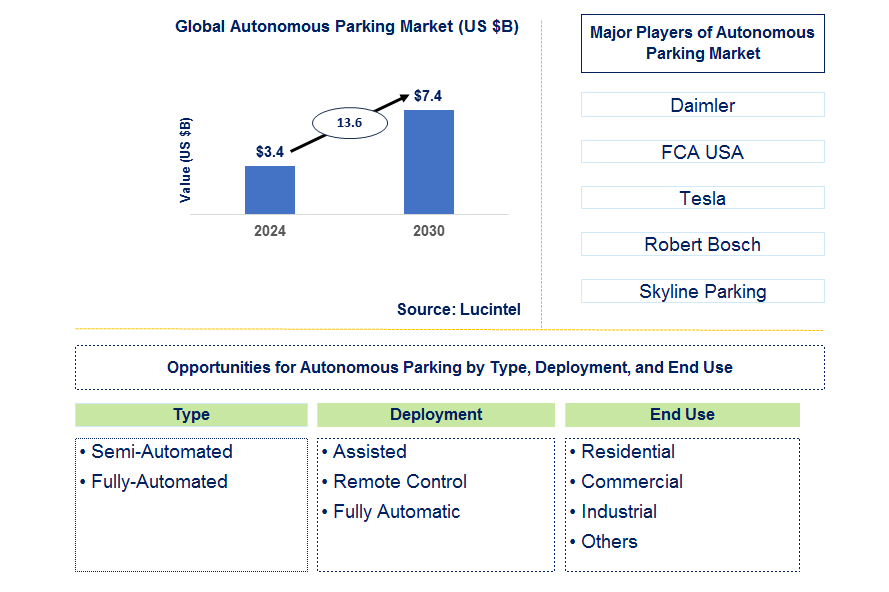
Key data points: The market size in 2030 = $7.4 billion, growth forecast = 13.6% annually for the next 6 years. Scroll below to get more insights. This market report covers trends, opportunities, and forecasts in the global autonomous parking market to 2030 by type (semi-automated and fully-automated), deployment (assisted, remote control, and fully automatic), end use (residential, commercial, industrial, and others), and region (North America, Europe, Asia Pacific, and the Rest of the World)
We'll send your sample report shortly.
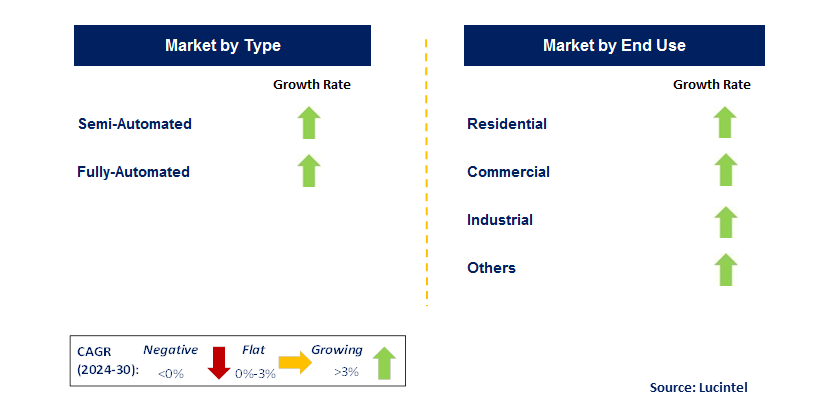
• Lucintel forecasts that, within the type category, fully-automated will remain a larger segment over the forecast period because the benefits of fully automated parking systems include better efficiency, expanded capacity, lower emissions, and improved safety and convenience.
• In terms of regions, North America will remain the largest region over the forecast period due to existence of advanced automotive technology players, rising focus on smart citites, supportive regulatory environment, as well as, rising implementation of pilot projects and testing technologies. Gain valuable insights for your business decisions with our comprehensive 150+ page report.
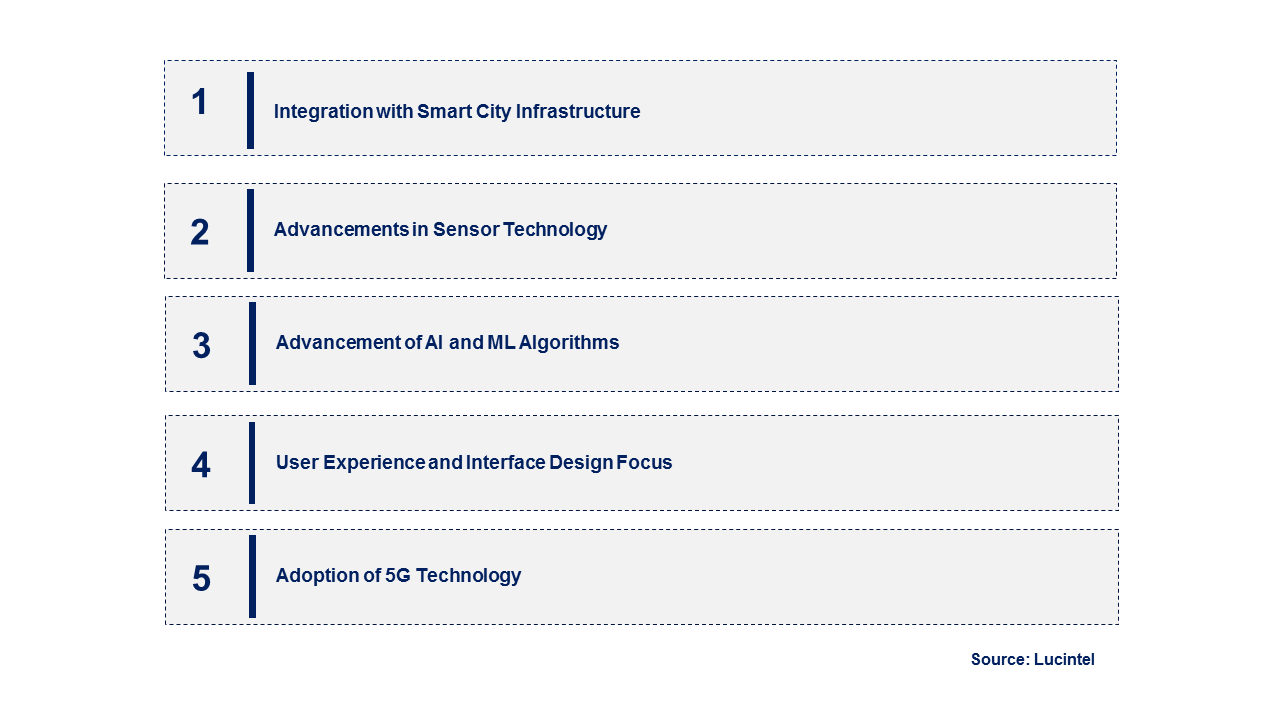
• Integration with Smart City Infrastructure: Modern intelligent car parks are increasingly integrated within smart city infrastructures. By connecting them to traffic lights and other urban sensors, this integration enhances urban space utilization along with better traffic management. It represents a trend toward more cohesive and responsive transportation ecosystems in cities.
• Advancements in Sensor Technology: There are continuous evolutions in sensor technology involving LIDAR, radar, and cameras, thereby increasing the accuracy and reliability of autonomous parking systems. Fewer obstacles can be detected due to these improvements, which enable detection capabilities under various environmental conditions, such as climatic factors or obstructions like trees, leading to safer parking options.
• Advancement of AI and ML Algorithms: The use of artificial intelligence and machine learning in autonomous parking systems is increasing. These technologies enable systems to learn from real-world data, thereby enhancing their decision-making capabilities and flexibility. Autonomous parking solutions become more accurate, perform better, and provide a better user experience through improved algorithms.
• User Experience and Interface Design Focus: It is becoming increasingly important to improve user experience with intuitive interfaces and seamless integration with mobile applications. Enhancements for user interfaces strive to make interactions with autonomous parking systems more user-friendly and efficient, allowing users to easily access their parking experiences.
• Adoption of 5G Technology: The rollout of 5G technology has revolutionized autonomous parking through fast communication between vehicles and parking structures at low latency. Consequently, this facilitates real-time information transfer while increasing the responsiveness and dependability of automated parking systems, allowing for precise operations and higher efficiency. These emerging trends indicate a move toward smarter, integrated, user-centric autonomous parking solutions. Advances in technology and regulatory developments shape the future of parking systems that promote innovation, thereby improving urban mobility.
• Sensor Integration Improvement: Recent times have seen improvements such as the inclusion of advanced sensors like high-resolution LIDAR, multi-angle cameras, and radar systems. This offers comprehensive environmental information that augments obstacle detection and movement within complex parking situations by vehicle control systems. Significant sensor integration results in improved reliability and accuracy of autonomous parking solutions, addressing both safety and performance issues.
• AI and Machine Learning Progress: There has been significant development in integrating AI and machine learning into self-driving car systems. These technologies enable systems to handle large-scale data processing, learn from real-world scenarios, and adjust to changing circumstances. System decision-making improves through better algorithms that make more precise parking movements and manage dynamic environments effectively.
• 5G Connectivity Implementation: Faster and more reliable communication between vehicles and infrastructure is occurring due to the introduction of 5G technology in autonomous parking. Real-time support for data exchange is available with 5G connectivity, which reduces latency and improves system response time. Consequently, this advancement enhances the efficiency of autonomous parking operations, creating more connected and intelligent transportation networks.
• Collaborations and Partnerships: Automotive manufacturers are joining forces with technology providers and urban planners. The purpose of such alliances is to develop integrated solutions where autonomous parking technologies harmonize with smart city infrastructure. Standardized systems, interoperability improvements, and regulatory concerns are featured prominently in these collaborative efforts. Recent developments within the autonomous parking market showcase sensor improvements, AI integration, 5G connectivity, and collaborations as well as partnerships. These innovations drive the evolution of autonomous parking solutions that improve performance while enhancing uptake within urban areas.
• Smart City Expansions: The integration of smart city projects with autonomous parking systems will lead to significant developments in the future. This can reduce urban traffic congestion, improve transportation efficiency, and increase the utilization of space in city environments as they are integrated with municipal authorities and town planners.
• Inexpensive Developments: Autonomous parking innovations that are affordable for new markets and budget-conscious customers can be developed. Cheaper sensor technologies and streamlined software can enable easy access to autonomous parking, thereby broadening market size.
• EV Coalescence: The growth opportunity arises from the integration between autonomous parking technology and electric vehicles, especially with the rise in EV adoption. Parking lot charging facilities can be enhanced by incorporating them with autonomous parking, making the use of EVs more user-friendly, seamless, and efficient.
• Superior Data Analytics for Enhanced User Insights: Investments in data analytics for actionable intelligence will enhance system performance as well as provide other strategic advantages. It enables optimized parking operations, better user experiences, and predictive maintenance through advanced analytics, fostering further advancements and efficiencies. Strategic growth opportunities in the autonomous parking market include expanding smart city initiatives, developing cost-effective solutions, integrating with electric vehicles, and leveraging data analytics. These opportunities offer pathways for innovation, market expansion, and enhanced user experiences.
• Advances in Technology: The increased use of artificial intelligence, connectivity, and other advancements have significantly contributed to this industry’s development by ensuring accurate sensing systems that provide better experiences for users who may need such services at any time.
• Rapid Urbanization and Traffic Congestion: Autonomous car parks that optimize space usage help solve the problem of parking in dense cities characterized by urbanization and increased congestion.
• Government Initiatives and Regulations: These initiatives play a vital role in the growth of the autonomous driving market and smart city infrastructure. Incentives and regulatory environments encourage investments in autonomous parking technologies.
• Consumer Demand for Convenience: The desire for a user-friendly experience has contributed to an increase in demand for autonomous parking systems. Users seek convenience, enhancing the appeal of these products and services. Challenges in the autonomous parking market include:
• High Development Costs: Developers incur significant costs associated with research, technology development, and implementation while creating advanced automated car parks. This can affect profitability for new entrants in the field.
• Regulatory and Safety Concerns: Complex regulations govern self-driving cars in order to operate autonomously on roadways and address safety issues. Adherence to evolving laws while maintaining system reliability is crucial for market acceptance.
• Integration with Existing Infrastructure: Most existing parking spaces were not designed with self-parking technology in mind, making it difficult to integrate them into a city environment, especially when they are incompatible or need upgrading.
• Consumer Acceptance and Trust: Establishing trust among consumers regarding the usefulness of this technology is important for widespread adoption of autonomous parking. Addressing concerns about safety, reliability, and user-friendliness will determine its acceptance. In conclusion, technological advancement and urbanization fuel growth in autonomous parking systems, but their success depends on overcoming challenges such as high development costs, regulatory concerns, integration issues, and consumer trust.
• Daimler
• FCA USA
• Tesla
• Robert Bosch
• Skyline Parking
• Westfalia Parking
• Unitronics
• Klaus Multiparking
• Robotic Parking Systems
• City Lift Parking
• Semi-Automated
• Fully-Automated
• Assisted
• Remote Control
• Fully Automatic
• Residential
• Commercial
• Industrial
• Others
• North America
• Europe
• Asia Pacific
• The Rest of the World
• United States: The U.S. is leading in advancing autonomous parking technology through AI integration that employs machine learning to enhance system accuracy and efficiency. Companies have partnered with tech firms to upgrade their sensor technologies and data processing capacity. Pilot programs and regulatory approvals will lead to widespread adoption within cities, facilitated by better user interface design and system reliability enhancements.
• China: Government support in China has facilitated rapid advances in autonomous parking solutions, driven by major investments by tech giants. Developments include using 5G technology to improve interaction between vehicles and parking infrastructure. The country is also focusing on research into next-generation sensing devices and smart parking strategies to alleviate increasing density in urban zones.
• Germany: Germany leads the development of autonomous parking systems, focusing on both new models and retrofitting existing ones with such technologies. The automotive industry has made strides in sensor fusion techniques and robustness under different driving conditions to ensure reliable performance. Automotive manufacturers are collaborating with various technology providers to deliver standardized solutions across the industry.
• India: The Indian autonomous parking market is still in its infancy, focusing on cost-effective solutions tailored to local requirements. Recent developments include testing grounds in smart cities that aim to optimize parking management and reduce traffic congestion. Additionally, integrating autonomous parking with public transit systems is an effective strategy for improving urban mobility.
• Japan: Japan has made significant progress in autonomous parking technology by focusing on compact and efficient systems. Japanese companies are experimenting with advanced sensing technologies from the outset, adding sophisticated artificial intelligence as they advance to enhance system accuracy. There is also an effort to incorporate these systems into existing structures while partnering with real estate developers and municipal authorities.


• Daimler
• FCA USA
• Tesla
• Robert Bosch
• Skyline Parking
• Westfalia Parking
• Unitronics
• Klaus Multiparking
• Robotic Parking Systems
• City Lift Parking Q6. Which autonomous parking market segment will be the largest in future? Answer: Lucintel forecasts that fully-automated will remain the larger segment over the forecast period because the benefits of fully automated parking systems include better efficiency, expanded capacity, lower emissions, and improved safety and convenience. Q7. In autonomous parking market, which region is expected to be the largest in next 5 years? Answer: North America will remain the largest region over the forecast period due to existence of advanced automotive technology players, rising focus on smart citites, supportive regulatory environment, as well as, rising implementation of pilot projects and testing technologies. Q.8 Do we receive customization in this report? Answer: Yes, Lucintel provides 10% customization without any additional cost.


Choose a license that fits your team. Instant PDF delivery.
Prices exclude taxes. Instant delivery. Custom licensing available on request.
Market Report · July 31, 2026
Market Report · July 22, 2026
Market Report · July 17, 2026
Trusted partner for strategic intelligence and business growth


Receive a complimentary market analysis tailored to your industry. Our analysts will identify key growth opportunities and competitive dynamics specific to your business.

Market size, growth rate, and key trend analysis for your specific sector.

Top competitor positioning and market share analysis.

Strategic recommendations backed by data-driven insights.
Get curated market intelligence and competitive moves straight to your inbox.
By subscribing, you agree to receive our monthly insights. Unsubscribe anytime.
Receive a complimentary market analysis tailored to your industry. Our analysts will identify key growth opportunities and competitive dynamics specific to your business.
Market size, growth rate, and key trend analysis for your specific sector.
Top competitor positioning and market share analysis.
Strategic recommendations backed by data-driven insights.
Get curated market intelligence, emerging trends, and competitive moves straight to your inbox each month.
By subscribing, you agree to receive our monthly insights. Unsubscribe anytime.
We'll send your sample report shortly.