
Report Feature
Automotive Solar Sensor Market Trends and Forecast
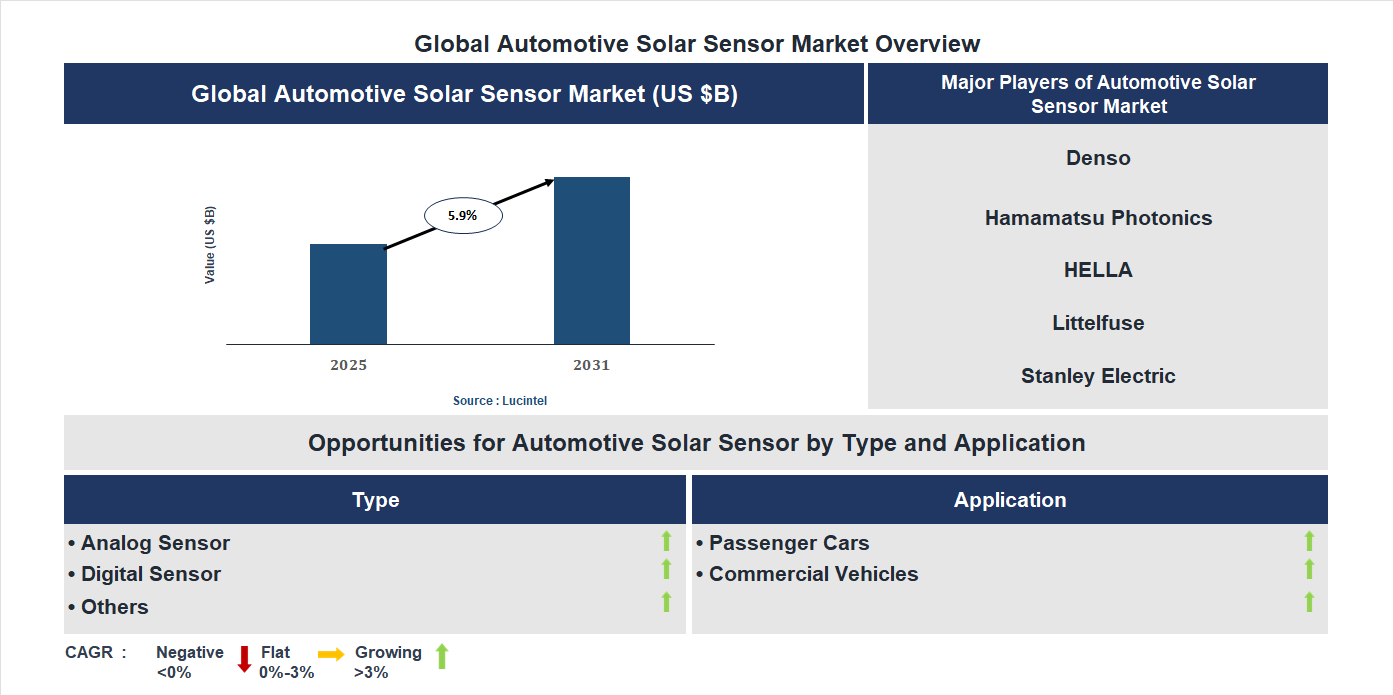
The future of the global automotive solar sensor market looks promising with opportunities in the passenger car and commercial vehicle markets. The global automotive solar sensor market is expected to grow with a CAGR of 5.9% from 2025 to 2031. The major drivers for this market are the increasing use of automatic climate control systems, the rising demand for energy efficient automotive technologies, and the growing adoption of smart sensing components in vehicles.• Lucintel forecasts that, within the type category, digital sensor is expected to witness higher growth over the forecast period.
• Within the application category, passenger car is expected to witness higher growth.
• In terms of region, APAC is expected to witness the highest growth over the forecast period. Gain valuable insights for your business decisions with our comprehensive 150+ page report. Sample figures with some insights are shown below.
Emerging Trends in the Automotive Solar Sensor Market
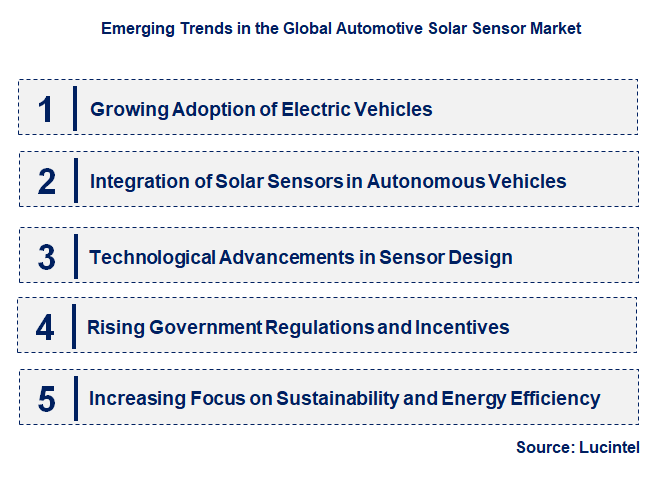
The automotive solar sensor market is experiencing rapid evolution driven by technological advancements, increasing demand for energy-efficient vehicles, and stricter environmental regulations. As automakers seek innovative solutions to enhance vehicle performance and sustainability, solar sensors are becoming integral components. These sensors help optimize energy use, improve safety features, and contribute to the development of autonomous and electric vehicles. The markets growth is also fueled by rising consumer awareness about eco-friendly transportation options and government incentives promoting renewable energy integration. This dynamic environment is fostering new opportunities and challenges, prompting industry players to innovate continuously and adapt to changing consumer and regulatory demands.• Growing adoption of electric vehicles: The shift towards electric vehicles (EVs) is significantly boosting the demand for solar sensors. Solar sensors help optimize energy management within EVs by monitoring sunlight exposure, which can be used to enhance battery efficiency and extend driving range. Automakers are integrating these sensors to improve vehicle sustainability and performance, aligning with global efforts to reduce carbon emissions. As EV sales continue to rise worldwide, the need for advanced solar sensing technology becomes more critical, making it a key driver of market growth and innovation.
• Integration of solar sensors in autonomous vehicles: Autonomous vehicles rely heavily on sensors for navigation, safety, and energy management. Solar sensors are increasingly being integrated into these systems to monitor sunlight and optimize the vehicle’s energy consumption. This integration helps autonomous vehicles operate more efficiently, especially in solar-powered or hybrid models. The trend enhances vehicle autonomy by providing real-time data that can be used to adjust operational parameters, reduce energy waste, and improve overall system reliability. As autonomous technology advances, the role of solar sensors becomes more prominent in ensuring sustainable and efficient vehicle operation.
• Technological advancements in sensor design: Innovations in sensor technology are leading to more compact, accurate, and cost-effective solar sensors. Developments include improved materials that enhance sensitivity and durability, as well as integration with IoT platforms for real-time data analysis. These advancements enable automakers to embed solar sensors seamlessly into various vehicle components, improving overall vehicle efficiency and safety. Enhanced sensor performance also allows for better adaptation to diverse environmental conditions, expanding their applicability across different vehicle types and markets. Continuous R&D efforts are expected to further refine sensor capabilities, driving market expansion.
• Rising government regulations and incentives: Governments worldwide are implementing stricter emission standards and promoting renewable energy adoption, which directly impacts the automotive solar sensor market. Incentives such as tax rebates, subsidies, and mandates for energy-efficient vehicles encourage automakers to incorporate solar sensors into their designs. These policies accelerate market growth by making solar sensor technology more attractive and financially viable for manufacturers. Additionally, regulatory frameworks are pushing for increased transparency and safety standards, prompting automakers to adopt advanced sensing solutions to meet compliance and consumer expectations.
• Increasing focus on sustainability and energy efficiency: The global emphasis on sustainability is driving automakers to develop greener vehicles equipped with energy-saving technologies like solar sensors. These sensors contribute to reducing reliance on traditional power sources, optimizing energy use, and extending vehicle range. The focus on eco-friendly transportation solutions aligns with consumer preferences and corporate social responsibility goals. As sustainability becomes a core industry principle, the demand for solar sensors that enhance vehicle efficiency and reduce environmental impact is expected to grow, shaping the future landscape of the automotive market. In summary, these emerging trends are collectively transforming the automotive solar sensor market by fostering innovation, enhancing vehicle efficiency, and aligning with global sustainability goals. The integration of advanced sensor technologies, supportive regulatory environments, and the shift towards electric and autonomous vehicles are creating a dynamic landscape that promises continued growth and evolution in the industry.
Recent Development in the Automotive Solar Sensor Market
The automotive solar sensor market has experienced significant growth driven by advancements in vehicle automation, increasing demand for energy-efficient solutions, and stricter environmental regulations. As automakers seek innovative ways to enhance vehicle performance and sustainability, solar sensors have become integral in optimizing energy use and improving safety features. Recent developments reflect technological innovations, expanding applications, and increased adoption across various vehicle types. These trends are shaping the future landscape of automotive solar sensors, making vehicles smarter, greener, and more efficient. The following key developments highlight the major shifts and innovations influencing this dynamic market.• Technological Advancements: Integration of high-efficiency photovoltaic cells has improved sensor accuracy and energy conversion rates, enabling better power management and extended vehicle range. These innovations enhance the overall vehicle performance and reduce reliance on traditional power sources, fostering sustainability.
• Expansion of Application Areas: Solar sensors are now increasingly used in advanced driver-assistance systems (ADAS), interior climate control, and sunroof shading. This diversification broadens market scope and enhances vehicle safety, comfort, and energy efficiency, attracting automakers interest.
• Growing Adoption in Electric Vehicles (EVs): The rising popularity of EVs has accelerated the adoption of solar sensors to supplement battery power, extend driving range, and reduce charging frequency. This trend supports the shift toward greener transportation and positions solar sensors as a critical component in EV design.
• Strategic Collaborations and Partnerships: Major automotive manufacturers and sensor technology companies are forming alliances to develop integrated solar sensor solutions. These collaborations facilitate innovation, reduce development costs, and accelerate market entry, boosting overall industry growth.
• Regulatory and Environmental Policies: Governments worldwide are implementing stricter emission standards and promoting renewable energy use, encouraging automakers to incorporate solar sensors. These policies create a favorable environment for market expansion and technological innovation. In summary, these developments are significantly impacting the automotive solar sensor market by driving technological innovation, expanding application areas, and aligning with sustainability goals. The market is becoming more competitive and dynamic, with increased adoption across various vehicle segments, ultimately contributing to greener, smarter, and more energy-efficient transportation solutions.
Strategic Growth Opportunities in the Automotive Solar Sensor Market
The automotive solar sensor market is experiencing rapid growth driven by advancements in vehicle automation, increasing adoption of electric vehicles, and the need for enhanced energy efficiency. As automakers focus on integrating smart sensors to improve vehicle performance and safety, new opportunities are emerging across various applications. These developments are transforming the industry landscape, creating avenues for innovation and competitive advantage. Key growth opportunities are centered around applications such as vehicle safety systems, energy management, autonomous driving, interior comfort, and exterior lighting. Exploring these areas reveals significant potential for market expansion and technological advancement.• Vehicle Safety Systems: Improving driver assistance and accident prevention : Solar sensors enhance the functionality of collision avoidance systems and adaptive cruise control by providing real-time environmental data, leading to safer driving experiences and reducing accident rates.
• Energy Management: Optimizing power consumption in electric vehicles : Solar sensors help monitor sunlight exposure and energy flow, enabling better management of solar energy harvesting and battery efficiency, which extends vehicle range and reduces energy costs.
• Autonomous Driving: Supporting sensor fusion and environment perception : These sensors contribute to the perception layer in autonomous vehicles by providing additional environmental data, improving object detection accuracy, and enabling safer autonomous navigation.
• Interior Comfort: Regulating climate control systems : Solar sensors detect sunlight intensity and vehicle interior temperature, allowing automatic adjustments to climate control systems, enhancing passenger comfort and reducing energy consumption.
• Exterior Lighting: Enhancing adaptive lighting systems : Solar sensors assist in adjusting exterior lighting based on ambient light conditions, improving visibility, safety, and energy efficiency during night driving or adverse weather conditions. In summary, these growth opportunities are significantly impacting the automotive solar sensor market by driving innovation, improving vehicle safety and efficiency, and supporting the shift toward smarter, more sustainable transportation solutions. As automakers continue to adopt advanced sensor technologies, the market is poised for substantial expansion and technological evolution.
Automotive Solar Sensor Market Driver and Challenges
The automotive solar sensor market is influenced by a variety of technological, economic, and regulatory factors that shape its growth trajectory. Advances in sensor technology and increasing vehicle automation are driving demand, while economic fluctuations impact consumer spending and manufacturing investments. Regulatory standards aimed at improving vehicle safety and energy efficiency further propel market expansion. However, challenges such as high development costs, technological integration issues, and regulatory compliance complexities pose significant hurdles. Understanding these drivers and challenges is essential for stakeholders to navigate the evolving landscape effectively and capitalize on emerging opportunities within the automotive solar sensor industry. The factors responsible for driving the automotive solar sensor market include:-• Technological Innovation: The rapid development of advanced sensor technologies enhances vehicle safety and energy efficiency. Automotive solar sensors are integral to systems like sunload management and automatic shading, which improve passenger comfort and reduce energy consumption. Innovations in miniaturization, durability, and accuracy are making sensors more reliable and cost-effective. As automakers focus on integrating smart, energy-efficient features, the demand for sophisticated solar sensors increases. This technological evolution supports the development of autonomous vehicles and connected car systems, further expanding market potential. The continuous improvement in sensor performance directly correlates with increased adoption across various vehicle segments, fueling overall market growth.
• Rising Adoption of Electric Vehicles (EVs): The global shift toward electric mobility is a significant driver for the automotive solar sensor market. EVs require advanced sensors to optimize energy management, enhance safety features, and improve overall vehicle performance. Solar sensors contribute to energy efficiency by managing sunlight exposure and reducing cooling loads, which is crucial for extending battery life. Governments worldwide are incentivizing EV adoption through subsidies and stricter emission regulations, indirectly boosting demand for compatible sensor technologies. As automakers expand their EV portfolios, the integration of solar sensors becomes more prevalent, supporting sustainable transportation initiatives and opening new revenue streams within the market.
• Increasing Focus on Vehicle Safety and Comfort: Consumer demand for safer and more comfortable vehicles is a key market driver. Automotive solar sensors enable features such as automatic sunroof shading, glare reduction, and climate control optimization, enhancing passenger comfort. Additionally, these sensors support advanced driver-assistance systems (ADAS) by providing real-time data on sunlight intensity and positioning, which improves vehicle responsiveness. Regulatory bodies are also mandating safety standards that encourage the adoption of such sensors. As automakers strive to differentiate their offerings through enhanced safety and comfort features, the integration of solar sensors becomes a strategic priority, thereby expanding market opportunities.
• Regulatory and Environmental Policies: Stringent government regulations aimed at reducing vehicle emissions and promoting energy efficiency are fueling the automotive solar sensor market. Policies encouraging the adoption of solar-powered and energy-efficient vehicle components incentivize automakers to incorporate advanced sensors. Additionally, standards related to vehicle safety and environmental impact compel manufacturers to adopt innovative sensor solutions. These regulations not only accelerate technological development but also create a favorable environment for market growth. Compliance with evolving standards ensures market players remain competitive and aligned with global sustainability goals, thereby driving demand for automotive solar sensors.
• Growing Automotive Electronics Market: The expanding automotive electronics sector is a major driver for solar sensor adoption. Increasing vehicle connectivity, automation, and electrification require sophisticated electronic components, including sensors. Solar sensors are integral to these systems, providing critical data for optimizing vehicle operation and energy management. The proliferation of connected and autonomous vehicles further amplifies the need for reliable, real-time sensing solutions. As automotive manufacturers invest heavily in electronic systems to meet consumer expectations and regulatory requirements, the demand for solar sensors is expected to rise significantly, supporting overall industry growth. The challenges facing this automotive solar sensor market include:-
• High Development and Manufacturing Costs: Developing advanced automotive solar sensors involves significant investment in research, testing, and manufacturing infrastructure. The complexity of designing sensors that withstand harsh environmental conditions while maintaining accuracy adds to costs. These high expenses can limit market entry for smaller players and slow down innovation. Additionally, the need for continuous upgrades to meet evolving regulatory standards further escalates costs. Manufacturers must balance quality and affordability, which can be challenging, potentially impacting profit margins and slowing market expansion.
• Technological Integration and Compatibility Issues: Integrating solar sensors seamlessly into existing vehicle systems presents technical challenges. Compatibility with diverse vehicle architectures and electronic control units (ECUs) requires extensive customization and testing. Ensuring sensors operate reliably across different environmental conditions, such as extreme temperatures and vibrations, complicates integration efforts. These issues can lead to delays in product deployment and increased development costs. Moreover, rapid technological changes necessitate frequent updates, making it difficult for manufacturers to maintain compatibility and ensure consistent performance, thereby hindering market growth.
• Regulatory Compliance and Standardization Challenges: Navigating the complex landscape of automotive safety and environmental regulations poses a significant challenge. Variations in standards across regions require manufacturers to adapt sensors to meet multiple compliance requirements, increasing development time and costs. The lack of universal standards for automotive solar sensors can lead to interoperability issues and market fragmentation. Staying ahead of evolving regulations demands continuous innovation and testing, which can be resource-intensive. Failure to comply or adapt swiftly can result in penalties, recalls, or loss of market share, impeding overall industry progress. In summary, the automotive solar sensor market is driven by technological advancements, the rise of electric vehicles, safety and comfort demands, regulatory policies, and the expanding electronics sector. However, high development costs, integration challenges, and regulatory complexities pose notable hurdles. These factors collectively influence the pace and direction of market growth. While opportunities for innovation and expansion are substantial, stakeholders must navigate these challenges carefully to sustain competitive advantage and capitalize on emerging trends. Overall, the markets future hinges on balancing technological progress with effective management of regulatory and cost-related obstacles.
List of Automotive Solar Sensor Companies
Companies in the market compete on the basis of product quality offered. Major players in this market focus on expanding their manufacturing facilities, R&D investments, infrastructural development, and leverage integration opportunities across the value chain. With these strategies automotive solar sensor companies cater increasing demand, ensure competitive effectiveness, develop innovative products & technologies, reduce production costs, and expand their customer base. Some of the automotive solar sensor companies profiled in this report include-• Denso
• Hamamatsu Photonics
• HELLA
• Littelfuse
• Stanley Electric
Automotive Solar Sensor Market by Segment
The study includes a forecast for the global automotive solar sensor market by type, application, and region.Automotive Solar Sensor Market by Type [Value from 2019 to 2031]:
• Analog Sensor
• Digital Sensor
• Others
Automotive Solar Sensor Market by Application [Value from 2019 to 2031]:
• Passenger Cars
• Commercial Vehicles
Automotive Solar Sensor Market by Region [Value from 2019 to 2031]:
• North America
• Europe
• Asia Pacific
• The Rest of the World
Country Wise Outlook for the Automotive Solar Sensor Market
The automotive solar sensor market is experiencing rapid growth driven by advancements in vehicle automation, increasing adoption of electric vehicles, and a global push towards sustainable transportation. Innovations in sensor technology are enhancing vehicle safety, energy efficiency, and autonomous driving capabilities. Governments worldwide are implementing stricter regulations to promote eco-friendly vehicles, further fueling market expansion. As automakers integrate solar sensors to optimize energy use and improve vehicle performance, regional developments reflect varying levels of technological adoption and investment. The following summaries highlight recent key developments in the United States, China, Germany, India, and Japan within this evolving market.• United States: The US market has seen significant investments in autonomous vehicle technology, with major automakers and tech firms developing advanced solar sensors to improve vehicle energy management and safety features. Regulatory support and consumer demand for eco-friendly vehicles are accelerating adoption. Innovations in sensor integration for electric vehicles are also prominent, with collaborations between industry leaders to enhance sensor accuracy and durability. The US government’s incentives for clean energy vehicles further boost market growth, making it a leader in automotive solar sensor advancements.
• China: China remains the largest market for automotive solar sensors, driven by government policies promoting electric vehicles and smart transportation. Domestic manufacturers are investing heavily in R&D to develop cost-effective, high-performance sensors suitable for mass production. The rapid expansion of EV infrastructure and urbanization has increased demand for solar sensors in commercial and passenger vehicles. Chinese automakers are also focusing on integrating solar sensors with vehicle connectivity systems to enable smarter, energy-efficient vehicles, positioning China as a key innovator in this sector.
• Germany: Germany’s automotive industry is emphasizing high-quality, precision sensors to meet stringent European safety and environmental standards. Leading automakers are incorporating solar sensors into their electric and hybrid vehicles to optimize energy use and extend battery life. The focus on sustainable mobility has spurred innovations in sensor technology, with a strong emphasis on durability and integration with advanced driver-assistance systems. Germany’s robust automotive supply chain and research institutions are pivotal in driving technological advancements and ensuring high standards in sensor performance.
• India: The Indian automotive market is witnessing growing interest in solar sensors as part of the shift towards electric mobility and smart vehicle solutions. Cost-effective sensor technologies are being developed to cater to the price-sensitive market while maintaining performance standards. Government initiatives promoting electric vehicles and renewable energy are encouraging local manufacturers to innovate in solar sensor applications. The expanding EV ecosystem and increasing adoption of connected vehicle features are creating new opportunities for sensor integration, positioning India as an emerging player in this market.
• Japan: Japan’s automotive sector is focusing on integrating solar sensors to enhance vehicle efficiency and support autonomous driving systems. Leading automakers are investing in R&D to develop sensors that can withstand harsh environmental conditions and provide precise data for vehicle control systems. The emphasis on eco-friendly vehicles and advanced safety features aligns with Japan’s commitment to sustainable mobility. Collaborations between automotive companies and technology firms are fostering innovations in sensor technology, ensuring Japan remains at the forefront of automotive solar sensor development.

Features of the Global Automotive Solar Sensor Market
Market Size Estimates: Automotive solar sensor market size estimation in terms of value ($B). Trend and Forecast Analysis: Market trends (2019 to 2024) and forecast (2025 to 2031) by various segments and regions. Segmentation Analysis: Automotive solar sensor market size by type, application, and region in terms of value ($B). Regional Analysis: Automotive solar sensor market breakdown by North America, Europe, Asia Pacific, and Rest of the World. Growth Opportunities: Analysis of growth opportunities in different types, applications, and regions for the automotive solar sensor market. Strategic Analysis: This includes M&A, new product development, and competitive landscape of the automotive solar sensor market. Analysis of competitive intensity of the industry based on Porter’s Five Forces model.
FAQ
Q1. What is the growth forecast for automotive solar sensor market? Answer: The global automotive solar sensor market is expected to grow with a CAGR of 5.9% from 2025 to 2031. Q2. What are the major drivers influencing the growth of the automotive solar sensor market? Answer: The major drivers for this market are the increasing use of automatic climate control systems, the rising demand for energy efficient automotive technologies, and the growing adoption of smart sensing components in vehicles. Q3. What are the major segments for automotive solar sensor market? Answer: The future of the automotive solar sensor market looks promising with opportunities in the passenger car and commercial vehicle markets. Q4. Who are the key automotive solar sensor market companies? Answer: Some of the key automotive solar sensor companies are as follows:• Denso
• Hamamatsu Photonics
• HELLA
• Littelfuse
• Stanley Electric Q5. Which automotive solar sensor market segment will be the largest in future? Answer: Lucintel forecasts that, within the type category, digital sensor is expected to witness higher growth over the forecast period. Q6. In automotive solar sensor market, which region is expected to be the largest in next 5 years? Answer: In terms of region, APAC is expected to witness the highest growth over the forecast period. Q7. Do we receive customization in this report? Answer: Yes, Lucintel provides 10% customization without any additional cost.
Table of Contents
List of Figures
List of Tables
Methodology
- In-depth interviews of the major players in this market
- Detailed secondary research from competitors’ financial statements and published data
- Extensive searches of published works, market, and database information pertaining to industry news, company press releases, and customer intentions
- A compilation of the experiences, judgments, and insights of Lucintel’s professionals, who have analyzed and tracked this market over the years.


Buy Now
Choose a license that fits your team. Instant PDF delivery.
Prices exclude taxes. Instant delivery. Custom licensing available on request.
Key Questions
- • What are some of the most promising, high-growth opportunities for the automotive solar sensor market by type (analog sensor, digital sensor, and others), application (passenger cars and commercial vehicles), and region (North America, Europe, Asia Pacific, and the Rest of the World)?
- • Which segments will grow at a faster pace and why?
- • Which region will grow at a faster pace and why?
- • What are the key factors affecting market dynamics? What are the key challenges and business risks in this market?
- • What are the business risks and competitive threats in this market?
- • What are the emerging trends in this market and the reasons behind them?
- • What are some of the changing demands of customers in the market?
- • What are the new developments in the market? Which companies are leading these developments?
- • Who are the major players in this market? What strategic initiatives are key players pursuing for business growth?
- • What are some of the competing products in this market and how big of a threat do they pose for loss of market share by material or product substitution?
- • What M&A activity has occurred in the last 5 years and what has its impact been on the industry? For any questions related to Automotive Solar Sensor Market, Automotive Solar Sensor Market Size, Automotive Solar Sensor Market Growth, Automotive Solar Sensor Market Analysis, Automotive Solar Sensor Market Report, Automotive Solar Sensor Market Share, Automotive Solar Sensor Market Trends, Automotive Solar Sensor Market Forecast, Automotive Solar Sensor Companies, write Lucintel analyst at email: helpdesk@lucintel.com. We will be glad to get back to you soon.


