
Report Feature
Automotive Sensor Module Market Trends and Forecast
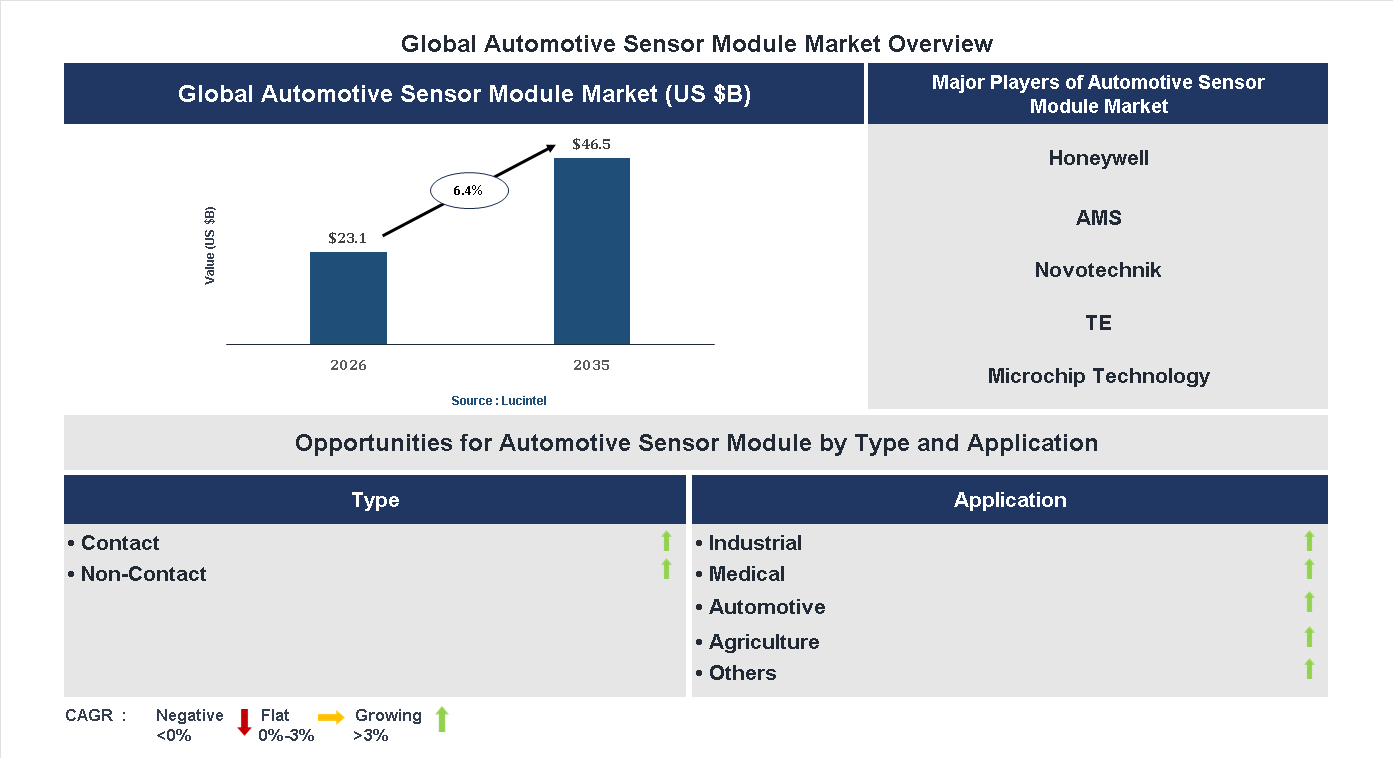
The future of the global automotive sensor module market looks promising with opportunities in the industrial, medical, automotive, and agriculture markets. The global automotive sensor module market is expected to reach an estimated $46.5 billion by 2035 with a CAGR of 6.4% from 2026 to 2035. The major drivers for this market are the increasing demand for real-time data enhancing sensor module, the growing adoption for focus on vehicle efficiency, and the rising demand for real time diagnostics.• Lucintel forecasts that, within the type category, contact is expected to witness higher growth over the forecast period.
• Within the application category, automotive is expected to witness the highest growth.
• In terms of region, APAC is expected to witness the highest growth over the forecast period. Gain valuable insights for your business decisions with our comprehensive 150+ page report. Sample figures with some insights are shown below.
Emerging Trends in the Automotive Sensor Module Market
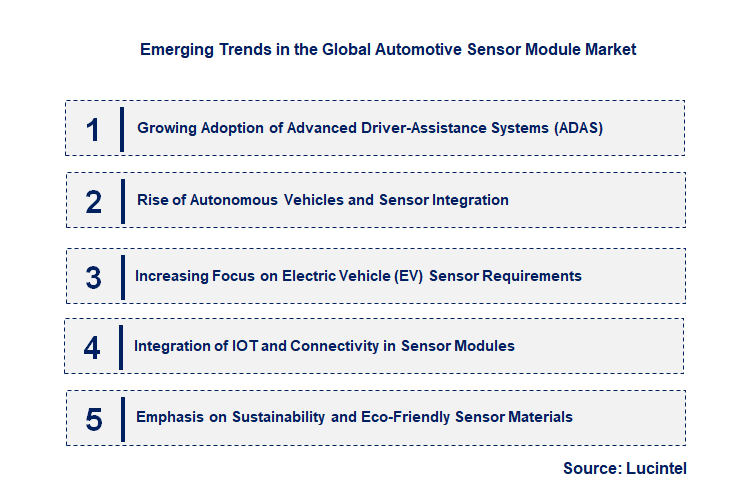
The automotive sensor module market is experiencing rapid evolution driven by technological advancements, increasing safety regulations, and the shift towards autonomous and electric vehicles. As automakers focus on enhancing vehicle safety, efficiency, and connectivity, sensor modules are becoming more sophisticated and integral to vehicle systems. These developments are not only transforming vehicle design and manufacturing but also influencing consumer expectations and regulatory standards. The market is characterized by innovation, increased competition, and a focus on sustainability, which collectively are shaping a dynamic landscape. Understanding these emerging trends is crucial for stakeholders aiming to capitalize on future growth opportunities and navigate the evolving industry landscape.• Growing Adoption of Advanced Driver-Assistance Systems (ADAS): The integration of ADAS features such as lane departure warnings, adaptive cruise control, and collision avoidance systems is driving demand for high-precision sensors. These sensors enable vehicles to perceive their environment accurately, improving safety and driving experience. As regulations tighten and consumer awareness increases, automakers are investing heavily in sensor modules to meet safety standards and differentiate their offerings. This trend is expected to continue, with sensor modules becoming more sophisticated and capable of supporting increasingly complex ADAS functionalities.
• Rise of Autonomous Vehicles and Sensor Integration: The development of autonomous vehicles relies heavily on a comprehensive array of sensors, including LiDAR, radar, ultrasonic, and cameras. These sensors work together to create a detailed perception of the vehicle’s surroundings, enabling safe navigation without human intervention. The market is witnessing significant investments in sensor technology to improve accuracy, reduce costs, and enhance reliability. As autonomous vehicle technology advances, the demand for integrated sensor modules that can seamlessly combine multiple sensor types is expected to surge, fundamentally transforming vehicle design and safety protocols.
• Increasing Focus on Electric Vehicle (EV) Sensor Requirements: Electric vehicles demand specialized sensors for battery management, thermal management, and energy efficiency. Accurate sensing of battery health, temperature, and charge levels is critical for safety and performance. The market is witnessing innovations in sensor modules tailored for EV applications, including high-temperature sensors and advanced monitoring systems. As the EV market expands rapidly, the need for robust, reliable sensors that can operate under extreme conditions is driving growth. This trend is reshaping sensor module design to meet the unique demands of electric powertrains and energy management systems.
• Integration of IoT and Connectivity in Sensor Modules: The rise of connected vehicles and the Internet of Things (IoT) is pushing sensor modules to become more intelligent and networked. Sensors now transmit real-time data to cloud platforms for analysis, predictive maintenance, and enhanced vehicle diagnostics. This connectivity improves vehicle performance, safety, and user experience. The market is witnessing the development of smart sensor modules with embedded communication capabilities, enabling seamless integration with vehicle networks and external systems. This trend is fostering a more connected, data-driven automotive ecosystem that enhances operational efficiency and customer satisfaction.
• Emphasis on Sustainability and Eco-Friendly Sensor Materials: Environmental concerns are prompting manufacturers to develop sensors using sustainable materials and energy-efficient designs. The focus is on reducing the carbon footprint of sensor production and operation, including the use of recyclable components and low-power electronics. Innovations in biodegradable sensors and energy-harvesting technologies are emerging to support eco-friendly vehicle manufacturing. This trend aligns with the broader shift towards sustainable mobility solutions, influencing market dynamics by encouraging the adoption of greener sensor technologies that support eco-conscious automotive development. In summary, these trends are collectively reshaping the automotive sensor module market by fostering innovation, enhancing vehicle safety and autonomy, and promoting sustainability. They are driving the industry towards smarter, more connected, and environmentally friendly vehicles, ultimately transforming how automotive systems are designed, manufactured, and experienced by consumers.
Recent Development in the Automotive Sensor Module Market
The automotive sensor module market is experiencing rapid growth driven by technological advancements, increasing vehicle automation, and stringent safety regulations. Innovations in sensor technology are enhancing vehicle performance, safety, and driver assistance systems. As automakers focus on electric and autonomous vehicles, the demand for sophisticated sensor modules is surging. This evolving landscape presents significant opportunities for market expansion, investment, and innovation, shaping the future of automotive safety and connectivity.• Growing Demand for Advanced Driver-Assistance Systems: The integration of sensors like LiDAR, radar, and cameras is crucial for ADAS, improving vehicle safety and enabling autonomous driving. This demand is driven by stricter safety regulations and consumer preference for safer vehicles, leading to increased sensor module adoption across all vehicle segments. Automakers are investing heavily in sensor technology to meet safety standards and enhance user experience, thus expanding the market significantly.
• Rising Adoption of Electric Vehicles (EVs): The shift towards EVs is boosting sensor module demand for battery management, thermal management, and vehicle control systems. Sensors are vital for monitoring battery health, optimizing energy efficiency, and ensuring safety. As EV sales grow globally, the need for reliable, high-performance sensor modules increases, creating new opportunities for manufacturers to innovate and supply advanced sensor solutions tailored for electric powertrains.
• Technological Advancements in Sensor Technology: Innovations such as miniaturization, improved accuracy, and integration capabilities are transforming sensor modules. These advancements enable more compact, efficient, and cost-effective sensors, facilitating their integration into various vehicle systems. Enhanced sensor performance supports the development of autonomous vehicles and smart safety features, thereby expanding market potential and encouraging automaker investment in cutting-edge sensor solutions.
• Increasing Focus on Vehicle Connectivity and IoT Integration: The rise of connected vehicles and IoT technology necessitates sophisticated sensor modules for real-time data collection and communication. Sensors enable vehicle-to-vehicle (V2V) and vehicle-to-infrastructure (V2I) connectivity, improving traffic management and safety. This trend drives demand for high-speed, reliable sensors capable of supporting complex data exchange, fostering growth in the automotive sensor module market as connectivity becomes a core vehicle feature.
• Stringent Safety and Emission Regulations: Governments worldwide are implementing strict safety and emission standards, compelling automakers to incorporate advanced sensors for compliance. Sensors are essential for monitoring emissions, ensuring vehicle safety, and enabling features like automatic emergency braking. These regulations accelerate the adoption of sensor modules, prompting manufacturers to develop innovative solutions that meet regulatory requirements and support the market’s expansion. The automotive sensor module market is poised for substantial growth, driven by technological innovation, regulatory pressures, and evolving vehicle architectures. These developments are fostering a more connected, safer, and efficient automotive landscape, offering significant opportunities for industry players to innovate and expand their market share.
Strategic Growth Opportunities in the Automotive Sensor Module Market
The automotive sensor module market is experiencing rapid expansion driven by technological advancements, increasing vehicle automation, and stringent safety regulations. As automakers integrate more sensors for enhanced safety, comfort, and efficiency, the demand for sophisticated sensor modules grows. This evolution presents numerous strategic growth opportunities across various applications, from autonomous driving to electric vehicles. Companies that capitalize on these opportunities can strengthen their market position and meet the rising consumer and regulatory expectations for smarter, safer vehicles.• Integration of Sensor Modules in Autonomous Vehicles: The rise of autonomous vehicles necessitates advanced sensor modules such as LiDAR, radar, and cameras for environment perception, obstacle detection, and navigation. This integration enhances vehicle safety and operational efficiency, creating a significant growth avenue. Automakers and suppliers are investing heavily in developing high-performance, reliable sensor modules that can operate seamlessly in diverse conditions, thus fueling market expansion and technological innovation.
• Expansion of Sensor Applications in Electric Vehicles (EVs): As EV adoption accelerates, sensor modules are increasingly vital for battery management, thermal regulation, and energy efficiency. Sensors enable real-time monitoring of battery health, optimize power consumption, and improve safety features. The growing EV market drives demand for specialized sensor modules, prompting manufacturers to develop compact, durable, and cost-effective solutions tailored for electric powertrains and charging systems.
• Adoption of Sensor Modules for Vehicle Safety and ADAS: Advanced Driver Assistance Systems (ADAS) rely heavily on sensor modules for functionalities like adaptive cruise control, lane departure warning, and collision avoidance. The increasing regulatory focus on vehicle safety standards propels automakers to incorporate more sophisticated sensors. This trend boosts demand for high-precision, multi-functional sensor modules, fostering innovation and expanding the market for safety-related applications.
• Development of Sensor Modules for Connected Vehicle Technology: Connected vehicles require sensor modules to facilitate vehicle-to-everything (V2X) communication, real-time data exchange, and infrastructure integration. These sensors support navigation, traffic management, and infotainment systems, enhancing the driving experience and safety. The push towards smart transportation networks and IoT integration presents substantial growth opportunities for sensor module manufacturers to develop compatible, high-speed, and secure sensor solutions.
• Growth of Sensor Modules in Commercial Vehicle Applications: Commercial vehicles benefit from sensor modules for fleet management, predictive maintenance, and safety enhancements. Sensors monitor engine performance, tire pressure, and load conditions, improving operational efficiency and safety compliance. The expanding logistics and transportation sectors, coupled with regulatory mandates, drive demand for rugged, reliable sensor modules tailored for heavy-duty environments, opening new avenues for market growth and technological development. The overall market is poised for significant expansion as these opportunities converge, fostering innovation and competitiveness. Companies that strategically invest in these areas will be well-positioned to capitalize on the evolving needs of the automotive industry, ensuring sustained growth and technological leadership in the automotive sensor module market.
Automotive Sensor Module Market Driver and Challenges
The automotive sensor module market is influenced by a complex interplay of technological advancements, economic shifts, and regulatory frameworks. As vehicles become smarter and more connected, the demand for sophisticated sensor modules increases, driven by innovations in autonomous driving, safety features, and vehicle efficiency. Economic factors such as rising consumer spending on automotive upgrades and the global push towards electric vehicles further propel market growth. Simultaneously, regulatory standards aimed at reducing emissions and enhancing safety compel manufacturers to adopt advanced sensor technologies. However, these drivers are counterbalanced by challenges like high development costs, supply chain disruptions, and stringent compliance requirements, which can hinder market expansion and innovation. The factors responsible for driving the automotive sensor module market include:-• Technological Innovation: The rapid development of autonomous vehicle technology and advanced driver-assistance systems (ADAS) necessitates sophisticated sensor modules. These sensors enable real-time data collection for vehicle navigation, safety, and efficiency, making them indispensable. Continuous improvements in sensor accuracy, miniaturization, and integration with AI systems are expanding their applications, thus fueling market growth. As automakers prioritize innovation, the demand for cutting-edge sensor modules is expected to surge, creating new opportunities for manufacturers and suppliers.
• Growing Adoption of Electric Vehicles (EVs): The global shift towards electric mobility is a significant driver for the sensor module market. EVs rely heavily on sensors for battery management, thermal regulation, and vehicle diagnostics. As governments implement stricter emission standards and offer incentives for EV adoption, automakers are investing more in sensor technologies to enhance vehicle performance and safety. This trend not only boosts demand for existing sensor modules but also encourages the development of specialized sensors tailored for EV applications, further expanding the market.
• Increasing Focus on Vehicle Safety and Regulations: Stringent safety regulations worldwide, such as Euro NCAP and NHTSA standards, mandate the integration of advanced sensors in vehicles to improve crashworthiness and pedestrian safety. These regulations compel automakers to incorporate sensors like radar, lidar, and ultrasonic sensors into their vehicles, driving market growth. Additionally, safety features like automatic emergency braking and lane-keeping assist rely on sensor modules, making compliance a key factor in market expansion. The regulatory landscape thus acts as both a catalyst and a framework for technological development in the sensor module industry.
• Rising Demand for Autonomous Vehicles: The push towards fully autonomous vehicles is a major driver for the sensor module market. Autonomous systems depend on a suite of sensors to perceive the environment, including lidar, radar, and cameras. The need for high-resolution, reliable sensors that can operate in diverse conditions is fueling innovation and investment in sensor technology. As automakers and tech companies race to commercialize autonomous vehicles, the demand for advanced sensor modules is expected to grow exponentially, shaping the future landscape of the automotive industry.
• Expansion of Connected Car Technologies: The proliferation of connected car features, such as real-time navigation, telematics, and vehicle-to-everything (V2X) communication, relies heavily on sensor modules. These sensors facilitate data collection and transmission, enabling enhanced user experiences and improved safety. The integration of sensors with IoT platforms and cloud services is creating new revenue streams and market segments. As consumers and regulators demand smarter, more connected vehicles, the sensor module market is poised for significant growth driven by technological convergence and digital transformation. The challenges facing this Market include:-
• High Development and Manufacturing Costs: Developing advanced sensor modules involves significant R&D investment, sophisticated manufacturing processes, and high-quality materials. These costs can be prohibitive, especially for smaller players, limiting market entry and innovation. Additionally, the need for continuous upgrades to meet evolving safety and performance standards further escalates expenses. High costs can translate into higher vehicle prices, potentially dampening consumer demand and slowing market growth, particularly in price-sensitive regions.
• Supply Chain Disruptions: The global supply chain for electronic components, including sensors, is vulnerable to disruptions caused by geopolitical tensions, pandemics, and logistical issues. Shortages of raw materials like silicon and rare earth elements can delay production and increase costs. These disruptions threaten the timely delivery of sensor modules, impacting automakers production schedules and market availability. Ensuring a resilient supply chain is critical for sustained growth, but current vulnerabilities pose significant risks to market stability.
• Stringent Regulatory and Compliance Requirements: The automotive industry faces increasingly strict safety, environmental, and quality standards across different regions. Meeting these diverse and evolving regulations requires extensive testing, certification, and adaptation of sensor technologies, which can be time-consuming and costly. Non-compliance can lead to penalties, recalls, and reputational damage. Navigating complex regulatory landscapes remains a significant challenge for manufacturers aiming to innovate while maintaining compliance, potentially slowing down the pace of technological adoption. The automotive sensor module market is driven by rapid technological advancements, the rise of electric and autonomous vehicles, and increasing safety and connectivity demands. However, high costs, supply chain issues, and regulatory hurdles present notable challenges. These factors collectively shape a dynamic environment where innovation is essential but must be balanced with strategic management of risks. The markets future will depend on how effectively industry players can leverage opportunities while mitigating these challenges, ultimately influencing the pace of growth and technological evolution in the automotive sector.
List of Automotive Sensor Module Companies
Companies in the market compete on the basis of product quality offered. Major players in this market focus on expanding their manufacturing facilities, R&D investments, infrastructural development, and leverage integration opportunities across the value chain. With these strategies automotive sensor module companies cater increasing demand, ensure competitive effectiveness, develop innovative products & technologies, reduce production costs, and expand their customer base. Some of the automotive sensor module companies profiled in this report include-• Honeywell
• AMS
• Novotechnik
• TE
• Microchip Technology
• Infineon Technologies
• Allegro MicroSystems
• TT Electronics
• Vish
• Renishaw
Automotive Sensor Module Market by Segment
The study includes a forecast for the global automotive sensor module market by type, application, and region.Automotive Sensor Module Market by Type [Value from 2019 to 2035]:
• Contact
• Non-Contact
Automotive Sensor Module Market by Application [Value from 2019 to 2035]:
• Industrial
• Medical
• Automotive
• Agriculture
• Others
Automotive Sensor Module Market by Region [Value from 2019 to 2035]:
• North America
• Europe
• Asia Pacific
• The Rest of the World
Country Wise Outlook for the Automotive Sensor Module Market
The automotive sensor module market has experienced rapid growth driven by advancements in vehicle automation, increased safety regulations, and the shift towards electric vehicles globally. Technological innovations, such as the integration of AI and IoT, have enhanced sensor capabilities, leading to more sophisticated and reliable systems. Countries are investing heavily in research and development to stay competitive, resulting in a dynamic landscape with new product launches and strategic partnerships. The markets evolution reflects broader trends in mobility, emphasizing safety, efficiency, and sustainability. Each key region contributes uniquely to this growth, influenced by local policies, technological adoption, and manufacturing capabilities.• United States: The US market has seen significant advancements in autonomous vehicle sensor technology, with major automakers and tech companies investing heavily in R&D. There is a focus on integrating lidar, radar, and camera sensors to improve vehicle safety and automation levels. Regulatory support and consumer demand for safety features have accelerated adoption. Additionally, collaborations between automotive manufacturers and sensor suppliers are driving innovation, with a growing emphasis on AI-powered sensor systems for enhanced vehicle perception and decision-making.
• China: China remains a dominant player in the automotive sensor module market, driven by government initiatives promoting electric and autonomous vehicles. The country has seen rapid adoption of advanced sensors, including high-resolution cameras and 3D lidar, to support its smart vehicle ecosystem. Domestic companies are expanding their R&D efforts and manufacturing capacities to meet rising demand. Strategic partnerships with global tech firms are also fostering innovation, positioning China as a key hub for next-generation sensor technologies in the automotive sector.
• Germany: Germanys automotive industry is focusing on integrating advanced sensor modules to support its push towards Industry 4.0 and autonomous driving. Leading automakers like BMW and Mercedes-Benz are investing in sensor innovations to enhance vehicle safety and driver assistance systems. The country emphasizes high-quality, reliable sensors, often collaborating with European tech firms and suppliers. Germanys strong automotive manufacturing base and emphasis on sustainability are driving the development of sensors optimized for electric and hybrid vehicles, ensuring compliance with stringent safety and environmental standards.
• India: The Indian automotive sensor market is witnessing rapid growth due to increasing vehicle safety regulations and the rising adoption of connected vehicles. Local manufacturers are expanding their product portfolios to include advanced sensors such as ultrasonic, radar, and camera modules. The government’s push for electric mobility and smart transportation infrastructure is further fueling demand. Additionally, collaborations with global sensor technology firms are enabling Indian companies to develop cost-effective, high-performance sensor solutions tailored to the domestic markets needs.
• Japan: Japan continues to lead in sensor innovation, leveraging its strong electronics and automotive manufacturing sectors. The focus is on developing sensors for autonomous vehicles, with significant investments in lidar, radar, and vision sensors. Japanese automakers are integrating these sensors into their next-generation vehicles to enhance safety and automation features. The country also emphasizes miniaturization and energy efficiency in sensor design, aligning with its sustainability goals. Collaborations between automotive firms and technology providers are fostering advancements, ensuring Japan remains at the forefront of automotive sensor technology development.

Features of the Global Automotive Sensor Module Market
Market Size Estimates: Automotive sensor module market size estimation in terms of value ($B). Trend and Forecast Analysis: Market trends (2019 to 2025) and forecast (2026 to 2035) by various segments and regions. Segmentation Analysis: Automotive sensor module market size by type, application, and region in terms of value ($B). Regional Analysis: Automotive sensor module market breakdown by North America, Europe, Asia Pacific, and Rest of the World. Growth Opportunities: Analysis of growth opportunities in different types, applications, and regions for the automotive sensor module market. Strategic Analysis: This includes M&A, new product development, and competitive landscape of the automotive sensor module market. Analysis of competitive intensity of the industry based on Porter’s Five Forces model.
FAQ
Q1. What is the automotive sensor module market size? Answer: The global automotive sensor module market is expected to reach an estimated $46.5 billion by 2035. Q2. What is the growth forecast for automotive sensor module market? Answer: The global automotive sensor module market is expected to grow with a CAGR of 6.4% from 2026 to 2035. Q3. What are the major drivers influencing the growth of the automotive sensor module market? Answer: The major drivers for this market are the increasing demand for real-time data enhancing sensor module, the growing adoption for focus on vehicle efficiency, and the rising demand for real time diagnostics. Q4. What are the major segments for automotive sensor module market? Answer: The future of the automotive sensor module market looks promising with opportunities in the industrial, medical, automotive, and agriculture markets. Q5. Who are the key automotive sensor module market companies? Answer: Some of the key automotive sensor module companies are as follows:• Honeywell
• AMS
• Novotechnik
• TE
• Microchip Technology
• Infineon Technologies
• Allegro MicroSystems
• TT Electronics
• Vish
• Renishaw Q6. Which automotive sensor module market segment will be the largest in future? Answer: Lucintel forecasts that, within the type category, contact is expected to witness higher growth over the forecast period. Q7. In automotive sensor module market, which region is expected to be the largest in next 5 years? Answer: In terms of region, APAC is expected to witness the highest growth over the forecast period. Q8. Do we receive customization in this report? Answer: Yes, Lucintel provides 10% customization without any additional cost.
Table of Contents
List of Figures
List of Tables
Methodology
- In-depth interviews of the major players in this market
- Detailed secondary research from competitors’ financial statements and published data
- Extensive searches of published works, market, and database information pertaining to industry news, company press releases, and customer intentions
- A compilation of the experiences, judgments, and insights of Lucintel’s professionals, who have analyzed and tracked this market over the years.


Key Questions
- • What are some of the most promising, high-growth opportunities for the automotive sensor module market by type (contact and non-contact), application (industrial, medical, automotive, agriculture, and others), and region (North America, Europe, Asia Pacific, and the Rest of the World)?
- • Which segments will grow at a faster pace and why?
- • Which region will grow at a faster pace and why?
- • What are the key factors affecting market dynamics? What are the key challenges and business risks in this market?
- • What are the business risks and competitive threats in this market?
- • What are the emerging trends in this market and the reasons behind them?
- • What are some of the changing demands of customers in the market?
- • What are the new developments in the market? Which companies are leading these developments?
- • Who are the major players in this market? What strategic initiatives are key players pursuing for business growth?
- • What are some of the competing products in this market and how big of a threat do they pose for loss of market share by material or product substitution?
- • What M&A activity has occurred in the last 7 years and what has its impact been on the industry? For any questions related to Automotive Sensor Module Market, Automotive Sensor Module Market Size, Automotive Sensor Module Market Growth, Automotive Sensor Module Market Analysis, Automotive Sensor Module Market Report, Automotive Sensor Module Market Share, Automotive Sensor Module Market Trends, Automotive Sensor Module Market Forecast, Automotive Sensor Module Companies, write Lucintel analyst at email: helpdesk@lucintel.com. We will be glad to get back to you soon.


