
Market Report · July 31, 2026

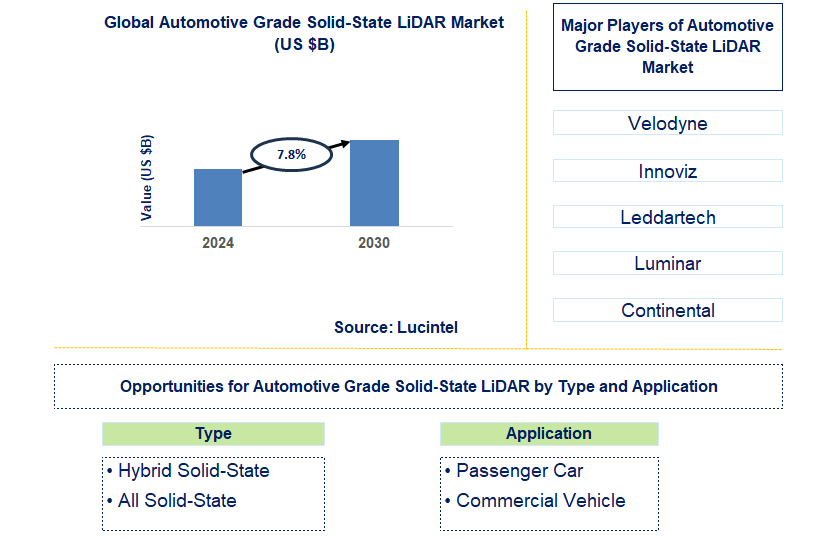
Key data points: The growth forecast = 7.8% annually for the next 6 years. Scroll below to get more insights. This market report covers trends, opportunities, and forecasts in the global automotive grade solid-state lidar market to 2030 by type (hybrid solid-state and all solid-state), application (passenger car and commercial vehicle), and region (North America, Europe, Asia Pacific, and the Rest of the World)
We'll send your sample report shortly.
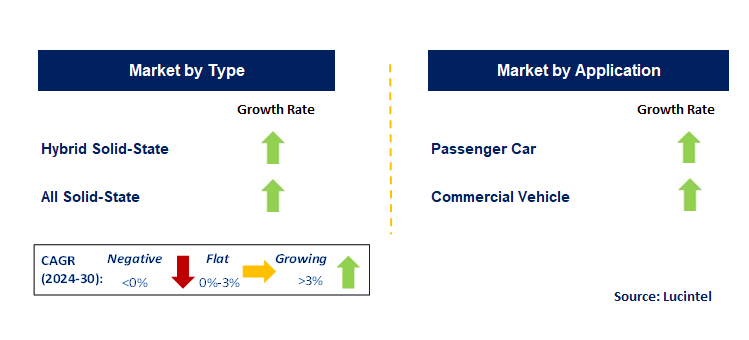
• Lucintel forecasts that, within the type category, hybrid solid-state is expected to witness higher growth over the forecast period.
• Within the application category, passenger car is expected to witness higher growth.
• In terms of regions, APAC is expected to witness the highest growth over the forecast period. A more than 150-page report is developed to help in your business decisions.
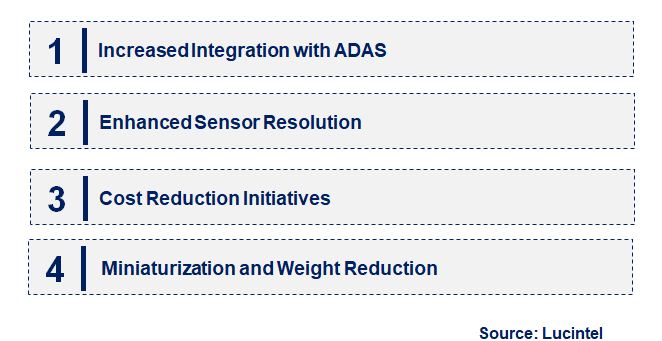
• Increased Integration with ADAS: LiDAR systems are increasingly being integrated with advanced driver-assistance systems to enhance safety features and autonomous driving capabilities. This trend is driving the development of more compact and cost-effective solutions.
• Enhanced Sensor Resolution: Advances in technology are leading to higher resolution sensors that offer greater accuracy and longer range. This improvement is crucial for achieving higher levels of vehicle automation and safety.
• Cost Reduction Initiatives: Efforts to reduce the cost of solid-state LiDAR systems are gaining momentum. Innovations in manufacturing processes and material science are making these systems more accessible for broader adoption in the automotive market.
• Miniaturization and Weight Reduction: Manufacturers are focusing on making LiDAR systems smaller and lighter. This trend is important for seamless integration into various vehicle designs without compromising performance. These emerging trends are collectively advancing the capabilities and adoption of automotive grade solid-state LiDAR systems. They address the need for better performance, cost-effectiveness, and integration into modern vehicles, paving the way for more widespread use and innovation in automotive safety and automation.
• Advanced Manufacturing Techniques: New manufacturing techniques, such as microfabrication and wafer-level packaging, are improving the performance and reducing the cost of solid-state LiDAR systems. These advancements allow for higher precision and better scalability, which are crucial for mass production and affordability.
• Integration with 5G Technology: The integration of solid-state LiDAR with 5G networks is enhancing real-time data processing and communication between vehicles and infrastructure. This development is crucial for the advancement of autonomous driving and smart city applications, as it supports faster data transfer and more reliable connectivity.
• Emergence of New Players: New companies and startups are entering the solid-state LiDAR market, bringing innovative technologies and competitive pricing. This influx of new players is driving rapid advancements and increasing the variety of available solutions, contributing to a more dynamic and competitive market.
• Collaborations and Partnerships: Strategic partnerships between automotive manufacturers and LiDAR technology providers are fostering innovation and accelerating the development of new systems. These collaborations are enabling more effective integration of LiDAR technology into vehicles and supporting the advancement of autonomous driving features. These developments underscore the dynamic progress in the automotive grade solid-state LiDAR market. Innovations in manufacturing, technology integration, and industry collaboration are driving significant advancements and shaping the future of automotive safety and automation.
• Expanding ADAS Integration: As automotive manufacturers increasingly adopt advanced driver-assistance systems, there is significant potential for integrating solid-state LiDAR to enhance vehicle safety and automation. This trend presents opportunities for companies to develop systems that seamlessly integrate with ADAS technologies.
• Developing Cost-Effective Solutions: There is a growing demand for affordable solid-state LiDAR systems, particularly in emerging markets. Developing cost-effective solutions can open new market segments and drive broader adoption of LiDAR technology across various vehicle categories.
• Leveraging AI and Machine Learning: Incorporating AI and machine learning algorithms with LiDAR data can improve object detection and decision-making processes. This integration provides opportunities to enhance the capabilities of LiDAR systems and offer more advanced features to automotive manufacturers.
• Expanding into New Markets: Emerging markets are presenting new growth opportunities for solid-state LiDAR technology. Expanding into these regions can provide access to new customer bases and drive global adoption of advanced automotive technologies. These strategic growth opportunities highlight the potential for expanding the application and adoption of automotive grade solid-state LiDAR. By focusing on integration with ADAS, cost reduction, AI advancements, and new market expansion, companies can capitalize on emerging trends and drive future growth in the industry.
• Advancements in Autonomous Driving: The push towards fully autonomous vehicles is driving demand for high-performance solid-state LiDAR systems. These systems provide critical data for navigation and obstacle detection, which are essential for safe and reliable autonomous driving.
• Government Regulations and Standards: Increasing regulatory requirements for vehicle safety and automation are accelerating the adoption of solid-state LiDAR technology. Government standards that mandate advanced safety features are pushing manufacturers to integrate LiDAR systems into their vehicles.
• Technological Innovations: Continuous advancements in LiDAR technology, such as improvements in sensor resolution and miniaturization, are driving growth. Innovations that enhance performance and reduce costs are making LiDAR systems more attractive to automotive manufacturers.
• Consumer Demand for Safety Features: Growing consumer demand for advanced safety features in vehicles is boosting the adoption of solid-state LiDAR. Consumers are increasingly seeking vehicles equipped with cutting-edge technologies that enhance safety and driving experience. Challenges in the automotive grade solid-state LiDAR market include:
• Costs of Technology: The high cost of solid-state LiDAR systems remains a significant challenge, limiting their widespread adoption. The expense of advanced components and manufacturing processes can make it difficult for manufacturers to offer affordable solutions.
• Integration Complexity: Integrating LiDAR systems with existing vehicle architectures and technologies can be complex. Ensuring compatibility with various vehicle models and ADAS features presents a technical challenge for manufacturers.
• Supply Chain Issues: The supply chain for critical raw materials and components can be volatile, affecting production and availability. Disruptions in the supply chain can impact the cost and delivery timelines for LiDAR systems.
• Regulatory and Safety Concerns: Ensuring compliance with diverse regulatory requirements and safety standards across different markets can be challenging. Variations in regulations and safety expectations may affect the development and deployment of LiDAR technology. The automotive grade solid-state LiDAR market is influenced by key drivers, such as advancements in autonomous driving, government regulations, technological innovations, and consumer demand. However, challenges including high costs, integration complexity, supply chain issues, and regulatory concerns need to be addressed to drive continued growth and adoption.
• Velodyne
• Innoviz
• Leddartech
• Luminar
• Continental
• Ouster
• Robosense
• Hybrid Solid-State
• All Solid-State
• Passenger Car
• Commercial Vehicle
• North America
• Europe
• Asia Pacific
• The Rest of the World
• United States: Recent developments in the U.S. automotive grade solid-state LiDAR market have focused on enhancing sensor resolution and integration with advanced driver-assistance systems (ADAS). Companies like Waymo and Luminar are pushing the envelope with next-gen sensors that offer superior range and accuracy. Significant investment is also being directed towards improving the manufacturability of these systems, reducing costs, and increasing adoption across various vehicle models.
• China: China has seen rapid growth in automotive grade solid-state LiDAR technology, driven by local firms such as Hesai and RoboSense. These companies are advancing the technology with lower-cost solutions and greater integration capabilities. Additionally, the Chinese government’s support for autonomous vehicle initiatives is fostering a competitive environment, accelerating innovation and reducing the cost barriers for widespread adoption.
• Germany: The German automotive industry is leveraging solid-state LiDAR technology to enhance its leadership in vehicle safety and autonomous driving. Companies like Bosch and Continental are integrating advanced LiDAR systems into new vehicle models, focusing on improving sensor accuracy and integration with existing vehicle systems. The emphasis is also on ensuring compliance with stringent European automotive standards and facilitating seamless integration with other ADAS features.
• India: In India, the adoption of automotive grade solid-state LiDAR is in its nascent stages but shows promise due to increasing interest from global players and local startups. Efforts are being made to develop cost-effective solutions tailored to the Indian automotive market, with a focus on affordability and scalability. This development is being spurred by growing investments in smart transportation infrastructure and government incentives for technology adoption.
• Japan: Japan is at the forefront of integrating automotive grade solid-state LiDAR with advanced driver assistance systems (ADAS) and autonomous driving technologies. Companies such as Sony and Panasonic are investing heavily in research and development to enhance the performance and miniaturization of LiDAR systems. Japan’s focus is on achieving high precision and reliability, which is critical for both domestic and international markets.


• Velodyne
• Innoviz
• Leddartech
• Luminar
• Continental
• Ouster
• Robosense Q5. Which automotive grade solid-state lidar market segment will be the largest in future? Answer: Lucintel forecasts that hybrid solid-state is expected to witness higher growth over the forecast period. Q6. In automotive grade solid-state lidar market, which region is expected to be the largest in next 5 years? APAC is expected to witness the highest growth over the forecast period. Q.7 Do we receive customization in this report? Answer: Yes, Lucintel provides 10% customization without any additional cost.


Choose a license that fits your team. Instant PDF delivery.
Prices exclude taxes. Instant delivery. Custom licensing available on request.
Market Report · July 31, 2026
Market Report · July 22, 2026
Market Report · July 17, 2026
Trusted partner for strategic intelligence and business growth


Receive a complimentary market analysis tailored to your industry. Our analysts will identify key growth opportunities and competitive dynamics specific to your business.

Market size, growth rate, and key trend analysis for your specific sector.

Top competitor positioning and market share analysis.

Strategic recommendations backed by data-driven insights.
Get curated market intelligence and competitive moves straight to your inbox.
By subscribing, you agree to receive our monthly insights. Unsubscribe anytime.
Receive a complimentary market analysis tailored to your industry. Our analysts will identify key growth opportunities and competitive dynamics specific to your business.
Market size, growth rate, and key trend analysis for your specific sector.
Top competitor positioning and market share analysis.
Strategic recommendations backed by data-driven insights.
Get curated market intelligence, emerging trends, and competitive moves straight to your inbox each month.
By subscribing, you agree to receive our monthly insights. Unsubscribe anytime.
We'll send your sample report shortly.