
Market Report · July 31, 2026

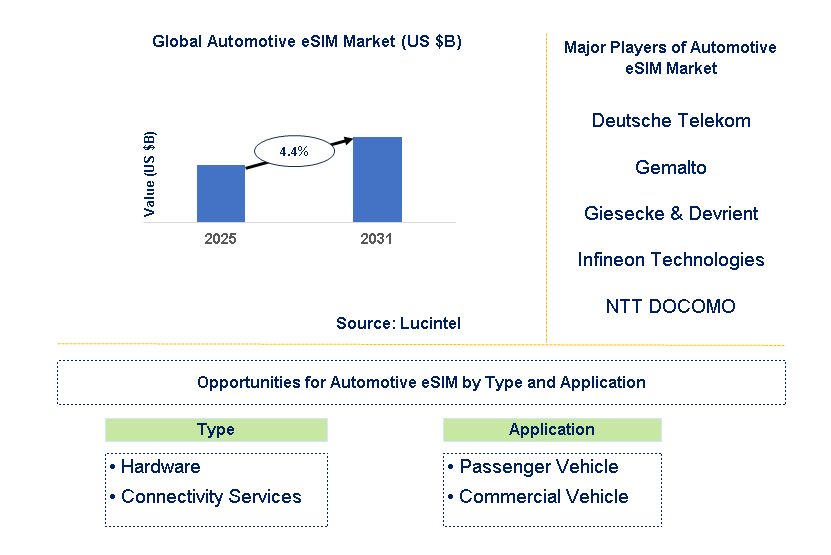
Key data points: The growth forecast = 4.4% annually for the next 7 years. Scroll below to get more insights. This market report covers Trends, opportunities and forecasts in automotive eSIM market to 2031 by type (hardware and connectivity services), application (passenger vehicle and commercial vehicle), and region (North America, Europe, Asia Pacific, and the Rest of the World)
We'll send your sample report shortly.
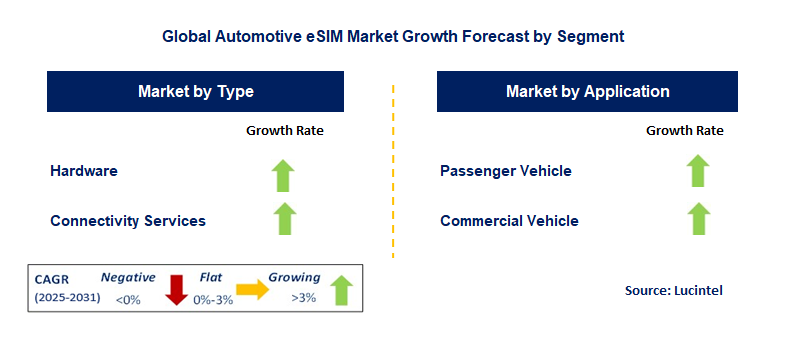
• Lucintel forecasts that, within the type category, connectivity service is expected to witness higher growth over the forecast period due to the increasing demand for connected vehicle features, real-time communication, and the shift towards 5g.
• Within the application category, passenger vehicle is expected to witness higher growth.
• In terms of region, Europe is expected to witness the highest growth over the forecast period due to its advanced automotive industry.
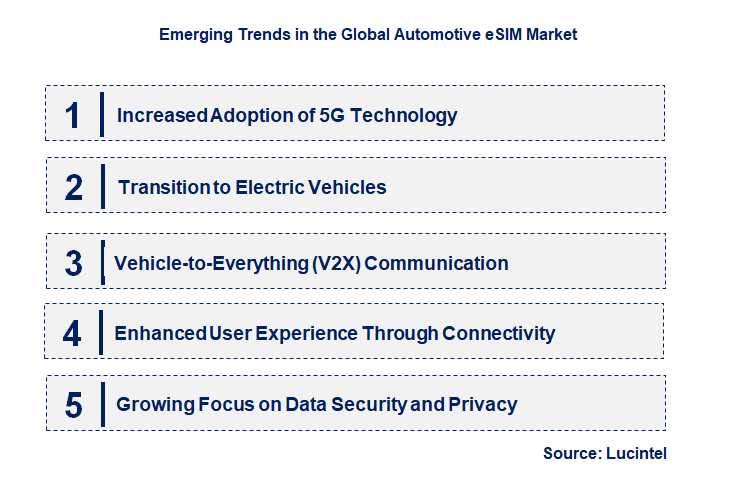
• Increased Adoption of 5G Technology: The deployment of 5G networks is a key trend driving the adoption of automotive eSIMs. With the promise of ultra-fast speeds, low latency, and higher connectivity reliability, 5G enables more sophisticated and real-time services in connected vehicles. This includes autonomous driving, remote vehicle monitoring, and advanced infotainment systems. The automotive sector is leveraging 5G to offer a better driving experience, improve safety features, and enable data-intensive applications that require high-speed connectivity.
• Transition to Electric Vehicles: In the global automotive market, electric vehicles are changing the game, and eSIM technology is an essential part of connecting and managing these vehicles. eSIMs are used in remote diagnostics, battery management, and over-the-air updates for EVs. Also, enhanced connectivity features for owners include navigation, charging station locators, and energy optimization. The integration of eSIMs allows for more efficient management of EV fleets and offers new opportunities for service providers in the growing electric mobility sector.
• Vehicle-to-Everything (V2X) Communication: Vehicle-to-Everything (V2X) communication is becoming an integral part of the automotive eSIM market. V2X allows vehicles to communicate with other vehicles, infrastructure, and even pedestrians to enhance safety and traffic efficiency. eSIM technology plays a key role in enabling V2X by providing reliable, secure, and flexible connectivity. This trend is particularly significant for autonomous vehicles, where real-time data exchange between the vehicle and its environment is crucial for safe operation and navigation.
• Enhanced User Experience Through Connectivity: Automotive eSIMs are allowing the integration of more connected and personalized driving experiences. They are now enabling features like in-car entertainment, cloud-based applications, and real-time vehicle updates. The focus is on seamless integration between the vehicle and the driver's digital ecosystem. Services such as remote control through mobile apps, voice assistants, and AI-driven personalization are being offered. The increased connectivity provided by eSIMs enhances the overall user experience and supports the growing demand for smart, connected vehicles.
• Growing Focus on Data Security and Privacy: As vehicles become more connected, data security and privacy have become critical concerns. The automotive eSIM market is responding to these concerns by incorporating robust encryption and authentication mechanisms to ensure the safety of personal and vehicle data. Automakers and eSIM providers are working together to implement secure over-the-air updates, prevent unauthorized access to vehicle systems, and ensure compliance with data protection regulations. This trend is essential for maintaining consumer trust and meeting regulatory requirements. The trends of the emerging automotive eSIM markets transform the interaction of a vehicle with its environment and the driver. Increasing adoption of 5G, switch towards electric vehicles, V2X communication, concentration on user experience, and concerns about data security are reshaping the market. Trends are engaging highly connected, efficient, and secure vehicle generations, and thus, automotive eSIM technology will play central roles in the future of the automotive industries.
• Integration of Over-the-Air Updates: One of the most significant developments in the automotive eSIM market is the widespread adoption of over-the-air (OTA) updates. eSIM technology enables seamless software updates, allowing automakers to enhance vehicle performance, fix bugs, and introduce new features without requiring customers to visit service centers. This development improves the user experience, reduces maintenance costs, and enhances vehicle safety by ensuring that the latest software is always available.
• Expansion of 5G Connectivity: The global rollout of 5G networks is driving the adoption of automotive eSIMs, as it offers the high-speed, low-latency connectivity needed for real-time vehicle data exchange. Automakers are increasingly incorporating eSIM technology to support advanced in-car services, including autonomous driving, telematics, and infotainment. The expansion of 5G enables a new era of connected vehicles, where data flows seamlessly between the vehicle, infrastructure, and the cloud.
• Government Support for Smart Mobility: Governments around the world are supporting the adoption of connected and electric vehicles through policies and regulations. Many countries are providing incentives for automakers to adopt smart mobility solutions, including eSIM-enabled connectivity. This government support is accelerating the development of the automotive eSIM market by creating a favorable environment for innovation and investment in smart mobility technologies.
• Collaboration Between Automakers and Telecom Providers: Another notable development is the growing collaboration between automakers and telecom providers to enable seamless connectivity in vehicles. Telecom companies are providing the necessary infrastructure for eSIM technology, while automakers are integrating eSIMs into their vehicles to offer connected services. These collaborations ensure that vehicles remain connected at all times, improving driver safety, convenience, and entertainment.
• Introduction of Global eSIM Standards: The development of global eSIM standards is another key advancement in the market. Standardization ensures that eSIMs are interoperable across different regions and networks, facilitating easier adoption and scalability. With the establishment of these standards, automakers can deploy eSIM technology globally, enabling seamless vehicle connectivity no matter where the car is located. Recent developments in the automotive eSIM market highlight the rapid evolution of connected vehicle technology. The integration of OTA updates, expansion of 5G connectivity, government support for smart mobility, collaboration between automakers and telecom providers, and the establishment of global eSIM standards are all key factors contributing to the growth of this market. These developments are setting the stage for a more connected, efficient, and secure automotive ecosystem.
• Telematics and Fleet Management: Telematics and fleet management are key applications for automotive eSIM technology. eSIMs enable real-time tracking, diagnostics, and performance monitoring of fleet vehicles, improving operational efficiency. Fleet operators can leverage eSIMs to manage vehicle health, monitor driver behavior, and optimize routes. The growing adoption of connected and autonomous vehicles is driving the demand for eSIM-enabled telematics solutions in fleet management.
• In-Vehicle Infotainment Systems: The integration of eSIM technology into in-vehicle infotainment systems is another promising growth opportunity. eSIMs enable seamless connectivity for entertainment, navigation, and communication, enhancing the user experience. As consumers demand more personalized and connected in-car experiences, the automotive industry is increasingly relying on eSIMs to deliver advanced infotainment features such as streaming, real-time traffic updates, and voice assistants.
• Electric Vehicle (EV) Management: With the rise of electric vehicles, eSIM technology plays a crucial role in managing EVs’ performance and charging systems. eSIMs enable remote diagnostics, battery monitoring, and software updates, improving the overall ownership experience. Automakers can leverage eSIMs to offer real-time data on battery health, charging status, and energy consumption, helping EV owners optimize their vehicle's performance and increase operational efficiency.
• Autonomous Vehicles and V2X Communication: Autonomous vehicles and V2X communication are becoming some of the prime movers for the automotive eSIM market. The seamless communication that an eSIM enables between the autonomous vehicle, infrastructure, and other vehicles would facilitate safe navigation with efficiency. eSIM technology also supports the exchange of real-time data that could enhance safety, traffic management, and autonomous driving systems development.
• Global Roaming and Connectivity Solutions: As the automobile industry grows in their international markets, global roaming and connectivity solutions through eSIM technology have become the norm. With eSIMs, there is no need for a change of physical SIM to connect vehicles into various networks globally. In connected and electric vehicles, the need to refresh huge blocks of data across regions is required to support the service provision for all automobile global customers, hence the reliance on consistent and reliable services. The automotive eSIM market presents various strategic growth opportunities across key applications, including telematics, infotainment, EV management, autonomous vehicles, and global connectivity. These opportunities are driving the adoption of eSIM technology in the automotive sector, enabling the development of smarter, more connected vehicles that offer enhanced performance and user experiences.
• Deutsche Telekom AG
• Gemalto
• Giesecke & Devrient
• Infineon Technologies AG
• NTT DOCOMO
• NXP Semiconductors
• Sierra Wireless
• Singapore Telecommunications Limited
• STMicroelectronics
• Telefónica
• Hardware
• Connectivity Services
• Passenger Vehicle
• Commercial Vehicle
• North America
• Europe
• Asia Pacific
• The Rest of the World
• United States: Automotive eSIM technology within the United States is being taken up at a rapid rate with the use of connected cars and IoT integration. Major automakers like General Motors, Ford, and Tesla are incorporating eSIM solutions into their vehicles to support features such as real-time data collection, telematics, and over-the-air updates. The expansion of 5G networks also plays a crucial role in boosting the capabilities of eSIMs in vehicles. The regulatory support for the integration of electric vehicle or EV along with incentives encourages increased adoption. These make the US a core region in the ongoing technological transformation of the country and, globally as well.
• China: Both government policy as well as surging demand by consumers push forward the eSIM market of automobile in China. As one of the largest automotive markets globally, China is rapidly adopting eSIM technology to enable connectivity features like vehicle diagnostics, navigation, and entertainment systems. The Chinese government’s focus on smart mobility and green technology is fostering innovation in the automotive sector. Local automakers, such as BYD and NIO, are increasingly incorporating eSIM technology into their electric and connected vehicles to enhance the driving experience and provide more efficient after-sales services.
• Germany: Germany, as a leader in automotive innovation, is also embracing eSIM technology in its vehicles. Major German automakers, including Volkswagen, BMW, and Mercedes-Benz, are implementing eSIM solutions to support connected services such as infotainment systems, driver assistance, and remote vehicle management. Germany is aggressively pushing toward sustainability and electric mobility, which has an impact on the adoption of eSIMs in electric vehicles. The country is working on enhancing digital infrastructure and integrating smart features into vehicles, making it a critical player in the European automotive eSIM market.
• India: The automotive eSIM market in India is in its early stages but is growing rapidly. The demand for connected and electric vehicles is accelerating the adoption of eSIM technology. Indian auto companies, like Tata Motors and Mahindra, are beginning to fit their vehicles with eSIMs in order to provide services such as telematics, tracking, and remote diagnostics. Government initiatives in promoting electric mobility and smart infrastructure development will continue to push the adoption of eSIM technology in the country. Growth of 5G connectivity will also spur the growth of the automotive eSIM market in India.
• Japan: Japan is a prominent country in the automotive eSIM market with leaders Toyota, Honda, and Nissan embracing eSIM technology for their automobiles. Its use enables connectivity amenities such as real-time vehicle tracking, over-the-air software updates, and enhanced safety services. Japan’s emphasis on advanced technologies, including 5G, is driving innovation in the connected car space. Additionally, the country’s commitment to environmental sustainability and electric vehicle adoption further promotes the use of eSIMs in the automotive sector, solidifying Japan’s position as a key market for automotive eSIM technology.


• Deutsche Telekom AG
• Gemalto
• Giesecke & Devrient
• Infineon Technologies AG
• NTT DOCOMO
• NXP Semiconductors
• Sierra Wireless
• Singapore Telecommunications Limited
• STMicroelectronics
• Telefónica Q5. Which automotive eSIM market segment will be the largest in future? Answer: Lucintel forecasts that, within the type category, connectivity service is expected to witness higher growth over the forecast period due to the increasing demand for connected vehicle features, real-time communication, and the shift towards 5g. Q6. In automotive eSIM market, which region is expected to be the largest in next 5 years? Answer: In terms of region, Europe is expected to witness the highest growth over the forecast period due to its advanced automotive industry. Q7. Do we receive customization in this report? Answer: Yes, Lucintel provides 10% customization without any additional cost.


Choose a license that fits your team. Instant PDF delivery.
Prices exclude taxes. Instant delivery. Custom licensing available on request.
Market Report · July 31, 2026
Market Report · July 22, 2026
Market Report · July 17, 2026
Trusted partner for strategic intelligence and business growth


Receive a complimentary market analysis tailored to your industry. Our analysts will identify key growth opportunities and competitive dynamics specific to your business.

Market size, growth rate, and key trend analysis for your specific sector.

Top competitor positioning and market share analysis.

Strategic recommendations backed by data-driven insights.
Get curated market intelligence and competitive moves straight to your inbox.
By subscribing, you agree to receive our monthly insights. Unsubscribe anytime.
Receive a complimentary market analysis tailored to your industry. Our analysts will identify key growth opportunities and competitive dynamics specific to your business.
Market size, growth rate, and key trend analysis for your specific sector.
Top competitor positioning and market share analysis.
Strategic recommendations backed by data-driven insights.
Get curated market intelligence, emerging trends, and competitive moves straight to your inbox each month.
By subscribing, you agree to receive our monthly insights. Unsubscribe anytime.
We'll send your sample report shortly.