
Market Report · May 18, 2026

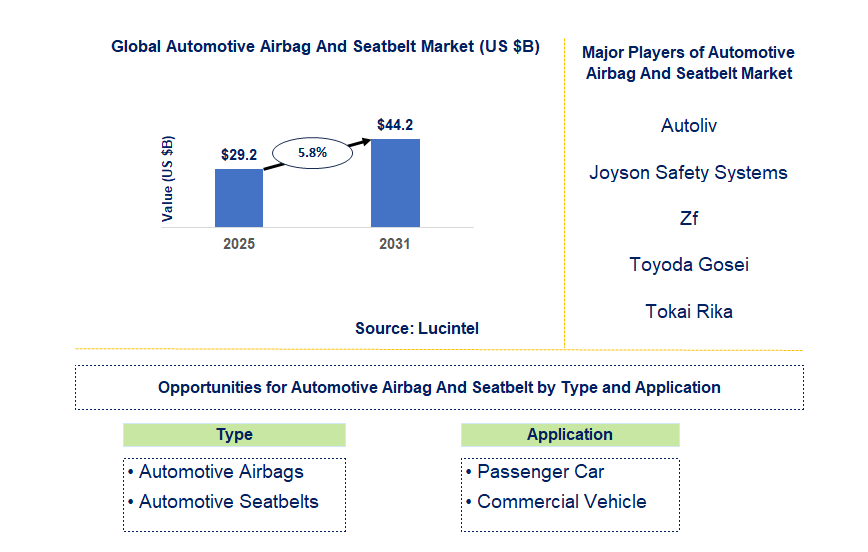
Key data points: The market size in 2031 = $44.2 billion, growth forecast = 0.058 annually for the next 7 years. Scroll below to get more insights. This market report covers Trends, opportunities and forecasts in automotive airbag and seatbelt market to 2031 by type (automotive airbags and automotive seatbelts), application (passenger car and commercial vehicle), and region (North America, Europe, Asia Pacific, and the Rest of the World)
We'll send your sample report shortly.
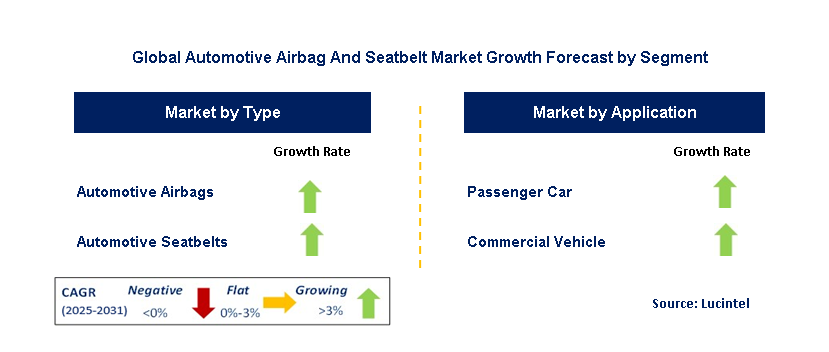
• Lucintel forecasts that, within the type category, automotive airbags is expected to witness higher growth over the forecast period.
• Within the application category, passenger car is expected to witness higher growth.
• In terms of region, APAC is expected to witness the highest growth over the forecast period.
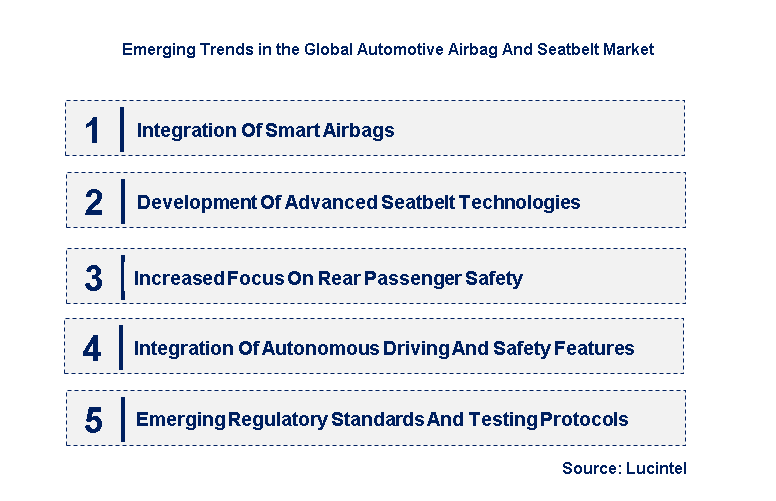
• Integration of Smart Airbags: Smart airbags are becoming increasingly prevalent in the automotive market. The airbags vary their deployment force in accordance with various factors such as the severity of a crash, the position of the occupant, and the occupant's size and weight. This helps to ensure greater effectiveness in protecting the occupants and reduces the likelihood of injury caused by over-deployment. Smart airbags are driven by improvements in sensor technology and artificial intelligence, which will make airbags more adaptive and responsive to real-world crash scenarios. This trend is especially important in assisting to enhance the overall safety of passengers in both frontal and side-impact crashes.
• Development of Advanced Seatbelt Technologies: Advanced seatbelt technologies, including seatbelts with force limiters, pre-tensioners, and adjustable shoulder straps, are becoming standard features in vehicles. These technologies help distribute crash forces more effectively and reduce the risk of injury during an accident. Increasing demands of consumers who require safety from around the globe and more rigorous regulations are further causing expansion for these systems. More and more innovative technologies are emerging, which includes inflatable seatbelts in order to have additional cushioning when a vehicle crashes. So it is a system that in the coming future is expected to become a requirement for all automobiles.
• Increased Focus on Rear Passenger Safety: Traditionally, airbag and seatbelt technologies were designed for front-seat passengers. However, there is now a growing focus on improving rear passenger safety. In many markets, including India and China, government regulations are starting to mandate rear-seat airbags and improved seatbelt systems. Automakers are responding by incorporating features such as rear side airbags, three-point seatbelts, and more robust rear-seat protection mechanisms. This trend reflects growing awareness of the importance of safety for all vehicle occupants, not just those in the front seats.
• Integration of Autonomous Driving And Safety Features: As autonomous driving technology progresses, airbag and seatbelt systems must evolve to accommodate new vehicle designs and driving scenarios. For example, in the case of self-driving vehicles, the necessity for driver-airbags may fade away, but there will still be a demand for systems designed to protect occupants from side and rear impacts. Seatbelts will also change as seats might face different directions in autonomous vehicles. The marriage of these technologies with autonomous driving is one major trend that shapes the future of automotive safety systems.
• Emerging Regulatory Standards and Testing Protocols: The world has seen increased emphasis globally from regulatory bodies on the safety of automotive airbag and seatbelts, with greater pressures put on higher standards and testing protocols. For instance, enhanced crash testing requirements have become a definitive reality in Europe and the U.S., which developed more advanced airbag and seatbelt systems. Manufacturers will have to meet these regulatory requirements for their vehicles to be certified and safe. The changing standards of this body are bound to influence more innovation in the market since car manufacturers seek to design vehicles that provide ultimate protection to their passengers. These emerging trends smart airbags, advanced seatbelt technologies, rear passenger safety, integration with autonomous driving, and stricter regulatory standards—are reshaping the automotive airbag and seatbelt market. As manufacturers continue to innovate and improve safety features, these trends will play a pivotal role in reducing fatalities and injuries, contributing to the future of safer vehicles on the road.
• Multi-Stage Airbags: Multi-stage airbags deploy at different rates and levels of force depending on the severity of a crash. These airbags provide better protection by preventing injuries caused by overly forceful deployment. This technology is being incorporated into both front and side airbags, with manufacturers like Toyota and Ford leading the way. Multi-stage airbags provide superior safety in high-speed crashes, delivering protection for more impact situations. This technology is essential because most automotive producers are striving to make their cars safer and meet the rising standards of safety requirements from regulatory commissions.
• Deployment of Inflatable Seatbelts: Inflatable seatbelts, which offer extra padding during impact, become increasingly popular in the automotive industry. These seatbelts inflate upon impact to disperse the forces exerted on the passenger's body. Ford has been one of the leaders in this area, especially on the rear seats of its cars. Inflatable seatbelts are more effective in the prevention of neck and chest injuries in side impacts. With increasing safety standards, inflatable seatbelts will continue to gain traction, thus giving better protection to all occupants in a vehicle.
• Enhanced Rear Seat Airbag Protection: Increased Rear Seat Airbag Safety Rear seat airbags are rapidly becoming an indispensable safety feature with regulatory requirements that increase the rear seat safety demand, especially from markets such as India and China. Improved designs for rear side-impact airbags, head-level airbags, and knee airbags provide enhanced rear seat protection. Automakers are now adding these features to a wider variety of vehicle models, responding to increasing consumer demand for safety in all seating positions. This development reflects the growing recognition of rear seat safety and the role that these systems play in reducing fatalities and injuries in accidents.
• Smart Seatbelt Technologies: Smart seatbelts that adjust to an occupant's body and driving conditions are being introduced in the market. These seatbelts are equipped with sensors that can detect the occupant’s size, weight, and position, ensuring optimal protection during an accident. Companies like Volvo and BMW have incorporated smart seatbelt technology in their vehicles to enhance safety further. By offering a more personalized approach to seatbelt protection, these technologies aim to improve crash outcomes for different individuals. The growing use of smart seatbelts is expected to lead to broader adoption of adaptive safety systems.
• Advanced Pedestrian Protection Systems: Automakers are increasingly focusing on pedestrian protection, incorporating airbags and seatbelt technologies to reduce pedestrian injuries in collisions. In response to regulations in Europe and other regions, manufacturers are introducing pedestrian airbags that deploy in the event of a collision to cushion the impact. These technologies are expected to reduce fatalities and severe injuries to pedestrians, which is becoming a growing concern in urban areas. As the automotive industry continues to prioritize pedestrian safety, advanced protection systems will likely become widespread, providing comprehensive protection for both vehicle occupants and pedestrians. Developments such as multi-stage airbags, inflatable seatbelts, and smart seatbelt technologies in the automotive airbag and seatbelt market are increasingly ensuring the safety of vehicles. This helps the manufacturer meet regulatory requirements that keep evolving with a safer protection system for passengers. Such technologies, maturing day by day, are sure to minimize road injuries and fatalities.
• Integration of Advanced Safety Systems in Autonomous Vehicles: Autonomous vehicles open up great opportunities for the automotive airbag and seatbelt market. These vehicles are not likely to have a driver and passenger seat like other conventional vehicles. Hence, airbags and seatbelts would require a new design. Companies that innovate to develop safety systems that are adaptable to autonomous vehicles will have a large market share. These systems can extend to high sophistication restraint systems and adapt based on vehicle mode ensuring the safety of passengers, despite the configuration chosen for seating as well as regarding the type of operation the car is under in terms of speed and the various modes.
• Expansion of Safety Features in Budget Vehicles: The expansion of basic safety features will be the real growth area across budget vehicles by equipping entry-level cars from India and Chinese manufacturers with newer airbag, seatbelt variants. Manufacturers will be focusing on the ability to offer high-quality safety solutions at affordable prices to capture market share in these rapidly growing markets. Affordable safety features, such as rear seat air bags and advanced seat belt systems, are quickly becoming a necessary feature for vehicles in this market.
• With Electric Vehicles: Electric vehicles, which are being increasingly adopted nowadays, also bring an opportunity in terms of the integration of high-end airbags and seat belts. The structures of EVs are generally not the same as those of normal vehicles, so the airbag and seat belts will have to be customized. Manufacturers specializing in customized safety systems for EVs will gain by this trend. In addition, EVs provide the opportunity for the enhanced use of advanced, lightweight materials, bringing even greater potential for more efficient and safe restraint systems.
• Airbag Deployment Technology: Developments are being made to improve airbag deployment technology to provide greater accuracy and effectiveness in a wider range of collision conditions. Sensors are therefore being developed that measure the severity of the crash and the condition of the occupants, thus allowing development of airbags that are released with a force appropriate to the severity of the crash and the condition of the occupants. Manufacturers which plan to develop next-generation airbag systems will get substantial advantages from the growing demand for more effective crash protection systems in high-end as well as mass-market vehicles.
• Compliance with Regulatory Frameworks and Global Safety Standards: Manufacturers are obliged to innovate further as regulatory bodies around the world continue to enforce stronger vehicle safety standards. In the European Union and the United States, the safety standards of airbags and seatbelts have been strictly implemented, and manufacturers are compelled to include rear seat airbags and more sophisticated seatbelt systems. Companies will well position themselves to take charge of the market by introducing even more high-tech and compliant systems ahead of the regulations. Strategic growth opportunities in the automotive airbag and seatbelt market, such as integration with autonomous vehicles, expansion of safety features in budget cars, and the adaptation of systems for electric vehicles, will shape the future of automotive safety. Manufacturers that capitalize on these opportunities will continue to drive innovation, ensuring enhanced protection for vehicle occupants across the globe.
• Autoliv
• Joyson Safety Systems
• Zf
• Toyoda Gosei
• Tokai Rika
• Nihon Plast
• Hyundai Mobis
• Wonder Auto Group
• Ashimori
• Taihang Changqing
• Automotive Airbags
• Automotive Seatbelts
• Passenger Car
• Commercial Vehicle
• North America
• Europe
• Asia Pacific
• The Rest of the World
• United States: In the United States, the automotive airbag and seatbelt market has evolved with the implementation of advanced airbag technologies, such as side-curtain airbags, knee airbags, and inflatable seatbelts. Such changes are more common nowadays as a result of public awareness of safety features and governmental regulations. The NHTSA has, for all these years, upgraded vehicle safety standards while making the manufacturers more inclined to use newer forms of technology in the vehicles. In addition, US-based companies such as General Motors and Ford are continually pursuing the adoption of advanced restraint systems, such as smart airbags that vary with the severity of the impact.
• China: In China, massive advancements in airbag and seatbelt technology have been realized through the booming automotive industry and the effort being made by the country to improve road safety. BYD and Greely, among other Chinese automakers, have implemented advanced airbag systems in their vehicles, meeting both local and international safety standards. The government has also enforced stricter vehicle safety regulations, requiring all new vehicles to be equipped with airbags and seatbelts. The increasing adoption of autonomous driving technology also impacts the development of airbags and seatbelts. After all, these systems have to be adapted for new seating configurations and driving modes of the future.
• Germany: Germany is the largest producer of a few automotive brands, including Volkswagen, BMW, and Daimler. It has been the backbone of the innovations regarding airbags and seatbelts. The country has contributed immensely to the development of multi-stage airbags and adaptive seatbelt systems that adjust according to the size and weight of the occupant. Advanced safety technologies such as pedestrian airbags and side-impact airbags have been integrated into vehicles by Germany. German car manufacturers are taking their safety features to new heights since the European Union has made sure that strict safety regulations are followed, ensuring their vehicles meet or exceed global standards for crash protection and occupant safety.
• India: The automotive airbag and seatbelt market is growing in India with the country having more focus on road safety. The Indian government has been further working to enforce safety measures wherein now all new cars are being fitted with airbags and seatbelts. Companies in India, like Tata Motors and Mahindra & Mahindra, are introducing new models equipped with advanced airbag and seatbelt systems. Consumer awareness about vehicle safety is on the rise, and automakers are responding to this by including more safety features, such as airbags for rear passengers, in their lower and mid-range models to meet the demands of safety-conscious buyers.
• Japan: Japan has long been a leader in automotive safety innovations, with companies like Toyota, Honda, and Nissan incorporating cutting-edge airbag and seatbelt technologies. The country has innovated developments like pre-tensioning seatbelts, which tighten during a collision, and curtain airbags that protect passengers during side-impact accidents. Japanese automakers have been able to contribute greatly to the evolution of global safety standards because of Japan's intense focus on research and development. Additionally, Japan’s adoption of active safety systems, including sensors that trigger airbags and seatbelts, demonstrates the country's commitment to reducing road fatalities and improving overall vehicle safety.


• Autoliv
• Joyson Safety Systems
• Zf
• Toyoda Gosei
• Tokai Rika
• Nihon Plast
• Hyundai Mobis
• Wonder Auto Group
• Ashimori
• Taihang Changqing Q6. Which automotive airbag and seatbelt market segment will be the largest in future? Answer: Lucintel forecasts that, within the type category, automotive airbags is expected to witness higher growth over the forecast period. Q7. In automotive airbag and seatbelt market, which region is expected to be the largest in next 5 years? Answer: In terms of region, APAC is expected to witness the highest growth over the forecast period. Q8. Do we receive customization in this report? Answer: Yes, Lucintel provides 10% customization without any additional cost.


Choose a license that fits your team. Instant PDF delivery.
Prices exclude taxes. Instant delivery. Custom licensing available on request.
Market Report · May 18, 2026
Market Report · May 18, 2026
Market Report · May 18, 2026
Trusted partner for strategic intelligence and business growth


Receive a complimentary market analysis tailored to your industry. Our analysts will identify key growth opportunities and competitive dynamics specific to your business.

Market size, growth rate, and key trend analysis for your specific sector.

Top competitor positioning and market share analysis.

Strategic recommendations backed by data-driven insights.
Get curated market intelligence and competitive moves straight to your inbox.
By subscribing, you agree to receive our monthly insights. Unsubscribe anytime.
Receive a complimentary market analysis tailored to your industry. Our analysts will identify key growth opportunities and competitive dynamics specific to your business.
Market size, growth rate, and key trend analysis for your specific sector.
Top competitor positioning and market share analysis.
Strategic recommendations backed by data-driven insights.
Get curated market intelligence, emerging trends, and competitive moves straight to your inbox each month.
By subscribing, you agree to receive our monthly insights. Unsubscribe anytime.
We'll send your sample report shortly.