
Market Report · July 31, 2026

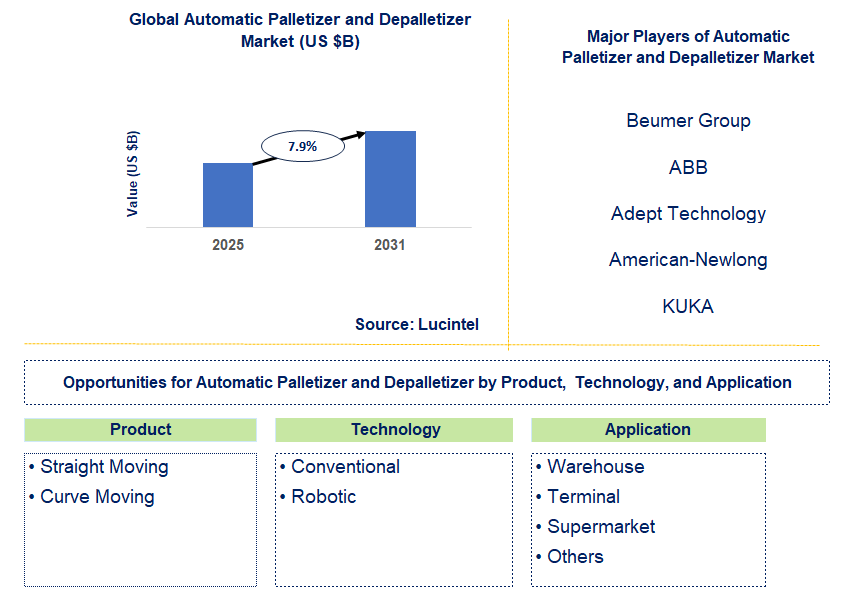
Key data points: The growth forecast = 7.9% annually for the next 7 years. Scroll below to get more insights. This market report covers trends, opportunities and forecasts in automatic palletizer and depalletizer market to 2031 by product (straight moving and curve moving), technology (conventional and robotic), application (warehouse, terminal, supermarket, and others), and region (North America, Europe, Asia Pacific, and the Rest of the World)
We'll send your sample report shortly.
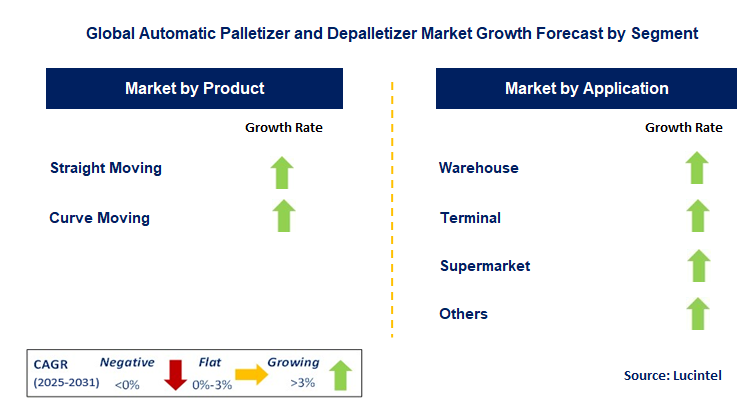
• Lucintel forecasts that, within the product category, straight moving is expected to witness higher growth over the forecast period.
• Within the application category, warehouse is expected to witness the highest growth.
• In terms of region, APAC is expected to witness the highest growth over the forecast period. Gain valuable insights for your business decisions with our comprehensive 150+ page report. Sample figures with some insights are shown below.
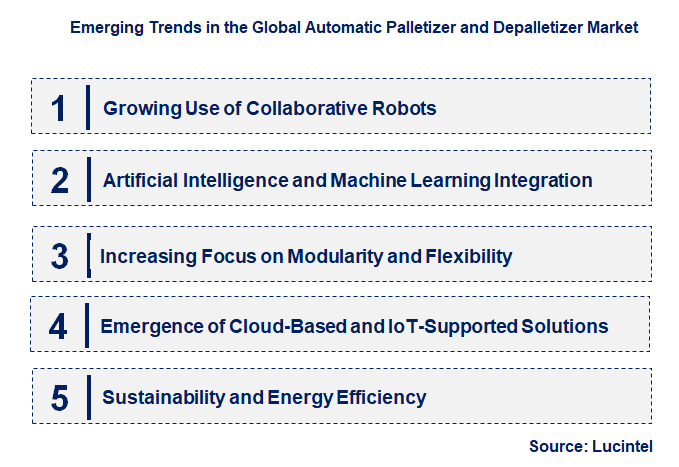
• Growing Use of Collaborative Robots: Cobots are intended to cooperate with human workers within common workspaces, providing a mix of automation and human intervention. Their greater safety and simplicity of programming enable their deployment in flexible use across different tasks, like palletizing and depalletizing. This trend will help companies automate certain processes without fully replacing the existing infrastructure, promoting greater efficiency and lower exposure to work-related injury through human-robot collaboration.
• Artificial Intelligence and Machine Learning Integration: AI and ML are being used more and more in automatic depalletizing and palletizing systems to improve performance and decision-making. Vision systems based on AI can recognize and manage a greater number of products with higher accuracy, while ML-based algorithms can study operational data to forecast maintenance requirements, optimize pallet layouts, and enhance overall system efficiency. This results in less downtime, fewer errors, and greater responsiveness to shifting production needs.
• Increasing Focus on Modularity and Flexibility: Today's automatic palletizing and depalletizing systems are more and more developed with modularity and flexibility in focus. This makes it simple for companies to reconfigure their equipment to accommodate various product configurations, pallet lengths, and stacking sequences. Modular designs are also less demanding in terms of scaling and maintenance, so companies can scale up or down their automation without heavy capital investment or production downtime.
• Emergence of Cloud-Based and IoT-Supported Solutions: The combination of Industrial Internet of Things (IoT) and cloud computing is supporting remote monitoring, diagnostics, and control of automatic palletizing and depalletizing equipment. Real-time information about system performance, energy usage, and potential problems can be monitored and analyzed remotely, supporting proactive maintenance, improving operational efficiency, and allowing more efficient inventory management. This connectivity increases overall equipment effectiveness and decreases on-site intervention requirements.
• Sustainability and Energy Efficiency: More energy-efficient and sustainable automatic depalletizing and palletizing solutions are increasingly in demand. Companies are working on creating systems that use less energy, reduce waste, and employ environmentally friendly materials. This is motivated by mounting environmental consciousness and legislation, along with the promise of long-term cost savings from lower energy use and waste elimination. These trends are all converging to transform the automatic palletizer and depalletizer market by propelling the creation of smarter, more flexible, safer, and more sustainable solutions. This transformation is making it possible for companies in different industries to attain greater efficiency, productivity, and cost savings in their material handling processes.
• Robotic End-of-Arm Tooling Advancements: Tremendous innovation has occurred in the development and operations of EOAT, which permits robots to manipulate an increased range of products, including products with sizes, shapes, and materials. Improved gripper technologies, including the use of modern sensors and materials, facilitate for gentle yet firm manipulation of delicate items, as well as effective manipulation of large or heavy goods. This broadens the use of robotic palletizers and depalletizers in various industries.
• Integrated Palletizing and Depalletizing System Development: The trend is moving towards systems to carry out both palletizing and depalletizing functions under a single machine. Such integrated systems are space-efficient and facilitate smoother material flow by minimizing the need for individual machines and intricate transfer devices. They improve overall efficiency and find special application in facilities with limited floor area or operations needing both functions.
• Improved Safety Features and Human-Machine Interface (HMI): New advancements encompass substantial advancements in safety features, including enhanced safety sensor controls, and easy-to-use HMIs. These advancements provide improved safety interactions between humans and automated processes, with growing deployments of collaborative robots. Easy-to-use HMIs make programming, running, and diagnostics more accessible without a need for specialized technical training.
• Integration of 3D Vision Systems for Intricate Handling: The use of advanced 3D vision systems enables automatic palletizers and depalletizers to detect and deal with products in more accuracy and flexibility. They can distinguish different product orientation, size, and shape and so robots are enabled to pick up and put down products in right place even for mixed-SKU cases. This innovation is increasing flexibility and minimizing precise upstream product alignment requirement.
• Design of Autonomous and Mobile Palletizing Solutions: Autonomous guided vehicles (AGVs) with palletizing functions and mobile robotic palletizers are being presented as new solutions for agile and flexible material handling. These can travel on their own within a factory or warehouse to carry out palletizing operations at various locations as required, providing greater flexibility and eliminating the need for permanent automation infrastructure. These innovations are having a profound effect on the automatic palletizer and depalletizer market by making material handling operations more efficient, flexible, and secure. They are promoting greater automation adoption across industries, resulting in enhanced productivity and lower operational expenses.
• Food and Beverage Industry: The food and beverage industry is a key area of growth owing to the high levels of packaged products and the high standards of hygiene. There are opportunities for creating systems capable of processing varied product types (e.g., bottles, cans, cartons) at high speeds while keeping them clean. There is an increasing need for flexible solutions able to support repeated product changeover and packaging. Automation assists in minimizing manual handling, reducing contamination hazards and enhancing overall throughput in food and beverage processing and distribution.
• Pharmaceutical and Personal Care Industry: This industry demands accurate and cautious handling of products, as well as compliance with stringent regulatory requirements. Opportunities for growth lie in offering automated palletizing and depalletizing solutions that maintain product integrity, traceability, and compliance. Equipment with sophisticated vision functionality for quality inspection and serialization, along with delicate handling devices for fragile products, are on the rise. Automation reduces the risk of human contact, decreasing the chances of contamination and promoting effective handling of pharmaceutical and personal care products.
• E-commerce and Logistics: The accelerated development of e-commerce has brought a substantial need for effective warehousing and order fulfillment solutions. Automatic depalletizers and palletizers are important to the automation of handling various and often packages. Potential areas include designing high-speed systems with sophisticated sorting and handling functions to process the growing volume and complexity of e-commerce logistics. Mobile and autonomous solutions also have growth potential for flexible and scalable warehouse automation.
• Consumer Goods Industry: The consumer goods industry, from household products to electronics, demands flexible and high-performance palletizing and depalletizing solutions. Opportunities for growth exist in delivering systems that accommodate multiple packaging styles, sizes, and weights while maximizing pallet stability and density for cost-effective transport and storage. Flexible automation capable of adjusting to changing product offerings and seasonal variations in demand is greatly appreciated.
• Industrial Manufacturing and Chemicals: The industrial manufacturing and chemicals industries frequently handle heavy, bulky, or toxic materials, so automated handling solutions are necessary to ensure safety as well as efficiency. Opportunities for growth lie in developing strong palletizing and depalletizing systems with the ability to withstand loads and challenging environments. Explosion-proof designs and the capability to connect with other automated material handling equipment are key factors of consideration in this industry. These growth prospects are transforming the automatic palletizer and depalletizer market by promoting innovation and the creation of application-specific solutions. By tapping into the specific needs and issues of these primary industries, manufacturers are able to leverage the growing demand for automation and boost their market share.
• Beumer Group
• ABB
• Adept Technology
• American-Newlong
• KUKA
• A-B-C Packaging Machine
• Fanuc corporation
• Ouellette Machinery Systems
• Columbia Machine
• Arrowhead Systems
• Straight Moving
• Curve Moving
• Conventional
• Robotic
• North America
• Europe
• Asia Pacific
• The Rest of the World
• United States: The United States market is growing strongly because of the heightened requirement for efficient warehousing and distribution facilities driven by the growing e-commerce industry. Firms are significantly investing in automation to streamline supply chains and lower the cost of material handling. Increasingly, high-speed palletizers and depalletizers are being adopted and integrated with advanced vision systems to enhance precision. In addition, there is growing interest in robotic solutions that have the capability to deal with a variety of product shapes and sizes to add flexibility to operations.
• China: China is a fast-growing market for automated palletizers and depalletizers, fueled by its huge industrialization and surging e-commerce market. There is a necessity for effective warehousing and logistics solutions to match the high traffic of goods movement. Recent trends involve the greater use of automated systems in factories and distribution hubs to enhance throughput and minimize labor expenses. More emphasis is being placed on the creation of low-cost and domestically produced automation technology.
• Germany: Germany, being a country with a robust industrial sector and a focus on technological innovations, is a key market for automatic depalletizers and palletizers. The attention is on integrating these systems into very efficient and flexible production lines following Industry 4.0 principles. Recent trends involve the implementation of advanced robotic palletizing solutions with sophisticated control systems and easy integration with warehouse management systems. Energy efficiency and sustainability are also becoming key considerations in new installations.
• India: The Indian market for automatic palletizers and depalletizers is in a growth phase, driven by increasing automation in manufacturing and logistics sectors, and the expansion of e-commerce. While currently smaller compared to more developed economies, the demand for automated material handling solutions is rising as businesses seek to improve efficiency and reduce reliance on manual labor. Recent trends involve the phasing in of robotic palletizers, especially in food and beverage and pharmaceutical segments, as more companies become aware of the advantages of automation.
• Japan: As a robotics and automation leader, Japan boasts a mature market for automatic depalletizers and palletizers. The recent trend is towards improving the accuracy, speed, and flexibility of these systems. Strong emphasis is placed on combining cutting-edge technologies such as machine learning and AI to optimize pallet patterns and increase overall operational efficiency. Collaborative robots that can coexist with humans in the manufacturing and logistics setting are also becoming increasingly prominent.


• Beumer Group
• ABB
• Adept Technology
• American-Newlong
• KUKA
• A-B-C Packaging Machine
• Fanuc corporation
• Ouellette Machinery Systems
• Columbia Machine
• Arrowhead Systems Q5. Which automatic palletizer and depalletizer market segment will be the largest in future? Answer: Lucintel forecasts that, within the product category, straight moving is expected to witness higher growth over the forecast period. Q6. In automatic palletizer and depalletizer market, which region is expected to be the largest in next 5 years? Answer: In terms of region, APAC is expected to witness the highest growth over the forecast period. Q7. Do we receive customization in this report? Answer: Yes, Lucintel provides 10% customization without any additional cost.


Choose a license that fits your team. Instant PDF delivery.
Prices exclude taxes. Instant delivery. Custom licensing available on request.
Market Report · July 31, 2026
Market Report · July 22, 2026
Market Report · July 20, 2026
Trusted partner for strategic intelligence and business growth


Receive a complimentary market analysis tailored to your industry. Our analysts will identify key growth opportunities and competitive dynamics specific to your business.

Market size, growth rate, and key trend analysis for your specific sector.

Top competitor positioning and market share analysis.

Strategic recommendations backed by data-driven insights.
Get curated market intelligence and competitive moves straight to your inbox.
By subscribing, you agree to receive our monthly insights. Unsubscribe anytime.
Receive a complimentary market analysis tailored to your industry. Our analysts will identify key growth opportunities and competitive dynamics specific to your business.
Market size, growth rate, and key trend analysis for your specific sector.
Top competitor positioning and market share analysis.
Strategic recommendations backed by data-driven insights.
Get curated market intelligence, emerging trends, and competitive moves straight to your inbox each month.
By subscribing, you agree to receive our monthly insights. Unsubscribe anytime.
We'll send your sample report shortly.