
Market Report · July 29, 2026

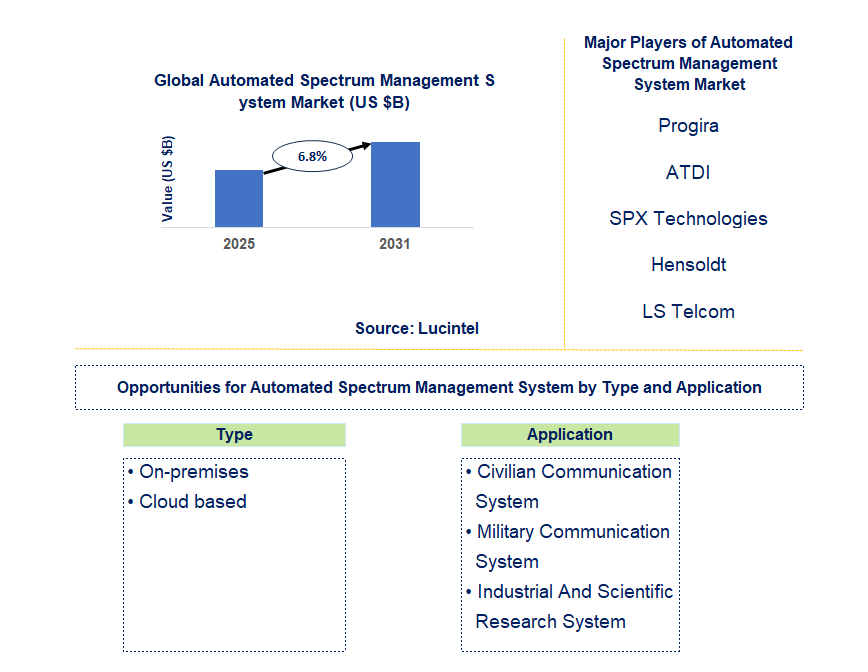
Key data points: The growth forecast = 6.8% annually for the next 7 years. Scroll below to get more insights. This market report covers Trends, opportunities and forecasts in automated spectrum management system market to 2031 by type (on-premises and cloud based), application (civilian communication system, military communication system, industrial & scientific research system, and others), and region (North America, Europe, Asia Pacific, and the Rest of the World)
We'll send your sample report shortly.
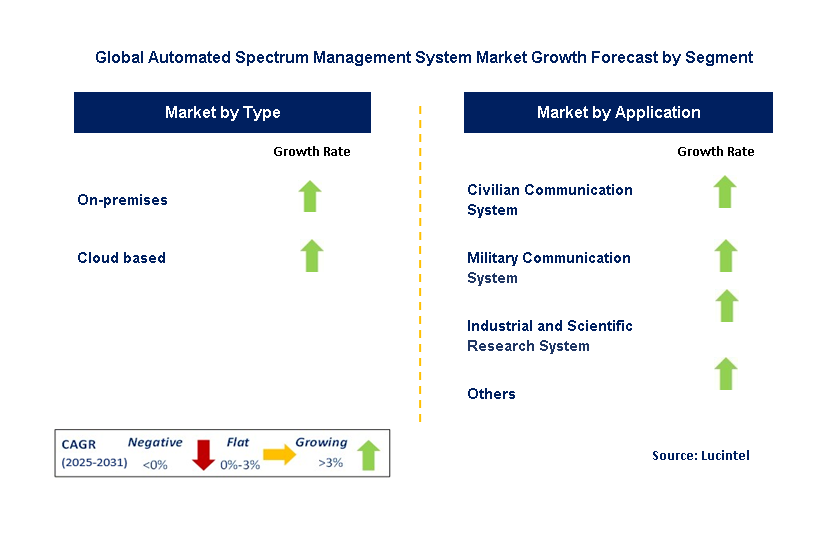
• Lucintel forecasts that, within the type category, cloud based is expected to witness higher growth over the forecast period due to its scalability, flexibility, and cost-effectiveness.
• Within the application category, military communication system is expected to witness the highest growth due to the rising defense and security investments.
• In terms of region, APAC is expected to witness the highest growth over the forecast period.
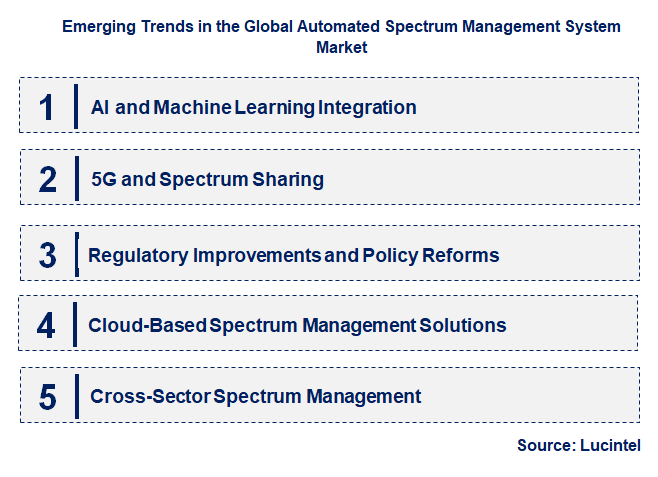
• AI and Machine Learning Integration: Spectrum management automation is now more dependent on AI and ML to optimize usage and allocation in real time. AI and ML assist in forecasting spectrum demand, automating interference detection, and optimizing the use of the spectrum, thus making the network more efficient.
• 5G and Spectrum Sharing: The development of 5G is accelerating the demand for more dynamic spectrum management systems. Spectrum sharing, enabling the optimal use of unused frequencies, is emerging as a top trend, supporting high-speed mobile networks and improving spectrum efficiency.
• Regulatory Improvements and Policy Reforms: Numerous nations are revamping rules to aid in autonomous spectrum management so that there is greater flexibility and quicker spectrum allocation. The regulatory reforms are aimed at facilitating new technologies like 5G, IoT, and AI, enhancing wireless communication innovation.
• Cloud-Based Spectrum Management Solutions: Cloud technology is becoming a very important aspect of spectrum management. Cloud-based solutions provide scalable and cost-effective methods to manage spectrum data, monitor the use of the spectrum, and control network resources by location.
• Cross-Sector Spectrum Management: Automation is facilitating more effective spectrum sharing across various sectors, including telecom, military, and public safety. Cross-sector cooperation is ensuring maximum spectrum efficiency, particularly with increasing demand for wireless communication. These trends are forcing significant changes in the management of spectrum around the world, compelling the industry towards more agile, efficient, and technology-oriented solutions.
• AI-Based Spectrum Allocation: AI technology has transformed spectrum allocation by making real-time optimization of spectrum usage possible. This innovation enables network operators to handle their spectrum effectively, reducing interference and optimizing coverage, especially in populated regions.
• Regulatory Reforms for Spectrum Sharing: Numerous countries are reforming their regulations in order to permit dynamic spectrum sharing. Such reforms are aimed at incorporating new technologies, such as 5G, in a manner that spectrum resources are utilized efficiently and optimally across various sectors.
• IoT Integration in Spectrum Management: With the emergence of IoT devices, there are new requirements for the use of spectrum. Spectrum management systems are now being customized to meet the particular requirements of IoT, which optimize communication and prevent congestion in frequency bands.
• Cloud-Based Solutions for Spectrum Monitoring: Cloud-based systems are being implemented increasingly to monitor the usage of the spectrum in real time. The systems provide cost-effective and scalable solutions for the tracking of spectrum allocation and ensuring efficient usage of the frequencies across wide regions.
• Improved Spectrum Monitoring and Interference Detection: Automated monitoring systems have been made available for easier detection of interference and its mitigation. Such a development becomes important for reliability and quality wireless communications, especially in high-density environments and safety-critical applications. These technologies are greatly increasing the efficiency and scalability of global spectrum management systems, paving the way for emerging wireless technologies such as 5G.
• 5G Spectrum Management: With 5G rollouts speeding up around the world, there is a tremendous scope for automated spectrum management systems to maximize the use of 5G spectrum through allocation and monitoring. This will assist in resolving the excessive wireless capacity demand and ensuring effective use of available spectrum.
• IoT Integration: With the increasing volume of IoT devices, there is a requirement for automated spectrum management systems that are capable of managing the specific challenges of IoT networks, including handling enormous device density and providing continuous connectivity in densely populated spectrum bands.
• Government and Military Applications: Governments and military forces are increasingly utilizing automated spectrum management systems to effectively allocate the spectrum and prevent interference between the important communication systems. This is an emerging opportunity for innovative spectrum management technologies.
• Smart Cities: The emergence of smart cities that are based on large-scale IoT networks has been a huge opportunity for automated spectrum management systems to maximize the use of available spectrum for numerous applications ranging from traffic to public safety.
• Rural Connectivity: Automated spectrum management has the potential to optimize the use of spectrum in rural and underserved regions, providing improved connectivity and quality of service. The potential is especially relevant where infrastructure issues constrain connectivity options. These prospects are making automated spectrum management an imperative for the effective and efficient use of wireless communications resources across industry sectors.
• Progira
• ATDI
• SPX Technologies
• Hensoldt
• LS Telcom
• Spectrum Center
• Keysight
• On-premises
• Cloud based
• Civilian Communication System
• Military Communication System
• Industrial & Scientific Research System
• Others
• North America
• Europe
• Asia Pacific
• The Rest of the World
• United States: The U.S. has been aggressively developing its spectrum management abilities through the application of artificial intelligence (AI) and machine learning (ML) in spectrum allocation and monitoring. The Federal Communications Commission (FCC) is advocating for policies that encourage efficient use of spectrum, making remarkable progress in 5G and Wi-Fi spectrum management, enhancing spectrum sharing models.
• China: China is prioritizing the establishment of strong automated spectrum management systems to facilitate its accelerated 5G deployment. The nation's regulatory authorities are simplifying the processes of allocating spectrum and enhancing spectrum monitoring systems, which will greatly enhance the efficiency of wireless communication networks to enable high-capacity communication.
• Germany: Germany has significantly advanced in spectrum management automation through its 5G and Industry 4.0 programs. Automated frequency management systems have been piloted by the Federal Network Agency (BNetzA), and spectrum sharing is encouraged to maximize the usage of spectrum for both commercial and government purposes.
• India: India is increasingly looking to automation in spectrum management as it looks to rollout 4G and 5G services on a larger scale. The Department of Telecommunications (DoT) is planning to create policies that include automated spectrum management with a view to increasing efficiency in spectrum allocation, monitoring, and resolving interference issues, in order to enhance the quality of service in urban and rural areas.
• Japan: Japan is utilizing automation to efficiently manage spectrum, especially in the 5G era. The Ministry of Internal Affairs and Communications (MIC) is leading automated spectrum management solutions that accelerate the speed of spectrum allocation and enhance service quality. Spectrum sharing models are also being researched to optimize spectrum utilization.


• Progira
• ATDI
• SPX Technologies
• Hensoldt
• LS Telcom
• Spectrum Center
• Keysight Q5. Which automated spectrum management system market segment will be the largest in future? Answer: Lucintel forecasts that, within the type category, cloud based is expected to witness higher growth over the forecast period due to its scalability, flexibility, and cost-effectiveness. Q6. In automated spectrum management system market, which region is expected to be the largest in next 5 years? Answer: In terms of region, APAC is expected to witness the highest growth over the forecast period. Q7. Do we receive customization in this report? Answer: Yes, Lucintel provides 10% customization without any additional cost.


Choose a license that fits your team. Instant PDF delivery.
Prices exclude taxes. Instant delivery. Custom licensing available on request.
Market Report · July 29, 2026
Market Report · July 20, 2026
Market Report · July 20, 2026
Trusted partner for strategic intelligence and business growth


Receive a complimentary market analysis tailored to your industry. Our analysts will identify key growth opportunities and competitive dynamics specific to your business.

Market size, growth rate, and key trend analysis for your specific sector.

Top competitor positioning and market share analysis.

Strategic recommendations backed by data-driven insights.
Get curated market intelligence and competitive moves straight to your inbox.
By subscribing, you agree to receive our monthly insights. Unsubscribe anytime.
Receive a complimentary market analysis tailored to your industry. Our analysts will identify key growth opportunities and competitive dynamics specific to your business.
Market size, growth rate, and key trend analysis for your specific sector.
Top competitor positioning and market share analysis.
Strategic recommendations backed by data-driven insights.
Get curated market intelligence, emerging trends, and competitive moves straight to your inbox each month.
By subscribing, you agree to receive our monthly insights. Unsubscribe anytime.
We'll send your sample report shortly.