
Market Report · July 31, 2026

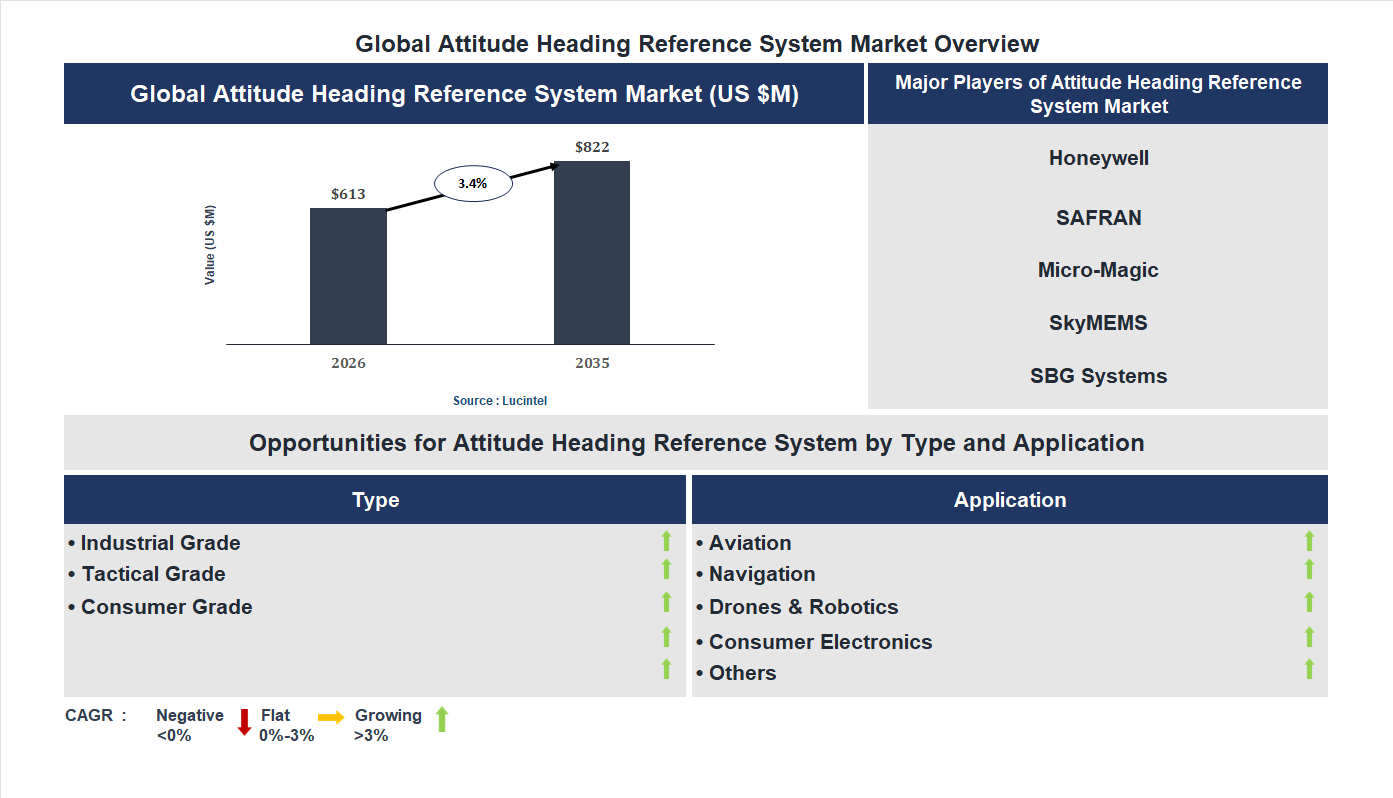
Key data points: The market size in 2035 = $822 million, growth forecast = 3.4% annually for the next 8 years. Scroll below to get more insights. This market report covers trends, opportunities and forecasts in attitude heading reference system market to 2035 by type (industrial grade, tactical grade, and consumer grade), application (aviation, navigation, drones & robotics, consumer electronics, and others), and region (North America, Europe, Asia Pacific, and the Rest of the World)
We'll send your sample report shortly.
• Lucintel forecasts that, within the type category, tactical grade is expected to witness the highest growth over the forecast period.
• Within the application category, drone & robotic is expected to witness the highest growth.
• In terms of region, APAC is expected to witness the highest growth over the forecast period. Gain valuable insights for your business decisions with our comprehensive 150+ page report. Sample figures with some insights are shown below.
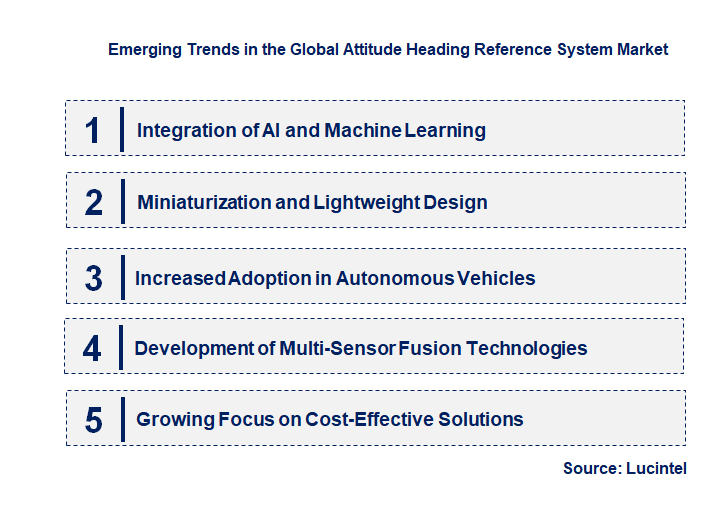
• Integration of AI and Machine Learning: Enhances accuracy and reliability by enabling real-time data processing and predictive analytics, reducing errors caused by sensor drift or environmental factors. This integration allows AHRS to adapt dynamically to changing conditions, improving performance in complex environments like autonomous vehicles and military applications. The impact is significant, as it leads to smarter, more autonomous systems capable of making real-time adjustments, thereby increasing safety and operational efficiency.
• Miniaturization and Lightweight Design: Focuses on reducing the size and weight of AHRS units without compromising performance. This trend is driven by the demand for compact systems in UAVs, drones, and portable devices, where space and weight are critical constraints. The impact includes broader application possibilities, improved fuel efficiency in aerospace, and enhanced maneuverability in smaller platforms. Miniaturized AHRS also facilitate integration into wearable and handheld devices, expanding market reach.
• Increased Adoption in Autonomous Vehicles: As autonomous cars, drones, and maritime vessels become more prevalent, AHRS systems are increasingly integrated into these platforms for precise navigation and stability. This trend is driven by the need for high-precision orientation data in GPS-denied environments and complex operational scenarios. The impact is a surge in demand for robust, high-performance AHRS solutions, fostering innovation in sensor fusion and system redundancy to ensure safety and reliability in autonomous operations.
• Development of Multi-Sensor Fusion Technologies: Combines data from gyroscopes, accelerometers, magnetometers, and GPS to improve accuracy and robustness. This approach mitigates individual sensor limitations and enhances system resilience against environmental disturbances. The impact is a significant boost in navigation precision, especially in challenging environments like tunnels or urban canyons, making AHRS indispensable for critical applications in aerospace, defense, and autonomous systems.
• Growing Focus on Cost-Effective Solutions: Emphasizes the development of affordable AHRS units to penetrate emerging markets and small-scale applications. This trend involves leveraging economies of scale, advanced manufacturing techniques, and open-source platforms. The impact includes increased market accessibility for startups and developing regions, fostering innovation, and expanding the overall market size. Cost-effective solutions also enable widespread adoption in consumer electronics, robotics, and educational tools. These trends are collectively transforming the AHRS market by enhancing system performance, expanding application domains, and making advanced navigation solutions more accessible. The integration of AI, miniaturization, multi-sensor fusion, and cost reduction strategies are driving innovation, ensuring the market remains competitive and poised for sustained growth across diverse sectors.
• Growing Adoption in Aerospace Industry: The aerospace sector is increasingly integrating AHRS for improved navigation accuracy. This growth is driven by the need for reliable attitude and heading data in commercial and military aircraft, enhancing flight safety and operational efficiency. The deployment of advanced AHRS in next-generation aircraft and UAVs is expanding market reach, fostering innovation in sensor technology and system integration. As aerospace demands evolve, the market benefits from increased investments and technological collaborations, boosting overall industry growth.
• Advancements in Sensor Technology: Innovations in MEMS and fiber-optic sensors are revolutionizing AHRS performance. These advancements offer higher accuracy, lower power consumption, and reduced size, making systems more adaptable for various applications. Enhanced sensor capabilities improve stability and reliability in challenging environments, such as high altitudes or turbulent conditions. The integration of AI and machine learning further refines data processing, leading to smarter, more responsive systems. These technological strides are expanding the market’s scope across multiple sectors, including defense and autonomous vehicles.
• Rising Demand in Autonomous Vehicles: The surge in autonomous vehicle development is fueling AHRS adoption for precise navigation and orientation. These systems are critical for ensuring vehicle stability, safety, and accurate positioning in complex environments. As autonomous technology advances, the need for miniaturized, highly reliable AHRS solutions grows. Market players are investing in research to develop robust systems capable of operating in diverse conditions. This trend is expected to significantly expand the market, supporting the future of driverless transportation and smart mobility solutions.
• Increased Focus on Defense Applications: Defense agencies are increasingly deploying AHRS for missile guidance, naval navigation, and military aircraft. The demand stems from the need for highly accurate, resilient systems capable of functioning in hostile environments. Innovations in ruggedization and anti-jamming features are enhancing system reliability. The integration of AHRS with other defense technologies improves operational effectiveness and situational awareness. This focus on defense applications is driving market growth, encouraging manufacturers to develop specialized, high-performance systems tailored for military needs.
• Integration with Next-Generation Navigation Systems: AHRS is becoming a vital component of integrated navigation solutions, including GPS-denied environments. Combining AHRS with inertial navigation systems (INS) and other sensors enhances accuracy and reliability where GPS signals are unavailable or compromised. This integration supports applications in underground mining, submarines, and space exploration. The development of hybrid systems is expanding market opportunities, fostering innovation in sensor fusion technologies. As reliance on autonomous and remote operations increases, the market for integrated navigation solutions is poised for substantial growth. The overall impact of these developments is a dynamic, expanding market characterized by technological innovation and increased application diversity. Enhanced accuracy, reliability, and miniaturization are driving adoption across aerospace, defense, autonomous vehicles, and other sectors. This evolution is fostering competitive growth, creating new business opportunities, and supporting the global shift towards smarter, more autonomous navigation systems.
• Integration of AHRS in Autonomous Vehicles: The integration of AHRS in autonomous vehicles enhances navigation accuracy and stability, especially in GPS-denied environments. This technology supports self-driving cars, drones, and maritime vessels by providing precise orientation data, improving safety and operational efficiency. Growing adoption in urban mobility and logistics sectors presents significant market opportunities, with sub-segments including ground vehicles, aerial drones, and maritime navigation systems.
• Adoption of Miniaturized and Lightweight AHRS Solutions: The demand for compact, lightweight AHRS units is rising, driven by aerospace, UAVs, and portable devices. Miniaturization reduces weight and power consumption, enabling integration into smaller platforms without compromising performance. This trend opens opportunities for high-performance MEMS-based systems, wearable applications, and space-constrained environments, expanding the market for versatile, low-cost AHRS solutions suitable for diverse industries.
• Expansion of AHRS in Military and Defense Applications: Military and defense sectors increasingly rely on AHRS for missile guidance, aircraft stabilization, and tactical navigation. The need for highly accurate, rugged, and reliable systems in harsh environments drives innovation. Opportunities exist in developing advanced, multi-sensor fusion systems, enhancing resistance to jamming, and integrating with other defense technologies, thereby strengthening market presence in defense applications worldwide.
• Development of Hybrid Navigation Systems Combining AHRS and GNSS: Hybrid systems combining AHRS with Global Navigation Satellite Systems (GNSS) improve positioning accuracy and reliability, especially in challenging environments like tunnels or urban canyons. This integration supports applications in aviation, maritime, and surveying. The development of seamless, real-time sensor fusion algorithms offers significant growth potential, enabling continuous navigation and orientation in GPS-degraded scenarios, thus broadening market applications and customer base.
• Increasing Use of AHRS in Commercial Aerospace and Unmanned Aerial Vehicles: The commercial aerospace industry and UAV market are expanding rapidly, requiring precise attitude and heading data for flight stability and control. AHRS systems are critical for autopilot functions, flight management, and stability augmentation. Growing demand for lightweight, high-accuracy systems in commercial aircraft and drones presents opportunities for innovation, including advanced sensor fusion, enhanced robustness, and integration with other avionics systems, fueling overall market growth. The overall market for attitude heading reference system market is poised for substantial expansion as these opportunities drive technological advancements and broaden application scopes, ultimately enhancing navigation, safety, and operational efficiency across multiple industries.
• Technological Innovation: The continuous development of advanced sensors and algorithms enhances the accuracy and reliability of AHRS, making them indispensable in modern aircraft and unmanned systems. Innovations like miniaturization and integration with GPS improve system performance and reduce weight, which is critical for aerospace applications. These technological advancements attract aerospace manufacturers and defense agencies, fueling market growth. Moreover, the adoption of AI and machine learning further refines navigation capabilities, opening new avenues for market expansion.
• Increasing Defense and Aerospace Spending: Governments worldwide are increasing their investments in defense and civil aviation sectors to modernize their fleets and enhance security. The rising procurement of military aircraft, drones, and commercial planes necessitates sophisticated navigation systems like AHRS. This surge in defense budgets directly correlates with increased demand for high-precision attitude and heading reference systems, supporting market growth. Additionally, the expansion of commercial aviation in emerging economies boosts the need for reliable navigation solutions.
• Growing Adoption of Autonomous Vehicles: The rise of autonomous and semi-autonomous vehicles, including drones and aircraft, relies heavily on accurate attitude and heading data provided by AHRS. These systems are critical for ensuring stability, navigation, and safety in autonomous operations. As industries push toward automation, the demand for robust AHRS solutions increases, driving market expansion. The integration of AHRS with other autonomous systems enhances overall operational efficiency and safety, making them a vital component in future mobility solutions.
• Regulatory and Safety Standards: Stringent safety regulations and certification requirements by aviation authorities such as FAA and EASA mandate the use of high-quality navigation systems. Compliance with these standards ensures system reliability and safety, encouraging manufacturers to adopt advanced AHRS. Regulatory frameworks also promote innovation by setting performance benchmarks, which in turn stimulates market growth. As safety remains a top priority in aerospace, adherence to these standards sustains demand for cutting-edge AHRS solutions. The challenges in the attitude heading reference system market are:
• High System Costs: The development and integration of advanced AHRS involve significant investment in high-precision sensors, calibration, and testing. These costs translate into higher prices for end-users, limiting adoption among smaller aerospace firms and emerging markets. The expense also impacts the overall profitability for manufacturers, potentially slowing innovation and deployment. Cost reduction strategies are essential to expand market reach and ensure broader adoption across various sectors.
• Technological Complexity: Designing and maintaining highly accurate AHRS requires sophisticated technology and expertise. The complexity of integrating AHRS with other avionics systems and ensuring consistent performance under diverse operational conditions presents technical challenges. This complexity can lead to increased development time, higher failure rates, and maintenance issues, which may hinder widespread adoption. Overcoming these technical hurdles is crucial for ensuring system reliability and market growth.
• Regulatory Compliance and Certification: Navigating the complex regulatory landscape for certification of AHRS systems is a significant challenge. Achieving compliance with international safety standards involves extensive testing, documentation, and certification processes, which can be time-consuming and costly. Delays in certification can hinder product launches and market entry, impacting revenue streams. Ensuring ongoing compliance with evolving regulations remains a critical challenge for manufacturers aiming to expand globally. The AHRS Market is driven by technological advancements, increased defense and civil aviation investments, the rise of autonomous vehicles, and strict safety standards. However, high costs, technological complexity, and regulatory hurdles pose notable challenges. These factors collectively shape the market landscape, requiring stakeholders to innovate and adapt strategically. While growth prospects remain promising, addressing these challenges is essential for sustained expansion and competitive advantage in the evolving aerospace and defense sectors.
• Honeywell
• SAFRAN
• Micro-Magic
• SkyMEMS
• SBG Systems
• Inertial Labs
• Movella (Xsens)
• Advanced Navigation
• UAV Navigation
• Shenzhen Ruifen Technology
• Industrial Grade
• Tactical Grade
• Consumer Grade
• Aviation
• Navigation
• Drones & Robotics
• Consumer Electronics
• Others
• North America
• Europe
• Asia Pacific
• The Rest of the World
• United States: The US market has seen substantial innovation with major aerospace and defense companies developing advanced AHRS systems that integrate with autonomous aircraft and drones. There is a focus on miniaturization and improved accuracy, driven by military and commercial aviation needs. Collaborations between tech firms and government agencies are accelerating the deployment of next-generation systems, while startups are introducing disruptive technologies in sensor integration and data processing.
• China: China is rapidly expanding its AHRS capabilities to support its growing aerospace and defense sectors. The country has invested heavily in indigenous technology development to reduce reliance on foreign systems. Recent advancements include high-precision AHRS for military aircraft and commercial drones, along with increased production capacity. Government initiatives aim to foster domestic innovation and establish China as a global leader in navigation technology.
• Germany: Germanys AHRS market is characterized by a focus on high-precision systems for civil aviation and industrial applications. Leading companies are enhancing sensor accuracy and robustness to meet stringent European safety standards. There is also a trend toward integrating AHRS with other navigation systems for improved reliability. Germanys emphasis on quality and innovation continues to position it as a key player in the European market.
• India: India is witnessing rapid growth in the adoption of AHRS technology, particularly in defense and emerging commercial sectors like autonomous vehicles and UAVs. The country is investing in indigenous R&D to develop cost-effective and reliable systems. Recent developments include collaborations with international firms and government initiatives to boost local manufacturing, aiming to reduce dependency on imports and foster self-reliance.
• Japan: Japans AHRS market is driven by advancements in aerospace, robotics, and transportation sectors. Companies are focusing on miniaturization, energy efficiency, and integration with other navigation and control systems. Japan is also investing in research to improve system resilience against environmental factors. The country’s emphasis on innovation and quality ensures its continued leadership in high-precision navigation solutions.


• Honeywell
• SAFRAN
• Micro-Magic
• SkyMEMS
• SBG Systems
• Inertial Labs
• Movella (Xsens)
• Advanced Navigation
• UAV Navigation
• Shenzhen Ruifen Technology Q6. Which attitude heading reference system market segment will be the largest in future? Answer: Lucintel forecasts that, within the type category, tactical grade is expected to witness the highest growth over the forecast period. Q7. In attitude heading reference system market, which region is expected to be the largest in next 8 years? Answer: In terms of region, APAC is expected to witness the highest growth over the forecast period. Q8. Do we receive customization in this report? Answer: Yes, Lucintel provides 10% customization without any additional cost.


Choose a license that fits your team. Instant PDF delivery.
Prices exclude taxes. Instant delivery. Custom licensing available on request.
Market Report · July 31, 2026
Market Report · July 31, 2026
Market Report · July 31, 2026
Trusted partner for strategic intelligence and business growth


Receive a complimentary market analysis tailored to your industry. Our analysts will identify key growth opportunities and competitive dynamics specific to your business.

Market size, growth rate, and key trend analysis for your specific sector.

Top competitor positioning and market share analysis.

Strategic recommendations backed by data-driven insights.
Get curated market intelligence and competitive moves straight to your inbox.
By subscribing, you agree to receive our monthly insights. Unsubscribe anytime.
Receive a complimentary market analysis tailored to your industry. Our analysts will identify key growth opportunities and competitive dynamics specific to your business.
Market size, growth rate, and key trend analysis for your specific sector.
Top competitor positioning and market share analysis.
Strategic recommendations backed by data-driven insights.
Get curated market intelligence, emerging trends, and competitive moves straight to your inbox each month.
By subscribing, you agree to receive our monthly insights. Unsubscribe anytime.
We'll send your sample report shortly.