
Report Feature
Assisted Reproduction Micro Tool Market Trends and Forecast
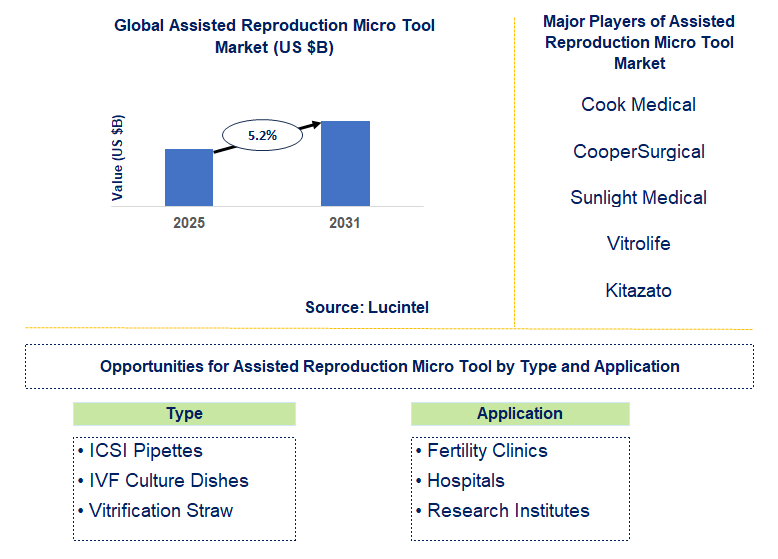
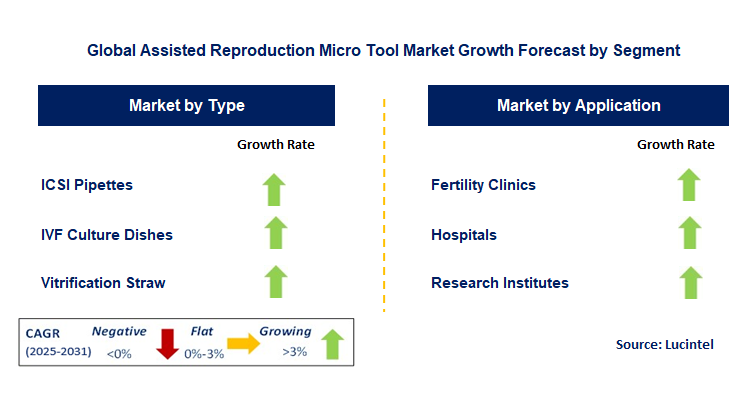
The future of the global assisted reproduction micro tool market looks promising with opportunities in the fertility clinic, hospital, and research institute markets. The global assisted reproduction micro tool market is expected to grow with a CAGR of 5.2% from 2025 to 2031. The major drivers for this market are the increasing demand for assisted reproduction treatments, the rising prevalence of infertility cases, and the growing adoption of advanced reproductive technologies.• Lucintel forecasts that, within the type category, ICSI pipette is expected to witness the highest growth over the forecast period.
• Within the application category, fertility clinic is expected to witness the highest growth.
• In terms of region, APAC is expected to witness the highest growth over the forecast period. Gain valuable insights for your business decisions with our comprehensive 150+ page report. Sample figures with some insights are shown below.
Emerging Trends in the Assisted Reproduction Micro Tool Market
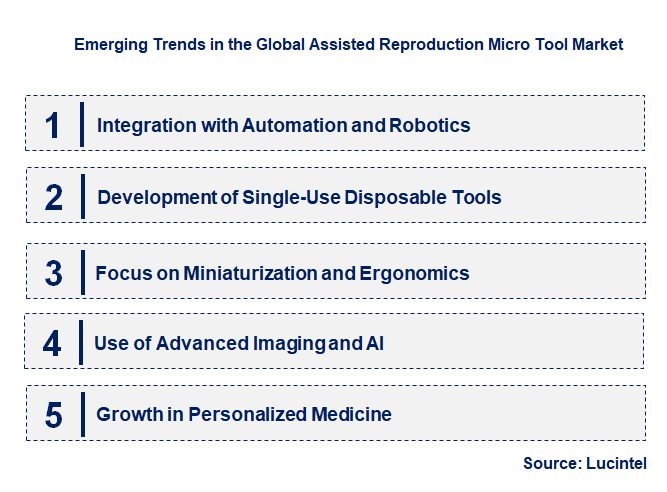
The assisted reproduction micro tool market is being reshaped by several key trends, reflecting a broader industry shift toward automation, personalization, and enhanced safety. These trends are influencing tool design, material science, and technological capabilities, positioning micro tools as a crucial component of a modern fertility clinic’s strategy for achieving higher success rates.• Integration with Automation and Robotics: A key trend is the integration of micro tools with robotic systems for automated procedures. The impact is a significant reduction in human error and enhanced precision. Automated systems can perform delicate tasks like ICSI and embryo biopsy with sub-micron accuracy, which is crucial for improving fertilization and implantation rates and achieving more consistent results.
• Development of Single-Use Disposable Tools: The market is seeing a trend toward the use of sterile, single-use, disposable micro tools. The impact is a more effective barrier to the spread of pathogens and a significant reduction in the risk of cross-contamination. This is crucial for maintaining the highest standards of safety and hygiene in a clinical setting and is becoming a key driver for market growth.
• Focus on Miniaturization and Ergonomics: There is an emerging trend of creating smaller, more precise, and more ergonomic micro tools. The impact is a less invasive procedure and reduced physical strain on embryologists. These tools allow for greater control during delicate procedures, which can lead to higher success rates and improve the overall user experience.
• Use of Advanced Imaging and AI: A key trend is the integration of advanced imaging technologies and AI into micro tools. The impact is more accurate embryo and sperm selection. AI-powered systems can analyze real-time images to identify the best quality gametes and embryos, which significantly improves the chances of a successful pregnancy and reduces the number of cycles required.
• Growth in Personalized Medicine: This trend involves creating micro tools that can be customized for individual patient needs, such as for patients with specific genetic conditions. The impact is a more tailored approach to treatment. By designing tools for specific applications, manufacturers can provide solutions for complex cases, which is a key area of growth in the market. These emerging trends are fundamentally reshaping the assisted reproduction micro tool market, making products more intelligent, hygienic, and user-friendly. The focus on automation, single-use designs, and personalized medicine is creating new value and transforming how fertility clinics operate.
Recent Development in the Assisted Reproduction Micro Tool Market
The assisted reproduction micro tool market is witnessing a dynamic period of development, driven by a global emphasis on improving the success rates of fertility treatments. These developments are centered on enhancing tool functionality, material science, and design to meet the evolving needs of fertility clinics and patients.• Launch of New Micropipette Designs: A significant development is the introduction of new micropipette designs with improved tip geometries and a higher degree of precision. The impact is better control during delicate procedures like ICSI and embryo biopsy. This leads to reduced cellular damage and a higher chance of successful fertilization and implantation.
• Introduction of Advanced Polymer Materials: Manufacturers are now using advanced polymer materials that are more durable and have a higher degree of transparency and biocompatibility. The impact is a longer-lasting and more reliable product. These materials are also less reactive with sensitive biological samples, which is crucial for maintaining their viability.
• Development of Specialization for Procedures: Recent developments include the creation of micro tools with specialized configurations for specific medical procedures. The impact is a more streamlined and efficient workflow for embryologists. These tools come pre-configured with the necessary features for tasks like embryo transfer or genetic testing, reducing preparation time and potential for error.
• Increased Focus on Ergonomic Design: There has been an increased focus on the ergonomic design of micro tools to reduce physical strain on embryologists. The impact is a safer and more comfortable working environment. Features like lightweight construction, easy grip, and balanced design are now standard to minimize fatigue during long and intricate procedures.
• Market Consolidation and Partnerships: The market is seeing a trend of consolidation, with larger medical device companies acquiring smaller specialized manufacturers. The impact is an increase in research and development funding. This allows for faster innovation and the development of more advanced products that meet evolving customer needs and improve patient care. These recent developments are collectively transforming the assisted reproduction micro tool market into a more sophisticated and user-friendly industry. The focus on improved design, new materials, and advanced sterilization techniques is enhancing the quality of the products and fundamentally changing how fertility treatments are performed.
Strategic Growth Opportunities in the Assisted Reproduction Micro Tool Market
The assisted reproduction micro tool market offers strategic growth opportunities across key applications, driven by a growing need for efficiency and precision in fertility care. These opportunities are focused on expanding into new segments and leveraging the tools' advantages to provide solutions for specific industry needs.• Targeting the Male Infertility Segment: The most significant growth opportunity is to expand into the male infertility market. The impact is a high-value customer base that requires specialized micro tools for sperm selection and manipulation. This is a largely underserved market with significant growth potential, particularly with rising male infertility rates.
• Expansion into Preimplantation Genetic Testing: The rapidly growing field of preimplantation genetic testing (PGT) is a high-potential growth opportunity. The impact is a demand for specialized, ultra-fine micro tools for embryo biopsy. PGT requires highly precise instruments to safely remove a few cells from the embryo without causing damage.
• Serving the Fertility Preservation Market: The growing trend of fertility preservation, particularly egg freezing, is a major strategic opportunity. The impact is a demand for new, specialized micro tools for oocyte vitrification and warming. By developing products optimized for these procedures, manufacturers can capture a leading position in this high-growth segment.
• Focusing on Emerging Economies: The rapidly growing healthcare infrastructure in emerging economies like China and India presents a significant growth opportunity. The impact is a large, new customer base. By offering affordable and reliable micro tools, companies can secure a strong foothold in these regions.
• Developing Tools for Research Applications: The market has a strong opportunity to expand into academic and research institutions. The impact is a new revenue stream. Researchers require specialized micro tools for a wide variety of experiments related to reproductive biology, which can provide a stable and growing market for these products. These strategic growth opportunities highlight the market's potential beyond its traditional base. By focusing on high-value applications in male infertility and PGT, expanding into new sectors like fertility preservation, and targeting emerging markets, the market can achieve significant and sustainable growth.
Assisted Reproduction Micro Tool Market Driver and Challenges
The assisted reproduction micro tool market is propelled by a combination of powerful drivers and significant challenges. The major drivers, including the rising prevalence of infertility and technological advancements, are fueling expansion. However, it must also address key challenges related to high costs and stringent regulations to maintain its growth trajectory. The factors responsible for driving the assisted reproduction micro tool market include: 1. Rising Infertility Rates: The increasing global incidence of infertility, driven by factors like delayed parenthood and lifestyle changes, is a primary driver. This creates a constant and growing demand for assisted reproductive technologies, and consequently, for the micro tools that are essential for these procedures. 2. Technological Advancements: Continuous innovation in micro-tool design, material science, and the integration of robotics is a major driver. The development of more precise and less invasive tools improves the success rates of procedures, making them more attractive to patients and clinicians, which stimulates market growth. 3. Increasing Awareness and Acceptance: The growing social acceptance of assisted reproductive technologies, coupled with increased awareness of fertility treatments, is a key driver. This encourages more individuals and couples to seek treatment, which fuels demand for the micro tools and other related equipment. 4. Favorable Government Policies: In many countries, favorable government policies and reimbursement schemes for fertility treatments are a significant driver. This makes the procedures more accessible and affordable for a larger patient population, which stimulates market growth and encourages the adoption of these advanced products. 5. Growth of Fertility Clinics: The rapid increase in the number of fertility clinics globally is a major driver. As these clinics are established, they require a full range of micro tools and other equipment, creating a consistent and growing demand for the market. Challenges in the assisted reproduction micro tool market are: 1. High Cost of Treatment: The high cost of assisted reproductive procedures, including the micro tools, is a significant challenge. This can limit access to this advanced care, especially in low- and middle-income countries, and can be a financial burden for patients and healthcare systems. 2. Stringent Regulatory Hurdles: The development and commercialization of new medical devices like assisted reproduction micro tools are subject to stringent regulatory approval processes. The time and cost involved in gaining approval from bodies like the FDA and EMA are significant challenges that can delay market entry and innovation. 3. Ethical and Social Concerns: The market faces challenges related to ethical and social concerns surrounding issues like embryo selection, genetic manipulation, and surrogacy. These debates can lead to restrictive regulations or negative public perception, which can impact market growth in certain regions. The assisted reproduction micro tool market is experiencing robust growth driven by the rising incidence of infertility and technological innovation. However, it must navigate significant challenges related to the high cost of treatment and stringent regulatory requirements. Successfully addressing these issues will be crucial for the market's continued expansion and its essential role in improving fertility care.List of Assisted Reproduction Micro Tool Companies
Companies in the market compete on the basis of product quality offered. Major players in this market focus on expanding their manufacturing facilities, R&D investments, infrastructural development, and leverage integration opportunities across the value chain. With these strategies assisted reproduction micro tool companies cater increasing demand, ensure competitive effectiveness, develop innovative products & technologies, reduce production costs, and expand their customer base. Some of the assisted reproduction micro tool companies profiled in this report include-• Cook Medical
• CooperSurgical
• Sunlight Medical
• Vitrolife
• Kitazato
• Synga
• Microtech
• Hamilton Thorne
• ASTEC Pipette
• Cryo Bio System
Assisted Reproduction Micro Tool Market by Segment
The study includes a forecast for the global assisted reproduction micro tool market by type, application, and region.Assisted Reproduction Micro Tool Market by Type [Value from 2019 to 2031]:
• ICSI Pipettes
• IVF Culture Dishes
• Vitrification Straw
Assisted Reproduction Micro Tool Market by Application [Value from 2019 to 2031]:
• Fertility Clinics
• Hospitals
• Research Institutes
Assisted Reproduction Micro Tool Market by Region [Value from 2019 to 2031]:
• North America
• Europe
• Asia Pacific
• The Rest of the World
Country Wise Outlook for the Assisted Reproduction Micro Tool Market
The assisted reproduction micro tool market is experiencing a significant transformation driven by advancements in micromanipulation and a global rise in infertility rates. Recent developments are centered on improving the precision, safety, and efficiency of these tools, crucial for procedures like IVF and ICSI. The focus is on creating less invasive, more reliable instruments to enhance success rates and patient outcomes.• United States: The U.S. market is a leader in technological innovation, with recent developments focusing on the integration of artificial intelligence and robotics into micro tools. This is improving the accuracy of procedures like embryo biopsy and sperm injection, and is driven by the need to optimize clinical workflows and enhance the high-stakes environment of fertility clinics.
• China: China’s market is rapidly growing, with a surge in the number of fertility clinics and government support for reproductive health. Recent developments include domestic manufacturers improving product quality to reduce reliance on imports and provide cost-effective solutions. This is making advanced micro tools more accessible to a larger patient population and is helping to meet a massive unmet demand.
• Germany: Germany's market is characterized by a strong emphasis on precision engineering and strict regulatory standards. Recent developments are centered on creating highly ergonomic and biocompatible micro tools. The market is also seeing a push for single-use, disposable instruments to minimize the risk of contamination, reflecting a strong focus on patient safety and procedural integrity.
• India: The Indian market is experiencing a significant increase in demand for assisted reproduction micro tools, fueled by the rapid growth of its fertility industry. Recent developments include a strong demand for affordable, reliable instruments and an increase in local manufacturing to reduce costs. The focus is on providing robust and practical solutions for the country's diverse range of fertility clinics.
• Japan: Japan's market is mature and technologically advanced. Recent developments show a strong focus on creating super-precise micro tools for advanced procedures. The market sees a strong demand for tools that can improve embryo selection and implantation success rates, reflecting a focus on optimizing every stage of the IVF process to achieve superior patient outcomes.

Features of the Global Assisted Reproduction Micro Tool Market
Market Size Estimates: Assisted reproduction micro tool market size estimation in terms of value ($B). Trend and Forecast Analysis: Market trends (2019 to 2024) and forecast (2025 to 2031) by various segments and regions. Segmentation Analysis: Assisted reproduction micro tool market size by type, application, and region in terms of value ($B). Regional Analysis: Assisted reproduction micro tool market breakdown by North America, Europe, Asia Pacific, and Rest of the World. Growth Opportunities: Analysis of growth opportunities in different types, applications, and regions for the assisted reproduction micro tool market. Strategic Analysis: This includes M&A, new product development, and competitive landscape of the assisted reproduction micro tool market. Analysis of competitive intensity of the industry based on Porter’s Five Forces model.
FAQ
Q1. What is the growth forecast for assisted reproduction micro tool market? Answer: The global assisted reproduction micro tool market is expected to grow with a CAGR of 5.2% from 2025 to 2031. Q2. What are the major drivers influencing the growth of the assisted reproduction micro tool market? Answer: The major drivers for this market are the increasing demand for assisted reproduction treatments, the rising prevalence of infertility cases, and the growing adoption of advanced reproductive technologies. Q3. What are the major segments for assisted reproduction micro tool market? Answer: The future of the assisted reproduction micro tool market looks promising with opportunities in the fertility clinic, hospital, and research institute markets. Q4. Who are the key assisted reproduction micro tool market companies? Answer: Some of the key assisted reproduction micro tool companies are as follows:• Cook Medical
• CooperSurgical
• Sunlight Medical
• Vitrolife
• Kitazato
• Synga
• Microtech
• Hamilton Thorne
• ASTEC Pipette
• Cryo Bio System Q5. Which assisted reproduction micro tool market segment will be the largest in future? Answer: Lucintel forecasts that, within the type category, ICSI pipette is expected to witness the highest growth over the forecast period. Q6. In assisted reproduction micro tool market, which region is expected to be the largest in next 5 years? Answer: In terms of region, APAC is expected to witness the highest growth over the forecast period. Q7. Do we receive customization in this report? Answer: Yes, Lucintel provides 10% customization without any additional cost.
Table of Contents
Methodology
- In-depth interviews of the major players in this market
- Detailed secondary research from competitors’ financial statements and published data
- Extensive searches of published works, market, and database information pertaining to industry news, company press releases, and customer intentions
- A compilation of the experiences, judgments, and insights of Lucintel’s professionals, who have analyzed and tracked this market over the years.


Buy Now
Choose a license that fits your team. Instant PDF delivery.
Prices exclude taxes. Instant delivery. Custom licensing available on request.
Key Questions
- • What are some of the most promising, high-growth opportunities for the assisted reproduction micro tool market by type (ICSI pipettes, IVF culture dishes, and vitrification straw), application (fertility clinics, hospitals, and research institutes), and region (North America, Europe, Asia Pacific, and the Rest of the World)?
- • Which segments will grow at a faster pace and why?
- • Which region will grow at a faster pace and why?
- • What are the key factors affecting market dynamics? What are the key challenges and business risks in this market?
- • What are the business risks and competitive threats in this market?
- • What are the emerging trends in this market and the reasons behind them?
- • What are some of the changing demands of customers in the market?
- • What are the new developments in the market? Which companies are leading these developments?
- • Who are the major players in this market? What strategic initiatives are key players pursuing for business growth?
- • What are some of the competing products in this market and how big of a threat do they pose for loss of market share by material or product substitution?
- • What M&A activity has occurred in the last 5 years and what has its impact been on the industry? For any questions related to Assisted Reproduction Micro Tool Market, Assisted Reproduction Micro Tool Market Size, Assisted Reproduction Micro Tool Market Growth, Assisted Reproduction Micro Tool Market Analysis, Assisted Reproduction Micro Tool Market Report, Assisted Reproduction Micro Tool Market Share, Assisted Reproduction Micro Tool Market Trends, Assisted Reproduction Micro Tool Market Forecast, Assisted Reproduction Micro Tool Companies, write Lucintel analyst at email: helpdesk@lucintel.com. We will be glad to get back to you soon.


