
Market Report · May 18, 2026

This market report covers trends, opportunities, and forecasts in the global artificial satellite market to 2031 by technology (communication satellites, navigation satellites, earth observation satellites, military satellites, scientific satellites, and others), application (commercial, military, scientific, and others), and region (North America, Europe, Asia Pacific, and the Rest of the World)
We'll send your sample report shortly.
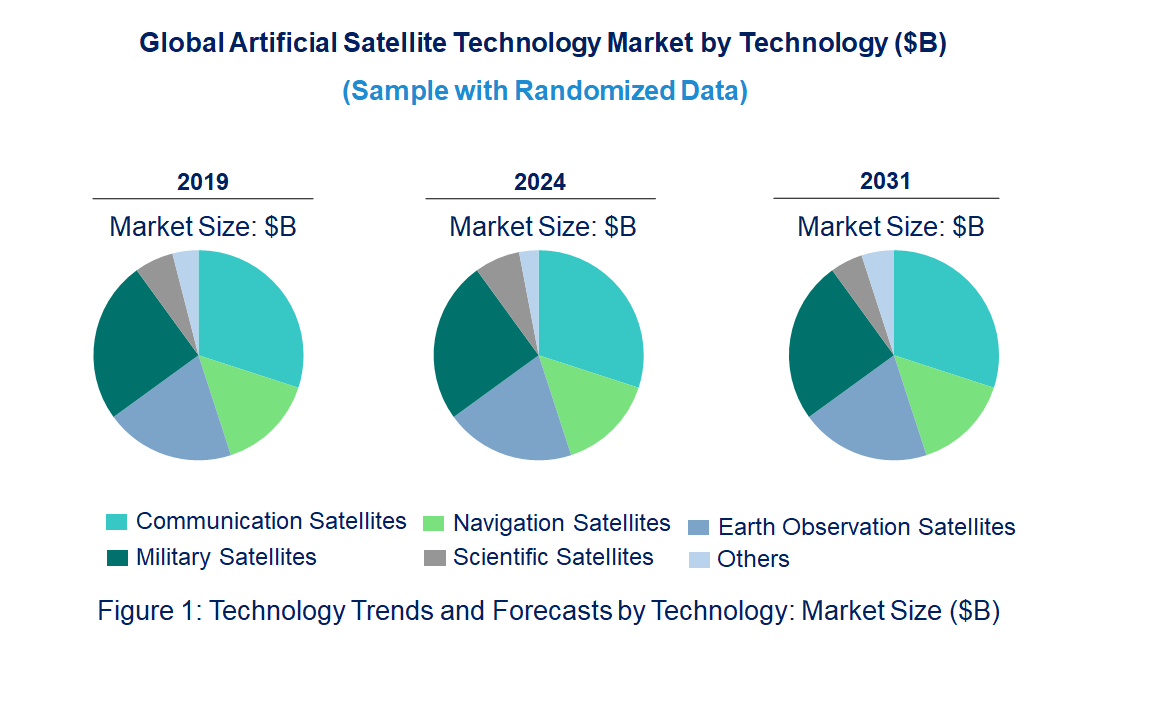
![Artificial Satellite Market Trend and Forecast by Application [Value from 2019 to 2031]:](https://lucintel.com/images/Artificial-Satellite-Technology-Market-Segment.png "Artificial Satellite Market Trend and Forecast by Application [Value from 2019 to 2031]:")
• Miniaturization of Satellites: The industry trend is toward smaller, cheaper satellites. These miniaturized satellites, often referred to as CubeSats or SmallSats, are more and more used for Earth observation, communication, and scientific missions, cutting down launch costs and allowing the deployment of satellites much more frequently.
• Mega Constellations: SpaceX, Amazon, and OneWeb are launching large satellite constellations to provide broadband coverage globally. These constellations are aimed at meeting the demand for high-speed internet in remote areas and revolutionizing global communication through continuous, low-latency connectivity.
• Increased Use of Satellite-Based Internet of Things: IoT technologies that integrate with satellites are fast becoming a very key trend, especially when applied to agriculture, logistics, and environmental monitoring applications. It enables remote asset, infrastructure, and natural resource monitoring in real-time, improving operational efficiency and decision-making.
• Earth Observation Satellites: Earth observation satellites are being upgraded with even more advanced imaging technology and artificial intelligence-driven data analytics. These satellites are used in a variety of applications, from climate monitoring to disaster response, agriculture, and urban planning, providing valuable insights and actionable data.
• Emerging Space Tourism and Commercial Ventures: Interest in artificial satellites for communication, navigation, and Earth observation is fueled by the growth of space tourism and commercial space ventures. Companies like Blue Origin and Virgin Galactic are spearheading commercial space travel and thus opening new opportunities for satellite use in private sector applications. Trends such as miniaturization, satellite mega constellations, satellite-based IoT, advances in Earth observation, and commercial space ventures are changing the Artificial Satellite market. All these trends are promoting innovation, cost reduction, and an increased range of applications for satellites, thereby transforming industries and providing new services globally.
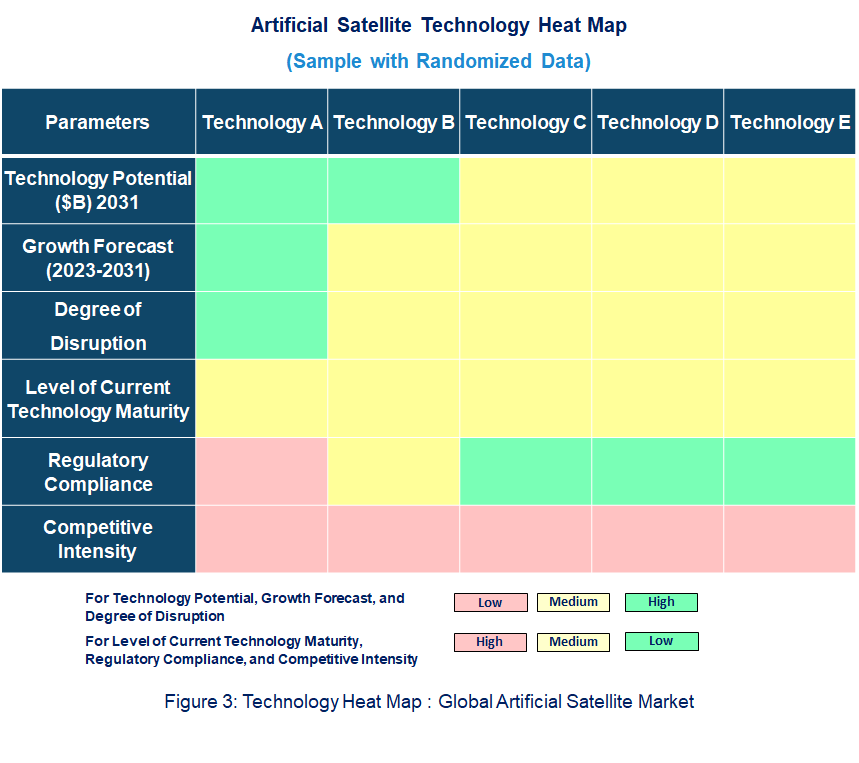
• Potential in Technology: The possibilities in communications, climate monitoring, and scientific research offered by an artificial satellite are truly massive. Small satellites, as well as mega-constellations such as Starlink of SpaceX, bring about the potential for high-speed internet accessibility even in remote areas not adequately covered. Simultaneously, they facilitate the opportunity for real-time observation and monitoring of Earth.
• Degree of Disruption: Artificial satellite technology causes tremendous disruption, particularly in telecommunications. Satellites provide an internet system that competes directly with the traditional broadband provider. Further, it improves disaster management and climate monitoring, and this has a new answer to the challenges the world faces today. With the LEO-based mass deployment of satellites, several industries may change in operation such as agriculture, logistics, and defense.
• Current Technology Maturity Level : The market for satellite technology is growing while innovation in the miniaturization of satellites and the management of orbit continues.
• Regulatory Compliance: Despite the development of this market, key challenges persist compliance with regulatory requirements regarding orbital debris, spectrum management, and international treaties on satellite use. Governments and international organizations are looking to promote the use of satellites sustainably and securely as they are increasingly utilized.
• Lockheed Martin Corporation: Lockheed Martin is one of the most progressive companies in the area of satellite technology. Among recent developments, the successful launch of its next-generation GPS III satellite, providing more precise signal accuracy and enhanced security features, is notable. In addition, the company continues to expand its small satellite technology capabilities, making them flexible and cost-effective solutions for commercial, defense, and scientific applications.
• Boeing Defense, Space & Security: Boeing leads in satellite manufacturing, advancing high-capacity communication satellites and Earth observation systems. Among the latest advancements in Boeing's satellite communications technology, the 702X satellite platform provides higher data throughput, increased resiliency, and lower operational costs. The company is also expanding into the emerging LEO satellite market, using its experience in the construction of robust space systems.
• Northrop Grumman Corporation: Northrop Grumman has made tremendous inroads in satellite propulsion and autonomy. Its newly developed MEVs are capable of expanding the life span of an aged satellite orbiting within a geostationary orbit, providing continuous operational satellite services both for military and commercial purposes. Northrop Grumman is also focusing efforts on building small satellite constellations and upgrading satellite service lines for national security as well as the commercial side.
• Airbus Defence and Space: Airbus was working on its satellite system, which was focused majorly on Earth observation, communication, and defense applications. The company's recent good fortune in launching the high-resolution "Pléiades Neo" Earth Observation satellites has transformed the ability of Earth observation with high spatial resolution. Airbus is also on the way to developing hybrid constellations of satellites, blending both GEO and LEO together to deliver better global coverages and faster data rates.
• Thales Alenia Space: Thales Alenia Space has pioneered the development of advanced satellites for communication and Earth observation purposes. The company recently developed the "Koreasat-5A" communication satellite for the Republic of Korea, which manifests its ability to provide high-quality services to military and commercial customers. Thales Alenia Space has also been making further progress in the expansion of satellite constellations, ensuring next-generation satellites offer more dependable and faster services.
• SpaceX: With the reusable Falcon 9, the company has turned out to be a significant leader in the satellite launch market by decreasing launch costs into satellite deployment by several magnitudes. Starlink- SpaceX is currently deploying thousands of small satellites in Low Earth Orbit that are revolutionizing broadband access globally. Innovations of satellite constellations, combined with low-cost launching capabilities, disrupted the satellite industry and hastened the development of services over satellites.
• Orbital Sciences Corporation part of Northrop Grumman Innovation Systems: Orbital Sciences, which has since been integrated into Northrop Grumman Innovation Systems, has served the satellite market with improvements in their launch services and satellite technologies. Their focus on small satellite systems has seen an advance on their Minotaur rocket family, through which low-cost access to orbit can now be made, further making the space more accessible for customers that have commercial and governmental operations.
• SSL (Space Systems Loral): SSL continues to be a key player in the development of communication and Earth observation satellites, with recent initiatives focused on enhancing satellite reliability and data capacity. The company’s work on developing the "Anik G1" communication satellite and its advancements in LEO satellite networks have enabled more efficient and faster communication, particularly for the commercial and government sectors.
• OHB SE: OHB SE has significantly been producing innovations in the satellite market, especially in developing small satellites and satellite constellations. The firm has concentrated on building cost-effective and highly capable Earth observation and telecommunication as well as scientific satellites. International space agencies have also cooperated with OHB in their satellite system provision for climate change monitoring as well as disaster management.
• Mitsubishi Electric Corporation: Mitsubishi Electric is evolving its satellite technology through activities in the "Akasaki" and "RICO" communication satellites. With these systems, data rates are improved and the efficiency of communications and broadcasting services is significantly enhanced. Mitsubishi Electric's focus is also on state-of-the-art propulsion devices for satellites to increase life expectancy and improve performance characteristics in space. These developments reflect the rapid progress in the artificial satellite market, where the key players are driving innovation in satellite design, communication, and propulsion technologies. With advancements in satellite constellations, miniaturization, and reusable launch systems, these companies are making space-based solutions more accessible and impactful for a wide range of commercial, military, and scientific applications.
• Growing demands for Global connectivity: Another growing demand driving the artificial satellite market is in far-flung areas around the world that require high speed connectivity; satellite constellations which are those SpaceX and OneWeb are currently deploying aim to achieve these goals by providing, broadband service, improving telecommunications and access to the net.
• Reduced Cost of Satellite Launches: With the advancements in reusable rocket technology and miniaturization of satellites, the cost of launching satellites is reducing. This has made satellite missions more economical, thus allowing for frequent launches and more organizations, such as startups and research institutions, to enter the satellite market.
• Government Spending and Space Exploration Programs: Growth in the market is due to increased government spending on space exploration and satellite-based infrastructure. National space agencies and governments are funding satellite programs for defense, weather monitoring, and disaster response, which is increasing demand for advanced artificial satellite technologies and related services. Challenges in the artificial satellite market are:
• Space debris and collision risks: The increasing threats from space debris are considered to be one of the primary challenges in the market of artificial satellites. Launching more satellites into orbit causes increased collision and accumulation of debris, which ultimately influences the performance of a satellite and its sustainability.
• Regulatory and Licensing Issues: The more the deployments are done, the greater the regulatory challenges become such as spectrum allocation and management of orbital slots. Here governments must ensure the responsible use of space without compromising the principle of fairness and prevention of overcrowding in space that could lead to interference and operational risks. The artificial satellite market has factors driving it, including demands for global connectivity, launch cost reductions, and governments pushing for space exploration. But the hurdles such as space debris and regulatory issues hinder the market from significant growth. All these combine and shape the market into developing sustainable development in space.
• Lockheed Martin Corporation
• Boeing Defense, Space & Security
• Northrop Grumman Corporation
• Airbus Defence And Space
• Thales Alenia Space
• Spacex
• Disruption Potential of Artificial Satellite Technologies Communication satellites, navigation satellites, Earth observation satellites, military satellites, scientific satellites, and other satellite technologies all have a high potential for disruption in their respective industries. Communication satellites are changing the way the global internet is accessed. Navigation satellites increase accuracy in mapping and geolocation. Earth observation satellites provide critical data for the environment and agriculture. Military satellites are essential in defense and surveillance operations. Scientific satellites help in furthering the exploration of space and collecting data, and other special satellites offer multiple applications in various industries.
• Competitive Intensity and Regulatory Compliance High competitive intensity in the artificial satellite market, given the large number of players coming from both the public and private sectors. The importance of regulatory compliance is also on the rise, especially in matters relating to spectrum allocation, orbital management, and compliance with international space treaties to ensure responsible deployment of satellites and data use.
• Technology Readiness and Key Applications Communication satellites are thoroughly mature and support global connectivity and broadband services. Navigation satellites are deployed in many geographies for GPS services that are constantly being improved in terms of accuracy. Earth observation satellites are being exploited more and more for climate surveillance and disaster management. Military satellites support war-fighting capabilities. Scientific satellites support space exploration and related research, while other satellite technologies support a wide range of specialized applications.
• Communication Satellites
• Navigation Satellites
• Earth Observation Satellites
• Military Satellites
• Scientific Satellites
• Others
• Commercial
• Military
• Scientific
• Others
• North America
• Europe
• Asia Pacific
• The Rest of the World
• Latest Developments and Innovations in the Artificial Satellite Technologies
• Companies / Ecosystems
• Strategic Opportunities by Technology Type


Choose a license that fits your team. Instant PDF delivery.
Prices exclude taxes. Instant delivery. Custom licensing available on request.
Market Report · May 18, 2026
Market Report · May 18, 2026
Market Report · May 18, 2026
Trusted partner for strategic intelligence and business growth


Receive a complimentary market analysis tailored to your industry. Our analysts will identify key growth opportunities and competitive dynamics specific to your business.

Market size, growth rate, and key trend analysis for your specific sector.

Top competitor positioning and market share analysis.

Strategic recommendations backed by data-driven insights.
Get curated market intelligence and competitive moves straight to your inbox.
By subscribing, you agree to receive our monthly insights. Unsubscribe anytime.
Receive a complimentary market analysis tailored to your industry. Our analysts will identify key growth opportunities and competitive dynamics specific to your business.
Market size, growth rate, and key trend analysis for your specific sector.
Top competitor positioning and market share analysis.
Strategic recommendations backed by data-driven insights.
Get curated market intelligence, emerging trends, and competitive moves straight to your inbox each month.
By subscribing, you agree to receive our monthly insights. Unsubscribe anytime.
We'll send your sample report shortly.