
Market Report · July 31, 2026

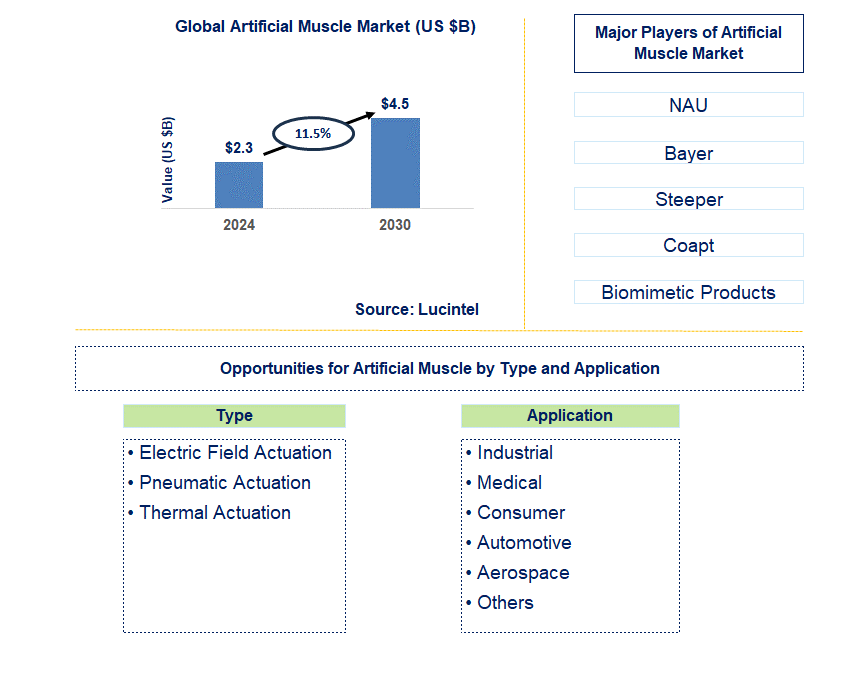
Key data points: The market size in 2030 = $4.5 billion, growth forecast = 11.5% annually for the next 6 years. Scroll below to get more insights. This market report covers trends, opportunities, and forecasts in the global artificial muscle market to 2030 by type (electric field actuation, pneumatic actuation, and thermal actuation), application (industrial, medical, consumer, automotive, aerospace, and others), and region (North America, Europe, Asia Pacific, and the Rest of the World)
We'll send your sample report shortly.
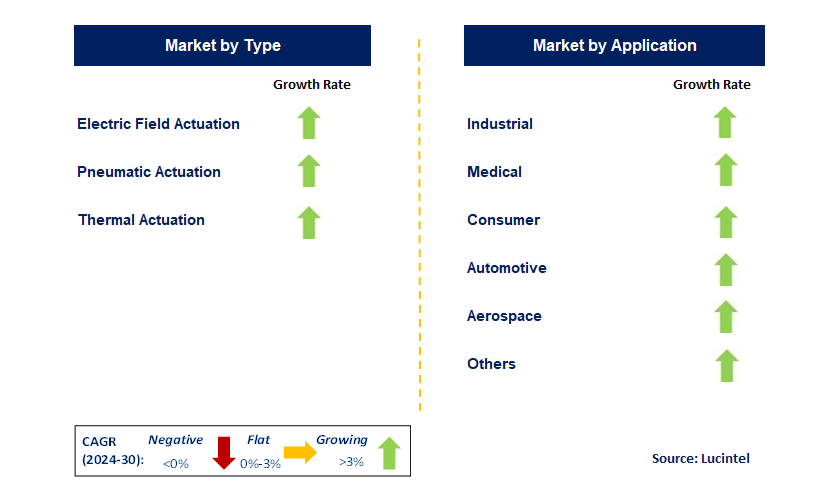
• Lucintel forecasts that, within the type category, electric field actuation will remain the largest segment over the forecast period due to its increasing adoption of electric vehicles for actuating various components like brake systems.
• Within this application category, automotive will remain the largest segment due to the growing adoption of autonomous driving technologies and connected car features and increasing demand for shared mobility services like Uber and Lyft.
• In terms of regions, North America will remain the largest region over the forecast period due to the growing adoption of automation and advanced robotics in various industries and the rising demand for innovative healthcare technologies in the region. A more than 150-page report is developed to help in your business decisions.
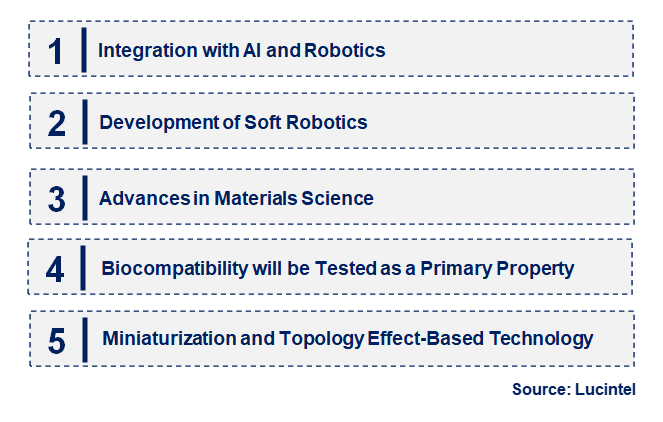
• Integration with AI and Robotics: The use of artificial muscles with AI and robotics enhances the manipulative capabilities of robotic systems, improving the accuracy of movements and adaptability. This trend enhances robotics related to automation, prosthetics, and wearable technologies, making them more functional and efficient.
• Development of Soft Robotics: Soft robots using artificial muscles are more effective since they support more natural movements compared to conventional rigid robots. This trend allows for better interaction with the environment, extending applications in healthcare, manufacturing, and service industries.
• Advances in Materials Science: Progress in materials science leads to better functionality and longer lifecycles of artificial muscle components. These materials provide more energy-efficient and effective performance, driving innovation in robotics, implantable devices, and electronics such as goggles.
• Biocompatibility as a Primary Property: Artificial muscles that do not trigger foreign-body reactions are crucial for medical devices and prosthetic limbs. This trend assures the development of artificial muscles safe for use within the human body, improving clinical outcomes and enabling broader adoption.
• Miniaturization and Topology Effect-Based Technology: Smaller versions of artificial muscles, such as soft actuators inflated with air, enable the design of lightweight and soft wearable devices. This trend supports growth in consumer electronics, healthcare wearables, assistive technologies, and the feasibility of artificial muscle technology for the general population. Emerging trends such as AI and robotics integration, the rise of soft robotics, advances in material science, and the growing focus on biocompatibility and miniaturization for wearable tech are influencing the artificial muscle market. These trends are driving novel technologies, diversifying applications, and enhancing the efficiency and availability of artificial muscles.
• Advanced Electroactive Polymers: Advanced electroactive polymers make artificial muscles more flexible, responsive, and durable. This development enhances the performance of robotics, prosthetics, and wearable technologies, providing new opportunities for innovation.
• Integration with AI for Enhanced Control: AI-powered control improves the accuracy and variability of artificial muscles, enhancing their application in robotics and prosthetics. This development facilitates advanced applications and improves the performance of artificial muscle technologies.
• Growth in Soft Robotics: The use of artificial muscles in soft robotics enables more realistic movements and versatility. This advancement supports growth in healthcare, manufacturing, and service industries by improving the flexibility and functionality of robotic systems.
• Low-Cost Synthetic Muscles: Low-cost synthetic muscles are particularly beneficial in developing countries where cost is a significant barrier. This development expands the use of artificial muscles in prosthetics and assistive devices, targeting a broader population.
• Soft Artificial Muscles: Biodegradable artificial muscles for use in the body reduce the risks associated with prosthetics and medical implants. This development improves patient care and contributes to the advancement of healthcare services. Improvements such as advanced electroactive polymers, AI integration, soft robotics growth, low-cost synthetic muscles, and body-safe artificial muscles are revolutionizing the artificial muscle market. These developments are accelerating technological progress, enhancing the performance of artificial muscles, and expanding the scope of electronic artificial muscle applications.
• Growth in Deployable Medical Devices: Artificial muscles provide enhanced functionality and flexibility in medical devices, expanding their application in prosthetics and rehabilitation. This opportunity supports growth in the healthcare sector and encourages further research in medical devices.
• Expansion into Wearable Devices: Artificial muscles in wearable devices offer increased comfort, flexibility, and functionality. This opportunity drives the growth of consumer electronics, fitness wearables, and assistive technologies, making artificial muscle technology more affordable and useful.
• Increase in Use of Soft Robotics: Soft robotics powered by artificial muscle actuators offer greater flexibility and natural motion. This opportunity sustains growth in areas such as manufacturing, service robotics, and exploration, improving the efficiency and flexibility of robotic systems.
• Innovations in AI Integration: Integrating AI-powered control units into artificial muscle systems enables fine-tuned performance for more advanced applications. This opportunity enhances robotic prosthetics and supports the growth of automation, robotics, and healthcare.
• Cost Reduction and Accessibility: Reducing the cost of artificial muscles creates opportunities for their use, particularly in underdeveloped countries. This opportunity helps make artificial muscles more accessible for prosthetic and assistive devices, addressing the needs of a larger population. Strategically identifying growth opportunities in medical devices, wearable markets, soft robotics, AI integration, and cost reduction is shaping the artificial muscle market. These opportunities can drive market growth, improve the impact of the technology, and expand applications in diverse sectors.
• Technological Advancements: Improvements in materials such as electroactive polymers and shape-memory alloys enhance the capabilities of artificial muscles. These advancements promote market growth by enabling more efficient applications in robotics, medicine, and wearables.
• Rising Demand for Robotics and Wearables: The increasing use of artificial muscles in robotics and wearables expands the market. Growth is driven by the demand for higher performance, flexibility, and functionality across sectors including healthcare, consumer electronics, and industry.
• Growth in Medical Applications: The demand for advanced prosthetics and rehabilitation devices fuels artificial muscle development. This growth is supported by improvements in biocompatibility and device performance, enhancing patient recovery and healthcare applications.
• Investment in Research and Development: Investment in R&D fosters creativity and technological progress, helping to develop new materials, designs, and applications. This driver stimulates market growth by unlocking the potential of artificial muscle technologies.
• Focus on Customization and Personalization: Artificial muscles with tailored properties are being developed to meet customer needs in robotics, prosthetics, and wearables. This trend boosts market growth by enhancing customer satisfaction through personalized solutions. Challenges in the artificial muscle market include:
• High Production Costs: The advanced materials and technologies used in artificial muscles result in high production costs, limiting affordability and market penetration. Addressing this challenge is crucial for the widespread adoption of artificial muscle technologies.
• Regulatory and Safety Concerns: Regulatory requirements and safety concerns can delay market entry and product approvals. Companies must navigate these challenges to introduce new artificial muscle technologies effectively.
• Lack of Information and Adoption: Limited knowledge and slow adoption rates hinder the potential growth of artificial muscle technologies. Increased education and awareness are needed to expand the adoption of artificial muscles across various sectors. Technological advancements, rising demand for robotics and wearables, growing medical applications, R&D investment, and customization are all driving the artificial muscle market. However, challenges such as high production costs, regulatory hurdles, and low adoption rates must be addressed for sustained market growth and successful technology deployment.
• NAU
• Bayer
• Steeper
• Coapt
• Biomimetic Products
• Korea Advanced Institute of Science and Technology
• Chas A Blatchford and Sons
• Blatchford
• Otto Bock
• WillowWood
• Electric Field Actuation
• Pneumatic Actuation
• Thermal Actuation
• Industrial
• Medical
• Consumer
• Automotive
• Aerospace
• Others
• North America
• Europe
• Asia Pacific
• The Rest of the World
• United States: Artificial muscle research in the United States involves embedding advanced materials like electroactive polymers and shape-memory alloys into robotic systems and medical devices. Companies and research organizations are developing soft robotics and prosthetic devices with natural movements and fine dexterity. There is also growing investment in AI-powered control systems to enhance the capabilities of artificial muscles.
• China: China has made significant progress in artificial muscle development, particularly in high-performance electroactive polymers and nanomaterials. Researchers and companies are focused on creating affordable and scalable solutions for robotics and wearables, supported by government backing and increased R&D investments.
• Germany: Germany is advancing artificial muscle technology, particularly in soft robotics and composite materials. Researchers are exploring new biohybrid muscle designs for medical applications such as prosthetics and exoskeletons. Miniaturized hybrid robots are also being developed to expand the industry.
• India: In India, artificial muscle development focuses on affordability and accessibility. Researchers are leveraging locally available resources and low-cost technologies to create synthetic muscles, particularly for prosthetics and rehabilitation devices, addressing the needs of a large disabled population.
• Japan: Japan is leading innovation in artificial muscles, focusing on smart materials and robotics. Japanese firms and research centers are developing artificial muscles that can withstand the stresses of use in sophisticated robots and portable devices, with an emphasis on AI and machine learning to enhance muscle performance.


• NAU
• Bayer
• Steeper
• Coapt
• Biomimetic Products
• Korea Advanced Institute of Science and Technology
• Chas A Blatchford and Sons
• Blatchford
• Otto Bock
• WillowWood Q6. Which artificial muscle market segment will be the largest in future? Answer: Lucintel forecasts that electric field actuation will remain the largest segment over the forecast period due to its increasing adoption of electric vehicles for actuating various components like brake systems. Q7. In artificial muscle market, which region is expected to be the largest in next 5 years? Answer: North America will remain the largest region over the forecast period due to growing adoption of automation and advanced robotics in various industries and rising demand for innovative healthcare technologies in the region. Q.8 Do we receive customization in this report? Answer: Yes, Lucintel provides 10% customization without any additional cost.


Choose a license that fits your team. Instant PDF delivery.
Prices exclude taxes. Instant delivery. Custom licensing available on request.
Market Report · July 31, 2026
Market Report · July 31, 2026
Market Report · July 31, 2026
Trusted partner for strategic intelligence and business growth


Receive a complimentary market analysis tailored to your industry. Our analysts will identify key growth opportunities and competitive dynamics specific to your business.

Market size, growth rate, and key trend analysis for your specific sector.

Top competitor positioning and market share analysis.

Strategic recommendations backed by data-driven insights.
Get curated market intelligence and competitive moves straight to your inbox.
By subscribing, you agree to receive our monthly insights. Unsubscribe anytime.
Receive a complimentary market analysis tailored to your industry. Our analysts will identify key growth opportunities and competitive dynamics specific to your business.
Market size, growth rate, and key trend analysis for your specific sector.
Top competitor positioning and market share analysis.
Strategic recommendations backed by data-driven insights.
Get curated market intelligence, emerging trends, and competitive moves straight to your inbox each month.
By subscribing, you agree to receive our monthly insights. Unsubscribe anytime.
We'll send your sample report shortly.