
Market Report · July 22, 2026

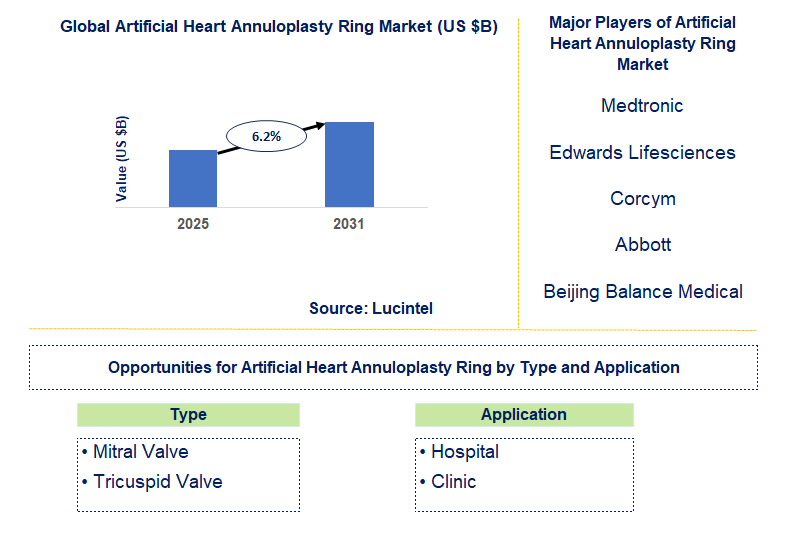
Key data points: The growth forecast = 6.2% annually for the next 7 years. Scroll below to get more insights. This market report covers trends, opportunities and forecasts in artificial heart annuloplasty ring market to 2031 by type (mitral valve and tricuspid valve), application (hospital and clinic), and region (North America, Europe, Asia Pacific, and the Rest of the World)
We'll send your sample report shortly.
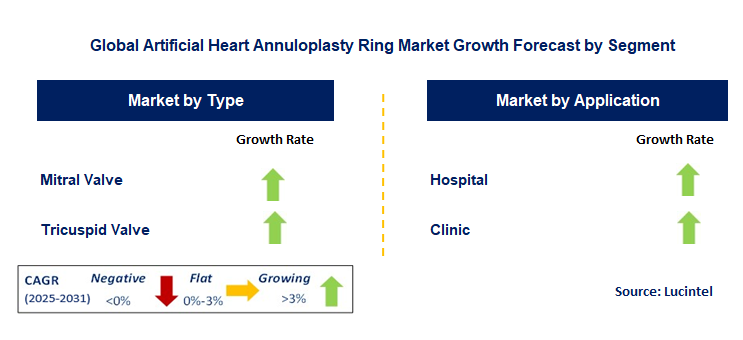
• Lucintel forecasts that, within the type category, mitral valve is expected to witness higher growth over the forecast period.
• Within the application category, hospital is expected to witness higher growth.
• In terms of region, APAC is expected to witness the highest growth over the forecast period. Gain valuable insights for your business decisions with our comprehensive 150+ page report. Sample figures with some insights are shown below.
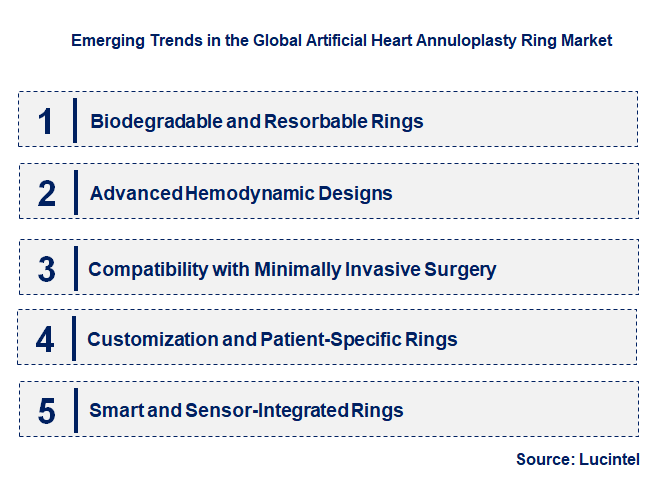
• Biodegradable and Resorbable Rings: This trend involves developing annuloplasty rings from materials that naturally degrade over time after they have helped reshape the valve annulus. The rings are designed to induce the growth of autologous tissue. The impact is a more natural repair with less long-term foreign body presence in the heart, potentially reducing the risk of complications and future re-operations.
• Advanced Hemodynamic Designs: There is a growing focus on designing annuloplasty rings that closely mimic the natural three-dimensional shape and dynamic motion of the heart valve. This includes saddle-shaped and flexible rings. The impact is a significant improvement in post-operative valve function and hemodynamics, leading to better clinical outcomes and a reduced risk of regurgitation.
• Compatibility with Minimally Invasive Surgery: This trend focuses on developing annuloplasty rings that are compatible with minimally invasive and transcatheter procedures. These designs are smaller and can be delivered through a catheter. The impact is a reduction in surgical trauma, shorter hospital stays, and faster patient recovery, which is highly appealing to both surgeons and patients.
• Customization and Patient-Specific Rings: This trend involves using 3D imaging and printing to create annuloplasty rings that are custom-designed for a patient's specific anatomy. This ensures a perfect fit and optimal repair. The impact is a highly personalized approach to surgery. This technology allows surgeons to address unique anatomical challenges and improve the precision of the repair.
• Smart and Sensor-Integrated Rings: This emerging trend involves integrating sensors into annuloplasty rings to monitor post-operative valve function in real-time. This can provide valuable data on blood flow and pressure. The impact is a proactive approach to patient care. This technology could enable early detection of potential issues, allowing for timely intervention before complications arise. These trends are collectively reshaping the market by transforming annuloplasty rings from standard medical devices into sophisticated, personalized, and biologically integrated tools. The focus has shifted to a holistic approach that prioritizes long-term patient well-being, functional outcomes, and compatibility with modern surgical techniques.
• Introduction of New Ring Shapes and Rigidity: Recent developments include the commercial launch of new ring shapes, such as saddle-shaped and semi-rigid rings, that provide better anatomical support than traditional flat rings. The impact is improved post-operative hemodynamics and a more stable, durable repair. This helps surgeons achieve better outcomes for complex valve pathologies and reduces the likelihood of re-operation.
• Advancements in Biocompatible Materials: The market has seen developments in the materials used for annuloplasty rings, with a focus on advanced polymers and composites. These materials are more biocompatible and flexible, reducing the risk of tissue inflammation and erosion. The impact is a safer and more durable implant. This is crucial for long-term patient health and reduces the risk of complications associated with foreign body rejection.
• Consolidation through Mergers and Acquisitions: The market is witnessing a trend of major medical device companies acquiring smaller, innovative startups. For example, the acquisition of smaller companies by market leaders like Medtronic and Edwards Lifesciences. The impact is a consolidation of technology and a faster path to market for innovative products, as established companies leverage their distribution networks and resources.
• Growth of Transcatheter Valve-in-Ring Procedures: Recent developments in transcatheter technology have led to a new procedure where a new heart valve is implanted directly inside a failed annuloplasty ring. The impact is a less invasive option for patients who require a re-operation. This provides a lifeline for high-risk patients who may not be suitable for another open-heart surgery, expanding the treatment landscape.
• Use of 3D Printing for Prototyping: The development of 3D printing technology is being used to create patient-specific prototypes of annuloplasty rings. This allows surgeons to test the fit and design before the actual surgery. The impact is a more personalized and precise surgical plan. This helps reduce surgical time, improves placement accuracy, and enhances the overall safety of the procedure. These developments are collectively impacting the market by fostering a more patient-centric and technology-driven approach to heart valve repair. They are not only improving the quality of life for patients but are also creating a more efficient and safer environment for surgeons.
• Mitral Valve Repair: This is the largest and most established application for annuloplasty rings, representing a major growth opportunity. The focus is on developing new ring designs and materials to improve outcomes for mitral regurgitation. The impact is a high-volume, high-value market where innovation in product design and procedural efficiency can lead to significant market share gains.
• Tricuspid Valve Repair: This application is a rapidly growing opportunity. As awareness of tricuspid regurgitation increases, so does the demand for effective repair solutions. Companies are developing specialized rings tailored to the unique anatomy of the tricuspid valve. The impact is the creation of a dedicated market segment with significant growth potential, as more surgeons adopt tricuspid repair procedures.
• Pediatric Cardiac Surgery: This is a niche but high-growth application for annuloplasty rings that can grow with the child. This is a significant challenge in pediatric cardiology. The impact is a specialized market segment that requires a strong focus on innovation, research, and long-term clinical data to address a critical unmet need in a vulnerable patient population.
• Transcatheter Procedures: The trend towards less invasive surgery presents a major growth opportunity. The market can grow by providing annuloplasty rings that can be delivered through a catheter, which is less traumatic for the patient. The impact is a shift from traditional open-heart surgery to catheter-based procedures, opening up a new market segment for transcatheter-compatible devices.
• Emerging Economies: The markets in China, India, and other emerging economies represent a major growth opportunity. The focus is on providing cost-effective and high-quality annuloplasty rings to meet the rising demand for cardiac surgery. The impact is a long-term growth strategy that requires a strong focus on local manufacturing, accessible pricing, and building a local distribution network. These opportunities are impacting the market by encouraging diversification and specialization. Companies are now able to create products and services that cater to the unique needs of different applications, leading to a more segmented and competitive market that is better equipped to serve the distinct needs of a wide range of patients and surgeons.
• Medtronic
• Edwards Lifesciences
• Corcym
• Abbott
• Beijing Balance Medical
• Mitral Valve
• Tricuspid Valve
• Hospital
• Clinic
• North America
• Europe
• Asia Pacific
• The Rest of the World
• United States: The U.S. market is a global leader, driven by a high volume of heart valve surgeries and advanced healthcare infrastructure. Recent developments include the commercialization of new saddle-shaped annuloplasty rings that better mimic the natural anatomy of the mitral valve. The market is also seeing a rise in strategic partnerships between device manufacturers and hospitals to accelerate product innovation and clinical adoption.
• China: The Chinese market is experiencing rapid growth, fueled by an expanding patient base and rising healthcare expenditure. Recent developments are focused on domestic manufacturing of annuloplasty rings to reduce import costs and meet local demand. There is a growing emphasis on developing cost-effective solutions that are accessible to a wider population, while also improving product quality to meet international standards.
• Germany: Germany's market is characterized by a strong emphasis on high-quality, precision-engineered medical devices. Key developments include the use of advanced materials and designs that offer superior biocompatibility and long-term durability. The market is also seeing an increase in R&D for next-generation flexible and adjustable rings that can accommodate the dynamic motion of the heart.
• India: The Indian market is witnessing significant growth, driven by a large patient pool and improving cardiac care infrastructure. A key development is the rising demand for affordable annuloplasty rings, with a focus on local manufacturing to reduce costs. The market is also seeing a shift towards more advanced, semi-rigid rings that provide better support for a range of valve diseases.
• Japan: The Japanese market is distinguished by its high adoption of sophisticated medical technologies and a rapidly aging population. Recent developments include the use of miniaturization and advanced materials to create highly biocompatible and durable rings. The market is also seeing a strong demand for products that are compatible with transcatheter procedures, reflecting a preference for less invasive surgery.


• Medtronic
• Edwards Lifesciences
• Corcym
• Abbott
• Beijing Balance Medical Q5. Which artificial heart annuloplasty ring market segment will be the largest in future? Answer: Lucintel forecasts that, within the type category, mitral valve is expected to witness higher growth over the forecast period. Q6. In artificial heart annuloplasty ring market, which region is expected to be the largest in next 5 years? Answer: In terms of region, APAC is expected to witness the highest growth over the forecast period. Q7. Do we receive customization in this report? Answer: Yes, Lucintel provides 10% customization without any additional cost.


Choose a license that fits your team. Instant PDF delivery.
Prices exclude taxes. Instant delivery. Custom licensing available on request.
Market Report · July 22, 2026
Market Report · July 22, 2026
Market Report · July 22, 2026
Trusted partner for strategic intelligence and business growth


Receive a complimentary market analysis tailored to your industry. Our analysts will identify key growth opportunities and competitive dynamics specific to your business.

Market size, growth rate, and key trend analysis for your specific sector.

Top competitor positioning and market share analysis.

Strategic recommendations backed by data-driven insights.
Get curated market intelligence and competitive moves straight to your inbox.
By subscribing, you agree to receive our monthly insights. Unsubscribe anytime.
Receive a complimentary market analysis tailored to your industry. Our analysts will identify key growth opportunities and competitive dynamics specific to your business.
Market size, growth rate, and key trend analysis for your specific sector.
Top competitor positioning and market share analysis.
Strategic recommendations backed by data-driven insights.
Get curated market intelligence, emerging trends, and competitive moves straight to your inbox each month.
By subscribing, you agree to receive our monthly insights. Unsubscribe anytime.
We'll send your sample report shortly.