Semiconductor Grade Neon Gas Market Report: Trends, Forecast and Competitive Analysis to 2035

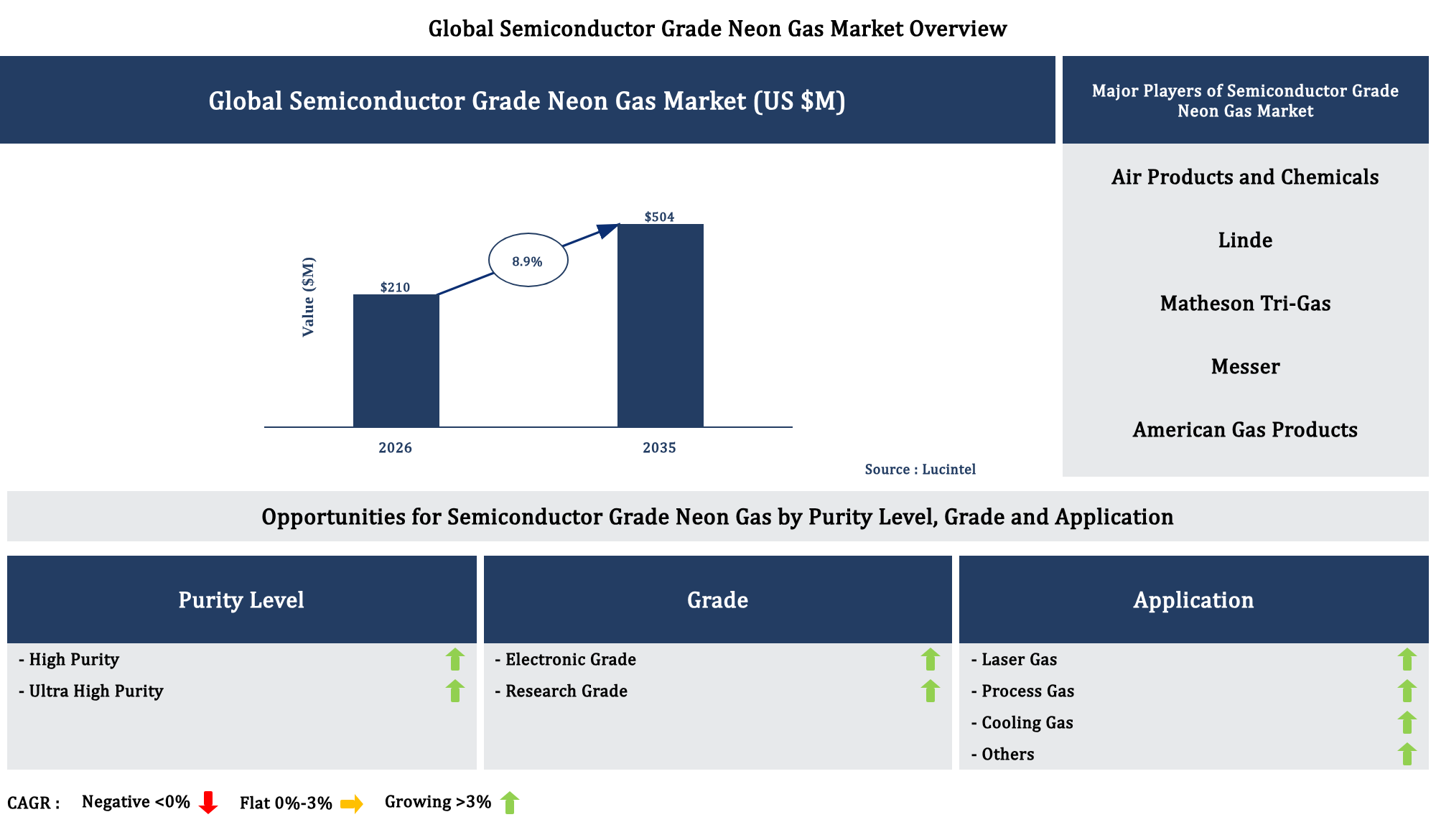
Key data points: The market size in 2035 = $504 million, growth forecast = 8.9% annually for the next 8 years. Scroll below to get more insights. This market report covers trends, opportunities and forecasts in semiconductor grade neon gas market to 2035 by purity level (high purity and ultra high purity), grade (electronic grade and research grade), application (laser gas, process gas, cooling gas, and others), and region (North America, Europe, Asia Pacific, and the Rest of the World)

Publisher: Lucintel Last Updated: July 2026
See Pricing

Download Sample Report

| ✨ New Download Sample report — Get instant insights! | ✨ New Download Sample report — Get instant insights!

Semiconductor Grade Neon Gas Market Report: Trends, Forecast and Competitive Analysis to 2035

Semiconductor Grade Neon Gas Market

Lucintel finds that, the future of the global semiconductor grade neon gas market looks promising with opportunities in the laser gas, process gas, and cooling gas markets. The global semiconductor grade neon gas market is expected to reach an estimated $504 million by 2035 with a CAGR of 8.9% from 2026 to 2035. The major drivers for this market are the rising demand for high-performance electronic devices, the increasing adoption of advanced duv lithography technologies, and the growing demand for consumer electronics.

Key Takeaways

  • Lucintel forecasts that, within the purity level category, ultra high purity is expected to witness higher growth over the forecast period due to stringent semiconductor fabrication purity requirements.
  • Within the application category, laser gas is expected to witness the highest growth due to increasing demand for advanced laser-based lithography processes.
  • In terms of regions, APAC is expected to witness the highest growth over the forecast period due to strong semiconductor manufacturing and fab expansion.

Gain valuable insights for your business decisions with our comprehensive 150+ page report.
Semiconductor Grade Neon Gas Market

Emerging Trends in the Semiconductor Grade Neon Gas Market

What key trends are shaping this market, and what's driving them?

As per Lucintel analysis, the semiconductor grade neon gas market is witnessing dynamic growth owing to the growing demand for electronic devices, technological advancements, and the demand for higher precision in manufacturing processes. The electronics industry is growing, and the need for high purity gases, such as neon, is growing with it, leading to innovations in production, supply chain management and sustainability practices. These changes are changing the dynamics of the market, impacting prices, regional trends, and regulations. The semiconductor industry itself is vital for the global economy and technological advancement, and stakeholders will need to adjust to these new trends to remain competitive and satisfy the industry's ever-increasing demands.

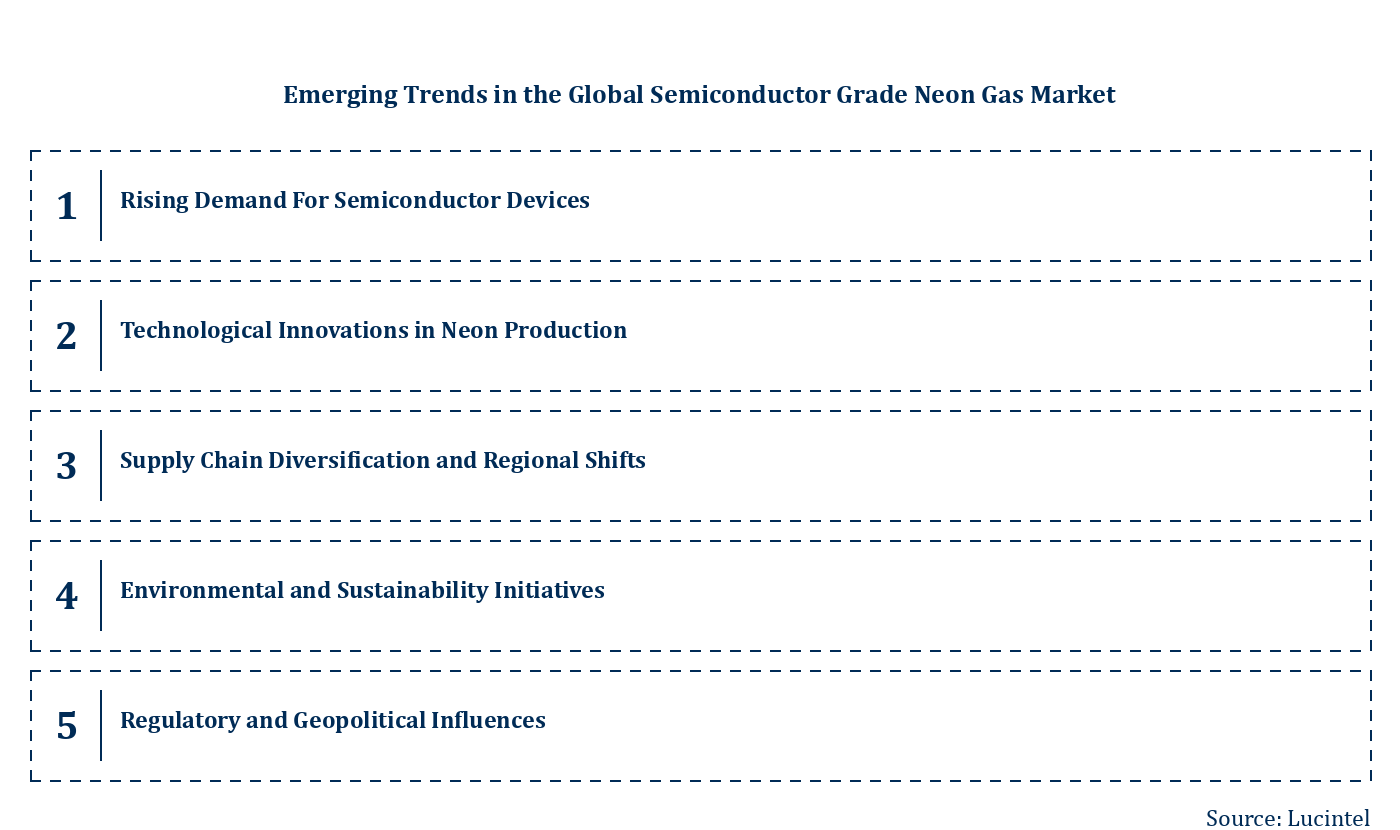
  • Rising Demand for Semiconductor Devices: The increasing demand for semiconductor devices is driven by the increasing number of smartphones, computers and the IoT devices. These litography processes that use lasers to create the chips require neon gas, which is increasing in consumption. While the technology has developed and enabled more precise and smaller semiconductors, the demand for them has been increasing and so has the demand for the neon. The trend highlights the significance of a steady supply chain and superior quality of neon gas for producing semiconductors that meets the requirements for the market growth and innovation in semiconductor manufacturing.
  • Technological Innovations in Neon Production: New technologies in neon production like cryogenic distillation and high-purity purification methods are enhancing the efficiency and purity of neon production. The innovations will lower the cost of the neon gas that is essential to semiconductor production and improve the quality of the gas. Better production technologies also help suppliers better respond to the increasing demand, providing supply stability. Consequently, the market experiences increased competition, improved product quality and ability to meet the changing requirements of high precision semiconductor manufacturing processes.
  • Supply Chain Diversification and Regional Shifts: Reliance on a few areas in the world for neon production has led to vulnerabilities, particularly with geopolitical tensions and supply disruptions. To reduce risk, companies are now diversifying and setting up regional production sites. Investments in the local production of neon are being made in countries such as the U.S., China and Russia. This regional transition contributes to greater supply security, shorter lead times, and market dynamics, thus making the market more resilient and responsive to fluctuations in global demand.
  • Environmental and Sustainability Initiatives: The industry has been shifting towards implementing more environmentally friendly practices, including the recycling of neon gases and the use of less energy in the production process. The goals of these programs are to reduce environmental footprint and meet more stringent standards. This helps to enhance corporate responsibility and resonates with eco-friendly customers and clients. With sustainability making a significant part of the criteria, businesses that invest in sustainable technologies and processes are getting a competitive edge, positioning the market to become more responsible and eco-efficient.
  • Regulatory and Geopolitical Influences: Governments are introducing policies on the production, export and consumption of neon gases which affect global trade flows. The imposition of trade restrictions, sanctions and export controls can have an impact on supply chains and market prices. Also, tensions in geopolitics may result in shortage or price hike, forcing companies to look for other sources or to produce their own products. The regulatory decisions and geopolitical considerations are pivotal in determining market stability, their impact on investment choices, and the strategic adjustments of industry stakeholders to maintain supply continuity and adherence with regulations.

Lucintel conclude that, overall, these trends are shaping the future of the semiconductor grade neon gas market in various ways, including improving supply chain resilience, advancing technologies, and highlighting sustainable practices. They are helping to create a more dynamic and competitive industry that is also more environmentally friendly, ensuring the continued growth and innovation of the semiconductor industry globally.
Semiconductor Grade Neon Gas Market by country

Recent Developments in the Semiconductor Grade Neon Gas Market

What are the latest developments or innovations taking place in this market?

According to Lucintel, the semiconductor industry is undergoing fast technological developments and a growing need for faster, better performing devices. Semiconductor grade neon gas is becoming increasingly important in the manufacture process because of its indispensable need in the laser-based lithography and etching technique. Innovations, supply chain enhancements and growing applications are creating the market landscape. The transformations are opening new opportunities for manufacturers and stakeholders, impacting global supply dynamics and market growth paths.

  • Growing Demand for Advanced Semiconductor Manufacturing: The need for high pure neon gas for laser lithography is rising as there is an increasing demand for the production of electronic devices, AI devices, and 5G equipment. This need is driving manufacturers to expand production capacity and build greater supply chain resilience to guarantee the continuity of supply for chip manufacturing. This market is growing quickly, with neon gas being a vital part of semiconductor manufacturing, fueling technological advances and economic growth.
  • Technological Innovations To Improve Neon Gas Applications: New developments in laser lithography and etching methods are improving the efficiency and purity of neon gases. The improvements allow for smaller features and higher device yields, which decreases cost and enhances device performance. However, manufacturers are turning to new neon gas formulations and delivery systems that are changing the manufacturing process. The evolution is propelling the market growth as it helps in producing more sophisticated and smaller semiconductor devices.
  • Supply Chain Diversification and Strategic Stockpiling: Geopolitical instabilities and supply risks have led to companies diversifying neon gas supply and creating strategic stocks. Countries are investing in local production facilities and alternative suppliers to reduce risks. This strategic approach will increase security in the supply, decrease price volatility, and limit reliance on scarce resources. Thus, the market is improving its resilience and is gaining investment interest and long-term growth prospects for the players in the market.
  • Increasing Environmental and Safety Regulations: The rise in Environmental and Safety Regulations: Compliance with stricter environmental regulations and safety measures is impacting the production and handling of neon gas. Companies are taking measures to become more environmentally friendly in their production processes and to enhance level of safety to meet regulations. The changes are fueling innovation in gas purification and containment technologies that can make a product more expensive, but introduce new markets. Overall, these regulations are creating a more sustainable and compliant marketplace, with positive technological implications.
  • New Applications of Neon Gas: Neon gas is finding more applications in emerging technologies like quantum computing, medical imaging, and laser manufacturing. This diversification helps expand the market for the products and decreasing dependence on the traditional semiconductor applications. The demand is expected to increase with the recent introduction of neon gas in different industries and investments have been made in production capacity and research. This growth is creating a more dynamic and resilient market landscape, and providing opportunities for innovation and growth in other sectors.

Lucintel conclude that, the recent developments in the semiconductor grade neon gas market are significantly impacting the industry by enhancing supply stability, fostering technological innovation, and expanding application areas. These factors collectively drive market growth, attract investments, and promote sustainable practices. As the market evolves, stakeholders are better positioned to meet rising global demand, ensuring continued technological progress and economic benefits

Strategic Growth Opportunities in the Semiconductor Grade Neon Gas Market

Which growth strategies are key players adopting to strengthen their market position?

The demand for semiconductors is growing at a high rate and is expected to accelerate the growth of the semiconductor grade neon gas market. The market for semiconductor grade neon gas is expanding at fast pace due to the rising demands for advanced electronics and manufacturing processes. Today's advancement in electronics has heightened the demand for high-purity gases, such as neon, for laser applications, chip manufacture and display production. New sources of supply, higher purity requirements and increased regional penetration are being targeted by market players to take advantage of the new opportunities. It's expected the growth will continue to gain momentum as strategic investments and technological innovations drive the industry forward, positioning neon as an indispensable part of semiconductor production.

  • Growing Demand for Neon in Laser and Lithography Applications: The rising trend in neon usage for laser applications, such as semiconductor lithography and micromachining, is a major growth opportunity. The higher the chip complexity, the greater the need for high-precision laser sources, thus increasing the amount of neon consumption. Neon is being produced at a high level of purity for use in advanced manufacturing processes because manufacturers are investing in it to maintain a high level of quality. It is likely to persist because the semiconductor industry is driving for smaller and more efficient chips.
  • Expansion of Semiconductor Manufacturing Facilities Worldwide: The rapid growth of semiconductor manufacturing plants around the world, particularly in Asia and North America, is putting high-purity neon gas in demand. The neon gas used for plasma etching and other critical processes is in large demand in new fabs. To decrease reliance on traditional sources, companies are developing regional supply chains and sourcing strategies to secure a reliable supply. This regional expansion should continue to drive market expansion over the long term and lessen supply chain risks.
  • Technological Advancements for Improving Neon Purity and Efficiency: Progress in gas purification and handling technologies are improving the purity of neon, particularly for sensitive semiconductor applications. The new extraction and recycling processes for neon are more efficient, which cuts environmental costs and reduces costs. The developments make it possible for the manufacturers to deliver the quality specifications required by the chipmakers, and thus help grow the market. The demand of ultra-high-purity neon can be further stimulated as the technology advances and the competitiveness of the price is improved.
  • Rising Investments in Sustainable and Alternative Gas Sourcing: Environmental concerns and supply chain risks are prompting investments in sustainable neon sourcing methods, including recycling and alternative extraction techniques. There are businesses looking to cut losses and energy use in the manufacturing of neon. These programs are intended to support a sustainable and environmentally responsible supply chain that is consistent with the global sustainability initiatives. These investments are anticipated to reduce expenses and enhance the security of the supply; this would have a positive influence on market stability and prospects.
  • Emerging Applications Such as Quantum Computing: Neon's distinctive properties are being increasingly used in emerging applications like quantum computing and advanced photonics. Precise laser sources and high purity gases are key to these applications, making neon an important part. The need for specialized grades of neon will continue to increase as research continues and new technologies become available. This diversification is into the high tech sectors, providing new revenue streams and long term growth prospects for market players.

Lucintel conclude that, the global market continues to be strong, with new applications, regional growth and technological advancements. Together, these prospects drive forward the significance of neon in semiconductor production, ensuring continued advancement and growth within the industry.

Semiconductor Grade Neon Gas Market Drivers and Challenges

What core factors influence market dynamics?

Several technological, economic and regulatory factors will impact the semiconductor grade neon gas market. The demand for highly pure neon gas, which is used in laser lithography, is propelled by the rapid progress in the semiconductor manufacturing technology. Capital investment in semiconductor plants is affected by the economic fluctuations, which will affect the consumption of neon. Regulations related to environmental safety and gas purity impact production and supply chains. Furthermore, geopolitical factors and the resilience of the supply chain are pivotal in influencing the market dynamics. All of these factors contribute to a complex scenario where innovation, compliance and geopolitical stability are fundamental to future growth and market stability.

The factors responsible for driving the semiconductor grade neon gas market include:-

  • Technological Development: As the semiconductor manufacturing processes develop and evolve, particularly the introduction of extreme ultraviolet (EUV) lithography, there is a growing demand for high-purity neon gas. The market for precise, reliable, and high-quality neon is expanding because as chip complexity increases, so does the demand for high-quality neon. For the next generation of semiconductors, neon's function is further enhanced by innovations in laser technology and manufacturing techniques. This technological development keeps demand more or less level, which leads to investments in production capacity and into the development of the supply chain and subsequent market growth.
  • Expansion of The Semiconductor Industry: The global growth of consumer electronics, automotive electronics, and data centers have greatly increased the size of the semiconductor industry. The industry is scaling up to meet with the growing demand in the industry and the requirement of high purity gases like neon increases. Regional demand is being fueled primarily by a number of countries heavily investing in semiconductor fabrication facilities (fabs), particularly in the Asia-Pacific region. This expansion is directly linked to the growth in the consumption of neon, further demonstrating the market's expansion potential. The growing industry also drives technology improvements in neon extraction and purification, which guarantee supply of quality.
  • Consolidation in the market of key suppliers in the field of neon gas is increasing, ensuring supply stability and quality control. Key manufacturers are pursuing growth by building capacity and entering into strategic partnerships to establish long-term supply deals. Key manufacturers are prioritising capacity expansion and strategic partnerships to secure long-term supply deals. By consolidating the market, it helps eliminate market fragmentation, better price stability and uniformity of quality for semiconductor manufacturers. This concentration is crucial for ensuring the continued availability of neon in the supply chain, especially given the geopolitical uncertainties and disruptions caused by the pandemic, thereby boosting trust in neon availability among end-users and driving additional investments in the industry.
  • Regulatory and Environmental Standards: The regulatory and environmental standards such as environmental safety, gas purity, and manufacturing emissions have an impact on the neon gas market. In order to minimize environmental damage, governments are setting higher environmental standards, forcing producers to find more efficient and cleaner ways of extracting and purifying resources. While compliance adds to operational costs, it is essential for product quality and safety, which is vital to semiconductor manufacturing. The regulations also encourage innovation in sustainable production methods, which may make production more difficult, but will contribute to market sustainability and consumer and regulatory confidence.
  • Price Volatility and Raw Material Availability: The price of neon gas can fluctuate depending on the availability of raw materials, extraction costs, and geopolitical issues. The market is vulnerable to supply disruptions due to the availability of limited sources of neon, with air separation units being the main source. Volatility may affect semiconductor manufacturers' purchasing strategies and their profit margins. Also, major neon producing countries can have a conflict of interest which can limit supply, driving up price and supply shortages. A strategy of stockpiling and diversified sourcing will help the management of these risks, which may affect market stability and growth courses.

what challenges or risks do businesses in this market face?

The Challenges in the semiconductor grade neon gas market are:

  • Supply Chain Disruptions: The production of neon gas is highly concentrated, with a few countries and companies having a large share of production. Supply disruptions as a result of geopolitical or natural disaster or pandemic can have a significant effect on supply availability. These disruptions cause prices to spike and shortages, impacting the manufacturing of semiconductors and their price schedules. The dependency on few sources makes the market vulnerable and needs diversification and strategic reserves. These challenges need to be overcome through resilient supply chains and investing in alternative production methods to guarantee regular supply.
  • Environmental and Regulatory Compliance Costs: Rising environmental regulations come with rising environmental compliance costs to neon producers. These methods require a large amount of capital to implement more clean extraction and purification methods, which can increase production costs. These expenses can be incurred by consumers, affecting competitiveness. Also, new projects could be delayed or production capacity might be reduced due to stricter standards, which would cap supply growth. Producers need to continuously innovate and adapt to meet the increasingly complex regulatory environments, which can be a costly process, but is vital for sustainability and market access.
  • Market Price Volatility: The price of neon is quite volatile, influenced by fluctuations in the demand and supply of the product, cost of raw materials, and geopolitical factors. The volatility in prices makes it difficult for semiconductor manufacturers to plan procurement and budget. Higher prices can result in higher costs for the chip producers, which may affect the pricing and profitability of the products. Price falls, however, could deter investment in the production capacity of neon. This volatility can be managed through strategic inventory management and long-term contracts, but the unpredictability of the market can still pose challenges for overcoming it and achieving stable growth.

Lucintel conclude that, technological advancements, industry expansion, supply chain dynamics, regulatory requirements, and price fluctuations all contribute to the dynamics of the semiconductor grade neon gas market. Technological advances and industry growth fuel demand but supply chain weaknesses and regulatory burdens are major hurdles. Additionally, there are price fluctuations, which need a strategic management of stakeholders. In conclusion, these factors and trends work together to shape market stability, growth potential, and business strategies within the industry. To thrive in this dynamic landscape, a holistic strategy that incorporates innovation, diversification, and adherence to regulations is necessary.

List of Semiconductor Grade Neon Gas Market Companies

Companies in the market compete on the basis of product quality offered. Major players in this market focus on expanding their manufacturing facilities, R&D investments, infrastructural development, and leverage integration opportunities across the value chain. Through these strategies semiconductor grade neon gas market companies cater increasing demand, ensure competitive effectiveness, develop innovative products & technologies, reduce production costs, and expand their customer base. Some of the semiconductor grade neon gas market companies profiled in this report include-

  • Air Products and Chemicals
  • Linde
  • Matheson Tri-Gas
  • Messer
  • American Gas Products
  • Taiyo Nippon Sanso
  • Iceblick
  • Air Liquide
  • Air Water
  • Proton Gases

Semiconductor Grade Neon Gas Market by Segment

The study includes a forecast for the global semiconductor grade neon gas market by purity level, grade, application, and region.

  • Semiconductor Grade Neon Gas Market by Purity Level [Value from 2019 to 2035]:
    • High Purity
    • Ultra High Purity
  • Semiconductor Grade Neon Gas Market by Grade [Value from 2019 to 2035]:
    • Electronic Grade
    • Research Grade
  • Semiconductor Grade Neon Gas Market by Application [Value from 2019 to 2035]:
    • Laser Gas
    • Process Gas
    • Cooling Gas
    • Others
  • Semiconductor Grade Neon Gas Market by Region [Value ($M) from 2019 to 2035]:
    • North America
    • Europe
    • Asia Pacific
    • The Rest of the World

Country Wise Outlook for the Semiconductor Grade Neon Gas Market

What Are the Key Regional Trends in the semiconductor grade neon gas market?

The market for semiconductor grade neon gas has undergone major transformations due to developments in technology, geopolitics and supply chain. The world is demanding semiconductors and the various nations are putting money into their manufacturing capacity and are diversifying their supply in order to be sure of stability. Changes in manufacturing methods, and greater regulation, also have an impact on market trends. The strategic moves and progress in this key industry are summarized below for key U.S. players, China, Germany, India, and Japan.

  • United States: Domestic production of neon gas has been boosted in the U.S. as a result of supply chain disruption and geopolitical tension, to lessen dependence on imports. There are also efforts by major semiconductor companies to work with local suppliers to ensure a reliable supply of neon and governmental programs that promote the industry with financial and policy assistance. Advancements in the technology and purification/recycling of neon are also being given more attention for improved sustainability and cost saving.
  • China: Neon gas production is surging in China to supply the growing demand for this gas from its growing semiconductor industry. The government has undertaken strategic initiatives for the development of domestic sources and lessening reliance on foreign imports. The Chinese companies are investing in the most modern extraction and purification technologies and several new plants are being built to secure supply. This is part of China's strategy to become self-sufficient in its supply of key semiconductor materials.
  • Germany: Germany continues to be a major supplier of semiconductors and continues to invest in the production and supply of high quality neon gas. Recent innovations consist of upgrading current facilities and investing in new purification technologies. European and global markets also depend on German firms which are investigating sustainable production to fulfill environmental standards and minimize carbon footprint, allowing them to be trusted as reliable suppliers.
  • India: India is planning a strategic push to build its domestic neon gas industry, to cater to the exploding semiconductor manufacturing industry. Government plans to set up local production units and enhancing extraction techniques. Joint venture agreements with foreign companies are in the process of being signed and technology and expertise are being transferred. The country aims to become a key player in the global semiconductor supply chain and minimize reliance on imports, with the aforementioned initiatives playing a key role in achieving that goal.
  • Japan: Technological innovation in neon gas production is continuing to be the focus in Japan, with an emphasis on high purity and efficiency. The nation is funding research to enhance extraction and recycling techniques to have a steady supply for its semiconductor industry. Not only that, Japanese companies are also investigating eco-friendly production methods and establishing strategic partnerships to enhance supply chain resiliency due to uncertainties around the world. The developments are designed to ensure Japan's competitiveness in the international semiconductor market.

Features of the Semiconductor Grade Neon Gas Market

  • Market Size Estimates: Semiconductor grade neon gas market size estimation in terms of value ($M).Trend and Forecast Analysis: Market trends (2019 to 2025) and forecast (2026 to 2035) by various segments and regions.Segmentation Analysis: Semiconductor grade neon gas market size by purity level, grade, application, and region in terms of value ($M).Regional Analysis: Semiconductor grade neon gas market breakdown by North America, Europe, Asia Pacific, and Rest of the World.Growth Opportunities: Analysis of growth opportunities in different purity level, grade, application, and regions for the semiconductor grade neon gas market.Strategic Analysis: This includes M&A, new product development, and competitive landscape of the semiconductor grade neon gas market.Analysis of competitive intensity of the industry based on Porter’s Five Forces model.

Top 5 Companies

  • Air Products and Chemicals
  • Linde
  • Matheson Tri-Gas
  • Messer
  • American Gas Products

Table of Contents

1. Executive Summary
14.1 Competitive Analysis Overview

List of Figures

List of Tables

Methodology

Lucintel has been in the business of market research and management consulting since 2000 and has published over 1000 market intelligence reports in various markets / applications and served over 1,000 clients worldwide. This study is a culmination of four months of full-time effort performed by Lucintel's analyst team. The analysts used the following sources for the creation and completion of this valuable report:

  • In-depth interviews of the major players in this market
  • Detailed secondary research from competitors' financial statements and published data
  • Extensive searches of published works, market, and database information pertaining to industry news, company press releases, and customer intentions
  • A compilation of the experiences, judgments, and insights of Lucintel's professionals, who have analyzed and tracked this market over the years.

Extensive research and interviews are conducted across the supply chain of this market to estimate market share, market size, trends, drivers, challenges, and forecasts. Below is a brief summary of the primary interviews that were conducted by job function for this report.

Lucintel's methodology for market research

Thus, Lucintel compiles vast amounts of data from numerous sources, validates the integrity of that data, and performs a comprehensive analysis. Lucintel then organizes the data, its findings, and insights into a concise report designed to support the strategic decision-making process. The figure below is a graphical representation of Lucintel's research process.

Primary interviews by job function

Buy Now

Choose a license that fits your team. Instant PDF delivery.

Market Report

1 User PDF

$4,850
Buy Now

Market Report

2-5 Users PDF

$6,700
Buy Now

Market Report

Corporate PDF

$8,850
Buy Now

Market Report

Global PDF

$10,000
Buy Now

Prices exclude taxes. Instant delivery. Custom licensing available on request.

Frequently Asked Questions

What is the semiconductor grade neon gas market size?
The global semiconductor grade neon gas market is expected to reach an estimated $504 billion by 2035.
What is the growth forecast for semiconductor grade neon gas market?
The global semiconductor grade neon gas market is expected to grow with a CAGR of 8.9% from 2026 to 2035.
What are the major drivers influencing the growth of the semiconductor grade neon gas market?
The major drivers for this market are the rising demand for high-performance electronic devices, the increasing adoption of advanced duv lithography technologies, and the growing demand for consumer electronics.
What are the major segments for semiconductor grade neon gas market?
The future of the semiconductor grade neon gas market looks promising with opportunities in the laser gas, process gas, and cooling gas markets.
Who are the key semiconductor grade neon gas market companies?

Some of the key semiconductor grade neon gas market companies are as follows:

  • Air Products and Chemicals
  • Linde
  • Matheson Tri-Gas
  • Messer
  • American Gas Products
  • Taiyo Nippon Sanso
  • Iceblick
  • Air Liquide
  • Air Water
  • Proton Gases
Which semiconductor grade neon gas market segment will be the largest in future?
Lucintel forecasts that, within the purity level category, ultra high purity is expected to witness higher growth over the forecast period.
In semiconductor grade neon gas market, which region is expected to be the largest in next 9 years?
In terms of region, APAC is expected to witness the highest growth over the forecast period.
Do we receive customization in this report?
Yes, lucintel provides 10% customization without any additional cost.

Key Questions

  • What are some of the most promising, high-growth opportunities for the semiconductor grade neon gas market to 2035 by purity level (high purity and ultra high purity), grade (electronic grade and research grade), application (laser gas, process gas, cooling gas, and others), and region (North America, Europe, Asia Pacific, and the Rest of the World)?
  • Which segments will grow at a faster pace and why?
  • Which region will grow at a faster pace and why?
  • What are the key factors affecting market dynamics? What are the key challenges and business risks in this market?
  • What are the business risks and competitive threats in this market?
  • What are the emerging trends in this market and the reasons behind them?
  • What are some of the changing demands of customers in the market?
  • What are the new developments in the market? Which companies are leading these developments?
  • Who are the major players in this market? What strategic initiatives are key players pursuing for business growth?
  • What are some of the competing products in this market and how big of a threat do they pose for loss of market share by material or product substitution?
  • What M&A activity has occurred in the last 9 years, and what has its impact been on the industry?
Why Choose Us

The Lucintel Advantage

Trusted partner for strategic intelligence and business growth

25+ Years Excellence

25+ Years Excellence

Quarter century of proven expertise in management consulting and market research across global markets.
Game-Changer Ideas

Game-Changer Ideas

Innovative strategies and actionable insights that help clients become the smartest in their industry.
Global Reach

Global Reach

Extensive coverage across 50+ industries and markets worldwide with localized expertise.
Start Your Growth Journey

Get Your Free
Market Intelligence
Briefing

Receive a complimentary market analysis tailored to your industry. Our analysts will identify key growth opportunities and competitive dynamics specific to your business.

Custom Market Snapshot

Market size, growth rate, and key trend analysis for your specific sector.

Competitive Landscape Overview

Top competitor positioning and market share analysis.

Growth Opportunity Identification

Strategic recommendations backed by data-driven insights.

Subscribe

Subscribe to our Newsletter

Get curated market intelligence and competitive moves straight to your inbox.

By subscribing, you agree to receive our monthly insights. Unsubscribe anytime.

Industry Trends Market Signals Opportunities Competitor Moves