
Report Feature
Sea Water and Brackish Water Desalination Trends and Forecast
The future of the global sea water and brackish water desalination market looks promising with opportunities in the thermal desalination and membrane desalination markets. The global sea water and brackish water desalination market is expected to reach an estimated $28.2 billion by 2030 with a CAGR of 7.8% from 2024 to 2030. The major drivers for this market are the rising scarcity of freshwater and the increasing development of desalination units.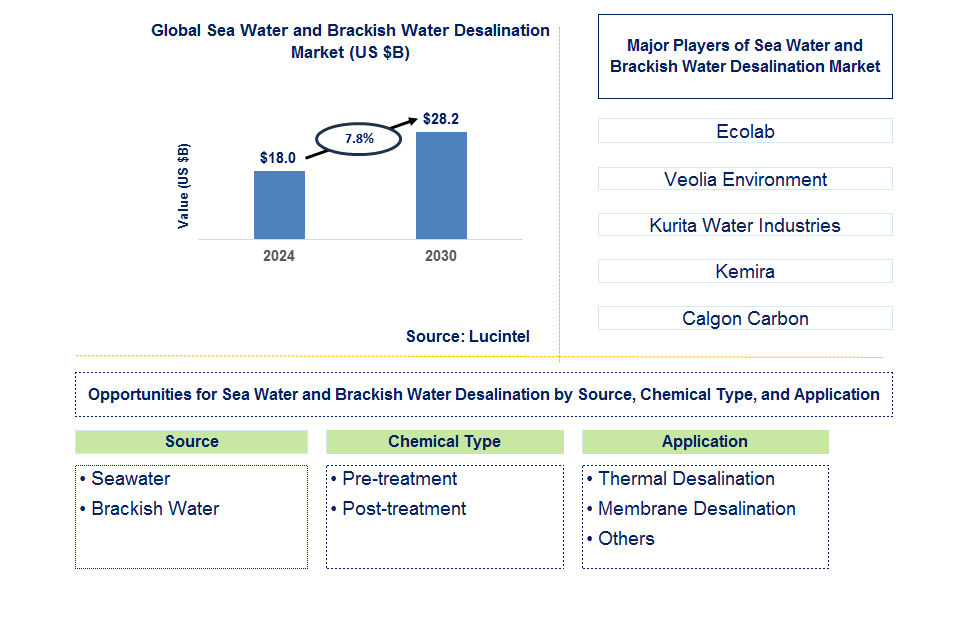
Country Wise Outlook for the Sea Water and Brackish Water Desalination Market
Major players in the market are expanding their operations and forming strategic partnerships to strengthen their positions. Below is an overview of recent developments by major sea water and brackish water desalination producers in key regions: the USA, China, India, Japan, and Germany.• United States: In the U.S., advancements in reverse osmosis technology are improving desalination efficiency and reducing energy consumption. The government is investing in pilot projects for innovative desalination methods, such as solar desalination, to address water scarcity issues in arid regions while minimizing environmental impact.
• China: China is focusing on large-scale desalination plants, with several projects underway along its coastline. The country is also investing in research for advanced membrane technologies to enhance desalination efficiency, aiming to meet the growing water demand driven by rapid urbanization and industrialization.
• Germany: Germany is emphasizing sustainable desalination solutions by integrating renewable energy sources like wind and solar into desalination processes. Research initiatives are exploring innovative membrane materials that can reduce energy costs and improve the overall efficiency of desalination plants.
• India: India is increasing investments in desalination technology to combat water scarcity in coastal regions. The government is promoting public-private partnerships to develop and deploy new desalination plants, focusing on energy-efficient technologies and cost-effective solutions to serve its growing population.
• Japan: Japan is advancing its desalination technology through research on energy-efficient systems and innovative membrane materials. The government is also encouraging collaboration between private companies and research institutions to develop sustainable solutions for water supply challenges, particularly in disaster-prone areas.
Emerging Trends in the Sea Water and Brackish Water Desalination Market
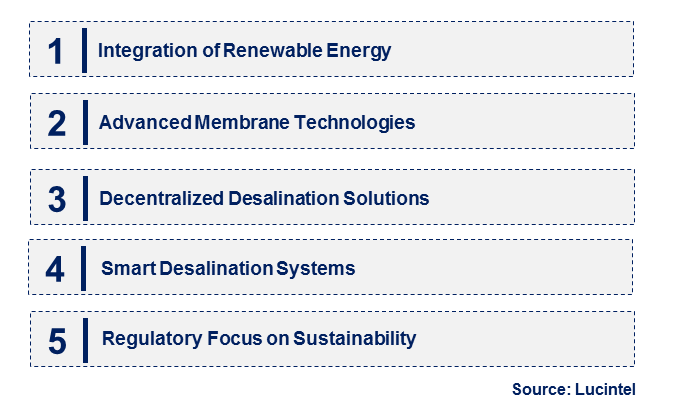
The sea water and brackish water desalination market is evolving with several emerging trends driven by technological advancements, sustainability initiatives, and economic factors. These trends are reshaping the industry and providing new opportunities for enhancing water supply and quality.• Integration of Renewable Energy: The use of renewable energy sources, such as solar and wind power, in desalination processes is increasing. This trend not only reduces operational costs but also minimizes environmental impact, aligning with global sustainability goals.
• Advanced Membrane Technologies: Innovations in membrane materials are improving desalination efficiency and reducing fouling. New polymer membranes with higher permeability and lower energy requirements are being developed, leading to more cost-effective and sustainable desalination solutions.
• Decentralized Desalination Solutions: There is a growing shift towards decentralized desalination systems that can be deployed in remote or underserved areas. These systems allow for localized water supply solutions, reducing infrastructure costs and improving access to clean water.
• Smart Desalination Systems: The integration of IoT and AI technologies is enhancing the monitoring and management of desalination plants. Smart systems enable real-time data analysis for improved operational efficiency and maintenance, reducing downtime and costs.
• Regulatory Focus on Sustainability: Governments are increasingly enforcing regulations that prioritize sustainable practices in desalination projects. This trend is prompting companies to adopt environmentally friendly technologies and materials, aligning with global efforts to combat water scarcity and climate change. These emerging trends are transforming the sea water and brackish water desalination market, promoting sustainability, efficiency, and accessibility. As these trends continue to evolve, they will significantly impact the industry's future landscape.
Recent Developments in the Sea Water and Brackish Water Desalination Market
The sea water and brackish water desalination market is witnessing significant developments driven by technological advancements, policy changes, and investment in infrastructure. These developments aim to enhance efficiency, reduce costs, and improve sustainability in water treatment processes.• Advancements in Energy Recovery Technologies: Innovations in energy recovery devices are allowing desalination plants to operate more efficiently by capturing and reusing energy. This development significantly reduces operational costs and energy consumption, making desalination more economically viable.
• Government Initiatives and Funding: Several governments are increasing funding for research and development in desalination technologies. These initiatives aim to accelerate the adoption of innovative solutions that address water scarcity and improve water quality.
• Partnerships for Technology Development: Collaborations between private companies and research institutions are driving advancements in desalination technology. These partnerships are fostering innovation in membrane materials and system designs, enhancing overall performance and sustainability.
• Focus on Waste Management Solutions: Companies are increasingly addressing the challenges of brine disposal, exploring sustainable waste management practices. Developing technologies to minimize environmental impact is becoming a priority in new desalination projects.
• Pilot Projects for Innovative Methods: Numerous pilot projects are being launched to test emerging desalination techniques, such as solar desalination and forward osmosis. These initiatives aim to identify scalable solutions that can be implemented in various geographical contexts. These recent developments are shaping the sea water and brackish water desalination market by enhancing efficiency, promoting sustainability, and addressing critical water supply challenges. As the industry evolves, these advancements will play a crucial role in meeting global water demand.
Strategic Growth Opportunities for Sea Water and Brackish Water Desalination Market
The sea water and brackish water desalination market presents various strategic growth opportunities across key applications. These opportunities arise from technological advancements, increasing water scarcity, and the need for sustainable solutions to meet global water demands.• Municipal Water Supply Solutions: There is a significant opportunity for desalination technology to address municipal water supply needs, particularly in arid regions. By providing a reliable source of potable water, desalination can help meet the growing demands of urban populations.
• Industrial Applications: Industries such as agriculture and manufacturing can benefit from desalination for process water and irrigation. Implementing desalination technologies can ensure a consistent water supply and enhance productivity, particularly in water-scarce areas.
• Offshore Desalination Plants: Developing offshore desalination facilities can provide water directly to coastal cities, reducing the strain on freshwater resources. This approach can enhance water security while minimizing land use and environmental impact.
• Integration with Renewable Energy Projects: Collaborating desalination projects with renewable energy initiatives can create sustainable water supply solutions. This integration can lower operational costs and reduce the carbon footprint of desalination processes.
• Emergency Water Supply Systems: Developing portable desalination units for emergency situations can provide immediate access to clean water during crises, such as natural disasters. This opportunity can enhance disaster resilience and support affected communities. These strategic growth opportunities are shaping the future of the sea water and brackish water desalination market. Companies that effectively capitalize on these opportunities will likely enhance their competitive advantage and contribute to global water sustainability.
Sea Water and Brackish Water Desalination Market Driver and Challenges
The sea water and brackish water desalination market is influenced by various drivers and challenges, including technological advancements, economic conditions, and regulatory factors. Understanding these elements is crucial for stakeholders navigating this dynamic industry. The factors responsible for driving the sea water and brackish water desalination market include:• Increasing Water Scarcity: Growing demand for freshwater due to population growth and climate change is driving investments in desalination technologies. This trend highlights the need for alternative water sources to ensure sustainable supply.
• Technological Innovations: Advances in desalination technologies, including energy-efficient processes and improved membranes, are enhancing the feasibility and affordability of desalination. These innovations are making desalination a more attractive solution for water supply challenges.
• Government Support and Funding: Increased governmental funding for desalination projects is driving market growth. Public investments are often aimed at addressing water scarcity issues and promoting sustainable water management practices.
• Environmental Concerns: The need for sustainable water solutions is prompting the adoption of desalination technologies that minimize environmental impacts. This trend reflects a growing awareness of the ecological implications of water supply methods.
• Global Climate Change: The effects of climate change on freshwater resources are pushing countries to explore alternative water supply methods. Desalination offers a viable solution to mitigate the impacts of droughts and changing precipitation patterns. Challenges in the sea water and brackish water desalination market are:
• High Capital and Operational Costs: The initial investment and ongoing operational costs associated with desalination technologies can be substantial. This challenge may deter smaller municipalities or developing regions from implementing desalination projects.
• Environmental Impact of Brine Disposal: The disposal of concentrated brine from desalination processes poses environmental challenges. Managing brine waste is critical to prevent negative impacts on marine ecosystems.
• Energy Consumption: Desalination processes often require significant energy input, which can contribute to greenhouse gas emissions. Reducing energy consumption remains a challenge for improving sustainability in desalination.
• Technological Complexity: The complexity of desalination technologies may pose challenges for implementation and maintenance. Ensuring access to skilled personnel and resources is essential for successful operations.
• Regulatory Hurdles: Navigating the regulatory landscape for desalination projects can be complex. Compliance with environmental regulations and obtaining necessary permits can slow project development and increase costs. The sea water and brackish water desalination market is shaped by a combination of strong drivers and significant challenges. Companies that can effectively leverage opportunities while addressing challenges will be well-positioned to thrive in this dynamic industry.
List of Sea Water and Brackish Water Desalination Companies
Companies in the market compete on the basis of product quality offered. Major players in this market focus on expanding their manufacturing facilities, R&D investments, infrastructural development, and leverage integration opportunities across the value chain. Through these strategies sea water and brackish water desalination companies cater increasing demand, ensure competitive effectiveness, develop innovative products & technologies, reduce production costs, and expand their customer base. Some of the sea water and brackish water desalination companies profiled in this report include-• Ecolab
• Veolia Environment
• Kurita Water Industries
• Kemira
• Calgon Carbon
• Thermax Chemicals
• Suez Environment
• Solenis
• Organo Chemical
• BASF
Sea Water and Brackish Water Desalination by Segment
The study includes a forecast for the global sea water and brackish water desalination by source, chemical type, application, and region.Sea Water and Brackish Water Desalination Market by Source [Analysis by Value from 2018 to 2030]:
• Seawater
• Brackish Water
Sea Water and Brackish Water Desalination Market by Chemical Type [Analysis by Value from 2018 to 2030]:
• Pre-treatment
• Post-treatment
Sea Water and Brackish Water Desalination Market by Application [Analysis by Value from 2018 to 2030]:
• Thermal Desalination
• Membrane Desalination
• Others
Sea Water and Brackish Water Desalination Market by Region [Analysis by Value from 2018 to 2030]:
• North America
• Europe
• Asia Pacific
• The Rest of the World
Sea Water and Brackish Water Desalination Market Insights
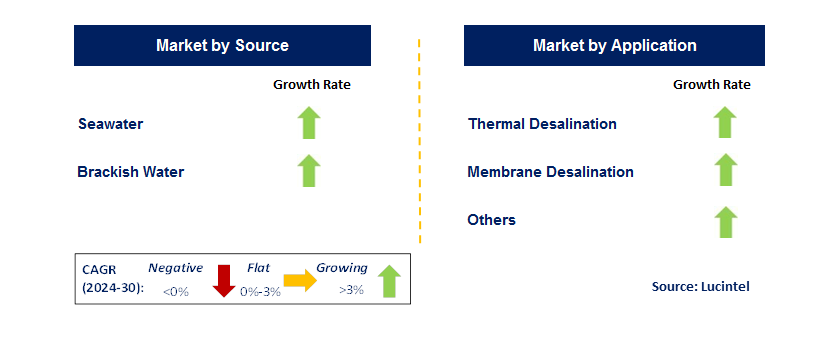
• Lucintel forecasts that, within the source category, brackish water is expected to witness a higher growth over the forecast period due to its substantial usage as a feasible substitute water source for industrial, agricultural, and municipal uses due to its lower salt content.
• In terms of regions, APAC is expected to witness the highest growth over the forecast period due to rapid growth in population and continual development of seawater & brackish water desalination plants in the region.

Features of the Global Sea Water and Brackish Water Desalination Market
Market Size Estimates: Sea water and brackish water desalination market size estimation in terms of value ($B). Trend and Forecast Analysis: Market trends (2018 to 2023) and forecast (2024 to 2030) by various segments and regions. Segmentation Analysis: Sea water and brackish water desalination market size by source, chemical type, application, and region in terms of value ($B). Regional Analysis: Sea water and brackish water desalination market breakdown by North America, Europe, Asia Pacific, and Rest of the World. Growth Opportunities: Analysis of growth opportunities in different sources, chemical types, applications, and regions for the sea water and brackish water desalination market. Strategic Analysis: This includes M&A, new product development, and competitive landscape of the sea water and brackish water desalination market. Analysis of competitive intensity of the industry based on Porter’s Five Forces model.If you are looking to expand your business in this or adjacent markets, then contact us. We have done hundreds of strategic consulting projects in market entry, opportunity screening, due diligence, supply chain analysis, M & A, and more.

FAQ
Q1. What is the sea water and brackish water desalination market size? Answer: The global sea water and brackish water desalination market is expected to reach an estimated $28.2 billion by 2030. Q2. What is the growth forecast for sea water and brackish water desalination market? Answer: The global sea water and brackish water desalination market is expected to grow with a CAGR of 7.8% from 2024 to 2030. Q3. What are the major drivers influencing the growth of the sea water and brackish water desalination market? Answer: The major drivers for this market are the rising scarcity of freshwater and the increasing development of desalination units. Q4. What are the major segments for sea water and brackish water desalination market? Answer: The future of the sea water and brackish water desalination market looks promising with opportunities in the thermal desalination and membrane desalination markets. Q5. Who are the key sea water and brackish water desalination market companies? Answer: Some of the key sea water and brackish water desalination companies are as follows:• Ecolab
• Veolia Environment
• Kurita Water Industries
• Kemira
• Calgon Carbon
• Thermax Chemicals
• Suez Environment
• Solenis
• Organo Chemical
• BASF Q6. Which sea water and brackish water desalination market segment will be the largest in future? Answer: Lucintel forecasts that brackish water is expected to witness a higher growth over the forecast period due to its substantial usage as a feasible substitute water source for industrial, agricultural, and municipal uses due to its lower salt content. Q7. In sea water and brackish water desalination market, which region is expected to be the largest in next 5 years? Answer: APAC is expected to witness the highest growth over the forecast period due to rapid growth in population and continual development of seawater & brackish water desalination plants in the region. Q.8 Do we receive customization in this report? Answer: Yes, Lucintel provides 10% customization without any additional cost.
Table of Contents
Methodology
- In-depth interviews of the major players in this market
- Detailed secondary research from competitors’ financial statements and published data
- Extensive searches of published works, market, and database information pertaining to industry news, company press releases, and customer intentions
- A compilation of the experiences, judgments, and insights of Lucintel’s professionals, who have analyzed and tracked this market over the years.


Buy Now
Choose a license that fits your team. Instant PDF delivery.
Prices exclude taxes. Instant delivery. Custom licensing available on request.
Key Questions
- • What are some of the most promising, high-growth opportunities for the sea water and brackish water desalination market by source (seawater and brackish water), chemical type (pre-treatment and post-treatment), application (thermal desalination, membrane desalination, and others), and region (North America, Europe, Asia Pacific, and the Rest of the World)?
- • Which segments will grow at a faster pace and why?
- • Which region will grow at a faster pace and why?
- • What are the key factors affecting market dynamics? What are the key challenges and business risks in this market?
- • What are the business risks and competitive threats in this market?
- • What are the emerging trends in this market and the reasons behind them?
- • What are some of the changing demands of customers in the market?
- • What are the new developments in the market? Which companies are leading these developments?
- • Who are the major players in this market? What strategic initiatives are key players pursuing for business growth?
- • What are some of the competing products in this market and how big of a threat do they pose for loss of market share by material or product substitution?
- • What M&A activity has occurred in the last 5 years and what has its impact been on the industry? For any questions related to Sea Water And Brackish Water Desalination Market, Sea Water And Brackish Water Desalination Market Size, Sea Water And Brackish Water Desalination Market Growth, Sea Water And Brackish Water Desalination Market Analysis, Sea Water And Brackish Water Desalination Market Report, Sea Water And Brackish Water Desalination Market Share, Sea Water And Brackish Water Desalination Market Trends, Sea Water And Brackish Water Desalination Market Forecast, Sea Water And Brackish Water Desalination Companies, write Lucintel analyst at email: helpdesk@lucintel.com. We will be glad to get back to you soon.


