
Report Feature
Rust Lubricant Market
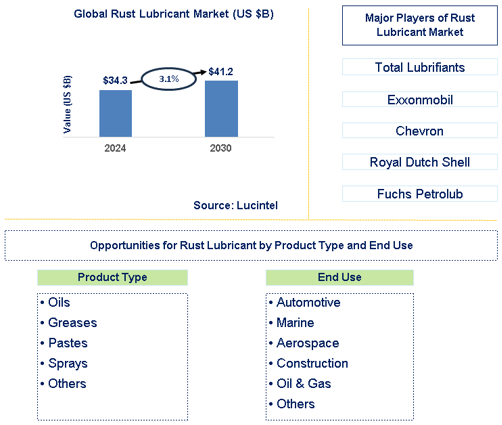
The future of the global rust lubricant market looks promising with opportunities in the automotive, marine, aerospace, construction, and oil & gas markets. The global rust lubricant market is expected to reach an estimated $41.2 billion by 2031 with a CAGR of 3.4% from 2025 to 2031. The major drivers for this market are increasing need for maintenance and repair activities among industries and growing demand for eco-friendly and water-based lubricants.• Lucintel forecasts that, within the product type category, oil is expected to witness the highest growth over the forecast period.
• Within the end use category, automotive is expected to witness the highest growth over the forecast period.
• In terms of regions APAC is expected to witness highest growth over the forecast period. Gain valuable insights for your business decisions with our comprehensive 150+ page report.
Emerging Trends in the Rust Lubricant Market
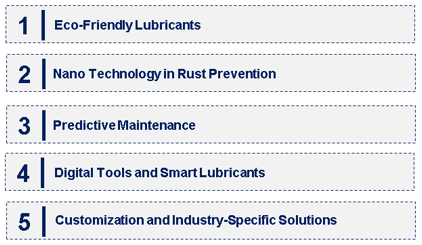
The rust lubricant market is going through changes as new trends shape its future direction. As customers apply more efficient and environmentally friendly corrosion inhibitors, manufacturers respond with novel product offerings. Among them are eco-friendly lubricants, advancements in nanotechnology, and the rising significance of predictive maintenance, along with the integration of digital tools for monitoring and analysis purposes. These factors are currently driving growth while redefining market dynamics.• Eco-Friendly Lubricants: There is an increased demand for environmentally friendly petroleum jelly lubrication products due to global factors concerning conservation measures, hence promoting environmentally friendly rust inhibitors. Manufacturers have developed biodegradable formulations that do not harm the environment but offer good rust protection within these criteria. This has particularly been observed in areas like the European Union and North America, where strict regulations regarding environmental pollution controls exist. Eco-friendly lubricants play a key role in the current lube oil market as they appeal to both consumers and producers who value environmental sustainability issues.
• Nanotechnology in Rust Prevention: Nanotechnology has disrupted the rust lubricant market by making it possible to create lubricants with better protective properties. Corrosion resistance can be improved upon by nano-lubricants that can percolate further down into metal surfaces. This trend has been popular among industrial sectors like aerospace and electronics, which require high-performance and long-lasting products. Increasingly, the application of nanotechnology is anticipated to result in the development of higher-performing anti-rust agents.
• Predictive Maintenance: Predictive maintenance services have led to a need for smart lubricants compatible with modern monitoring systems, which are significant drivers of demand for rust prevention technologies. These lubricants can work alongside sensors and data analytics tools that forecast when breakdowns will occur, leading to reduced outages and increased equipment lifespan. This trend is especially important in sectors with critical plants such as manufacturing and energy, where unscheduled repairs could lead to huge losses.
• Digital Tools and Smart Lubricants: A rising trend involves incorporating digital tools and smart technologies within rust lubricants. Smart lubricants will provide real-time information concerning corrosion, friction, or levels of wear, enabling more accurate maintenance scheduling. These developments are becoming commonplace in sectors where efficiency is paramount, such as automotive and machinery. The world’s approach to equipment maintenance has changed based on the ability to monitor and manage oiling remotely.
• Customization and Industry-Specific Solutions: There is increasing demand for industry-specific rust inhibitor designs tailored specifically to individual needs in the chemical industry. For example, many manufacturers develop special formulations accounting for unique problems faced by various industries, such as high humidity encountered in marine applications or extreme temperatures in the aerospace industry, among others. In addition, this move encourages innovation while offering specific solutions each time, thereby giving them a competitive advantage over their counterparts. Thus, customization plays a key role in addressing different requirements set by companies worldwide. These emerging trends are reshaping the rust lubricant market by driving innovation and responding to the evolving needs of industries. Therefore, companies that recognize these trends will be better positioned to take advantage of them and maintain their competitiveness within the evolving market.
Recent Developments in the Rust Lubricant Market
The rust lubricant market is witnessing a wave of innovation and strategic growth that is reshaping its future trajectory. Technological advancements, environmental considerations and changing industry requirements are some of the factors that have led to these developments. Companies are now more interested in manufacturing efficient, sustainable and application based anti-rust agents. This section highlights five principal changes affecting the sector and their implications on future expansion.• Introduction of Biodegradable Rust Lubricants: The introduction of biodegradable rust lubricants into the market is evident due to growing environmental regulations as well as consumer demands for sustainability. While being effective against corrosion, they also have less negative impacts on environment compared with other types of lubricants used for same purposes. The value attached on offering such products which can easily decompose is very significant particularly when considering areas with rigid environmental policies as these firms becomes leading players in the market.
• Advancements in Nano-Lubricant Technology: Nano-lubricants play a crucial role in today’s rust prevention sector. The advanced technology behind them makes them penetrate deeply into metal surfaces providing extra strength against corrosions at higher levels. Consequently, nano-lubricants allow producers offer high-performance solutions developed specifically for industries with specific demands e.g., aviation or security where only toughness matters most.
• Increased Focus on Industry-Specific Solutions: Rust lubricants customized for specific industry requirements are increasingly being manufactured by producers, who are in turn focusing on the automotive, marine, and aerospace sectors among others. This customization focus enables firms to practically respond to peculiar issues such as extreme temperatures or high humidity. Industry-specific solutions are gaining prominence in the market place thus enabling firms to pursue niche markets and increase their market share.
• Expansion of Predictive Maintenance Practices: The popularity of predictive maintenance is augmenting the growth of demand for rust lubricants that can work alongside advanced monitoring tools and analytics. They have been designed to be compatible with sensors as well as data analytics systems which facilitate real-time tracking and accurate maintenance planning. As a result, businesses have managed to minimize machine downtime rates, extend lifetime of assets and optimize repair schedules.
• Strategic Partnerships and Collaborations: Lubricant manufacturers have entered into strategic partnerships with industries like automotive, aerospace, manufacturing etc., thereby leading to increased number of alliances within the rust lubricant Market. These collaborations aim at developing new products together as well as enhancing distribution networks while enlarging their market reach respectively. By doing so companies can take advantage of each other’s strengths resulting into faster innovation that meets customers’ changing needs. As a result, these trends will lead to increased efficiency levels more so when it comes to innovation related matters. Given that this trend continues, businesses should expect more opportunities from these advancements thus remaining competitive in an ever evolving business environment.
Strategic Growth Opportunities in the Rust Lubricant Market
In a world teeming with applications for rust lubricant market strategic avenues exist. When looking at corrosion prevention alternatives available today industries tend also seek more efficient ones specifically designed for them. For example there are rising prospects across segments such as automobile parts producers; ship building companies; air carriers operating fleets worldwide including those engaged mainly inland shipping purposes just like containers used widely off shore installations this sector yields substantial demand lubricants that are salt water resistant and can be applied at extreme temperatures. In addition, we are witnessing the birth of a new market in rust lubricants with the potential for growth within the marine industry in particular as leading manufacturers try to outdo each other through advancements like highly sophisticated formulations that provide optimum protection against corrosive effects of seawater even under severe climatic conditions.• Automotive Industry Applications: The automotive industry is an area where significant opportunities exist for rust lubricant because of the increasing use of electric vehicles (EVs). As EVs take over, there will be more need for special oils that prevent corrosion of battery parts and electrical systems. This has spurred development of rust lubricants specifically designed to address needs stemming from utilization these type cars which present lucrative business prospects.
• Marine Industry Applications: This has been attributed to the fact that vessels and offshore structures face very harsh environmental conditions making them big consumers of anti-rust grease. Specifically, there is a growing demand for lubes expected to offer better cure rates when it comes to saltwater related problems. With more advanced formulations being released by different vendors every year so far it seems they have gotten all their bases covered based on models I have seen which appear capable surviving in marine settings without getting damaged at all thus going some way towards capturing larger shares within this market.
• Aerospace Industry Applications: To withstand high temperatures and extreme conditions aerospace industry needs special types such as high-performance anti-corrosion oil . To survive in low-temperature environments at high altitude, lubes providing long-lasting anticorrosion action are necessary here due combo above mentioned variables giving rise niche hence anyone who can make them stand out should see increased orders coming their way according some experts currently operating market space globally where demand also remains strong across board requirements ranging up multiple customers.
• Applications of Industrial Machinery: Moreover, industrial machinery is another domain where rust lubricants are in high demand. The growth opportunities are driven by the need for lubricants that can elongate the life of the machine, reduce maintenance costs and improve operational efficiency. This is because as technology evolves and industries move to more advanced, automated machinery there will be an increase in demand for high-performance rust lubricants capable of protecting such valuable assets hence creating a favorable market.
• Applications in Construction Industry: In addition to that, construction industry represents one of the most promising areas for development of rust lubricant particularly in regions with high humidity and extreme weather conditions. The increased globalization of infrastructure projects has led to a rise in demand for rust prevention solutions in construction equipment and materials. Tap into this expanding market and drive their growth Manufacturers who develop rust lubricants designed to withstand the challenging conditions on construction sites can. Thus, these are strategic growth opportunities across various applications driving rust lubricant market expansion. To capitalize on these opportunities and achieve sustained market growth, it will require companies that focus on innovation, customization, and meeting specific needs required by different industries.
Rust Lubricant Market Driver and Challenges
While it may seem that the rust lubricant market is affected mainly by economics or regulations which may either favor or hinder its progress as well as being drivers at times; technological advancements do occasionally play a significant role: understanding these elements is essential for success of all interested parties when navigating through this market segment. Technological advances include developments in lubricant technology, increasing industrial activities along with growing environmental consciousness amongst others. However they also face challenges like strict regulations concerning environment conservation, fluctuating raw material prices and substitute products. The factors responsible for driving the rust lubricant market include: 1. Technological Advancements: Market growth has been propelled by innovations such as nano-lubricants or environmentally friendly products used in formulating corrosion inhibitors against metal corrosion. These advances offer better protection against corrosion while satisfying the changing requirements of industries and therefore contributing to increased uptake. Thus, companies that engage in research and development to produce more efficient and sustainable solutions may outperform their rivals in the long run. 2. Industrial Growth: Automotive, aerospace and manufacturing are some of the sectors where industrialization is happening fast leading to an increase in demand for rust lubricants. This has increased the need for reliable rust prevention solutions as these sectors expand thus facilitating market growth. Further still, Infrastructure projects have risen together with industrialization among emerging nations and this has contributed to a wider base market for rust lubricants. 3. Environmental Awareness: Growing environmental concerns coupled with stringent regulations are increasing the demand for eco-friendly rust lubricants. In response, manufacturers have developed biodegradable products that do not harm nature while still providing efficient corrosion protection. Especially in areas with tough environmental policies eco-friendly lubricants will remain one of key growth drivers of the industry. 4. Increased Focus on Maintenance: The importance of regular maintenance when it comes to extending machinery’s life span is causing an escalation in demand for rust lubricants. As such, industries are increasingly adopting preventive maintenance because they realize how much money it can save them thereby spurring more use of antirust chemicals by them. It is particularly true in industries where time machines are critical because any downtime costs them huge amounts. 5. Global Supply Chain Expansion: The ongoing globalisation process necessitates the usage of rust inhibitors during transportation and storage of equipment or parts by different companies far from their home countries. Consequently, as firms expand globally there is a rising level reliance on robust antirust chemicals able temperatures prevailing at different locations within which these firms operate. This trend has promoted market growth hence creating opportunities for multinational corporations capable of effectively reaching customers’ expectations everywhere around the world. Challenges in the rust lubricant market are: 1. Regulatory Compliance: A challenge for rust lubricant manufacturers is the tough environmental and safety regulations. Smaller companies face the hurdle of market entry due to expensive R&D and testing as a result of compliance with these regulations. Besides, diverse regulations across regions pose difficulties in global market strategies for ensuring consistent compliance by firms. 2. Fluctuating Raw Material Prices: Basic oils and additives are examples of raw materials used in making rust lubricants whose costs are subject to change. Any fluctuations in raw material prices can affect profit margins, leading to price instability among manufacturers. This is especially true during times of economic uncertainties where supply chain interruptions can exacerbate price volatility further. 3. Competition from Alternative Solutions: Intrinsic rust resistance coatings, galvanization or advanced materials make the rust lubricant industry face competition from other anti-corrosion solutions. Occasionally, they may provide better value for money or even more enduring shielding thereby posing a challenge to ordinary rust lubricants. Manufacturers constantly have to be at the cutting edge of their business so that they keep up with what specific target industries want. The rust lubricant market has a dynamic interplay between drivers and challenges. However, technological advancements and industrial growth create invaluable opportunities while regulatory intricacies must also be considered together with fluctuating prices and competition from alternative remedies. Understanding these factors is vital when developing strategies that can drive growth and sustain competitiveness in a changing market landscape.List of Rust Lubricant Market Companies
Companies in the market compete on the basis of product quality offered. Major players in this market focus on expanding their manufacturing facilities, R&D investments, infrastructural development, and leverage integration opportunities across the value chain. With these strategies rust lubricant companies cater increasing demand, ensure competitive effectiveness, develop innovative products & technologies, reduce production costs, and expand their customer base. Some of the rust lubricant companies profiled in this report include• Total Lubrifiants
• ExxonMobil
• Chevron
• Royal Dutch Shell
• Fuchs Petrolub
• Lubrizol
• Sinopec
• Quaker Chemical
• Klüber
• Valvoline
Rust Lubricant by Segment
The study includes a forecast for the global rust lubricant by product type, end use, and region.Rust Lubricant Market by Product Type [Analysis by Value from 2019 to 2031]:
• Oils
• Greases
• Pastes
• Sprays
• Others
Rust Lubricant Market by End Use [Analysis by Value from 2019 to 2031]:
• Automotive
• Marine
• Aerospace
• Construction
• Oil & Gas
• Others
Rust Lubricant Market by Region [Analysis by Value from 2019 to 2031]:
• North America
• Europe
• Asia Pacific
• The Rest of the World
Country Wise Outlook for the Rust Lubricant Market
The rust lubricant market has been experiencing notable progress in major economies, driven by improvements in techniques for preventing corrosion and increasing industrialization. In the U.S., China, Germany, India, and Japan, the market is changing due to many factors such as improving economies, increased manufacturing activities, and growing concern about equipment maintenance. These trends are reshaping the market landscape, providing opportunities for both new entrants and established companies.• United States: Increased investment in infrastructure and manufacturing is driving the expansion of the rust lubricant market in the United States. The government's focus on reviving industry under President Biden's administration has increased demand for rust prevention products. For instance, eco-friendly rust inhibitors have been introduced, while other formulations that provide long-lasting protection against rusting have also dominated this industry. This trend is supported by increased awareness of the environmental impact of traditional rust prevention products.
• China: In China, rapid industrialization and expansion of its manufacturing sector are propelling its lubricants industry forward. The shift towards environmentally friendly lubricants was informed by the government's campaign to reduce pollution. Such advances include heavy industries tailoring high-performance, low-emission rating anti-rust lubricants, among others. A lot thus depends on China's push towards sustainability and its "Made in China 2025" policy.
• Germany: Germany robust automotive sector and machinery sector significantly influence its anti-oxidant lube oil competition structure, creating room for biodegradable lube oil production. Some recent developments include links between car manufacturing industries and grease manufacturers, which lead to special concoctions that are supposed to be used only with electric vehicles and not with others produced in Germany alone. Through innovation focus and a constant desire to achieve sustainable development goals, Germany continues asserting itself as Europe's leading nation regarding such products.
• India: Growth in the construction and automobile sectors is expanding India's anti-rust petroleum jelly business. Recently, the Indian government gave a boost to domestic manufacturing under the "Make in India" program, thereby increasing local demand for rust prevention products. These include affordable, high-performance anti-rust jellies made specifically for the tough Indian climate. In addition, local and international market players are competing in this market, driving innovation in their products.
• Japan: Japan anti-oxidant lube oil business is characterized by a focus on advanced technology and precision engineering. Both the automotive and electronics industries in this country require effective means of preventing corrosion. One of the recent trends involves producing nano-lubricants that provide maximum micro-level protection against wear. Being driven by research and development, it focuses on the production of such goods that will meet the strict quality demands established by national industries.

Features of the Global Rust Lubricant Market
Market Size Estimates: Rust lubricant market size estimation in terms of value ($B). Trend and Forecast Analysis: Market trends (2019 to 2024) and forecast (2025 to 2031) by various segments and regions. Segmentation Analysis: Rust lubricant market size by product type, end use, and region in terms of value ($B). Regional Analysis: Rust lubricant market breakdown by North America, Europe, Asia Pacific, and Rest of the World. Growth Opportunities: Analysis of growth opportunities in different product types, end uses, and regions for the rust lubricant market. Strategic Analysis: This includes M&A, new product development, and competitive landscape of the rust lubricant market. Analysis of competitive intensity of the industry based on Porter’s Five Forces model. If you are looking to expand your business in this or adjacent markets, then contact us. We have done hundreds of strategic consulting projects in market entry, opportunity screening, due diligence, supply chain analysis, M & A, and more.
FAQ
Q1. What is the rust lubricant market size? Answer: The global rust lubricant market is expected to reach an estimated $41.2 billion by 2031. Q2. What is the growth forecast for rust lubricant market? Answer: The global rust lubricant market is expected to grow with a CAGR of 3.4% from 2025 to 2031. Q3. What are the major drivers influencing the growth of the rust lubricant market? Answer: The major drivers for this market are increasing need for maintenance and repair activities among industries and growing demand for eco-friendly and water-based lubricants. Q4. What are the major segments for rust lubricant market? Answer: The future of the rust lubricant market looks promising with opportunities in the automotive, marine, aerospace, construction, and oil & gas markets. Q5. Who are the key rust lubricant market companies? Answer: Some of the key rust lubricant companies are as follows:• Total Lubrifiants
• ExxonMobil
• Chevron
• Royal Dutch Shell
• Fuchs Petrolub
• Lubrizol
• Sinopec
• Quaker Chemical
• Klüber
• Valvoline Q6. Which rust lubricant market segment will be the largest in future? Answer: Lucintel forecasts that, within the product type category oil is expected to witness the highest growth over the forecast period. Q7. In rust lubricant market, which region is expected to be the largest in next 5 years? Answer: In terms of regions APAC is expected to witness highest growth over the forecast period. Q8. Do we receive customization in this report? Answer: Yes, Lucintel provides 10% customization without any additional cost.
Table of Contents
Methodology
- In-depth interviews of the major players in this market
- Detailed secondary research from competitors’ financial statements and published data
- Extensive searches of published works, market, and database information pertaining to industry news, company press releases, and customer intentions
- A compilation of the experiences, judgments, and insights of Lucintel’s professionals, who have analyzed and tracked this market over the years.


Buy Now
Choose a license that fits your team. Instant PDF delivery.
Prices exclude taxes. Instant delivery. Custom licensing available on request.
Key Questions
- • What are some of the most promising, high-growth opportunities for the rust lubricant market by product type (oils, greases, pastes, sprays, and others), end use (automotive, marine, aerospace, construction, oil & gas, and others), and region (North America, Europe, Asia Pacific, and the Rest of the World)?
- • Which segments will grow at a faster pace and why?
- • Which region will grow at a faster pace and why?
- • What are the key factors affecting market dynamics? What are the key challenges and business risks in this market?
- • What are the business risks and competitive threats in this market?
- • What are the emerging trends in this market and the reasons behind them?
- • What are some of the changing demands of customers in the market?
- • What are the new developments in the market? Which companies are leading these developments?
- • Who are the major players in this market? What strategic initiatives are key players pursuing for business growth?
- • What are some of the competing products in this market and how big of a threat do they pose for loss of market share by material or product substitution?
- • What M&A activity has occurred in the last 5 years and what has its impact been on the industry?
- • What M&A activity has occurred in the last 5 years and what has its impact been on the industry? For any questions related to Rust Lubricant Market, Rust Lubricant Market Size, Rust Lubricant Market Growth, Rust Lubricant Market Analysis, Rust Lubricant Market Report, Rust Lubricant Market Share, Rust Lubricant Market Trends, Rust Lubricant Market Forecast, Rust Lubricant Companies, write Lucintel analyst at email: helpdesk@lucintel.com. We will be glad to get back to you soon.


