
Report Feature
Remote Firing System Market Trends and Forecast
The technologies in the remote firing system market have developed rapidly in recent years, gradually changing from traditional wired remote firing systems to more modern wireless remote firing systems. This transition enhances operational flexibility and allows for greater mobility and control in different environments. In addition, the optical and electronic remote firing systems developed have enhanced accuracy and safety by offering more reliable communication, reducing the risk of misfires, and enabling real-time monitoring. These technological changes are transforming the remote firing system market with greater precision, efficiency, and adaptability for military, industrial, and commercial purposes.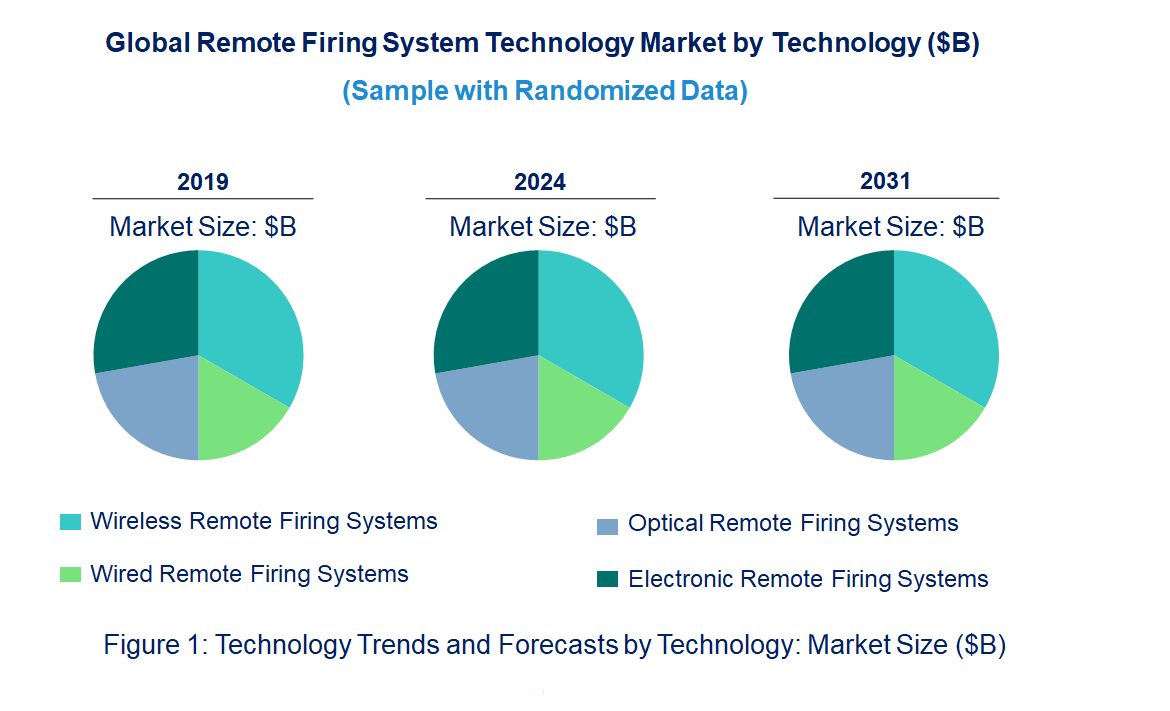
Emerging Trends in the Remote Firing System Market
The remote firing system market is evolving rapidly due to technological advancements and increasing demand across various sectors. The following key trends are shaping the market and driving its growth:• Advances in Wireless Technology: Wireless remote firing systems have become very popular due to the absence of physical cables. This provides increased flexibility and mobility. It is particularly significant in military and industrial applications, where such remote firing systems are required to operate flexibly in complex, dynamic environments.
• Integration with Smart Devices: Smart devices, including smartphones, tablets, and computers, are helping integrate remote firing systems, improving user control and monitoring. This means operators can remotely manage and monitor firing systems, increasing convenience and reducing the need for on-site personnel.
• Increased Demand for Accuracy and Precision: Precision-oriented requirements are driving the development of remote control optical and electronic firing systems that provide better targeting and control over operations, minimizing collateral damage.
• Focus on Safety and Reliability: With heightened concerns over safety, there is a greater emphasis on designing remote firing systems that offer secure communication channels and fail-safe mechanisms. These advancements ensure system reliability during critical operations and reduce the risk of malfunctions or unintended discharges.
• Expansion of Industrial and Commercial Applications: Remote firing systems are increasingly applied in industrial and commercial sectors, particularly in mining, demolition, and other risky operations. The advantages of remote control of explosives are increased safety for workers and operational efficiency, driving growth in non-military applications. These emerging trends are redefining the remote firing system market to be more accurate, flexible, and safe. With the transition towards wireless, integrated, and precise technologies, the military, industrial, and commercial sectors have experienced enhanced operational capabilities.
Remote Firing System Market : Industry Potential, Technological Development, and Compliance Considerations
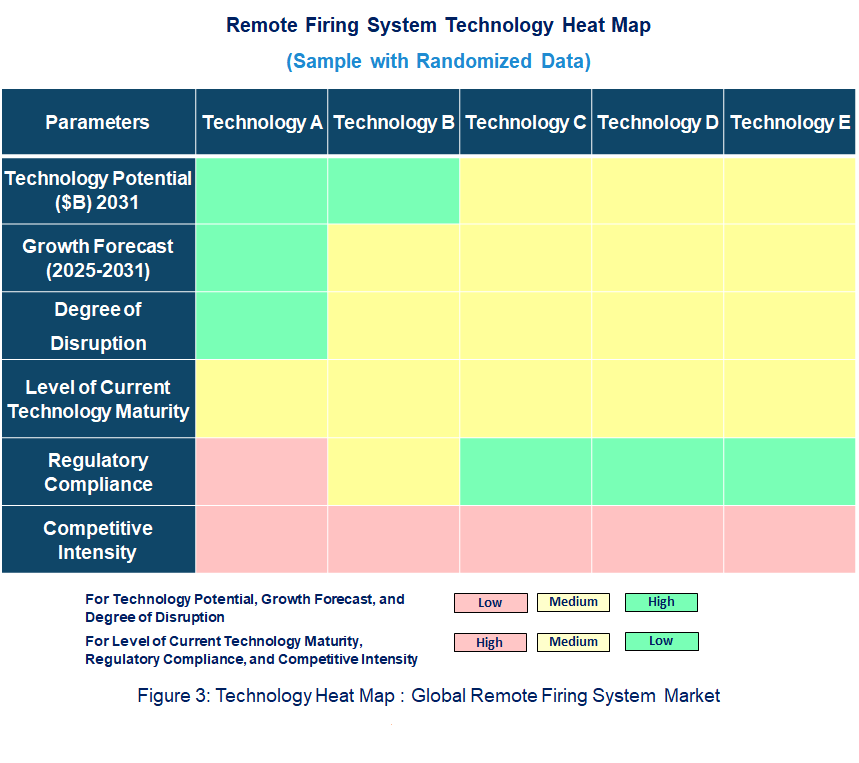
The remote firing system market, mainly used in defense, military, and mining industries, uses advanced technology for the precise detonation of explosives from a distance. These systems are critical in controlling explosions in hazardous environments and enhancing safety and efficiency in operations.• Technology Potential: The potential of remote firing technology is that it can enhance safety, accuracy, and control when applied in operations. Improvements in wireless communication, GPS integration, and automation capabilities can ensure reliability and precision in detonations. The advancement in IoT, real-time monitoring, and AI-driven analytics can deliver instantaneous feedback on system performance, enhancing risk management.
• The degree of disruption is moderate. Remote firing systems are not new, but technological advances are increasingly shifting traditional methods toward automation and greater precision. This may lead to a decrease in human error, increased safety, and reduced necessity for manual intervention in dangerous environments.
• Level of Current Technology Maturity: Technologies related to the remote firing system are already relatively mature, as there are already developed systems operational in the military and mining sectors. Further innovation in automation, data analytics, and AI should complement the realization of system capability and safety features.
• Regulatory Compliance: Given the hazardous nature of explosives in this market, it is important to meet safety requirements. The remote firing system would need to comply with governmental organizations such as the DoD to ensure proper care in use and safe working conditions.
Recent Technological development in Remote Firing System Market by Key Players
The remote firing system market is experiencing continuous innovation and development from key players, who are integrating various advanced technologies to enhance the performance of systems and expand the range of applications. These developments reflect the industry’s focus on improving safety, flexibility, and precision in remote firing operations.• L3 Technologies: L3 Technologies has extended its scope in the remote firing system market by incorporating advanced wireless communication technologies into its systems. Their emphasis on improving operational efficiency and security has made their solutions highly sought after in the military and defense sectors.
• Rheinmetall: Rheinmetall has furthered its development of remote firing systems, integrating electronic and optical technologies into the systems to achieve greater targeting accuracy. These systems have increasingly found their way into military applications, ensuring greater precision and better control over the high-stakes environment of operations.
• General Atomics: General Atomics has developed a cutting-edge remote firing system with enhanced optical sensors and wireless capabilities. Their solutions are geared toward improving military applications by enhancing safety and targeting, but also provide scalable solutions for industrial usage.
• General Dynamics: General Dynamics has achieved a lot in integrating real-time data transmission and secure communication features into its remote firing systems. With these improvements, military personnel can operate the system in remote locations with much more reliability and safety in critical operations.
• Textron: Textron has invested heavily in making its remote firing systems highly efficient by implementing wireless communication and automation. Their systems are more flexible and provide more control, especially when doing demolitions or controlled detonations in industrial settings.
• Lockheed Martin: Lockheed Martin continues to advance its remote firing technologies with AI and machine learning integration, enabling better targeting ability and faster system response time. Its solutions are designed to maximize overall efficiency with safety in defense and aerospace applications.
• Harris Corporation: Harris Corporation introduces remote firing systems with improved data encryption and cybersecurity in the communication system. Their remote firing systems are specifically designed for military operations with maximum security and precision requirements.
• Honeywell: Honeywell has optimized its remote firing systems by emphasizing reliability as well as fail-safe mechanisms. They include advanced safety protocols to minimize the risk of malfunctioning, particularly in high-risk industrial and defense applications.
• BAE Systems: BAE Systems has invested in developing remote firing systems with advanced optics and wireless communication technologies. Their systems are specifically designed for military applications, with high-precision targeting and the ability to operate in complex environments.
• Raytheon: Raytheon introduced remote firing systems, equipped with advanced sensors and wireless capability. Their systems have been developed to enhance operational efficiency in addition to improving accuracy for military and defense applications during remote detonation. All these developments reflect the progress of key players in the remote firing system market toward the advancement of technology to better the performance, safety, and accuracy of systems that satisfy different requirements.
Remote Firing System Market Driver and Challenges
Several drivers and challenges are impacting the remote firing system market. Technological, industrial, and regulatory pressures are driving the industry to change its activities. Below is an overview of major drivers and challenges affecting market growth: The factors responsible for driving the remote firing system market include:• Technological advancements of wireless, optical, and electronic remote firing systems: Developments in all of these technologies have shown positive results as they are the source of much-improved accuracy, adaptability, and safety for the performance of remote firing systems in the military, industrial, and commercial fields.
• Demand for Safety and Security: The fear for the safety of remote operations, especially in military and hazardous industrial settings, demands more secure and reliable remote firing systems. This raises the demand for better safety mechanisms, and improved safety mechanisms spur innovation in system design.
• Growing Defense Expenditure: With rising spending on defense and security across the world, the demand for sophisticated remote firing systems is escalating. Increased precision and reliability during military operations are also helping the market grow.
• Industrial Applications Expansion: Remote firing systems are increasingly being used for industrial applications such as mining and demolition. Such applications focus on explosion control and the reduction of hazardous conditions in the workforce, which is enabling growth in industries. Challenges in the remote firing system market include:
• High Costs: The high-end technologies applied to the systems for remote firing require substantial upfront costs. This remains one of the major challenges for many industries, including small companies or organizations with limited budgets.
• Compliance with Regulations: The remote firing system market is heavily regulated, especially in defense and explosives handling. These markets require full compliance with safety standards and regulations in different regions, posing a challenge for manufacturers and service providers.
• Reliability in Harsh Environments: Systems operating in harsh or extreme environments, like combat zones or rugged industrial settings, require a high level of reliability and robustness. Meeting these environmental challenges can make system design more challenging and costly. On the whole, while the remote firing system market is driven by technological innovations, military investments, and industrial expansion, it is also constrained by high costs, regulatory hurdles, and reliability issues. This will be critical for further growth and widespread application across these sectors.
List of Remote Firing System Companies
Companies in the market compete based on product quality offered. Major players in this market focus on expanding their manufacturing facilities, R&D investments, infrastructural development, and leverage integration opportunities across the value chain. With these strategies remote firing system companies cater to increasing demand, ensure competitive effectiveness, develop innovative products & technologies, reduce production costs, and expand their customer base. Some of the remote firing system companies profiled in this report include.• L3 Technologies
• Rheinmetall
• General Atomics
• General Dynamics
• Textron
• Lockheed Martin
Remote Firing System Market by Technology
• Technology Readiness by Technology Type for Remote Firing System Market: Wireless Remote Firing Systems are the most mature technology and ready for widespread use since they offer high flexibility, real-time control, and secure communication. Their preparedness is enhanced by the increasing demand for mobile, secure, and efficient operations in military and industrial sectors. Wired Remote Firing Systems, while reliable and secure, are becoming less competitive due to technological advances and their dependence on physical connections, which limits mobility and operational range. Optical remote firing systems are less common but can offer accurate, secure activation techniques that are particularly useful in niches such as demolition or highly secured facilities, but only when operating within specific environments. Electronic remote firing systems integrate the latest technologies to provide the greatest possible degree of customization and reliability, making them ready for complex or high-risk environments. All the systems require regulatory compliance that follows stringent safety protocols to ensure secure operation and prevent unauthorized use, but key applications range from military operations to industrial explosive handling and controlled demolitions.
• Competitive Intensity and Regulatory Compliance of Various Technologies in the Remote Firing System Market: The competitive intensity in the remote firing system market is moderate, since different technologies—wireless, wired, optical, and electronic systems—vary in advantages according to the application needs. However, wireless and optical systems are developing rapidly, and becoming more competitive, especially in the military and high-security sectors. Wire-based systems, although in operation, are not in as high demand due to their lack of flexibility and mobility. Regulation in this industry is key, especially with the use of firing systems in sensitive operations. Technologies will need to adhere to strict safety and security standards to ensure that it is impossible to easily modify these systems. Regulations regarding the safe handling, installation, and usage of these systems, especially related to safety in explosive environments, are essential for ensuring compliance throughout regions and industries.
• Disruption Potential of Different Technologies for the Remote Firing System Market: Wireless Remote Firing Systems have high disruption potential in the remote firing market, providing flexibility and ease of use by eliminating physical connections, enhancing operational safety, and allowing for remote detonation over longer distances. Wired Remote Firing Systems, although more secure in certain applications, are limited by their need for physical wiring, reducing flexibility and mobility. Optical Remote Firing Systems provide accurate control through light-based activation, ideal for high-security applications with minimal interference. Electronic Remote Firing Systems combine various electronic components to achieve the most reliable and customizable detonation. This allows for increased safety and integration with modern technologies. The ability of these systems to accommodate various security levels and operational environments marks a change in direction, offering users greater choices for safer, more efficient firing solutions.
Remote Firing System Market Trend and Forecast by Technology [Value from 2019 to 2031]:
• Wireless Remote Firing Systems
• Wired Remote Firing Systems
• Optical Remote Firing Systems
• Electronic Remote Firing Systems
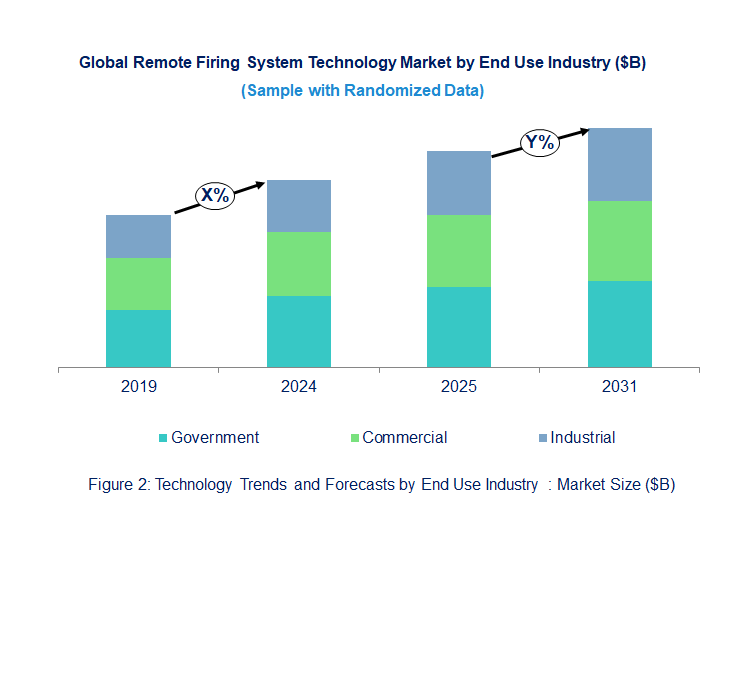
Remote Firing System Market Trend and Forecast by End Use Industry [Value from 2019 to 2031]:
• Government
• Commercial
• Industrial
Remote Firing System Market by Region [Value from 2019 to 2031]:
• North America
• Europe
• Asia Pacific
• The Rest of the World
• Latest Developments and Innovations in the Remote Firing System Technologies
• Companies / Ecosystems
• Strategic Opportunities by Technology Type
Features of the Global Remote Firing System Market
Market Size Estimates: Remote firing system market size estimation in terms of ($B). Trend and Forecast Analysis: Market trends (2019 to 2024) and forecast (2025 to 2031) by various segments and regions. Segmentation Analysis: Technology trends in the global remote firing system market size by various segments, such as end use and technology in terms of value and volume shipments. Regional Analysis: Technology trends in the global remote firing system market breakdown by North America, Europe, Asia Pacific, and the Rest of the World. Growth Opportunities: Analysis of growth opportunities in different end uses, technologies, and regions for technology trends in the global remote firing system market. Strategic Analysis: This includes M&A, new product development, and competitive landscape for technology trends in the global remote firing system market. Analysis of competitive intensity of the industry based on Porter’s Five Forces model.Table of Contents
Methodology
- In-depth interviews of the major players in this market
- Detailed secondary research from competitors’ financial statements and published data
- Extensive searches of published works, market, and database information pertaining to industry news, company press releases, and customer intentions
- A compilation of the experiences, judgments, and insights of Lucintel’s professionals, who have analyzed and tracked this market over the years.


Buy Now
Choose a license that fits your team. Instant PDF delivery.
Prices exclude taxes. Instant delivery. Custom licensing available on request.
Key Questions
- • What are some of the most promising potential, high-growth opportunities for the technology trends in the global remote firing system market by technology (wireless remote firing systems, wired remote firing systems, optical remote firing systems, and electronic remote firing systems), end use (government, commercial, and industrial), and region (North America, Europe, Asia Pacific, and the Rest of the World)?
- • Which technology segments will grow at a faster pace and why?
- • Which regions will grow at a faster pace and why?
- • What are the key factors affecting dynamics of different technology? What are the drivers and challenges of these technologies in the global remote firing system market?
- • What are the business risks and threats to the technology trends in the global remote firing system market?
- • What are the emerging trends in these technologies in the global remote firing system market and the reasons behind them?
- • Which technologies have potential of disruption in this market?
- • What are the new developments in the technology trends in the global remote firing system market? Which companies are leading these developments?
- • Who are the major players in technology trends in the global remote firing system market? What strategic initiatives are being implemented by key players for business growth?
- • What are strategic growth opportunities in this remote firing system technology space?
- • What M & A activities did take place in the last five years in technology trends in the global remote firing system market?


