
Report Feature
Precision Autonomous Robots Market Trends and Forecast
The technologies in precision autonomous robot technology have drastically changed over the past years, shifting from rule-based programming to AI-driven decision-making systems. Traditional GPS-based navigation has been replaced by advanced sensor fusion and real-time localization techniques. In addition, reliance on manual programming for tasks is moving toward machine learning models that enable robots to adapt and optimize their performance autonomously, which improves precision, efficiency, and versatility in industries such as agriculture, healthcare, and logistics.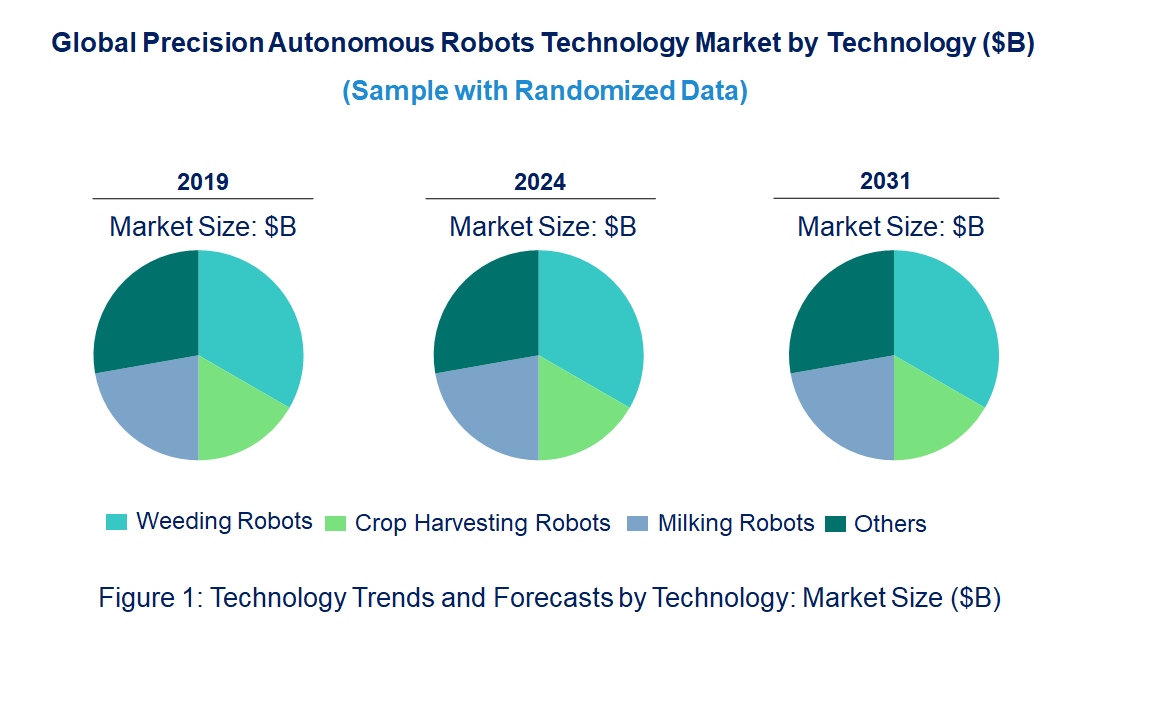
Emerging Trends in the Precision Autonomous Robots Market
The rapid advancements in artificial intelligence, sensor technology, and connectivity are revolutionizing the field of precision autonomous robots (PAR). The use of these robots is now common in various industries, including agriculture, manufacturing, healthcare, and logistics. Here are five key emerging trends transforming the PAR landscape:• Integration of AI and Machine Learning: AI and machine learning algorithms allow PAR to read, adapt to complex environments, and make decisions autonomously. This trend improves accuracy and efficiency, allowing robots to carry out complex tasks with fewer human interventions.
• Improved Sensor Fusion: The implementation of advanced sensors such as LiDAR, ultrasonic, and vision systems makes PAR attain situational awareness. Sensor fusion improves navigation, obstacle detection, and operational safety in dynamic environments.
• 5G Connectivity: 5G networks are changing how PAR communicates, making the transfer of data in real time and remote control functions possible. This connectivity allows cloud-based processing and seamless integration with larger IoT ecosystems, creating more productivity.
• Collaborative Robotics (Cobots): Cobots are designed to work safely and effectively in collaboration with humans. In developing cobots, their focus is on precision and adaptability in shared workspaces, which increases manufacturing, healthcare, and small business applications.
• Energy Efficiency and Sustainability: Innovations like battery technology as well as energy management systems, increase efficiency in the operation of the PAR. Sustainable practice with design and energy utilization complies with global intent, with environmental impact reduction. These trends are drivers of the paradigm shift toward Precision Autonomous Robots technology. AI, enhanced connectivity, sensor advancement, collaborative functionalities, and sustainability are enabling novel applications, performance improvements, and adoption in industries. These developments put PAR at the crux of innovation and efficient modern automation.
Precision Autonomous Robots Market : Industry Potential, Technological Development, and Compliance Considerations
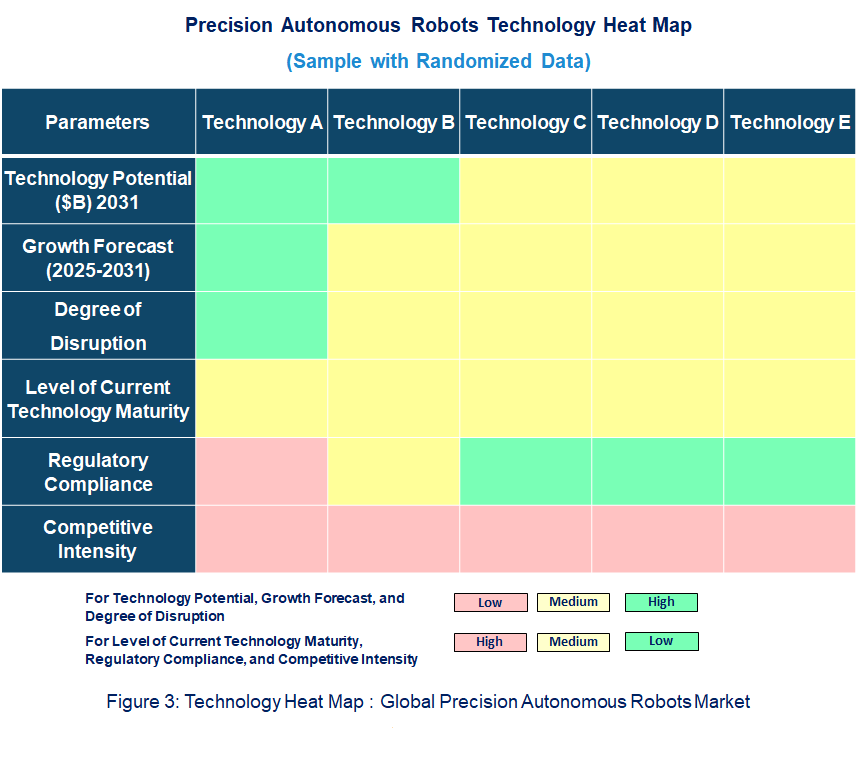
Precision autonomous robots (PAR) are at the forefront of automation through advanced artificial intelligence, sensor technology, and connectivity. PAR is transforming industries by providing a level of precision and efficiency in complex task execution unmatched to date. Below is the analysis of the technology potential, disruption level, maturity, and regulatory compliance.• Technology Potential: This ability of PAR is what is going to change industries, especially agriculture, manufacturing, logistics, and healthcare. By harnessing the potential of AI, they adapt well to changing conditions and optimize operations for error minimization. It's that precision that gives way to the usage of targeted spraying of pesticides and complicated surgeries, and inventory control for maximizing productivity and sustainability.
• Degree of Disruption: PAR technology is changing everything. Agriculture now allows precision farming for better resource utilization; its counterpart in manufacturing brings efficiency and speed to product generation. Such innovation pushes firms towards moving away from labor-based and shifting toward automated and data-oriented companies that maximize efficiency and profits.
• Current Level of Technology Maturity: The technology is maturing rapidly, with robust advancements in AI, sensor fusion, and 5G connectivity. Although some PAR applications are already in widespread use, others, such as fully autonomous healthcare robots, are still in the developmental stages.
• Regulatory Compliance: Regulatory frameworks, particularly in healthcare and agriculture, are evolving to ensure safety, ethical considerations, and environmental sustainability. Standards compliance is important for building trust and promoting wide adoption.
Recent Technological development in Precision Autonomous Robots Market by Key Players
Recent Innovation in Precision Autonomous Robots Technology PAR market is highly evolving since key players are finding new ways to cope up with increasing demand in automation sectors across agriculture, manufacturing industries, and other fields. This forces these companies to improve their robotics technology with new dimensions related to AI, integration of sensors, and more efficiency in terms of energy utilization for enhancing precision and productivity. The following is a list of recent innovations made by major players: Burro Burro unveiled self-driving farming robots that work collaboratively with human farmers. Their systems concentrate more on fruit transportation and way-finding within the field. Through high-level computer vision, as well as machine learning, such improvements will be realized both in efficiency and in reducing cost through labor in agriculture-related operations.• Ekobot Ekobot has designed wedding robots powered by AI. These robots are designed using the latest cameras and sensors that detect and remove weeds effectively without the use of chemical herbicides and ensure farming with minimal environmental damage.
• Naïo Technologies Naïo Technologies continues the quest for innovation in agricultural robotics with autonomous weeders and harvest assistants. It is a combination of GPS and LiDAR technology for navigation, enabling a farmer to work on huge farmlands with very little environmental impact.
• Advanced Intelligent Systems (AIS) AIS is specializing in modular robotics for indoor and outdoor applications. Its AI-powered robots with sensor fusion technology bring scalable solutions to horticulture and logistics, enhancing the efficiencies of various applications.
• Korechi Korechi has launched autonomous robots specifically designed for turf and field management. These systems, which incorporate mapping technologies and AI-driven route optimization, allow for the accurate maintenance of large green spaces, such as golf courses and sports fields, with reduced operational costs.
• Kilter Kilter specializes in precision irrigation and crop monitoring robots. Their systems use real-time data analytics and sensor networks to optimize water usage for the betterment of sustainable agriculture and crop yields.
• Automato Robotics Automato Robotics has developed cost-effective and lightweight robots for small farms. These robots carry out harvesting and sorting operations with high precision, which saves farmers money when trying to modernize their operations without large investments. The advances above reflect the speedy innovation of Precision Autonomous Robots. Organizations such as Burro, Ekobot, and Naïo Technologies are helping industry change through innovations in AI, sustainability, and efficiency- - in a way that may spur transformative impacts across several different sectors.
Precision Autonomous Robots Market Driver and Challenges
The precision autonomous robots (PAR) market has huge growth opportunities based on technological improvements and rising demand in all agricultural, logistics, and manufacturing industries. As a result of a quest for efficiency, sustainability, and safety, opportunities and challenges are driving the growth of this market. The factors responsible for driving the precision autonomous robots market include:• Increasing Demand for Automation in Agriculture: The demand for PAR in farming operations is on the increase as companies are interested in automating labor-intensive tasks such as harvesting, planting, and irrigation. This enhances operational efficiency while reducing costs and promoting sustainable agricultural practices.
• Advancement of Artificial Intelligence and Machine Learning: AI-driven decision-making and machine learning allow for real-time adaptation by robots, optimizing workflows and performing complex tasks without humans. This increases productivity, accuracy, and adaptability in virtually all industries.
• Sensor Integration and Technology Fusion: The sensors, LiDAR, GPS, and cameras, improve navigation, obstacle detection, and environmental mapping. This means more accuracy, safety, and operational efficiency both in indoor and outdoor environments.
• 5G Connectivity and Cloud Integration: 5G networks and cloud solutions can allow the PAR system to have real-time communication, remote diagnostics, and data analysis. Thus, this is going to make integration and scalability possible with large-scale operations without a hitch.
• Sustainable Technologies and Environmental Focus: Increased interest in green operations pushes for energy-efficient PAR solutions, such as improving battery technology and the use of eco-friendly materials, in a bid to enhance environmental accountability. Challenges
• Technological Integration Costs: Technological integration of sophisticated PAR systems is expensive, thus acting as a hindrance to smaller and medium-sized enterprises.
• Regulatory and Safety Issues: The complexity in standards compliance, such as ISO/SAE 21434, and safety regulations takes much effort and research, which can delay the deployment.
• Technological Complexity and Maintenance Issues: Advanced technologies used in PAR systems require continued R&D and expertise in maintenance and troubleshooting to ensure robustness and longevity. Technological advancement, increasing automation demand, and sustainability lead the market for Precision Autonomous Robots. It is while opportunities in AI, sensor integration, and cloud connectivity push the growth that obstacles such as high costs, regulations, and maintenance complexities need to be addressed. As a result, this interplay of forces shapes the market landscape to become dynamic, innovative, and scalable.
List of Precision Autonomous Robots Companies
Companies in the market compete based on product quality offered. Major players in this market focus on expanding their manufacturing facilities, R&D investments, infrastructural development, and leverage integration opportunities across the value chain. With these strategies precision autonomous robots companies cater to increasing demand, ensure competitive effectiveness, develop innovative products & technologies, reduce production costs, and expand their customer base. Some of the precision autonomous robots companies profiled in this report include.• Burro
• Ekobot
• Naïo Technologies
• Advanced Intelligent Systems
• Korechi
• Kilter
Precision Autonomous Robots Market by Technology
• Technology Readiness and Key Applications: Welding robots are very mature in terms of technology; they use advanced sensors and machine learning to identify and eliminate weeds accurately, with applications in eco-friendly farming practices. Crop harvesting robots are getting more reliable, combining AI, robotics, and sensor fusion to optimize harvesting operations, ensuring higher yields and labor savings. Milking robots are well-developed, utilizing automated extraction systems and health monitoring tools to improve efficiency in dairy farming operations. Other technologies, like autonomous irrigation and field drones, are moderately ready and tend to be customized based on terrain and environmental requirements. Each system integrates GPS, machine learning, and real-time data analytics to optimize field operations. Application areas include large-scale industrial farms, smaller niche farms, and research-driven agricultural operations. Its ability to work autonomously enables 24/7 operation, minimizing downtime. Data gathering and analytics also enable better decision-making, forecasting, and operational planning. Energy efficiency is also an emerging trend across these technologies, with efforts to incorporate sustainable solutions. Scalability and adaptability remain the key considerations for all systems, ensuring they remain functional across diverse geographical locations. These solutions are progressively shaping farming practices into highly automated, data-driven, and environmentally responsible operations.
• Competitive intensity and compliance with regulations: The precision autonomous robots competitive intensity in weeding robots is high since a large number of startups, as well as established companies, are vying to provide ecologically friendly and cost-effective products. In crop harvesting, intense competition results from the demand for more speed and efficiency in terms of machines that can work across varied environments. Milking robots experience stiff competition because the technologies employed ensure better integration into farm management systems. Other agricultural technologies, such as irrigation and monitoring drones, witness severe competition among players dedicated to optimization and real-time integration. Regulatory compliance is a factor throughout all technologies since abidance by environmental and safety regulations like ISO and SAE standards is required, mainly for the reliability of products with animal welfare and environmental protection. The main challenges include getting certifications regarding the safety of machines and how data is protected; then, there is the ethics behind automation. Companies have to contend with various regulations at the regional level as far as the deployment of these technologies in agriculture is concerned. Compliance usually requires a lot of research and development to meet specified safety and operational requirements. Altogether, these factors give companies the impetus for innovation, scalability, and operation in a sustainable manner while ensuring conformance to global standards in agriculture technology.
• Potential to Cause Disruption from Different Technologies: Welding robots have disruption potential because they ensure the precise removal of weeds in fields using automation and decrease herbicides with a reduction in environmental damage. Crop harvesting robots revolutionized farming as it does an intricate job quickly and correctly, increasing yield and efficiency. Milking robots streamline dairy operations and consistently get milk while keeping the cows healthy. Other technologies, like autonomous irrigation and field monitoring drones, support higher operational efficiency. It minimizes labor requirements, cuts down operational costs, and increases the overall productivity of agriculture. It brings precision and data analytics for smarter decision-making in all aspects of agriculture. Through machine learning algorithms, these robots adapt to changing field conditions autonomously. Energy efficiency and sustainability of these robots align with the goals of the environment. Sensor technology and artificial intelligence, in combination, help provide solid performance in different grounds and climate conditions. Such innovation puts the world moving away from traditional farming to wholly data-driven automated operations. This change endows farmers with scalability, cost-saving, and sustainability solutions by setting new standards in agrotech.
Precision Autonomous Robots Market Trend and Forecast by Technology [Value from 2019 to 2031]:
• Weeding Robots
• Crop Harvesting Robots
• Milking Robots
• Others
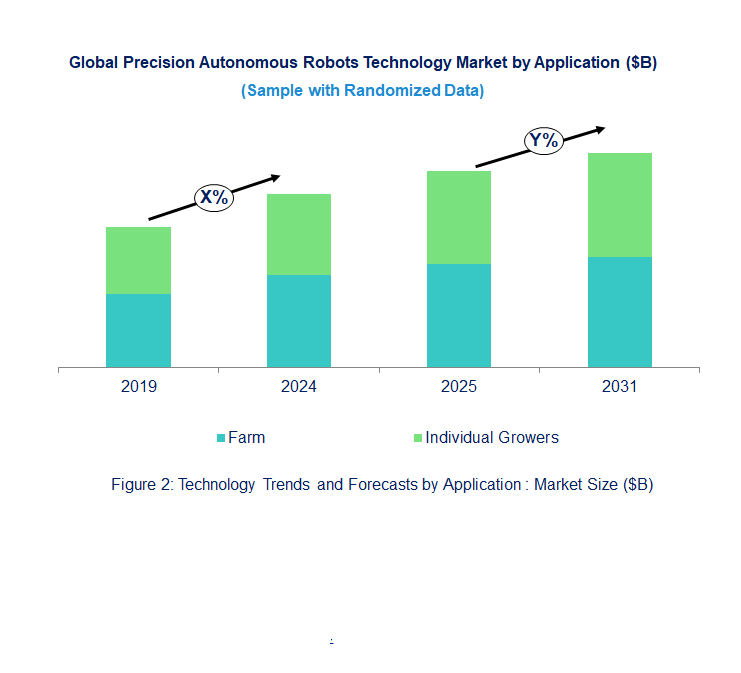
Precision Autonomous Robots Market Trend and Forecast by Application [Value from 2019 to 2031]:
• Farm
• Individual Growers
Precision Autonomous Robots Market by Region [Value from 2019 to 2031]:
• North America
• Europe
• Asia Pacific
• The Rest of the World
• Latest Developments and Innovations in the Precision Autonomous Robots Technologies
• Companies / Ecosystems
• Strategic Opportunities by Technology Type
Features of the Global Precision Autonomous Robots Market
Market Size Estimates: Precision autonomous robots market size estimation in terms of ($B). Trend and Forecast Analysis: Market trends (2019 to 2024) and forecast (2025 to 2031) by various segments and regions. Segmentation Analysis: Technology trends in the global precision autonomous robots market size by various segments, such as application and technology in terms of value and volume shipments. Regional Analysis: Technology trends in the global precision autonomous robots market breakdown by North America, Europe, Asia Pacific, and the Rest of the World. Growth Opportunities: Analysis of growth opportunities in different application, technologies, and regions for technology trends in the global precision autonomous robots market. Strategic Analysis: This includes M&A, new product development, and competitive landscape for technology trends in the global precision autonomous robots market. Analysis of competitive intensity of the industry based on Porter’s Five Forces model.Table of Contents
Methodology
- In-depth interviews of the major players in this market
- Detailed secondary research from competitors’ financial statements and published data
- Extensive searches of published works, market, and database information pertaining to industry news, company press releases, and customer intentions
- A compilation of the experiences, judgments, and insights of Lucintel’s professionals, who have analyzed and tracked this market over the years.


Buy Now
Choose a license that fits your team. Instant PDF delivery.
Prices exclude taxes. Instant delivery. Custom licensing available on request.
Key Questions
- • What are some of the most promising potential, high-growth opportunities for the technology trends in the global precision autonomous robots market by technology (weeding robots, crop harvesting robots, milking robots, and others), application (farm and individual growers), and region (North America, Europe, Asia Pacific, and the Rest of the World)?
- • Which technology segments will grow at a faster pace and why?
- • Which regions will grow at a faster pace and why?
- • What are the key factors affecting dynamics of different technology? What are the drivers and challenges of these technologies in the global precision autonomous robots market?
- • What are the business risks and threats to the technology trends in the global precision autonomous robots market?
- • What are the emerging trends in these technologies in the global precision autonomous robots market and the reasons behind them?
- • Which technologies have potential of disruption in this market?
- • What are the new developments in the technology trends in the global precision autonomous robots market? Which companies are leading these developments?
- • Who are the major players in technology trends in the global precision autonomous robots market? What strategic initiatives are being implemented by key players for business growth?
- • What are strategic growth opportunities in this precision autonomous robots technology space?
- • What M & A activities did take place in the last five years in technology trends in the global precision autonomous robots market?


