
Report Feature
Organic Acid Market Trends and Forecast
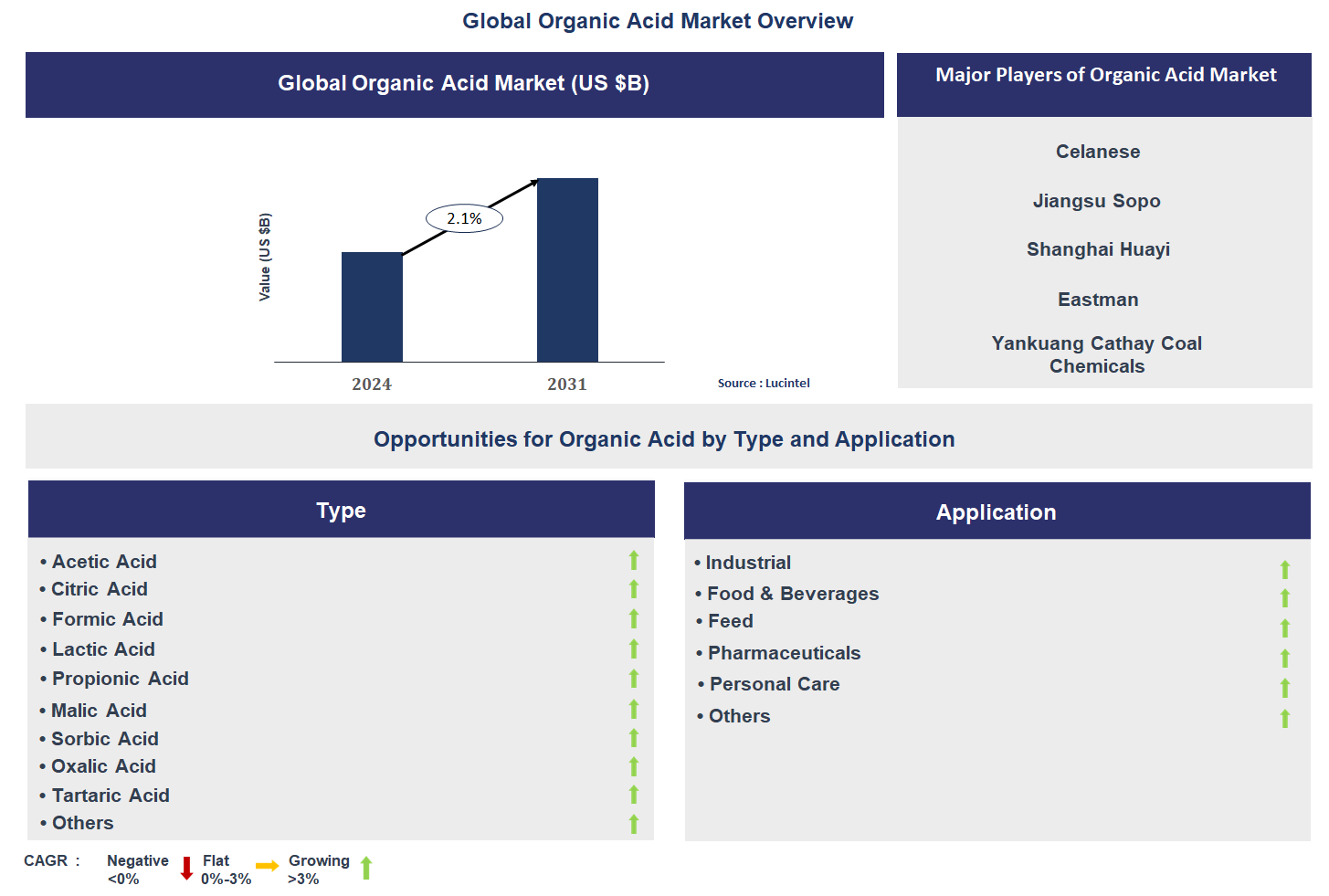
The future of the global organic acid market looks promising with opportunities in the industrial, food & beverage, feed, pharmaceutical, and personal care markets. The global organic acid market is expected to grow with a CAGR of 2.1% from 2025 to 2031. The major drivers for this market are the increasing demand for biodegradable plastics, the rising use in food preservation, and the growing adoption in pharmaceutical applications.• Lucintel forecasts that, within the type category, acetic acid is expected to witness the highest growth over the forecast period.
• Within the application category, food & beverage is expected to witness the highest growth.
• In terms of region, APAC is expected to witness the highest growth over the forecast period. Gain valuable insights for your business decisions with our comprehensive 150+ page report. Sample figures with some insights are shown below.
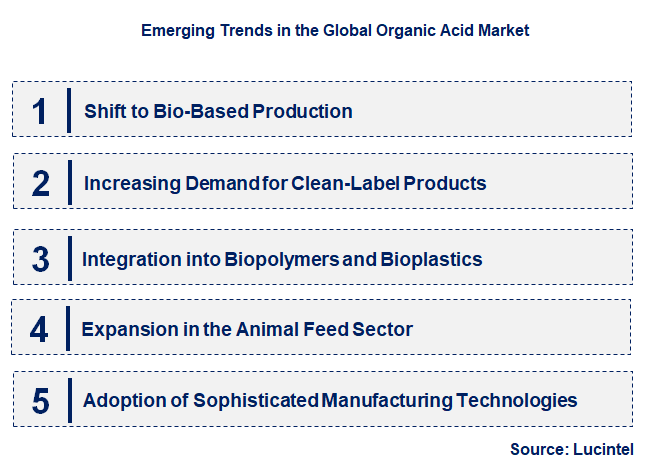
Emerging Trends in the Organic Acid Market
The organic acid market is undergoing a dramatic shift, fueled by changing consumer attitudes, technological advances, and international pressure to be sustainable. These new trends are shifting the industry away from its chemical petrochemical origins into a greener, more technology-focused, consumer-driven model. This transition is not only altering the way organic acids are made, but is also altering how they are used, revealing new, high-value applications for a versatile line of chemicals.• Shift to Bio-Based Production: A significant trend is the industry-wide switch from conventional petrochemical synthesis to bio-based production processes, mainly fermentation. This is fueled by sustainability and a need to minimize the carbon footprint. Firms are increasingly employing renewable feedstocks, such as corn, sugar, and agricultural residues, to manufacture organic acids. This not only sustainable makes the products but also gives a more stable supply chain, less prone to variation with crude oil prices.
• Increasing Demand for Clean-Label Products: The consumers are increasingly demanding products made from natural, recognizable ingredients. This has led to a high demand for organic acids, especially citric, lactic, and acetic acids, which are utilized as natural preservatives, flavor enhancers, and pH regulators in food and beverages. This trend is forcing food manufacturers to substitute synthetic additives with organic acids to fulfill the demand for "clean-label" and transparent products.
• Integration into Biopolymers and Bioplastics: Organic acids such as succinic acid and lactic acid are becoming increasingly prominent as central building blocks for the production of biopolymers and bioplastics. This is an immediate reaction to world attempts to curb plastic pollution and transition towards a circular economy. The application of organic acids within this sector is developing a high-growth, high-value market segment and represents a primary strategic priority for chemical companies.
• Expansion in the Animal Feed Sector: There is a large and increasing demand for the application of organic acids as animal feed additives in the animal husbandry sector. Organic acids prove effective in enhancing animal gut health, growth promotion, and minimizing the use of antibiotics. This is being spurred by increasing regulations on the use of antibiotics in animal agriculture and an aspiration for healthier and more sustainable meat production.
• Adoption of Sophisticated Manufacturing Technologies: The organic acid industry is embracing sophisticated technologies like bioreactors and fermentation optimization with artificial intelligence. All these technologies are enhancing production efficiency, cost savings, and final product purity. Use of technology is helping companies manufacture specialty, high-purity organic acids required in high-tech applications such as pharmaceuticals and electronics. These trends are actually transforming the market for organic acids. The emphasis is moving away from a commodity-based model towards more specialized, innovation-driven model. The market is segmenting, with firms emphasizing high-value, sustainable products. The long-term success of market players will be determined by how they invest in bio-based technologies, respond to increasing demand for clean-label products, and pioneer new, high-growth applications such as bioplastics and animal feed.
Recent Development in the Organic Acid Market
The market of organic acid is experiencing a phase of dynamic growth due to the combination of technological, environmental, and economic considerations. All these changes are modifying the industry’s panorama, affecting manufacturing processes, uses of the products, and business tactics. Organic acids are taking a central position at a time when the world is embracing a healthier and more sustainable future, and the recent developments are a sign of the industry’s reaction to a new scenario of needs and challenges.• Investment in Large-Scale Bio-Fermentation Plants: The major breakthrough is the investment in large-scale bio-fermentation plants for the production of organic acids. New plants are being constructed or existing plants are being expanded to make organic acids from renewable raw material. This is a direct reaction to growing demand for green products and an effort to gain a competitive advantage in a market that is fast turning away from petrochemical sources.
• Development of High-Purity Grades for Pharmaceuticals: There is a significant development in the manufacture of ultra-high-purity organic acids for the pharmaceutical market. This is based on the stringent quality demands for drug formulation, excipients, and other life science uses. Chemical manufacturers are spending in cutting-edge purification technologies to address these demanding standards, making a high-margin and premium segment in the market.
• Strategic Collaborations and Partnerships: There is an increasing number of companies developing strategic collaborations and partnerships to speed up the commercialization and development of new organic acid applications. For instance, collaborations between food companies and chemical companies or bioplastics manufacturers are increasingly prevalent. These partnerships assist in resource and knowledge sharing, allowing for quicker go-to-market of innovative offerings.
• Animal Feed and Health Growth: One of the major recent trends is the quick growth of organic acids in the animal feed and health industry. Organic acids are more and more being utilized as a replacement for antibiotics, influenced by policies and consumer pressure for antibiotic-free beef. Firms are creating new types of organic acid formulations that can enhance animal gut health and performance, forming a substantial market growth driver.
• Regulatory Shifts in Favor of Sustainable Production: Governments and global organizations are putting more stringent controls on the employment of petrochemical-based chemicals and encouraging the use of bio-based products. This has made a significant difference to the organic acid market, directly supporting bio-based methods of production. This regulatory backing is making the situation more conducive to firms that are investing in sustainable production technology. All these developments are together nudging the organic acid market towards a technology-enabled, more sustainable future. They point towards a shift from a conventional, bulk-commodity business to one which is high-end, niche-based applications. The market is turning more robust and vibrant, with success riding on a company’s capacity to innovate, establish a sustainable supply chain, and be in sync with global regulatory and consumer trends.
Strategic Growth Opportunities in the Organic Acid Market
The organic acid market has a variety of strategic opportunities for growth, and it is driven by its adaptability as well as the possibility of innovation in mainstream applications. The most exciting opportunities exist where it competes in markets that support the overall direction in worldwide trends towards sustainability, health, and advanced technology. By targeting these high-growth segments, companies can progress up the value chain and acquire a more lucrative and sustainable position in the market.• Bioplastics and Biodegradable Polymers: The biggest growth opportunity exists in using organic acids such as succinic acid, lactic acid, and adipic acid as the feedstocks for bioplastics and biodegradable polymers. With nations and organizations around the world looking to minimize their dependence on fossil fuels and reduce plastic waste, demand for bio-based polymers is skyrocketing. This presents a profitable market for organic acid manufacturers to provide a key ingredient for the fast-growing bioplastics market.
• Food and Beverage Industry: Organic acids are still a large market application in the food and beverage industry, and strategically there is a potential to be tapped with the "clean-label" trend. Firms can emphasize selling organic acids as natural, safe, and effective to use as substitutes for synthetic flavor enhancers and preservatives. Potential lies in offering a large portfolio of specialty organic acids that have specific food applications and consumer demand for natural products.
• Animal Feed Additives: The world’s movement away from antibiotic growth promoters in animal farming is a massive growth opportunity for organic acids as feed additives. Organic acids enhance gut health and nutrient uptake, producing healthier animals and improved yields. Businesses can build a portfolio of innovative organic acid products to suit various animal species and farming systems, becoming a go-to partner for a sustainable animal husbandry industry.
• Pharmaceutical and Life Sciences: The pharmaceutical and life science sectors are a high-margin growth sector. Organic acids are applied as excipients, intermediates, and solvents during drug production. The opportunity lies in the production of pharmaceutical-grade organic acids with high standards of quality and purity. This segment has high margins and stable demand due to ongoing innovation in the development of drugs and the manufacturing of generic and specialty drugs.
• Personal Care and Cosmetics: Niche but expanding, the personal care and cosmetics segment represents a strategic opportunity. Citric acid and lactic acid are among organic acids that serve as pH adjusters, exfoliants, and moisturizers in cosmetic products. The opportunity lies in delivering high-purity, cosmetic-grade organic acids to address the need for natural and efficient active ingredients in skincare, hair care, and other personal hygiene items. These growth prospects are significantly influencing the organic acid industry by promoting a move toward more value-added and application-specific business orientation. This is stimulating R&D and capital expenditure on new technology, including improved fermentation techniques and purification processes. The industry is becoming increasingly buoyant by diversifying into high-growth segments, curbing its traditional reliance on a limited number of major industries.
Organic Acid Market Driver and Challenges
The market for organic acid is shaped by a nuanced interrelationship of strong drivers and important challenges. The growth in the market is essentially driven by the increasing need for sustainable, natural, and high-purity chemicals in different industries. Such growth, however, is moderated by inherent challenges, such as raw material price volatility and stiff competition from man-made substitutes. It is key for any firm seeking success in this dynamic industry to understand these dynamics. The factors responsible for driving the organic acid market include: 1. Increasing Demand for Sustainable Chemicals: The biggest driver is the overall trend towards sustainability and a circular economy globally. Companies are shifting away from petrochemicals and adopting bio-based chemicals that come from renewable feedstocks. Organic acids, especially those made using fermentation, are the ideal fit for this trend, as they are seen as an eco-friendlier option. 2. Food and Beverage Industry Growth: Increased global population and dietary changes are fueling a boom in the food and beverage industry. Organic acids find applications as preservatives, flavoring agents, and acidity regulators. Increased demand for "clean-label" products is also driving their consumption as natural substitutes for synthetic additives. 3. Production Technology Advances: Advances in biotechnology and fermentation technology are improving the efficiency and cost of organic acid production. Developments in microbial strains and bioreactor technology are enhancing yields and lowering costs of production, making bio-based organic acids competitive against their petrochemical counterparts. 4. Growing Demand in the Animal Feed Sector: Restrictive policies around antibiotic use in animal feed are compelling a shift towards natural feed additives. Organic acids are becoming increasingly popular as gut-friendly and growth-promoting additives in feed for livestock. This is opening up a new and sizable market for organic acids. 5. Urbanization and Industrialization: The fast rate of industrialization and urbanization in the emerging economies is increasing the demand for items such as textiles, adhesives, and paints, all of which utilize organic acids. This is significantly contributing to the growth of the market in markets such as Asia-Pacific and Latin America. Challenges in the organic acid market are: 1. Raw Material Price Volatility: The manufacture of bio-based organic acids is based on agricultural feedstocks such as corn, sugarcane, and molasses. Prices of these raw materials tend to be volatile based on weather, crop yields, and commodity market instability. This complicates manufacturers’ abilities to keep production costs and prices consistent, which can affect profitability. 2. Competition from Synthetic Alternatives: Organic acid market is fiercely challenged by synthetic substitutes that are usually cheaper and more plentiful. Although bio-based organic acids are increasingly popular because of issues related to sustainability, cost-conscious industries can still settle for synthetic alternatives, which can restrict market growth in some applications. 3. Technological and Infrastructure Barriers: Although bio-based manufacturing is the major driving force, it demands huge investment in specific infrastructure and technology. High capital outlay and requirement of experienced manpower can be used as an entry deterrent for new entrants, particularly in developing nations where the infrastructure likely to be used may not be available easily. The organic acid industry is in a precarious balance. Although strong drivers are pushing it into a sustainable, high-growth future, it will have to counter serious threats from raw material prices as well as competition. The fortunes of players in the market will hinge on how they invest in technology innovation to reduce costs of production, shift into premium-value applications, and optimize their supply chains to insulate themselves from the volatility of raw material prices.List of Organic Acid Companies
Companies in the market compete on the basis of product quality offered. Major players in this market focus on expanding their manufacturing facilities, R&D investments, infrastructural development, and leverage integration opportunities across the value chain. With these strategies organic acid companies cater increasing demand, ensure competitive effectiveness, develop innovative products & technologies, reduce production costs, and expand their customer base. Some of the organic acid companies profiled in this report include-• Celanese
• Jiangsu Sopo
• Shanghai Huayi
• Eastman
• Yankuang Cathay Coal Chemicals
• Chang Chun Group
• Lyondellbasell
• Shandong Hualu-Hengsheng
• Kingboard Chemical
• Daicel
Organic Acid Market by Segment
The study includes a forecast for the global organic acid market by type, application, and region.Organic Acid Market by Type [Value from 2019 to 2031]:
• Acetic Acid
• Citric Acid
• Formic Acid
• Lactic Acid
• Propionic Acid
• Malic Acid
• Sorbic Acid
• Oxalic Acid
• Tartaric Acid
• Others
Organic Acid Market by Application [Value from 2019 to 2031]:
• Industrial
• Food & Beverages
• Feed
• Pharmaceuticals
• Personal Care
• Others
Organic Acid Market by Region [Value from 2019 to 2031]:
• North America
• Europe
• Asia Pacific
• The Rest of the World
Country Wise Outlook for the Organic Acid Market
The organic acid market globally is undergoing a major realignment, shifting from a largely petrochemical-driven business to one that is growing more and more bio-based in production. This transition is spurred on by various factors, from rising environmental awareness, increasing regulations, and consumer demand for cleaner label and more sustainable products. Thus, market trends are bifurcating between geographies. Every nation, ranging from the United States to Japan, is charting its way through these transformations by tapping into its own industrial strengths, technological prowess, and regulatory systems to gain a competitive advantage.• United States: The U.S. market for organic acids is being fueled by a strong sustainability push and an increase in the demand for food preservatives that are natural in nature. There is strong movement away from petrochemical origins towards bio-based fermentation processes, especially for acids applied in the food and beverage and bioplastics segments. This is further driven by an increasing consumer desire for clean-label products. Strategic investments in research and development, coupled with emphasis on specialty and high-purity grades for the pharmaceuticals industry, are major trends dictating the market.
• China: Being a leading participant in the world organic acid market, China is dominated by the huge production capacity and a large domestic market. Although some segments, like low-purity citric acid, are confronted with issues of price compression and overcapacity in the country, a key development is the growing emphasis on technology upgrades and bio-based manufacturing. The government and private companies are investing in new bioprocesses for the production of organic acids from renewable feedstocks, as part of larger national efforts towards sustainable industrial development.
• Germany: Organic acid market in Germany is a European leader, driven by a high focus on quality and sustainability. The market is driven by Germany’s large and strong pharmaceutical, chemical, and food sectors, which require high-purity organic acids. Current trends involve substantial investments in green chemistry and biomass as a feedstock for the production of organic acids. Leading this innovation are German industries, which make the country a central location for sustainable production of organic acids and a leader in addressing Europe’s tight environmental regulations.
• India: The Indian organic acid industry is growing very quickly, driven by the industrialization and urbanization of the country at a very fast rate. Demand is strongest for food and beverage, animal feed, and construction applications. The government’s "Make in India" program has been a main development, promoting local production and lowering dependence on imports. This has caused domestic manufacturing capacity to rise. Market growth is further supported by rising knowledge of food safety and the merits of organic acids as animal feed additives.
• Japan: Japan is an advanced and mature market for organic acids. The market is dominated by its established electronics and high-tech chemical industries. New developments involve an increased emphasis on applying organic acids in the manufacture of specialty polymers and electronic materials. Organic acid companies are investing in research to create new applications and to purify the organic acids for these high-technology industries.

Features of the Global Organic Acid Market
Market Size Estimates: Organic acid market size estimation in terms of value ($B). Trend and Forecast Analysis: Market trends (2019 to 2024) and forecast (2025 to 2031) by various segments and regions. Segmentation Analysis: Organic acid market size by type, application, and region in terms of value ($B). Regional Analysis: Organic acid market breakdown by North America, Europe, Asia Pacific, and Rest of the World. Growth Opportunities: Analysis of growth opportunities in different types, applications, and regions for the organic acid market. Strategic Analysis: This includes M&A, new product development, and competitive landscape of the organic acid market. Analysis of competitive intensity of the industry based on Porter’s Five Forces model.
FAQ
Q1. What is the growth forecast for organic acid market? Answer: The global organic acid market is expected to grow with a CAGR of 2.1% from 2025 to 2031. Q2. What are the major drivers influencing the growth of the organic acid market? Answer: The major drivers for this market are the increasing demand for biodegradable plastics, the rising use in food preservation, and the growing adoption in pharmaceutical applications. Q3. What are the major segments for organic acid market? Answer: The future of the organic acid market looks promising with opportunities in the industrial, food & beverage, feed, pharmaceutical, and personal care markets. Q4. Who are the key organic acid market companies? Answer: Some of the key organic acid companies are as follows:• Celanese
• Jiangsu Sopo
• Shanghai Huayi
• Eastman
• Yankuang Cathay Coal Chemicals
• Chang Chun Group
• Lyondellbasell
• Shandong Hualu-Hengsheng
• Kingboard Chemical
• Daicel Q5. Which organic acid market segment will be the largest in future? Answer: Lucintel forecasts that, within the type category, acetic acid is expected to witness the highest growth over the forecast period. Q6. In organic acid market, which region is expected to be the largest in next 5 years? Answer: In terms of region, APAC is expected to witness the highest growth over the forecast period. Q7. Do we receive customization in this report? Answer: Yes, Lucintel provides 10% customization without any additional cost.
Table of Contents
List of Figures
List of Tables
Methodology
- In-depth interviews of the major players in this market
- Detailed secondary research from competitors’ financial statements and published data
- Extensive searches of published works, market, and database information pertaining to industry news, company press releases, and customer intentions
- A compilation of the experiences, judgments, and insights of Lucintel’s professionals, who have analyzed and tracked this market over the years.


Buy Now
Choose a license that fits your team. Instant PDF delivery.
Prices exclude taxes. Instant delivery. Custom licensing available on request.
Key Questions
- • What are some of the most promising, high-growth opportunities for the organic acid market by type (acetic acid, citric acid, formic acid, lactic acid, propionic acid, malic acid, sorbic acid, oxalic acid, tartaric acid, and others), application (industrial, food & beverages, feed, pharmaceuticals, personal care, and others), and region (North America, Europe, Asia Pacific, and the Rest of the World)?
- • Which segments will grow at a faster pace and why?
- • Which region will grow at a faster pace and why?
- • What are the key factors affecting market dynamics? What are the key challenges and business risks in this market?
- • What are the business risks and competitive threats in this market?
- • What are the emerging trends in this market and the reasons behind them?
- • What are some of the changing demands of customers in the market?
- • What are the new developments in the market? Which companies are leading these developments?
- • Who are the major players in this market? What strategic initiatives are key players pursuing for business growth?
- • What are some of the competing products in this market and how big of a threat do they pose for loss of market share by material or product substitution?
- • What M&A activity has occurred in the last 5 years and what has its impact been on the industry? For any questions related to Organic Acid Market, Organic Acid Market Size, Organic Acid Market Growth, Organic Acid Market Analysis, Organic Acid Market Report, Organic Acid Market Share, Organic Acid Market Trends, Organic Acid Market Forecast, Organic Acid Companies, write Lucintel analyst at email: helpdesk@lucintel.com. We will be glad to get back to you soon.


