
Report Feature
OpenRANHardware Device Market Trends and Forecast
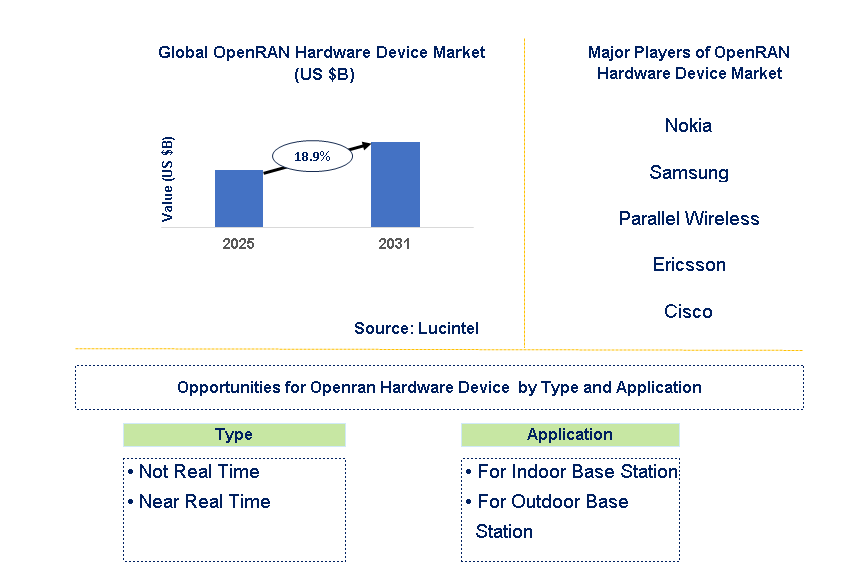
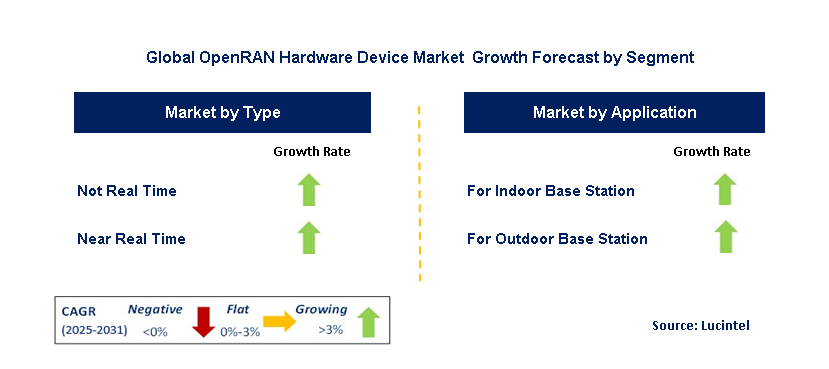
The future of the global openRANhardware device market looks promising with opportunities in the for indoor base station and for outdoor base station markets. The global openRANhardware device market is expected to grow with a CAGR of 18.9% from 2025 to 2031. The major drivers for this market are growing demand for 5g infrastructure, rising demand for affordable and scalabl, and increasing demand for network flexibility.Lucintel forecasts that, within the type category, near real-time is expected to witness higher growth over the forecast period.
Within the application category, outdoor base station is expected to witness the higher growth.
In terms of region, APAC is expected to witness the highest growth over the forecast period.
Gain valuable insights for your business decisions with our comprehensive 150+ page report. Sample figures with some insights are shown below.
Emerging Trends in the OpenRAN Hardware Device Market
The open hardware device market for OpenRAN is being revolutionized by new trends that are also transforming the nature of the telecommunication industry as a whole. It represents a bigger trend toward a more flexible, interoperable, and cost-effective solution. The technologies are getting momentum across all regions around the world with more focus on innovations that will help improve the efficiency, scalability, and security of the networks. Emerging new standards, rising demand for 5G, and changing regulatory environments are major driving factors. Five key trends influence the OpenRAN hardware market and create new opportunities for telecom providers and hardware manufacturers, as explained below.• Shift Towards Multi-Vendor Ecosystems: The most prominent trend in the OpenRAN hardware market is the shift toward multi-vendor ecosystems. Telecom operators are looking to reduce vendor lock-in and increase flexibility by sourcing hardware from multiple providers. This allows operators to optimize their networks, lowering costs and fostering innovation. It also promotes greater competition among vendors, which can lead to faster technological advancements and better pricing for hardware solutions. With OpenRAN, operators can integrate hardware from various vendors, ensuring better compatibility and choice, which is essential for the 5G rollout.
• Increased Focus on Cost Efficiency: Cost efficiency remains a key focus within the OpenRAN hardware market, especially in the context of global 5G expansion. OpenRAN’s modular nature enables telecom providers to choose hardware components that best suit their needs, thus reducing capital and operational expenditure. Now with increasing competition between these hardware producers as well as telecommunication companies both are eager to get a larger share in revenue by saving all extra costs, whereas the benefitting of adding shelf hardware as well as off the shelf software along with the networking system increases cost savings without lowering quality performance and scale level for OpenRAN.
• OpenRAN Hardware Device Demand Rises with Expansion : The OpenRAN technologies give telecom operators the ability to scale their 5G networks very quickly and efficiently with more flexible and cost-effective infrastructure solutions. The OpenRAN allows the operator to mix and match components from different vendors, which is very crucial for the dense networks needed to be deployed for 5G services. This trend is particularly important in regions where 5G adoption is accelerating because OpenRAN ensures network readiness and minimizes the costs of deployment.
• Standardization and Interoperability: One of the significant trends occurring in the openRAN hardware market is standardization and interoperability. The community behind openRAN is working hard toward developing standards-based open, open interfaces enabling the workability of hardware or software from two different vendors' lines. In itself, that's a strong move forward, supporting innovation, eliminating high costs for multiple proprietary variations, and getting ahead in bringing faster and advanced forms of network to markets. Such bodies include the O-RAN Alliance, which defines standards for OpenRAN hardware devices, ensuring that they meet specified interoperability and quality levels.
• Security and Privacy Enhancements: The more widespread OpenRAN deployments become, the more pressing security and privacy issues become. Telecom operators are becoming more concerned about securing their networks against cyber attacks and safeguarding personal data. OpenRAN hardware providers are investing in advanced security measures, including encryption and secure interfaces, to secure network traffic and avoid unauthorized access. Because of the open nature of OpenRAN, ensuring strong security frameworks is essential in order to prevent vulnerabilities that might be exploited in the future. Improved security will play a major role in hastening the pace of adoption of OpenRAN technology in sensitive markets that have stringent data privacy regulations.
The above trends are going to make OpenRAN hardware device market a flexible, cost-effective, scalable, and security-focused one. OpenRAN technologies have proven to be a viable replacement for proprietary, single-vendor solutions as the demand for 5G networks increases; thus, helping telecom providers optimize their network infrastructure. The call for multisourced ecosystems, cost-effectiveness, and standardization underlines how the future of the OpenRAN hardware market is going to take shape.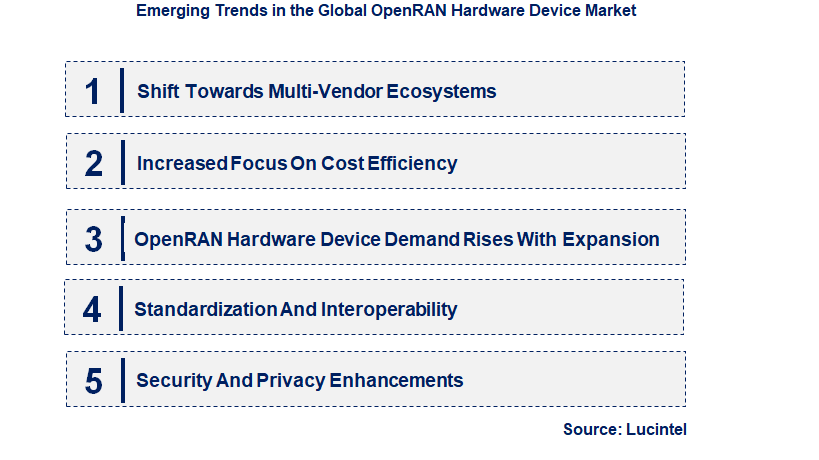
Recent Development in the OpenRAN Hardware Device Market
The OpenRAN hardware device market has seen several key developments that have had a significant impact on the telecom sector. These developments are driving adoption, fostering innovation, and improving the flexibility and scalability of telecom infrastructure. As the demand for next-gen mobile networks like 5G continues to grow, open RAN hardware is becoming an increasingly integral part of the solution. Telecom operators and hardware manufacturers are navigating new opportunities and challenges presented by open RAN technologies. Five key developments in the OpenRAN hardware device market are reshaping the industry below.• Increased Collaboration Across Industry Stakeholders: Telecom operators, hardware vendors, and software providers are increasingly collaborating with each other within the OpenRAN ecosystem. In this manner, challenges such as interoperability, performance optimization, and security can be addressed collectively through collaborations. The solutions created through these collaborations cater to the differences in the diverse needs of telecom operators, which range from small regional players to large multinational giants. Industry stakeholders should be aligned around common standards for acceleration of OpenRAN adoption, to ensure that hardware devices can work seamlessly together in real-world network environments.
• Government Support for OpenRAN Technologies: The United States, Europe, and India, among other governments in the same regions, have been promoting OpenRAN through financing and policy, which helps curb reliance on foreign vendors for proprietary network equipment. Public sector investment in R&D, combined with partnerships between governments and the industry leaders, enables the development of the next generation of telecom infrastructure. Government support helps accelerate the use of OpenRAN technologies to make them accessible and push forward the market.
• Advances in the Integration of 5G and Edge Computing: The integration of OpenRAN hardware with 5G and edge computing technologies drives intense innovation in the telecom network industry. OpenRAN facilitates flexibility, scalability, and cost-effectiveness in 5G deployment, which, in turn, are increasingly combined with edge computing for applications based on ultra-low latencies. This is particularly significant for industries such as autonomous vehicles, smart cities, and industrial automation, where low latency and real-time data processing are paramount. OpenRAN, 5G, and edge computing convergence are unlocking new opportunities for telecom operators and their customers.
• New Entrants into the Market: The OpenRAN hardware market is witnessing entry by new players, many of whom were not typically involved in telecom infrastructure. The entrance of new startups and non-traditional companies in the market, with innovative hardware solutions that disrupt the status quo of established telecom giants, is another aspect of the diversification of the OpenRAN ecosystem. New entrants bring new ideas, new technology, and competitive pricing. All these are providing greater choice and better pricing to telecom operators, accelerating the adoption of OpenRAN hardware.
• Improved Hardware Performance: OpenRAN hardware has been improved in terms of performance, with vendors focusing on developing more powerful and efficient components. Improvements include processing power, energy efficiency, and overall reliability, making OpenRAN hardware increasingly suitable for large-scale network deployments. These performance gains are critical as telecom operators scale their networks to meet the demands of 5G and beyond. The continuous progress in OpenRAN hardware, for instance, would ensure a good support for next-generation telecom services that have competitive prices.
The developments in the OpenRAN hardware device market are opening significant opportunities for telecom operators and vendors alike. Increased collaboration, government support, integration with 5G and edge computing, entry of new players, and improved hardware performance are all contributing to a dynamic and rapidly evolving market. These developments are making OpenRAN a key enabler of next-gen telecom infrastructure and are helping drive the transition to more open, flexible, and cost-effective networks.Strategic Growth Opportunities in the OpenRAN Hardware Device Market
Several strategic market growth opportunities exist in OpenRAN hardware devices across various key applications. With evolving telecom networks, the need for more flexible, cost-effective, and interoperable hardware solutions will continue. OpenRAN technologies offer telecom operators flexibility that was previously unattainable to mix vendor equipment in network deployment. Here are five key growth opportunities in the OpenRAN hardware market, each addressing distinct needs in telecom infrastructure, from 5G rollouts to connectivity in rural areas.• 5G Network Deployment: The demand for OpenRAN hardware is growing alongside the global rollout of 5G networks. Telecom operators require flexible, scalable, and cost-efficient solutions to expand their 5G coverage rapidly. OpenRAN technologies offer a modular approach that enables operators to deploy 5G infrastructure more quickly, with greater flexibility in vendor selection. This growth opportunity will be particularly significant in regions with accelerating 5G adoption; it will bring demand for higher-performance hardware solutions needed to meet performance requirements of the next generation in mobile networks.
• Rural Connectivity Expansion: Improved rural connectivity would be one of the major growth opportunities for OpenRAN hardware. The flexibility and cost-effectiveness provided by OpenRAN can serve as an ideal solution for the expansion of telecom networks in underserved rural areas, which have limited infrastructure that has had costs in the past. OpenRAN enables more affordable and scalable options, thereby reducing the financial hurdles created towards deploying rural networks. Increasingly, governments and telecom operators are focusing on rural connectivity, making this a very strong area for growth in OpenRAN hardware.
• Edge Computing and IOT: Edge computing and Internet of Things are some of the greatest growth areas for OpenRAN hardware because the same technology also helps to address the telecom operator's quest for low-latency applications such as autonomous vehicles and smart cities. Through the ability of OpenRAN to be fully integrated with edge computing platforms, the data processing time can be reduced real-time and this can further contribute to efficiency improvement in networks; therefore, OpenRAN will serve as an enabling factor for a new wave of IoT and edge computing applications.
• Private Networks for Enterprises: Private 5G networks are one of the most important application areas for OpenRAN hardware. Enterprises are increasingly looking for secure, high-performance, and customizable networks, and private 5G solutions are the answer. OpenRAN hardware offers the flexibility and scalability needed for enterprises to deploy tailored private networks without relying on proprietary equipment. This is particularly valuable in industries like manufacturing, logistics, and healthcare, where businesses require dedicated, high-performance networks to support critical applications.
• Network Slicing: Network slicing is an emerging technology that allows telecom operators to create a multi-virtual network in a single physical network, tailored to specific use cases. The OpenRAN hardware is well-suited to supporting this deployment to create isolated virtual networks. It would open up a great growth opportunity for OpenRAN technologies in both enterprise and consumer markets since it allows operators to allocate the resources and meet the specific needs of different applications.
OpenRAN hardware growth opportunities range from 5G deployment to private enterprise networks. While telecom operators and industries are continually searching for solutions that are flexible, cost-effective, and scalable, OpenRAN technology provides significant scope for growth in this respect. With continued innovation in telecom infrastructure, strategic opportunities of such a nature will lead to future opportunities in the OpenRAN hardware market.OpenRAN Hardware Device Market Driver and Challenges
The open RAN hardware device market is influenced by both drivers and challenges. The growth of the market can be driven by the advancement of technology, economic factors, and regulatory pressures, while challenges include interoperability and security concerns. The evolving nature of telecom networks and increasing adoption of 5G call for more flexible, cost-effective solutions. However, an open system such as OpenRAN poses challenges for system integrity and vendor interoperability. We dive into five key drivers and three challenges that impact the OpenRAN hardware market, described below.The factors responsible for driving the openran hardware device market include:
1. Technological advancements in telecom networks: Technological progress, particularly in 5G and edge computing, is a primary driver for the OpenRAN hardware market. OpenRAN's modular approach allows telecom operators to rapidly deploy next-gen networks. As demand for 5G services increases, OpenRAN provides a flexible solution for telecom operators to scale their networks without relying on proprietary systems, making it a key enabler for 5G rollouts.
2. Cost Reduction Pressures: Telecom operators are under constant pressure to reduce capital and operational costs. OpenRAN’s ability to integrate hardware from multiple vendors and use off-the-shelf components offers significant cost savings compared to traditional proprietary systems. This driver is particularly important for smaller operators and markets where budget constraints limit network infrastructure investments.
3. Regulatory Support and Policy Initiatives: Governments and other regulatory bodies in countries around the world are supporting the development of OpenRAN through funding efforts and policy development aimed at reducing dependence on proprietary providers for network equipment. In doing this, regulatory efforts include stimulating openness to lower prices and increase resilience by encouraging competition, which is achieving rapid adoption and favorable market conditions.
4. Increasing Demand for Interoperability: There is increasing demand for interoperability from telecom operators, which is another advantage of having OpenRAN hardware, as operators look to have interoperability between different network components. With the ability to bring together devices from different vendors, an operator can create a more flexible, diverse, and efficient network. It is particularly critical in global markets where telecom providers look for more customized and future-proofed solutions.
5. Global Push for 5G Networks: A global push for 5G networks has also increased demand for the OpenRAN hardware. Telecom operators require cost-effective and scalable infrastructure solutions to support the increased data demands of 5G. Here, OpenRAN comes as a solution that can help meet this demand, positioning it as a key enabler in the global 5G race.
Challenges in the openran hardware device market are:
1. Interoperability Issues: Although OpenRAN has many advantages, there are interoperability issues between hardware and software components from various vendors. One of the significant challenges is that it is a challenge to integrate multiple vendors without any hitch, and different network elements must work together seamlessly to realize the full potential of OpenRAN.
2. Security Concerns: The open nature of OpenRAN introduces potential security risks. Telecom operators are concerned about vulnerabilities in the network infrastructure, especially with third-party vendors involved. OpenRAN hardware providers are investing in enhanced security protocols and measures to mitigate these risks, but ensuring the security of open networks remains a key challenge.
3. Complexity of Implementation : OpenRAN hardware solutions pose complexity in deployment, especially with operators who are habitual to proprietary systems. Network management and integration require more changes in its structure, increasing the cost, and time input for the transitions. This implies that careful planning and collaboration involving operators, hardware vendors, and software developers will be an important step.
The drivers and challenges in the OpenRAN hardware device market reflect the complexities of transitioning to a more open and flexible telecom infrastructure. Technological advancements, cost reduction pressures, and regulatory support are accelerating adoption, while challenges related to interoperability, security, and implementation complexity need to be addressed. Together, these factors are shaping the evolution of the OpenRAN hardware market, presenting both opportunities and obstacles for telecom operators and hardware vendors.
List of OpenRANHardware Device Companies
Companies in the market compete on the basis of product quality offered. Major players in this market focus on expanding their manufacturing facilities, R&D investments, infrastructural development, and leverage integration opportunities across the value chain. With these strategies openRANhardware device companies cater increasing demand, ensure competitive effectiveness, develop innovative products & technologies, reduce production costs, and expand their customer base. Some of the openRANhardware device companies profiled in this report include-• Nokia
• Samsung
• Parallel Wireless
• Ericsson
• Cisco
• Dell
• Altiostar
OpenRANHardware Device Market by Segment
The study includes a forecast for the global openRANhardware device market by type, application, and region.OpenRANHardware Device Market by Type [Value from 2019 to 2031]:
• Not Real Time
• Near Real Time
OpenRANHardware Device Market by Application [Value from 2019 to 2031]:
• For Indoor Base Station
• For Outdoor Base Station
OpenRANHardware Device Market by Region [Value from 2019 to 2031]:
• North America
• Europe
• Asia Pacific
• The Rest of the World
Country Wise Outlook for the OpenRAN Hardware Device Market
The OpenRAN hardware device market has witnessed significant advancements across various global markets, driven by the need for more flexible, cost-effective, and interoperable networking solutions. OpenRAN (Open Radio Access Network) allows telecom operators to mix and match components from different vendors, avoiding reliance on proprietary systems from traditional network equipment providers. As 5G rollout speeds up and digital transformation continues, key markets including the United States, China, Germany, India, and Japan are witnessing rapid developments in OpenRAN hardware. These changes are reshaping telecom infrastructure, driving innovation, and presenting new opportunities for telecom providers and hardware manufacturers.• United States: In the United States, OpenRAN hardware uptake is increasing as giant telecoms like Verizon and AT&T are looking increasingly towards diversification of their network infrastructure. OpenRAN adoption has been supported in the United States by funding and initiatives that can help reduce foreign dependency on technology vendors, especially Huawei, a Chinese company. In the market, there are business collaborations involving American companies and international players, for instance, Nokia and Ericsson, in an effort to build more open and interoperable hardware. The attractiveness of creating a competitive open ecosystem in the U.S. is driving growth in the sector of hardware devices.
• China: OpenRAN's hardware device market in China is being shaped by both domestic and international developments. Chinese telecom giants such as Huawei and ZTE, historically leading players in the infrastructure of the network market, are still very significant though faced with increased competition from international regulatory pressures. Chinese authorities are investing in OpenRAN technologies, where the state aims at modernizing networks and further building an open and flexible infrastructure. However, political tensions and trade restrictions, especially with the United States, pose challenges to China's OpenRAN hardware market, although local players are finding ways to innovate and cater to domestic needs.
• Germany: Germany is witnessing a rapid shift to OpenRAN hardware solutions, which are driven by the European Union's efforts to diversify telecom infrastructure and promote more competition. Deutsche Telekom is also one of the pioneering telecom service providers in the country to roll out OpenRAN technology, to test new hardware components from different vendors. Germany market has both European and non-European companies investing in this region. Local players combine efforts with international companies to provide more cost-efficient, scalable solutions. Regulatory support and the necessity to introduce next-gen mobile services push the country toward using OpenRAN hardware.
• India: India’s OpenRAN hardware market is expanding rapidly, with the government actively supporting telecom infrastructure innovation. Key players like Bharti Airtel and Reliance Jio are exploring OpenRAN technologies to improve network performance, reduce costs, and scale 5G services across the country. Indian firms are increasingly partnering with global vendors to develop cost-effective and interoperable OpenRAN hardware. India is seeing huge growth in population and digital demand, which, along with the government efforts to improve connectivity, is positively driving the adoption of OpenRAN. However, it faces challenges concerning funding and rollout complexity in the rural areas for 5G.
• Japan: The country is also embracing OpenRAN hardware development as part of its wider telecom modernization effort. Key telecom companies, such as NTT and SoftBank, are conducting trials and deployments of OpenRAN solutions to enhance 5G coverage and reduce reliance on proprietary hardware from traditional vendors. Japan is focusing on driving innovation through local collaborations with global OpenRAN vendors. The market is particularly influenced by the need for flexibility, security, and cost reduction in telecom infrastructure. As Japan steps into the age of more advanced 5G capabilities, the OpenRAN hardware area becomes a major hub of innovation and investment.

Features of the Global OpenRANHardware Device Market
Market Size Estimates: openRANhardware device market size estimation in terms of value ($B).Trend and Forecast Analysis: Market trends (2019 to 2024) and forecast (2025 to 2031) by various segments and regions.
Segmentation Analysis: openRANhardware device market size by type, application, and region in terms of value ($B).
Regional Analysis: openRANhardware device market breakdown by North America, Europe, Asia Pacific, and Rest of the World.
Growth Opportunities: Analysis of growth opportunities in different type, application, and regions for the openRANhardware device market .
Strategic Analysis: This includes M&A, new product development, and competitive landscape of the openRANhardware device market .
Analysis of competitive intensity of the industry based on Porter’s Five Forces model.

FAQ
Q1. What is the growth forecast for openRANhardware device market ?Answer: The global openRANhardware device market is expected to grow with a CAGR of 18.9% from 2025 to 2031.
Q2. What are the major drivers influencing the growth of the openRANhardware device market ?
Answer: The major drivers for this market are growing demand for 5g infrastructure, rising demand for affordable and scalabl, and increasing demand for network flexibility.
Q3. What are the major segments for openRANhardware device market ?
Answer: The future of the openRANhardware device market looks promising with opportunities in the for indoor base station and for outdoor base station markets.
Q4. Who are the key openRANhardware device market companies?
Answer: Some of the key openRANhardware device companies are as follows:
• Nokia
• Samsung
• Parallel Wireless
• Ericsson
• Cisco
• Dell
• Altiostar
Q5. Which openRANhardware device market segment will be the largest in future?Answer: Lucintel forecasts that near real-time is expected to witness higher growth over the forecast period.
Q6. In openRANhardware device market , which region is expected to be the largest in next 5 years?
Answer: APAC is expected to witness the highest growth over the forecast period.
Q7. Do we receive customization in this report?
Answer: Yes, Lucintel provides 10% customization without any additional cost.
Table of Contents
Methodology
- In-depth interviews of the major players in this market
- Detailed secondary research from competitors’ financial statements and published data
- Extensive searches of published works, market, and database information pertaining to industry news, company press releases, and customer intentions
- A compilation of the experiences, judgments, and insights of Lucintel’s professionals, who have analyzed and tracked this market over the years.


Buy Now
Choose a license that fits your team. Instant PDF delivery.
Prices exclude taxes. Instant delivery. Custom licensing available on request.
Key Questions
- • What are some of the most promising, high-growth opportunities for the openRANhardware device market by type (not real time and near real time), application (for indoor base station and for outdoor base station), and region (North America, Europe, Asia Pacific, and the Rest of the World)?
- • Which segments will grow at a faster pace and why?
- • Which region will grow at a faster pace and why?
- • What are the key factors affecting market dynamics? What are the key challenges and business risks in this market?
- • What are the business risks and competitive threats in this market?
- • What are the emerging trends in this market and the reasons behind them?
- • What are some of the changing demands of customers in the market?
- • What are the new developments in the market? Which companies are leading these developments?
- • Who are the major players in this market? What strategic initiatives are key players pursuing for business growth?
- • What are some of the competing products in this market and how big of a threat do they pose for loss of market share by material or product substitution?
- • What M&A activity has occurred in the last 5 years and what has its impact been on the industry? For any questions related to OpenRANHardware Device Market, OpenRANHardware Device Market Size, OpenRANHardware Device Market Growth, OpenRANHardware Device Market Analysis, OpenRANHardware Device Market Report, OpenRANHardware Device Market Share, OpenRANHardware Device Market Trends, OpenRANHardware Device Market Forecast, OpenRANHardware Device Companies, write Lucintel analyst at email: helpdesk@lucintel.com. We will be glad to get back to you soon.


