
Report Feature
Nuclear Battery Market Trends and Forecast
The future of the global nuclear battery market looks promising with opportunities in the automotive, residential, commercial, and industrial markets. The global nuclear battery market is expected to grow with a CAGR of 8.7% from 2025 to 2031. The major drivers for this market are the increasing demand for long-lasting power sources, the rising use in space exploration missions, and the growing application in defense & remote sensors.• Lucintel forecasts that, within the type category, thermal conversion battery is expected to witness higher growth over the forecast period.
• Within the application category, industrial is expected to witness the highest growth.
• In terms of region, APAC is expected to witness the highest growth over the forecast period. Gain valuable insights for your business decisions with our comprehensive 150+ page report. Sample figures with some insights are shown below.

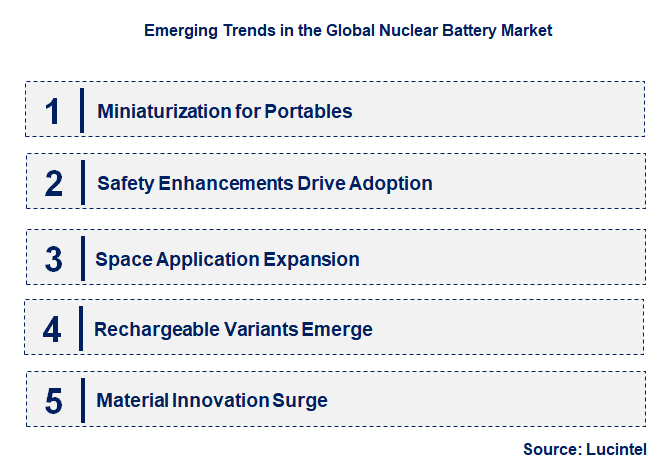
Emerging Trends in the Nuclear Battery Market
Emerging trends in the nuclear battery market emphasize ultra-durable, eco-safe power amid rising autonomous demands. Advancements target rechargeability and miniaturization for diverse sectors like space and wearables. These shifts bridge efficiency gaps, unlocking commercial scalability. They redefine energy storage, prioritizing longevity over frequent replacements.• Miniaturization for Portables: Shrinking designs enable integration into implants and gadgets, boosting power density without bulk. This extends device lifespans, reducing e-waste and user interventions. Impact includes widespread medical adoption, cost savings in healthcare, and inspiration for IoT ecosystems with seamless, maintenance-free operation.
• Safety Enhancements Drive Adoption: Novel materials like silicon carbide shield radiation, making batteries viable for consumer markets. Regulatory approvals follow rigorous testing. This builds public trust, expands terrestrial uses beyond space, and accelerates commercialization, mitigating risks while amplifying market accessibility.
• Space Application Expansion: Optimized for extreme conditions, nuclear batteries power long-duration missions and satellites. Efficiency gains support deep-space probes. The trend fuels aerospace investments, ensures mission reliability, and spills over to terrestrial drones, enhancing global exploration capabilities.
• Rechargeable Variants Emerge: Breakthroughs in uranium-based recharging overcome one-way decay limits, enabling cycles for renewables buffering. This hybridizes nuclear with solar, stabilizing grids. Impact transforms intermittent energy handling, cuts fossil dependence, and positions batteries as versatile storage hubs.
• Material Innovation Surge: Perovskites and chalcogenides improve conversion efficiency and compactness. Research yields higher outputs from low-volume sources. This catalyzes cross-sector disruptions, attracts funding, and elevates nuclear batteries in high-stakes fields like defense, driving broader efficiency benchmarks. These trends reshape the nuclear battery market by prioritizing durability and versatility. They dismantle legacy barriers, fostering integration across industries from health to energy. Collectively, innovations spur growth, align with sustainability mandates. This evolution cements nuclear batteries as enablers of resilient, future-proof power networks.
Recent Development in the Nuclear Battery Market
Nuclear battery market developments spotlight breakthroughs in longevity and safety for niche power needs. From funding rounds to prototype launches, they enhance viability in space and autonomy. These milestones blend research with industry, overcoming radiation hurdles. They signal a sector maturing toward widespread, reliable deployment.• Funding Boost for Startups: A U.S. firm raised millions to scale nuclear battery tech for defense and exploration. This accelerates prototyping and testing phases. Impact includes faster market entry, diversified supply chains, and heightened investor confidence, propelling innovation velocity across applications.
• Long-Lifespan Battery Unveil: Chinese researchers introduced a carbon-14 model lasting millennia, encased for safety. Efficiency soared threefold for practical uses. This democratizes ultra-durable power, spurs consumer electronics growth, and sets global standards for sustainable, low-maintenance energy sources.
• Rechargeable Uranium Prototype: Japan assembled the first uranium-based rechargeable battery from waste, confirming cycle performance. It targets renewable integration. The development recycles resources, reduces waste, and enables grid-scale buffering, transforming nuclear tech into a circular, versatile asset.
• Material Efficiency Leap: Global efforts harness perovskites for compact, high-output designs, improving power conversion. This suits sensors and wearables. Consequences encompass lighter aerospace loads, extended runtimes, and R&D momentum, elevating competitiveness against conventional batteries.
• Space Endurance Innovation: A century-long battery for outer space emerged, enduring vacuum and radiation. It powers uncrewed probes indefinitely. This bolsters mission economics, minimizes resupply needs, and inspires terrestrial analogs for remote monitoring, expanding operational frontiers. These developments impact the nuclear battery market by amplifying practicality and reach. They ignite collaborations, align with exploration goals, and broaden economic viability. Overall, they dismantle adoption obstacles, fostering a greener trajectory. This catalyzes transformative shifts in enduring power solutions worldwide.
Strategic Growth Opportunities in the Nuclear Battery Market
Strategic opportunities in the nuclear battery market exploit longevity for high-reliability applications. Tailored to space, health, and autonomy, they leverage safety gains for sector penetration. These pathways blend tech with demand, capturing value in underserved niches. They drive exponential scaling amid electrification surges.• Space Exploration Powering: Ultra-reliable batteries sustain satellites and rovers in harsh voids, outlasting solar limits. This extends mission durations, slashing launch costs. Impact revolutionizes deep-space ventures, secures contracts with agencies, and transfers tech to commercial orbits for persistent monitoring.
• Medical Implant Integration: Compact designs fuel pacemakers and sensors for lifetime operation without surgery. Biocompatibility ensures safe implantation. This improves patient outcomes, cuts healthcare expenses, and expands to neural devices, positioning nuclear batteries as staples in proactive medicine.
• Military Remote Sensing: Durable power for unmanned systems in denied areas enables persistent surveillance. Radiation shielding suits tactical deployments. Growth here fortifies defense postures, reduces logistics burdens, and opens export markets, enhancing strategic autonomy in contested environments.
• Autonomous Drone Operations: Long-endurance packs enable non-stop flights for delivery and inspection. Miniaturization fits aerial payloads. This disrupts logistics chains, boosts efficiency in infrastructure checks, and inspires swarm tech, embedding batteries in urban mobility ecosystems.
• Industrial Remote Monitoring: Batteries power oil rigs and pipelines in inaccessible spots, minimizing downtime. Harsh-condition resilience adds value. The opportunity stabilizes critical infrastructures, lowers operational risks, and aligns with energy transitions, amplifying reliability in extractive sectors. These opportunities impact the nuclear battery market by targeting resilient niches. They amplify revenues, innovate deployments, and sync with autonomy waves. Ultimately, this cultivates a dynamic, application-rich arena. It accelerates equitable energy access and tech synergies globally.
Nuclear Battery Market Driver and Challenges
The nuclear battery market navigates technological, economic, and regulatory influences shaping its path. Drivers like longevity demands propel adoption, while safety norms pose tests. These factors interplay to spur balanced progress. They outline a landscape demanding innovation for sustained momentum. The factors responsible for driving the nuclear battery market include: 1. Long-Life Power Demand: Need for maintenance-free sources in remote ops drives uptake in space and sensors. This cuts replacement logistics, appealing to high-stakes users. Implications include cost efficiencies, broader sector integration, and market expansion through proven reliability. 2. Space Mission Requirements: Agencies seek enduring energy for probes, fueling R&D investments. This ensures uninterrupted data flows. The driver accelerates tech maturation, secures funding streams, and spills benefits to civilian aerospace, elevating global exploration standards. 3. Miniaturization Advances: Compact designs suit wearables and implants, meeting portability trends. Efficiency tweaks enhance output. This fosters consumer and medical growth, attracts diverse investments, and positions batteries as enablers of next-gen devices. 4. Safety Technology Improvements: Shielding innovations mitigate risks, easing approvals. This builds stakeholder confidence. Consequences encompass wider applications, regulatory streamlining, and competitive edges, transforming perceptions from niche to mainstream viable. 5. Regulatory Support Evolution: Policies favoring clean, dense energy incentivize development. This unlocks subsidies and partnerships. The driver hastens commercialization, bridges compliance gaps, and diversifies uses, anchoring nuclear batteries in sustainable frameworks. Challenges in the nuclear battery market are: 1. Stringent Safety Regulations: Rigorous radiation controls delay deployments and raise compliance costs. This confines early uses to vetted sectors. The challenge slows scaling, heightens entry barriers, and demands ongoing validation to broaden accessibility. 2. High Development Expenses: Exotic materials and testing inflate upfront investments. Supply constraints exacerbate this. Implications include limited startup participation, prolonged ROI timelines, and reliance on public funding, tempering rapid market penetration. 3. Public Perception Barriers: Fears of nuclear risks hinder acceptance despite safety proofs. Media amplifies concerns. This curbs consumer adoption, influences policy hesitancy, and necessitates education campaigns to unlock full potential. Drivers such as longevity and space needs thrust nuclear batteries toward expansive roles. Challenges like regulations require vigilant resolutions to capitalize gains. Net, optimistic expansion prevails with strategic focus. This forges a robust trajectory for innovative, enduring energy paradigms.List of Nuclear Battery Companies
Companies in the market compete on the basis of product quality offered. Major players in this market focus on expanding their manufacturing facilities, R&D investments, infrastructural development, and leverage integration opportunities across the value chain. With these strategies nuclear battery companies cater increasing demand, ensure competitive effectiveness, develop innovative products & technologies, reduce production costs, and expand their customer base. Some of the nuclear battery companies profiled in this report include-• Exide Technologies
• Tesla Energy
• Vattenfall
• American Elements
• Curtiss-Wright Corporation
• Comsoll
• Thermo
Nuclear Battery Market by Segment
The study includes a forecast for the global nuclear battery market by type, application, and region.Nuclear Battery Market by Type [Value from 2019 to 2031]:
• Thermal Conversion Batteries
• Non-thermal Conversion Batteries
Nuclear Battery Market by Application [Value from 2019 to 2031]:
• Automotive
• Residential
• Commercial
• Industrial
• Others
Nuclear Battery Market by Region [Value from 2019 to 2031]:
• North America
• Europe
• Asia Pacific
• The Rest of the World
Country Wise Outlook for the Nuclear Battery Market
The nuclear battery market surges with innovations in compact, long-lasting power for extreme environments. Driven by space exploration and remote sensing needs, countries advance safety and efficiency. These efforts reduce reliance on frequent recharges, supporting sustainable tech amid energy transitions. Overall, they position nuclear batteries as vital for future autonomous systems.• United States: A startup secured substantial funding to accelerate nuclear battery production for space and defense. Researchers developed radiocarbon-based designs for safe, decades-long operation without charging. This enhances reliability in sensors and drones, cutting maintenance costs and boosting U.S. leadership in autonomous tech ecosystems.
• China: Scientists unveiled a carbon-14 nuclear battery encased in silicon carbide, achieving millennium-long lifespan with high stability. Efficiency tripled over prior models, targeting consumer and industrial uses. This propels mass production plans, lowering barriers for portable devices and strengthening Chinas edge in durable energy solutions.
• Germany: Focus intensifies on fusion-integrated battery tech, funding material advancements for efficient nuclear storage. Projects repurpose nuclear sites for hybrid systems blending radioisotopes with renewables. This fosters grid stability, aligns with EU green goals, and accelerates R&D for compact, high-output batteries in industrial applications.
• India: BARC pioneered nuclear batteries harnessing radioactive decay for extended operation in remote areas. Indigenous designs leverage thorium reserves for space and medical implants. This addresses energy access gaps, spurs local manufacturing, and positions India as a key player in affordable, long-life power for developing infrastructure.
• Japan: Engineers created the worlds first uranium rechargeable battery using depleted waste, verifying performance in tests. A space-grade variant promises century-long runtime under harsh conditions. This recycles materials, supports satellite missions, and enhances Japans precision in sustainable, high-endurance energy for aerospace and renewables.

Features of the Global Nuclear Battery Market
Market Size Estimates: Nuclear battery market size estimation in terms of value ($B). Trend and Forecast Analysis: Market trends (2019 to 2024) and forecast (2025 to 2031) by various segments and regions. Segmentation Analysis: Nuclear battery market size by type, application, and region in terms of value ($B). Regional Analysis: Nuclear battery market breakdown by North America, Europe, Asia Pacific, and Rest of the World. Growth Opportunities: Analysis of growth opportunities in different types, applications, and regions for the nuclear battery market. Strategic Analysis: This includes M&A, new product development, and competitive landscape of the nuclear battery market. Analysis of competitive intensity of the industry based on Porter’s Five Forces model.
FAQ
Q1. What is the growth forecast for nuclear battery market? Answer: The global nuclear battery market is expected to grow with a CAGR of 8.7% from 2025 to 2031. Q2. What are the major drivers influencing the growth of the nuclear battery market? Answer: The major drivers for this market are the increasing demand for long-lasting power sources, the rising use in space exploration missions, and the growing application in defense & remote sensors. Q3. What are the major segments for nuclear battery market? Answer: The future of the nuclear battery market looks promising with opportunities in the automotive, residential, commercial, and industrial markets. Q4. Who are the key nuclear battery market companies? Answer: Some of the key nuclear battery companies are as follows:• Exide Technologies
• Tesla Energy
• Vattenfall
• American Elements
• Curtiss-Wright Corporation
• Comsoll
• Thermo Q5. Which nuclear battery market segment will be the largest in future? Answer: Lucintel forecasts that, within the type category, thermal conversion battery is expected to witness higher growth over the forecast period. Q6. In nuclear battery market, which region is expected to be the largest in next 5 years? Answer: In terms of region, APAC is expected to witness the highest growth over the forecast period. Q7. Do we receive customization in this report? Answer: Yes, Lucintel provides 10% customization without any additional cost.
List of Figures
List of Tables
Methodology
- In-depth interviews of the major players in this market
- Detailed secondary research from competitors’ financial statements and published data
- Extensive searches of published works, market, and database information pertaining to industry news, company press releases, and customer intentions
- A compilation of the experiences, judgments, and insights of Lucintel’s professionals, who have analyzed and tracked this market over the years.


Buy Now
Choose a license that fits your team. Instant PDF delivery.
Prices exclude taxes. Instant delivery. Custom licensing available on request.
Key Questions
- • What are some of the most promising, high-growth opportunities for the nuclear battery market by type (thermal conversion batteries and non-thermal conversion batteries), application (automotive, residential, commercial, industrial, and others), and region (North America, Europe, Asia Pacific, and the Rest of the World)?
- • Which segments will grow at a faster pace and why?
- • Which region will grow at a faster pace and why?
- • What are the key factors affecting market dynamics? What are the key challenges and business risks in this market?
- • What are the business risks and competitive threats in this market?
- • What are the emerging trends in this market and the reasons behind them?
- • What are some of the changing demands of customers in the market?
- • What are the new developments in the market? Which companies are leading these developments?
- • Who are the major players in this market? What strategic initiatives are key players pursuing for business growth?
- • What are some of the competing products in this market and how big of a threat do they pose for loss of market share by material or product substitution?
- • What M&A activity has occurred in the last 5 years and what has its impact been on the industry? For any questions related to Nuclear Battery Market, Nuclear Battery Market Size, Nuclear Battery Market Growth, Nuclear Battery Market Analysis, Nuclear Battery Market Report, Nuclear Battery Market Share, Nuclear Battery Market Trends, Nuclear Battery Market Forecast, Nuclear Battery Companies, write Lucintel analyst at email: helpdesk@lucintel.com. We will be glad to get back to you soon.


