
Report Feature
Low-Cost Bluetooth 5.0 Module Trends and Forecast
The future of the global low-cost bluetooth 5.0 module market looks promising with opportunities in the consumer electronic, medical equipment, and industrial iot markets. The global low-cost bluetooth 5.0 module market is expected to grow with a CAGR of 3.5% from 2024 to 2030. The major drivers for this market are increasing demand for iot applications, growing market for wearable devices, and rising integration of bluetooth technology in automotive infotainment systems.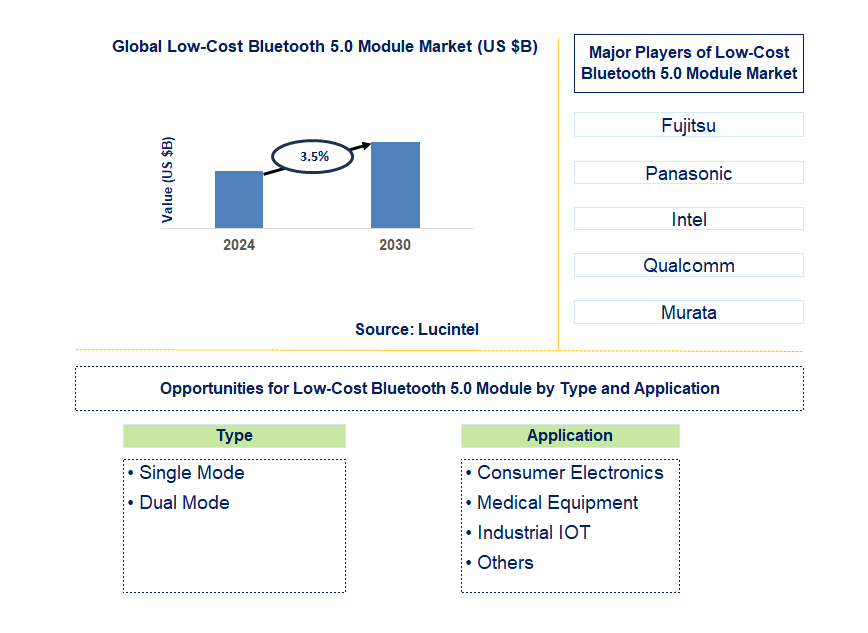
Country Wise Outlook for the Low-Cost Bluetooth 5.0 Module Market
The Low-Cost Bluetooth 5.0 Module is also undergoing rapid changes, given the increased demand for connectivity and smart devices all over the world. The Low-Cost Bluetooth 5.0 Module market in the United States, China, Germany, India, and Japan is all li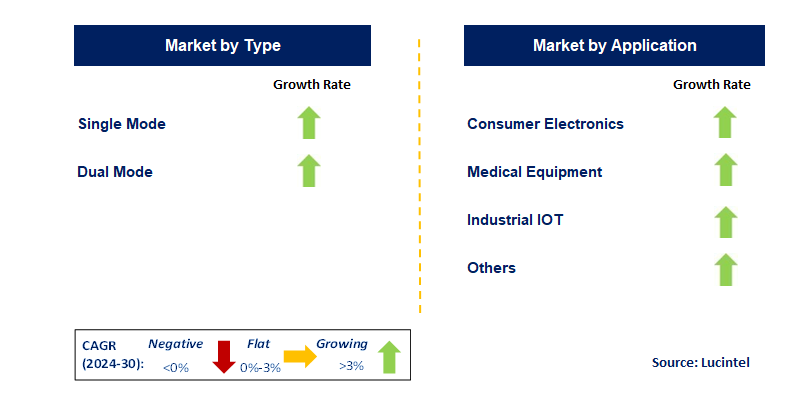
Emerging Trends in the Low-Cost Bluetooth 5.0 Module Market
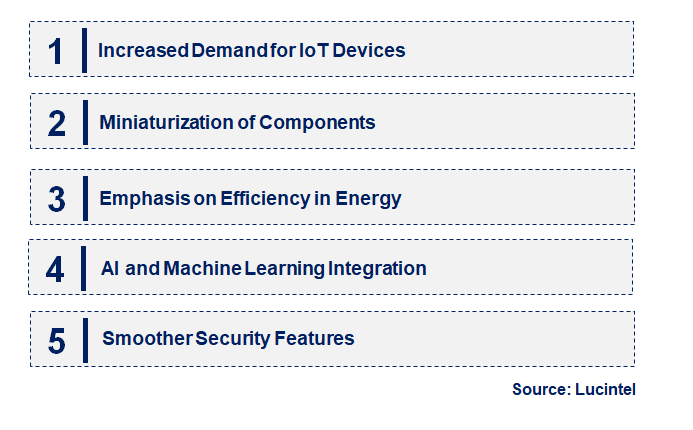
The market for affordable Bluetooth 5.0 modules has been characterized by a series of rising trends that have been pushed forward by the momentum of technological evolution and the demands of consumers. These emerging trends reflect manufacturers' responses to the changing landscape of connected devices and smart applications.• Increased Demand for IoT Devices: The most significant driving force behind the large demand for Bluetooth 5.0 modules is the huge growth of IoT applications. The growth requirements of smart home appliances, wearables, and industrial IoT solutions have made features such as increased range and low power consumption a priority. This is a critical trend since market growth and module design innovation depend on the communication efficiency between devices.
• Miniaturization of Components: The miniaturization of Bluetooth modules is becoming a common issue as the desire for smaller, sleeker products from consumers grows. Chip manufacturers are creating compact chips that provide solid functionality in less space. This trend is significant for wearable technology and portable electronics, enhancing energy efficiency and achieving a better user experience in terms of energy waste.
• Emphasis on Energy Efficiency: The proliferation of battery-operated devices puts energy efficiency at the forefront of key focus areas. Bluetooth 5.0 modules are being designed to minimize power consumption in standby modes. This is crucial for applications that require long battery life, such as IoT devices in remote locations, making them practical and appealing to use.
• AI and Machine Learning Integration: The infusion of AI and machine learning into Bluetooth technology creates smarter devices. Modules with the capability for complex data processing are becoming increasingly in demand, which has implications for predictive algorithms and automated responses. This significantly enhances user experience, making devices more intuitive and widely adopted.
• Enhanced Security Features: There is an increasing need for data privacy and security, prompting manufacturers to develop Bluetooth modules with advanced security protocols. These protocols are particularly important in healthcare, finance, and smart homes, where sensitive information requires system security. Enhanced security fosters consumer trust, contributing to market growth. These trends are emerging to shape the current features of the Low-Cost Bluetooth 5.0 Module market in terms of innovation, functionality, and effective user experience. As manufacturers pursue these trends, the market enters a fast lane of growth and diverse applications across various sectors.
Recent Developments in the Low-Cost Bluetooth 5.0 Module Market
The Low-Cost Bluetooth 5.0 Module is experiencing significant developments due to technological advancements and the need for efficient connectivity solutions. These developments reflect the industry’s response to growing consumer demand and competitive pressure for Bluetooth technology to remain relevant in a highly interconnected world.• Launch of Integrated Bluetooth Modules: Recently, some manufacturers have introduced integrated Bluetooth 5.0 modules that combine multiple functionalities in a single chip. Such integration results in an overall reduction of component count, which saves costs and reduces complexity for manufacturers. These modules cater to the growing demand for compact and efficient IoT products, ensuring higher performance and easier production.
• Improvements in Range and Speed: Recent technological innovations have driven significant improvements in both the range and speed of Bluetooth 5.0 modules. Enhanced antenna designs, along with optimized software protocols, ensure greater reliability even at longer distances, which is a primary requirement for smart city infrastructure and industrial automation applications. This not only improves user experience but also opens new avenues for integral applications.
• Greater Adoption of Modular Design: The Bluetooth 5.0 modules are part of a rapidly increasing trend toward modular design, allowing manufacturers to customize features based on specific application needs. This reduces development costs and time, enabling companies to reach the market more quickly with new products. Modular designs also simplify upgrades, helping devices keep pace in a fast-evolving technological landscape.
• Collaborations and Partnerships: Technology companies are increasingly collaborating strategically to create advancements in Bluetooth 5.0 module development. Shared expertise and resources through partnerships lead to innovative product offerings, breakthrough developments, and more satisfying outcomes. By collaborating, companies can increase research capacities, streamline the development process, and better adapt to market demands, paving the way for growth.
• Regulatory Compliance and Standards: As markets expand, maintaining international standards and conforming to regulations is essential. Manufacturers now place greater emphasis on strict safety and performance standards for their Bluetooth 5.0 module offerings. Compliance not only enhances product credibility but also helps manufacturers enter the global marketplace, promoting the proliferation of Bluetooth technology across various sectors. These developments will significantly impact the market for Low-Cost Bluetooth 5.0 Modules by fostering innovation and improving product performance in compliance with regulatory mechanisms. As the market progresses, these trends are expected to lead to higher adoption rates and broader applications.
Strategic Growth Opportunities for Low-Cost Bluetooth 5.0 Module Market
The Low-Cost Bluetooth 5.0 Module market presents numerous growth opportunities across various applications. The primary driver of this growth is the increasing demand for smart technology and connectivity. However, specific focus areas for applications will enable manufacturing companies to develop more opportunities for market expansion.• Smart Home Devices: Smart Home Automation is creating a vast market for Bluetooth 5.0 module manufacturing companies. Smart locks, lighting systems, and home security systems are in high demand due to the growing consumer need for convenience in daily living. Modules that enable smooth integration and interoperability with other smart devices will enhance user experience and drive market growth.
• Wearable Technology: The wearable technology industry has been experiencing rapid growth in recent years due to consumer interest in health monitoring and fitness tracking. Low-cost Bluetooth 5.0 modules offer crucial connectivity for wearables, such as smartwatches and health trackers, ensuring reliable connections. Companies can benefit from this growth by developing innovative modules that enable sophisticated health features and provide a seamless user interface.
• Healthcare Applications: The healthcare industry increasingly adopts Bluetooth technology for remote patient monitoring and telehealth solutions. Bluetooth 5.0 modules enable real-time data transmission between medical devices and healthcare providers, enhancing patient care. Companies specializing in secure, low-latency modules with expertise in the healthcare domain can capitalize on this growing market, improving overall healthcare delivery.
• Industrial Automation: Industry 4.0 is advancing, leading to increased demand for wireless communication solutions in industrial environments. Manufacturers are integrating Bluetooth modules into their machinery and sensors for monitoring and control purposes. Reliable connectivity in complex environments and improvements in operational efficiency help manufacturers reduce costs, positioning them competitively in the industrial market.
• Automotive Connectivity: The connected vehicle market, with its advanced infotainment and telematics systems, is experiencing increasing demand within the automotive sector. Low-cost Bluetooth 5.0 modules facilitate seamless communication between vehicles and mobile devices, enhancing user experience. As the industry trends toward smart, connected vehicles, automotive-grade module manufacturers can capitalize on the innovation opportunities within automotive technology. These growth opportunities highlight the expanding use cases of Bluetooth 5.0 modules across numerous applications. With these opportunities, manufacturers will be better positioned to improve their products and gain an advantage in a rapidly competitive marketplace.
Low-Cost Bluetooth 5.0 Module Market Driver and Challenges
The Low-Cost Bluetooth 5.0 Module market is shaped by various technological, economic, and regulatory factors. More advanced devices compel manufacturers to balance opportunities and challenges as a means of competitive positioning. Key drivers include advancements in wireless technology, broad adoption of the Internet of Things, and the need for energy-efficient solutions, leading to changes in market dynamics. Regulatory compliance, market saturation, and cybersecurity concerns influence the industry's growth trend. To thrive in this fast-evolving market, it is essential to understand these emerging drivers and challenges. The factors driving the low-cost Bluetooth 5.0 module market include:• Rising IoT Adoption: The growth in use cases that have fueled IoT adoption will drive demand for Bluetooth 5.0 modules as reliable, low-cost connectivity solutions. More industries are integrating smart technologies into their services, making these solutions essential. IoT applications require Bluetooth 5.0, which offers an extended range and low energy consumption. This trend is particularly strong in industries like healthcare, automotive, and smart cities, where connectivity and data management are critical, thereby accelerating Bluetooth module market growth.
• Consumer Demand for Smart Devices: The consumer frenzy for smart devices has led to rising demand for Bluetooth 5.0 modules. The growing need for convenience, automation, and connectivity in daily life has prompted manufacturers to introduce innovative products that utilize Bluetooth technology. Consumers increasingly seek smart wearables and home appliances to enhance communication. This consumer-driven trend encourages manufacturers to improve their offerings, resulting in market competition, innovation, and affordability.
• Energy Efficiency Focus: Another focus area for Bluetooth 5.0 modules is energy efficiency, primarily driven by the high market demand for efficient solutions. Increased battery usage creates a high demand for low-power consumption modules that operate efficiently. Maximizing energy efficiency in Bluetooth 5.0 modules ensures extended battery life. This focus appeals not only to eco-conscious consumers but also to regulatory initiatives aimed at reducing carbon footprints, making energy efficiency a critical consideration for manufacturers.
• Expansion in Automotive Applications: The automotive industry increasingly integrates Bluetooth technology for connected vehicle solutions. The growing demand for connectivity and seamless user experiences also drives growth in the Bluetooth 5.0 module market. All these applications rely on Bluetooth to ensure smooth communication between various devices, including hands-free calling, infotainment systems, and telematics. The demand for advanced Bluetooth modules presents opportunities for manufacturers to innovate and enhance vehicle functionality, thereby expanding the market. Challenges in the low-cost Bluetooth 5.0 module market include:
• Regulatory Compliance: The challenge of regulatory compliance poses difficulties for many manufacturers of Bluetooth modules, as requirements vary by region. Safety and performance standards can be strict and costly to maintain. Companies that produce non-compliant products risk penalties or market withdrawal, harming their reputation and bottom line. Manufacturers can cope with this challenge by investing in thorough testing and quality assurance processes, which may stretch resources for smaller firms competing in a fast-paced market.
• Market Saturation: The Bluetooth module market is becoming saturated, increasing competition among manufacturers. With numerous players offering similar products, distinguishing offerings can be challenging, leading to price wars that erode profit margins. Companies need to focus on innovation, quality differentiation, and customer service. This shift toward value-added features and unique solutions will give firms a competitive edge but requires long-term investment in research and development.
• Cybersecurity Concerns: Growing concerns over cybersecurity have become increasingly prevalent. Vulnerabilities in wireless communication may expose devices to hacking and data breaches, eroding user trust and safety. Companies have a responsibility to develop secure Bluetooth modules by incorporating strong encryption and authentication protocols. Failure to do so can lead to significant legal liabilities and damage the brand. As a market leader, companies must prioritize security in their offerings. The Low-Cost Bluetooth 5.0 Module market is driven by pivotal factors, including technological advancements, the rise in IoT adoption, and increasing customer demand for smart devices, contributing to robust growth. Regulatory relations, market saturation, and cybersecurity concerns must be closely monitored. Innovation should be balanced with compliance while considering security risks to stay competitive. As these drivers grow, they will collectively continue to define the trajectory of the Bluetooth 5.0 module market, affecting opportunities and strategies across stakeholders.
List of
Companies in the• Fujitsu
• Panasonic
• Intel
• Qualcomm
• Murata
• Cypress Semiconductor
• Hosiden
Low-Cost Bluetooth 5.0 Module by Segment
The study includes a forecast for the global low-cost bluetooth 5.0 module by type, application, and region.Low-Cost Bluetooth 5.0 Module Market by Type [Analysis by Value from 2018 to 2030]:
• Single Mode
• Dual Mode
Low-Cost Bluetooth 5.0 Module Market by Application [Analysis by Value from 2018 to 2030]:
• Consumer Electronics
• Medical Equipment
• Industrial IOT
• Others
Low-Cost Bluetooth 5.0 Module Market by Region [Analysis by Value from 2018 to 2030]:
• North America
• Europe
• Asia Pacific
• The Rest of the World
Low-Cost Bluetooth 5.0 Module Market Insights
• Lucintel forecasts that the single mode is expected to witness higher growth over the forecast period.
• Within this market, consumer electronics are expected to experience the highest growth.
• APAC is expected to witness the highest growth over the forecast period.

Features of the Global Low-Cost Bluetooth 5.0 Module Market
Market Size Estimates: Low-cost bluetooth 5.0 module market size estimation in terms of value ($B). Trend and Forecast Analysis: Market trends (2018 to 2023) and forecast (2024 to 2030) by various segments and regions. Segmentation Analysis: Low-cost bluetooth 5.0 module market size by type, application, and region in terms of value ($B). Regional Analysis: Low-cost bluetooth 5.0 module market breakdown by North America, Europe, Asia Pacific, and Rest of the World. Growth Opportunities: Analysis of growth opportunities in different type, application, and regions for the low-cost bluetooth 5.0 module market. Strategic Analysis: This includes M&A, new product development, and competitive landscape of the low-cost bluetooth 5.0 module market. Analysis of competitive intensity of the industry based on Porter’s Five Forces model.
FAQ
Q1. What is the growth forecast for low-cost bluetooth 5.0 module market? Answer: The global low-cost bluetooth 5.0 module market is expected to grow with a CAGR of 3.5% from 2024 to 2030. Q2. What are the major drivers influencing the growth of the low-cost bluetooth 5.0 module market? Answer: TThe major drivers for this market are increasing demand for iot applications, growing market for wearable devices, and rising integration of bluetooth technology in automotive infotainment systems. Q3. What are the major segments for low-cost bluetooth 5.0 module market? Answer: The future of the global low-cost bluetooth 5.0 module market looks promising with opportunities in the consumer electronic, medical equipment, and industrial iot markets. Q4. Who are the key low-cost bluetooth 5.0 module market companies? Answer: Some of the key low-cost bluetooth 5.0 module companies are as follows:• Fujitsu
• Panasonic
• Intel
• Qualcomm
• Murata
• Cypress Semiconductor
• Hosiden Q5. Which low-cost bluetooth 5.0 module market segment will be the largest in future? Answer: Lucintel forecasts that single mode is expected to witness the highest growth over the forecast period. Q6. In low-cost bluetooth 5.0 module market, which region is expected to be the largest in next 5 years? Answer: APAC is expected to witness highest growth over the forecast period. Q.7 Do we receive customization in this report? Answer: Yes, Lucintel provides 10% customization without any additional cost.
Table of Contents
Methodology
- In-depth interviews of the major players in this market
- Detailed secondary research from competitors’ financial statements and published data
- Extensive searches of published works, market, and database information pertaining to industry news, company press releases, and customer intentions
- A compilation of the experiences, judgments, and insights of Lucintel’s professionals, who have analyzed and tracked this market over the years.


Buy Now
Choose a license that fits your team. Instant PDF delivery.
Prices exclude taxes. Instant delivery. Custom licensing available on request.
Key Questions
- • What are some of the most promising, high-growth opportunities for the low-cost bluetooth 5.0 module market by type (single mode and dual mode), application (consumer electronics, medical equipment, industrial iot, and others), and region (North America, Europe, Asia Pacific, and the Rest of the World)?
- • Which segments will grow at a faster pace and why?
- • Which region will grow at a faster pace and why?
- • What are the key factors affecting market dynamics? What are the key challenges and business risks in this market?
- • What are the business risks and competitive threats in this market?
- • What are the emerging trends in this market and the reasons behind them?
- • What are some of the changing demands of customers in the market?
- • What are the new developments in the market? Which companies are leading these developments?
- • Who are the major players in this market? What strategic initiatives are key players pursuing for business growth?
- • What are some of the competing products in this market and how big of a threat do they pose for loss of market share by material or product substitution?
- • What M&A activity has occurred in the last 5 years and what has its impact been on the industry? For any questions related to Low-Cost Bluetooth 5.0 Module Market, Low-Cost Bluetooth 5.0 Module Market Size, Low-Cost Bluetooth 5.0 Module Market Growth, Low-Cost Bluetooth 5.0 Module Market Analysis, Low-Cost Bluetooth 5.0 Module Market Report, Low-Cost Bluetooth 5.0 Module Market Share, Low-Cost Bluetooth 5.0 Module Market Trends, Low-Cost Bluetooth 5.0 Module Market Forecast, Low-Cost Bluetooth 5.0 Module Companies, write Lucintel analyst at email: helpdesk@lucintel.com. We will be glad to get back to you soon.


