
Report Feature
K-12 Online Tutoring Market Trends and Forecast
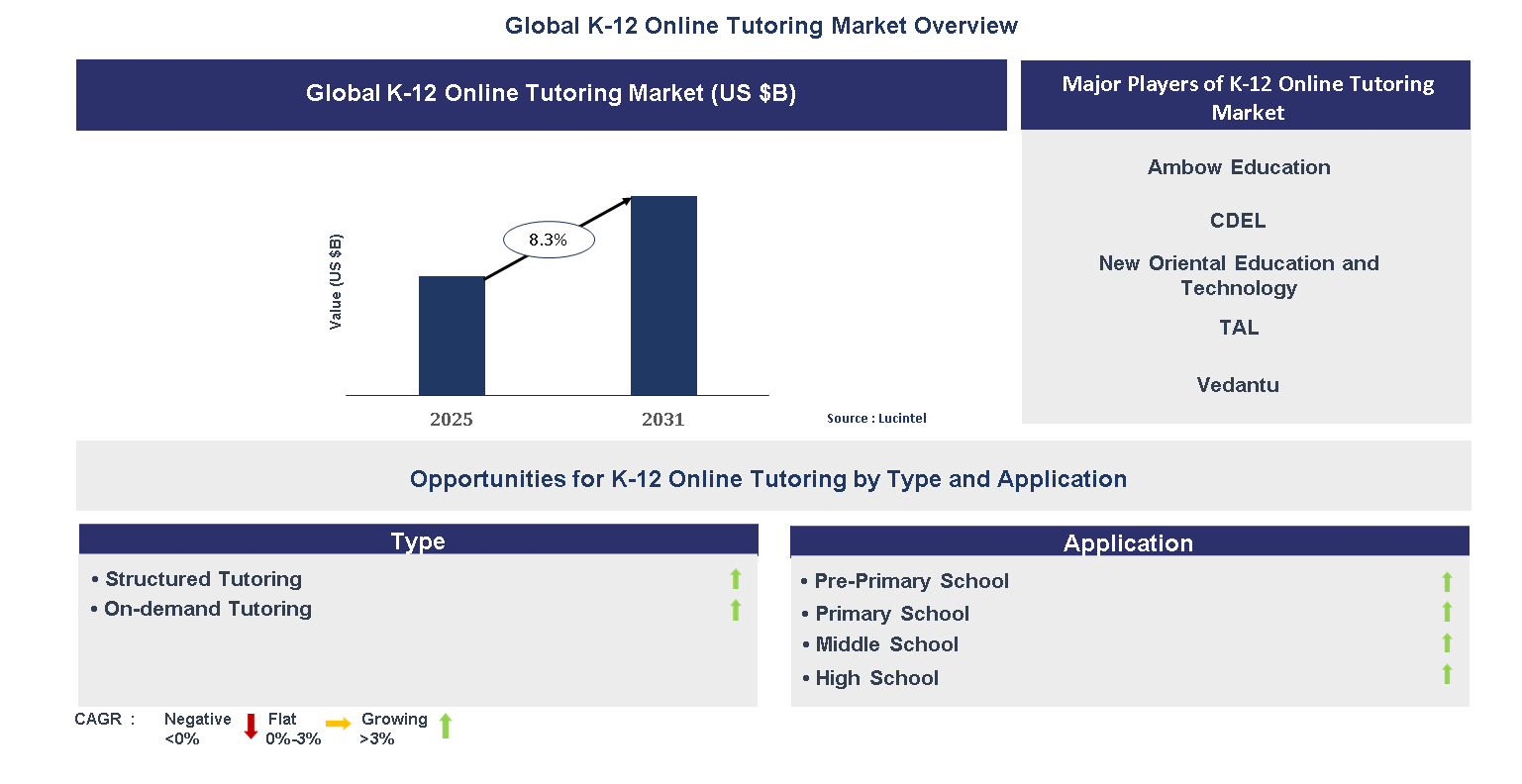
The future of the global K-12 online tutoring market looks promising with opportunities in the structured tutoring and on-demand tutoring markets. The global K-12 online tutoring market is expected to grow with a CAGR of 8.3% from 2025 to 2031. The major drivers for this market are the increasing preference for personalized learning solutions, the rising adoption of digital learning platforms, and the growing demand for flexible education options.• Lucintel forecasts that, within the application category, primary school is expected to witness the highest growth over the forecast period.
• Within the type category, on-demand tutoring is expected to witness higher growth.
• In terms of region, APAC is expected to witness the highest growth over the forecast period. Gain valuable insights for your business decisions with our comprehensive 150+ page report. Sample figures with some insights are shown below.
Emerging Trends in the K-12 Online Tutoring Market
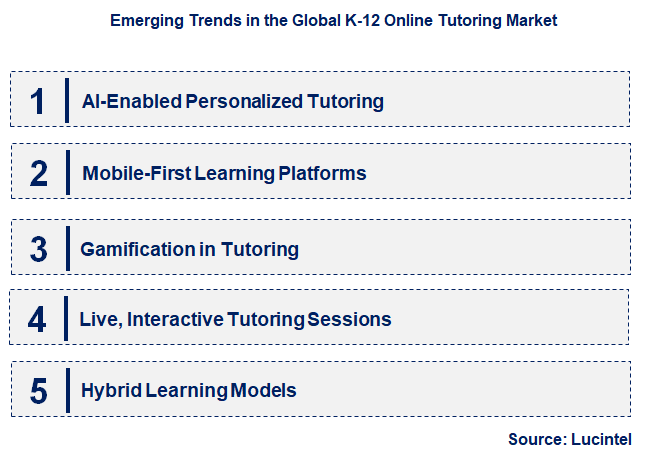
The K-12 online tutoring industry is quickly transforming due to technological advancements, shifts in consumer behavior, and mounting competition. With the rising need for customized education, some major trends are remodeling the online tutoring landscape. Not only are these trends enhancing the ease and efficacy of tutoring but also making possible new modes of learning in alignment with varied learning tendencies. The following are the main emerging trends in the K-12 online tutoring sector.• AI-Enabled Personalized Tutoring: AI-based personalized tutoring is emerging as a top trend in the market. Employing machine learning algorithms, these platforms evaluate student performance on an individual basis and customize lessons to suit their specific requirements. This personalization enables students to learn at their own pace and enhances the quality of learning. AI can also provide real-time feedback, which is indispensable for timely intervention. These technologies enable more interactive, effective, and personalized learning, which makes online tutoring platforms highly effective.
• Mobile-First Learning Platforms: As smartphone usage grows, mobile-first learning platforms are becoming increasingly popular in the K-12 online tutoring space. These platforms are built to be mobile-optimized, making it convenient for students to use tutoring services anywhere, anytime - whether on the bus, at a café, or in their own home. Mobile-first platforms create education that is more accessible and convenient, allowing students to participate in tutoring sessions anywhere and at any time. This change is in accordance with the increasing trend of mobile learning in education, responding to the demands of the digital-native generation.
• Gamification in Tutoring: Gamification is a new development in the K-12 online tutoring industry that increases motivation and engagement. Through the use of game-like features like rewards, levels, and interactive challenges, tutoring websites make learning enjoyable and rewarding for students. This trend not only enhances student interaction but also brings a sense of accomplishment, prompting students to finish work and learn better. Gamified tutoring websites are especially favored by younger students, wherein interactive learning through play is an important aspect of educational growth.
• Live, Interactive Tutoring Sessions: There is growing demand for live, real-time, interactive sessions with tutors. In contrast to pre-recorded sessions, live sessions enable students to interact with tutors, clarify doubts, and seek instant feedback. This makes it easier for students to understand difficult concepts. As online tutoring websites become more advanced, most are adding live video tutoring to their repertoire, making the learning process more engaging. Live tutoring sessions also aid in smoother communication between tutors and students, keeping students motivated and engaged during the learning process.
• Hybrid Learning Models: Hybrid learning models, which are a mix of in-person and online learning, are also becoming popular in the K-12 online tutoring space. This movement provides students with the flexibility of online classes and the structure of traditional classroom learning. Tutorial centers are increasingly offering hybrid models, where students learn virtually and sometimes meet in person for individualized assistance. This strategy closes the gap between virtual and physical learning spaces to meet the needs of multiple students. The K-12 online tutoring market is being redefined by some major trends, such as AI-driven personalization in tutoring, mobile-first platforms, gamification, real-time interactive sessions, and hybrid learning models. All these trends are opening online tutoring to more consumers, making it more engaging and effective, and catering to the wide-ranging requirements of students worldwide. As technology continues to evolve and consumer behavior changes, these trends will propel further innovation in the market.
Recent Development in the K-12 Online Tutoring Market
The K-12 tutoring market has witnessed tremendous growth over the past few years, fueled by technological advances and growing demand for customized learning. The move to digital learning, spurred by the worldwide pandemic, has stimulated innovation in tutoring service offerings, generating new opportunities and challenges. Tutoring platforms now service diverse student needs ranging from learning support to test preparation. As academic expectations change, a number of important developments are redefining the future of K-12 online tutoring, both in how students will learn and how tutors will teach.• Emergence of AI and Adaptive Learning Technology: Artificial intelligence (AI) has emerged as the key driver of K-12 online tutoring evolution. AI is being widely adopted by platforms to offer learners personalized learning through performance analysis and corresponding content adaptation. This makes it possible for personalized lesson plans that adapt in real time to a students strengths, weaknesses, and learning speed. Adaptive learning ensures that lesson delivery is optimized, keeping students engaged and adequately challenged. The productivity of AI-driven tools is making it possible for tutors to concentrate on higher-order instruction, while machines perform routine work.
• Expansion of Subscription-based Models: Subscription-based tutoring solutions have become increasingly popular, as parents and students have access to flexible, affordable solutions. Instead of paying session by session, families can subscribe on a monthly or yearly basis for unlimited or a given number of tutoring hours. This model is convenient for students to get ongoing support without breaking the bank, and its more manageable for parents to control their budgets. Moreover, subscription services typically offer a range of learning materials, including videos, practice quizzes, and interactive lessons, further enhancing the learning process.
• Global Tutoring Platforms Expansion: Globalization has enabled students to access tutors across the globe, giving birth to global tutoring platforms. This has created varied learning possibilities, making students available to specialized skills that perhaps would not be locally accessible. For example, a student in America can now get tutored in high-level mathematics from a very qualified tutor in India or the UK. The possibility of choosing tutors on the basis of qualifications, years of experience, and user ratings has improved tutoring quality as well as providing more choice and flexibility.
• Integration of Gamification in Learning: Gamification is another trend that is gradually being incorporated into K-12 online tutoring. By using game elements like points, levels, and rewards, tutoring sites are making learning more interactive and fun for students. This method works best for children who might be challenged by conventional teaching techniques. Gamification encourages motivation since learning is experienced as a delightful challenge, hence enhancing retention and completion rates. Gamification also facilitates monitoring of progress in a tangible and visual manner, providing learners with a feeling of accomplishment and motivating them to learn more.
• Greater Emphasis on Soft Skills Development: Although academic subjects continue to be the central thrust of K-12 tutoring, there has indeed been a trend towards creating soft skills, like thinking critically, solving problems, and emotional intelligence. Most online tutoring sites are now creating programs that extend beyond tutoring, concentrating on the development of students social and emotional learning (SEL). These are important to ensure students success in the long term, both in studies and their future professional life. As parents and schools see the value in such skills, the need for tutoring services that include SEL is increasing, so tutoring is becoming more holistic and balanced. Recent trends in the K-12 online tutoring industry are transforming education. The confluence of AI, subscription-based models, and gamification, coupled with the growth of global platforms and increased focus on soft skills, are increasingly making tutoring more personal, accessible, and fun. These technologies are enabling students to learn in manners best suited to their unique needs and interests, as well as offering tutors more effective tools with which to improve their instruction. As they unfold, these trends hold the promise of making K-12 online tutoring a more integrated and powerful part of contemporary education.
Strategic Growth Opportunities in the K-12 Online Tutoring Market
The K-12 online tutoring industry offers great growth potential, particularly since the demand for flexible, accessible, and individualized learning is still on the increase. Online tutoring firms can take advantage of upcoming trends, penetrate underserved areas, and diversify their offerings to access growth potential. Some of the five major growth opportunities in the K-12 online tutoring industry include the following applications and innovations that have the potential to redefine the market:.• Growth of STEM Education: As the world increasingly focuses on Science, Technology, Engineering, and Mathematics (STEM) education, online tutoring platforms are in a position to specialize in these subjects to capture increased demand. Offering specialized tutoring services for courses in STEM can reach a broader market, particularly in areas where good STEM education is scarce. Specializing in coding, robotics, and data science for students from grades K-12 can make tutoring platforms trendsetters in this high-demanding area of education.
• Targeting Non-English Speaking Regions: Tapping into non-English speaking markets is a major growth opportunity for online tutoring websites. By providing language-based tutoring, particularly in emerging economies such as India and China, businesses are able to access new markets. Moreover, most online websites are making inroads in bilingual learning, so students can study both English and native languages. This phenomenon offers new markets for online tutors and education providers, allowing them to support varying linguistic and cultural requirements.
• Virtual Reality and Augmented Reality Integration: The inclusion of Virtual Reality (VR) and Augmented Reality (AR) technologies within online tutoring platforms presents a new opportunity for growth. These technologies have the ability to create immersive learning environments that enhance understanding of abstract subjects such as science, history, and math by making them more interactive and stimulating. Through the inclusion of VR/AR, tutoring platforms can provide students with experiential learning opportunities that mirror real-world scenarios, improving comprehension and retention. This technology innovation may also entice high-tech parents looking for innovative education solutions for their children.
• School and Education Institution Partnerships: Strategic collaborations with schools and educational institutions present large growth prospects for online tutoring platforms. Through collaborations with schools, tutoring businesses can offer students additional learning tools and aids, supplementing classroom instruction. School partnerships also provide avenues to increase the platforms user base, as schools have the infrastructure and credibility to integrate online tutoring as part of the curriculum.
• Tailoring Services for Special Needs Education: With a focus on special education is another expansion avenue for tutoring sites online. Providing specialized tutoring for students who have learning disabilities, developmental delays, or other impairments is a niche but important market that tutoring websites can address. Creating customized methods of teaching, materials, and tools created specifically for special education requirements can enhance educational outcomes and address an underserved part of the student base. Strategic development prospects in the K-12 online tutoring industry, including increasing STEM education, serving non-English speaking areas, incorporating VR/AR, school partnerships, and tailoring services for special needs education, will enable firms to access new demand and remain competitive in a rapidly changing market. These prospects not only fulfill the various needs of contemporary learners but also stimulate innovation, leading to long-term success in the burgeoning online tutoring industry.
K-12 Online Tutoring Market Driver and Challenges
The K-12 online tutoring market is influenced by numerous technological, economic, and regulatory drivers and challenges. Technological drivers, such as mobile platforms and artificial intelligence, have promoted easy and efficient access to online tutoring. Economic factors, like increased demand for customized education, are also contributing to expansion. But there are still challenges such as regulatory limits and the requirement for high-quality content. Knowing these drivers and challenges is vital to stakeholders hoping to benefit from the expanding market while overcoming prospective obstacles. The factors responsible for driving the K-12 online tutoring market include: 1. Technological Advancements: One of the most important drivers for the K-12 online tutoring market is technological progress. Tutoring programs powered by artificial intelligence can review a students performance in real time, providing individualized lesson plans and adaptive learning routes. In addition, the development of mobile learning apps allows students to receive tutoring services at any time and location. The growing application of virtual and augmented realities in tutoring services also increases the enthusiasm and engagement of learning. 2. Growing Demand for Personalized Education: The increasing need for customized education is another major booster for the online tutoring industry. Students and parents are looking for learning solutions that fit individual abilities and weaknesses. In contrast to classroom learning, online tutoring has the potential to offer customized content, instant feedback, and variable schedules to suit students learning velocities. This push for personalized learning is particularly dominant in fields such as math, science, and languages, where students tend to need individual instruction. As pupils call for greater personalized attention, the market for online tutoring stands ready to respond to these demands. 3. Growth in Internet Availability and Mobile Education: With better internet connectivity, particularly in the developing world, more pupils are able to use online education platforms. Mobile phones such as smartphones and tablets enable students to study remotely, increasing the accessibility of online tutoring further. The growing coverage of mobile and broadband networks brings online tutoring to students of rural or underserved communities, closing educational disparities. This increasing coverage of the internet has been especially significant amid the COVID-19 outbreak when online learning became the main source of learning for numerous students across the world. 4. Scheduling Flexibility in Learning: The scheduling flexibility that is offered by online tutoring is a key market growth driver. Students are no longer required to adhere to fixed schedules or travel to physical locations for tutoring. Rather, they can pick tutoring sessions at their convenience, either after school, during the weekends, or even during holidays. Such flexibility is especially beneficial for working parents who need their children to learn more but do not have time to visit conventional tutoring centers. 5. Cost-Effectiveness of Online Tutoring: Online tutoring can frequently be more cost-effective than face-to-face tutoring. It does away with transportation, physical infrastructure, and overhead costs of tutor centers. Online platforms also have the option to provide multiple pricing models, thus making tutoring more affordable for more students. As parents and students become more aware of educational spending, online tutoring offers a convenient and cost-effective option, particularly in regions where in-person tutoring would be more costly or out of reach. Challenges in the K-12 online tutoring market are: 1. Regulatory Challenges: Regulatory frameworks that vary from one region to another is one of the biggest challenges the K-12 online tutoring industry is confronted with. Regulations in nations such as China have restricted the scope of after-school tutoring services, thus affecting online tutoring companies directly. In other nations, the absence of uniform rules for online learning and AI-powered tutoring may create issues of data privacy and security. 2. Quality Control and Content Standardization: The other major challenge is upholding the quality of online tutoring services and content standardization across various platforms. In contrast to the traditional educational systems, in which curricula are uniform, online tutoring sites differ significantly in terms of content quality, instruction styles, and tutors qualifications. With the growth in the number of platforms available in the marketplace, it is a serious challenge to ensure students get consistent, high-quality education. It is essential that platforms build intensive screening procedures for tutors and standardized curricula that align with education objectives. 3. Student Engagement and Retention: Engaging students in an e-learning environment is challenging. Students are distracted at home and do not have the motivation or concentration that comes with a classroom setting. Tutoring websites must continually improve and employ interactive features to engage students, whether through gamification, instant feedback, or collaborative virtual tools. Without high levels of engagement, students will lose interest or not absorb what they learn. Therefore, maintaining student motivation and guaranteeing long-term retention becomes a challenge for online tutoring firms. The K-12 online tutoring industry is fueled by several factors, ranging from technological innovation, demand for individualized learning, expanded access to the internet, flexible scheduling, and affordability. The industry also experiences challenges ranging from regulatory barriers, quality management, and student motivation. As the market develops, the stakeholders will need to manage these challenges while tapping into emerging trends to attain sustainable development. It is important to grasp these drivers and challenges in order for firms to succeed in this fast-changing industry.List of K-12 Online Tutoring Companies
Companies in the market compete on the basis of product quality offered. Major players in this market focus on expanding their manufacturing facilities, R&D investments, infrastructural development, and leverage integration opportunities across the value chain. With these strategies K-12 online tutoring companies cater increasing demand, ensure competitive effectiveness, develop innovative products & technologies, reduce production costs, and expand their customer base. Some of the K-12 online tutoring companies profiled in this report include-• Ambow Education
• CDEL
• New Oriental Education and Technology
• TAL
• Vedantu
• iTutorGroup
• EF Education First
• Chegg
• Knewton
• Tokyo Academics
K-12 Online Tutoring Market by Segment
The study includes a forecast for the global K-12 online tutoring market by type, application, and region.K-12 Online Tutoring Market by Type [Value from 2019 to 2031]:
• Structured Tutoring
• On-demand Tutoring
K-12 Online Tutoring Market by Application [Value from 2019 to 2031]:
• Pre-Primary School
• Primary School
• Middle School
• High School
K-12 Online Tutoring Market by Region [Value from 2019 to 2031]:
• North America
• Europe
• Asia Pacific
• The Rest of the World
Country Wise Outlook for the K-12 Online Tutoring Market
The K-12 online tutoring market has witnessed exponential growth over the last few years, fueled by innovation in technology and the ever-growing need for customized learning. With schools and households finding it increasingly difficult to provide efficient, accessible education, online tutoring platforms are an attractive option. They provide students with flexible learning modes, opening up access to good quality education anywhere in the world. The COVID-19 pandemic further accelerated the shift toward digital learning, with many countries embracing e-learning solutions. This report will examine recent developments in the K-12 online tutoring market across key countries including the United States, China, Germany, India, and Japan.• United States: In the United States, the K-12 online tutoring market has surged, driven by the increased adoption of digital learning tools during the pandemic. Tutoring services have widened across topics like mathematics, science, and English language, with sites like Chegg, Khan Academy, and Varsity Tutors experiencing major upticks. Additionally, American parents are spending more money on one-on-one tutoring for their kids, which is also boosting demand. The market is also witnessing the emergence of AI-based tutoring, which enables personalized lesson plans and in-the-moment feedback.
• China: Chinas K-12 online tutoring industry has witnessed explosive expansion, especially amid government interventions aimed at the tutoring sector. Although policy changes have remodeled the market, restricting after-school tutoring enterprises, new opportunities have been created in online platforms providing tutoring services in more versatile forms. Large players like TAL Education and Guandao are still innovating by seeking to grow their offerings into sectors such as STEM education.
• Germany: Germany has also experienced slow but consistent growth in the K-12 online tutoring market. Schools expanded the use of digital learning platforms throughout the pandemic period, and online tutoring has followed the trend. Organizations such as Scoyoc and Sofa tutor are providing e-learning full solutions incorporating tutoring and school material. German parents are increasingly open to using online tutoring services, particularly for subjects such as math’s and foreign languages. Moreover, Germanys rigorous focus on educational equity has fueled the need for affordable, accessible tutoring services and widened the scope of non-profit and state-backed online learning platforms.
• India: In India, the market for online tutoring for K-12 levels has proliferated, fueled by the increasing middle class and growth in disposable income. Companies such as Biju’s, Vedanta, and Unacademic have taken the lead in offering affordable and accessible online learning. These websites have diversified their services to meet a range of educational requirements, from test-taking preparation to comprehensive subject study. The flexibility and ease of online tutoring have made it increasingly attractive in rural communities, where high-quality educational opportunities have long been scarce.
• Japan: In Japan, the K-12 online tutoring industry is growing, but at a more conservative rate than in other countries. Although conventional face-to-face tutoring is well-liked, internet-based platforms like Lurk also becoming popular. Japans rigorous academic requirements and highly competitive university entrance tests have spurred demand for extra schooling, so more students and parents are turning to online tutoring services. Japanese firms are also incorporating AI and gamification into their models of tutoring to ensure learning is more engaging and effective.

Features of the Global K-12 Online Tutoring Market
Market Size Estimates: K-12 online tutoring market size estimation in terms of value ($B). Trend and Forecast Analysis: Market trends (2019 to 2024) and forecast (2025 to 2031) by various segments and regions. Segmentation Analysis: K-12 online tutoring market size by type, application, and region in terms of value ($B). Regional Analysis: K-12 online tutoring market breakdown by North America, Europe, Asia Pacific, and Rest of the World. Growth Opportunities: Analysis of growth opportunities in different type, application, and regions for the K-12 online tutoring market. Strategic Analysis: This includes M&A, new product development, and competitive landscape of the K-12 online tutoring market. Analysis of competitive intensity of the industry based on Porter’s Five Forces model.
FAQ
Q1. What is the growth forecast for K-12 online tutoring market? Answer: The global K-12 online tutoring market is expected to grow with a CAGR of 8.3% from 2025 to 2031. Q2. What are the major drivers influencing the growth of the K-12 online tutoring market? Answer: The major drivers for this market are the increasing preference for personalized learning solutions, the rising adoption of digital learning platforms, and the growing demand for flexible education options. Q3. What are the major segments for K-12 online tutoring market? Answer: The future of the K-12 online tutoring market looks promising with opportunities in the structured tutoring and on-demand tutoring markets. Q4. Who are the key K-12 online tutoring market companies? Answer: Some of the key k-12 online tutoring companies are as follows:• Ambow Education
• CDEL
• New Oriental Education and Technology
• TAL
• Vedantu
• iTutorGroup
• EF Education First
• Chegg
• Knewton
• Tokyo Academics Q5. Which K-12 online tutoring market segment will be the largest in future? Answer: Lucintel forecasts that, within the application category, primary school is expected to witness the highest growth over the forecast period. Q6. In K-12 online tutoring market, which region is expected to be the largest in next 5 years? Answer: In terms of region, APAC is expected to witness the highest growth over the forecast period. Q7. Do we receive customization in this report? Answer: Yes, Lucintel provides 10% customization without any additional cost.
Table of Contents
List of Figures
List of Tables
Methodology
- In-depth interviews of the major players in this market
- Detailed secondary research from competitors’ financial statements and published data
- Extensive searches of published works, market, and database information pertaining to industry news, company press releases, and customer intentions
- A compilation of the experiences, judgments, and insights of Lucintel’s professionals, who have analyzed and tracked this market over the years.


Buy Now
Choose a license that fits your team. Instant PDF delivery.
Prices exclude taxes. Instant delivery. Custom licensing available on request.
Key Questions
- • What are some of the most promising, high-growth opportunities for the K-12 online tutoring market by type (structured tutoring and on-demand tutoring), application (pre-primary school, primary school, middle school, and high school), and region (North America, Europe, Asia Pacific, and the Rest of the World)?
- • Which segments will grow at a faster pace and why?
- • Which region will grow at a faster pace and why?
- • What are the key factors affecting market dynamics? What are the key challenges and business risks in this market?
- • What are the business risks and competitive threats in this market?
- • What are the emerging trends in this market and the reasons behind them?
- • What are some of the changing demands of customers in the market?
- • What are the new developments in the market? Which companies are leading these developments?
- • Who are the major players in this market? What strategic initiatives are key players pursuing for business growth?
- • What are some of the competing products in this market and how big of a threat do they pose for loss of market share by material or product substitution?
- • What M&A activity has occurred in the last 5 years and what has its impact been on the industry? For any questions related to K-12 Online Tutoring Market, K-12 Online Tutoring Market Size, K-12 Online Tutoring Market Growth, K-12 Online Tutoring Market Analysis, K-12 Online Tutoring Market Report, K-12 Online Tutoring Market Share, K-12 Online Tutoring Market Trends, K-12 Online Tutoring Market Forecast, K-12 Online Tutoring Companies, write Lucintel analyst at email: helpdesk@lucintel.com. We will be glad to get back to you soon.


