
Report Feature
K-12 IT Infrastructure Spending Market Trends and Forecast
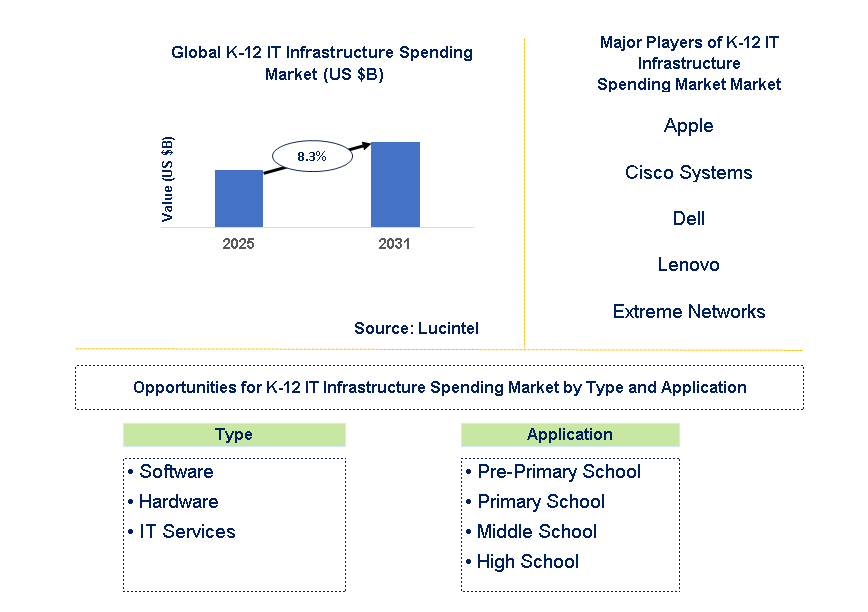
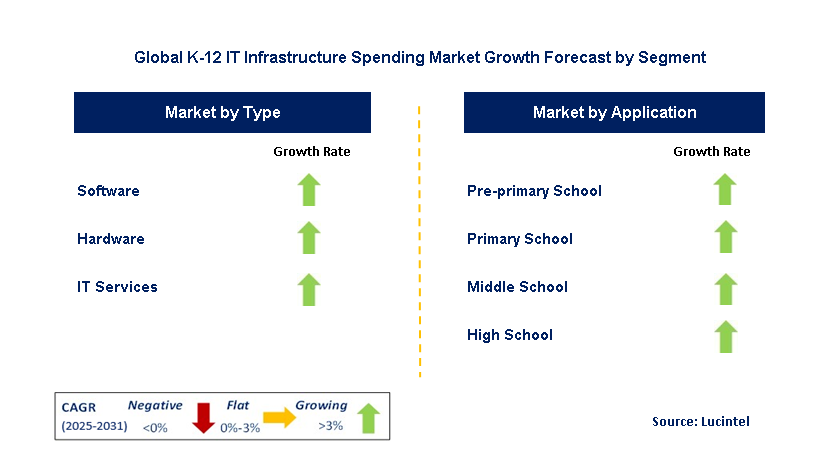
The future of the global K-12 IT infrastructure spending market looks promising with opportunities in the pre-primary school, primary school, middle school and high school markets. The global K-12 IT infrastructure spending market is expected to grow with a CAGR of 8.3% from 2025 to 2031. The major drivers for this market are growing reliance on digital platforms, rising demand for data storage, and increase in digital tools and resources.Lucintel forecasts that, within the type category, IT service are expected to witness the highest growth over the forecast period.
Within this application category, primary school is expected to witness the highest growth.
In terms of region, APAC is expected to witness the highest growth over the forecast period.
Gain valuable insights for your business decisions with our comprehensive 150+ page report. Sample figures with some insights are shown below.
Emerging Trends in the K-12 IT Infrastructure Spending Market
The K-12 IT infrastructure spending market is in a process of evolution, and several emerging trends are changing the face of education. Such trends reflect an increasing integration of technology into the classroom and growing demand for digital learning resources.• Increased Investment in Cloud-Based Solutions: Schools are increasingly investing in cloud-based services to enhance learning experiences and administrative efficiency. Cloud computing allows the school to offer flexible, scalable, and cost-effective solutions that host any amount of learning materials, applications, or student data. This perfectly accommodates the collaboration between students, teachers, and parents and increases access to resources in education. Through this, the incorporation of AI tools and learning management systems is also smoothed out with the cloud, which helps customize the learning experience and supports classroom management for the teacher.
• Digital Equity and Inclusion: Digital equity will continue to play a major focus since schools now invest in the infrastructure that assures all students access to technology based on location or socio-economic standing. Governments should ensure the connectivity of broadband internet in rural or underdeveloped areas to support equal opportunities to digital learning by students. A growing trend is that tablets and other inexpensive devices are provided to students, so that cost will not be a barrier to access.
• AI and Data Analytics In Education: Schools are increasingly adopting AI-driven tools in an effort to personalize learning experiences while analyzing student performance. All of these technologies help the educator track progress, spot learning gaps, and provide targeted interventions. Data analytics is also undertaken in enhancing the efficiency of the administration, including the handling of student records, scheduling, and allocation of resources. This trend is expected to result in a more personalized and efficient education system in which students learn more based on their specific needs.
• Cybersecurity and Data Privacy Concerns: The use of digital tools in education increase the concerns over cybersecurity and data privacy. Schools are making investments in more robust cybersecurity, ensuring the data of students will be safe. Encryption, firewalls, and secure access control systems are in place. It is also common to see institutions focusing on best practices for educating teachers and other staff members to secure data with appropriate compliance on data protection rules such as GDPR in Europe and FERPA in the United States.
• STEM and ICT Curricula: Schools are increasing their investments in STEM (Science, Technology, Engineering, and Mathematics) and ICT (Information and Communication Technology) education to equip students with the skills needed for future careers in technology. Investments are being made in digital tools and learning platforms that teach coding, robotics, and other technical skills. Some important initiatives would keep the students relevant to an always-changing job landscape where digital competencies will not be the exemption.
The K-12 IT infrastructure spending market, include the influence to increase the degree of investments with respect to a greater need to develop the implementation of digitalized tools and access to cloud and cybersecurity. Based on this forecast, more trends will enhance higher demands in relation to education by requiring sophisticated or advanced IT infrastructures.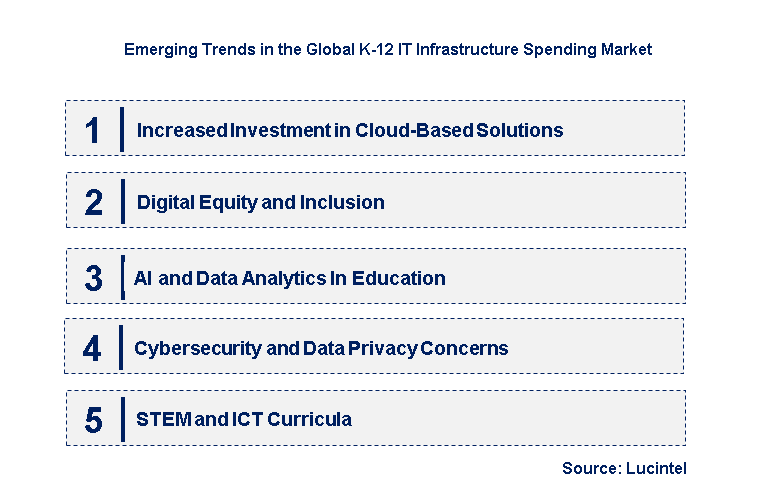
Recent Development in the K-12 IT Infrastructure Spending Market
Recent developments in the K-12 IT infrastructure spending market depict the growing acknowledgment of the role of technology in improving education and supporting digital learning. Governments and educational institutions have started to make more investments in this sector in order to maintain a modernized and connected environment for education.• U.S. Federal and State Initiatives: The U.S. government has invested a lot into K-12's IT infrastructure improvements, especially during the COVID-19 pandemic. Massive funding of digital learning tools, broadband expansion, and provision of devices are parts of the American Rescue Plan. Similarly, state governments make massive investments to upgrade school networks to support additional online learning platforms. All of these are set to reduce the digital divide among students and give all of them equal access to the technology of a modern education.
• Education Modernization Programs Nationwide in China: China is digitizing the education system, with huge investments in cloud-based platforms, AI technologies, and broadband access. The government commits to improving the digital learning resources, especially for rural areas, to ensure an equal opportunity to education. These encompass upgrades to the network, setting up e-learning platforms, and device availability to the students. There is a trend in the development of AI that uses the tool for individualized learning, with tools aiming at improved results.
• German DigitalPakt Schule Initiative: The DigitalPakt Schule initiative for schools, set on investment into the digital infrastructure for schools, received significant boost over the recent past. The initiative will fund schools to upgrade their IT infrastructure, including the purchase of devices, installation of high-speed internet, and teacher training on digital tools. The emphasis on broadband access and the availability of digital learning tools for all students is at the heart of the country's efforts to modernize its education system.
• India's NEP 2020 and Digital Education Extension: India's National Education Policy (NEP) 2020 has brought into focus digital education and its access to everyone in the nation. The government is investing in the development of digital platforms, apps, and devices to promote e-learning across rural areas. NEP 2020 promotes the creation of digital content in regional languages as well, hence extending access to education. Despite the challenges of internet connectivity, these investments are a step toward improving educational equity and technology integration.
• Japan's Investment in ICT and E-Learning Platforms: Japan's K-12 education system is rapidly adopting digital technologies to support e-learning and improve educational outcomes. The government has been investing in e-learning platforms, school networks, and ICT devices for students. There is increasing emphasis on teaching ICT literacy both to teachers and students. Enhancing ICT literacy among teachers and students is very much in step with Japan's long-term view of innovation in education and developing students who have the right skill sets for digital skills in a future workforce.
The overall development suggests that the world's K-12 sector is developing in a very imposing fashion, and the figure for IT infrastructure spending is growing rapidly. What focuses on equity and connectivity also enhances digital tools, thereby making the future of education directional towards schools on which the equipping challenges of digital learning come to play.Strategic Growth Opportunities in the K-12 IT Infrastructure Spending Market
The K-12 IT infrastructure spending market has a range of growth opportunities through technological advancements, increases in demand for digital solutions in learning areas, and government initiatives focused on updating education systems.• Cloud-Based Solutions: The demand for cloud-based learning platforms, virtual classrooms, and storage solutions is increasing. Schools are investing in scalable, cost-effective cloud infrastructure to host digital learning materials, provide collaborative tools, and manage administrative data. This trend opens up growth opportunities for cloud service providers and educational technology companies to offer customized solutions for K-12 institutions.
• Rural Broadband Deployments: K-12 IT infrastructure growth opportunity is significant through broadband expansion in rural and under-served areas. Government efforts to bridge the digital divide have spurred investments in broadband infrastructure. Companies that provide broadband services and related technologies are likely to gain as schools in remote areas receive high-speed internet, which opens up online learning opportunities.
• Cybersecurity Solutions for Schools: The more schools begin to rely on digital tools, the more cybersecurity solutions are required. There is a growing need for software and services that protect student data, secure networks, and ensure safe online learning environments. Companies specializing in cybersecurity for educational institutions have a huge growth opportunity as schools prioritize data privacy and security.
• AI and Data Analytics Solutions: The integration of AI and data analytics into K-12 education is a massive growth opportunity. Educational technology companies can offer AI-driven learning platforms that personalize education, monitor student progress, and provide real-time analytics to teachers. These solutions are gaining traction as schools look to improve student outcomes and enhance administrative efficiency.
• Professional development for educators: As more and more schools adopt new technologies, there will be a significant requirement for professional development programs that educate educators about how to make best use of digital tools in the classroom. Training services companies, educational content companies focused on digital tools and teaching methods will all benefit from increased demand in professional development of the K-12 sector.
The strategic opportunities revealed above show promising growth in K-12 IT infrastructure market sizes because of rapidly emerging technologies that fuel the concept of digital learning.K-12 IT Infrastructure Spending Market Driver and Challenges
Various drivers and challenges have an effect on the spending of K12 IT infrastructure; such factors tend to influence investment into digital learning, thereby defining its pace as well as reach.The factors responsible for driving the k-12 it infrastructure spending market include:
1. Government initiatives and funding: There is growing support of IT infrastructure spending in K-12 schools through direct government funding. Policy initiatives like the American Rescue Plan in the United States and Germany's DigitalPakt Schule assist schools by providing funding for upgrading the IT infrastructure and making equal access to technology a reality.
2. Increased Demand for Digital Learning Tools: This shift in the direction toward online and hybrid learning models has increased demands for digital learning platforms, devices, and a robust IT network. Schools are investing heaviliy in technology to ensure that their students have access to high quality digital learning resources.
3. Focus on Digital Equity: Governments and institutions are focusing on digital equity. All students should have access to the technology required for learning, regardless of their socio-economic background. This focus is driving investments in broadband infrastructure and the provision of devices.
4. Technological Advancements: It also pertains to technological advancements-the ever-evolving nature of educational technology, involving AI, cloud computing, and data analytics-to compel schools into investments in newer, upgraded infrastructures. For many, the belief is that such technologies enhance the learning experience and improve education results.
5. Need for Cybersecurity: With the increasing use of digital tools in schools, cybersecurity has emerged as a serious issue. There is a pressing need to safeguard student data, secure networks, and ensure a safe learning environment, which drives investments in cybersecurity solutions for K-12 institutions.
Challenges in the k-12 it infrastructure spending market are:
1. Budget Constraints: Many schools face budget constraints, especially in underfunded districts, that limit their ability to invest in necessary IT infrastructure upgrades. The challenge remains in finding sustainable funding sources.
2. Integration Complexity: Schools face many challenges in integrating new technologies with existing systems. Compatibility between legacy systems and new digital tools is complex and expensive.
3. Digital Divide: Efforts to provide equitable access to technology have not eradicated disparities in broadband access and device availability, especially in rural and low-income areas. Gaps in this area must be addressed to ensure that all students can benefit from digital education.
The growth in K-12 IT infrastructure spending is dominated by technological advances, government initiatives, and calls for greater digital equity. However, challenges in overcoming budget constraints, the complexities of integrating new systems, and the digital divide all stand in the way of an equitable distribution of benefits from digital education. Further investment and strategic planning will help address these hurdles in attaining the ultimate goal: a more connected and efficient education process.
List of K-12 IT Infrastructure Spending Companies
Companies in the market compete on the basis of product quality offered. Major players in this market focus on expanding their manufacturing facilities, R&D investments, infrastructural development, and leverage integration opportunities across the value chain. With these strategies K-12 IT infrastructure spending market companies cater increasing demand, ensure competitive effectiveness, develop innovative products & technologies, reduce production costs, and expand their customer base. Some of the K-12 IT infrastructure spending market companies profiled in this report include-• Apple
• Cisco Systems
• Dell
• Lenovo
• Extreme Networks
K-12 IT Infrastructure Spending Market by Segment
The study includes a forecast for the global K-12 IT infrastructure spending market by type, application, and region.K-12 IT Infrastructure Spending Market by Type [Value from 2019 to 2031]:
• Software
• Hardware
• It Services
K-12 IT Infrastructure Spending Market by Application [Value from 2019 to 2031]:
• Pre-Primary School
• Primary School
• Middle School
• High School
K-12 IT Infrastructure Spending Market by Region [Value from 2019 to 2031]:
• North America
• Europe
• Asia Pacific
• The Rest of the World
Country Wise Outlook for the K-12 IT Infrastructure Spending Market
K-12 IT infrastructure spending is becoming very dynamic, considering the increased spending by educational institutions around the world on technology that supports digital learning, enhances connectivity, and streamlines administrative processes. All this is facilitated by the rising trend of using online learning platforms, interactive tools, and cloud services, all of which need solid IT infrastructure. As countries such as the United States, China, Germany, India, and Japan focus on educational technology, they are investing heavily in upgrading networks, deploying devices, and expanding broadband access, which are essential for a modern, connected educational environment.• United States: In the United States, K-12 IT infrastructure spending has grown significantly, mainly because of the shift toward remote and hybrid learning during the COVID-19 pandemic. E-learning tools, cloud-based platforms, and internet connectivity have received increased investments from educational institutions. Significant funding has been allocated by the government through initiatives such as the American Rescue Plan so that school districts are not left far behind and enjoy equitable access to technology. Cybersecurity is extremely important due to the increasing dependency of schools on digital platforms. Moreover, investments in data-driven education tools are building momentum to support such customized learning experiences for students.
• China: In China, the government has focused on improving digital infrastructure within the K-12 education system as part of the country's broader efforts to digitize and modernize education. There is a heavy investment in cloud computing, AI-driven platforms, and digital classrooms. Another critical move, just like the Ministry of China, is the Ministry of Education in Germany, which has initiated and rolled out broadband access to ensure that every student has access to broadband networks for digital learning. Educational technology is also being used to embrace personalized learning and take up the gaps in education equity, especially in underdeveloped regions.
• Germany: Germany has significantly improved its K-12 IT infrastructure through digital education and broadband access in schools. The government's "DigitalPakt Schule" is an initiative that will invest billions of euros into improving school IT infrastructure, including the purchase of digital devices, upgrading networks, and providing training for educators. The COVID-19 pandemic has further accelerated these investments as schools shift to online learning platforms. Germany is also investing in cyber security and privacy of data since it realizes these are growing risks associated with the digital tools used in the school environment.
• India: India is on the fast lane towards increasing IT infrastructure expenditure on K-12 education, with an emphasis on enhancing the accessibility to digital learning materials and high-speed internet connectivity across rural landscapes. In order to achieve the aforementioned targets, the government of Japan has set up its National Education Policy 2020, among other initiatives, that favor digitization and efforts towards filling the digital gap. Investments in e-learning platforms, educational apps, and affordable devices are being made. Internet accessibility and affordability in remote areas could lead to a slowdown in rolling out digital infrastructure across the entire country.
• Japan: IT spending on K-12 infrastructure is growing in Japan, and emphasis is being given to improving technology integration in the education sector. The Japanese government has made sizeable investments in e-learning platforms, digital classrooms, and deployment of IT devices in schools. There is strong emphasis on ICT skills improvement in students and teachers. Japan has taken steps to upgrade school networks, providing faster internet connectivity and ensuring that all schools are equipped with the necessary tools for digital learning. Increasing collaboration between schools and tech companies is also part of Japan's approach to foster innovation in education.

Features of the Global K-12 IT Infrastructure Spending Market
Market Size Estimates: K-12 IT infrastructure spending market size estimation in terms of value ($B).Trend and Forecast Analysis: Market trends (2019 to 2024) and forecast (2025 to 2031) by various segments and regions.
Segmentation Analysis: K-12 IT infrastructure spending market size by type, application, and region in terms of value ($B).
Regional Analysis: K-12 IT infrastructure spending market breakdown by North America, Europe, Asia Pacific, and Rest of the World.
Growth Opportunities: Analysis of growth opportunities in different type, application, and regions for the K-12 IT infrastructure spending market.
Strategic Analysis: This includes M&A, new product development, and competitive landscape of the K-12 IT infrastructure spending market.
Analysis of competitive intensity of the industry based on Porter’s Five Forces model.

FAQ
Q1. What is the growth forecast for K-12 IT infrastructure spending market?Answer: The global K-12 IT infrastructure spending market is expected to grow with a CAGR of 8.3% from 2025 to 2031.
Q2. What are the major drivers influencing the growth of the K-12 IT infrastructure spending market?
Answer: The major drivers for this market are growing reliance on digital platforms, rising demand for data storage, and increase in digital tools and resources.
Q3. What are the major segments for K-12 IT infrastructure spending market?
Answer: The future of the K-12 IT infrastructure spending market looks promising with opportunities in the pre-primary school, primary school, middle school and high school markets.
Q4. Who are the key K-12 IT infrastructure spending market companies?
Answer: Some of the key K-12 IT infrastructure spending market companies are as follows:
• Apple
• Cisco Systems
• Dell
• Lenovo
• Extreme Networks
Q5. Which K-12 IT infrastructure spending market segment will be the largest in future?Answer: Lucintel forecasts that it services is expected to witness the highest growth over the forecast period.
Q6. In K-12 IT infrastructure spending market, which region is expected to be the largest in next 5 years?
Answer: APAC is expected to witness the highest growth over the forecast period.
Q7. Do we receive customization in this report?
Answer: Yes, Lucintel provides 10% customization without any additional cost.
Table of Contents
Methodology
- In-depth interviews of the major players in this market
- Detailed secondary research from competitors’ financial statements and published data
- Extensive searches of published works, market, and database information pertaining to industry news, company press releases, and customer intentions
- A compilation of the experiences, judgments, and insights of Lucintel’s professionals, who have analyzed and tracked this market over the years.


Buy Now
Choose a license that fits your team. Instant PDF delivery.
Prices exclude taxes. Instant delivery. Custom licensing available on request.
Key Questions
- • What are some of the most promising, high-growth opportunities for the K-12 IT infrastructure spending market by type (software, hardware, and it services), application (pre-primary school, primary school, middle school, and high school), and region (North America, Europe, Asia Pacific, and the Rest of the World)?
- • Which segments will grow at a faster pace and why?
- • Which region will grow at a faster pace and why?
- • What are the key factors affecting market dynamics? What are the key challenges and business risks in this market?
- • What are the business risks and competitive threats in this market?
- • What are the emerging trends in this market and the reasons behind them?
- • What are some of the changing demands of customers in the market?
- • What are the new developments in the market? Which companies are leading these developments?
- • Who are the major players in this market? What strategic initiatives are key players pursuing for business growth?
- • What are some of the competing products in this market and how big of a threat do they pose for loss of market share by material or product substitution?
- • What M&A activity has occurred in the last 5 years and what has its impact been on the industry? For any questions related to K-12 IT Infrastructure Spending Market, K-12 IT Infrastructure Spending Market Size, K-12 IT Infrastructure Spending Market Growth, K-12 IT Infrastructure Spending Market Analysis, K-12 IT Infrastructure Spending Market Report, K-12 IT Infrastructure Spending Market Share, K-12 IT Infrastructure Spending Market Trends, K-12 IT Infrastructure Spending Market Forecast, K-12 IT Infrastructure Spending Companies, write Lucintel analyst at email: helpdesk@lucintel.com. We will be glad to get back to you soon.


