
Report Feature
IEEE 802.11.ax Hardware Market Trends and Forecast
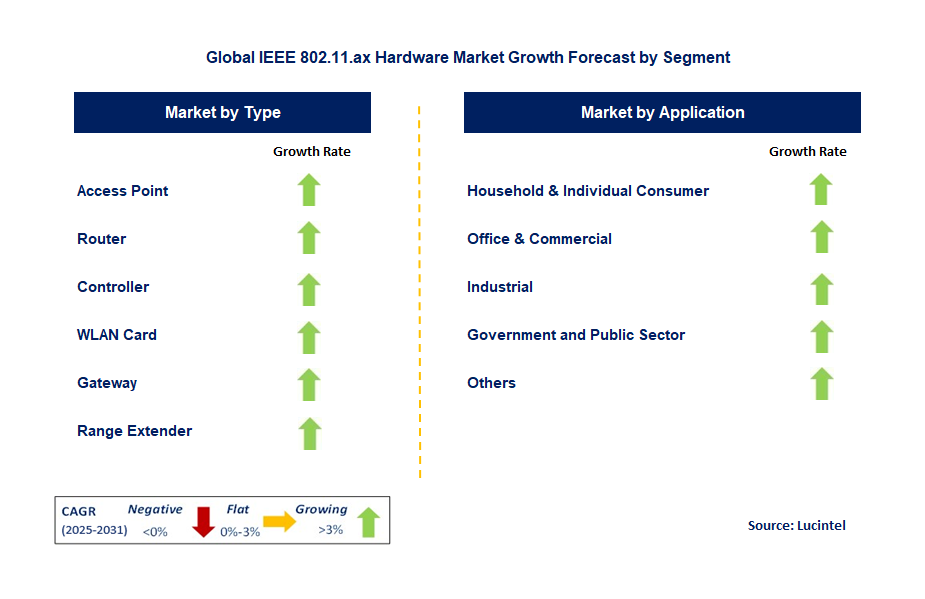
The future of the global IEEE 802.11.ax hardware market looks promising with opportunities in the household & individual consumer, office & commercial, industrial, and government and public sector markets. The global IEEE 802.11.ax hardware market is expected to grow with a CAGR of 11.2% from 2025 to 2031. The major drivers for this market are growing demand for high-speed internet and wireless connectivity, increased adoption of IoT devices and smart home technology, and rising need for improved network efficiency and reduced latency. Lucintel forecasts that, within the type category, access point is expected to witness the highest growth over the forecast period due to access points are essential for enabling wi-fi 6 (802.11.ax) connectivity in both residential and enterprise environments. Within the application category, office & commercial is expected to witness the highest growth due to the increasing demand for high-performance, reliable wireless networks in businesses and enterprises. In terms of region, APAC is expected to witness the highest growth over the forecast period due to this region has a large and growing demand for advanced wireless connectivity. Gain valuable insights for your business decisions with our comprehensive 150+ page report. Sample figures with some insights are shown below.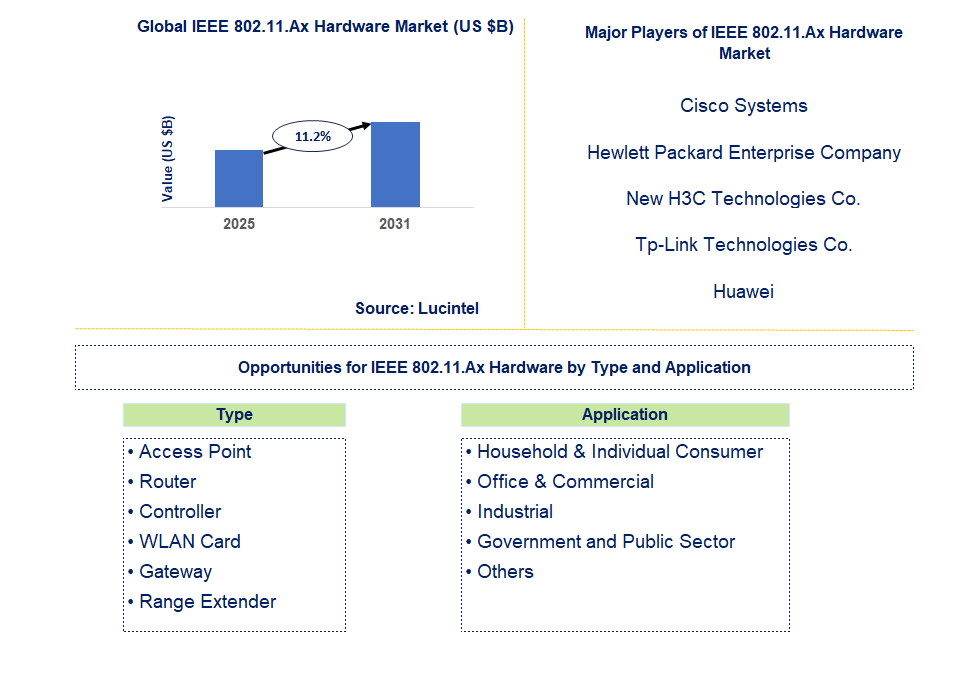
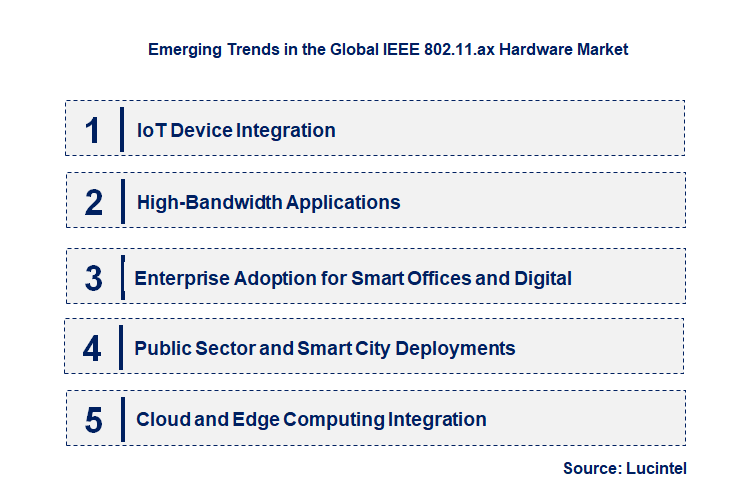
Emerging Trends in the IEEE 802.11.ax Hardware Market
The IEEE 802.11.ax hardware market is changing fast, with emerging trends that are reshaping the way consumers and businesses approach wireless connectivity. As demand for faster speeds, better performance, and increased capacity grows, Wi-Fi 6 is becoming a crucial technology for a range of applications. Below, we explore five key trends driving the adoption and growth of 802.11.ax hardware, from the rise of IoT to the increasing demand for high-speed internet.• IoT Device Integration: IoT devices are increasingly being integrated into homes, businesses, and industrial settings. Wi-Fi 6 is optimized for high-density environments, so it is best suited to support the increased number of IoT devices. This includes smart homes, connected appliances, and sensor networks. The capability of Wi-Fi 6 in managing more devices at a go while ensuring minimal latency and excellent reliability is transforming the way IoT will be integrated into work and business life. Therefore, more IoT applications will increase the demand for Wi-Fi 6.
• High-Bandwidth Applications: The biggest advantage of IEEE 802.11.ax hardware is that it supports high-bandwidth applications, including 4K and 8K video streaming, virtual reality, and gaming. As entertainment and communication services evolve to offer more immersive experiences, the demand for faster and more stable wireless connections will increase. With far higher data throughput and a much reduced latency, Wi-Fi 6 is specifically suited for these applications to support next-generation content consumers and businesses.
• Enterprise Adoption for Smart Offices and Digital Transformation: In the course of the digital transformation of business, Wi-Fi 6 is playing an important role in realizing efficient, connected environments. Wi-Fi 6 enables better connectivity for high-density environments, such as offices, warehouses, and manufacturing facilities, where large numbers of connected devices are used. Businesses are adopting Wi-Fi 6 to support the growing use of smartphones, tablets, laptops, and IoT devices in the workplace. This trend is helping businesses improve productivity, enhance collaboration, and support smart office initiatives that require high-speed, reliable connectivity.
• Public Sector and Smart City Deployments: Wi-Fi 6 is rapidly being adopted in public environments in conjunction with smart cities development. Governments and municipalities are putting in infrastructure using Wi-Fi 6 to enable public transportation systems, parks, and commercial districts with high-speed internet access. This serves the demand for public connectivity and also addresses applications like public safety, environmental monitoring, and connected transportation systems. Wi-Fi 6‘s ability to support a large number of connected devices makes it a key enabler of smart city initiatives.
• Cloud and Edge Computing Integration: As cloud and edge computing services grow, Wi-Fi 6 hardware is becoming essential for connecting remote devices to cloud infrastructure. The technology‘s low latency, higher throughput, and greater capacity make it ideal for edge applications, where data is processed closer to the source. While integrating with the cloud, Wi-Fi 6 provides even more reliable and seamless connectivity, while faster data transmission makes it suitable for edge devices. Such demand is, therefore, pushing Wi-Fi 6 into various cloud-dependent industries like retail, healthcare, and logistics. Emerging trends indicate how IEEE 802.11.ax hardware is evolving in response to IoT, high-bandwidth applications, and digital transformation demands. As business and governments embrace Wi-Fi 6 for smart cities, cloud computing, and high-density environments, the hardware market will continue growing and innovating.
Recent Development in the IEEE 802.11.ax Hardware Market
Recent developments in the IEEE 802.11.ax (Wi-Fi 6) hardware market are a reflection of the growing demand for high-speed wireless connectivity and the increasing adoption of next-generation applications. These developments are helping to address network congestion, latency, and bandwidth limitations, which are critical as more devices and services rely on wireless networks. Below, we explore five key developments that are driving the evolution of Wi-Fi 6 hardware.• Mass Adoption of Wi-Fi 6 Routers and Access Points: One of the key developments in the Wi-Fi 6 market is the mass adoption of Wi-Fi 6 routers and access points. Some of the leading hardware manufacturers, such as Net gear, TP-Link, and Linksys, have launched a series of Wi-Fi 6-enabled devices designed to support the growing demand for faster, more reliable internet. This adoption is being driven by consumer and business demand for higher data throughput, especially in environments with high device density. Wi-Fi 6 routers and access points are becoming standard in homes and offices, providing better performance for a variety of devices.
• Integration of Wi-Fi 6 with 5G Technology: Another significant development is the integration of Wi-Fi 6 with 5G technology. With the rollout of 5G networks, Wi-Fi 6 is supplemented with faster speeds and lower latency. The convergence of Wi-Fi 6 and 5G is revolutionizing healthcare, entertainment, and manufacturing industries through the provision of reliable, high-speed wireless connectivity. This ensures that Wi-Fi networks can handle the enormous data amounts that 5G applications produce, further increasing Wi-Fi 6 adoption.
• Enterprise Network Upgrades: Businesses are upgrading their wireless networks to support Wi-Fi 6 as more devices are being connected in the workplace. Wi-Fi 6 offers better support for high-density environments, which means enterprises can support more simultaneous connections and provide faster, more stable connections for employees and customers. This shift is mainly seen in industries like education, retail, and hospitality, which require good-quality wireless connectivity for day-to-day operations and satisfaction of customers.
• Wi-Fi 6-enabled mobile devices: The latest series of Wi-Fi 6-enabled smartphones, laptops, and tablets is helping fast-track the uptake of Wi-Fi 6 hardware. As device makers like Apple, Samsung, and Dell are increasingly introducing Wi-Fi 6 technology into the latest mobile devices they make, Wi-Fi 6 technology has come to be extensively used in a variety of connectivity needs by these end-users. Consequently, Wi-Fi 6 routers and access points that can accommodate and connect such Wi-Fi 6-enabled devices quickly and efficiently drive demand for this particular hardware.
• Public Wi-Fi 6 Networks: Public Wi-Fi networks are also changing with the adoption of Wi-Fi 6. Cities and municipalities are increasingly investing in Wi-Fi 6 infrastructure to provide faster and more reliable public internet access. Public transportation systems, airports, and public parks are becoming hotspots for Wi-Fi 6, enhancing connectivity for commuters, travelers, and the general public. This development is helping bridge the digital divide by ensuring that communities have access to high-speed internet, no matter where they are. The IEEE 802.11.ax hardware market is changing with recent developments that are forcing the adoption of Wi-Fi 6 in consumer and enterprise environments. Integration of Wi-Fi 6 with 5G, roll-out of Wi-Fi 6 routers and devices, and the upgrade of enterprise networks are all reshaping the wireless connectivity landscape. These changes are helping businesses and consumers get the most out of faster, more reliable wireless communication.
Strategic Growth Opportunites in the IEEE 802.11.ax Hardware Market
The IEEE 802.11.ax (Wi-Fi 6) hardware market shows significant growth opportunities in key applications in consumer electronics, enterprise solutions, smart cities, and more. Growing demand for faster and efficient wireless networks fuels the adoption of Wi-Fi 6 to support wide-ranging use cases. Below are five key growth opportunities in the Wi-Fi 6 hardware market with implications for both businesses and consumers.• Smart Home and IoT Applications: Wi-Fi 6 presents a massive growth opportunity for the smart home and IoT markets. Wi-Fi 6 can manage a large number of connected devices, ensuring low-latency communication. It is thus well suited for smart homes, connected appliances, and IoT systems. With the proliferation of IoT devices, companies are adopting Wi-Fi 6 to power their smart ecosystems. This opens great avenues for router manufacturers, access point, and smart device manufacturers for designing Wi-Fi 6-compatible products.
• Enterprise Network Upgrade: With increased reliance on digital solutions and connected devices, upgrading enterprise networks using Wi-Fi 6 technology will be a big opportunity. Wi-Fi 6 supports high-density environments, increases network efficiency, and enhances connectivity among employees and customers. Businesses operating in retail, healthcare, and education sectors have been investing in Wi-Fi 6 to satisfy the growing demand for high-speed internet and seamless connectivity across their networks.
• Public Infrastructure and Smart Cities: Wi-Fi 6 is becoming a key enabler for smart city initiatives and public infrastructure projects. Governments and municipalities are investing in Wi-Fi 6 networks to provide high-speed internet access in public spaces, such as parks, transportation hubs, and commercial districts. Wi-Fi 6 is designed to support the growing number of connected devices in urban environments and is a part of smart cities that leverage IoT, big data, and connected transportation systems.
• Gaming and High-Bandwidth Applications: Wi-Fi 6 is becoming a must-have for gamers and high-bandwidth applications. Gamers, content creators, and streamers are adopting Wi-Fi 6 to benefit from faster speeds, lower latency, and better network performance. The increasing need for immersive gaming experiences, 4K/8K video streaming, and virtual reality is creating the demand for more powerful wireless solutions. As gaming and content consumption continue to rise, Wi-Fi 6 is well positioned to meet those demands.
• Cloud and Edge Computing: The emergence of cloud and edge computing has immense growth opportunities for Wi-Fi 6 hardware. Wi-Fi 6‘s speed and low latency are important in supporting edge devices and cloud-based applications. As companies move to the cloud-based infrastructure and edge computing platforms, more demand is required for Wi-Fi 6 technology to ensure fast, reliable wireless communication. The strategic growth opportunities in the IEEE 802.11.ax hardware market are diverse and expansive. Wi-Fi 6 is targeted to grow smart homes, enterprises, smart cities, gaming, and cloud computing. These opportunities reflect the growth of importance for Wi-Fi 6 as a foundational technology for future wireless networks and connected systems.
IEEE 802.11.ax Hardware Market Driver and Challenges
Technological advancements, economic pressures, and regulatory challenges are among the factors that affect the IEEE 802.11.ax hardware market. As demand for high-speed wireless networks continues to grow, Wi-Fi 6 (IEEE 802.11.ax) is critical in delivering the performance enhancements needed over the previous Wi-Fi standards. However, on the other side, the uptake of Wi-Fi 6 technology is also faced by several challenges that include competition of other wireless technologies, economic constraints, and regulatory issues in some geographical regions. Now, let us discuss five main drivers that have been encouraging Wi-Fi 6 adoption and three key challenges to the market: The factors responsible for driving the ieee 802.11.ax hardware market include: 1. Increasing Demand for High-Speed Internet and Connectivity: As more devices become connected and data consumption continues to rise, there is an increasing demand for faster, more reliable internet connections. IEEE 802.11.ax (Wi-Fi 6) addresses these needs by providing faster speeds, higher capacity, and better performance in high-density environments. The proliferation of smart homes, IoT devices, and cloud-based applications further drives the need for Wi-Fi 6, making it an essential solution for both consumers and businesses looking for seamless connectivity across multiple devices. 2. Internet of Things (IoT): Due to the growth of IoT devices in industries like healthcare, automotive, retail, and smart homes, there is a strong requirement for wireless networks that are able to carry large numbers of connected devices. Wi-Fi 6 is designed to undertake the challenge of high-density environments and minimize latency to provide reliable connections for the IoT devices. As IoT adoption continues to grow around the globe, Wi-Fi 6 is playing an important role in ensuring that networks can handle more devices and perform well. 3. Superior Network Efficiency and Performance: This is one of the key reasons for the adoption of IEEE 802.11.ax hardware: it delivers superior network efficiency. Wi-Fi 6 introduces OFDMA and MU-MIMO technologies, which are used to optimize network resources for better performance in a high-user environment. OFDMA and MU-MIMO improve bandwidth utilization and reduce congestion, which makes Wi-Fi 6 the best choice for offices, airports, and stadiums where multiple devices are connected simultaneously. 4. Deployment of 5G Networks: With the global rollout of 5G networks, there is a rising need for complementary technologies that can support the high-speed and low-latency requirements of 5G applications. Wi-Fi 6 provides the bandwidth and network efficiency to complement 5G, especially in indoor environments where cellular coverage might be limited. This is because of the synergy that is created by the combination of Wi-Fi 6 and 5G to offer seamless connectivity for high-demand applications such as AR, VR, and cloud gaming, which depend on both speed and low latency. 5. Wireless Networks Adoption among Consumers and Enterprises: Increasing dependence on wireless networks in both personal and professional lives will drive the adoption of Wi-Fi 6. Consumer devices, such as smartphones, laptops, and smart home devices, are becoming Wi-Fi 6 compatible. On the enterprise side, the infrastructure is being upgraded to accommodate an increasing number of connected devices and bandwidth-intensive applications. This massive adoption by both consumers and enterprises drives the demand for Wi-Fi 6 hardware. Challenges in the ieee 802.11.ax hardware market are: 1. High Deployment Cost: Although it has its benefits, the cost of deploying IEEE 802.11.ax (Wi-Fi 6) hardware is a significant barrier, especially for small and medium-sized businesses. The initial investment required to upgrade routers, access points, and other networking equipment to Wi-Fi 6 can be high. This cost challenge is compounded by the need for compatible devices and infrastructure, as not all existing hardware supports the new standard. Where business concerns are primarily based on cost, this might hinder the proliferation of Wi-Fi 6 across all regions. 2. Interoperability problems with old devices: Since this is a newer standard, another problem that arises for the market of Wi-Fi 6 technology is interoperability problems with the old Wi-Fi equipment, which has not been made compatible with this new standard. Backwards compatibility with other Wi-Fi standards means that it is compatible with older devices; however, this does not guarantee that older devices will be able to take advantage of the added features of Wi-Fi 6, such as improved speeds and network efficiency. This may imply slower adoption since users and businesses are less likely to invest in new hardware before legacy devices have been fully phased out. 3. Regulatory Obstacles and Spectrum Assignment: Some challenges are regulatory in nature, such as spectrum assignment and also the limitation in wireless communication. In a few countries, the regulatory bodies have not yet assigned spectrum for Wi-Fi 6 and, thus, might delay implementing Wi-Fi 6 networks. Regions with more stringent regulations will face difficulties deploying Wi-Fi 6 infrastructure in public spaces and critical areas. These regulatory challenges might act as a slow-down measure to Wi-Fi 6 adoption in certain markets. The IEEE 802.11.ax hardware market is influenced by both considerable drivers and challenges. The keys for its growth drivers include faster connectivity with higher efficiencies, the widespread penetration of the IoT, better performance networks, implementation of 5G, and wider consumer as well as enterprise take-up. Conversely, the growth in Wi-Fi 6 may face challenges of very high installation costs, limited interoperability capabilities between legacy equipment, and significant regulatory hurdles that impact implementation. Despite these challenges, the impact of such drivers in general is to push the market forward while providing a channel for innovativeness and development in the wireless networking solutions in various industries.List of IEEE 802.11.ax Hardware Companies
Companies in the market compete on the basis of product quality offered. Major players in this market focus on expanding their manufacturing facilities, R&D investments, infrastructural development, and leverage integration opportunities across the value chain. With these strategies IEEE 802.11.ax hardware companies cater increasing demand, ensure competitive effectiveness, develop innovative products & technologies, reduce production costs, and expand their customer base. Some of the IEEE 802.11.ax hardware companies profiled in this report include-• Cisco Systems
• Hewlett Packard Enterprise Company
• New H3C Technologies Co.
• Tp-Link Technologies Co.
• Huawei
• Asustek Computer Inc.
• D-Link Corporation
IEEE 802.11.ax Hardware Market by Segment
The study includes a forecast for the global IEEE 802.11.ax hardware market by type, application, and region.IEEE 802.11.ax Hardware Market by Type [Value from 2019 to 2031]:
• Access Point
• Router
• Controller
• WLAN Card
• Gateway
• Range Extender
IEEE 802.11.ax Hardware Market by Application [Value from 2019 to 2031]:
• Household & Individual Consumer
• Office & Commercial
• Industrial
• Government and Public Sector
• Others
IEEE 802.11.ax Hardware Market by Region [Value from 2019 to 2031]:
• North America
• Europe
• Asia Pacific
• The Rest of the World
Country Wise Outlook for the IEEE 802.11.ax Hardware Market
The IEEE 802.11.ax hardware market, also famously known as Wi-Fi 6, has been rapidly growing in the recent past due to accelerated demand for faster and more efficient wireless communication. Since new Wi-Fi standards like 802.11.ax popped up, markets across the United States, China, Germany, India, and Japan significantly progressed in their wireless infrastructure development that allows for high-speed internet, low latency, and better capacity management. These developments are crucial for supporting applications such as the Internet of Things (IoT), smart homes, and high-bandwidth services like video streaming and virtual reality. Below, we discuss the key developments in the 802.11.ax hardware market across these countries.• United States: In the United States, the adoption of IEEE 802.11.ax hardware is growing steadily, driven by both consumer demand and enterprise needs. Wi-Fi 6 routers are fast becoming a staple on both commercial and residential fronts, as the main players upgrade their wireless infrastructure to accommodate the increased bandwidth requirements of connected devices. ISPs within the U.S. are also investing in Wi-Fi 6-enabled access points in order to continue scaling the network‘s capacity and performance. The U.S. government is highly focused on the improvement of 5G and Wi-Fi technology, which facilitates the advanced adoption of Wi-Fi 6 to enhance connectivity as a whole.
• China: China is highly adopting IEEE 802.11.ax technology as part of its overall digital transformation. Wi-Fi 6 also seems to be penetrating faster; especially in urban areas, the demand for high-speed internet explodes. Chinese companies like Huawei are embedding 802.11.ax hardware into their product lines, making Wi-Fi 6 the standard in enterprise solutions, public hotspots, and residential networks. Chinese government policy touting a smart city initiative and backing for 5G networks supports Wi-Fi 6 adoption, forming a strong building block for further expansion in the country‘s wireless infrastructure.
• Germany: IEEE 802.11.ax hardware is being deployed in Germany, mainly in urban and business environments. German companies, especially manufacturing and industrial automation, are adopting Wi-Fi 6 for increased capacity and efficiency. The technology is being integrated into enterprise networks to support the growth of IoT devices and smart factory systems. Another key driver behind the deployment of Wi-Fi 6 in public areas, especially transport nodes and business houses, where high-speed and reliable access becomes a basic requirement, is the increasing requirement for high-speed internet in Germany.
• India: The demand for adoption of Wi-Fi 6 is highly increasing in India, based on the urgency to provide reliability and high speed over the whole of urban as well as rural areas. The country has a massive population along with increasing digital penetration, thus ensuring significant demand for speedier wireless communications solutions. Internet service providers and mobile network operators are investing in 802.11.ax technology to meet the growing data consumption needs of consumers and businesses. Other factors include the government‘s focus on digital infrastructure and the deployment of 5G networks, which will make Wi-Fi 6 technology a necessity for new applications such as IoT, education, and remote work.
• Japan: Japan is one of the first countries to adopt IEEE 802.11.ax technology, with Wi-Fi 6 being widely deployed across the country. Japan‘s technological infrastructure is robust, and the country focuses on innovation, making it a leader in the adoption of next-generation wireless technologies. Wi-Fi 6 is now basically impossible to avoid for both business and consumer networks because an increasing number of enterprises are upgrading their networks to support IoT, High Definition video conferencing and smarter applications. Japan‘s commitment to promoting its digital transformation, accelerating internet speeds, is helping accelerate the deployment of devices enabled with Wi-Fi 6, all contributing to improved connectivity nationwide.

Features of the Global IEEE 802.11.ax Hardware Market
Market Size Estimates: IEEE 802.11.ax hardware market size estimation in terms of value ($B). Trend and Forecast Analysis: Market trends (2019 to 2024) and forecast (2025 to 2031) by various segments and regions. Segmentation Analysis: IEEE 802.11.ax hardware market size by type, application, and region in terms of value ($B). Regional Analysis: IEEE 802.11.ax hardware market breakdown by North America, Europe, Asia Pacific, and Rest of the World. Growth Opportunities: Analysis of growth opportunities in different type, application, and regions for the IEEE 802.11.ax hardware market. Strategic Analysis: This includes M&A, new product development, and competitive landscape of the IEEE 802.11.ax hardware market. Analysis of competitive intensity of the industry based on Porter’s Five Forces model.
FAQ
Q1. What is the growth forecast for IEEE 802.11.ax hardware market? Answer: The global IEEE 802.11.ax hardware market is expected to grow with a CAGR of 11.2% from 2025 to 2031. Q2. What are the major drivers influencing the growth of the IEEE 802.11.ax hardware market? Answer: The major drivers for this market are growing demand for high-speed internet and wireless connectivity, increased adoption of IoT devices and smart home technology, and rising need for improved network efficiency and reduced latency. Q3. What are the major segments for IEEE 802.11.ax hardware market? Answer: The future of the IEEE 802.11.ax hardware market looks promising with opportunities in the household & individual consumer, office & commercial, industrial, and government and public sector markets. Q4. Who are the key IEEE 802.11.ax hardware market companies? Answer: Some of the key IEEE 802.11.ax hardware companies are as follows:• Cisco Systems
• Hewlett Packard Enterprise Company
• New H3C Technologies Co.
• Tp-Link Technologies Co.
• Huawei
• Asustek Computer Inc.
• D-Link Corporation Q5. Which IEEE 802.11.ax hardware market segment will be the largest in future? Answer: Lucintel forecasts that access point is expected to witness the highest growth over the forecast period due to access points are essential for enabling wi-fi 6 (802.11.ax) connectivity in both residential and enterprise environments. Q6. In IEEE 802.11.ax hardware market, which region is expected to be the largest in next 5 years? Answer: APAC is expected to witness the highest growth over the forecast period due to this region has a large and growing demand for advanced wireless connectivity. Q7. Do we receive customization in this report? Answer: Yes, Lucintel provides 10% customization without any additional cost.
Table of Contents
Methodology
- In-depth interviews of the major players in this market
- Detailed secondary research from competitors’ financial statements and published data
- Extensive searches of published works, market, and database information pertaining to industry news, company press releases, and customer intentions
- A compilation of the experiences, judgments, and insights of Lucintel’s professionals, who have analyzed and tracked this market over the years.


Buy Now
Choose a license that fits your team. Instant PDF delivery.
Prices exclude taxes. Instant delivery. Custom licensing available on request.
Key Questions
- • What are some of the most promising, high-growth opportunities for the IEEE 802.11.ax hardware market by type (access point, router, controller, WLAN card, gateway, and range extender), application (household & individual consumer, office & commercial, industrial, government and public sector, and others), and region (North America, Europe, Asia Pacific, and the Rest of the World)?
- • Which segments will grow at a faster pace and why?
- • Which region will grow at a faster pace and why?
- • What are the key factors affecting market dynamics? What are the key challenges and business risks in this market?
- • What are the business risks and competitive threats in this market?
- • What are the emerging trends in this market and the reasons behind them?
- • What are some of the changing demands of customers in the market?
- • What are the new developments in the market? Which companies are leading these developments?
- • Who are the major players in this market? What strategic initiatives are key players pursuing for business growth?
- • What are some of the competing products in this market and how big of a threat do they pose for loss of market share by material or product substitution?
- • What M&A activity has occurred in the last 5 years and what has its impact been on the industry? For any questions related to IEEE 802.11.ax Hardware Market, IEEE 802.11.ax Hardware Market Size, IEEE 802.11.ax Hardware Market Growth, IEEE 802.11.ax Hardware Market Analysis, IEEE 802.11.ax Hardware Market Report, IEEE 802.11.ax Hardware Market Share, IEEE 802.11.ax Hardware Market Trends, IEEE 802.11.ax Hardware Market Forecast, IEEE 802.11.ax Hardware Companies, write Lucintel analyst at email: helpdesk@lucintel.com. We will be glad to get back to you soon.


