
Report Feature
GMP Viral Vector Manufacturing Market Trends and Forecast
The future of the global GMP viral vector manufacturing market looks promising with opportunities in the clinical research, commercial production markets. The global GMP viral vector manufacturing market is expected to grow with a CAGR of 17.5% from 2025 to 2031. The major drivers for this market are increasing adoption of personalized medicine, growing demand for gene therapies, and increasing prevalence of genetic diseases. Lucintel forecasts that, within the type category, aav vector manufacturing is expected to witness the highest growth over the forecast period due to demand for gene therapies, inherited genetic disorders, neurological diseases. Within the application category, commercial production is expected to witness the higher growth due to increasing demand for viral vectors in large-scale commercial applications. In terms of region, North America is expected to witness the highest growth over the forecast period due to advanced biopharmaceutical industry, regulatory support. Gain valuable insights for your business decisions with our comprehensive 150+ page report. Sample figures with some insights are shown below.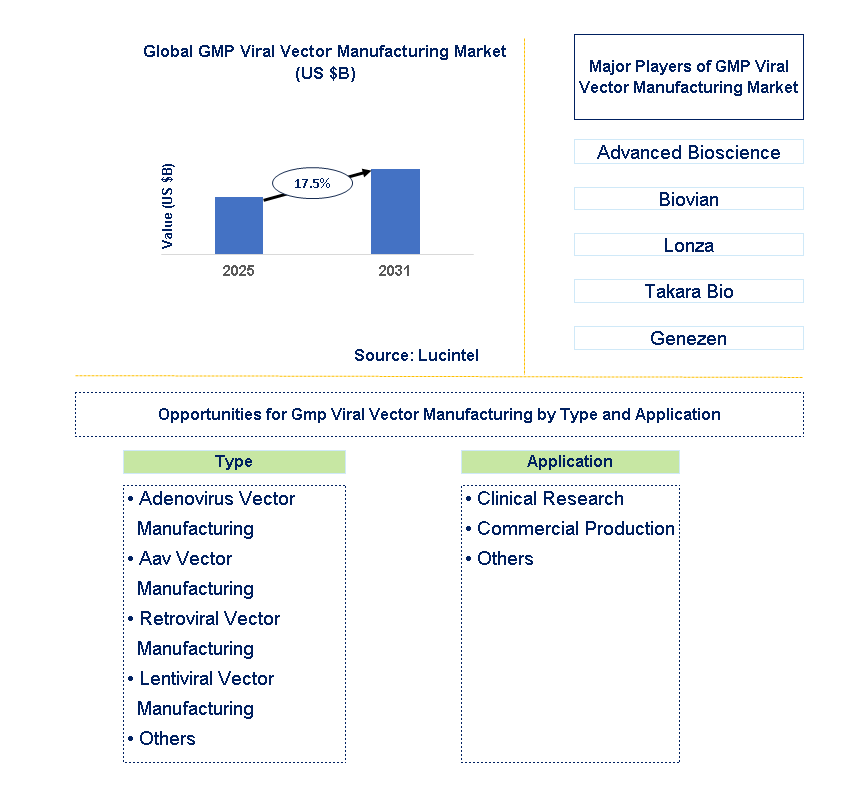
GMP Viral Vector Manufacturing Market by Segment
• Integration of Automation in Production: Automation is becoming a significant trend in GMP viral vector manufacturing. Automation helps reduce human error, improve efficiency, and enhance reproducibility in the production of viral vectors. Automated systems are being implemented in various stages, such as transfection, viral vector production, and purification, which allows for more consistent and higher-quality products. The trend towards automation also helps scale up production to meet increasing global demand for gene therapies.
• Focus on Viral Vector Safety and Quality Control: With the expansion of gene therapies, ensuring the safety and quality of viral vectors is more critical than ever. Companies are increasingly investing in advanced quality control measures, such as enhanced viral testing, vector characterization, and contamination prevention strategies. These measures ensure compliance with stringent regulatory standards, safeguard patient health, and build confidence in viral vector-based therapies, particularly for clinical and commercial use.
• Shift Toward Serum-Free and Chemically Defined Media: There is a growing trend towards using serum-free and chemically defined media in GMP viral vector production. This shift minimizes the risk of contamination and enhances the consistency and reproducibility of vector production. Moreover, these media formulations are more cost-effective and are essential for large-scale manufacturing. The adoption of serum-free media is becoming increasingly important as companies work to reduce production costs while maintaining high-quality standards.
• Collaboration and Outsourcing for Capacity Expansion: To meet the increasing demand for GMP viral vector manufacturing, many companies are turning to partnerships and outsourcing arrangements with contract manufacturing organizations (CMOs). These collaborations allow companies to rapidly scale production and access advanced technologies without having to invest in building new manufacturing facilities. This trend is also helping to increase the availability of GMP-compliant viral vectors for gene therapies, enabling faster development of new treatments. These emerging trends are reshaping the GMP viral vector manufacturing market by enhancing efficiency, scalability, and safety. As the market continues to evolve, the integration of advanced technologies, such as automation and serum-free media, will improve production processes and reduce costs. Meanwhile, increased collaboration and outsourcing will ensure that the industry can meet the growing global demand for viral vectors, accelerating the development and availability of gene therapies." src="Emerging Trends in the GMP Viral Vector Manufacturing Market" style="height: auto;width: auto;" title="The GMP viral vector manufacturing market is undergoing several key trends as it adapts to the increasing demand for gene therapies and vaccines. These trends reflect advancements in manufacturing technologies, regulatory changes, and growing investments in the biotech sector, all of which contribute to the evolution of this market.
• Adoption of Scalable Manufacturing Platforms: As demand for viral vectors grows, the need for scalable manufacturing solutions has increased. Companies are developing platforms that can handle large-scale production of viral vectors while maintaining high quality and regulatory compliance. This includes optimizing bioreactor systems and implementing continuous production methods, which improve output and reduce costs. These innovations are crucial for meeting the rising demand for viral vectors used in gene therapies.
• Integration of Automation in Production: Automation is becoming a significant trend in GMP viral vector manufacturing. Automation helps reduce human error, improve efficiency, and enhance reproducibility in the production of viral vectors. Automated systems are being implemented in various stages, such as transfection, viral vector production, and purification, which allows for more consistent and higher-quality products. The trend towards automation also helps scale up production to meet increasing global demand for gene therapies.
• Focus on Viral Vector Safety and Quality Control: With the expansion of gene therapies, ensuring the safety and quality of viral vectors is more critical than ever. Companies are increasingly investing in advanced quality control measures, such as enhanced viral testing, vector characterization, and contamination prevention strategies. These measures ensure compliance with stringent regulatory standards, safeguard patient health, and build confidence in viral vector-based therapies, particularly for clinical and commercial use.
• Shift Toward Serum-Free and Chemically Defined Media: There is a growing trend towards using serum-free and chemically defined media in GMP viral vector production. This shift minimizes the risk of contamination and enhances the consistency and reproducibility of vector production. Moreover, these media formulations are more cost-effective and are essential for large-scale manufacturing. The adoption of serum-free media is becoming increasingly important as companies work to reduce production costs while maintaining high-quality standards.
• Collaboration and Outsourcing for Capacity Expansion: To meet the increasing demand for GMP viral vector manufacturing, many companies are turning to partnerships and outsourcing arrangements with contract manufacturing organizations (CMOs). These collaborations allow companies to rapidly scale production and access advanced technologies without having to invest in building new manufacturing facilities. This trend is also helping to increase the availability of GMP-compliant viral vectors for gene therapies, enabling faster development of new treatments. These emerging trends are reshaping the GMP viral vector manufacturing market by enhancing efficiency, scalability, and safety. As the market continues to evolve, the integration of advanced technologies, such as automation and serum-free media, will improve production processes and reduce costs. Meanwhile, increased collaboration and outsourcing will ensure that the industry can meet the growing global demand for viral vectors, accelerating the development and availability of gene therapies." />
Emerging Trends in the GMP Viral Vector Manufacturing Market
Recent Development in the GMP Viral Vector Manufacturing Market
The GMP viral vector manufacturing market has seen several recent developments that are shaping its growth trajectory. These developments address the challenges of increasing production capacity, improving manufacturing efficiency, and complying with stringent regulatory standards, while ensuring the delivery of high-quality viral vectors for gene therapies.• Introduction of New Scalable Production Platforms: Companies are increasingly focusing on developing scalable production systems that can handle high volumes of viral vector production. Recent developments include the introduction of single-use bioreactors and continuous bioprocessing systems that increase production efficiency. These platforms allow for the manufacturing of viral vectors at a larger scale, making gene therapies more accessible and cost-effective.
• Advancements in Viral Vector Purification Technologies: Recent technological advancements in viral vector purification, such as affinity chromatography and membrane filtration, are improving the purity and yield of viral vectors. These advancements are essential for ensuring the safety and efficacy of gene therapies, particularly when transitioning from clinical trials to commercial production. High-purity vectors are critical for reducing the risk of adverse effects in patients.
• Increased Adoption of Automated Systems: Automation has become a critical component in GMP viral vector manufacturing. New automated systems for transfection, purification, and packaging are being implemented to increase consistency, reduce manual labor, and enhance reproducibility. These systems are also crucial for scaling production to meet the increasing demand for viral vectors, especially in gene therapy applications.
• Integration of Serum-Free Media in Production: The shift to serum-free and chemically defined media in GMP viral vector production has been a major development. Serum-free media reduce the risk of contamination and variability, while improving consistency in production. This transition is key to reducing the cost of viral vector manufacturing and ensuring the safety of gene therapies as they move through clinical and commercial stages.
• Regulatory Advancements for Faster Approval: Regulatory bodies, such as the FDA and EMA, have introduced new guidelines and frameworks to expedite the approval of gene therapies and related manufacturing processes. These regulatory advancements are helping companies navigate the approval process more efficiently, ensuring that viral vector production systems are compliant with GMP standards while accelerating the development of new treatments. These recent developments are transforming the GMP viral vector manufacturing market by improving scalability, reducing costs, and enhancing the safety and efficacy of viral vector production. The integration of automation, serum-free media, and advanced purification techniques is paving the way for more efficient and cost-effective manufacturing processes, thus supporting the growth of gene therapies and vaccines globally.
Strategic Growth Opportunities in the GMP Viral Vector Manufacturing Market
The GMP viral vector manufacturing market offers several strategic growth opportunities, particularly as the demand for gene therapies and vaccines continues to rise. These opportunities are driven by advancements in manufacturing technologies, regulatory support, and the growing need for scalable, high-quality viral vectors.• Gene Therapy for Genetic Disorders: The increasing prevalence of genetic disorders presents a significant growth opportunity for GMP viral vector manufacturing. Viral vectors are essential for the delivery of gene therapies, and the rising demand for treatments for conditions such as cystic fibrosis, Duchenne muscular dystrophy, and hemophilia will drive the need for large-scale vector production.
• Oncology Applications: Viral vectors are increasingly being explored for cancer therapies, particularly in immunotherapy and gene editing approaches. The growing focus on personalized cancer treatments presents an opportunity for GMP viral vector manufacturers to develop vectors tailored to specific tumors, thus increasing the demand for high-quality, scalable manufacturing services.
• Vaccine Development: The global demand for vaccines, especially in response to pandemics, is driving growth in GMP viral vector manufacturing. Viral vectors are used in the development of viral vector-based vaccines, such as those for COVID-19. This trend presents opportunities for manufacturers to expand production capacity and develop innovative production methods to meet the growing need for vaccine supplies.
• Regenerative Medicine: The regenerative medicine sector, which focuses on cell and tissue repair, is another area of significant opportunity. GMP viral vectors play a crucial role in gene editing, cell reprogramming, and tissue regeneration. As regenerative medicine continues to advance, the demand for viral vectors will increase, presenting new growth opportunities for manufacturers.
• Contract Manufacturing Services: The increasing complexity of viral vector production has led to growth in contract manufacturing organizations (CMOs) that provide specialized services for vector production. CMOs allow biotech companies to scale their manufacturing capabilities without significant upfront investment, creating a growth opportunity for companies offering GMP viral vector production services. These growth opportunities highlight the expanding applications of GMP viral vectors across gene therapy, oncology, vaccine development, regenerative medicine, and contract manufacturing. As demand increases across these sectors, GMP viral vector manufacturers must adapt by scaling production, adopting new technologies, and complying with evolving regulatory standards.
GMP Viral Vector Manufacturing Market Driver and Challenges
The GMP viral vector manufacturing market is influenced by a range of drivers and challenges, including advancements in technology, regulatory support, economic factors, and production hurdles. These factors are shaping the future of viral vector manufacturing, impacting both market growth and the adoption of gene therapies. The factors responsible for driving the GMP Viral Vector Manufacturing market include: 1. Technological Advancements in Viral Vector Production: The development of more efficient viral vector production technologies, such as high-yield expression systems and improved purification methods, is driving the growth of the market. These innovations are crucial for increasing the scalability and cost-effectiveness of viral vector manufacturing. 2. Expanding Gene Therapy Market: The rapid growth of the gene therapy market is a significant driver for GMP viral vector manufacturing. As more gene therapies enter clinical trials and reach commercialization, the demand for viral vectors will continue to rise, creating a favorable environment for market growth. 3. Regulatory Support and Streamlined Approvals: Regulatory bodies, such as the FDA and EMA, are providing greater clarity and more efficient approval processes for gene therapies and viral vector production. This regulatory support is helping to accelerate the adoption of viral vector-based therapies, thus expanding the demand for GMP manufacturing services. 4. Investment in Biotechnology and Healthcare: Increasing investments in biotechnology and healthcare infrastructure are supporting the growth of the GMP viral vector manufacturing market. With more funding flowing into the development of gene therapies, companies are focusing on improving manufacturing capabilities to meet the growing demand. 5. Increase in Vaccine Development and Production: The rising global demand for vaccines, including viral vector-based vaccines, is driving the growth of GMP viral vector manufacturing. The need for large-scale production of vaccines, especially in response to pandemics, has led to the expansion of manufacturing capacity for viral vectors. Challenges in the GMP Viral Vector Manufacturing market are: 1. High Production Costs: The high cost of GMP-compliant viral vector production, particularly for large-scale manufacturing, remains a challenge. Reducing production costs through process optimization, automation, and economies of scale will be essential for making gene therapies and vaccines more affordable. 2. Production Scalability: Scaling viral vector production to meet the growing demand for gene therapies and vaccines is a significant challenge. Developing scalable manufacturing systems and increasing production capacity while maintaining quality and compliance with GMP standards will be key to overcoming this challenge. 3. Regulatory Compliance: Navigating complex regulatory requirements and ensuring compliance with GMP standards can be challenging, especially for emerging biotech companies. Maintaining high levels of quality control while adhering to stringent regulatory guidelines is critical to the success of viral vector manufacturing operations. The drivers, including technological advancements, regulatory support, and investment in biotechnology, are fueling growth in the GMP viral vector manufacturing market. However, challenges such as production costs, scalability, and regulatory compliance must be addressed to sustain long-term growth. By overcoming these challenges, the market can continue to support the development of gene therapies, vaccines, and other advanced medical treatments.List of GMP Viral Vector Manufacturing Companies
Companies in the market compete on the basis of product quality offered. Major players in this market focus on expanding their manufacturing facilities, R&D investments, infrastructural development, and leverage integration opportunities across the value chain. With these strategies GMP viral vector manufacturing companies cater increasing demand, ensure competitive effectiveness, develop innovative products & technologies, reduce production costs, and expand their customer base. Some of the GMP viral vector manufacturing companies profiled in this report include-• Advanced Bioscience Laboratories
• Biovian
• Lonza
• Takara Bio
• Genezen
• Halix
• Merck
• Batavia Biosciences
• Exothera
• Wuxi Biologics
GMP Viral Vector Manufacturing Market by Segment
The study includes a forecast for the global GMP viral vector manufacturing market by type, application, and region.GMP Viral Vector Manufacturing Market by Type [Value from 2019 to 2031]:
• Adenovirus Vector Manufacturing
• Aav Vector Manufacturing
• Retroviral Vector Manufacturing
• Lentiviral Vector Manufacturing
• Others
GMP Viral Vector Manufacturing Market by Application [Value from 2019 to 2031]:
• Clinical Research
• Commercial Production
• Others
GMP Viral Vector Manufacturing Market by Region [Value from 2019 to 2031]:
• North America
• Europe
• Asia Pacific
• The Rest of the World
Country Wise Outlook for the GMP Viral Vector Manufacturing Market
The GMP (Good Manufacturing Practice) viral vector manufacturing market has witnessed rapid growth due to the expanding demand for gene therapies and vaccines. As viral vectors play a critical role in delivering therapeutic genes, the need for high-quality, scalable, and compliant manufacturing services has become more pronounced. This is especially true in the United States, China, Germany, India, and Japan, where biotechnology advancements, regulatory support, and increased funding for gene therapy projects are accelerating the growth of GMP viral vector manufacturing. These countries have been at the forefront of innovations in viral vector technologies, enhancing the quality and supply of these products.• United States: In the United States, the GMP viral vector manufacturing market has flourished thanks to significant investments from biopharmaceutical companies and government funding for gene therapy projects. The U.S. is home to many biotech leaders that have developed scalable viral vector production platforms. Innovations such as cell line engineering, automated systems, and process intensification are improving manufacturing efficiency and reducing costs. Additionally, regulatory bodies like the FDA have streamlined the approval process for gene therapies, creating a favorable environment for viral vector production. These developments are crucial in meeting the growing demand for gene therapies and vaccines.
• China: China’s GMP viral vector manufacturing market is rapidly expanding, driven by strong government support and growing investments in biotechnology. The country’s focus on gene therapy and vaccine development has led to the establishment of state-of-the-art production facilities. Chinese companies are improving their viral vector manufacturing processes by adopting advanced technologies, such as viral vector production in serum-free media and increased use of automation. Furthermore, the Chinese government has introduced favorable policies and funding for biotech research, which is enabling the growth of the viral vector manufacturing sector and facilitating the development of gene therapies for both local and global markets.
• Germany: Germany has become a key player in Europe’s GMP viral vector manufacturing market, with a strong focus on gene therapy and immunotherapy. The country is home to several world-class research institutions and biotech companies that are advancing the production of high-quality viral vectors. Germany is enhancing its viral vector manufacturing capacity by adopting new technologies such as transient transfection and scalable bioreactor systems. These innovations are crucial for improving the efficiency, safety, and cost-effectiveness of viral vector production. Moreover, the regulatory framework in Germany, governed by the European Medicines Agency (EMA), ensures that GMP standards are maintained in all production activities.
• India: India is emerging as an important player in the GMP viral vector manufacturing market, with its biotechnology sector growing rapidly. The country is focusing on the development of cost-effective viral vector manufacturing platforms to support the production of gene therapies, particularly for local and regional needs. Indian companies are adopting advanced viral vector technologies, such as stable cell lines and continuous culture systems, to enhance production capabilities. Moreover, India’s large patient population presents significant opportunities for gene therapy applications. The government’s increasing support for biotech research, as well as its emphasis on affordable healthcare, is expected to further boost the GMP viral vector manufacturing market.
• Japan: Japan is making significant strides in GMP viral vector manufacturing, driven by its robust biotechnology industry and governmental support for gene therapy development. Japanese companies are adopting cutting-edge technologies such as viral vector packaging systems and improved purification techniques to enhance vector production efficiency and scalability. The country’s focus on regenerative medicine and cancer therapies is accelerating the need for GMP-compliant viral vectors. Furthermore, Japan’s regulatory environment is conducive to the growth of gene therapies, with streamlined approval processes for GMP viral vector production and clinical trials, thus positioning the country as a leader in the Asia-Pacific region.

Features of the Global GMP Viral Vector Manufacturing Market
Market Size Estimates: GMP viral vector manufacturing market size estimation in terms of value ($B). Trend and Forecast Analysis: Market trends (2019 to 2024) and forecast (2025 to 2031) by various segments and regions. Segmentation Analysis: GMP viral vector manufacturing market size by type, application, and region in terms of value ($B). Regional Analysis: GMP viral vector manufacturing market breakdown by North America, Europe, Asia Pacific, and Rest of the World. Growth Opportunities: Analysis of growth opportunities in different type, application, and regions for the GMP viral vector manufacturing market. Strategic Analysis: This includes M&A, new product development, and competitive landscape of the GMP viral vector manufacturing market. Analysis of competitive intensity of the industry based on Porter’s Five Forces model.
FAQ
Q1. What is the growth forecast for GMP viral vector manufacturing market? Answer: The global GMP viral vector manufacturing market is expected to grow with a CAGR of 17.5% from 2025 to 2031. Q2. What are the major drivers influencing the growth of the GMP viral vector manufacturing market? Answer: The major drivers for this market are increasing adoption of personalized medicine, growing demand for gene therapies, and increasing prevalence of genetic diseases. Q3. What are the major segments for GMP viral vector manufacturing market? Answer: The future of the GMP viral vector manufacturing market looks promising with opportunities in the clinical research, commercial production markets. Q4. Who are the key GMP viral vector manufacturing market companies? Answer: Some of the key GMP viral vector manufacturing companies are as follows:• Advanced Bioscience Laboratories
• Biovian
• Lonza
• Takara Bio
• Genezen
• Halix
• Merck
• Batavia Biosciences
• Exothera
• Wuxi Biologics Q5. Which GMP viral vector manufacturing market segment will be the largest in future? Answer: Lucintel forecasts that aav vector manufacturing is expected to witness the highest growth over the forecast period due to demand for gene therapies, inherited genetic disorders, neurological diseases. Q6. In GMP viral vector manufacturing market, which region is expected to be the largest in next 5 years? Answer: North America is expected to witness the highest growth over the forecast period due to advanced biopharmaceutical industry, regulatory support. Q7. Do we receive customization in this report? Answer: Yes, Lucintel provides 10% customization without any additional cost.
Table of Contents
Methodology
- In-depth interviews of the major players in this market
- Detailed secondary research from competitors’ financial statements and published data
- Extensive searches of published works, market, and database information pertaining to industry news, company press releases, and customer intentions
- A compilation of the experiences, judgments, and insights of Lucintel’s professionals, who have analyzed and tracked this market over the years.


Buy Now
Choose a license that fits your team. Instant PDF delivery.
Prices exclude taxes. Instant delivery. Custom licensing available on request.
Key Questions
- • What are some of the most promising, high-growth opportunities for the GMP viral vector manufacturing market by type (adenovirus vector manufacturing, aav vector manufacturing, retroviral vector manufacturing, lentiviral vector manufacturing, and others), application (clinical research, commercial production, and others), and region (North America, Europe, Asia Pacific, and the Rest of the World)?
- • Which segments will grow at a faster pace and why?
- • Which region will grow at a faster pace and why?
- • What are the key factors affecting market dynamics? What are the key challenges and business risks in this market?
- • What are the business risks and competitive threats in this market?
- • What are the emerging trends in this market and the reasons behind them?
- • What are some of the changing demands of customers in the market?
- • What are the new developments in the market? Which companies are leading these developments?
- • Who are the major players in this market? What strategic initiatives are key players pursuing for business growth?
- • What are some of the competing products in this market and how big of a threat do they pose for loss of market share by material or product substitution?
- • What M&A activity has occurred in the last 5 years and what has its impact been on the industry? For any questions related to GMP Viral Vector Manufacturing Market, GMP Viral Vector Manufacturing Market Size, GMP Viral Vector Manufacturing Market Growth, GMP Viral Vector Manufacturing Market Analysis, GMP Viral Vector Manufacturing Market Report, GMP Viral Vector Manufacturing Market Share, GMP Viral Vector Manufacturing Market Trends, GMP Viral Vector Manufacturing Market Forecast, GMP Viral Vector Manufacturing Companies, write Lucintel analyst at email: helpdesk@lucintel.com. We will be glad to get back to you soon.


