
Report Feature
Fully Automatic Cell Culture System Market Trends and Forecast
The future of the global fully automatic cell culture system market looks promising with opportunities in the biopharma manufacturing, tissue culture and engineering, gene therapy and others markets. The global fully automatic cell culture system market is expected to grow with a CAGR of 8.7% from 2025 to 2031. The major drivers for this market are rising need for biologics and personalized and increasing demand for biopharmaceuticals. Lucintel forecasts that, within the type category, large size is expected to witness higher growth over the forecast period. Within the application category, biopharma manufacturing is expected to witness the higher growth. In terms of region, APAC is expected to witness the highest growth over the forecast period. Gain valuable insights for your business decisions with our comprehensive 150+ page report. Sample figures with some insights are shown below.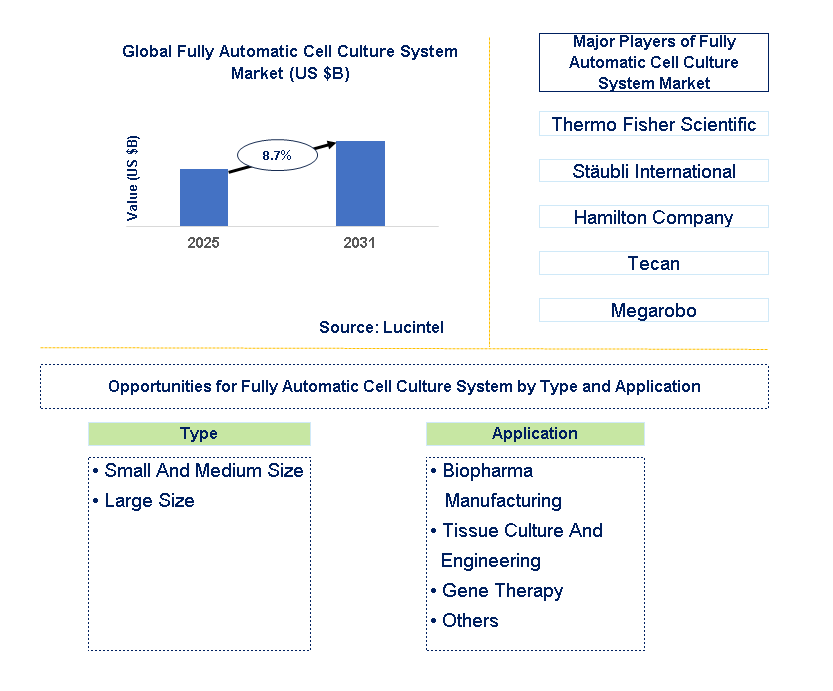
Fully Automatic Cell Culture System Market by Segment
• Miniaturization and Portability of Systems: The miniaturization of fully automatic cell culture systems is a key trend aimed at making these technologies more accessible and versatile. Compact and portable systems are being developed to cater to small-scale laboratories, remote locations, and hospitals. These systems allow for more flexible and cost-effective applications, such as point-of-care diagnostics, small-scale bioproduction, and personalized medicine. This trend is also enhancing the adoption of automated cell culture technologies in regions with limited infrastructure.
• Increased Focus on High-Throughput Screening: High-throughput screening (HTS) is one of the main drivers of the demand for fully automatic cell culture systems. These systems are being designed to perform thousands of experiments in parallel, providing valuable data for drug discovery, toxicology testing, and genomics research. Automation in HTS reduces labor costs, improves reproducibility, and accelerates the drug discovery process. As the pharmaceutical industry continues to push for faster, more efficient research processes, fully automatic cell culture systems with HTS capabilities are becoming indispensable tools.
• Integration with Robotic Systems: Robotics integration with fully automatic cell culture systems is an emerging trend that enhances the precision and throughput of cell culture processes. Robotic arms and liquid handling systems can perform tasks such as pipetting, media exchange, and cell harvesting with high efficiency and minimal human intervention. This trend is especially important in biomanufacturing, where consistent and repeatable results are crucial. Automated robotic systems help improve productivity, reduce contamination risks, and enable large-scale cell culture operations.
• Incorporation of Real-Time Monitoring and Analytics: Real-time monitoring and analytics are becoming essential features of fully automatic cell culture systems. These technologies provide continuous feedback on culture conditions such as temperature, pH, dissolved oxygen, and cell density, allowing researchers to make real-time adjustments. The integration of sensors and data analytics helps maintain optimal culture conditions, ensuring better results and reducing the risk of experiment failure. This trend is particularly valuable in clinical applications and biomanufacturing, where maintaining consistent culture conditions is critical. The emerging trends in the fully automatic cell culture system market are shaping the future of biotechnology, with innovations in AI, miniaturization, high-throughput screening, robotics, and real-time monitoring playing key roles. These trends are improving the efficiency, precision, and scalability of cell culture technologies, enabling faster drug development, better disease modeling, and more personalized healthcare solutions. As these trends continue to evolve, they will reshape the industry, offering new opportunities for growth and innovation." src="Emerging Trends in the Fully Automatic Cell Culture System Market" style="height: auto;width: auto;" title="The fully automatic cell culture system market is experiencing significant transformation, driven by technological advancements and changing demands in pharmaceutical and biotechnological research. Emerging trends are shaping the market by enhancing efficiency, precision, and accessibility. These trends are not only improving the research and manufacturing processes but are also creating new opportunities for innovation in fields like personalized medicine, gene therapy, and vaccine development.
• Integration of Artificial Intelligence and Machine Learning: AI and ML are being increasingly integrated into fully automatic cell culture systems to optimize workflows, predict outcomes, and enhance data analysis. Machine learning algorithms can process large datasets from cell culture experiments to provide insights into cell behavior, growth patterns, and responses to treatments. This reduces the risk of human error and accelerates research timelines, making the systems more valuable in drug development, biomanufacturing, and cell therapy.
• Miniaturization and Portability of Systems: The miniaturization of fully automatic cell culture systems is a key trend aimed at making these technologies more accessible and versatile. Compact and portable systems are being developed to cater to small-scale laboratories, remote locations, and hospitals. These systems allow for more flexible and cost-effective applications, such as point-of-care diagnostics, small-scale bioproduction, and personalized medicine. This trend is also enhancing the adoption of automated cell culture technologies in regions with limited infrastructure.
• Increased Focus on High-Throughput Screening: High-throughput screening (HTS) is one of the main drivers of the demand for fully automatic cell culture systems. These systems are being designed to perform thousands of experiments in parallel, providing valuable data for drug discovery, toxicology testing, and genomics research. Automation in HTS reduces labor costs, improves reproducibility, and accelerates the drug discovery process. As the pharmaceutical industry continues to push for faster, more efficient research processes, fully automatic cell culture systems with HTS capabilities are becoming indispensable tools.
• Integration with Robotic Systems: Robotics integration with fully automatic cell culture systems is an emerging trend that enhances the precision and throughput of cell culture processes. Robotic arms and liquid handling systems can perform tasks such as pipetting, media exchange, and cell harvesting with high efficiency and minimal human intervention. This trend is especially important in biomanufacturing, where consistent and repeatable results are crucial. Automated robotic systems help improve productivity, reduce contamination risks, and enable large-scale cell culture operations.
• Incorporation of Real-Time Monitoring and Analytics: Real-time monitoring and analytics are becoming essential features of fully automatic cell culture systems. These technologies provide continuous feedback on culture conditions such as temperature, pH, dissolved oxygen, and cell density, allowing researchers to make real-time adjustments. The integration of sensors and data analytics helps maintain optimal culture conditions, ensuring better results and reducing the risk of experiment failure. This trend is particularly valuable in clinical applications and biomanufacturing, where maintaining consistent culture conditions is critical. The emerging trends in the fully automatic cell culture system market are shaping the future of biotechnology, with innovations in AI, miniaturization, high-throughput screening, robotics, and real-time monitoring playing key roles. These trends are improving the efficiency, precision, and scalability of cell culture technologies, enabling faster drug development, better disease modeling, and more personalized healthcare solutions. As these trends continue to evolve, they will reshape the industry, offering new opportunities for growth and innovation." />
Emerging Trends in the Fully Automatic Cell Culture System Market
Recent Development in the Fully Automatic Cell Culture System Market
The fully automatic cell culture system market is experiencing rapid innovation, driven by advancements in automation, sensor technology, and data analytics. These developments are enabling more efficient, reproducible, and scalable cell culture processes, which are crucial for the pharmaceutical, biotechnology, and healthcare industries. Below are five key developments that are driving the evolution of the market.• Advances in Closed-Loop Automation Systems: Closed-loop automation systems are a significant development in the cell culture market, allowing for automated monitoring and control of culture conditions without human intervention. These systems are equipped with sensors to monitor factors such as temperature, pH, and oxygen levels, and automatically adjust settings to maintain optimal conditions. This eliminates the need for manual adjustments, reducing errors and contamination risks. Closed-loop systems are particularly beneficial in large-scale cell culture applications, such as biomanufacturing and biopharmaceutical production, where consistency is critical.
• Improved Cell Culture Media and Supplementation: Advancements in cell culture media and supplementation have significantly improved the efficiency and quality of fully automated cell culture systems. New formulations and optimized media are enabling better cell growth, improved yields, and enhanced cell differentiation. Automated systems are increasingly being integrated with smart media supplementation technologies that adjust nutrient levels based on real-time monitoring. This ensures the optimal growth of cells in a more controlled environment, making automated systems more effective for a wide range of applications, from research to industrial production.
• Integration of AI-Driven Data Analytics: Artificial intelligence and machine learning are being integrated into fully automatic cell culture systems to improve data analysis and interpretation. AI algorithms can analyze large volumes of data from cell cultures to identify patterns and predict outcomes, such as cell behavior and responses to different treatments. This integration reduces human error and speeds up the decision-making process, making the systems more efficient for drug discovery, toxicology screening, and clinical applications. As AI continues to advance, its role in automating data analytics will be critical for future developments.
• Development of Modular and Scalable Systems: Modular and scalable cell culture systems are becoming increasingly popular, as they offer flexibility in research and production settings. These systems allow for the easy addition or removal of modules to meet the specific needs of an experiment or production process. The ability to scale up or down without significant infrastructure changes makes these systems cost-effective and adaptable for various applications, from small-scale research to large-scale bioproduction. This development is helping companies meet the growing demand for personalized medicine, gene therapy, and cell-based therapies.
• Advancements in Bioreactor Technology: Bioreactor technology has seen significant improvements, particularly in the development of automated, multi-parameter bioreactors for cell culture. These bioreactors are designed to maintain optimal conditions for large-scale cell growth, including the precise control of pH, oxygen, temperature, and other variables. Automated bioreactors enable more consistent and efficient production of cell-based products, such as vaccines, cell therapies, and biologics. As bioreactor technology continues to evolve, these systems are becoming integral to both research and commercial applications in the life sciences industry. These key developments are driving the adoption and evolution of fully automatic cell culture systems. Innovations in automation, bioreactor technology, AI-driven data analytics, and modular design are significantly improving the efficiency, scalability, and precision of cell culture processes. As these systems continue to evolve, they will play an increasingly important role in drug discovery, biomanufacturing, and clinical applications.
Strategic Growth Opportunities in the Fully Automatic Cell Culture System Market
The fully automatic cell culture system market is expanding rapidly, with significant growth opportunities emerging across various applications. The rise in personalized medicine, advances in cell-based therapies, and increased demand for high-throughput screening are creating new avenues for market expansion. Below are five key growth opportunities within the market, with a focus on applications in biotechnology, pharmaceuticals, and healthcare.• Expansion of Cell-Based Therapies: The rise of cell-based therapies, such as CAR T-cell therapies and stem cell treatments, presents significant growth opportunities for fully automatic cell culture systems. These therapies require large-scale, controlled cell culture processes to produce the necessary cells for treatment. Automated systems provide the precision and scalability required for the large-scale production of these therapies, making them crucial for the commercialization and widespread adoption of cell-based therapies.
• Increase in Drug Discovery and High-Throughput Screening: Fully automatic cell culture systems are integral to drug discovery and high-throughput screening (HTS), enabling the rapid testing of large numbers of compounds on cultured cells. This technology is particularly beneficial for pharmaceutical companies seeking to identify new drug candidates more efficiently. As drug discovery becomes more reliant on automation and data analytics, the demand for fully automatic systems capable of running thousands of experiments in parallel will continue to grow, especially in oncology, neurology, and infectious diseases.
• Rising Demand for Personalized Medicine: Personalized medicine is driving the need for more tailored and precise treatments, and fully automatic cell culture systems are crucial in this trend. These systems enable researchers to better understand individual cell behaviors and responses to treatments, thereby facilitating the development of customized therapies. As personalized medicine continues to gain traction, the demand for automated cell culture technologies that can deliver precise, reproducible results will increase.
• Advancements in Vaccine Development: Fully automatic cell culture systems play a key role in vaccine development, especially in the production of cell-based vaccines. These systems ensure that cell cultures are maintained under optimal conditions, providing the necessary quantities of cells for vaccine production. With the increasing demand for vaccines, particularly in light of recent global health crises, the need for automated systems to streamline production processes and improve yield is expected to grow.
• Adoption in Research and Academia: Fully automatic cell culture systems are increasingly being adopted in research and academic institutions to facilitate high-quality, reproducible research. With advancements in automation, these systems are becoming more affordable and accessible to academic labs. This expansion into research institutions will drive the demand for fully automated systems as researchers seek to improve efficiency, accuracy, and throughput in their studies. The strategic growth opportunities in the fully automatic cell culture system market are substantial. Applications in cell-based therapies, drug discovery, personalized medicine, vaccine development, and academic research are driving demand for these systems. As these opportunities continue to grow, fully automatic cell culture systems will play a critical role in advancing biotechnology, pharmaceuticals, and healthcare.
Fully Automatic Cell Culture System Market Driver and Challenges
The fully automatic cell culture system market is influenced by various technological, economic, and regulatory factors. The key drivers include advancements in automation, the increasing need for high-throughput screening, and the growth of personalized medicine. On the other hand, challenges such as high system costs, complex regulatory requirements, and the need for skilled personnel to operate these systems are hindering broader adoption. The factors responsible for driving the Fully Automatic Cell Culture System market include: 1. Technological Advancements in Automation: Technological innovations in automation are a significant driver of growth in the fully automatic cell culture system market. Automated systems offer faster, more precise, and reproducible results, allowing researchers to conduct experiments at a larger scale with minimal human intervention. These advancements make automated systems an essential tool in drug discovery, vaccine production, and clinical applications, further driving market demand. 2. Rising Demand for Personalized Medicine: The growing focus on personalized medicine is a major driver for the fully automatic cell culture system market. Personalized therapies require customized cell culture processes that can yield more accurate and specific results. Automated systems are increasingly being used in this area, as they allow for the precise control of culture conditions and offer scalability for clinical applications, leading to wider adoption in healthcare. 3. High Throughput Screening in Drug Discovery: The pharmaceutical industry’s demand for faster and more efficient drug discovery is propelling the growth of fully automatic cell culture systems. High-throughput screening capabilities enable researchers to test thousands of compounds on cultured cells in a short amount of time, significantly speeding up the drug discovery process. As this need continues to grow, so will the demand for automated cell culture systems capable of supporting large-scale screening. 4. Increase in Cell-Based Therapies: The rapid growth of cell-based therapies, such as gene and stem cell therapies, is driving the demand for fully automatic cell culture systems. These therapies require large-scale cell production processes that automated systems can efficiently handle. The growing adoption of these therapies in clinical settings is further fueling the market. 5. Focus on Biomanufacturing and Biotechnology: Biomanufacturing is becoming an essential part of the pharmaceutical and biotechnology industries, and automated cell culture systems are critical for ensuring consistency and scalability. These systems are increasingly used for the production of biologics, vaccines, and cell therapies. The growing demand for biologics is accelerating the adoption of automated cell culture systems in biomanufacturing. Challenges in the Fully Automatic Cell Culture System market are: 1. High Initial Investment Costs: One of the primary challenges in adopting fully automatic cell culture systems is the high initial investment required. The upfront costs of purchasing and setting up automated systems can be significant, especially for small and medium-sized laboratories. While these systems offer long-term benefits in terms of efficiency and scalability, the high initial costs may deter some organizations from investing in automation. 2. Regulatory and Compliance Issues: The regulatory environment surrounding automated cell culture systems, especially in clinical and biomanufacturing applications, is complex. Ensuring compliance with stringent regulatory requirements from bodies like the FDA and EMA can be challenging for manufacturers and end-users. Failure to meet these standards can delay product development and market entry, impacting the growth of the market. 3. Lack of Skilled Workforce: The effective use of fully automatic cell culture systems requires specialized knowledge and training. A shortage of skilled technicians and researchers capable of operating and maintaining these systems can hinder adoption. Organizations must invest in training programs to ensure the workforce is adequately prepared to use these advanced technologies. The drivers of growth in the fully automatic cell culture system market, such as technological advancements, the rise of personalized medicine, and the demand for high-throughput screening, are significant. However, challenges related to high initial costs, regulatory hurdles, and the need for skilled personnel may limit broader adoption. Addressing these challenges will be crucial for the continued expansion of the market.List of Fully Automatic Cell Culture System Companies
Companies in the market compete on the basis of product quality offered. Major players in this market focus on expanding their manufacturing facilities, R&D investments, infrastructural development, and leverage integration opportunities across the value chain. With these strategies fully automatic cell culture system companies cater increasing demand, ensure competitive effectiveness, develop innovative products & technologies, reduce production costs, and expand their customer base. Some of the fully automatic cell culture system companies profiled in this report include-• Thermo Fisher Scientific
• Stäubli International
• Hamilton Company
• Tecan
• Megarobo
• Yocon
• Shanghai Remed Biotechnology
Fully Automatic Cell Culture System Market by Segment
The study includes a forecast for the global fully automatic cell culture system market by type, application, and region.Fully Automatic Cell Culture System Market by Type [Value from 2019 to 2031]:
• Small And Medium Size
• Large Size
Fully Automatic Cell Culture System Market by Application [Value from 2019 to 2031]:
• Biopharma Manufacturing
• Tissue Culture And Engineering
• Gene Therapy
• Others
Fully Automatic Cell Culture System Market by Region [Value from 2019 to 2031]:
• North America
• Europe
• Asia Pacific
• The Rest of the World
Country Wise Outlook for the Fully Automatic Cell Culture System Market
Fully automatic cell culture systems are an essential innovation in biotechnological and pharmaceutical research, enabling researchers to automate the process of growing and maintaining cells in laboratory settings. These systems offer precision, efficiency, and scalability, making them crucial in drug development, gene therapy, and regenerative medicine. Over the past few years, the market for fully automatic cell culture systems has seen rapid advancements across several countries, driven by demand for high-throughput screening, better disease modeling, and the need for reproducible results. The United States, China, Germany, India, and Japan have witnessed significant developments in these systems.• United States: In the United States, the fully automatic cell culture system market is flourishing due to the country’s strong presence in biotechnology and pharmaceutical research. Companies like Thermos Fisher, Beckman Coulter, and Corning are developing advanced automated systems to meet the growing demand for cell-based assays, drug testing, and bioproduction. The increasing adoption of precision medicine, coupled with advancements in cell therapy and tissue engineering, is driving market growth. The U.S. Food and Drug Administration (FDA) is also fostering regulatory frameworks that support the adoption of automated systems in clinical trials and therapeutic applications.
• China: China’s investment in biotechnology and healthcare infrastructure has significantly boosted the demand for fully automatic cell culture systems. Chinese companies like BGI Group and Mindray are spearheading the development of automated systems tailored to local needs. With China being a major hub for contract research organizations (CROs), the demand for high-throughput, cost-effective, and reproducible cell culture systems has increased. Furthermore, China’s growing emphasis on personalized medicine and stem cell research is expected to further expand the use of automated systems in clinical and industrial settings. The government’s strong support for biotechnology innovation continues to fuel this growth.
• Germany: Germany is a leader in industrial biotechnology and life sciences, and this is reflected in the growing adoption of fully automatic cell culture systems. German companies like Eppendorf and Sartorius are at the forefront, developing systems that integrate automation with data analytics, ensuring higher accuracy and reproducibility in cell culture experiments. Germany’s emphasis on pharmaceutical innovation, coupled with its commitment to regulatory compliance, has made it a key player in the European market for automated cell culture systems. The integration of Industry 4.0 technologies, such as IoT and AI, is pushing the development of next-generation automated solutions.
• India: India’s cell culture market is growing, driven by the country’s expanding pharmaceutical and biotechnology sectors. While the adoption of fully automatic cell culture systems is still in the early stages, companies such as Biocon and Prema’s Life Sciences are increasingly incorporating automated systems into their research workflows. India’s strong contract research and manufacturing service (CRAMS) sector is also driving the demand for these systems as CROs look to improve efficiency, reduce errors, and scale up research. Government initiatives to support innovation and biotechnology development in India are expected to further accelerate the adoption of automated cell culture systems.
• Japan: Japan has a long-standing tradition of excellence in biotechnology and medical research, and the demand for fully automatic cell culture systems is growing steadily. Companies like FUJIFILM and Hitachi High-Technologies are leading the way in developing automated solutions for the growing life sciences market. Japan’s robust healthcare infrastructure and commitment to regenerative medicine, including stem cell research, have created a strong demand for high-precision cell culture systems. The government’s focus on advanced healthcare technologies, coupled with Japan’s aging population, is pushing the growth of automated systems for drug testing, disease modeling, and personalized medicine.

Features of the Global Fully Automatic Cell Culture System Market
Market Size Estimates: Fully automatic cell culture system market size estimation in terms of value ($B). Trend and Forecast Analysis: Market trends (2019 to 2024) and forecast (2025 to 2031) by various segments and regions. Segmentation Analysis: Fully automatic cell culture system market size by type, application, and region in terms of value ($B). Regional Analysis: Fully automatic cell culture system market breakdown by North America, Europe, Asia Pacific, and Rest of the World. Growth Opportunities: Analysis of growth opportunities in different type, application, and regions for the fully automatic cell culture system market. Strategic Analysis: This includes M&A, new product development, and competitive landscape of the fully automatic cell culture system market. Analysis of competitive intensity of the industry based on Porter’s Five Forces model.
FAQ
Q1. What is the growth forecast for fully automatic cell culture system market? Answer: The global fully automatic cell culture system market is expected to grow with a CAGR of 8.7% from 2025 to 2031. Q2. What are the major drivers influencing the growth of the fully automatic cell culture system market? Answer: The major drivers for this market are rising need for biologics and personalized and increasing demand for biopharmaceuticals. Q3. What are the major segments for fully automatic cell culture system market? Answer: The future of the fully automatic cell culture system market looks promising with opportunities in the biopharma manufacturing, tissue culture and engineering, gene therapy and others markets. Q4. Who are the key fully automatic cell culture system market companies? Answer: Some of the key fully automatic cell culture system companies are as follows:• Thermo Fisher Scientific
• Stäubli International
• Hamilton Company
• Tecan
• Megarobo
• Yocon
• Shanghai Remed Biotechnology Q5. Which fully automatic cell culture system market segment will be the largest in future? Answer: Lucintel forecasts that large size is expected to witness higher growth over the forecast period. Q6. In fully automatic cell culture system market, which region is expected to be the largest in next 5 years? Answer: APAC is expected to witness the highest growth over the forecast period. Q7. Do we receive customization in this report? Answer: Yes, Lucintel provides 10% customization without any additional cost.
Table of Contents
Methodology
- In-depth interviews of the major players in this market
- Detailed secondary research from competitors’ financial statements and published data
- Extensive searches of published works, market, and database information pertaining to industry news, company press releases, and customer intentions
- A compilation of the experiences, judgments, and insights of Lucintel’s professionals, who have analyzed and tracked this market over the years.


Buy Now
Choose a license that fits your team. Instant PDF delivery.
Prices exclude taxes. Instant delivery. Custom licensing available on request.
Key Questions
- • What are some of the most promising, high-growth opportunities for the fully automatic cell culture system market by type (small and medium size and large size), application (biopharma manufacturing, tissue culture and engineering, gene therapy, and others), and region (North America, Europe, Asia Pacific, and the Rest of the World)?
- • Which segments will grow at a faster pace and why?
- • Which region will grow at a faster pace and why?
- • What are the key factors affecting market dynamics? What are the key challenges and business risks in this market?
- • What are the business risks and competitive threats in this market?
- • What are the emerging trends in this market and the reasons behind them?
- • What are some of the changing demands of customers in the market?
- • What are the new developments in the market? Which companies are leading these developments?
- • Who are the major players in this market? What strategic initiatives are key players pursuing for business growth?
- • What are some of the competing products in this market and how big of a threat do they pose for loss of market share by material or product substitution?
- • What M&A activity has occurred in the last 5 years and what has its impact been on the industry? For any questions related to Fully Automatic Cell Culture System Market, Fully Automatic Cell Culture System Market Size, Fully Automatic Cell Culture System Market Growth, Fully Automatic Cell Culture System Market Analysis, Fully Automatic Cell Culture System Market Report, Fully Automatic Cell Culture System Market Share, Fully Automatic Cell Culture System Market Trends, Fully Automatic Cell Culture System Market Forecast, Fully Automatic Cell Culture System Companies, write Lucintel analyst at email: helpdesk@lucintel.com. We will be glad to get back to you soon.


