
Report Feature
Enhanced Flight Vision System Market Trends and Forecast
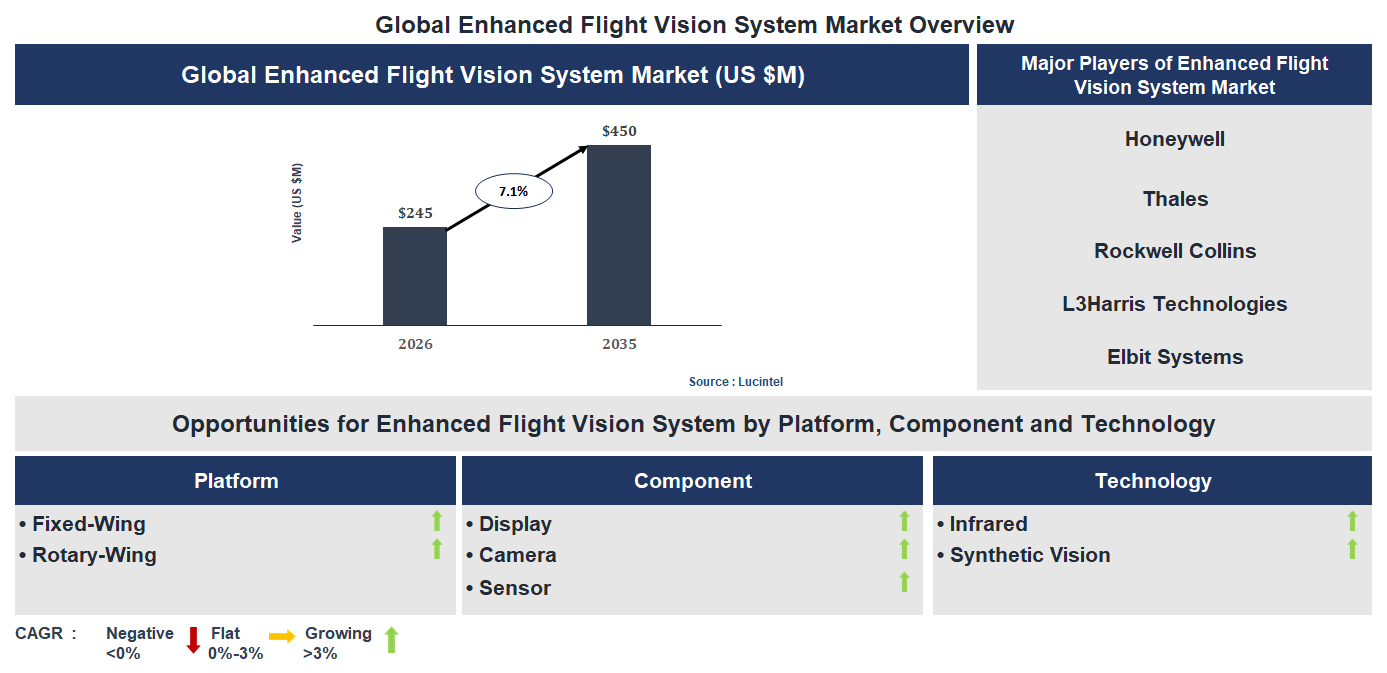
The future of the global enhanced flight vision system market looks promising with opportunities in the display, camera, and sensor markets. The global enhanced flight vision system market is expected to reach an estimated $450 million by 2035 with a CAGR of 7.1% from 2026 to 2035. The major drivers for this market are the increasing adoption of advanced technologies, the rising demand for flight safety solutions, and the growing need for improved navigation systems.• Lucintel forecasts that, within the technology category, infrared is expected to witness higher growth over the forecast period.
• Within the component category, display is expected to witness the highest growth.
• In terms of region, North America is expected to witness the highest growth over the forecast period. Gain valuable insights for your business decisions with our comprehensive 150+ page report. Sample figures with some insights are shown below.
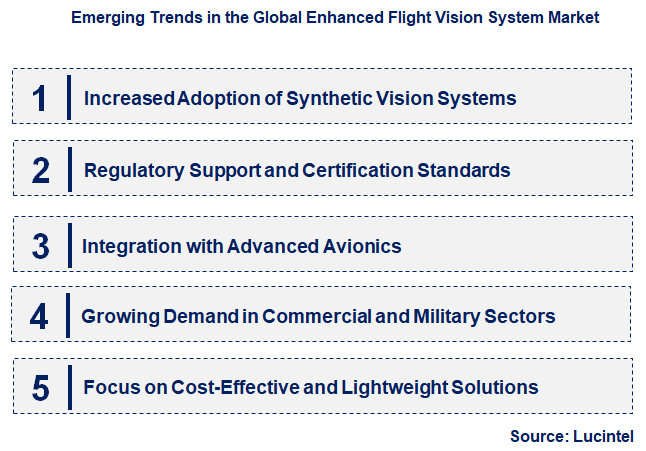
Emerging Trends in the Enhanced Flight Vision System Market
The enhanced flight vision system market is experiencing rapid growth driven by technological advancements, regulatory changes, and increasing safety demands in the aviation industry. As airlines and manufacturers seek to improve pilot visibility and operational efficiency, new trends are emerging that are transforming how flight vision systems are integrated and utilized. These developments are not only enhancing safety standards but also enabling more efficient flight operations, especially in challenging weather conditions. The markets evolution reflects a broader shift towards smarter, more reliable, and integrated cockpit solutions, shaping the future landscape of aviation safety and performance.• Increased Adoption of Synthetic Vision Systems: The integration of synthetic vision technology is becoming more prevalent, providing pilots with a 3D, computer-generated view of the environment outside the aircraft. This trend enhances situational awareness during low-visibility conditions, reducing the risk of accidents. The impact is significant as it allows for safer landings and takeoffs in adverse weather, expanding operational capabilities and improving overall safety standards across commercial and military aviation sectors.
• Regulatory Support and Certification Standards: Governments and aviation authorities are updating regulations to incorporate advanced flight vision systems, encouraging wider adoption. Certification processes are becoming more streamlined, facilitating quicker deployment of EFVS technologies. This regulatory backing boosts market confidence and accelerates adoption rates, ensuring that safety enhancements are standardized across the industry. It also incentivizes manufacturers to innovate, knowing that their products will meet evolving safety and operational standards.
• Integration with Advanced Avionics: EFVS is increasingly being integrated with other cockpit systems such as autopilot, weather radar, and traffic management tools. This interconnectedness improves operational efficiency and safety by providing pilots with comprehensive situational data. The impact is a more cohesive cockpit environment that supports decision-making, reduces workload, and enhances real-time responsiveness, especially during complex or adverse flight conditions, thereby transforming traditional cockpit operations into more intelligent, integrated systems.
• Growing Demand in Commercial and Military Sectors: The market is witnessing rising demand from both commercial airlines aiming to improve safety and military forces seeking enhanced operational capabilities. This dual-sector growth is driven by the need for reliable vision systems in diverse environments and operational scenarios. The increased demand is fostering innovation and competition among manufacturers, leading to more advanced, cost-effective solutions that cater to a broad range of applications, ultimately expanding the market reach and technological capabilities.
• Focus on Cost-Effective and Lightweight Solutions: Manufacturers are developing more affordable, lightweight EFVS components to facilitate widespread adoption, especially in smaller aircraft and regional jets. This trend reduces the overall cost burden and makes advanced vision systems accessible to a broader customer base. The impact includes increased retrofit opportunities and the democratization of safety technology, which can significantly improve safety standards across various segments of the aviation industry without imposing substantial weight or cost penalties. These trends are collectively reshaping the Enhanced Flight Vision System Market by making advanced safety features more accessible, integrated, and regulatory-compliant. They are driving innovation, expanding market reach, and setting new standards for safety and operational efficiency in aviation, ultimately leading to safer, more reliable, and more efficient flight operations worldwide.
Recent Developments in the Enhanced Flight Vision System Market
The enhanced flight vision system market is experiencing rapid growth driven by technological advancements, regulatory support, and increasing demand for safer, more efficient aviation operations. As airlines and manufacturers prioritize safety and operational efficiency, EFVS solutions are becoming integral to modern aircraft. Innovations in sensor technology, integration with autopilot systems, and expanding certification standards are shaping the market landscape. These developments are creating new opportunities for stakeholders and transforming the future of aviation safety and performance.• Growing Adoption of EFVS in Commercial Aviation: The increasing integration of EFVS in commercial aircraft enhances safety during low-visibility conditions, reducing delays and diversions. Airlines recognize the value of EFVS for operational efficiency, leading to widespread adoption. Regulatory bodies are updating standards to facilitate certification, further accelerating deployment. This growth improves safety margins, optimizes flight operations, and reduces costs, making EFVS a critical component in modern aircraft systems.
• Technological Advancements in Sensor and Display Systems: Innovations in sensor technology, such as high-resolution imaging and infrared capabilities, are significantly improving EFVS performance. Enhanced display systems provide pilots with clearer, more detailed terrain and obstacle information, even in adverse weather. These advancements increase system reliability and usability, encouraging broader adoption across various aircraft types. The improved technology directly impacts safety, situational awareness, and operational efficiency in challenging conditions.
• Increasing Regulatory Support and Certification Standards: Regulatory agencies like FAA and EASA are updating certification standards to include EFVS, promoting wider acceptance. Streamlined approval processes and clear guidelines are reducing barriers for manufacturers and operators. This regulatory support encourages investment in EFVS technology, accelerates market growth, and ensures safety compliance. As standards evolve, more aircraft will be equipped with EFVS, enhancing overall aviation safety and operational capabilities.
• Rising Demand for Safety and Operational Efficiency: Airlines are prioritizing safety enhancements and operational efficiency amid rising air traffic and complex flight environments. EFVS offers real-time terrain and obstacle awareness, reducing accident risks and improving decision-making. The demand is driven by the need to minimize delays, fuel consumption, and operational costs. This focus on safety and efficiency is propelling market growth, with EFVS becoming a standard feature in new aircraft and retrofit programs.
• Expansion of EFVS Applications Beyond Commercial Aircraft: The use of EFVS is expanding into military, cargo, and private aviation sectors, driven by the need for enhanced safety and operational flexibility. Military applications benefit from improved navigation and target identification, while cargo and private aircraft leverage EFVS for all-weather operations. This diversification broadens market opportunities, stimulates innovation, and increases overall demand, positioning EFVS as a versatile solution across multiple aviation segments. The recent developments in EFVS technology, regulation, and application are significantly transforming the aviation market. Enhanced safety, operational efficiency, and expanding application areas are driving strong growth. These advancements are fostering innovation, reducing costs, and setting new standards for aviation safety worldwide. As adoption accelerates across commercial, military, and private sectors, the EFVS market is poised for sustained expansion, shaping the future of safer, more efficient flight operations globally.
Strategic Growth Opportunities in the Enhanced Flight Vision System Market
The enhanced flight vision system market is experiencing rapid growth driven by technological advancements, regulatory support, and increasing safety standards in aviation. As airlines and manufacturers seek to improve pilot visibility and operational efficiency, EFVS adoption is expanding across commercial and military sectors. This presents significant opportunities for innovation, market penetration, and strategic partnerships, ultimately transforming flight safety and navigation capabilities worldwide.• Expanding Adoption in Commercial Aviation: The increasing demand for enhanced safety and operational efficiency is driving widespread adoption of EFVS in commercial aircraft. Airlines are investing in these systems to enable safer landings in low visibility conditions, reduce delays, and improve turnaround times. Regulatory bodies are also updating certification standards, encouraging airlines to upgrade existing fleets. This growth is supported by technological improvements, cost reductions, and the need to meet stringent safety regulations, making EFVS a critical component in modern commercial fleets.
• Integration of Artificial Intelligence for Advanced Navigation: Incorporating AI into EFVS offers significant growth potential by enabling real-time data analysis, predictive analytics, and autonomous decision-making. AI-driven systems can enhance situational awareness, improve obstacle detection, and optimize flight paths, especially in complex environments. This integration will facilitate smarter, more reliable systems that adapt to changing conditions, reduce pilot workload, and increase safety margins. The development of AI-enabled EFVS is poised to revolutionize flight navigation and safety protocols.
• Rising Demand for Military and Defense Applications: Military aircraft require advanced vision systems for operations in challenging environments, including low visibility and hostile terrains. The growing need for enhanced situational awareness, target identification, and night vision capabilities is fueling the adoption of EFVS in defense sectors. Governments are investing heavily in upgrading existing fleets and developing new systems to ensure national security. This demand is expected to continue rising, driven by geopolitical tensions and technological advancements in military aviation.
• Technological Innovations in Sensor and Display Technologies: Advances in sensor technology, such as high-resolution imaging and infrared sensors, are significantly improving EFVS capabilities. Simultaneously, innovations in display systems, including heads-up displays (HUDs) and augmented reality interfaces, enhance pilot interaction and situational awareness. These technological improvements enable clearer, more detailed visuals in various lighting and weather conditions, expanding EFVS usability. Continuous R&D efforts are expected to further refine these systems, making them more reliable, compact, and cost-effective.
• Strategic Collaborations and Market Expansion in Emerging Economies: Collaborations between aerospace manufacturers, technology providers, and regulatory agencies are accelerating EFVS deployment. Emerging economies are increasingly investing in modernizing their aviation infrastructure, creating new markets for EFVS solutions. These regions offer growth opportunities due to rising air traffic, expanding airline fleets, and government initiatives to improve aviation safety. Strategic partnerships and localized manufacturing are expected to facilitate market penetration, making EFVS more accessible and affordable globally. These growth opportunities collectively are set to significantly expand the Enhanced Flight Vision System market, fostering technological innovation, increasing adoption across commercial and military sectors, and opening new regional markets. As safety standards and operational efficiencies become paramount, EFVS will play a crucial role in shaping the future of aviation. The market’s evolution will be driven by strategic collaborations, technological advancements, and regulatory support, ultimately enhancing flight safety and efficiency worldwide.
Enhanced Flight Vision System Market Driver and Challenges
The enhanced flight vision system market is influenced by a variety of technological, economic, and regulatory factors. Advances in avionics technology, increasing demand for safety and efficiency, and evolving regulatory standards are key drivers. Economic growth in the aviation sector and rising investments in modernization initiatives further propel market expansion. However, the market also faces challenges such as high implementation costs, regulatory hurdles, and technological integration issues. These factors collectively shape the growth trajectory of EFVS, impacting manufacturers, airlines, and regulatory bodies. Understanding these drivers and challenges is essential for stakeholders aiming to capitalize on emerging opportunities and navigate potential risks effectively. The factors responsible for driving the enhanced flight vision system market include:• Technological Advancements: The continuous development of high-resolution sensors, infrared imaging, and real-time data processing enhances EFVS capabilities. These innovations improve pilot visibility during low-visibility conditions, increasing safety and operational efficiency. As technology becomes more sophisticated and affordable, adoption rates are expected to rise across commercial and military aviation sectors. The integration of artificial intelligence and machine learning further optimizes system performance, making EFVS indispensable for modern aircraft. This technological evolution not only boosts safety standards but also aligns with regulatory requirements, fostering market growth.
• Increasing Safety Regulations: Regulatory bodies such as the FAA and EASA are mandating enhanced safety features, including EFVS, for certain aircraft operations. These regulations aim to improve safety during low-visibility landings and takeoffs, especially in challenging weather conditions. The push for stricter safety standards compels airlines and manufacturers to adopt EFVS technology to comply with legal requirements. This regulatory environment accelerates market adoption, encouraging innovation and investment in advanced flight vision systems to meet evolving safety mandates.
• Rising Air Traffic and Airport Congestion: The global increase in air traffic volume and airport congestion necessitate more efficient and safer flight operations. EFVS enables pilots to perform landings and takeoffs in adverse weather conditions, reducing delays and increasing airport throughput. This efficiency is crucial for airlines seeking to optimize schedules and minimize operational costs. As air traffic continues to grow, the demand for reliable vision systems that enhance situational awareness and safety becomes more critical, driving market expansion.
• Growing Investment in Aircraft Modernization: Airlines and military organizations are investing heavily in upgrading existing fleets with advanced avionics, including EFVS. Modernization initiatives aim to improve safety, fuel efficiency, and operational performance. The integration of EFVS into new aircraft and retrofitting older models enhances overall fleet capabilities. Increased funding from government and private sectors for modernization projects further fuels market growth, making EFVS a vital component of aircraft upgrade programs.
• Demand for Enhanced Safety and Operational Efficiency: The need to minimize accidents and improve operational efficiency is a primary driver. EFVS provides pilots with enhanced visibility during low-light and adverse weather conditions, significantly reducing the risk of accidents. It also allows for more precise landings and takeoffs, reducing delays and fuel consumption. As airlines prioritize safety and efficiency to remain competitive, the adoption of EFVS becomes a strategic imperative, propelling market growth. The challenges facing the enhanced flight vision system market include:
• High Implementation and Maintenance Costs: The installation of EFVS involves significant capital expenditure, including advanced sensors, display systems, and integration with existing avionics. Maintenance and calibration of these sophisticated systems add to operational costs. For airlines and military operators, these expenses can be prohibitive, especially for smaller organizations or those operating older aircraft. The high costs may slow down widespread adoption, particularly in regions with budget constraints, limiting market growth potential.
• Regulatory and Certification Barriers: Despite the push for safety, obtaining regulatory approval for EFVS systems can be complex and time-consuming. Certification processes involve rigorous testing and compliance with stringent standards, which can delay deployment. Variations in regulations across different countries further complicate international adoption. These barriers can hinder rapid market expansion and increase costs for manufacturers seeking global market access.
• Technological Integration Challenges: Integrating EFVS with existing aircraft systems and ensuring compatibility with various aircraft types pose significant technical challenges. Ensuring system reliability, cybersecurity, and seamless operation requires extensive testing and validation. These integration issues can lead to delays in deployment and increased development costs. Overcoming these technical hurdles is essential for widespread adoption but remains a significant challenge for manufacturers and operators. The enhanced flight vision system market is driven by technological innovations, regulatory mandates, increasing air traffic, modernization investments, and safety priorities. However, high costs, regulatory complexities, and integration challenges pose significant hurdles. These factors collectively influence the pace and scope of market growth, requiring strategic planning and collaboration among stakeholders to harness opportunities while mitigating risks. The overall impact suggests a promising yet cautious expansion trajectory, emphasizing the need for continued innovation and regulatory support to realize the full potential of EFVS technology.
List of Enhanced Flight Vision System Companies
Companies in the market compete on the basis of product quality offered. Major players in this market focus on expanding their manufacturing facilities, R&D investments, infrastructural development, and leverage integration opportunities across the value chain. With these strategies enhanced flight vision system companies cater increasing demand, ensure competitive effectiveness, develop innovative products & technologies, reduce production costs, and expand their customer base. Some of the enhanced flight vision system companies profiled in this report include-• Honeywell
• Thales
• Rockwell Collins
• L3Harris Technologies
• Elbit Systems
• Northrop Grumman
• General Electric
• BAE Systems
• Garmin
• United Technologies Corporation
Enhanced Flight Vision System Market by Segment
The study includes a forecast for the global enhanced flight vision system market by platform, component, technology, and region.Enhanced Flight Vision System Market by Platform [Value from 2019 to 2035]:
• Fixed-Wing
• Rotary-Wing
Enhanced Flight Vision System Market by Component [Value from 2019 to 2035]:
• Display
• Camera
• Sensor
Enhanced Flight Vision System Market by Technology [Value from 2019 to 2035]:
• Infrared
• Synthetic Vision
Enhanced Flight Vision System Market by Region [Value from 2019 to 2035]:
• North America
• Europe
• Asia Pacific
• The Rest of the World
Country Wise Outlook for the Enhanced Flight Vision System Market
The enhanced flight vision system market is experiencing rapid growth driven by technological advancements, regulatory updates, and increasing demand for safety and efficiency in aviation. As airlines and manufacturers seek to improve pilot situational awareness, the adoption of EFVS is expanding globally. Countries are investing in research, development, and infrastructure to support these systems, reflecting a broader trend toward automation and safety enhancements in aviation. The markets evolution is also influenced by regional regulatory frameworks, technological innovations, and the push for greener, more efficient aircraft operations. This overview highlights recent developments across key markets: the United States, China, Germany, India, and Japan.• United States: The US leads in EFVS adoption, with FAA approvals expanding for low-visibility landings, and major airlines integrating EFVS into commercial operations. Recent regulatory updates facilitate broader use, and collaborations between tech firms and aerospace companies accelerate innovation. The US government is also investing in research to improve system reliability and integration with other cockpit technologies.
• China: China is rapidly advancing its EFVS capabilities, driven by government initiatives to modernize its aviation infrastructure. The country has seen increased adoption of EFVS in domestic airlines, supported by local manufacturers developing cost-effective solutions. Regulatory frameworks are evolving to accommodate new technologies, and partnerships with international firms are fostering knowledge transfer and innovation.
• Germany: Germany, as part of the European aviation sector, is focusing on integrating EFVS with existing European safety standards. Recent developments include certification of new EFVS components and increased collaboration between aerospace firms and research institutions. The emphasis is on enhancing system accuracy and reliability to meet stringent safety requirements across European skies.
• India: India is witnessing significant growth in EFVS deployment, driven by expanding air traffic and modernization efforts. Regulatory bodies are updating guidelines to facilitate EFVS use, and local manufacturers are developing affordable systems tailored to regional needs. The government’s focus on improving airport infrastructure and safety standards is further propelling market growth.
• Japan: Japan is actively adopting EFVS technology, with recent pilot programs demonstrating its effectiveness in adverse weather conditions. The country’s aerospace industry is investing in research to enhance system performance and integration with existing aircraft systems. Regulatory agencies are working to streamline approval processes, supporting wider adoption across Japanese airlines.

Features of the Global Enhanced Flight Vision System Market
Market Size Estimates: Enhanced flight vision system market size estimation in terms of value ($M). Trend and Forecast Analysis: Market trends (2019 to 2025) and forecast (2026 to 2035) by various segments and regions. Segmentation Analysis: Enhanced flight vision system market size by platform, component, technology, and region in terms of value ($M). Regional Analysis: Enhanced flight vision system market breakdown by North America, Europe, Asia Pacific, and Rest of the World. Growth Opportunities: Analysis of growth opportunities in different platforms, components, technologies, and regions for the enhanced flight vision system market. Strategic Analysis: This includes M&A, new product development, and competitive landscape of the enhanced flight vision system market. Analysis of competitive intensity of the industry based on Porter’s Five Forces model.
FAQ
Q1. What is the enhanced flight vision system market size? Answer: The global enhanced flight vision system market is expected to reach an estimated $450 million by 2035. Q2. What is the growth forecast for enhanced flight vision system market? Answer: The global enhanced flight vision system market is expected to grow with a CAGR of 7.1% from 2026 to 2035. Q3. What are the major drivers influencing the growth of the enhanced flight vision system market? Answer: The major drivers for this market are the increasing adoption of advanced technologies, the rising demand for flight safety solutions, and the growing need for improved navigation systems. Q4. What are the major segments for enhanced flight vision system market? Answer: The future of the enhanced flight vision system market looks promising with opportunities in the display, camera, and sensor markets. Q5. Who are the key enhanced flight vision system market companies? Answer: Some of the key enhanced flight vision system companies are as follows:• Honeywell
• Thales
• Rockwell Collins
• L3Harris Technologies
• Elbit Systems
• Northrop Grumman
• General Electric
• BAE Systems
• Garmin
• United Technologies Corporation Q6. Which enhanced flight vision system market segment will be the largest in future? Answer: Lucintel forecasts that, within the technology category, infrared is expected to witness higher growth over the forecast period. Q7. In enhanced flight vision system market, which region is expected to be the largest in next 8 years? Answer: In terms of region, North America is expected to witness the highest growth over the forecast period. Q8. Do we receive customization in this report? Answer: Yes, Lucintel provides 10% customization without any additional cost.
Table of Contents
List of Figures
List of Tables
Methodology
- In-depth interviews of the major players in this market
- Detailed secondary research from competitors’ financial statements and published data
- Extensive searches of published works, market, and database information pertaining to industry news, company press releases, and customer intentions
- A compilation of the experiences, judgments, and insights of Lucintel’s professionals, who have analyzed and tracked this market over the years.


Buy Now
Choose a license that fits your team. Instant PDF delivery.
Prices exclude taxes. Instant delivery. Custom licensing available on request.
Key Questions
- • What are some of the most promising, high-growth opportunities for the enhanced flight vision system market by platform (fixed-wing and rotary-wing), component (display, camera, and sensor), technology (infrared and synthetic vision), and region (North America, Europe, Asia Pacific, and the Rest of the World)?
- • Which segments will grow at a faster pace and why?
- • Which region will grow at a faster pace and why?
- • What are the key factors affecting market dynamics? What are the key challenges and business risks in this market?
- • What are the business risks and competitive threats in this market?
- • What are the emerging trends in this market and the reasons behind them?
- • What are some of the changing demands of customers in the market?
- • What are the new developments in the market? Which companies are leading these developments?
- • Who are the major players in this market? What strategic initiatives are key players pursuing for business growth?
- • What are some of the competing products in this market and how big of a threat do they pose for loss of market share by material or product substitution?
- • What M&A activity has occurred in the last 5 years and what has its impact been on the industry? For any questions related to Enhanced Flight Vision System Market, Enhanced Flight Vision System Market Size, Enhanced Flight Vision System Market Growth, Enhanced Flight Vision System Market Analysis, Enhanced Flight Vision System Market Report, Enhanced Flight Vision System Market Share, Enhanced Flight Vision System Market Trends, Enhanced Flight Vision System Market Forecast, Enhanced Flight Vision System Companies, write Lucintel analyst at email: helpdesk@lucintel.com. We will be glad to get back to you soon.


