
Report Feature
Electronic Radiator Trends and Forecast
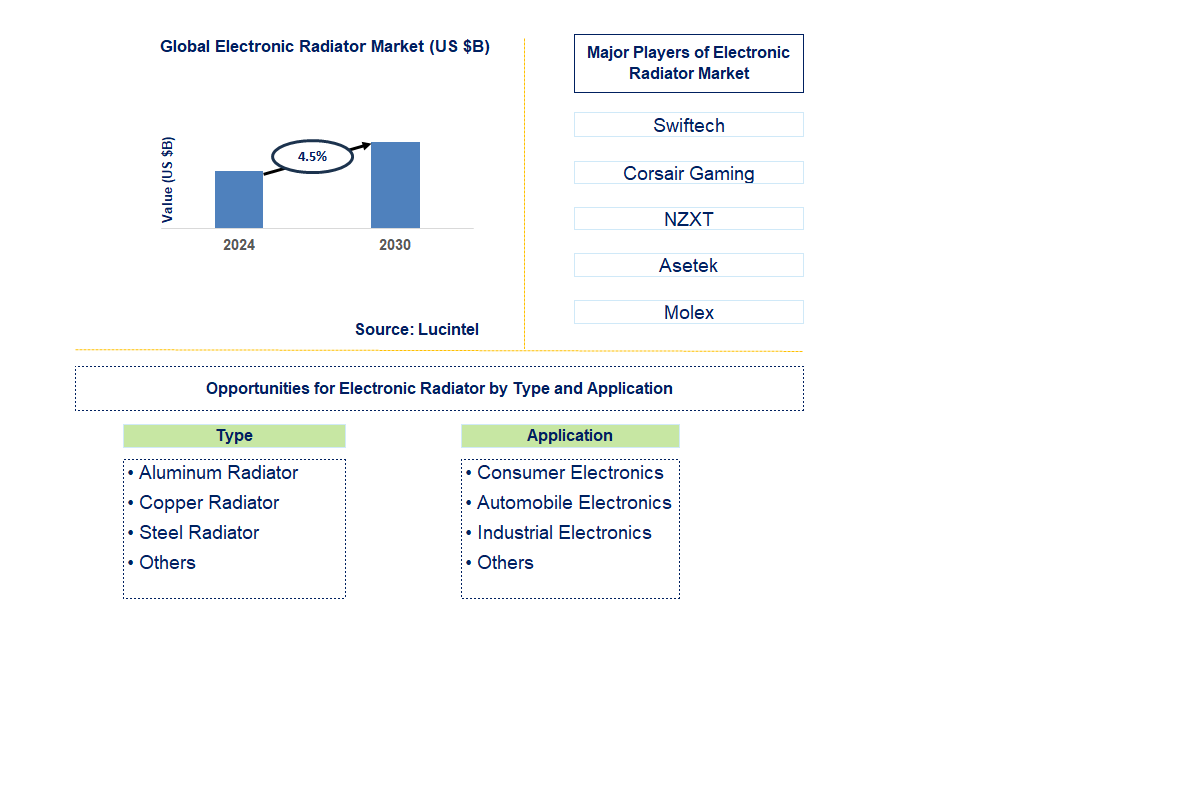
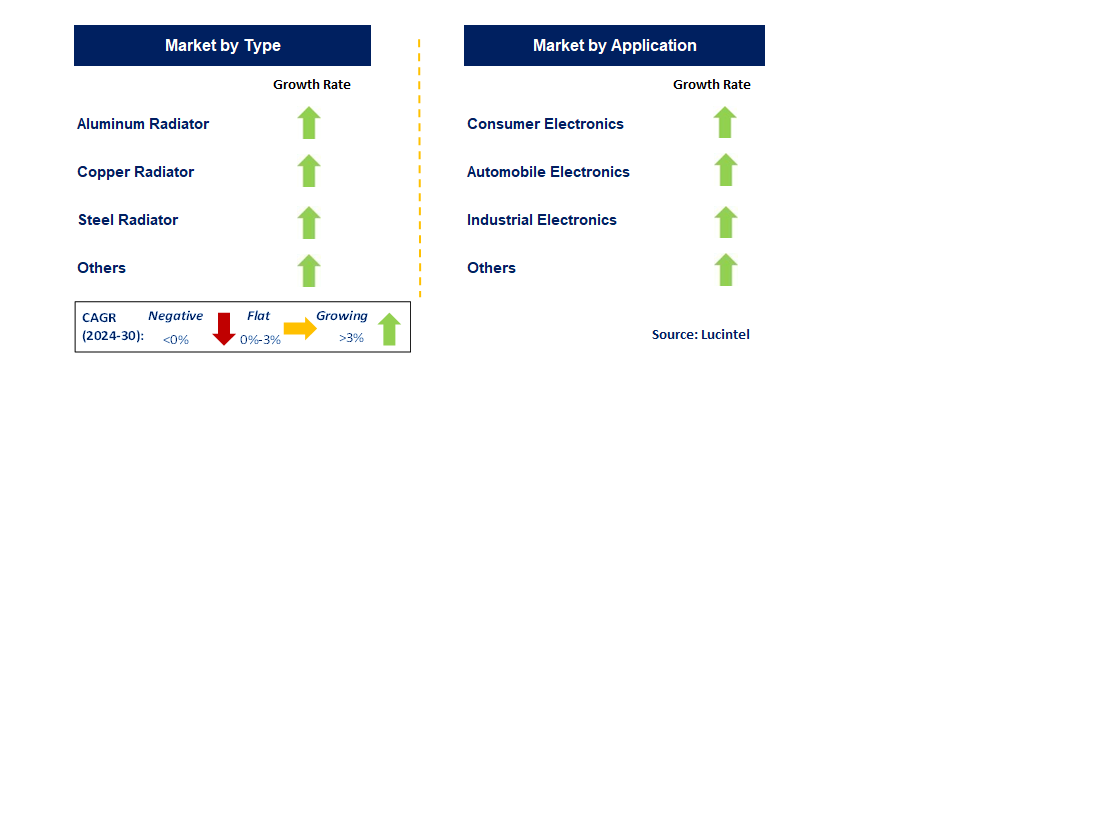
The future of the global electronic radiator market looks promising with opportunities in the consumer electronic, automobile electronic, and industrial electronic markets. The global electronic radiator market is expected to grow with a CAGR of 4.5% from 2024 to 2030. The major drivers for this market are increasing adoption of smart home technologies, growing concerns about climate change lead to higher demand for energy-efficient heating solutions, and stringent energy efficiency standards.• Lucintel forecasts that aluminum radiator is expected to witness the highest growth over the forecast period.
• Within this market, consumer electronic is expected to witness the highest growth.
• APAC is expected to witness highest growth over the forecast period. A more than 150-page report is developed to help in your business decisions.
Emerging Trends in the Electronic Radiator Market
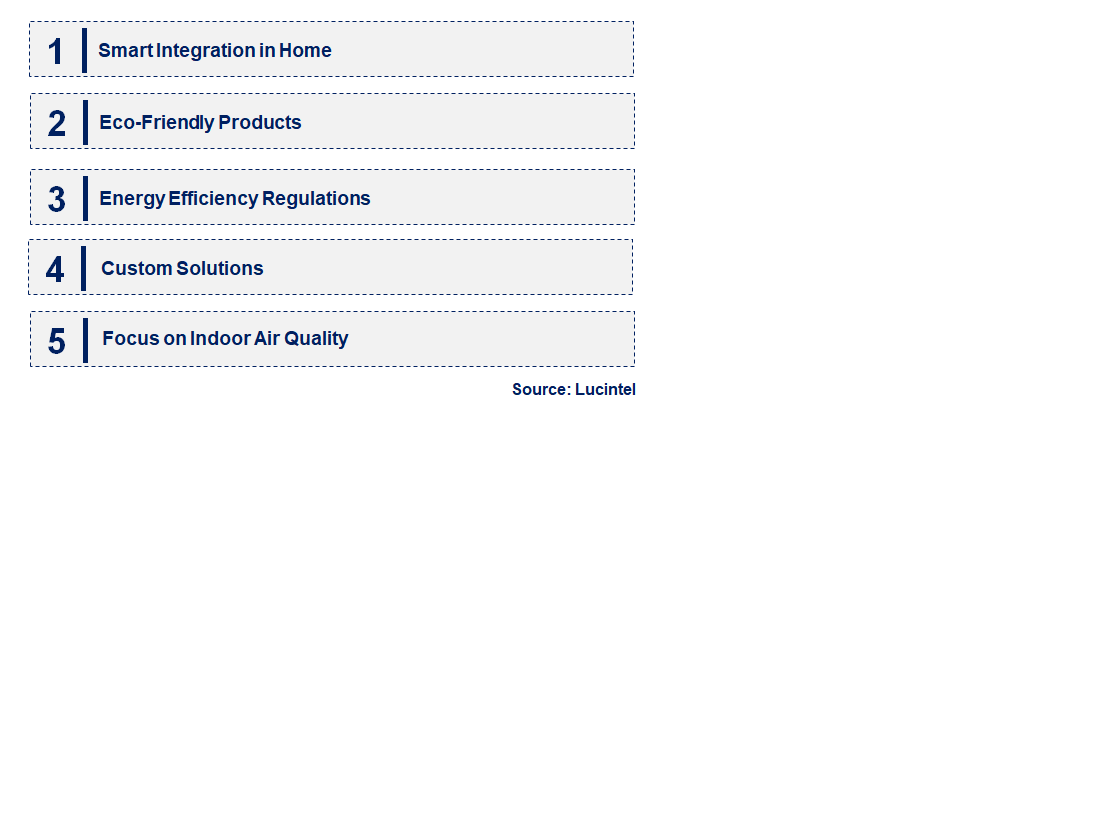
The Electronic Radiator market is characterized by the influence of several emerging trends that fall in line with shifting consumer preferences and changing technology. To embrace these trends as the market is shifting, it has become very crucial for manufactures and other relevant players to take maximum advantage of new opportunities to remain competitive in the market. Technology as well as changing consumer expectations influence electronic radiators in terms of design, marketing, and their use in homes and businesses.• Smart Integration in Home: Smart home technologies are gaining popularity where consumers desire to integrate the electronic radiators into their home automation systems with seamless integration. Thus, it allows users to control heating solutions from a remote location, increasing convenience and even efficiency in terms of energy use. Companies are investing in smart features to meet this strong demand and thus gain an edge over other market players.
• Eco-Friendly Products: With growing environmental concern, the trend goes towards environmentally friendly products. In the electronic radiator market, the trend is of eco-friendly materials and energy-efficient technologies. Manufacturers have come up with innovations that produce product not only for purpose but reduce carbon footprint alongside attaining sustainability goals across the world, which will attract a more environmentally concerned consumer.
• Energy Efficiency Regulations: Economical strength remains an overarching theme in the electronic radiator market, with stricter energy efficiency regulations causing the industry to change. Efficiencies driven through state standards are being backed by governments around the world. The enforcement of these standards serves as a catalyst for enforcing innovations within compliant products, while not only lowering the price for the consumer, but also their energy consumption and thereby their long-term costs.
• Custom Solutions: The trends in heating products are to search for the most personally tailor-made heating solutions possible to address consumer specifications. In response to that, manufacturers have produced customization-friendly options, ranging from adjustable heat settings to different designs for variations. This way, consumer satisfaction increases and, more importantly, brands become differentiable in the great battle of market competition, which leads to brand loyalty.
• Focus on Indoor Air Quality: Generally, growth in awareness of indoor air quality and its impact on health has been a significant influence factor of the electronic radiator market. Among the most popular products are those which have air purification properties and optimal humidity control. Thus, one senses a real link between comfort and health as manufacturers try to make more holistic approaches towards well-being for the user. The new trends in the electronic radiator market confirm a major trend toward smarter, more eco-friendly, and customizable heating solutions. Increasing calls from consumers for sustainability and convenience are pressed by manufacturers through the added features of IoT technology, aesthetic appeal, and indoor air quality. The dynamics of the market are being changed, and companies must innovate and catch up with the changing expectations of customers.
Recent Developments in the Electronic Radiator Market
Electronic radiator market transforming and the key factors driving it are individual technological advancements, changes in consumer demands, and shifting regulations. Such shifts not only change what exists but also create new opportunities for innovation in line with the expectation of modern consumers and the environment. Stakeholders need to be seen to understand these primary shifts if they must navigate this changing landscape well and tap into these new openings.• IoT Integration: The integration of IoT technology changes how people use electronic radiators. In that regard, the utilization of smartphones allows for remote home heating control, increasing the ease and efficiency of energy management. While involving users in a more interactive engagement with the product, this innovation further creates demand for smart home integration, hence forcing manufacturers to be even more innovative.
• Energy Efficient Designs: The energy-efficient designs are now changing the face of the electronic radiator market. Companies are highly focused on developing products having reduced power consumption along with maximum performance. This goes in tandem with consumer needs and regulatory requirements, thus providing growth impetus to the market.
• High-Quality Materials: Advancements in the material usage of electronic radiators enhance performance and durability in their manufacturing process. New composite materials and smart material developments are producing lighter, more efficient products. This development reduces production costs while improving product lifespan, making it attractive to consumers looking for quality reliability.
• Compliance Innovations: Complying with more rigorous regulations, manufacturing companies invest in compliance inventions that can still retain performance. The products will include ones that meet or better energy efficiency, and their production will enable enterprises to market the product well. Compliance inventions play a role in establishing the long-term market viability and competitiveness.
• Apparence: Currently, electronic radiators are being designed according to the demands of consumers for aesthetic home decor. Manufacturers have developed aesthetically attractive models that combine functionality and design, thus increasing market appeal. Consumer purchase decisions are becoming more dominated by the aesthetics of a product. The innovation pace in the market determines product development within electronic radiators, and the manner in which the company may respond to consumer needs or regulate pressures. The merger of the IoT, the improvement in energy efficiency, and the aesthetic focus reorient regular heating solutions to become modern and wanted products. These improvements enhance user experience yet place companies better for competition as their products serve more than one purpose and aesthetically meet a certain requirement.
Strategic Growth Opportunities for Electronic Radiator Market
The Electronic Radiator market provides significant application of strategic opportunities for growth. While manufacturers seize the opportunities, scope for innovation and market expansion can grow. Identification and exploitation of these growth areas will be vital to business execution while businesses look to enhance market share and profitability in a competitive market.• Domestic Heating: Residential heating solutions are in high demand due to the emergence of ownership trends in homes and urbanization. Therefore, with stylish products, manufacturers can obviously gain by offering consumers energy-saving opportunities while fulfilling their demands. The market is expected to be hard to sustain because people will have long-term concerns regarding innovation and brands.
• Commercial Heating: In commercial buildings, more money is being spent on making operations energy-efficient so as to cut down the costs. The manufacturers can penetrate this market by researching and coming up with products that can give businesses scalable solutions. Alliance with commercial developers and contractors can also help tap into the market by riding on the wave of increasing sustainability interest in commercial properties.
• Smart Home Technologies: In this trend, smart technologies for homes will help the market for electronic radiators assimilate IoT capabilities into their products. A business opportunity is also opened for smart heating solutions that allow a person to manage their heating from anywhere. Smart technology focus focuses on consumer desires related to convenience and energy management.
• Sustainability-related innovations: Advances in sustainable product have opened the way for manufacturers to innovation on eco-friendly material and energy-efficient design. Sustainable is a good area that gives focus to an environmentally sustainable and healthy brand which can easily promote and differentiate products and attract environmentally-friendly consumers-a factor that has increasingly become important in building market share and long-term success.
• Applications in Healthcare: Comfort and patient safety require reliable heating solutions in the healthcare sector. Specialized products targeting this area can open new markets. The possibility of growth for manufacturers lies in cooperation with healthcare providers to develop solutions that answer to specific needs. The electronic radiator market indicates huge growth opportunities in various applications, especially in the residential, commercial, and healthcare sectors. As manufacturers consider these options, emphasis on smart technologies and sustainable practices will be the key to unlocking consumer interest and, thus, driving sales. When product development matches market requirements and strategic collaborations are seen as inroads for companies, competitive advantage will increase and lead to a long-term road to growth.
Electronic Radiator Market Driver and Challenges
The Electronic Radiator market is significantly influenced by extensive drivers and challenges emanating from technology, economics, and regulation. These shape the dynamics of the market, affecting production patterns, consumer demand, and competitive strategies. Stakeholders need an understanding of these factors to steer through the myriad complexities of the changing market and capitalize on new opportunities. The factors responsible for driving the electronic radiator market include: 1. Technological Developments: Recent rapid innovations, especially IoT and energy efficiency, will evolve the electronic radiator market. The opportunities for smart functionality that can enable users to control it from anywhere and assist them with energy management make it more attractive to tech-savvy consumers. Manufacturers can definitely ensure growth and competitiveness in the market, particularly if they invest in R&D because it promotes distinctions of their product and enhances customer satisfaction. 2. Consumer Demand for Energy Efficiency: With increased consciousness among consumers toward saving energy, homeowners are looking for products that consume less energy, and heating products that take in less energy will definitely save utility bills. Additionally, the product will be appreciated by most customers since it fits perfectly with the values forwarded regarding environmental goodwill. This shift, step by step, forces the manufacturer to focus more on producing energy-efficient units, thus further driving innovation and prospects in the market. 3. Shifting Trends in Urbanization: As the population surges in cities, so does the demand for efficient heaters in homes and offices. The areas showing increased home ownership and infrastructure due to urbanization provide a sizeable market for electronic radiators. The producers of electric radiators that adapt to this trend can capture a larger share of this market, especially in the densely populated regions . Challenges in the electronic radiator market are: 1. Unbearable Market Competition: The electronic radiator market is now full of players. High competition dictates that the field needs to be differentiated. Manufacturers need to innovate constantly and provide products that would excite clients and keep them for a while. This can be resource-straining and cut at profitability. 2. Changing Consumer Preferences: Traditional manufacturers face headwinds in the form of changing consumer preferences toward smart, sustainable products. Agility and responsiveness to such changes in expectations require significant investments into R&D and marketing. If not, companies risk losing ground and being lost in the market. Over-all, the Electronic Radiator market becomes one that is influenced by a complex interplay of drivers and challenges. Technological progress and consumer demand for energy efficiency and increasing urbanization prove some major opportunities for growth. Costly production processes, high level of competition, and change in taste happen to be some of the major challenges. The manufacturers are geared up for facing such dynamics strategically to seize opportunities as well as to address any challenges with the help of which they can enhance their market position and sustain optimum growth rates.List of Electronic Radiator Companies
Companies in the market compete on the basis of product quality offered. Major players in this market focus on expanding their manufacturing facilities, R&D investments, infrastructural development, and leverage integration opportunities across the value chain. With these strategies electronic radiator companies cater increasing demand, ensure competitive effectiveness, develop innovative products & technologies, reduce production costs, and expand their customer base. Some of the electronic radiator companies profiled in this report include-• Swiftech
• Corsair Gaming
• NZXT
• Asetek
• Molex
• TE Connectivity
• Antec
Electronic Radiator by Segment
The study includes a forecast for the global electronic radiator by type, application, and region.Electronic Radiator Market by Type [Analysis by Value from 2018 to 2030]:
• Aluminum Radiator
• Copper Radiator
• Steel Radiator
• Others
Electronic Radiator Market by Application [Analysis by Value from 2018 to 2030]:
• Consumer Electronics
• Automobile Electronics
• Industrial Electronics
• Others
Electronic Radiator Market by Region [Shipment Analysis by Value from 2018 to 2030]:
• North America
• Europe
• Asia Pacific
• The Rest of the World
Country Wise Outlook for the Electronic Radiator Market
The Electronic Radiator market undergoes great changes, which could be brought about by technological advancement, concern for the environment, and changes in consumer culture. As the notion of climate change sets in and dawns on countries, an environmentally viable answer to such an alteration can be seen in electronic radiators as being more efficient and adaptable. Key countries such as the United States, China, Germany, India, and Japan do the same, which reflect specific challenges and opportunities within each of their respective markets. This overview presents new developments throughout each area to indicate the constant change in this market, outlining how the environment it undergoes influences the heating solution future.• United States: The electronic radiator market is on a rising trend in the U.S. as the country keeps on making moves toward upgrading energy efficiency and smart home technologies. Innovative designs incorporating IoT capability along with manufacturers' use of eco-friendly materials are seen as top trends, and recent regulatory incentives encourage the use of even more energy-efficient models for greater sustainability.
• China: The electronic radiator market in China is booming rapidly due to urbanization and rising disposable incomes. The government call for energy-efficient appliances prompts manufacturers to spend more on R&D in producing more advanced heating solutions. In addition, dire concerns over air quality are raising demand for electric heating as more people look to cleaner alternatives to traditional heating systems.
• Germany: Germany continues to be a market leader in the electronic radiator segment, focusing on sustainability and innovative technologies. With the smart heating solutions offered to the market, the energy consumption will be maximized. Again, regulatory frameworks that encourage standards in energy efficiency promote the development of advanced products to meet climate change ambitions underlined by Germany.
• India: Escalating temperatures in the country are contributing to the increase in the electronic radiator market in India. Manufacturers have a trend towards affordability and energy efficiency in catering to the growing requirement of the middle class. Efforts by the government for renewable sources of energy would help to push forth electronic heating products in the market.
• Japan: Japanese electronic radiators, in particular, are popular for incorporating and penetrating the use of smart technologies, innovation, and AI as well as IoT in heat solutions increase both performance and efficiency with augmented comfort to users. Another significant driving factor behind this motivation is the commitment of Japan towards its carbon emissions reduction policy. Additionally, further alignment with national policies regarding carbon emission cuts is further pressuring manufacturers to develop more environment-friendly products.

Features of the Global Electronic Radiator Market
Market Size Estimates: Electronic radiator market size estimation in terms of value ($B). Trend and Forecast Analysis: Market trends (2018 to 2023) and forecast (2024 to 2030) by various segments and regions. Segmentation Analysis: Electronic radiator market size by type, application, and region in terms of value ($B). Regional Analysis: Electronic radiator market breakdown by North America, Europe, Asia Pacific, and Rest of the World. Growth Opportunities: Analysis of growth opportunities in different type, application, and regions for the electronic radiator market. Strategic Analysis: This includes M&A, new product development, and competitive landscape of the electronic radiator market. Analysis of competitive intensity of the industry based on Porter’s Five Forces model.If you are looking to expand your business in this or adjacent markets, then contact us. We have done hundreds of strategic consulting projects in market entry, opportunity screening, due diligence, supply chain analysis, M & A, and more.

FAQ
Q1. What is the growth forecast for electronic radiator market? Answer: The global electronic radiator market is expected to grow with a CAGR of 4.5% from 2024 to 2030. Q2. What are the major drivers influencing the growth of the electronic radiator market? Answer: The major drivers for this market are increasing adoption of smart home technologies, growing concerns about climate change lead to higher demand for energy-efficient heating solutions and stringent energy efficiency standards. Q3. What are the major segments for electronic radiator market? Answer: The future of the electronic radiator market looks promising with opportunities in the consumer electronic, automobile electronic, and industrial electronic markets. Q4. Who are the key electronic radiator market companies? Answer: Some of the key electronic radiator companies are as follows:• Swiftech
• Corsair Gaming
• NZXT
• Asetek
• Molex
• TE Connectivity
• Antec Q5. Which electronic radiator market segment will be the largest in future? Answer: Lucintel forecasts that aluminum radiator is expected to witness the highest growth over the forecast period. Q6. In electronic radiator market, which region is expected to be the largest in next 5 years? Answer: APAC is expected to witness highest growth over the forecast period. Q.7 Do we receive customization in this report? Answer: Yes, Lucintel provides 10% customization without any additional cost.
Table of Contents
Methodology
- In-depth interviews of the major players in this market
- Detailed secondary research from competitors’ financial statements and published data
- Extensive searches of published works, market, and database information pertaining to industry news, company press releases, and customer intentions
- A compilation of the experiences, judgments, and insights of Lucintel’s professionals, who have analyzed and tracked this market over the years.


Buy Now
Choose a license that fits your team. Instant PDF delivery.
Prices exclude taxes. Instant delivery. Custom licensing available on request.
Key Questions
- • What are some of the most promising, high-growth opportunities for the electronic radiator market by type (aluminum radiator, copper radiator, steel radiator, and others), application (consumer electronics, automobile electronics, industrial electronics, and others), and region (North America, Europe, Asia Pacific, and the Rest of the World)?
- • Which segments will grow at a faster pace and why?
- • Which region will grow at a faster pace and why?
- • What are the key factors affecting market dynamics? What are the key challenges and business risks in this market?
- • What are the business risks and competitive threats in this market?
- • What are the emerging trends in this market and the reasons behind them?
- • What are some of the changing demands of customers in the market?
- • What are the new developments in the market? Which companies are leading these developments?
- • Who are the major players in this market? What strategic initiatives are key players pursuing for business growth?
- • What are some of the competing products in this market and how big of a threat do they pose for loss of market share by material or product substitution?
- • What M&A activity has occurred in the last 5 years and what has its impact been on the industry? For any questions related to Electronic Radiator Market, Electronic Radiator Market Size, Electronic Radiator Market Growth, Electronic Radiator Market Analysis, Electronic Radiator Market Report, Electronic Radiator Market Share, Electronic Radiator Market Trends, Electronic Radiator Market Forcast, Electronic Radiator Companies, write Lucintel analyst at email: helpdesk@lucintel.com. We will be glad to get back to you soon.


