
Report Feature
Cosmetic Surgery Market Trends and Forecast
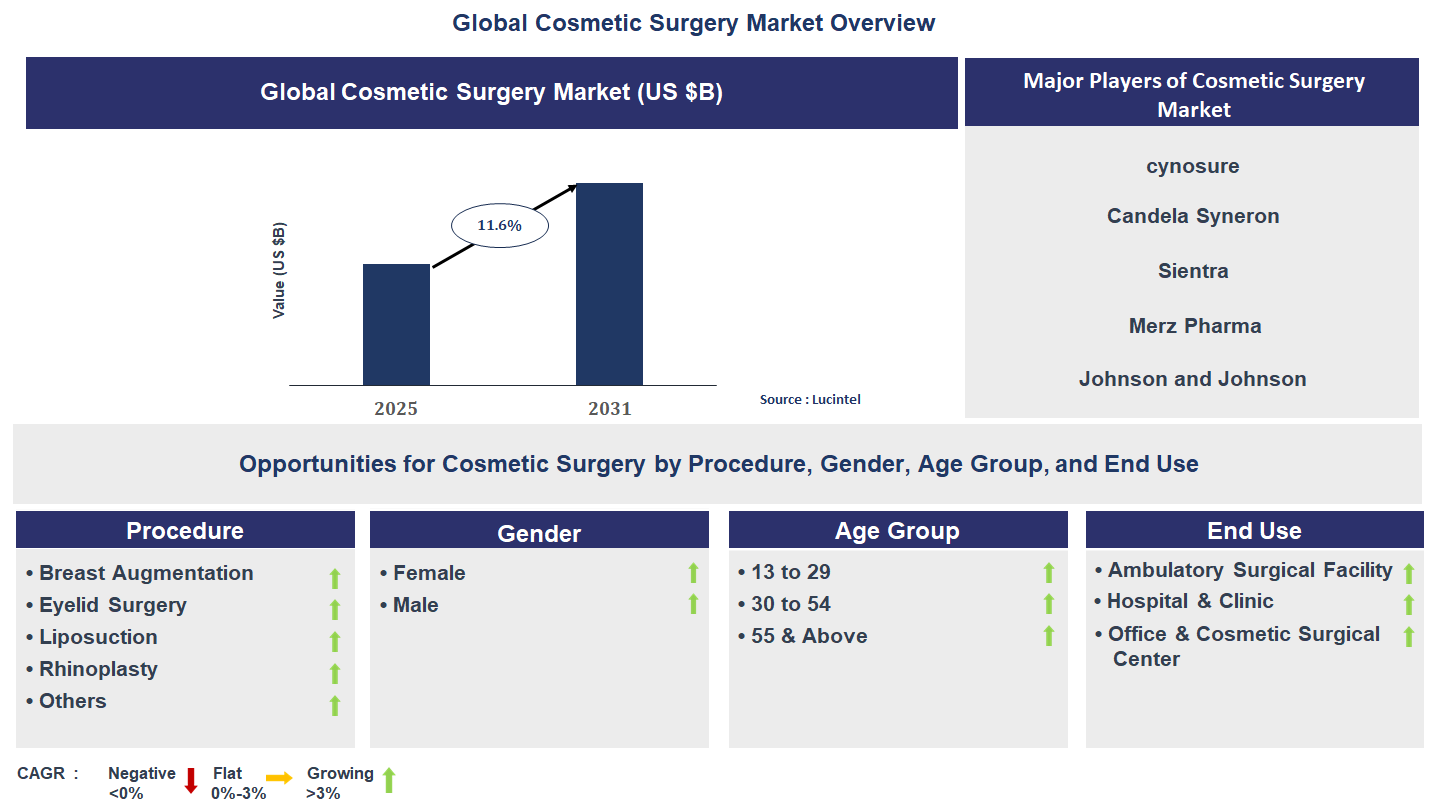
The future of the global cosmetic surgery market looks promising with opportunities in the ambulatory surgical facility, hospital & clinic, and office & cosmetic surgical center markets. The global cosmetic surgery market is expected to grow with a CAGR of 11.6% from 2025 to 2031. The major drivers for this market are the increasing focus on physical appearance, the rising influence of social media, and the growing availability of advanced procedures.• Lucintel forecasts that, within the procedure category, breast augmentation is expected to witness the highest growth over the forecast period.
• Within the end use category, hospital & clinic is expected to witness the highest growth.
• In terms of region, APAC is expected to witness the highest growth over the forecast period. Gain valuable insights for your business decisions with our comprehensive 150+ page report. Sample figures with some insights are shown below.
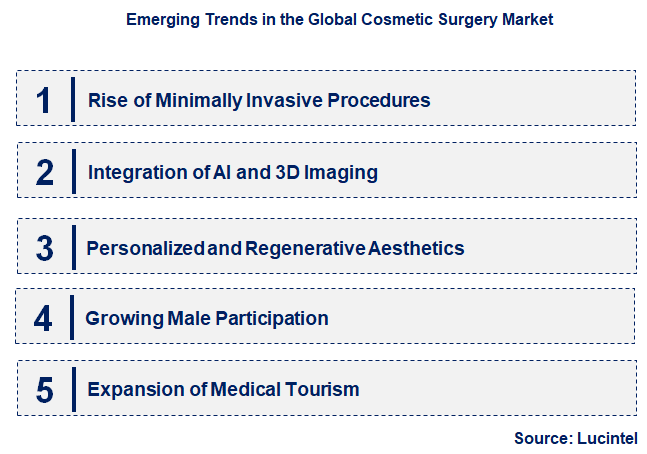
Emerging Trends in the Cosmetic Surgery Market
The cosmetic surgery market is undergoing significant transformation as technology, consumer behavior, and social influence reshape aesthetic preferences. Minimally invasive procedures, personalized treatments, and digital integration are setting new industry standards. The shift toward preventive and natural-looking enhancements reflects a more holistic view of beauty. Growing acceptance of aesthetic treatments among younger demographics and men is further broadening the market base.• Rise of Minimally Invasive Procedures: Demand for non-surgical treatments like injectables, laser therapy, and skin resurfacing is surging due to lower risk, reduced downtime, and natural outcomes. Technological innovation is enabling high-precision results, expanding consumer confidence.
• Integration of AI and 3D Imaging: Artificial intelligence and 3D imaging technologies are improving procedure planning and outcomes. Patients can visualize expected results, enhancing decision-making and satisfaction rates.
• Personalized and Regenerative Aesthetics: Customized treatment plans based on genetics, skin type, and lifestyle are gaining traction. Regenerative therapies, including stem-cell-based interventions, are redefining skin rejuvenation and tissue repair.
• Growing Male Participation: Increasing awareness and changing cultural perceptions have led to rising demand among men for treatments such as hair transplants, body contouring, and anti-aging procedures.
• Expansion of Medical Tourism: Affordable pricing, skilled surgeons, and advanced facilities are driving cross-border cosmetic surgery. Countries like India, Thailand, and Turkey are becoming major destinations for global aesthetic travelers. These emerging trends are reshaping the cosmetic surgery landscape by prioritizing safety, innovation, and inclusivity. As technology continues to evolve, the market is shifting toward personalized, minimally invasive, and accessible treatments that reflect modern beauty standards.
Recent Development in the Cosmetic Surgery Market
The cosmetic surgery industry is advancing rapidly with continuous innovation in devices, procedures, and materials. Growing investment in aesthetic research, digital tools, and patient-centered care is driving significant transformation.• Adoption of Robotic and AI-Assisted Surgery: Advanced robotic systems and AI algorithms are improving precision, reducing recovery times, and enhancing cosmetic outcomes.
• Growth of Injectable Treatments: Expanded use of hyaluronic acid fillers, Botox, and bio-stimulatory injectables is driving growth in non-invasive aesthetics.
• Advancements in Laser and Energy-Based Devices: New-generation laser and ultrasound technologies are improving results in skin tightening, hair removal, and fat reduction.
• Rise in Combination Treatments: Integrated procedures combining surgical and non-surgical techniques are delivering more comprehensive and lasting results.
• Increased Digitalization and Virtual Consultation: Online platforms and AI-based tools enable virtual consultations, helping patients make informed decisions before undergoing treatment. These developments are elevating the quality, safety, and accessibility of cosmetic procedures. Enhanced technology integration and growing patient awareness are creating a more innovative and patient-centric cosmetic surgery environment.
Strategic Growth Opportunities in the Cosmetic Surgery Market
Expanding applications of cosmetic surgery across various aesthetic domains present promising growth opportunities. From facial rejuvenation to body contouring, consumers are seeking solutions that combine precision, safety, and natural results.• Facial Aesthetics: Growing interest in facelifts, rhinoplasty, and injectables is fueling demand for minimally invasive facial procedures.
• Body Contouring: Technologies such as cry lipolysis and laser-assisted lipolysis are transforming body-shaping treatments.
• Breast Augmentation and Reconstruction: Increasing awareness of post-surgical reconstruction and aesthetic enhancement is expanding market potential.
• Hair Restoration: Advanced follicular unit extraction and platelet-rich plasma treatments are enhancing results and recovery outcomes.
• Skin Rejuvenation: Demand for anti-aging, pigmentation correction, and scar treatment solutions is driving innovation in laser and regenerative skincare. These growth opportunities are shaping the future of cosmetic surgery by broadening treatment applications and supporting innovation that aligns with individual preferences and medical needs.
Cosmetic Surgery Market Driver and Challenges
The cosmetic surgery market is driven by technological innovation, changing beauty standards, and economic growth. However, challenges related to cost, regulation, and safety continue to influence its progression. The factors responsible for driving the cosmetic surgery market include: 1. Technological Advancements: Continuous improvements in laser systems, AI, and surgical equipment are enhancing precision and patient satisfaction. 2. Rising Aesthetic Awareness: Growing acceptance of cosmetic procedures across demographics is expanding market penetration. 3. Increasing Disposable Income: Economic growth and rising affordability are boosting expenditure on personal aesthetics. 4. Social Media and Celebrity Influence: Digital exposure and influencer culture are shaping beauty ideals and increasing consumer interest. 5. Expanding Medical Tourism: Affordable treatment options and skilled surgeons are attracting international patients. Challenges in the cosmetic surgery market are: 1. High Procedure Costs: Advanced technologies and imported materials make some procedures expensive and less accessible to mass consumers. 2. Regulatory and Ethical Concerns: Lack of standardization and safety protocols in some regions pose challenges to patient trust. 3. Skilled Professional Shortage: Limited availability of trained practitioners in emerging markets restricts growth potential. The balance between innovation, affordability, and safety defines the future of the cosmetic surgery market. Overcoming these challenges while leveraging technological and demographic drivers will ensure sustained growth and enhanced patient satisfaction.List of Cosmetic Surgery Companies
Companies in the market compete on the basis of product quality offered. Major players in this market focus on expanding their manufacturing facilities, R&D investments, infrastructural development, and leverage integration opportunities across the value chain. With these strategies cosmetic surgery companies cater increasing demand, ensure competitive effectiveness, develop innovative products & technologies, reduce production costs, and expand their customer base. Some of the cosmetic surgery companies profiled in this report include-• Cynosure
• Candela Syneron
• Sientra
• Merz Pharma
• Johnson and Johnson
• Sinclair Pharmaceuticals Limited
• Teoxane Laboratories
• Bausch Health Companies
• Abbvie
• Galderma
Cosmetic Surgery Market by Segment
The study includes a forecast for the global cosmetic surgery market by procedure, gender, age group, end use, and region.Cosmetic Surgery Market by Procedure [Value from 2019 to 2031]:
• Breast Augmentation
• Eyelid Surgery
• Liposuction
• Rhinoplasty
• Others
Cosmetic Surgery Market by Gender [Value from 2019 to 2031]:
• Female
• Male
Cosmetic Surgery Market by Age Group [Value from 2019 to 2031]:
• 13 to 29
• 30 to 54
• 55 & Above
Cosmetic Surgery Market by End Use [Value from 2019 to 2031]:
• Ambulatory Surgical Facility
• Hospital & Clinic
• Office & Cosmetic Surgical Center
Cosmetic Surgery Market by Region [Value from 2019 to 2031]:
• North America
• Europe
• Asia Pacific
• The Rest of the World
Country Wise Outlook for the Cosmetic Surgery Market
The global cosmetic surgery market has evolved rapidly, driven by technological advancements, growing social media influence, and increased focus on personal aesthetics. Minimally invasive procedures and advanced laser technologies are making cosmetic enhancements safer, faster, and more accessible. Rising disposable incomes and the normalization of aesthetic treatments are fueling growth across key regions. Countries such as the United States, China, Germany, India, and Japan are witnessing a surge in both surgical and non-surgical procedures, supported by skilled practitioners, advanced clinics, and increasing awareness of appearance enhancement as a form of self-expression and confidence building.• United States: The United States continues to dominate the global cosmetic surgery market due to strong demand for non-invasive treatments and high technological adoption. The popularity of procedures such as liposuction, breast augmentation, Botox, and dermal fillers remains strong. Innovations like robotic-assisted surgery and AI-driven imaging systems are improving precision and patient satisfaction. Celebrity influence and social media trends play a vital role in shaping preferences.
• China: China has become one of the fastest-growing cosmetic surgery markets, driven by younger demographics and cultural shifts toward aesthetic enhancement. The demand for facial contouring, skin whitening, and double eyelid surgeries is particularly strong. The rise of medical tourism and digital consultation platforms is expanding market accessibility. Domestic clinics are increasingly adopting international standards, enhancing trust and service quality. Government regulations promoting patient safety and professional certification are also contributing to market stability. China’s strong social media culture continues to fuel interest in beauty transformation and aesthetic self-improvement.
• Germany: Germany’s cosmetic surgery market is expanding steadily, supported by advanced healthcare infrastructure and high medical standards. Non-surgical procedures such as Botox and dermal fillers dominate due to shorter recovery times and natural-looking results. Increasing emphasis on anti-aging treatments and wellness integration has attracted a mature clientele. The growing use of energy-based devices and 3D imaging for treatment planning is enhancing patient outcomes. German clinics are recognized for their precision and quality, drawing international patients seeking safe and effective aesthetic procedures.
• India: India’s cosmetic surgery market is witnessing robust growth driven by affordability, skilled surgeons, and growing awareness of aesthetic treatments. Popular procedures include hair transplants, rhinoplasty, and liposuction. Medical tourism is a significant growth driver, as international patients seek high-quality services at competitive prices. Increased use of digital platforms for consultations and personalized treatment planning is improving accessibility. The influence of Bollywood and social media continues to inspire cosmetic enhancements.
• Japan: Japan’s cosmetic surgery market is characterized by advanced technology and a strong cultural emphasis on subtle, natural results. Non-invasive procedures like skin rejuvenation, facial contouring, and laser therapies are in high demand. The market benefits from cutting-edge innovation in stem-cell-based treatments and regenerative aesthetics. High safety standards and government regulations ensure patient trust. Rising beauty consciousness among both genders, coupled with an aging population seeking anti-aging treatments, is fueling sustained growth. Japan’s integration of traditional wellness concepts with modern cosmetic techniques is a notable differentiator in the market.

Features of the Global Cosmetic Surgery Market
Market Size Estimates: Cosmetic surgery market size estimation in terms of value ($B). Trend and Forecast Analysis: Market trends (2019 to 2024) and forecast (2025 to 2031) by various segments and regions. Segmentation Analysis: Cosmetic surgery market size by various segments, such as by procedure, gender, age group, end use, and region in terms of value ($B). Regional Analysis: Cosmetic surgery market breakdown by North America, Europe, Asia Pacific, and Rest of the World. Growth Opportunities: Analysis of growth opportunities in different procedures, genders, age groups, end uses, and regions for the cosmetic surgery market. Strategic Analysis: This includes M&A, new product development, and competitive landscape of the cosmetic surgery market. Analysis of competitive intensity of the industry based on Porter’s Five Forces model.
FAQ
Q1. What is the growth forecast for cosmetic surgery market? Answer: The global cosmetic surgery market is expected to grow with a CAGR of 11.6% from 2025 to 2031. Q2. What are the major drivers influencing the growth of the cosmetic surgery market? Answer: The major drivers for this market are the increasing focus on physical appearance, the rising influence of social media, and the growing availability of advanced procedures. Q3. What are the major segments for cosmetic surgery market? Answer: The future of the cosmetic surgery market looks promising with opportunities in the ambulatory surgical facility, hospital & clinic, and office & cosmetic surgical center markets. Q4. Who are the key cosmetic surgery market companies? Answer: Some of the key cosmetic surgery companies are as follows:• Cynosure
• Candela Syneron
• Sientra
• Merz Pharma
• Johnson and Johnson
• Sinclair Pharmaceuticals Limited
• Teoxane Laboratories
• Bausch Health Companies
• Abbvie
• Galderma Q5. Which cosmetic surgery market segment will be the largest in future? Answer: Lucintel forecasts that, within the procedure category, breast augmentation is expected to witness the highest growth over the forecast period. Q6. In cosmetic surgery market, which region is expected to be the largest in next 5 years? Answer: In terms of region, APAC is expected to witness the highest growth over the forecast period. Q7. Do we receive customization in this report? Answer: Yes, Lucintel provides 10% customization without any additional cost.
Table of Contents
List of Figures
List of Tables
Methodology
- In-depth interviews of the major players in this market
- Detailed secondary research from competitors’ financial statements and published data
- Extensive searches of published works, market, and database information pertaining to industry news, company press releases, and customer intentions
- A compilation of the experiences, judgments, and insights of Lucintel’s professionals, who have analyzed and tracked this market over the years.


Buy Now
Choose a license that fits your team. Instant PDF delivery.
Prices exclude taxes. Instant delivery. Custom licensing available on request.
Key Questions
- • What are some of the most promising, high-growth opportunities for the cosmetic surgery market by procedure (breast augmentation, eyelid surgery, liposuction, rhinoplasty, and others), gender (female and male), age group (13 to 29, 30 to 54, and 55 & above), end use (ambulatory surgical facility, hospital & clinic, and office & cosmetic surgical center), and region (North America, Europe, Asia Pacific, and the Rest of the World)?
- • Which segments will grow at a faster pace and why?
- • Which region will grow at a faster pace and why?
- • What are the key factors affecting market dynamics? What are the key challenges and business risks in this market?
- • What are the business risks and competitive threats in this market?
- • What are the emerging trends in this market and the reasons behind them?
- • What are some of the changing demands of customers in the market?
- • What are the new developments in the market? Which companies are leading these developments?
- • Who are the major players in this market? What strategic initiatives are key players pursuing for business growth?
- • What are some of the competing products in this market and how big of a threat do they pose for loss of market share by material or product substitution?
- • What M&A activity has occurred in the last 5 years and what has its impact been on the industry? For any questions related to Cosmetic Surgery Market, Cosmetic Surgery Market Size, Cosmetic Surgery Market Growth, Cosmetic Surgery Market Analysis, Cosmetic Surgery Market Report, Cosmetic Surgery Market Share, Cosmetic Surgery Market Trends, Cosmetic Surgery Market Forecast, Cosmetic Surgery Companies, write Lucintel analyst at email: helpdesk@lucintel.com. We will be glad to get back to you soon.


