
Report Feature
Combat Management System Market Trends and Forecast
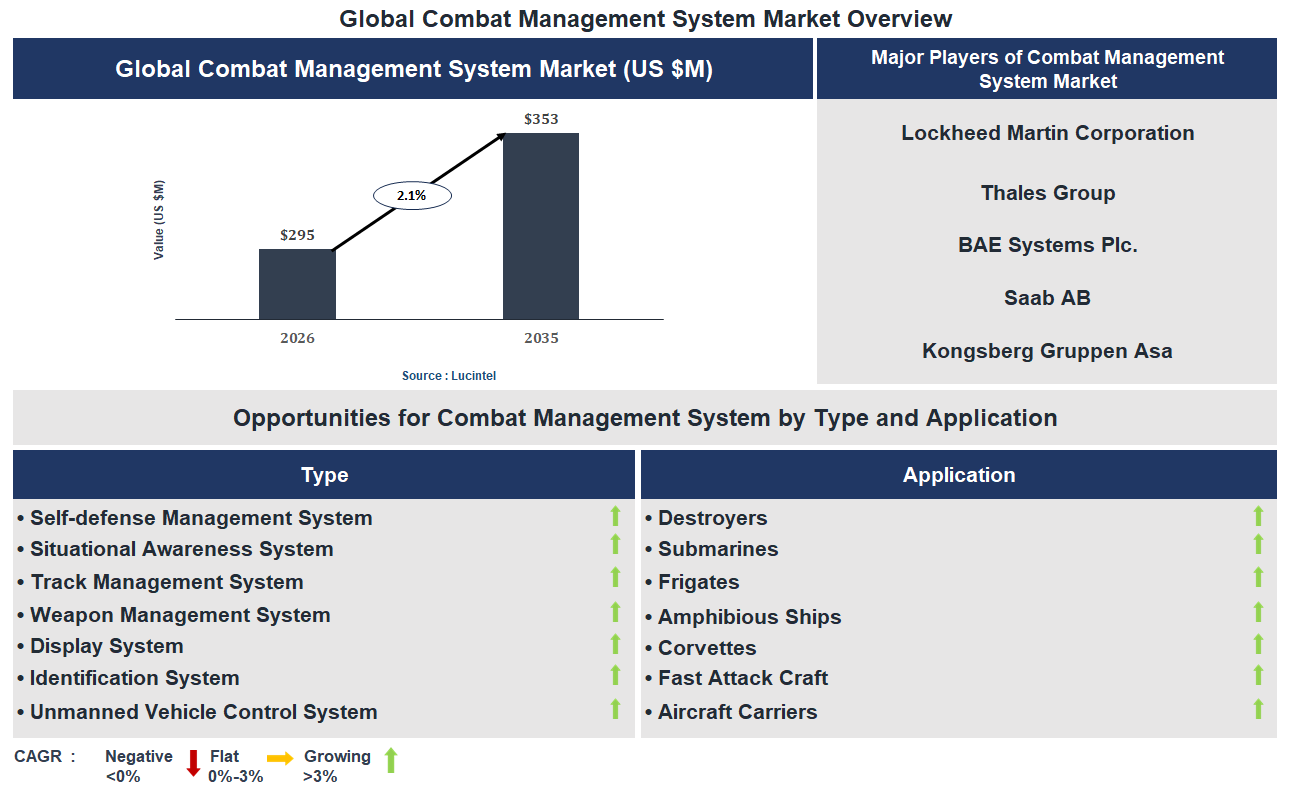
The future of the global combat management system market looks promising with opportunities in the destroyer, submarine, frigate, amphibious ship, corvette, fast attack craft, and aircraft carrier markets. The global combat management system market is expected to reach an estimated $353 million by 2035 with a CAGR of 2.1% from 2026 to 2035. The major drivers for this market are the increasing demand for integrated naval combat solutions, the rising adoption of advanced situational awareness systems, and the growing need for real time threat management.• Lucintel forecasts that, within the type category, situational awareness system is expected to witness the highest growth over the forecast period.
• Within the application category, frigate is expected to witness the highest growth.
• In terms of region, APAC is expected to witness the highest growth over the forecast period. Gain valuable insights for your business decisions with our comprehensive 150+ page report. Sample figures with some insights are shown below.
Emerging Trends in the Combat Management System Market
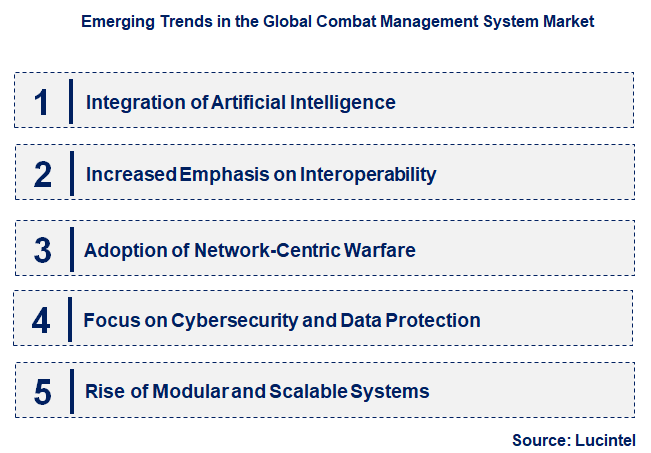
The combat management system market is experiencing rapid evolution driven by technological advancements, geopolitical shifts, and increasing defense budgets worldwide. As nations seek more sophisticated and integrated defense solutions, the market is witnessing significant changes in system capabilities, integration methods, and operational efficiency. These emerging trends are shaping the future landscape of defense strategies, emphasizing automation, interoperability, and enhanced situational awareness. Understanding these key developments is crucial for stakeholders aiming to stay ahead in this competitive and dynamic market environment.• Integration of Artificial Intelligence: The incorporation of AI into CMS enhances decision-making speed and accuracy by enabling real-time data analysis and predictive analytics. AI-driven systems can autonomously identify threats, optimize resource allocation, and support commanders with actionable insights, thereby improving operational efficiency and reducing human error. This trend is transforming traditional combat systems into smarter, more adaptive platforms capable of handling complex battlefield scenarios with minimal latency.
• Increased Emphasis on Interoperability: Modern combat environments demand seamless communication and coordination among diverse military assets. The trend toward interoperable CMS allows different platforms, such as ships, aircraft, and ground units, to share data effortlessly. This integration enhances situational awareness, streamlines command processes, and enables joint operations. As defense alliances expand and multi-national exercises become common, interoperability is becoming a critical factor influencing system procurement and development strategies.
• Adoption of Network-Centric Warfare: The shift towards network-centric warfare involves connecting various combat systems into a unified network to facilitate real-time data sharing and coordinated action. This approach improves battlefield awareness and response times, enabling forces to act cohesively. The trend is driving the development of advanced communication infrastructure within CMS, supporting faster decision cycles and more effective engagement of threats, ultimately leading to more agile and responsive military operations.
• Focus on Cybersecurity and Data Protection: As CMS become more connected and reliant on digital networks, safeguarding sensitive information from cyber threats has become paramount. The market is witnessing increased investment in robust cybersecurity measures, including encryption, intrusion detection, and secure communication protocols. Protecting combat systems from cyber-attacks ensures operational integrity and maintains strategic advantage, making cybersecurity a core component of modern CMS development and procurement.
• Rise of Modular and Scalable Systems: The demand for flexible and adaptable combat management solutions is fueling the development of modular systems that can be customized and upgraded easily. Scalable CMS allow armed forces to tailor capabilities to specific mission requirements and incorporate new technologies over time without complete system overhauls. This trend reduces lifecycle costs, enhances operational versatility, and ensures that defense systems remain relevant amid rapidly evolving threats and technological landscapes. These emerging trends are fundamentally reshaping the Combat Management System market by fostering smarter, more integrated, and resilient defense solutions. They enable armed forces to operate more efficiently, respond swiftly to threats, and maintain technological superiority in an increasingly complex global security environment.
Recent Developments in the Combat Management System Market
The combat management system market is experiencing rapid growth driven by technological advancements, increased defense budgets, and the need for enhanced battlefield efficiency. Countries are investing heavily in modernizing their military capabilities, leading to innovations in integrated systems, AI, and cybersecurity. These developments are transforming defense strategies, improving operational effectiveness, and fostering international collaborations. As nations seek advanced solutions to address emerging threats, the CMS market is poised for significant expansion, offering new opportunities for manufacturers and defense agencies worldwide.• Adoption of Artificial Intelligence: The adoption of AI in CMS enhances decision-making speed and accuracy, enabling real-time threat analysis and autonomous operations. This integration improves battlefield responsiveness and reduces human error, leading to more effective defense strategies. AI-driven systems facilitate predictive maintenance and data analytics, optimizing resource allocation. The impact is a more agile and intelligent defense infrastructure capable of countering complex threats efficiently.
• Increased Focus on Cybersecurity: As CMS systems become more interconnected, protecting them from cyber threats is critical. Recent developments include advanced encryption protocols and intrusion detection systems to safeguard sensitive military data. Strengthening cybersecurity measures ensures operational continuity and prevents adversaries from exploiting vulnerabilities. This focus enhances trust in digital defense platforms and supports the deployment of network-centric warfare capabilities, ultimately securing national defense assets.
• Adoption of Cloud Computing and Data Sharing: Cloud technology enables seamless data sharing across military units and allied forces, improving coordination and situational awareness. Recent innovations facilitate secure, scalable, and rapid access to critical information, enhancing operational efficiency. Cloud integration supports real-time updates, mission planning, and logistics management, leading to more synchronized and flexible military responses. This development fosters interoperability and accelerates decision-making processes in complex combat scenarios.
• Development of Modular and Scalable Systems: Modern CMS are increasingly modular, allowing customization based on specific operational needs. These scalable systems enable easy upgrades and integration of new technologies, ensuring longevity and adaptability. Modular designs reduce costs and deployment times, providing flexibility for diverse military platforms. The impact is a more versatile and future-proof defense system capable of evolving with emerging threats and technological advancements.
• Emphasis on Autonomous and Unmanned Systems: The integration of unmanned vehicles and autonomous platforms into CMS enhances battlefield reach and safety. These systems perform reconnaissance, surveillance, and combat roles, reducing risk to personnel. Recent developments focus on improving autonomy, sensor integration, and communication links. The deployment of autonomous systems increases operational efficiency, expands tactical options, and provides a strategic advantage in complex combat environments. The overall impact of these developments is a more advanced, secure, and adaptable Combat Management System market. These innovations are driving military modernization, improving operational effectiveness, and fostering international defense collaborations. As technology continues to evolve, the market is expected to grow significantly, offering new opportunities for innovation and strategic advantage in modern warfare.
Strategic Growth Opportunities in the Combat Management System Market
The combat management system market is experiencing rapid growth driven by technological advancements, increasing defense budgets, and evolving military strategies worldwide. As nations modernize their armed forces, the demand for integrated, reliable, and advanced combat management solutions rises. Opportunities lie in expanding applications across various military platforms, enhancing system capabilities, and adopting innovative technologies to improve operational efficiency and battlefield awareness. This dynamic environment offers significant potential for market players to innovate and capture new growth avenues.• Integration of AI and Machine Learning for Enhanced Situational Awareness: Incorporating AI and machine learning into CMS enables real-time data analysis, predictive analytics, and autonomous decision-making, significantly improving battlefield situational awareness. These technologies help identify threats faster, optimize resource allocation, and support commanders with actionable insights, leading to more effective combat strategies. As defense agencies prioritize smarter systems, integrating AI will be a key growth driver, fostering innovation and increasing system capabilities.
• Expansion of CMS Applications Across Naval and Airborne Platforms: The deployment of CMS is expanding beyond traditional land-based systems to naval ships and aircraft. This diversification allows for comprehensive battlefield management, improved coordination, and enhanced security across multiple domains. Growing naval modernization programs and airborne defense initiatives create opportunities for tailored CMS solutions, fostering interoperability and multi-platform integration, which are critical for modern military operations.
• Adoption of Cybersecurity Solutions to Protect Critical Defense Infrastructure: As CMS systems become more interconnected and reliant on digital networks, cybersecurity becomes paramount. Developing advanced cybersecurity measures to safeguard sensitive military data and prevent cyber-attacks is a significant growth opportunity. Strengthening defense against cyber threats ensures system integrity, operational continuity, and national security, prompting investments in secure communication protocols, encryption, and threat detection technologies within CMS.
• Development of Modular and Scalable CMS for Customizable Defense Solutions: Modular and scalable CMS architectures allow customization based on specific operational needs and platform requirements. This flexibility supports rapid deployment, upgrades, and integration with existing systems, reducing costs and enhancing adaptability. As militaries seek versatile solutions that can evolve with technological advancements, modular CMS designs will become increasingly attractive, enabling tailored, future-proof defense capabilities.
• Increasing Focus on Network-Centric Warfare and Data Sharing Capabilities: The shift towards network-centric warfare emphasizes seamless data sharing and real-time communication among various military units and platforms. Developing CMS with robust data integration, interoperability, and communication features enhances coordinated operations and strategic decision-making. This focus drives growth by enabling more synchronized, efficient, and effective combat responses, aligning with modern military doctrines and technological trends. The overall market outlook is positively influenced by these growth opportunities, fostering innovation, enhancing operational efficiency, and supporting modern military strategies. As defense organizations prioritize advanced, integrated, and secure combat management solutions, market players are positioned to capitalize on expanding applications and technological developments, ensuring sustained growth and competitiveness in the evolving defense landscape.
Combat Management System Market Driver and Challenges
The combat management system market is influenced by a variety of technological, economic, and regulatory factors that shape its growth and development. Rapid advancements in military technology, increasing defense budgets, and evolving geopolitical threats drive demand for sophisticated CMS solutions. Regulatory standards and international defense agreements also impact market dynamics, ensuring compliance and fostering innovation. Additionally, geopolitical tensions and the need for enhanced security measures propel the adoption of advanced combat management systems. However, the market faces challenges such as high development costs, technological complexity, and stringent regulatory requirements, which can hinder rapid deployment and innovation. Understanding these drivers and challenges is essential for stakeholders to navigate the evolving landscape effectively. The factors responsible for driving the combat management system market include:-• Technological Advancements: Rapid innovations in sensor technology, artificial intelligence, and data integration enhance CMS capabilities, enabling real-time decision-making and improved battlefield awareness. These advancements attract military investments to upgrade existing systems and develop next-generation solutions, fostering market growth. The integration of unmanned systems and cyber defense features further expands the scope of CMS applications, making them indispensable for modern warfare.
• Increasing Defense Budgets: Governments worldwide are allocating more funds toward defense modernization, driven by rising geopolitical tensions and security concerns. This increased spending facilitates procurement of advanced combat management systems for navies, air forces, and ground forces. As defense budgets grow, military organizations seek comprehensive solutions that improve operational efficiency, thereby fueling market expansion.
• Geopolitical Tensions and Security Threats: Escalating regional conflicts and international tensions necessitate enhanced military preparedness. Combat management systems are critical for situational awareness, threat detection, and coordinated response, making them vital for modern armed forces. The rising demand for such systems in conflict zones directly contributes to market growth, as nations seek to modernize their defense capabilities.
• Integration of Artificial Intelligence and Data Analytics: The incorporation of AI and big data analytics into CMS allows for predictive maintenance, threat assessment, and autonomous decision-making. These technologies improve operational efficiency and reduce human error, making CMS more effective. The push towards autonomous systems and smarter battlefield management drives innovation and market demand.
• Growing Focus on Naval and Air Defense: The increasing need for advanced naval and air defense systems to counter emerging threats has spurred investments in combat management solutions tailored for these domains. Enhanced interoperability, multi-domain integration, and survivability features are prioritized, expanding the market scope and encouraging technological development. The challenges facing the combat management system market include:-
• High Development and Maintenance Costs: Developing sophisticated CMS involves significant investment in research, technology, and skilled personnel. Maintenance and upgrades further add to operational expenses, which can be a barrier for some defense budgets. These costs may delay procurement cycles and limit widespread adoption, especially among smaller or developing nations.
• Technological Complexity and Integration Issues: CMS must integrate seamlessly with various platforms, sensors, and weapon systems, which presents technical challenges. Compatibility issues, system interoperability, and cybersecurity vulnerabilities complicate deployment. Overcoming these complexities requires extensive testing and customization, potentially delaying implementation and increasing costs.
• Stringent Regulatory and Export Controls: International regulations governing defense technology exports and compliance standards impose restrictions on CMS deployment and transfer. These regulations can limit market access, complicate international collaborations, and slow down the adoption process. Navigating these legal frameworks requires significant effort and strategic planning, impacting overall market growth. The combat management system market is driven by technological innovation, increased defense spending, geopolitical tensions, and advancements in AI and data analytics. However, high costs, technical complexities, and regulatory hurdles pose significant challenges. These factors collectively influence the pace and scope of market growth, requiring stakeholders to balance innovation with strategic compliance and cost management. Overall, the markets evolution will depend on how effectively these drivers are leveraged and challenges mitigated, shaping the future landscape of modern military defense systems.
List of Combat Management System Companies
Companies in the market compete on the basis of product quality offered. Major players in this market focus on expanding their manufacturing facilities, R&D investments, infrastructural development, and leverage integration opportunities across the value chain. With these strategies combat management system companies cater increasing demand, ensure competitive effectiveness, develop innovative products & technologies, reduce production costs, and expand their customer base. Some of the combat management system companies profiled in this report include-• Lockheed Martin Corporation
• Thales Group
• BAE Systems Plc.
• Saab AB
• Kongsberg Gruppen Asa
• Israel Aerospace Industries Ltd.
• Leonardo S.P.A.
• Raytheon Company
• Northrop Grumman Corporation
• Elbit Systems Ltd.
Combat Management System Market by Segment
The study includes a forecast for the global combat management system market by type, application, and region.Combat Management System Market by Type [Value from 2019 to 2035]:
• Self-defense Management System
• Situational Awareness System
• Track Management System
• Weapon Management System
• Display System
• Identification System
• Unmanned Vehicle Control System
Combat Management System Market by Application [Value from 2019 to 2035]:
• Destroyers
• Submarines
• Frigates
• Amphibious Ships
• Corvettes
• Fast Attack Craft
• Aircraft Carriers
Combat Management System Market by Region [Value from 2019 to 2035]:
• North America
• Europe
• Asia Pacific
• The Rest of the World
Country Wise Outlook for the Combat Management System Market
The combat management system market has experienced significant advancements driven by technological innovation, geopolitical shifts, and increased defense budgets worldwide. Countries are investing heavily in modernizing their naval and military capabilities to enhance situational awareness, interoperability, and combat efficiency. The integration of AI, automation, and advanced sensor systems is transforming CMS functionalities. As nations seek to strengthen their maritime security and defense readiness, the market dynamics are evolving rapidly, with new collaborations, product launches, and strategic initiatives shaping the future landscape of combat management systems.• United States: The US defense sector has focused on upgrading existing CMS platforms with AI-driven analytics and enhanced cybersecurity features. Major defense contractors like Lockheed Martin and Raytheon are developing next-generation systems that emphasize interoperability across allied forces. The US Navy is investing in integrated combat systems for its fleet modernization, including autonomous vessel capabilities and advanced sensor integration, to maintain maritime dominance and strategic superiority.
• China: China has made substantial progress in developing indigenous CMS technology, aiming for self-reliance in naval defense. The country is integrating advanced radar, missile, and sensor systems into its new-generation warships. Chinese defense firms are collaborating with international partners to incorporate cutting-edge automation and AI features. The focus remains on expanding its blue-water navy capabilities and enhancing regional maritime security through sophisticated combat management solutions.
• Germany: Germanys defense industry is emphasizing the modernization of its naval vessels with advanced CMS that support multi-domain operations. The country is investing in integrating cyber defense and electronic warfare capabilities into existing systems. German firms are also working on enhancing interoperability with NATO allies by adopting standardized communication protocols and modular system architectures, ensuring flexible and scalable combat management solutions for future conflicts.
• India: India is rapidly advancing its CMS technology to bolster its naval and coastal defense. The country is developing indigenous systems with a focus on automation, sensor integration, and network-centric warfare. Indian defense agencies are also procuring foreign systems to upgrade their fleet, emphasizing interoperability with allied forces. The strategic push aims to strengthen regional maritime security and counterbalance regional threats through sophisticated combat management capabilities.
• Japan: Japan is prioritizing the modernization of its maritime defense systems with a focus on AI, automation, and sensor integration. The country is upgrading its existing CMS platforms to improve situational awareness and response times. Japan is also investing in joint exercises and collaborations with allied nations to enhance interoperability. The emphasis remains on protecting its maritime interests in the Asia-Pacific region through advanced, resilient combat management systems.

Features of the Global Combat Management System Market
Market Size Estimates: Combat management system market size estimation in terms of value ($M). Trend and Forecast Analysis: Market trends (2019 to 2025) and forecast (2026 to 2035) by various segments and regions. Segmentation Analysis: Combat management system market size by type, application, and region in terms of value ($M). Regional Analysis: Combat management system market breakdown by North America, Europe, Asia Pacific, and Rest of the World. Growth Opportunities: Analysis of growth opportunities in different types, applications, and regions for the combat management system market. Strategic Analysis: This includes M&A, new product development, and competitive landscape of the combat management system market. Analysis of competitive intensity of the industry based on Porter’s Five Forces model.
FAQ
Q1. What is the combat management system market size? Answer: The global combat management system market is expected to reach an estimated $353 million by 2035. Q2. What is the growth forecast for combat management system market? Answer: The global combat management system market is expected to grow with a CAGR of 2.1% from 2026 to 2035. Q3. What are the major drivers influencing the growth of the combat management system market? Answer: The major drivers for this market are the increasing demand for integrated naval combat solutions, the rising adoption of advanced situational awareness systems, and the growing need for real time threat management. Q4. What are the major segments for combat management system market? Answer: The future of the combat management system market looks promising with opportunities in the destroyer, submarine, frigate, amphibious ship, corvette, fast attack craft, and aircraft carrier markets. Q5. Who are the key combat management system market companies? Answer: Some of the key combat management system companies are as follows:• Lockheed Martin Corporation
• Thales Group
• BAE Systems Plc.
• Saab AB
• Kongsberg Gruppen Asa
• Israel Aerospace Industries Ltd.
• Leonardo S.P.A.
• Raytheon Company
• Northrop Grumman Corporation
• Elbit Systems Ltd. Q6. Which combat management system market segment will be the largest in future? Answer: Lucintel forecasts that, within the type category, situational awareness system is expected to witness the highest growth over the forecast period. Q7. In combat management system market, which region is expected to be the largest in next 8 years? Answer: In terms of region, APAC is expected to witness the highest growth over the forecast period. Q8. Do we receive customization in this report? Answer: Yes, Lucintel provides 10% customization without any additional cost.
Table of Contents
List of Figures
List of Tables
Methodology
- In-depth interviews of the major players in this market
- Detailed secondary research from competitors’ financial statements and published data
- Extensive searches of published works, market, and database information pertaining to industry news, company press releases, and customer intentions
- A compilation of the experiences, judgments, and insights of Lucintel’s professionals, who have analyzed and tracked this market over the years.


Buy Now
Choose a license that fits your team. Instant PDF delivery.
Prices exclude taxes. Instant delivery. Custom licensing available on request.
Key Questions
- • What are some of the most promising, high-growth opportunities for the combat management system market by type (self-defense management system, situational awareness system, track management system, weapon management system, display system, identification system, and unmanned vehicle control system), application (destroyers, submarines, frigates, amphibious ships, corvettes, fast attack craft, and aircraft carriers), and region (North America, Europe, Asia Pacific, and the Rest of the World)?
- • Which segments will grow at a faster pace and why?
- • Which region will grow at a faster pace and why?
- • What are the key factors affecting market dynamics? What are the key challenges and business risks in this market?
- • What are the business risks and competitive threats in this market?
- • What are the emerging trends in this market and the reasons behind them?
- • What are some of the changing demands of customers in the market?
- • What are the new developments in the market? Which companies are leading these developments?
- • Who are the major players in this market? What strategic initiatives are key players pursuing for business growth?
- • What are some of the competing products in this market and how big of a threat do they pose for loss of market share by material or product substitution?
- • What M&A activity has occurred in the last 5 years and what has its impact been on the industry? For any questions related to Combat Management System Market, Combat Management System Market Size, Combat Management System Market Growth, Combat Management System Market Analysis, Combat Management System Market Report, Combat Management System Market Share, Combat Management System Market Trends, Combat Management System Market Forecast, Combat Management System Companies, write Lucintel analyst at email: helpdesk@lucintel.com. We will be glad to get back to you soon.


