
Report Feature
Biometrics in BFSI Market Trends and Forecast
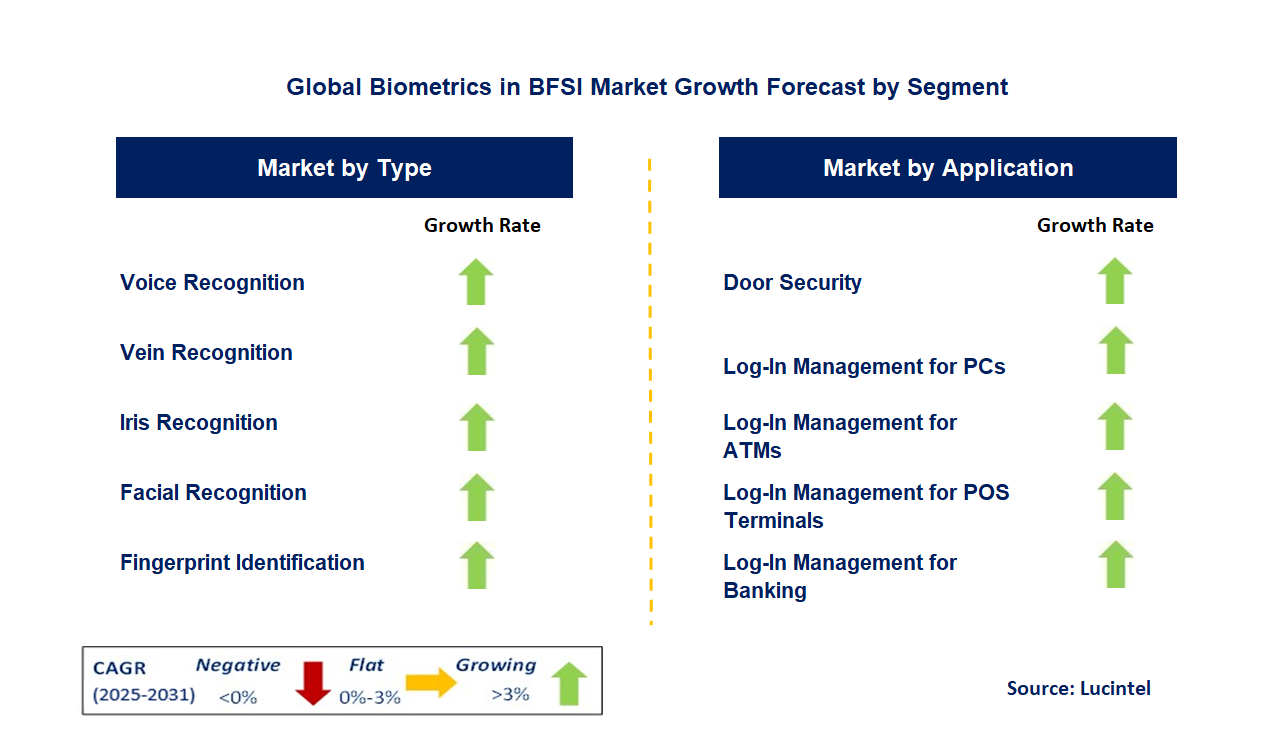
The future of the global biometrics in BFSI market looks promising with opportunities in the door security, log-in management for PCs, log-in management for ATMs, log-in management for POS terminals and log-in management for banking markets. The global biometrics in BFSI market is expected to grow with a CAGR of 8.4% from 2025 to 2031. The major drivers for this market are increasing reliance on digital banking, rising popularity of mobile banking app, and growing adoption of biometric authentication for enhanced security.Lucintel forecasts that, within the type category, fingerprint identification is expected to witness the highest growth over the forecast period.
Within the application category, log-in management for banking is expected to witness the highest growth.
In terms of region, APAC is expected to witness the highest growth over the forecast period.
Gain valuable insights for your business decisions with our comprehensive 150+ page report. Sample figures with some insights are shown below.

Emerging Trends in the Biometrics in BFSI Market
Emerging trends in BFSI market biometrics are being fueled by technological innovation, increasing security demands, and changes in consumer behavior. These are transforming the way the bank and other financial institutions relate to customers and improving security while enhancing user experience.• Multi-Modal Biometrics: Many financial institutions nowadays adopt multi-modal biometric systems that use combined multiple biometric identifiers, such as fingerprint, facial recognition, or voice. Because these institutions incorporate two or more means of biometric authentication, access by fraudster becomes highly unattainable with its robust and effective security in using authentications methods. As demand for safe alternatives without sacrificing the flexibility and usability characteristic of the legacy system continues, this trend can be seen surging among institutions.
• AI-Based Biometric Authentication: AI is the future of biometric authentication as it is making the biometric system more accurate and efficient. With AI, fraud detection is enhanced while the authentication processes are faster with reduced false positives in biometric verification. Biometrics will be able to change its tact in fraud through AI, thereby making the authentication dynamic. This will increase as AI develops and allows for more intelligent biometric systems.
• Biometric Payment Systems: Biometric payment systems are increasingly being used by consumers, where their unique biological feature is used to authenticate a transaction in lieu of a PIN or password. Such systems are also being embedded into mobile wallets, point-of-sale terminals, and ATMs, further enhancing the experience for users who make payments. As digital payments go up across the globe, there is a lot for biometric payment systems to handle in terms of secure, contactless transactions that not only bring people convenience but also prevent fraud.
• Voice Biometric Authentication: Voice biometrics is on the rise in the BFSI sector, especially in call centers and for remote banking services. It verifies identities through voice characteristics. Banks can identify people over the phone or voice-activated systems by analyzing unique characteristics of a person's voice. This trend increases customer service with faster and more secure authentication of transactions, account inquiries, and troubleshooting. With time, voice biometrics will become increasingly popular as consumers get accustomed to voice-based technologies.
• Cloud-Based Biometric Solutions: Cloud-based biometric solutions are becoming popular, providing banks with scalable, cost-effective ways to implement biometric authentication without expensive on-site infrastructure. This is attractive to smaller financial institutions that might not have the resources to build and maintain in-house biometric systems. Cloud-based biometrics allow for seamless integration with other financial services, thus enhancing customer experience and easier updates and maintenance.
These trends are transforming the biometrics in BFSI market by improving security, streamlining authentication processes, and enhancing customer experiences. Multi-modal and AI-powered biometrics offer more accurate and secure methods for user verification, while biometric payment systems and voice authentication provide greater convenience. As the market continues to evolve, the integration of these trends will drive further innovation in the banking and financial services sector.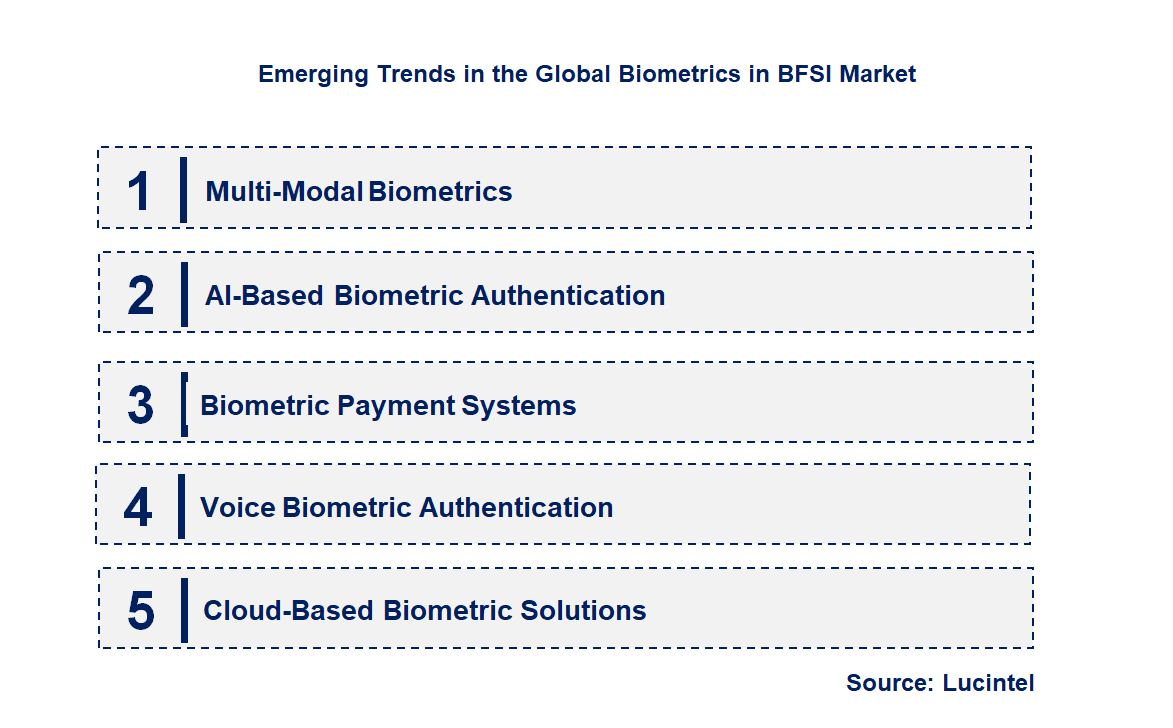
Recent Development in the Biometrics in BFSI Market
The latest developments in biometrics in the BFSI market indicate a broad emphasis on security, ease of services, and efficiency through upgraded technologies. They are slowly shaping the safe and efficient banking experience for global customers.• Implementation of Fingerprint and Facial Recognition in Mobile Banking: In mobile banking, financial institutions have started adopting fingerprint and facial recognition systems to increase the security features of mobile banking applications. Such biometric authentication methods provide convenient, password-free login and transaction approvals. With this trend of mobile-first banking, these technologies help institutions meet their customers' needs for secure, seamless digital banking experiences.
• Integration of AI for Fraud Prevention: Biometric systems are integrated with AI to improve fraud detection and prevent identity theft. By applying machine learning algorithms, banks can analyze biometric data patterns and detect suspicious activities in real time. This integration helps banks better protect customers from fraud and makes sure that the biometric system is smarter and adaptive to emerging threats.
• Biometric Authentication in ATMs: Biometrics is increasingly used to authenticate the user of ATMs instead of PIN-based methods or in combination with them. It includes fingerprint scanning and facial recognition technologies that offer a secure and convenient means of accessing customer accounts. With security concerns for ATMs on the rise, biometrics is likely to gain further momentum and strengthen overall security for financial transactions.
• Biometric payment solution smooth transactions: The increasing demand for seamless and secure transaction methods is popularizing biometric payment solutions. The bank and payments platforms, therefore, are integrating biometrics in digital wallets, mobile apps, or point-of-sale. These will allow consumers to complete transactions based on fingerprint scanning or facial recognition, reducing their physical cards and PIN, while maintaining heightened security.
• Regulatory Developments and Standards for Biometric Data Protection: With the increased usage of biometric technologies, regulatory bodies are formulating guidelines and standards for safe and secure handling of biometric data. These regulations would be aimed at safeguarding consumer privacy and ensuring safe storage and processing of biometric data. Financial institutions, in this context, have begun to comply with such regulations by setting up effective data protection mechanisms that ensure trust and thus promote widespread usage of biometric systems.
Developments in recent time reflect the burgeoning impact of biometric technology on bringing security, efficiency, and easy banking services closer together. Thus, with development in AI along with biometric payment solutions as well as emerging regulatory frameworks the BFSI space is heading in direction where biometrics will be common approach to secure money transactions and thus protect customer records.Strategic Growth Opportunities in the Biometrics in BFSI Market
One of the significant strategic growth opportunities offered by biometric technologies is to banks and financial institutions, since their adoption has been growing recently. The application is diverse, covering mobile banking up to fraud prevention, which helps financial institutions create avenues for improved customer experience and security.• Mobile Banking Authentication: Biometrics is one of the fastest-growing areas for mobile banking adoption. Fingerprint, facial, and voice recognition can be used by financial institutions to give customers safe and seamless access to their accounts. By implementing biometrics, banks can improve the security of mobile banking apps, reduce fraud, and increase customer trust, leading to higher user engagement and retention.
• Biometric Payment Systems: With the rise of digital payments, there is a huge opportunity for financial institutions to include biometrics in payment systems to make them more secure. Biometric payment options such as facial or fingerprint recognition offered by banks will give a safer, more convenient, and user-friendly payment experience that will lead to increased adoption of digital payment platforms.
• Remotely conducted verification of customers: This is an area where biometrics will play a huge role in making digital, remote, secure customer verification possible for account opening, loan applications, identity verification, etc. This opportunity is pertinent in large unbanked markets. Banks can make it easier to onboard a customer, enhance their experience, and further the cause of financial inclusion using biometric authentication.
• Fraud Prevention and Risk Management: Fraud prevention is one of the most important issues, and integration of biometrics for fraud prevention is a significant growth opportunity. Financial institutions can use biometric data, along with AI-driven fraud detection systems, to identify and mitigate risks. This will reduce the occurrence of identity theft and fraudulent transactions, enhancing the overall security of financial services.
• Compliance to regulations and Data Privacy: With increased data security awareness, financial institutions are putting emphasis on ensuring their biometric system is privacy compliant with the latest regulations like GDPR and other local data protection laws. Banks can develop secure, complaint, and adherent biometric systems to protect customer's data in the process of trusting this technology and respecting the legal standards.
The biometric technologies present a chance for the BFSI sector to change radically. The addition of biometrics in mobile banking, payments, fraud prevention, and remote verification can be useful for banks for enhancing security, improving the customer experience, and driving further adoption of digital services. Such opportunities will enable the banks to gain competitive advantages during the growing development of the BFSI market into an increasingly digital world.Biometrics in BFSI Market Driver and Challenges
The driver for the biometrics BFSI market is a combination of technological, economic, as well as regulatory drivers. Among them are the need for more secure processes, improved customer experience, and increased adoption of digital services. However, data privacy issues, as well as the cost of implementation and regulatory compliance, are important factors in the dynamics of this market.The factors responsible for driving the biometrics in BFSI market include:
1. Critical Need for Enhanced Security Features: The ever-increasing number of cyberattacks, identity thefts, and frauds has created an increased need for stronger security measures in the BFSI sector. Biometrics is a reliable and tamper-proof solution, and it happens to be one of the critical technologies required for safeguarding customer data and ensuring secure transactions.
2. Increasing Adoption of Digital Banking: Applications of digital banking services, especially after the COVID-19 pandemic, are increasingly fuelling demand in biometric solutions. With further exposure to online banking by consumers, biometrics provides an alternative authentication method that is secure and convenient as opposed to using passwords, which accelerates growth in the market.
3. Government Support and Regulatory Compliance: The government and the regulatory bodies are promoting the adoption of biometric technologies in the BFSI sector through regulations that guarantee the safe handling of biometric data. The regulations are assisting in the establishment of a conducive environment for the growth of biometric solutions while at the same time providing a framework for data privacy and protection.
4. Consumer Demand for Convenience: Consumers are seeking convenience in banking experiences. Biometric authentication offers a frictionless, user-friendly way to access accounts and conduct transactions without remembering passwords or PINs. This demand for frictionless experiences is driving the adoption of biometrics across the BFSI sector.
5. Technological Advancements: Advancement in biometric technology with continuously improved facial recognition algorithms, voice recognition, and artificial intelligence is highly driving the application of biometrics in the banking sector. Technological innovations lead to better precision, speed, and low-cost efficiency of the biometric systems; hence the growth of the market.
Challenges in the biometrics in BFSI market are:
1. Data Privacy and Security Issues: One of the biggest concerns in the BFSI biometrics market is the data privacy and security issues. Due to the sensitive nature of the biometric information, hackers target the same, and any breach may lead to the loss of trust among customers and also attract a legal issue on the financial institution's side.
2. High Implementation Costs: Biometric systems are expensive to implement, especially for smaller financial institutions. The requirement for specialized hardware, software, and infrastructure for biometric authentication often creates a significant barrier to the adoption of biometric systems, causing the growth of the market in certain regions.
3. Consumer Resistance and Trust Issues: Biometric systems continue to be an area of hesitation for some customers due to perceived privacy issues or data misuse, or perhaps even surveillance capabilities. Overcoming these trust issues and educating the customer on the value and security associated with biometrics is critical for higher adoption in the BFSI sector.
Various drivers such as improvements in security requirements, increasing trends of digital banking, and technological advances are setting the stage for BFSI market biometrics. However, it needs to overcome a lot more related to data privacy issues, the cost of implementation is too high, and customer resistance for its growth to be sustained. With all these, the markets are positioned for higher growth as financial institutions continue to embrace biometrics to serve their customers more conveniently and securely.
List of Biometrics in BFSI Market Companies
Companies in the market compete on the basis of product quality offered. Major players in this market focus on expanding their manufacturing facilities, R&D investments, infrastructural development, and leverage integration opportunities across the value chain. With these strategies biometrics in BFSI market companies cater increasing demand, ensure competitive effectiveness, develop innovative products & technologies, reduce production costs, and expand their customer base. Some of the biometrics in BFSI market companies profiled in this report include-• Cross Match Technologies
• Fujitsu
• Hid Global
• M2Sys
• Safran
Biometrics in BFSI Market by Segment
The study includes a forecast for the global Biometrics in BFSI Market by type, application, and region.Biometrics in BFSI Market by Type [Value from 2019 to 2031]:
• Voice Recognition
• Vein Recognition
• Iris Recognition
• Facial Recognition
• Fingerprint Identification
Biometrics in BFSI Market by Application [Value from 2019 to 2031]:
• Door Security
• Log-In Management For PCs
• Log-In Management For ATMs
• Log-In Management For POS Terminals
• Log-In Management For Banking
Biometrics in BFSI Market by Region [Value from 2019 to 2031]:
• North America
• Europe
• Asia Pacific
• The Rest of the World
Country Wise Outlook for the Biometrics in BFSI Market
The banking, financial services, and insurance (BFSI) industry is increasingly turning to biometric technologies to achieve better security, ease of use, and process efficiencies. The major biometric technologies being adopted are fingerprint recognition, facial recognition, iris scanning, and voice recognition-which are applied across different touchpoints-from mobile applications to ATMs. The need for even stronger security protocols in countries such as the United States, China, Germany, India, and Japan - especially with mounting concerns over fraud, identity theft, and even cybersecurity - has prompted biometric adoption. Biometric technology advancements offer more efficient, user-friendly, and secure alternatives to traditional authentication methods, hence transforming the BFSI landscape.• United States: The BFSI sector in the United States has been experiencing a tremendous uptake of biometric systems, especially in mobile banking and online transactions. The leading players in the market have incorporated fingerprint and facial recognition technologies into their apps, which allow customers to gain easy access and security. Voice recognition is also under exploration by financial institutions for automating customer services and preventing frauds. Furthermore, the regulatory bodies in the country include the Federal Trade Commission (FTC), among others, to provide guidelines for safe handling of biometric data. When the U.S. adopts biometrics, it will have an increasing shift towards multi-modal biometric authentication solutions that would offer more flexibility and accuracy for user verification.
• China: Biometric authentication practices have been the first in China in the BFSI domain, through an extensive variety of biometric technologies used in mobile banking and payments and even for in-branch transactions. Facial recognition and fingerprint scanning are extremely common, supported by high infrastructure quality and greater consumer confidence in biometric systems. Mass adoption has been driven by such an integration in various payment platforms through, for instance, Alipay and WeChat Pay. In addition, the Chinese government has developed regulatory guidelines that encourage the adoption of biometrics in banking but at the same time protect data. This has created a good platform for the future growth of biometrics in the BFSI market.
• Germany: Germany's strategy on biometrics in the BFSI sector is characterized by high security and compliance with regulatory standards. The country has brought fingerprint and face recognition technologies into mobile banking and ATM systems while adhering strictly to strict European Union regulations, including GDPR. And the market is growing-thought cautiously after the hesitancy of the cautious, careful banks who are balancing innovation against customer privacy. As biometric adoption increases, German financial institutions are expected to focus more on integrating AI and machine learning with biometric systems to enhance security and prevent fraud.
• India: In India, the integration of biometrics in the BFSI sector has been largely driven by the government's Aadhaar program, which uses biometric data for identity verification. Banks are utilizing fingerprint and iris recognition to authenticate customers and prevent fraud. Digital banking in India has also gained momentum in terms of biometrics for mobile transactions and remote banking. However, the issues surrounding data security and privacy are still at the forefront of challenges. To this end, the Indian government is working towards stronger regulatory frameworks that ensure protection of biometric data while encouraging wider adoption of biometric banking solutions.
• Japan: Japan is one of the leaders in adopting new biometric technologies in the BFSI sector. Japanese banks are increasingly adopting facial recognition, fingerprint scanning, and voice recognition for customer validation in both digital and physical channels of banking. High-tech infrastructure coupled with a technologically astute population has played a significant role in the effective and rapid adoption of these technologies. The government has actively supported the adoption of biometrics by implementing regulations that protect data and privacy. As Japan explores advanced biometrics, the BFSI market will continue to be further integrated with AI and machine learning technologies for enhanced fraud prevention and streamlined customer service processes.

Features of the Global Biometrics in BFSI Market
Market Size Estimates: Biometrics in BFSI market size estimation in terms of value ($B).Trend and Forecast Analysis: Market trends (2019 to 2024) and forecast (2025 to 2031) by various segments and regions.
Segmentation Analysis: Biometrics in BFSI market size by type, application, and region in terms of value ($B).
Regional Analysis: Biometrics in BFSI market breakdown by North America, Europe, Asia Pacific, and Rest of the World.
Growth Opportunities: Analysis of growth opportunities in different type, application, and regions for the biometrics in BFSI market.
Strategic Analysis: This includes M&A, new product development, and competitive landscape of the biometrics in BFSI market.
Analysis of competitive intensity of the industry based on Porter’s Five Forces model.

FAQ
Q1. What is the growth forecast for biometrics in BFSI market?Answer: The global biometrics in BFSI market is expected to grow with a CAGR of 8.4% from 2025 to 2031.
Q2. What are the major drivers influencing the growth of the biometrics in BFSI market?
Answer: The major drivers for this market are increasing reliance on digital banking, rising popularity of mobile banking app, and growing adoption of biometric authentication for enhanced security.
Q3. What are the major segments for biometrics in BFSI market?
Answer: The future of the biometrics in BFSI market looks promising with opportunities in the door security, log-in management for PCs, log-in management for ATMs, log-in management for POS terminals and log-in management for banking markets.
Q4. Who are the key biometrics in BFSI market companies?
Answer: Some of the key biometrics in BFSI market companies are as follows:
• Cross Match Technologies
• Fujitsu
• Hid Global
• M2Sys
• Safran
Q5. Which biometrics in BFSI market segment will be the largest in future?Answer: Lucintel forecasts that fingerprint identification is expected to witness the highest growth over the forecast period.
Q6. In biometrics in BFSI market, which region is expected to be the largest in next 5 years?
Answer: APAC is expected to witness the highest growth over the forecast period.
Q7. Do we receive customization in this report?
Answer: Yes, Lucintel provides 10% customization without any additional cost.
Table of Contents
Methodology
- In-depth interviews of the major players in this market
- Detailed secondary research from competitors’ financial statements and published data
- Extensive searches of published works, market, and database information pertaining to industry news, company press releases, and customer intentions
- A compilation of the experiences, judgments, and insights of Lucintel’s professionals, who have analyzed and tracked this market over the years.


Buy Now
Choose a license that fits your team. Instant PDF delivery.
Prices exclude taxes. Instant delivery. Custom licensing available on request.
Key Questions
- • What are some of the most promising, high-growth opportunities for the biometrics in BFSI market by type (voice recognition, vein recognition, iris recognition, facial recognition, and fingerprint identification), application (door security, log-in management for PCs, log-in management for ATMs, log-in management for POS terminals, and log-in management for banking), and region (North America, Europe, Asia Pacific, and the Rest of the World)?
- • Which segments will grow at a faster pace and why?
- • Which region will grow at a faster pace and why?
- • What are the key factors affecting market dynamics? What are the key challenges and business risks in this market?
- • What are the business risks and competitive threats in this market?
- • What are the emerging trends in this market and the reasons behind them?
- • What are some of the changing demands of customers in the market?
- • What are the new developments in the market? Which companies are leading these developments?
- • Who are the major players in this market? What strategic initiatives are key players pursuing for business growth?
- • What are some of the competing products in this market and how big of a threat do they pose for loss of market share by material or product substitution?
- • What M&A activity has occurred in the last 5 years and what has its impact been on the industry? For any questions related to Biometrics in BFSI Market , Biometrics in BFSI Market Size, Biometrics in BFSI Market Growth, Biometrics in BFSI Market Analysis, Biometrics in BFSI Market Report, Biometrics in BFSI Market Share, Biometrics in BFSI Market Trends, Biometrics in BFSI Market Forecast, Biometrics in BFSI Market Companies, write Lucintel analyst at email: helpdesk@lucintel.com. We will be glad to get back to you soon.


