
Report Feature
5G Device Trends and Forecast
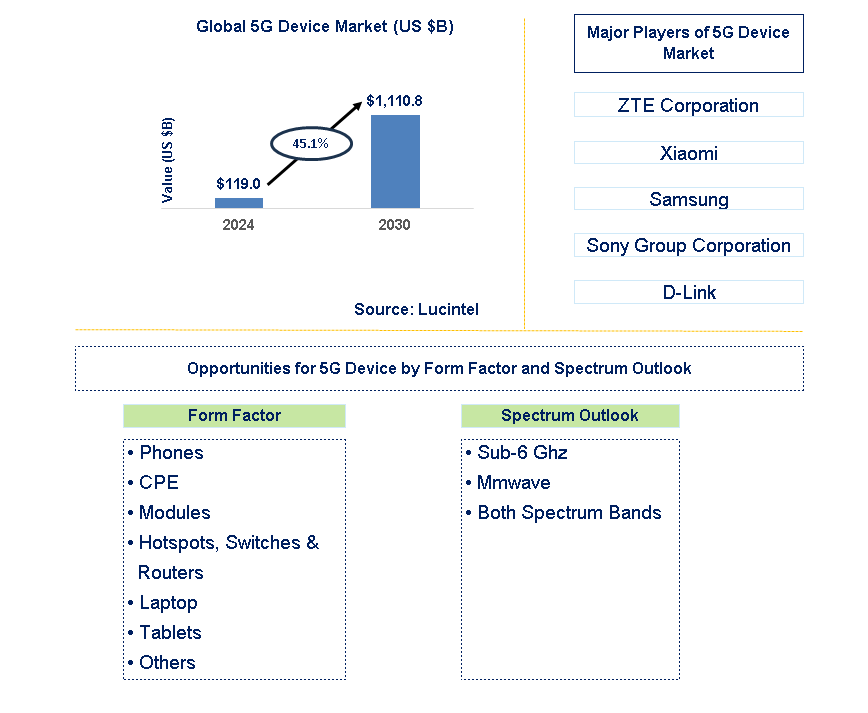
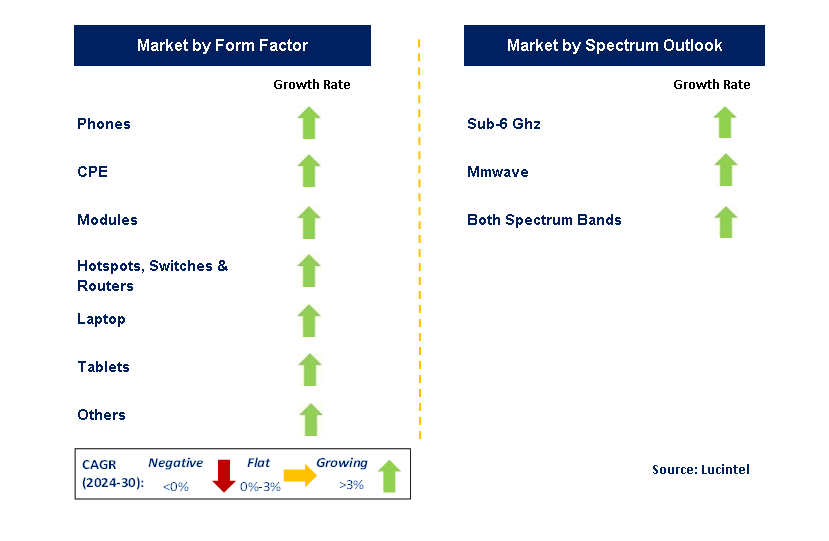
The future of the global 5G device market looks promising with opportunities in the sub-6 ghz, mmwave, and both spectrum bands markets. The global 5G device market is expected to reach an estimated $1,110.8 billion by 2030 with a CAGR of 45.1% from 2024 to 2030. The major drivers for this market are growing demand from customers for fast internet, rising data requirements for streaming and gaming drives, and growth of internet of things devices and the need for uninterrupted connectivity for applications utilizing augmented and virtual reality.• Lucintel forecasts that, within the form factor category, phones will remain the largest segment over the forecast period.
• Within the spectrum outlook category, sub-6 ghz will remain the largest segment because it provides a fair combination of capacity and coverage, and this indicates that devices using this frequency range are appropriate for both urban and rural settings since they may offer excellent data speeds together with wide area coverage.
• In terms of regions, APAC will remain the largest region over the forecast period due to rising urbanization and smartphone usage, as well as, customers are keen to take advantage of 5G networks' high-speed capabilities in the region.
Gain valuable insights for your business decisions with our comprehensive 150+ page report.
Emerging Trends in the 5G Device Market
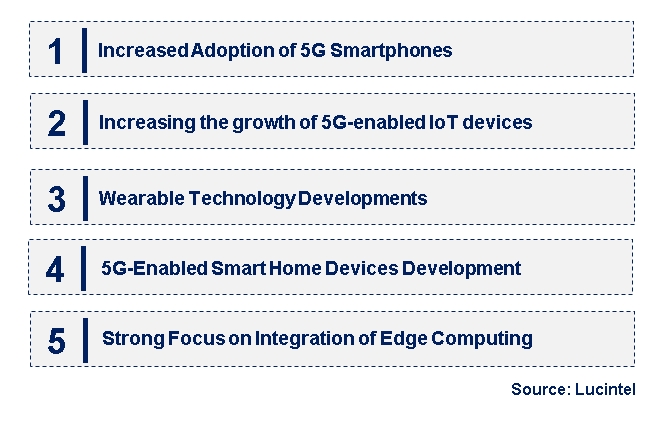
The emerging trends in the 5G device market are closely aligned with how technology continues to evolve in response to the changing needs of consumers and industries. These trends shape the landscape, drive innovation, and expand the use of 5G technology in many aspects of life.• Increased adoption of 5G smartphones: Another major trend in the 5G device market is the proliferation of 5G smartphones. Every major smartphone maker is launching a range of 5G-enabled smartphones, most of which feature advanced processing speeds and improved connectivity. This trend is driven by consumer demand for high-speed internet, along with the expansion of 5G networks into new areas. The increased availability and more affordable 5G smartphones are accelerating the migration from 4G to 5G, leading to wider diffusion and integration of 5G technology.
• Growth of 5G-enabled IoT devices: The growing penetration of 5G-enabled IoT devices will spur innovation and growth in industries such as smart cities, healthcare, and manufacturing. Moreover, 5G will enhance the performance of IoT devices by providing low latency, high speed, and the ability to process data in real time. This will enable more sophisticated applications, including smart grids, remote healthcare, and autonomous vehicles. The growth of 5G networks will support the expansion of IoT ecosystems and drive innovation in connected devices.
• Developments in wearable technology: Wearables are increasingly being equipped with 5G functionality, offering better connectivity and performance. Even a smartwatch or fitness tracker will benefit from 5G, allowing real-time health tracking, easy communication, and location services. Consumer interest in health and fitness, combined with the desire for always-connected devices, fuels this trend. The integration of 5G technology into wearables will extend their functionality and appeal, making them more popular and widespread.
• Development of 5G-enabled smart home devices: The market for 5G-enabled smart home devices is expanding rapidly as consumers seek more connectivity and automation in their homes. Smart thermostats, security cameras, and lighting are among the devices that are increasingly incorporating 5G capabilities for better performance and integration with other smart home technologies. This trend is driven by growing interest in home automation and the need for secure, high-speed connectivity. The adoption of 5G in smart home devices will create opportunities for further development of connected and functional home environments.
• Strong focus on integrating edge computing: The integration of edge computing with 5G-enabled devices is emerging as a major trend that will continuously improve application performance by supporting real-time data processing. Edge computing allows data to be processed closer to the source, reducing latency and improving the efficiency of 5G networks. This trend is particularly relevant for applications like augmented reality, autonomous vehicles, and industrial automation. By embedding edge computing with 5G technology, devices will perform faster and more reliably, enabling the growth of more advanced applications and services.
The rising trends in the 5G device market include an increase in 5G smartphones, growth in IoT devices, advancements in wearables, development of smart home technologies, and a focus on edge computing. These trends drive innovation, expand applications, and extend capabilities across industries. They are expected to continue evolving, shaping the future of 5G technology and its applications in both consumer and industrial sectors.
Recent Developments in the 5G Device Market
Advancements in the 5G device market indicate developments in technology, greater adoption by consumers, and the emergence of new applications. These developments influence market growth and evolution, while also highlighting key players and innovations driving the industry forward.• Affordable 5G smartphones: Major manufacturers like Xiaomi and Samsung have launched several 5G-enabled smartphones in the affordable segment. This has made 5G more accessible to a larger number of consumers. Cost-effective devices from these companies are accelerating 5G adoption and extending it to more people. Affordable 5G smartphones are boosting market growth and encouraging broader acceptance of 5G technology.
• Integration of 5G into wearable devices: Wearable devices, from smartwatches to fitness trackers, have gained popularity with the integration of 5G technology. As technology improves, companies like Apple and Fitbit are upgrading their wearables with 5G to ensure real-time health monitoring and seamless connectivity. This development broadens the functionality and appeal of wearable technology, driving greater consumer interest and adoption in the 5G device market.
• Advancements in 5G-enabled IoT solutions: The development of 5G-based IoT solutions is accelerating, especially in applications such as smart cities, industrial automation, and healthcare. Companies are launching IoT devices that leverage 5G's low latency and high-speed connectivity for real-time data processing and enhanced performance. This is driving further innovation and expanding the range of IoT device applications, which in turn increases the 5G device market.
• Expansion of 5G network infrastructure: The development of 5G network infrastructure has opened up opportunities for 5G devices. Large investments by major telecom operators in deploying 5G networks are driving the availability and adoption of 5G devices. Improved network coverage and capacity are boosting the proliferation of 5G smartphones, IoT devices, and other connected technologies, driving growth in the overall 5G device market.
• Introduction of advanced 5G router solutions: The introduction of advanced 5G routers for homes and businesses is meeting the demand for high-speed internet. Companies are producing high-performance 5G routers that offer faster and more reliable internet access. These solutions support seamless connectivity for a wide range of applications and contribute to the growing 5G device ecosystem.
Recent developments in the 5G device market—such as affordable 5G smartphones, wearables integrated with 5G, advanced IoT solutions, expanded network infrastructure, and new 5G routers—are significantly impacting the industry. These factors are fueling market growth by expanding the range of applications and enhancing the capabilities of 5G technology.
Strategic Growth Opportunities for 5G Device Market
The rapid evolution of the 5G device market—technological advancements and increasing demand across various applications—presents abundant opportunities for growth. This dynamic environment creates new use cases and applications, providing avenues for manufacturers to capitalize on emergent trends and meet the evolving needs of consumers.• Smart cities: The adoption of 5G technology in smart cities offers significant growth opportunities for 5G devices. Smart cities use 5G to enhance infrastructure, public services, and urban solutions, such as intelligent traffic management and environmental monitoring. Devices like smart sensors, connected traffic lights, and surveillance systems are essential. Integrating 5G enables real-time data processing and enhances connectivity, driving efficiency and innovation within cities. Investment in smart city projects is on the rise worldwide, reflecting this growth potential.
• Healthcare: 5G devices are transforming patient care and medical operations. Key opportunities in healthcare include telemedicine, remote patient monitoring, and connected medical devices. Low latency and high bandwidth enable high-quality video consultations, real-time health data transmission, and advanced diagnostics. As wearable health devices and remote surgical systems continue to emerge, there is a growing demand for 5G-enabled solutions that enable more accurate and timely medical interventions. This is becoming increasingly critical as healthcare systems aim to improve accessibility and efficiency.
• Automotive industry: The automotive sector presents significant growth opportunities for 5G devices, particularly with the rise of autonomous vehicle development and connected car technologies. 5G enables Vehicle-to-Everything (V2X) communication, allowing vehicles to communicate with infrastructure, other vehicles, and even pedestrians. This enhances safety, navigation, and entertainment systems. As the push for autonomous driving and smarter transportation solutions grows, 5G-enabled automotive devices are becoming crucial in the development of next-generation vehicles.
• Industrial automation: Industrial automation is a major use case for 5G technology. Low-latency connectivity and control are driving smart manufacturing and Industry 4.0. Examples of 5G devices in industry include smart sensors, robotics, and real-time monitoring systems. Advanced connectivity supports predictive maintenance, automated production lines, and supply chain management. This enhances operational efficiency, reduces costs, and promotes wider adoption of 5G devices in industrial settings.
• Entertainment and media: 5G technology is creating new possibilities in entertainment and media, from high-definition video streaming to immersive virtual and augmented reality applications. 5G enables the seamless transmission of high-quality content with low latency, supporting interactive gaming and other media formats. Increased consumer demand for digital experiences is driving the need for 5G-enabled devices that support high-bandwidth applications.
Key growth areas for the 5G device market include smart cities, healthcare, automotive, industrial automation, and entertainment. In each of these sectors, 5G provides the foundation for innovation and adoption of new technologies. These growth opportunities are transforming the landscape and creating new possibilities for investment and development in the industry.
5G Device Market Driver and Challenges
Technological, economic, and regulatory factors shape the trajectory of the 5G device market. Understanding the key drivers and challenges is crucial as stakeholders navigate the evolving landscape and seize opportunities within the 5G ecosystem.The factors responsible for driving the 5G device market include:
• Technological advancements: Rapid developments in 5G technology are driving the introduction of new and improved devices. Innovations in chipsets, antenna technologies, and network architecture are boosting device performance in terms of speed and connectivity. The adoption of cutting-edge 5G technologies is enabling manufacturers to create more efficient and capable devices, driving market growth and diversifying applications across industries.
• Growing need for high-speed connectivity: The demand for high-speed internet and seamless connectivity is a major driver of 5G device adoption. Applications like streaming, gaming, and industrial automation are creating substantial demand for faster data transfer rates, low latency, and more reliable networks. This demand is accelerating the development and deployment of 5G devices, fueling market growth.
• Expansion of 5G networks: The global expansion of 5G networks is a primary driver for the 5G device market. As 5G infrastructure expands worldwide, more networks will support the adoption of 5G-enabled devices. Improved coverage and network capacity will further enable the growth of advanced devices, broadening market adoption.
Challenges in the 5G device market include:
• High deployment costs: The deployment of 5G infrastructure and devices is costly, which can hinder profitability. Investments in network equipment, spectrum licenses, and device development are typically high. This could slow the pace of deployment and increase the cost of 5G devices, potentially limiting market growth.
• Regulatory and standardization issues: Variations in regional regulations and delays in global standardization may introduce uncertainties and raise entry barriers. These challenges could delay the deployment of 5G networks and limit the availability of compatible devices. Addressing these regulatory issues will be essential for market stability.
• Security and privacy concerns: Security and privacy issues related to 5G networks and devices could hinder adoption. As 5G networks handle massive amounts of data, the risk of cyberattacks and data breaches increases. Addressing these concerns is critical for gaining trust in 5G technology.
Key drivers of the 5G device market include technological advancements, growing demand for high-speed connectivity, and expanding 5G networks. However, challenges such as high deployment costs, regulatory issues, and security concerns must be addressed to ensure the continued growth of the market. By understanding these drivers and challenges, stakeholders will be better positioned to capitalize on opportunities and foster innovation in the 5G device marketplace.
List of 5G Device Companies
Companies in the market compete on the basis of product quality offered. Major players in this market focus on expanding their manufacturing facilities, R&D investments, infrastructural development, and leverage integration opportunities across the value chain. Through these strategies 5G device companies cater increasing demand, ensure competitive effectiveness, develop innovative products & technologies, reduce production costs, and expand their customer base. Some of the 5G device companies profiled in this report include-• ZTE Corporation
• Xiaomi
• Samsung
• Sony Group Corporation
• D-Link
• Huawei
• Nokia Corporation
• Fibocom Wireless
• MediaTek
• HTC Corporation
5G Device by Segment
The study includes a forecast for the global 5G device by form factor, spectrum outlook, and region.5G Device Market by Form Factor [Analysis by Value from 2018 to 2030]:
• Phones
• CPE
• Modules
• Hotspots, Switches & Routers
• Laptop
• Tablets
• Others
5G Device Market by Spectrum Outlook [Analysis by Value from 2018 to 2030]:
• Sub-6 Ghz
• Mmwave
• Both Spectrum Bands
5G Device Market by Region [Analysis by Value from 2018 to 2030]:
• North America
• Europe
• Asia Pacific
• The Rest of the World
Country Wise Outlook for the 5G Device Market
The rapid developments in the 5G device market are being recorded across various regions through technological innovation and increased demand for high-speed connectivity. These developments are shaping both consumer and industrial sectors. The adoption of 5G technology is accelerating as leading manufacturers release new devices that tap into its potential. Regional markets are pursuing unique strategies that contribute to the global trend in the 5G device industry.• United States: The 5G device market is driven by fast innovation and widespread adoption in the United States. Major carriers, such as Verizon, AT&T, and T-Mobile, are expanding their 5G infrastructure with a wide range of devices, from smartphones and tablets to IoT devices. Companies like Apple, Samsung, and Qualcomm lead the way with advancements in connectivity, speed, and power efficiency. The demand for 5G-enabled wearables and smart home devices is also growing rapidly in the U.S.
• China: China has emerged as a leader in 5G device deployment, with major technology companies, including Huawei and Xiaomi, making significant investments. The rapid rollout of 5G networks and the availability of 5G smartphones and IoT devices have contributed to market saturation. Huawei's extensive portfolio of 5G devices, such as smartphones, routers, and industrial IoT solutions, underscores China’s push for technological dominance. Supportive government policies, including subsidies and infrastructure investments, further accelerate 5G adoption.
• Germany: The demand for 5G devices in Germany is growing steadily, driven by companies like Siemens and Bosch adopting 5G for industrial applications. 5G smartphones and tablets are becoming more affordable from vendors like Nokia and Ericsson. Germany’s focus on Industry 4.0 has increased the demand for 5G-enabled smart sensors and automation machinery. The German government is also investing in 5G infrastructure to support wider adoption and innovation in the 5G device sector.
• India: India’s 5G device market is nascent but growing rapidly, particularly with the support of telecom operators like Reliance Jio and Airtel. While 5G infrastructure deployment is still in the early stages, affordable 5G smartphones from companies like Xiaomi and Samsung are gaining traction. Government initiatives and partnerships with international technology firms will further accelerate the deployment and adoption of 5G devices in the country.
• Japan: Japan is a leader in the 5G device market, with major telecommunications companies like NTT Docomo and SoftBank driving innovation. The country has a strong demand for 5G smartphones and IoT devices, with key manufacturers like Sony and NEC playing an important role. Japan’s focus on smart cities and industrial automation is fueling increased demand for 5G-enabled devices in advanced applications, such as autonomous vehicles and smart infrastructure. Government investments in 5G technology and infrastructure are further accelerating market growth.

Features of the Global 5G Device Market
Market Size Estimates: 5G device market size estimation in terms of value ($B).Trend and Forecast Analysis: Market trends (2018 to 2023) and forecast (2024 to 2030) by various segments and regions.
Segmentation Analysis: 5G device market size by form factor, spectrum outlook, and region in terms of value ($B).
Regional Analysis: 5G device market breakdown by North America, Europe, Asia Pacific, and Rest of the World.
Growth Opportunities: Analysis of growth opportunities in different form factor, spectrum outlook, and regions for the 5G device market.
Strategic Analysis: This includes M&A, new product development, and competitive landscape of the 5G device market.
Analysis of competitive intensity of the industry based on Porter’s Five Forces model.
If you are looking to expand your business in this market or adjacent markets, then contact us. We have done hundreds of strategic consulting projects in market entry, opportunity screening, due diligence, supply chain analysis, M & A, and more.

FAQ
Q1. What is the 5G device market size?Answer: The global 5G device market is expected to reach an estimated $1,110.8 billion by 2030.
Q2. What is the growth forecast for 5G device market?
Answer: The global 5G device market is expected to grow with a CAGR of 45.1% from 2024 to 2030.
Q3. What are the major drivers influencing the growth of the 5G device market?
Answer: The major drivers for this market are growing demand from customers for fast internet, rising data requirements for streaming and gaming drives and growth of internet of things devices and the need for uninterrupted connectivity for applications utilizing augmented and virtual reality.
Q4. What are the major segments for 5G device market?
Answer: The future of the 5G device market looks promising with opportunities in the sub-6 ghz, mmwave, and both spectrum bands markets.
Q5. Who are the key 5G device market companies?
Answer: Some of the key 5G device companies are as follows:
• ZTE Corporation
• Xiaomi
• Samsung
• Sony Group Corporation
• D-Link
• Huawei
• Nokia Corporation
• Fibocom Wireless
• MediaTek
• HTC Corporation
Q6. Which 5G device market segment will be the largest in future?Answer: Lucintel forecasts that phones will remain the largest segment over the forecast period.
Q7. In 5G device market, which region is expected to be the largest in next 5 years?
Answer: APAC will remain the largest region over the forecast period due to rising urbanization and smartphone usage, as well as, customers are keen to take advantage of 5G networks' high-speed capabilities in the region.
Q.8 Do we receive customization in this report?
Answer: Yes, Lucintel provides 10% customization without any additional cost.
Table of Contents
Methodology
- In-depth interviews of the major players in this market
- Detailed secondary research from competitors’ financial statements and published data
- Extensive searches of published works, market, and database information pertaining to industry news, company press releases, and customer intentions
- A compilation of the experiences, judgments, and insights of Lucintel’s professionals, who have analyzed and tracked this market over the years.


Buy Now
Choose a license that fits your team. Instant PDF delivery.
Prices exclude taxes. Instant delivery. Custom licensing available on request.
Key Questions
- • What are some of the most promising, high-growth opportunities for the 5G device market by form factor (phones, CPE, modules, hotspots, switches & routers, laptop, tablets, and others), spectrum outlook (sub-6 ghz, mmwave, and both spectrum bands), and region (North America, Europe, Asia Pacific, and the Rest of the World)?
- • Which segments will grow at a faster pace and why?
- • Which region will grow at a faster pace and why?
- • What are the key factors affecting market dynamics? What are the key challenges and business risks in this market?
- • What are the business risks and competitive threats in this market?
- • What are the emerging trends in this market and the reasons behind them?
- • What are some of the changing demands of customers in the market?
- • What are the new developments in the market? Which companies are leading these developments?
- • Who are the major players in this market? What strategic initiatives are key players pursuing for business growth?
- • What are some of the competing products in this market and how big of a threat do they pose for loss of market share by material or product substitution?
- • What M&A activity has occurred in the last 5 years and what has its impact been on the industry? For any questions related to 5G Device Market, 5G Device Market Size, 5G Device Market Growth, 5G Device Market Analysis, 5G Device Market Report, 5G Device Market Share, 5G Device Market Trends, 5G Device Market Forecast, 5G Device Companies, write Lucintel analyst at email: helpdesk@lucintel.com. We will be glad to get back to you soon.


