
Report Feature
AR Spine Surgery Navigation System Market Trends and Forecast
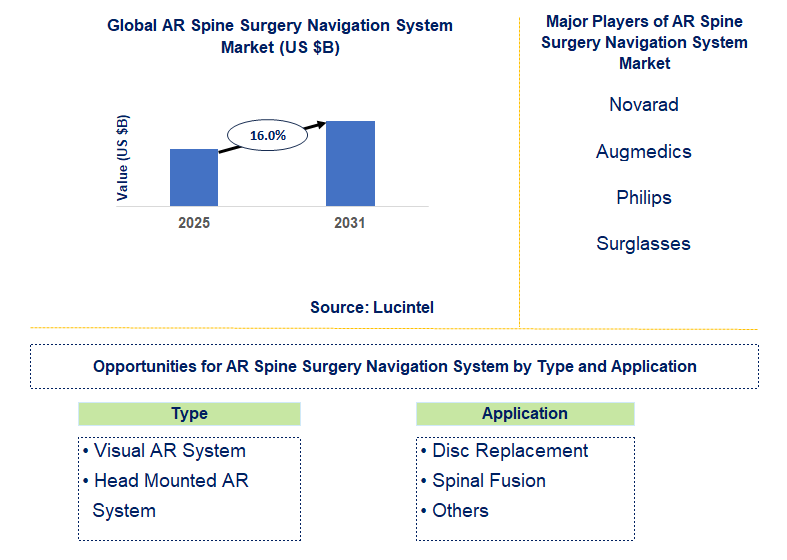
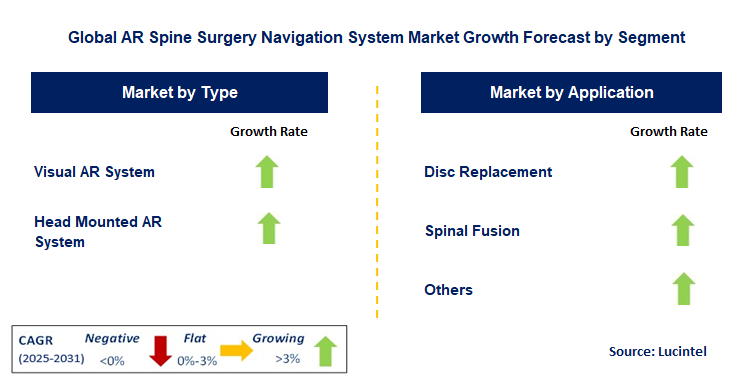
The future of the global ar spine surgery navigation system market looks promising with opportunities in the disc replacement and spinal fusion markets. The global ar spine surgery navigation system market is expected to grow with a CAGR of 16% from 2025 to 2031. The major drivers for this market are the increasing demand for minimally invasive spine surgeries, the rising adoption of augmented reality in healthcare, and the growing need for precision in spinal procedures.• Lucintel forecasts that, within the type category, head mounted AR system is expected to witness higher growth over the forecast period.
• Within the application category, spinal fusion is expected to witness higher growth.
• In terms of region, APAC is expected to witness the highest growth over the forecast period. Gain valuable insights for your business decisions with our comprehensive 150+ page report. Sample figures with some insights are shown below.
Emerging Trends in the AR Spine Surgery Navigation System Market
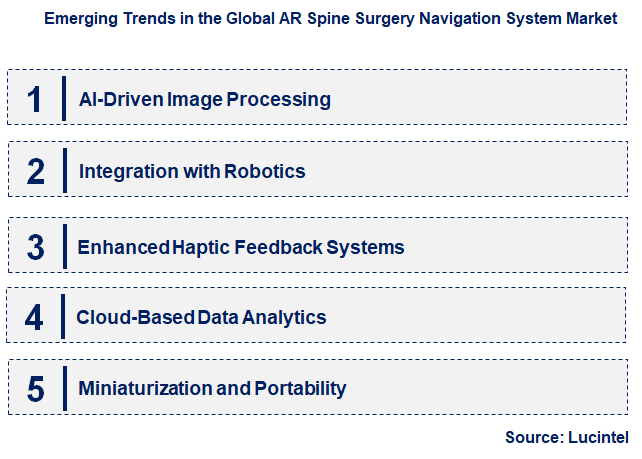
The AR spine surgery navigation system market is being reshaped by emerging trends that are pushing the boundaries of surgical precision and safety. These trends are moving beyond simple visualization to create a highly interactive, intelligent, and integrated surgical environment. They are driven by a need to improve patient outcomes, enhance surgeon performance, and streamline complex procedures.• AI-Driven Image Processing: This trend involves using artificial intelligence to analyze preoperative and intraoperative images. AI algorithms can enhance image clarity, automatically segment anatomical structures, and provide real-time guidance. The impact is a significant increase in surgical accuracy and efficiency. This technology helps surgeons identify critical structures with greater precision, reducing the risk of nerve or vessel damage.
• Integration with Robotics: This trend focuses on combining AR navigation with robotic surgical systems. The AR system provides the surgeon with a visual overlay, while the robotic arm executes the pre-planned movements with sub-millimeter precision. The impact is a highly synergistic system that reduces human error and enhances the surgeon's control. It allows for more complex and less invasive procedures.
• Enhanced Haptic Feedback Systems: This trend involves adding a sense of touch to the AR experience. The system provides haptic feedback to the surgeon's instruments to indicate proximity to critical structures or to guide them along a pre-planned trajectory. The impact is an additional layer of safety and precision. It allows surgeons to feel and react to the anatomy even when it is obscured from their direct view.
• Cloud-Based Data Analytics: This trend involves using cloud platforms to collect and analyze surgical data from multiple procedures. This data can be used to generate insights into surgical outcomes, identify best practices, and train new surgeons. The impact is a continuous improvement in surgical standards. It facilitates knowledge sharing and creates a learning ecosystem for the surgical community.
• Miniaturization and Portability: This trend is focused on developing smaller, more portable AR navigation systems. This makes the technology more accessible to a wider range of hospitals and surgical centers, including smaller clinics and ambulatory surgical centers. The impact is a democratization of advanced surgical technology, allowing more patients to benefit from AR-guided procedures outside of major medical centers. These trends are collectively reshaping the market by transforming AR spine navigation systems from a niche technology into a core component of modern surgical practice. The focus is shifting towards creating a complete, intelligent ecosystem that supports every aspect of the surgical workflow, from planning to post-operative analysis.
Recent Development in the AR Spine Surgery Navigation System Market
The AR spine surgery navigation system market is experiencing a series of recent developments that are significantly influencing its growth and adoption. These advancements are centered on improving the functionality, accessibility, and integration of these systems within the broader surgical ecosystem. The developments are making AR navigation a more practical and effective tool for surgeons worldwide.• FDA Approval for New Systems: The recent FDA clearance of several new AR spine navigation systems. These approvals validate the technology's safety and effectiveness. The impact is a major boost in market confidence and wider clinical adoption, as hospitals and surgeons are more willing to invest in and use approved, reliable technologies.
• Mergers and Acquisitions: The market is witnessing a trend of major medical device companies acquiring smaller AR technology startups. For example, Medtronic's acquisition of Medicrea and other strategic investments. The impact is a consolidation of technology and a faster path to market for innovative products, as established companies leverage their distribution networks and resources to scale up.
• Development of Hybrid Systems: Recent developments include the creation of hybrid systems that combine AR with other imaging modalities, such as fluoroscopy and CT. These systems provide a more comprehensive view of the surgical field. The impact is a more versatile and accurate tool for surgeons, reducing the need for multiple devices and streamlining the surgical workflow, leading to increased efficiency.
• Expansion of Training and Education: Major companies are now investing heavily in training programs and simulation platforms for surgeons. These programs use AR and VR to help surgeons become proficient with the new technology. The impact is a reduction in the learning curve for surgeons and a faster rate of adoption, which is critical for the growth and success of the market.
• Cloud Integration and Data Analytics: The development of cloud-based platforms that allow for real-time data collection and analysis is a key development. This enables surgeons to track and analyze their performance and outcomes. The impact is a move toward a more data-driven approach to surgery, which can lead to continuous improvement in surgical techniques and patient outcomes. These developments are collectively impacting the market by fostering a more mature and robust ecosystem. They are not only improving the technology itself but are also creating the necessary infrastructure for widespread adoption, including regulatory approval, training, and data-driven improvements.
Strategic Growth Opportunities in the AR Spine Surgery Navigation System Market
Strategic growth opportunities in the AR spine surgery navigation system market are emerging across key applications, driven by a global shift towards safer, more precise, and less invasive surgical procedures. These opportunities lie in targeting specific surgical segments and developing innovative solutions that address the unique challenges of each application.• Minimally Invasive Surgery: This is a significant growth opportunity as AR navigation is perfectly suited for MIS procedures. AR provides a clear, internal view without the large incisions of open surgery. The impact is a major boost in demand from surgeons performing MIS, leading to a new market segment focused on compact and highly precise AR systems tailored for this application.
• Complex Deformity and Scoliosis Surgery: This application offers a high-value opportunity, as complex spine cases require the highest level of precision. AR navigation systems can provide real-time guidance to correct deformities and place screws accurately. The impact is a premium market segment for advanced AR systems with sophisticated planning and tracking capabilities that cater to the most challenging surgical cases.
• Revision Surgery: Revision surgery is a challenging application with a high risk of complications due to altered anatomy. AR navigation can help surgeons visualize previous implants and scar tissue more clearly. The impact is a growth opportunity in providing solutions that improve safety and outcomes in complex re-operations, a segment where precision is paramount and error-reduction is critical.
• Ambulatory Surgery Centers: The trend of moving less complex spine surgeries to outpatient settings creates a growth opportunity. AR systems for ASCs must be affordable, easy to set up, and portable. The impact is a democratization of advanced technology, making it accessible to a wider range of facilities and driving market growth outside of major hospitals.
• Training and Simulation: The opportunity lies in providing not just the hardware and software but a complete training solution. Developing AR-based simulators and training modules allows surgeons to practice without patient risk. The impact is a new revenue stream and a way for companies to build strong relationships with the next generation of surgeons, fostering long-term brand loyalty. These opportunities are impacting the market by encouraging diversification and specialization. Companies are now able to target specific surgical applications with tailored products, leading to a more segmented and competitive market that better serves the distinct needs of surgeons and patients.
AR Spine Surgery Navigation System Market Driver and Challenges
The AR spine surgery navigation system market is influenced by a dynamic interplay of key drivers and challenges, which include various technological, economic, and regulatory factors. Understanding these forces is essential for market participants to develop effective strategies and maintain a competitive edge. The market's trajectory is shaped by factors that both foster growth and create significant obstacles. The factors responsible for driving the AR spine surgery navigation system market include: 1. Growing Demand for Minimally Invasive Surgery: The increasing preference for less invasive surgical procedures is a primary driver. AR navigation systems enhance the surgeon's ability to perform these procedures with greater precision and confidence. This reduces patient trauma, shortens recovery times, and makes spine surgery more accessible and appealing to a wider patient base. 2. Need for Enhanced Surgical Precision: Spine surgery is inherently complex and carries a high risk of complications. AR navigation provides real-time, high-fidelity anatomical visualization, which drastically improves screw placement accuracy. This enhanced precision is a major driver, as it directly leads to better patient outcomes and reduces the need for revision surgeries. 3. Technological Advancements: Continuous innovation in augmented reality, artificial intelligence, and imaging technology is a major driver. These advancements result in more intuitive, accurate, and user-friendly systems. The development of AI-driven tools for surgical planning and execution further fuels market growth by providing surgeons with more intelligent and effective tools. 4. Reduced Radiation Exposure: Traditional spine surgery often relies on fluoroscopy, which exposes both the patient and the surgical team to radiation. AR navigation systems can reduce or eliminate the need for repeated X-rays. This is a powerful driver as it aligns with modern safety protocols and is a key selling point for hospitals and surgeons. 5. Rising Prevalence of Spinal Disorders: The global increase in spinal conditions, such as degenerative disc disease and scoliosis, driven by an aging population and sedentary lifestyles, is a significant market driver. This growing patient pool requires effective and safe surgical solutions, creating a consistent and expanding market for AR navigation systems. Challenges in the AR spine surgery navigation system market are: 1. High Cost of Systems: The initial acquisition cost of AR spine navigation systems is very high. This is a significant barrier for many hospitals, especially in developing countries or smaller surgical centers with limited budgets. The high cost of the systems and associated maintenance can slow down market penetration and adoption. 2. Steep Learning Curve: While AR systems are designed to be intuitive, there is still a significant learning curve for surgeons to become proficient with the technology. Proper training is required, which adds to the cost and time commitment for healthcare providers. This can be a deterrent for busy surgeons and may limit the rate of adoption. 3. Regulatory Hurdles: The market is subject to a complex and stringent regulatory landscape. Gaining approval for new devices is a lengthy, expensive, and uncertain process. This is a major challenge for manufacturers, as it can delay product launches and stifle innovation. Navigating different regulations across various countries adds further complexity. The overall impact of these drivers and challenges is a market that is dynamic and complex. While powerful drivers like technological innovation and the demand for better surgical outcomes are propelling growth, significant challenges related to cost, training, and regulation are creating a more deliberate adoption cycle. Successfully addressing these challenges will be key for the market to reach its full potential.List of AR Spine Surgery Navigation System Companies
Companies in the market compete on the basis of product quality offered. Major players in this market focus on expanding their manufacturing facilities, R&D investments, infrastructural development, and leverage integration opportunities across the value chain. With these strategies ar spine surgery navigation system companies cater increasing demand, ensure competitive effectiveness, develop innovative products & technologies, reduce production costs, and expand their customer base. Some of the ar spine surgery navigation system companies profiled in this report include-• Novarad
• Augmedics
• Philips
• Surglasses
AR Spine Surgery Navigation System Market by Segment
The study includes a forecast for the global ar spine surgery navigation system market by type, application, and region.AR Spine Surgery Navigation System Market by Type [Value from 2019 to 2031]:
• Visual AR System
• Head Mounted AR System
AR Spine Surgery Navigation System Market by Application [Value from 2019 to 2031]:
• Disc Replacement
• Spinal Fusion
• Others
AR Spine Surgery Navigation System Market by Region [Value from 2019 to 2031]:
• North America
• Europe
• Asia Pacific
• The Rest of the World
Country Wise Outlook for the AR Spine Surgery Navigation System Market
Recent developments in the AR spine surgery navigation system market are driven by the urgent need for enhanced precision and safety in complex spinal procedures. These advancements are focused on integrating cutting-edge technologies like augmented reality, artificial intelligence, and robotics to provide surgeons with real-time, high-fidelity anatomical guidance. This evolution aims to improve surgical outcomes, reduce radiation exposure, and shorten recovery times for patients.• United States: The U.S. market is leading in the adoption of AR spine navigation systems due to a robust healthcare infrastructure and a high prevalence of spinal disorders. Key developments include FDA-approved systems with AI-driven image enhancement and advanced intraoperative tracking. The market is also seeing a rise in strategic partnerships and collaborations to accelerate technological innovation.
• China: The Chinese market is experiencing rapid growth, fueled by increasing healthcare investments and a large patient pool. Recent developments are centered on the domestic production of more affordable AR navigation systems to reduce reliance on imports. There is a strong government push for technological self-sufficiency, leading to local manufacturers introducing systems tailored to regional healthcare needs.
• Germany: Germany's market is characterized by a focus on high-quality, precision-engineered AR systems. Recent advancements include the integration of AR with robotic-assisted surgery, providing a seamless workflow that combines the precision of robotics with the visualization of AR. The market is also seeing a push for systems with advanced data analytics to support research and clinical decision-making.
• India: The Indian market is witnessing significant developments with a focus on cost-effective AR solutions to improve surgical outcomes in a resource-constrained environment. A key development is the growing adoption of hybrid systems that combine traditional navigation with AR overlays. This makes advanced technology more accessible to a wider range of hospitals, both in urban and semi-urban settings.
• Japan: The Japanese market is distinguished by its emphasis on advanced robotics and miniaturization. Recent developments include the creation of highly compact and sophisticated AR systems that can be easily integrated into existing operating room setups. The market is also seeing a strong demand for AR systems that minimize the surgical footprint and reduce the risk of complications.

Features of the Global AR Spine Surgery Navigation System Market
Market Size Estimates: Ar spine surgery navigation system market size estimation in terms of value ($B). Trend and Forecast Analysis: Market trends (2019 to 2024) and forecast (2025 to 2031) by various segments and regions. Segmentation Analysis: Ar spine surgery navigation system market size by type, application, and region in terms of value ($B). Regional Analysis: Ar spine surgery navigation system market breakdown by North America, Europe, Asia Pacific, and Rest of the World. Growth Opportunities: Analysis of growth opportunities in different types, applications, and regions for the ar spine surgery navigation system market. Strategic Analysis: This includes M&A, new product development, and competitive landscape of the ar spine surgery navigation system market. Analysis of competitive intensity of the industry based on Porter’s Five Forces model.
FAQ
Q1. What is the growth forecast for ar spine surgery navigation system market? Answer: The global ar spine surgery navigation system market is expected to grow with a CAGR of 16% from 2025 to 2031. Q2. What are the major drivers influencing the growth of the ar spine surgery navigation system market? Answer: The major drivers for this market are the increasing demand for minimally invasive spine surgeries, the rising adoption of augmented reality in healthcare, and the growing need for precision in spinal procedures. Q3. What are the major segments for ar spine surgery navigation system market? Answer: The future of the ar spine surgery navigation system market looks promising with opportunities in the disc replacement and spinal fusion markets. Q4. Who are the key ar spine surgery navigation system market companies? Answer: Some of the key ar spine surgery navigation system companies are as follows:• Novarad
• Augmedics
• Philips
• Surglasses Q5. Which ar spine surgery navigation system market segment will be the largest in future? Answer: Lucintel forecasts that, within the type category, head mounted AR system is expected to witness higher growth over the forecast period. Q6. In ar spine surgery navigation system market, which region is expected to be the largest in next 5 years? Answer: In terms of region, APAC is expected to witness the highest growth over the forecast period. Q7. Do we receive customization in this report? Answer: Yes, Lucintel provides 10% customization without any additional cost.
Table of Contents
Methodology
- In-depth interviews of the major players in this market
- Detailed secondary research from competitors’ financial statements and published data
- Extensive searches of published works, market, and database information pertaining to industry news, company press releases, and customer intentions
- A compilation of the experiences, judgments, and insights of Lucintel’s professionals, who have analyzed and tracked this market over the years.


Buy Now
Choose a license that fits your team. Instant PDF delivery.
Prices exclude taxes. Instant delivery. Custom licensing available on request.
Key Questions
- • What are some of the most promising, high-growth opportunities for the ar spine surgery navigation system market by type (visual AR system and head mounted AR system), application (disc replacement, spinal fusion, and others), and region (North America, Europe, Asia Pacific, and the Rest of the World)?
- • Which segments will grow at a faster pace and why?
- • Which region will grow at a faster pace and why?
- • What are the key factors affecting market dynamics? What are the key challenges and business risks in this market?
- • What are the business risks and competitive threats in this market?
- • What are the emerging trends in this market and the reasons behind them?
- • What are some of the changing demands of customers in the market?
- • What are the new developments in the market? Which companies are leading these developments?
- • Who are the major players in this market? What strategic initiatives are key players pursuing for business growth?
- • What are some of the competing products in this market and how big of a threat do they pose for loss of market share by material or product substitution?
- • What M&A activity has occurred in the last 5 years and what has its impact been on the industry? For any questions related to AR Spine Surgery Navigation System Market, AR Spine Surgery Navigation System Market Size, AR Spine Surgery Navigation System Market Growth, AR Spine Surgery Navigation System Market Analysis, AR Spine Surgery Navigation System Market Report, AR Spine Surgery Navigation System Market Share, AR Spine Surgery Navigation System Market Trends, AR Spine Surgery Navigation System Market Forecast, AR Spine Surgery Navigation System Companies, write Lucintel analyst at email: helpdesk@lucintel.com. We will be glad to get back to you soon.


