
Report Feature
Aquaculture Equipment Market Trends and Forecast
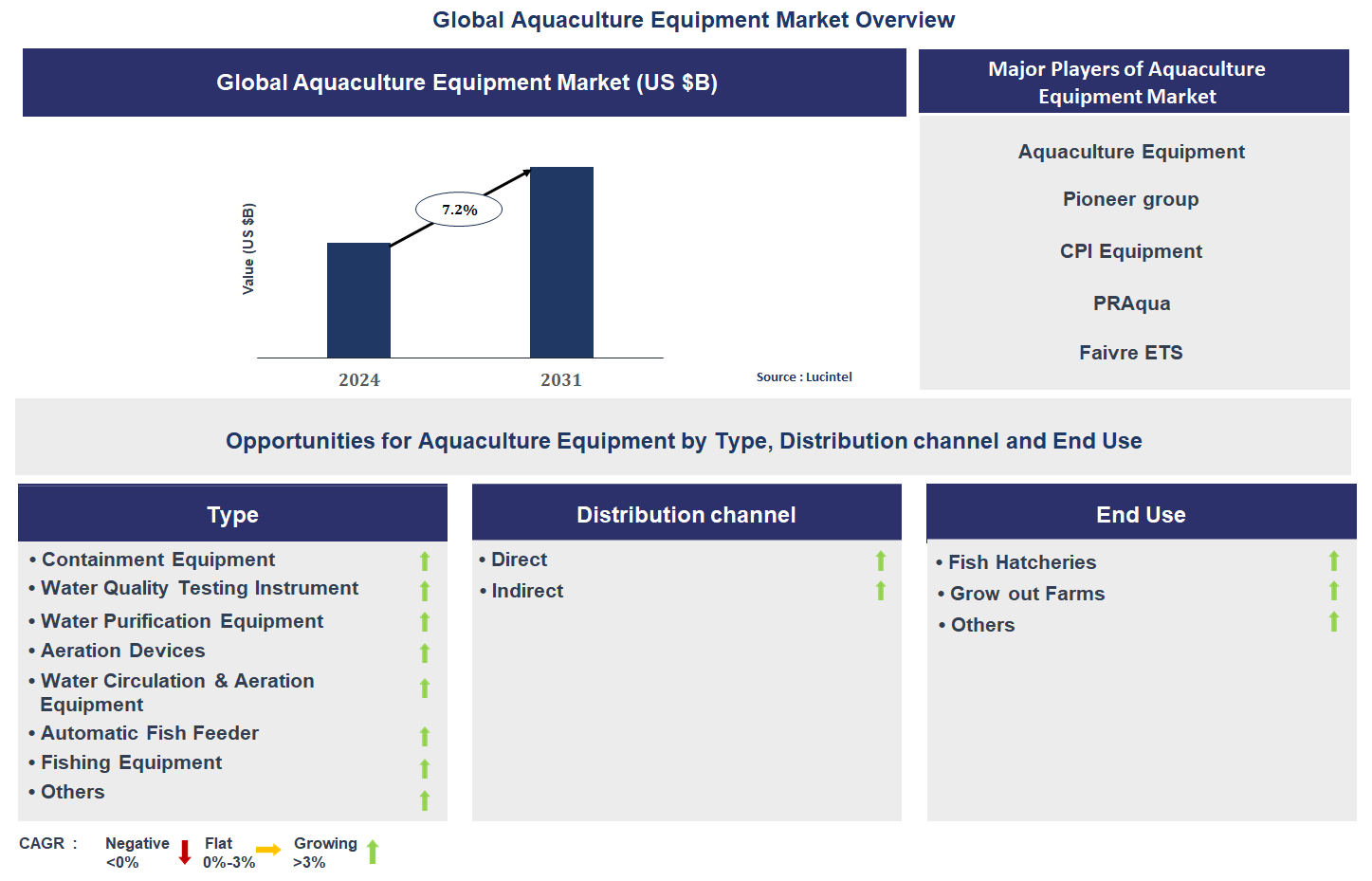
The future of the global aquaculture equipment market looks promising with opportunities in the containment equipment, water quality testing instrument, water purification equipment, aeration device, water circulation & aeration equipment, automatic fish feeder, and fishing equipment markets. The global aquaculture equipment market is expected to grow with a CAGR of 7.2% from 2025 to 2031. The major drivers for this market are the increasing demand for sustainable aquaculture practices, the rising adoption of automation in aquaculture, and the growing focus on fish health management.• Lucintel forecasts that, within the end use category, grow out farm is expected to witness higher growth over the forecast period.
• Within the type category, water purification equipment is expected to witness the highest growth.
• In terms of region, APAC is expected to witness the highest growth over the forecast period. Gain valuable insights for your business decisions with our comprehensive 150+ page report. Sample figures with some insights are shown below.
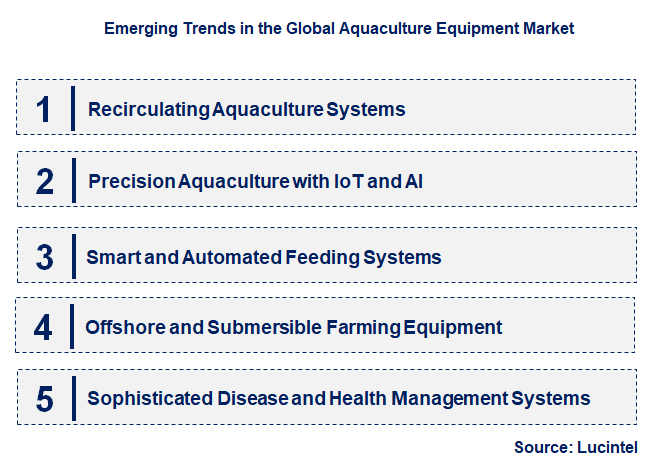
Emerging Trends in the Aquaculture Equipment Market
The aquaculture equipment industry is being influenced by a number of emerging trends that are evolving the business into a modern, high-tech, data-based industry from the conventional practice that it was. The trends are a response to global issues such as climate change, food security, and environmental sustainability. The trends signify a paradigm shift in aquatic organism farming towards more managed, efficient, and sustainable systems. The use of new technologies and techniques is not only enhancing productivity but also transforming the whole seafood production value chain.• Recirculating Aquaculture Systems: The movement towards Recirculating Aquaculture Systems is one of the most promising. RAS technology recycles and cleans water in a closed system, and farming can be done anywhere, without dependence on proximity to a water body. Such gear consists of advanced filters, pumps, oxygenators, and water treatment systems. The effect is a more sustainable and bio secure aquaculture. RAS minimizes water consumption and chance of disease outbreaks, while also excluding the discharge of waste into natural ecosystems, which is a significant environmental advantage.
• Precision Aquaculture with IoT and AI: Utilization of the Internet of Things (IoT) and artificial intelligence (AI) is establishing the trend of precision aquaculture. It entails installing a network of sensors for real-time monitoring of water quality, temperature, and fish behavior. AI algorithms interpret this information to decide on optimal feeding schedules and identify early disease signs. The result is a tremendous reduction in efficiency and yield improvement.
• Smart and Automated Feeding Systems: One of the major market trends is the creation of smart and automated feeding systems. These involve sensors and cameras that track the appetite and consumption of fish and release the exact amount of feed at the correct moment. Others employ AI to monitor the behavior of fish and make real-time adjustments in feeding. The effect is a considerable decrease in feed expense and environmental contamination. The primary cause of waste is overfeeding, and this can also deteriorate the quality of water. Automated systems eliminate this kind of waste, which ensures optimal utilization of each pellet of feed.
• Offshore and Submersible Farming Equipment: With increasingly congested coastal zones and overfishing, the practice of offshore and submersible aquaculture is on the rise. This implies the deployment of large, durable cages and feed lines that can better survive the harsh open-sea environment. Strategic opportunities include the design of proprietary mooring systems, remote monitoring devices, and underwater vehicle-based maintenance. The effect is an expansion of agriculture into new areas, which offers a scalable method to satisfy world seafood demand with reduced environmental impact on vulnerable coastal ecosystems.
• Sophisticated Disease and Health Management Systems: The movement toward sophisticated disease and health management systems is imperative in reducing economic losses and maintaining food safety. Sophisticated disease and health management systems comprise automated water quality analysis, disease detection sensors, and vaccination units. Some of these solutions apply imaging technology and artificial intelligence to observe single fish for stress or illness. The result is a more preventative and proactive fish health approach. By catching issues early, producers are able to avoid the need for antibiotics and other chemical treatments, resulting in healthier fish and a more sustainable product for consumers. These new trends collectively are redefining the aquaculture equipment market in terms of positioning it towards a more sustainable, high-tech, and future-oriented future that can address the multifaceted challenges of contemporary food production. The market is increasingly emphasizing offering holistic data-driven solutions rather than mere single pieces of equipment.
Recent Development in the Aquaculture Equipment Market
The aquaculture equipment market is a fast-moving sector, with an era of high technology and innovation underway. These technologies are prompted by an international movement towards greater sustainable and efficient food production, as well as for environmental issues to be addressed and fish to be healthier. The recent developments are concentrated on developing integrated, high-technology systems offering a holistic solution for aquaculture operations in the modern era.• Commercialization of Recirculating Aquaculture Systems (RAS): One of the most prominent developments is the mass commercialization of Recirculating Aquaculture Systems (RAS). This technology, previously a specialty solution, is now mainstream for freshwater and marine species. Improved affordability and energy efficiency of components like advanced biofilters and oxygen generators have made RAS an economically viable choice for a broader group of producers. The effect is a paradigm shift towards land-based, bio secure culture, which decreases dependence on conventional sea cages and reduces environmental risk.
• Integration of IoT and Sensor Technology: The integration of IoT and sensor technology into aquaculture equipment is a key development. Smart sensors can now be deployed to continuously monitor critical water parameters, such as dissolved oxygen, pH, and temperature. This data is transmitted to a central hub, allowing farmers to monitor conditions in real-time from anywhere in the world. The effect is enhanced operating efficiency and fewer manpower.
• Creation of AI-Based Feeding and Monitoring Systems: Another important development is the introduction of AI-based feeding and monitoring systems. Such systems employ underwater cameras and AI software to scan fish appetite and behavior. They can vary the amount and frequency of feed automatically so that there is minimal waste and maximum growth. The effect is a significant reduction in feed conversion rates and profitability. By avoiding overfeeding, these systems not only conserve money but also minimize the buildup of uneaten food, which can cause water pollution and disease.
• Development of Specialized Containment and Cage Systems: Development of specialized containment and cage systems is an important recent innovation. It involves the development of more robust, high-quality cage materials that can endure rough offshore environments and keep predators out. Closed-loop, semi-submersible cages, which create a seal against outside pollutants and pathogens, are also being developed. The effect is increased biosecurity and environmental protection. These new systems minimize the risk of escape of farmed fish into the environment and are more resistant to disease, which are major issues for the industry.
• Advances in Fish Processing and Handling Equipment: Recent advances also encompass new advances in fish handling and processing equipment. This includes the application of automation and robotics to sort, grade, and pack fish. New technology is being developed to be more delicate with the fish, minimizing stress and enhancing the quality of the end product. The effect is greater efficiency and a more humane method. Automation in this sector minimizes the role of manual labor, enhances uniformity, and allows the fish to be handled with care right from harvesting to the packaging level. These advancements are all having a combined effect on the aquaculture equipment market to produce a more high-tech, efficient, and sustainable industry. They are taking the industry in the direction of a technology-driven future in which technology is at the center of all phases of the farm operation, from hatchery through processing plant.
Strategic Growth Opportunities in the Aquaculture Equipment Market
The aquaculture equipment industry provides a wide range of strategic opportunity for growth in various major applications, fueled by the sector’s demand for greater productivity and sustainability. Those businesses that are able to produce and sell targeted equipment for these applications stand to gain huge success. The opportunities exist not only in conventional agriculture but also in new and upcoming industries, where technology advancements can be a competitive edge. It will be success based on the capacity to deliver customized solutions tailored to meet the individual challenges and objectives of various market segments.• Land-Based Aquaculture: Expansion of land-based aquaculture, especially with Recirculating Aquaculture Systems (RAS), is a huge strategic opportunity. Business can concentrate on producing and selling a complete range of equipment for such systems, from state-of-the-art water filtration units and oxygen generators to automated control systems. The effect is that it enables farmers to have a high-density, bio secure operation that delivers a consistent and reliable supply of fish irrespective of outside environmental conditions, hence a very appealing investment for an increasing market.
• Offshore Aquaculture: With coastal space being limited, offshore aquaculture offers a massive growth potential. The market requires specialized equipment that can handle the extreme conditions of open ocean environments. Strategic possibilities are constructing strong, big-scale submersible cages, remote monitoring sensors, and automation in feeding systems that may be controlled from a ground-based control center. The consequence is the extension of aquaculture into fresh, unexplored regions, essential for keeping up with growing global demand for seafood without putting coastal ecosystems under greater stress.
• Feed Management and Automation: Feed is among the highest expenses in aquaculture, providing a strategic opportunity for machinery that can maximize its use. The growth potential is in creating and selling smart feeding systems based on AI and sensors to track fish appetite and adjust feeding times in real time. The effect is that they can significantly minimize feed wastage, enhance feed conversion ratios, and decrease operating expenses. This is a compelling value proposition that has a direct relation to a farmer’s profitability and sustainability.
• Water Quality and Environmental Monitoring: Increased emphasis on environmental sustainability is opening up a strategic opportunity for equipment that monitors and controls water quality. These include dissolved oxygen, pH, and ammonia sensors, along with automated water treatment and filtration systems. The effect is that the equipment enables farmers to control the best water conditions, which is vital for fish health and growth. It also enables them to meet more stringent environmental regulations, which is one of the main market driving forces and a primary sales benefit.
• Disease Prevention and Health Management: Preventing disease outbreaks is a major challenge in aquaculture that presents a strategic opportunity for specialized equipment. Examples include equipment for fast detection of diseases, vaccination machinery, and highly sophisticated sterilization units for water. The effect is that the solutions prevent farmers from losing their stock and eliminate the use of antibiotics, which is increasingly a concern to consumers. This generates a marketplace for gear that induces a healthier product and a more ethical farming methodology. These strategic expansion opportunities are influencing the aquaculture equipment industry by stimulating a move toward very specialized, high-technology, and application-specific solutions. The industry is becoming increasingly segmented, as firms concentrate on delivering holistic systems that resolve the most important issues confronting the contemporary aquaculture industry.
Aquaculture Equipment Market Driver and Challenges
The aquaculture equipment industry is a fast-changing industry, driven by strong drivers and at the same time inhibited by major challenges. The drivers are a direct consequence of world trends, such as the growing protein demand, the decline in wild fish resources, and the increasing emphasis on sustainability. The challenges, on the other hand, are related to the high cost of new technologies, the complexity of implementation, and the need for a more robust regulatory framework. The factors responsible for driving the aquaculture equipment market include: 1. Increasing Global Seafood Demand: The most important factor is the world’s continually increasing demand for seafood as a nutritious source of protein. As the global population expands, aquaculture has emerged as a key food production system, which in turn drives the demand for more efficient and scalable gear to cater to such demand. 2. Wild Fish Stock Decline: Due to excessive fishing, wild fish stocks have declined significantly, serving as a strong catalyst for the aquaculture industry. This fosters a dependency on cultured seafood, followed by the demand for specialized equipment to facilitate sustainable and large-scale farming. 3. Technology Developments: Fast advancements in technology, specifically in automation, AI, and IoT, are fueling the market. The technologies are contributing to the creation of smarter and more effective equipment capable of maximizing feed consumption, tracking water quality, and enhancing general farm performance. 4. Focus on Sustainability and Environmental Regulations: There is a growing global focus on sustainability and environmental protection. This is a major driver for the market as it encourages the adoption of equipment that reduces pollution, minimizes water usage, and improves biosecurity, such as closed containment and RAS. 5. Enhanced Disease Management and Biosecurity: The necessity to avoid disease breakouts and conserve worth fish stocks is a major impetus. This is driving demand for specialized gear that can track fish health, sanitize water, and offer a bio secure environment, which minimizes economic losses for farmers. Challenges in the aquaculture equipment market are: 1. High Initial Investment: One of the biggest challenges is the high initial investment in sophisticated aquaculture machinery, especially for systems such as RAS and offshore cages. This poses a major obstacle for small- and medium-scale farmers, which can restrict market uptake to large corporations and heavily financed projects. 2. Permitting and Regulatory Barriers: The aquaculture sector is dominated by complicated and frequently strict environmental regulations. It can take a long time and be tough to acquire necessary permits to open new farm locations and to implement new technology, and this can hinder market growth and innovation. 3. Shortage of Skilled People and Expertise: Operating and maintaining sophisticated aquaculture equipment is a new skill set. There are not enough trained technicians who can efficiently take care of and repair these sophisticated systems, which poses a substantial hurdle to mass adoption, especially in emerging markets. In summary, the market for aquaculture equipment is being pulled by the imperative to address an increasing worldwide demand for seafood in a sustainable manner. At the same time, though, it is facing big challenges regarding innovation’s high cost, regulatory matters, and the demand for a more qualified labor force. The success of the market will lie in its capacity to respond to these challenges by offering cost-saving, user-friendly, and sustainable solutions that can enable a wider segment of producers to engage with the future of food production.List of Aquaculture Equipment Companies
Companies in the market compete on the basis of product quality offered. Major players in this market focus on expanding their manufacturing facilities, R&D investments, infrastructural development, and leverage integration opportunities across the value chain. With these strategies aquaculture equipment companies cater increasing demand, ensure competitive effectiveness, develop innovative products & technologies, reduce production costs, and expand their customer base. Some of the aquaculture equipment companies profiled in this report include-• Aquaculture Equipment
• Pioneer group
• CPI Equipment
• PRAqua
• Faivre ETS
• Norfab Equipment
• Aquaculture Systems Technologies
• Sino Aqua Corporation
• Xylem
• Baader Group
Aquaculture Equipment Market by Segment
The study includes a forecast for the global aquaculture equipment market by type, distribution channel, end use, and region.Aquaculture Equipment Market by Type [Value from 2019 to 2031]:
• Containment Equipment
• Water Quality Testing Instrument
• Water Purification Equipment
• Aeration Devices
• Water Circulation & Aeration Equipment
• Automatic Fish Feeder
• Fishing Equipment
• Others
Aquaculture Equipment Market by Distribution channel [Value from 2019 to 2031]:
• Direct
• Indirect
Aquaculture Equipment Market by End Use [Value from 2019 to 2031]:
• Fish Hatcheries
• Grow out Farms
• Others
Aquaculture Equipment Market by Region [Value from 2019 to 2031]:
• North America
• Europe
• Asia Pacific
• The Rest of the World
Country Wise Outlook for the Aquaculture Equipment Market
The world aquaculture equipment market is experiencing a major revolution, with pressures to address the increasing demand for seafood by the world in a sustainable and efficient way. With the world’s wild fish resources in danger of depletion, aquaculture is becoming an essential answer to food security. The latest developments are aimed at incorporating technology into farming practices to enhance productivity, minimize environmental footprint, and promote the health and well-being of aquatic animals. This has resulted in innovation across all aspects of feeding systems to water quality management, making the industry more advanced and dynamic.• United States: In the United States, the latest developments are aimed at technological innovation and sustainability. There is a sharp move towards implementing Recirculating Aquaculture Systems (RAS) and other land-based farming technologies to minimize environmental footprint and maximize biosecurity. There is innovation for smart feeding systems utilizing AI and sensors to maximize feed conversion efficiency and reduce waste. In addition to this, growing attention is being given to designing specialized gear for high-value species such as salmon and shrimp with the aim of enhancing fish health and product quality to satisfy consumer needs.
• China: The world’s largest farmed seafood producer, China, is facing a large-scale modernization of the aquaculture equipment industry. New developments are led by a transition from old-fashioned, low-technology approaches to industrialized, large-scale systems. The country has a major investment in closed containment and offshore aquaculture systems for minimizing pollution and disease epizootics. The Chinese firms are also designing their own state-of-the-art equipment, such as automated feed systems and advanced water quality sensors, as part of a national effort to ensure food security and sustainability.
• Germany: The aquaculture equipment sector in Germany is dominated by a strong emphasis on innovation and environmental stewardship. Current innovations are focused on the development of land-based aquaculture, specifically by implementing very efficient Recirculating Aquaculture Systems (RAS). German engineering skills are being used to create rugged water treatment, filtration, and oxygenation systems. The industry is also experiencing growth in specialized equipment for specialist species and efforts to design modular, plug-and-play systems to enable land-based aquaculture to become more readily accessible to a larger number of producers.
• India: The Indian aquaculture equipment market is growing at a rapid rate, driven by government policies and the growth of its fish and shrimp farming industries. The recent trends revolve around embracing new age farming technologies and equipment to enhance productivity and quality. The market is experiencing growth in the application of aeration systems, automated feeders, and water quality measuring equipment. There is also a strong drive toward developing affordable, domestic solutions that are designed to suit the requirement of small-scale farmers and can sustain the nation’s varied climatic conditions.
• Japan’s Japan’s aquaculture machinery market is changing to meet a dwindling wild-catch sector and the nation’s heavy seafood demand. Current developments focus on land-based aquaculture and high-tech technology to provide food security and high-quality products. There is also considerable investment in massive Recirculating Aquaculture Systems (RAS) facilities for high-value fish such as salmon. Japanese businesses are also leading the way to design AI and IoT-based monitoring systems offering real-time information on water quality and fish health to enable precision farming and minimize environmental footprint.

Features of the Global Aquaculture Equipment Market
Market Size Estimates: Aquaculture equipment market size estimation in terms of value ($B). Trend and Forecast Analysis: Market trends (2019 to 2024) and forecast (2025 to 2031) by various segments and regions. Segmentation Analysis: Aquaculture equipment market size by type, distribution channel, end use, and region in terms of value ($B). Regional Analysis: Aquaculture equipment market breakdown by North America, Europe, Asia Pacific, and Rest of the World. Growth Opportunities: Analysis of growth opportunities in different types, distribution channels, end uses, and regions for the aquaculture equipment market. Strategic Analysis: This includes M&A, new product development, and competitive landscape of the aquaculture equipment market. Analysis of competitive intensity of the industry based on Porter’s Five Forces model.
FAQ
Q1. What is the growth forecast for aquaculture equipment market? Answer: The global aquaculture equipment market is expected to grow with a CAGR of 7.2% from 2025 to 2031. Q2. What are the major drivers influencing the growth of the aquaculture equipment market? Answer: The major drivers for this market are the increasing demand for sustainable aquaculture practices, the rising adoption of automation in aquaculture, and the growing focus on fish health management. Q3. What are the major segments for aquaculture equipment market? Answer: The future of the aquaculture equipment market looks promising with opportunities in the containment equipment, water quality testing instrument, water purification equipment, aeration device, water circulation & aeration equipment, automatic fish feeder, and fishing equipment markets. Q4. Who are the key aquaculture equipment market companies? Answer: Some of the key aquaculture equipment companies are as follows:• Aquaculture Equipment
• Pioneer group
• CPI Equipment
• PRAqua
• Faivre ETS
• Norfab Equipment
• Aquaculture Systems Technologies
• Sino Aqua Corporation
• Xylem
• Baader Group Q5. Which aquaculture equipment market segment will be the largest in future? Answer: Lucintel forecasts that, within the end use category, grow out farm is expected to witness higher growth over the forecast period. Q6. In aquaculture equipment market, which region is expected to be the largest in next 5 years? Answer: In terms of region, APAC is expected to witness the highest growth over the forecast period. Q7. Do we receive customization in this report? Answer: Yes, Lucintel provides 10% customization without any additional cost.
Table of Contents
List of Figures
List of Tables
Methodology
- In-depth interviews of the major players in this market
- Detailed secondary research from competitors’ financial statements and published data
- Extensive searches of published works, market, and database information pertaining to industry news, company press releases, and customer intentions
- A compilation of the experiences, judgments, and insights of Lucintel’s professionals, who have analyzed and tracked this market over the years.


Buy Now
Choose a license that fits your team. Instant PDF delivery.
Prices exclude taxes. Instant delivery. Custom licensing available on request.
Key Questions
- • What are some of the most promising, high-growth opportunities for the aquaculture equipment market by type (containment equipment, water quality testing instrument, water purification equipment, aeration devices, water circulation & aeration equipment, automatic fish feeder, fishing equipment, and others), distribution channel (direct and indirect), end use (fish hatcheries, grow out farms, and others), and region (North America, Europe, Asia Pacific, and the Rest of the World)?
- • Which segments will grow at a faster pace and why?
- • Which region will grow at a faster pace and why?
- • What are the key factors affecting market dynamics? What are the key challenges and business risks in this market?
- • What are the business risks and competitive threats in this market?
- • What are the emerging trends in this market and the reasons behind them?
- • What are some of the changing demands of customers in the market?
- • What are the new developments in the market? Which companies are leading these developments?
- • Who are the major players in this market? What strategic initiatives are key players pursuing for business growth?
- • What are some of the competing products in this market and how big of a threat do they pose for loss of market share by material or product substitution?
- • What M&A activity has occurred in the last 5 years and what has its impact been on the industry? For any questions related to Aquaculture Equipment Market, Aquaculture Equipment Market Size, Aquaculture Equipment Market Growth, Aquaculture Equipment Market Analysis, Aquaculture Equipment Market Report, Aquaculture Equipment Market Share, Aquaculture Equipment Market Trends, Aquaculture Equipment Market Forecast, Aquaculture Equipment Companies, write Lucintel analyst at email: helpdesk@lucintel.com. We will be glad to get back to you soon.


