
Report Feature
API Gateway Observability Market Trends and Forecast
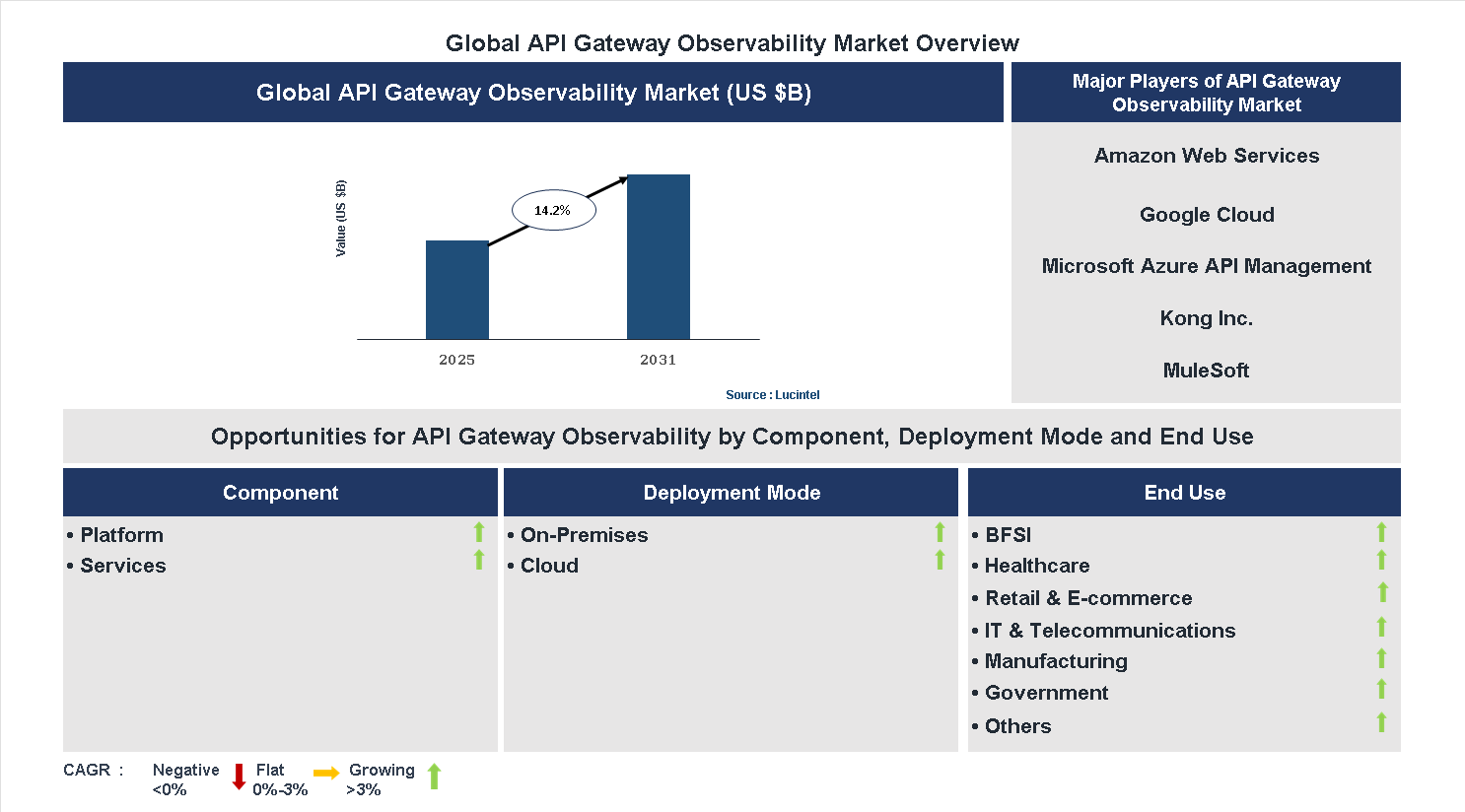
The future of the global API gateway observability market looks promising with opportunities in the BFSI, healthcare, retail & E-commerce, IT & telecommunication, manufacturing, and government markets. The global API gateway observability market is expected to grow with a CAGR of 14.2% from 2025 to 2031. The major drivers for this market are the increasing adoption of microservices architectures, the rising need for API performance monitoring, and the growing complexity of distributed application environments.• Lucintel forecasts that, within the component category, platform is expected to witness higher growth over the forecast period.
• Within the end use category, BFSI is expected to witness the highest growth.
• In terms of region, North America is expected to witness the highest growth over the forecast period. Gain valuable insights for your business decisions with our comprehensive 150+ page report. Sample figures with some insights are shown below.
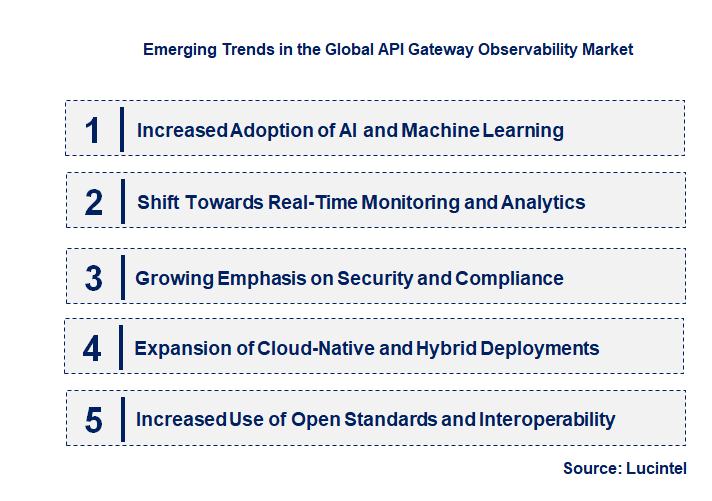
Emerging Trends in the API Gateway Observability Market
The API gateway observability market is experiencing rapid growth driven by the increasing adoption of microservices architectures, the need for enhanced security, and the demand for real-time monitoring and analytics. As organizations seek to improve their API management capabilities, emerging trends are shaping the future landscape of this market. These developments are not only improving operational efficiency but also enabling better decision-making, security, and customer experience. The following key trends highlight the evolving nature of API gateway observability and its strategic importance in modern digital ecosystems.• Increased Adoption of AI and Machine Learning: The integration of AI and ML into API observability tools is transforming how organizations monitor and analyze API performance. These technologies enable predictive analytics, anomaly detection, and automated troubleshooting, reducing downtime and improving reliability. AI-driven insights help teams proactively address issues before they impact users, leading to enhanced operational efficiency and customer satisfaction. As AI becomes more sophisticated, its role in API observability is expected to expand, making systems smarter and more autonomous.
• Shift Towards Real-Time Monitoring and Analytics: Real-time data collection and analysis are becoming critical for managing complex API ecosystems. Organizations require instant visibility into API performance, security threats, and usage patterns to respond swiftly to issues. Advanced observability platforms now offer dashboards and alerts that provide immediate insights, enabling faster decision-making and incident response. This trend enhances overall system resilience, minimizes downtime, and supports dynamic scaling, which is essential in today’s fast-paced digital environment.
• Growing Emphasis on Security and Compliance: As APIs become more integral to business operations, security and compliance are gaining prominence in observability strategies. Market players are integrating security features such as threat detection, access control, and audit trails into their platforms. Ensuring compliance with regulations like GDPR and HIPAA is also a priority, prompting the development of tools that facilitate audit readiness and data privacy. This focus helps organizations mitigate risks, prevent breaches, and maintain customer trust in an increasingly threat-prone landscape.
• Expansion of Cloud-Native and Hybrid Deployments: The shift towards cloud-native architectures and hybrid cloud environments is influencing API observability solutions. Vendors are developing tools that seamlessly integrate with containerized and serverless environments, providing comprehensive visibility across diverse deployment models. This trend supports scalability, flexibility, and cost-efficiency, enabling organizations to manage APIs effectively regardless of infrastructure complexity. As cloud adoption accelerates, observability solutions are evolving to meet the demands of distributed, dynamic environments.
• Increased Use of Open Standards and Interoperability: The market is witnessing a move towards open standards and greater interoperability among observability tools. This facilitates easier integration with existing DevOps pipelines, monitoring systems, and third-party platforms. Open APIs and standardized data formats enable more flexible and customizable solutions, reducing vendor lock-in and fostering innovation. This trend empowers organizations to build unified observability ecosystems that provide comprehensive insights, streamline workflows, and enhance overall API management capabilities. In summary, these emerging trends are fundamentally reshaping the API gateway observability market by enhancing automation, security, flexibility, and real-time insights. They are enabling organizations to better manage complex API ecosystems, improve operational resilience, and deliver superior digital experiences. As these trends continue to evolve, the market is poised for significant innovation and growth, driven by the increasing importance of API management in digital transformation strategies.
Recent Development in the API Gateway Observability Market
The API gateway observability market has experienced significant growth driven by the increasing adoption of microservices architectures, the need for enhanced visibility into API performance, and the rising importance of security and compliance. As organizations seek to optimize their API ecosystems, advancements in monitoring tools and integration capabilities have become crucial. Recent developments reflect a focus on real-time analytics, AI-powered insights, and improved integration with existing DevOps workflows. These trends are shaping the future of API management, making it more efficient, secure, and scalable. The following key developments highlight the current trajectory of this evolving market.• Adoption of AI and Machine Learning: AI and machine learning are increasingly integrated into observability tools, enabling predictive analytics and anomaly detection. This development allows organizations to proactively identify issues before they impact users, improving reliability and user experience. AI-driven insights also facilitate root cause analysis, reducing troubleshooting time and operational costs. As a result, API gateways become smarter, more autonomous, and capable of adapting to complex environments, enhancing overall system resilience.
• Real-Time Monitoring and Analytics: The shift towards real-time data collection and analysis has become a core feature of API observability solutions. This enables organizations to monitor API performance, latency, and error rates instantaneously, facilitating rapid response to issues. Real-time dashboards and alerts improve operational efficiency and help maintain high service levels. This development is particularly critical for high-traffic applications and microservices architectures, where timely insights are essential for maintaining seamless user experiences.
• Enhanced Security and Compliance Features: Security remains a top priority, prompting the integration of advanced security features within observability platforms. These include threat detection, API access controls, and compliance monitoring for regulations such as GDPR and HIPAA. Enhanced security capabilities help prevent data breaches and unauthorized access, ensuring data integrity and privacy. This development reassures organizations that their API ecosystems are protected while maintaining compliance with evolving regulatory standards.
• Integration with DevOps and CI/CD Pipelines: Modern observability tools are increasingly designed to integrate seamlessly with DevOps workflows and continuous integration/continuous deployment (CI/CD) pipelines. This integration facilitates automated testing, deployment, and monitoring, enabling faster release cycles and improved quality assurance. It also provides developers with immediate feedback on API performance and issues, fostering a culture of continuous improvement. This development accelerates innovation and reduces time-to-market for new features and services.
• Expansion of Multi-Cloud and Hybrid Cloud Support: As organizations adopt multi-cloud and hybrid cloud strategies, API observability solutions are evolving to support diverse environments. This includes enhanced compatibility with various cloud providers and on-premises systems, ensuring comprehensive visibility across all platforms. Such support enables centralized monitoring, simplifies management, and improves security across distributed architectures. This development is critical for organizations seeking flexibility, scalability, and resilience in their API ecosystems. In summary, these developments are transforming the API gateway observability market by making solutions more intelligent, responsive, secure, and integrated. The adoption of AI, real-time analytics, security enhancements, DevOps integration, and multi-cloud support is collectively driving greater operational efficiency, improved security posture, and faster innovation cycles. As a result, organizations are better equipped to manage complex API environments, ensuring optimal performance and customer satisfaction.
Strategic Growth Opportunities in the API Gateway Observability Market
The API gateway observability market is experiencing rapid growth driven by increasing digital transformation, the need for enhanced security, and the demand for seamless API management across various industries. As organizations adopt more complex architectures, the importance of monitoring, analyzing, and optimizing API performance becomes critical. This markets evolution is shaped by technological advancements and the rising adoption of cloud-based solutions, which demand robust observability tools. Key applications such as cloud services, financial services, healthcare, retail, and telecommunications are pivotal in driving market expansion. These sectors are leveraging observability to improve operational efficiency, ensure security, and deliver superior customer experiences.• Cloud Services: Enhanced API observability improves cloud infrastructure management by providing real-time insights into API performance, enabling faster troubleshooting, reducing downtime, and optimizing resource allocation. This leads to increased reliability and customer satisfaction in cloud environments.
• Financial Services: In banking and fintech, API observability ensures secure, compliant, and efficient transaction processing. It helps detect anomalies, prevent fraud, and maintain high service availability, which is vital for customer trust and regulatory adherence.
• Healthcare: API observability in healthcare facilitates secure data exchange between systems, ensuring compliance with regulations like HIPAA. It enhances system reliability, supports telemedicine, and improves patient data management, ultimately leading to better healthcare delivery.
• Retail: Retailers utilize API observability to monitor omnichannel platforms, optimize inventory management, and personalize customer experiences. This results in increased sales, improved customer engagement, and streamlined operations.
• Telecommunications: In telecom, API observability supports network management, service provisioning, and customer support by providing detailed insights into API performance. This enhances service quality, reduces outages, and accelerates innovation. In summary, these growth opportunities across key applications are significantly impacting the API gateway observability market by driving demand for advanced monitoring solutions. They enable organizations to enhance operational efficiency, ensure security, and deliver superior customer experiences, thereby fueling market expansion and technological innovation.
API Gateway Observability Market Driver and Challenges
The API gateway observability market is influenced by a range of technological, economic, and regulatory factors that shape its growth and development. Rapid advancements in cloud computing, the increasing adoption of microservices architectures, and the need for enhanced security and performance monitoring are key technological drivers. Economic factors such as the rising demand for digital transformation and the proliferation of connected devices further propel market expansion. Regulatory requirements around data privacy and compliance also influence market dynamics. However, the market faces challenges including integration complexities, high implementation costs, and evolving security threats. Understanding these drivers and challenges is essential for stakeholders to navigate the evolving landscape effectively. The factors responsible for driving the API gateway observability market include:• Technological Innovation: Rapid advancements in cloud computing and microservices architecture have increased the need for comprehensive observability solutions. As organizations shift towards distributed systems, monitoring and troubleshooting become more complex, driving demand for advanced API gateway observability tools that provide real-time insights, analytics, and troubleshooting capabilities. These innovations enable businesses to improve system reliability, optimize performance, and ensure seamless user experiences, fueling market growth.
• Increasing Adoption of Cloud and Hybrid Environments: The widespread adoption of cloud services and hybrid cloud environments has created a need for scalable, flexible observability solutions. Organizations require tools that can monitor APIs across multiple platforms and environments, ensuring consistent performance and security. This trend supports the growth of API gateway observability solutions that can seamlessly integrate with diverse cloud infrastructures, providing comprehensive visibility and control.
• Rising Focus on Security and Compliance: With increasing cyber threats and stringent regulatory standards, organizations are prioritizing security and compliance. API gateways serve as critical control points for managing access and data flow, making observability essential for detecting anomalies, preventing breaches, and ensuring compliance with regulations such as GDPR and HIPAA. This focus drives demand for advanced monitoring tools that enhance security posture and facilitate compliance reporting.
• Digital Transformation Initiatives: The ongoing digital transformation across industries accelerates the deployment of APIs and microservices, necessitating robust observability solutions. Companies seek to improve operational efficiency, customer engagement, and innovation through API-driven architectures. Observability tools enable proactive monitoring, quick issue resolution, and performance optimization, thereby supporting digital transformation goals and expanding market opportunities.
• Growing Use of AI and Machine Learning: The integration of AI and machine learning into observability platforms enhances anomaly detection, predictive analytics, and automated troubleshooting. These technologies enable organizations to identify issues proactively, reduce downtime, and improve overall system reliability. The adoption of AI-driven observability solutions is a significant driver, offering advanced insights and operational efficiencies that propel market growth. The challenges facing this API gateway observability market include:
• Integration Complexities: Integrating observability solutions with existing legacy systems and diverse API architectures can be complex and resource-intensive. Compatibility issues, data silos, and the need for customization often hinder seamless deployment. These complexities can lead to increased implementation time and costs, discouraging some organizations from adopting advanced observability tools and limiting market expansion.
• High Implementation and Maintenance Costs: Deploying comprehensive API gateway observability solutions requires significant investment in hardware, software, and skilled personnel. Ongoing maintenance, updates, and scaling further add to operational expenses. For small and medium-sized enterprises, these costs can be prohibitive, restricting market penetration and adoption rates, especially in cost-sensitive regions.
• Evolving Security Threats and Data Privacy Concerns: As cyber threats become more sophisticated, maintaining the security of observability data and ensuring privacy compliance pose ongoing challenges. Organizations must continuously update security protocols and manage sensitive data responsibly. Failure to do so can lead to breaches, legal penalties, and loss of customer trust, which can hinder market growth and adoption of observability solutions. In summary, the API gateway observability market is driven by technological innovations, cloud adoption, security priorities, digital transformation, and AI integration. However, integration challenges, high costs, and security concerns present significant hurdles. These factors collectively influence the markets trajectory, requiring stakeholders to balance technological advancements with strategic investments and security measures. Overall, the markets growth prospects remain strong, provided these challenges are effectively managed through innovation and collaboration.
List of API Gateway Observability Companies
Companies in the market compete on the basis of product quality offered. Major players in this market focus on expanding their manufacturing facilities, R&D investments, infrastructural development, and leverage integration opportunities across the value chain. With these strategies API gateway observability companies cater increasing demand, ensure competitive effectiveness, develop innovative products & technologies, reduce production costs, and expand their customer base. Some of the API gateway observability companies profiled in this report include-• Amazon Web Services
• Google Cloud
• Microsoft Azure API Management
• Kong Inc.
• MuleSoft
• IBM API Connect
• Axway
• Tyk Technologies
• WSO2
• Red Hat 3scale
API Gateway Observability Market by Segment
The study includes a forecast for the global API gateway observability market by component, deployment mode, end use, and region.API Gateway Observability Market by Component [Value from 2019 to 2031]:
• Platform
• Services
API Gateway Observability Market by Deployment Mode [Value from 2019 to 2031]:
• On-Premises
• Cloud
API Gateway Observability Market by End Use [Value from 2019 to 2031]:
• BFSI
• Healthcare
• Retail & E-commerce
• IT & Telecommunications
• Manufacturing
• Government
• Others
API Gateway Observability Market by Region [Value from 2019 to 2031]:
• North America
• Europe
• Asia Pacific
• The Rest of the World
Country Wise Outlook for the API Gateway Observability Market
The API gateway observability market has experienced significant growth driven by increasing digital transformation, rising adoption of microservices architectures, and the need for enhanced monitoring and security. Organizations worldwide are prioritizing real-time insights into API performance, security, and usage to optimize operations and ensure seamless user experiences. Technological advancements, such as AI-powered analytics and cloud integration, are further propelling market expansion. Governments and enterprises are investing heavily in API management solutions to support scalable, secure, and efficient digital ecosystems. This evolving landscape reflects a strategic shift towards comprehensive observability to meet the demands of modern application environments across major economies.• United States: The US market has seen rapid adoption of AI-driven observability tools, with major cloud providers integrating advanced analytics into their API gateways. Enterprises are focusing on security enhancements and real-time monitoring to comply with stringent data regulations. The rise of serverless architectures has also increased demand for scalable observability solutions, fostering innovation in the sector. Additionally, startups and tech giants are collaborating to develop more sophisticated API management platforms, emphasizing automation and predictive analytics.
• China: China’s API gateway observability market is expanding due to government initiatives promoting digital infrastructure and smart city projects. Local companies are investing in AI-enabled monitoring tools to improve API security and performance. The adoption of cloud-native solutions is accelerating, supported by domestic cloud providers offering tailored observability services. Regulatory policies are influencing the market, with a focus on data sovereignty and security, leading to the development of localized solutions that cater to specific industry needs.
• Germany: The German market emphasizes compliance with strict data privacy regulations such as GDPR, influencing API observability strategies. There is a strong focus on integrating observability with cybersecurity measures to prevent data breaches. Enterprises are adopting hybrid cloud solutions to balance security and flexibility, with a growing interest in open-source tools for cost-effective monitoring. Industry-specific solutions are emerging, especially in manufacturing and automotive sectors, to enhance operational efficiency and product quality.
• India: India’s API gateway observability market is witnessing rapid growth driven by digital transformation initiatives across sectors like banking, telecom, and e-commerce. Local providers are developing affordable, scalable observability solutions tailored to small and medium enterprises. Cloud adoption is increasing, with a focus on integrating AI and machine learning for predictive insights. Government programs promoting digital inclusion are also fueling demand for robust API management and monitoring tools to support a burgeoning digital economy.
• Japan: Japan’s market is characterized by a focus on high reliability and security, especially in sectors like finance and manufacturing. Companies are investing in advanced observability platforms that incorporate AI and IoT integration to monitor complex API ecosystems. There is a trend toward adopting multi-cloud strategies to ensure resilience and compliance with local regulations. Additionally, collaborations between technology firms and research institutions are fostering innovation in API security and performance analytics, supporting Japan’s goal of maintaining technological leadership.

Features of the Global API Gateway Observability Market
Market Size Estimates: API gateway observability market size estimation in terms of value ($B). Trend and Forecast Analysis: Market trends (2019 to 2024) and forecast (2025 to 2031) by various segments and regions. Segmentation Analysis: API gateway observability market size by component, deployment mode, end use, and region in terms of value ($B). Regional Analysis: API gateway observability market breakdown by North America, Europe, Asia Pacific, and Rest of the World. Growth Opportunities: Analysis of growth opportunities in different component, deployment mode, end use, and regions for the API gateway observability market. Strategic Analysis: This includes M&A, new product development, and competitive landscape of the API gateway observability market. Analysis of competitive intensity of the industry based on Porter’s Five Forces model.
FAQ
Q1. What is the growth forecast for API gateway observability market? Answer: The global API gateway observability market is expected to grow with a CAGR of 14.2% from 2025 to 2031. Q2. What are the major drivers influencing the growth of the API gateway observability market? Answer: The major drivers for this market are the increasing adoption of microservices architectures, the rising need for API performance monitoring, and the growing complexity of distributed application environments. Q3. What are the major segments for API gateway observability market? Answer: The future of the API gateway observability market looks promising with opportunities in the BFSI, healthcare, retail & E-commerce, IT & telecommunication, manufacturing, and government markets. Q4. Who are the key API gateway observability market companies? Answer: Some of the key API gateway observability companies are as follows:• Amazon Web Services
• Google Cloud
• Microsoft Azure API Management
• Kong Inc.
• MuleSoft
• IBM API Connect
• Axway
• Tyk Technologies
• WSO2
• Red Hat 3scale Q5. Which API gateway observability market segment will be the largest in future? Answer: Lucintel forecasts that, within the component category, platform is expected to witness higher growth over the forecast period. Q6. In API gateway observability market, which region is expected to be the largest in next 5 years? Answer: In terms of region, North America is expected to witness the highest growth over the forecast period. Q7. Do we receive customization in this report? Answer: Yes, Lucintel provides 10% customization without any additional cost.
Table of Contents
List of Figures
List of Tables
Methodology
- In-depth interviews of the major players in this market
- Detailed secondary research from competitors’ financial statements and published data
- Extensive searches of published works, market, and database information pertaining to industry news, company press releases, and customer intentions
- A compilation of the experiences, judgments, and insights of Lucintel’s professionals, who have analyzed and tracked this market over the years.


Buy Now
Choose a license that fits your team. Instant PDF delivery.
Prices exclude taxes. Instant delivery. Custom licensing available on request.
Key Questions
- • What are some of the most promising, high-growth opportunities for the API gateway observability market by component (platform and services), deployment mode (on-premises and cloud), end use (BFSI, healthcare, retail & E-commerce, IT & telecommunications, manufacturing, government, and others), and region (North America, Europe, Asia Pacific, and the Rest of the World)?
- • Which segments will grow at a faster pace and why?
- • Which region will grow at a faster pace and why?
- • What are the key factors affecting market dynamics? What are the key challenges and business risks in this market?
- • What are the business risks and competitive threats in this market?
- • What are the emerging trends in this market and the reasons behind them?
- • What are some of the changing demands of customers in the market?
- • What are the new developments in the market? Which companies are leading these developments?
- • Who are the major players in this market? What strategic initiatives are key players pursuing for business growth?
- • What are some of the competing products in this market and how big of a threat do they pose for loss of market share by material or product substitution?
- • What M&A activity has occurred in the last 5 years and what has its impact been on the industry? For any questions related to API Gateway Observability Market, API Gateway Observability Market Size, API Gateway Observability Market Growth, API Gateway Observability Market Analysis, API Gateway Observability Market Report, API Gateway Observability Market Share, API Gateway Observability Market Trends, API Gateway Observability Market Forecast, API Gateway Observability Companies, write Lucintel analyst at email: helpdesk@lucintel.com. We will be glad to get back to you soon.


