
'
...

The Impact of COVID-19 is included in Anticoagulant Reversal Agent Market Report. Buy it today to get an advantage.

Request the impact of COVID-19 on your product or industry


Anticoagulant Reversal Agent Market Trends and Forecast

The future of the global anticoagulant reversal agent market looks promising with opportunities in the ambulatory surgical center, clinic, hospital, and trauma center markets. The global anticoagulant reversal agent market is expected to grow with a CAGR of 8.1% from 2025 to 2031. The major drivers for this market are the increasing demand for rapid anticoagulant reversal, the rising incidence of anticoagulant related bleeding, and the growing adoption of novel anticoagulant therapies.

• Lucintel forecasts that, within the product type category, andexanet alfa is expected to witness the highest growth over the forecast period.
• Within the end use category, hospital is expected to witness the highest growth.
• In terms of region, APAC is expected to witness the highest growth over the forecast period.
Gain valuable insights for your business decisions with our comprehensive 150+ page report. Sample figures with some insights are shown below.
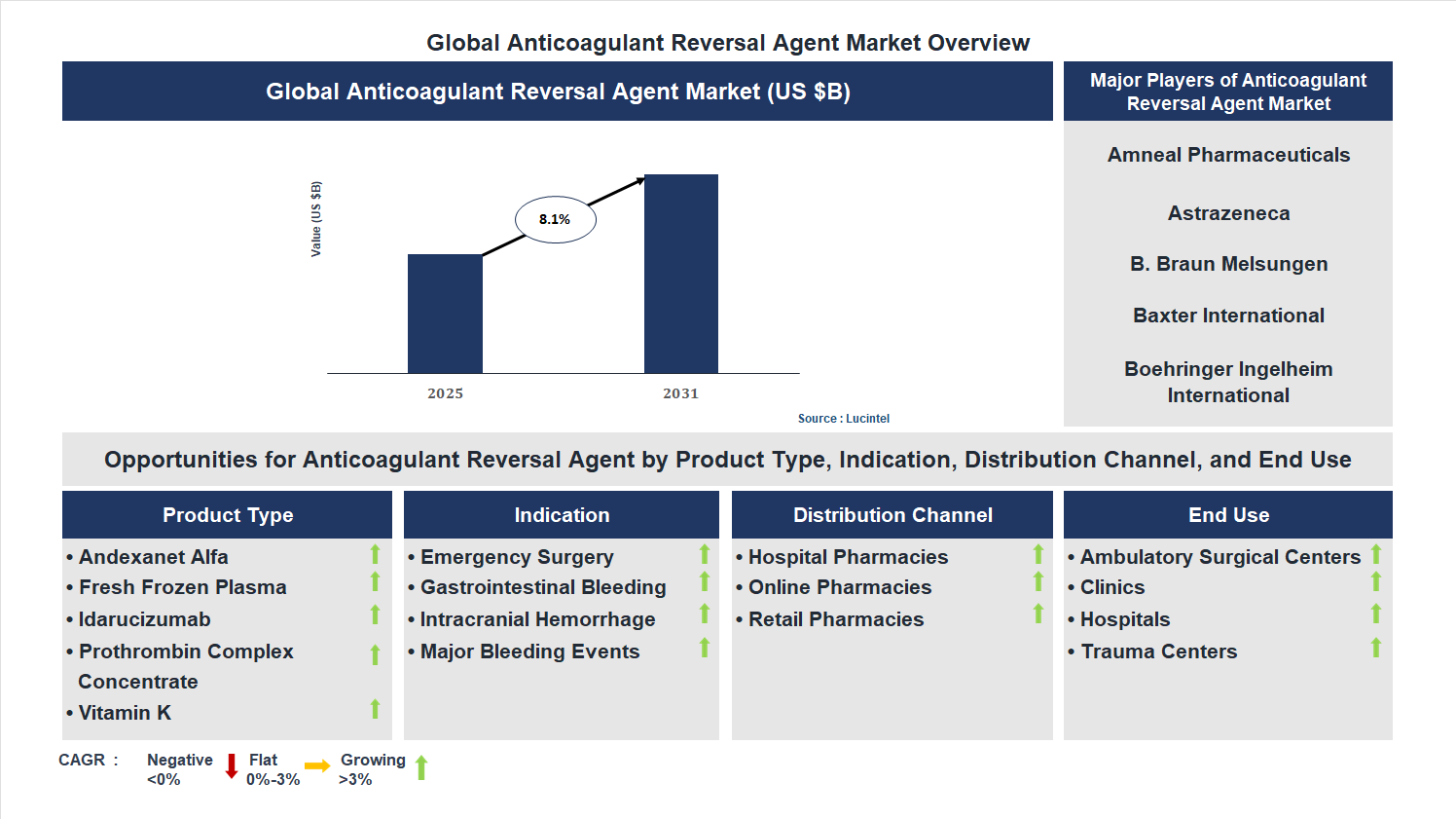
Anticoagulant Reversal Agent Market Trends and Forecast

Emerging Trends in the Anticoagulant Reversal Agent Market

The anticoagulant reversal agent market is experiencing rapid evolution driven by advancements in medical technology, increasing prevalence of blood clotting disorders, and a growing focus on patient safety. As anticoagulants become more widely used for conditions like atrial fibrillation and deep vein thrombosis, the need for effective reversal agents has become critical. This market is characterized by innovation, regulatory developments, and a shift towards personalized medicine. These trends are shaping the future landscape, influencing clinical practices, and impacting healthcare costs. Understanding these key developments is essential for stakeholders aiming to capitalize on emerging opportunities and improve patient outcomes in anticoagulation management.

• Growing Demand for Reversal Agents: The rising incidence of thromboembolic disorders and the widespread use of anticoagulants have increased the need for effective reversal agents. This demand is driven by the necessity to manage bleeding complications promptly, especially in emergencies. As awareness of patient safety grows, healthcare providers are prioritizing the availability of reversal options, leading to increased market adoption and the development of new agents.
• Innovation in Reversal Agents: Advances in biotechnology and pharmacology are leading to the development of novel reversal agents with improved efficacy and safety profiles. These innovations include specific agents for newer anticoagulants like factor Xa inhibitors and direct thrombin inhibitors. The introduction of these targeted therapies enhances clinical outcomes, reduces adverse effects, and broadens treatment options, thereby expanding the market.
• Regulatory Approvals and Guidelines: Regulatory agencies are increasingly approving new reversal agents and updating guidelines to incorporate their use. These approvals facilitate market entry for innovative products and encourage healthcare providers to adopt new standards of care. Clear regulatory pathways and guidelines also boost confidence among clinicians and investors, accelerating market growth.
• Personalized Medicine and Targeted Therapies: The trend towards personalized medicine is influencing the market by promoting tailored reversal strategies based on individual patient profiles. Genetic testing and biomarker analysis enable clinicians to select the most appropriate reversal agents, minimizing risks and optimizing treatment efficacy. This approach is expected to improve patient safety and reduce healthcare costs.
• Market Expansion and Geographic Growth: Emerging markets are witnessing increased adoption of anticoagulants and reversal agents due to rising healthcare infrastructure and awareness. Additionally, strategic collaborations and investments are expanding the market reach globally. This geographic growth not only increases market size but also introduces new challenges related to regulatory compliance and healthcare delivery systems.

In summary, these trends are collectively transforming the anticoagulant reversal agent market by fostering innovation, enhancing safety, and expanding access. They are driving a shift towards more personalized, effective, and rapid management of bleeding complications, ultimately improving patient outcomes and shaping the future of anticoagulation therapy worldwide.
Emerging Trends in the Anticoagulant Reversal Agent Market

Recent Development in the Anticoagulant Reversal Agent Market

The anticoagulant reversal agent market is experiencing rapid growth driven by increasing use of anticoagulants in various medical conditions, advancements in reversal agents, and rising awareness of bleeding risks. The development of safer, more effective reversal agents is crucial for patient safety and treatment efficacy. Technological innovations, regulatory approvals, and expanding applications across healthcare settings are shaping the market landscape. These developments are creating new opportunities for manufacturers, healthcare providers, and patients, ultimately improving clinical outcomes and reducing adverse events related to anticoagulant therapy.

• Growing Demand for Safer Reversal Agents: The market is expanding as new reversal agents with improved safety profiles are developed, reducing adverse effects and increasing clinician confidence in managing bleeding complications effectively.
• Advances in Recombinant and Monoclonal Antibodies: The introduction of recombinant and monoclonal antibody-based reversal agents has enhanced specificity and efficacy, leading to better patient outcomes and broader application in emergency settings.
• Regulatory Approvals and Market Entry: Recent approvals by regulatory bodies have accelerated market growth, enabling wider adoption of novel reversal agents and encouraging further innovation in the field.
• Increasing Use of Anticoagulants in Diverse Conditions: The rising prevalence of atrial fibrillation, venous thromboembolism, and other conditions requiring anticoagulation therapy is driving demand for effective reversal options, expanding market opportunities.
• Technological Innovations and Personalized Medicine: The integration of personalized treatment approaches and advanced diagnostics is improving the targeting and effectiveness of reversal agents, fostering market expansion and tailored patient care.

These developments are significantly impacting the anticoagulant reversal agent market by enhancing safety, efficacy, and accessibility. The introduction of innovative agents, regulatory support, and expanding clinical applications is fueling growth, improving patient outcomes, and shaping a dynamic, competitive landscape. This evolution is poised to meet increasing global healthcare demands and foster continued market expansion.

Strategic Growth Opportunities in the Anticoagulant Reversal Agent Market

The anticoagulant reversal agent market is experiencing rapid growth driven by increasing use of anticoagulants in various medical conditions, rising awareness of bleeding risks, and advancements in reversal therapies. The expanding aging population and the need for quick, effective reversal agents in emergencies further propel market expansion. Strategic investments, regulatory approvals, and technological innovations are shaping the competitive landscape, offering numerous opportunities for market players to enhance their product portfolios and meet the growing demand for safe and efficient reversal solutions.

• Increasing Use of Anticoagulants in Medical Treatments: The widespread adoption of anticoagulants for conditions like atrial fibrillation, deep vein thrombosis, and pulmonary embolism is fueling demand for reversal agents. As anticoagulant prescriptions rise globally, the need for effective reversal therapies becomes critical to manage bleeding complications. This trend encourages pharmaceutical companies to develop and improve reversal agents, ensuring patient safety and compliance with evolving treatment protocols. The growing patient base and expanding indications significantly contribute to market growth.
• Rising Incidence of Bleeding Complications and Emergency Procedures: The increasing occurrence of bleeding events due to anticoagulant therapy, especially in surgical and emergency settings, underscores the necessity for rapid reversal agents. Healthcare providers require reliable solutions to quickly counteract anticoagulant effects during surgeries, trauma, or overdose cases. This demand drives innovation in reversal agents with faster onset and higher efficacy. The focus on patient safety and improved clinical outcomes further accelerates market development and adoption of advanced reversal therapies.
• Technological Advancements in Reversal Agents: Innovations in biotechnology and pharmaceutical research are leading to the development of next-generation reversal agents with enhanced specificity, safety, and efficacy. Monoclonal antibodies, recombinant proteins, and novel small molecules are being explored to improve reversal times and reduce adverse effects. These technological breakthroughs enable personalized treatment approaches and expand the scope of reversal agents across different anticoagulants, thereby opening new market segments and increasing overall market size.
• Increasing Regulatory Approvals and Product Launches: Regulatory agencies worldwide are approving new reversal agents and expanding indications for existing products, which boosts market confidence and accessibility. The approval of agents like idarucizumab and andexanet alfa has set new standards for reversal therapies. Continuous product launches and regulatory support facilitate market penetration, especially in emerging economies. This environment encourages investment in research and development, fostering a competitive landscape that benefits healthcare providers and patients alike.
• Growing Awareness and Adoption of Reversal Agents in Clinical Practice: Education initiatives and clinical guidelines emphasizing the importance of reversal agents in anticoagulant management are increasing their adoption. Healthcare professionals are becoming more aware of the availability and benefits of these agents, leading to wider usage in hospitals and emergency settings. This increased awareness supports better patient outcomes, reduces complications, and encourages healthcare systems to integrate reversal agents into standard treatment protocols, further expanding market opportunities.

The overall impact of these growth opportunities is a robust and expanding market, driven by technological innovation, regulatory support, and increasing clinical needs. As awareness and adoption grow, the market is poised for sustained development, offering significant benefits for patients, healthcare providers, and industry stakeholders through improved safety, efficacy, and treatment outcomes.

Anticoagulant Reversal Agent Market Driver and Challenges

The anticoagulant reversal agent market is influenced by a variety of technological, economic, and regulatory factors that shape its growth and development. Advances in medical technology and drug development have led to more effective reversal agents, while economic considerations such as healthcare costs and reimbursement policies impact market accessibility. Regulatory frameworks ensure safety and efficacy but can also pose hurdles for approval and market entry. Additionally, the increasing prevalence of thromboembolic disorders and the need for rapid, reliable reversal options further drive demand. However, challenges such as high drug costs, regulatory delays, and safety concerns also influence market dynamics. Understanding these drivers and challenges is essential for stakeholders aiming to capitalize on market opportunities.

The factors responsible for driving the anticoagulant reversal agent market include:
• Technological Advancements: The development of novel reversal agents, such as specific antidotes for newer anticoagulants, has significantly improved treatment outcomes. These innovations enable rapid reversal of anticoagulation, reducing bleeding risks during emergencies. Enhanced diagnostic tools and personalized medicine approaches further optimize patient management. As research progresses, more targeted and safer reversal agents are expected, expanding market potential. The integration of biotechnology and pharmacogenomics accelerates the development pipeline, making the market more dynamic and responsive to clinical needs.
• Rising Prevalence of Thromboembolic Disorders: The increasing incidence of conditions like atrial fibrillation, deep vein thrombosis, and pulmonary embolism globally is a major driver. As populations age and lifestyle-related risk factors grow, the demand for anticoagulants and their reversal agents rises correspondingly. This trend necessitates effective reversal options to manage bleeding complications, thereby expanding the market. Healthcare systems are prioritizing rapid intervention capabilities, which further fuels the need for advanced reversal agents, ensuring market growth aligns with epidemiological shifts.
• Regulatory Approvals and Support: Stringent regulatory frameworks ensure the safety and efficacy of anticoagulant reversal agents, fostering trust among healthcare providers. Recent approvals of novel agents, such as idarucizumab and andexanet alfa, have validated their clinical utility and opened new market segments. Regulatory agencies support for innovative therapies accelerates market entry and adoption. Moreover, evolving guidelines and reimbursement policies incentivize the development and use of these agents, creating a conducive environment for market expansion and innovation.
• Increasing Adoption of Anticoagulants: The widespread use of anticoagulants for stroke prevention and other indications has directly increased the need for reversal agents. As clinicians prefer newer oral anticoagulants over traditional therapies due to convenience and safety profiles, the demand for specific reversal agents tailored to these drugs has surged. This shift enhances market opportunities for specialized reversal agents, encouraging pharmaceutical companies to invest in research and development. The growing awareness among healthcare professionals about managing bleeding risks further supports this trend, ensuring sustained market growth.
• Growing Awareness and Healthcare Infrastructure: Improved healthcare infrastructure and increased awareness about bleeding management have contributed to market expansion. Educational initiatives and training programs for healthcare providers emphasize the importance of rapid reversal in emergencies. Enhanced diagnostic capabilities enable timely intervention, reducing morbidity and mortality. Additionally, the expansion of healthcare facilities in emerging markets broadens access to these agents. This combination of awareness and infrastructure development ensures wider adoption and integration of reversal agents into standard treatment protocols, bolstering market growth.

The challenges facing this anticoagulant reversal agent market include:
• High Cost of Reversal Agents: The development and manufacturing of advanced reversal agents involve high costs, which translate into high prices. This can limit accessibility, especially in low- and middle-income countries where healthcare budgets are constrained. The high cost may also impact reimbursement policies, leading to reduced adoption in certain regions. Additionally, the economic burden on healthcare systems can hinder widespread use, creating a barrier to market growth. Balancing innovation with affordability remains a critical challenge for stakeholders aiming to expand market reach.
• Regulatory Delays and Complex Approval Processes: Despite the clinical benefits, the approval process for new reversal agents can be lengthy and complex. Regulatory agencies require extensive safety and efficacy data, which prolongs time-to-market. Delays in approval can hinder timely access to innovative therapies, affecting market competitiveness. Moreover, evolving regulatory standards and differing requirements across regions add complexity, increasing costs and uncertainty for manufacturers. Navigating these regulatory hurdles is essential for timely market entry and sustained growth.
• Safety and Efficacy Concerns: While reversal agents are crucial for managing bleeding complications, safety concerns such as thrombotic risks and allergic reactions persist. Ensuring a favorable safety profile is vital for clinical acceptance and regulatory approval. Any adverse events can undermine confidence among healthcare providers and patients, limiting market penetration. Continuous post-market surveillance and clinical studies are necessary to address these concerns, but they require significant investment. Balancing efficacy with safety remains a key challenge in maintaining market stability and expanding usage.

In summary, the anticoagulant reversal agent market is driven by technological innovations, rising disease prevalence, supportive regulatory environments, increased anticoagulant use, and improved healthcare infrastructure. However, high costs, regulatory delays, and safety concerns pose significant challenges. These factors collectively influence market dynamics, with opportunities for growth tempered by hurdles that require strategic management. Overall, the markets future depends on balancing innovation with affordability and safety, ensuring effective management of bleeding risks while expanding access worldwide.

List of Anticoagulant Reversal Agent Companies

Companies in the market compete on the basis of product quality offered. Major players in this market focus on expanding their manufacturing facilities, R&D investments, infrastructural development, and leverage integration opportunities across the value chain. With these strategies anticoagulant reversal agent companies cater increasing demand, ensure competitive effectiveness, develop innovative products & technologies, reduce production costs, and expand their customer base. Some of the anticoagulant reversal agent companies profiled in this report include-
• Amneal Pharmaceuticals
• Astrazeneca
• B. Braun Melsungen
• Baxter International
• Boehringer Ingelheim International
• Fresenius Kabi
• Pfizer
• Portola Pharmaceuticals
• Sagent Pharmaceuticals
• Sandoz International

Anticoagulant Reversal Agent Market by Segment

The study includes a forecast for the global anticoagulant reversal agent market by product type, indication, distribution channel, end use, and region.

Anticoagulant Reversal Agent Market by Product Type [Value from 2019 to 2031]:


• Andexanet Alfa
• Fresh Frozen Plasma
• Idarucizumab
• Prothrombin Complex Concentrate
• Vitamin K

Anticoagulant Reversal Agent Market by Indication [Value from 2019 to 2031]:


• Emergency Surgery
• Gastrointestinal Bleeding
• Intracranial Hemorrhage
• Major Bleeding Events

Anticoagulant Reversal Agent Market by Distribution Channel [Value from 2019 to 2031]:


• Hospital Pharmacies
• Online Pharmacies
• Retail Pharmacies

Anticoagulant Reversal Agent Market by End Use [Value from 2019 to 2031]:


• Ambulatory Surgical Centers
• Clinics
• Hospitals
• Trauma Centers

Anticoagulant Reversal Agent Market by Region [Value from 2019 to 2031]:


• North America
• Europe
• Asia Pacific
• The Rest of the World

Country Wise Outlook for the Anticoagulant Reversal Agent Market

The anticoagulant reversal agent market has experienced significant growth driven by increasing use of anticoagulants for various medical conditions, rising awareness of bleeding risks, and advancements in reversal technologies. Countries are adopting innovative strategies to improve patient safety and treatment outcomes. Regulatory approvals and technological innovations are shaping the market landscape, with a focus on developing faster, more effective reversal agents. The market dynamics vary across regions due to differing healthcare policies, technological adoption rates, and clinical practices. These developments reflect a global effort to enhance anticoagulant management and minimize adverse events associated with bleeding complications.

• United States: The US market has seen rapid adoption of new reversal agents like Andexanet alfa and idarucizumab, driven by high anticoagulant usage and regulatory approvals. Hospitals are increasingly integrating these agents into emergency protocols, supported by extensive clinical data. The FDAs approval of novel reversal drugs has boosted market growth, alongside rising awareness among healthcare providers. Additionally, ongoing research into personalized anticoagulation management is enhancing treatment safety and efficacy. The US also witnesses a surge in market collaborations and investments aimed at developing next-generation reversal agents, further expanding the market scope.
• China: China’s market is expanding due to the rising prevalence of cardiovascular diseases and increasing anticoagulant prescriptions. Government initiatives to improve healthcare infrastructure and drug approval processes have accelerated market growth. Local pharmaceutical companies are investing in developing cost-effective reversal agents to meet domestic demand. The adoption of advanced medical technologies and growing awareness of bleeding risks are also contributing factors. Moreover, collaborations with international firms are facilitating access to innovative reversal agents, positioning China as a key emerging market in this sector. The focus remains on balancing affordability with clinical efficacy to cater to a large patient population.
• Germany: Germany’s market benefits from a well-established healthcare system and high adoption of innovative medical therapies. The country has seen increased use of specific reversal agents for direct oral anticoagulants, supported by robust clinical guidelines. Regulatory bodies have approved several advanced reversal drugs, fostering market expansion. Germany’s emphasis on patient safety and evidence-based practices has driven demand for rapid and effective reversal solutions. Additionally, collaborations between pharmaceutical companies and healthcare institutions are fostering research and development efforts. The country’s focus on personalized medicine and minimally invasive procedures further propels the market forward.
• India: The Indian market is witnessing rapid growth due to increasing cardiovascular disease prevalence and expanding healthcare infrastructure. Rising awareness about anticoagulant management and bleeding complications is encouraging the adoption of reversal agents. Local manufacturers are developing affordable options to cater to the large population, while international companies are entering the market through partnerships. Government initiatives aimed at improving healthcare access and regulatory reforms are facilitating market growth. The increasing adoption of advanced medical devices and growing clinical research activities are also contributing to the development of the anticoagulant reversal segment, making India a promising emerging market.
• Japan: Japan’s market is characterized by high healthcare standards and widespread use of anticoagulants for atrial fibrillation and other conditions. The country has approved several advanced reversal agents, supported by extensive clinical research. Japan’s aging population has increased demand for safe and effective anticoagulation management, prompting innovations in reversal therapies. The government’s focus on healthcare innovation and regulatory support has accelerated market growth. Collaborations between domestic and international pharmaceutical companies are fostering the development of next-generation reversal agents. The emphasis on personalized treatment approaches and minimally invasive procedures continues to drive market expansion in Japan.

Lucintel Analytics Dashboard

Features of the Global Anticoagulant Reversal Agent Market

Market Size Estimates: Anticoagulant reversal agent market size estimation in terms of value ($B).
Trend and Forecast Analysis: Market trends (2019 to 2024) and forecast (2025 to 2031) by various segments and regions.
Segmentation Analysis: Anticoagulant reversal agent market size by various segments, such as by product type, indication, distribution channel, end use, and region in terms of value ($B).
Regional Analysis: Anticoagulant reversal agent market breakdown by North America, Europe, Asia Pacific, and Rest of the World.
Growth Opportunities: Analysis of growth opportunities in different product types, indications, distribution channels, end uses, and regions for the anticoagulant reversal agent market.
Strategic Analysis: This includes M&A, new product development, and competitive landscape of the anticoagulant reversal agent market.
Analysis of competitive intensity of the industry based on Porter’s Five Forces model.

Lucintel Consulting Services

FAQ

Q1. What is the growth forecast for anticoagulant reversal agent market?
Answer: The global anticoagulant reversal agent market is expected to grow with a CAGR of 8.1% from 2025 to 2031.
Q2. What are the major drivers influencing the growth of the anticoagulant reversal agent market?
Answer: The major drivers for this market are the increasing demand for rapid anticoagulant reversal, the rising incidence of anticoagulant related bleeding, and the growing adoption of novel anticoagulant therapies.
Q3. What are the major segments for anticoagulant reversal agent market?
Answer: The future of the anticoagulant reversal agent market looks promising with opportunities in the ambulatory surgical center, clinic, hospital, and trauma center markets.
Q4. Who are the key anticoagulant reversal agent market companies?
Answer: Some of the key anticoagulant reversal agent companies are as follows:
• Amneal Pharmaceuticals
• Astrazeneca
• B. Braun Melsungen
• Baxter International
• Boehringer Ingelheim International
• Fresenius Kabi
• Pfizer
• Portola Pharmaceuticals
• Sagent Pharmaceuticals
• Sandoz International
Q5. Which anticoagulant reversal agent market segment will be the largest in future?
Answer: Lucintel forecasts that, within the product type category, andexanet alfa is expected to witness the highest growth over the forecast period.
Q6. In anticoagulant reversal agent market, which region is expected to be the largest in next 5 years?
Answer: In terms of region, APAC is expected to witness the highest growth over the forecast period.
Q7. Do we receive customization in this report?
Answer: Yes, Lucintel provides 10% customization without any additional cost.

This report answers following 11 key questions:

Q.1. What are some of the most promising, high-growth opportunities for the anticoagulant reversal agent market by product type (andexanet alfa, fresh frozen plasma, idarucizumab, prothrombin complex concentrate, and vitamin K), indication (emergency surgery, gastrointestinal bleeding, intracranial hemorrhage, and major bleeding events), distribution channel (hospital pharmacies, online pharmacies, and retail pharmacies), end use (ambulatory surgical centers, clinics, hospitals, and trauma centers), and region (North America, Europe, Asia Pacific, and the Rest of the World)?
Q.2. Which segments will grow at a faster pace and why?
Q.3. Which region will grow at a faster pace and why?
Q.4. What are the key factors affecting market dynamics? What are the key challenges and business risks in this market?
Q.5. What are the business risks and competitive threats in this market?
Q.6. What are the emerging trends in this market and the reasons behind them?
Q.7. What are some of the changing demands of customers in the market?
Q.8. What are the new developments in the market? Which companies are leading these developments?
Q.9. Who are the major players in this market? What strategic initiatives are key players pursuing for business growth?
Q.10. What are some of the competing products in this market and how big of a threat do they pose for loss of market share by material or product substitution?
Q.11. What M&A activity has occurred in the last 6 years and what has its impact been on the industry?

For any questions related to Anticoagulant Reversal Agent Market, Anticoagulant Reversal Agent Market Size, Anticoagulant Reversal Agent Market Growth, Anticoagulant Reversal Agent Market Analysis, Anticoagulant Reversal Agent Market Report, Anticoagulant Reversal Agent Market Share, Anticoagulant Reversal Agent Market Trends, Anticoagulant Reversal Agent Market Forecast, Anticoagulant Reversal Agent Companies, write Lucintel analyst at email: helpdesk@lucintel.com. We will be glad to get back to you soon.
                                           Table of Contents

            1. Executive Summary

            2. Market Overview

                        2.1 Background and Classifications
                        2.2 Supply Chain

            3. Market Trends & Forecast Analysis

                        3.1 Macroeconomic Trends and Forecasts
                        3.2 Industry Drivers and Challenges
                        3.3 PESTLE Analysis
                        3.4 Patent Analysis
                        3.5 Regulatory Environment
                        3.6 Global Anticoagulant Reversal Agent Market Trends and Forecast

            4. Global Anticoagulant Reversal Agent Market by Product Type

                        4.1 Overview
                        4.2 Attractiveness Analysis by Product Type
                        4.3 Andexanet Alfa : Trends and Forecast 2019 to 2031
                        4.4 Fresh Frozen Plasma : Trends and Forecast 2019 to 2031
                        4.5 Idarucizumab : Trends and Forecast 2019 to 2031
                        4.6 Prothrombin Complex Concentrate : Trends and Forecast 2019 to 2031
                        4.7 Vitamin K : Trends and Forecast 2019 to 2031

            5. Global Anticoagulant Reversal Agent Market by Indication

                        5.1 Overview
                        5.2 Attractiveness Analysis by Indication
                        5.3 Emergency Surgery : Trends and Forecast 2019 to 2031
                        5.4 Gastrointestinal Bleeding : Trends and Forecast 2019 to 2031
                        5.5 Intracranial Hemorrhage : Trends and Forecast 2019 to 2031
                        5.6 Major Bleeding Events : Trends and Forecast 2019 to 2031

            6. Global Anticoagulant Reversal Agent Market by Distribution Channel

                        6.1 Overview
                        6.2 Attractiveness Analysis by Distribution Channel
                        6.3 Hospital Pharmacies : Trends and Forecast 2019 to 2031
                        6.4 Online Pharmacies : Trends and Forecast 2019 to 2031
                        6.5 Retail Pharmacies : Trends and Forecast 2019 to 2031

            7. Global Anticoagulant Reversal Agent Market by End Use

                        7.1 Overview
                        7.2 Attractiveness Analysis by End Use
                        7.3 Ambulatory Surgical Centers : Trends and Forecast 2019 to 2031
                        7.4 Clinics : Trends and Forecast 2019 to 2031
                        7.5 Hospitals : Trends and Forecast 2019 to 2031
                        7.6 Trauma Centers : Trends and Forecast 2019 to 2031

            8. Regional Analysis

                        8.1 Overview
                        8.2 Global Anticoagulant Reversal Agent Market by Region

            9. North American Anticoagulant Reversal Agent Market

                        9.1 Overview
                        9.2 North American Anticoagulant Reversal Agent Market by Product Type
                        9.3 North American Anticoagulant Reversal Agent Market by End Use
                        9.4 The United States Anticoagulant Reversal Agent Market
                        9.5 Canadian Anticoagulant Reversal Agent Market
                        9.6 Mexican Anticoagulant Reversal Agent Market

            10. European Anticoagulant Reversal Agent Market

                        10.1 Overview
                        10.2 European Anticoagulant Reversal Agent Market by Product Type
                        10.3 European Anticoagulant Reversal Agent Market by End Use
                        10.4 German Anticoagulant Reversal Agent Market
                        10.5 French Anticoagulant Reversal Agent Market
                        10.6 Italian Anticoagulant Reversal Agent Market
                        10.7 Spanish Anticoagulant Reversal Agent Market
                        10.8 The United Kingdom Anticoagulant Reversal Agent Market

            11. APAC Anticoagulant Reversal Agent Market

                        11.1 Overview
                        11.2 APAC Anticoagulant Reversal Agent Market by Product Type
                        11.3 APAC Anticoagulant Reversal Agent Market by End Use
                        11.4 Chinese Anticoagulant Reversal Agent Market
                        11.5 Indian Anticoagulant Reversal Agent Market
                        11.6 Japanese Anticoagulant Reversal Agent Market
                        11.7 South Korean Anticoagulant Reversal Agent Market
                        11.8 Indonesian Anticoagulant Reversal Agent Market

            12. ROW Anticoagulant Reversal Agent Market

                        12.1 Overview
                        12.2 ROW Anticoagulant Reversal Agent Market by Product Type
                        12.3 ROW Anticoagulant Reversal Agent Market by End Use
                        12.4 Middle Eastern Anticoagulant Reversal Agent Market
                        12.5 South American Anticoagulant Reversal Agent Market
                        12.6 African Anticoagulant Reversal Agent Market

            13. Competitor Analysis

                        13.1 Product Portfolio Analysis
                        13.2 Operational Integration
                        13.3 Porter’s Five Forces Analysis
                                    • Competitive Rivalry
                                    • Bargaining Power of Buyers
                                    • Bargaining Power of Suppliers
                                    • Threat of Substitutes
                                    • Threat of New Entrants
                        13.4 Market Share Analysis

            14. Opportunities & Strategic Analysis

                        14.1 Value Chain Analysis
                        14.2 Growth Opportunity Analysis
                                    14.2.1 Growth Opportunity by Product Type
                                    14.2.2 Growth Opportunity by Indication
                                    14.2.3 Growth Opportunity by Distribution Channel
                                    14.2.4 Growth Opportunity by End Use
                        14.3 Emerging Trends in the Global Anticoagulant Reversal Agent Market
                        14.4 Strategic Analysis
                                    14.4.1 New Product Development
                                    14.4.2 Certification and Licensing
                                    14.4.3 Mergers, Acquisitions, Agreements, Collaborations, and Joint Ventures

            15. Company Profiles of the Leading Players Across the Value Chain

                        15.1 Competitive Analysis Overview
                        15.2 Amneal Pharmaceuticals
                                    • Company Overview
                                    • Anticoagulant Reversal Agent Market Business Overview
                                    • New Product Development
                                    • Merger, Acquisition, and Collaboration
                                    • Certification and Licensing
                        15.3 Astrazeneca
                                    • Company Overview
                                    • Anticoagulant Reversal Agent Market Business Overview
                                    • New Product Development
                                    • Merger, Acquisition, and Collaboration
                                    • Certification and Licensing
                        15.4 B. Braun Melsungen
                                    • Company Overview
                                    • Anticoagulant Reversal Agent Market Business Overview
                                    • New Product Development
                                    • Merger, Acquisition, and Collaboration
                                    • Certification and Licensing
                        15.5 Baxter International
                                    • Company Overview
                                    • Anticoagulant Reversal Agent Market Business Overview
                                    • New Product Development
                                    • Merger, Acquisition, and Collaboration
                                    • Certification and Licensing
                        15.6 Boehringer Ingelheim International
                                    • Company Overview
                                    • Anticoagulant Reversal Agent Market Business Overview
                                    • New Product Development
                                    • Merger, Acquisition, and Collaboration
                                    • Certification and Licensing
                        15.7 Fresenius Kabi
                                    • Company Overview
                                    • Anticoagulant Reversal Agent Market Business Overview
                                    • New Product Development
                                    • Merger, Acquisition, and Collaboration
                                    • Certification and Licensing
                        15.8 Pfizer
                                    • Company Overview
                                    • Anticoagulant Reversal Agent Market Business Overview
                                    • New Product Development
                                    • Merger, Acquisition, and Collaboration
                                    • Certification and Licensing
                        15.9 Portola Pharmaceuticals
                                    • Company Overview
                                    • Anticoagulant Reversal Agent Market Business Overview
                                    • New Product Development
                                    • Merger, Acquisition, and Collaboration
                                    • Certification and Licensing
                        15.10 Sagent Pharmaceuticals
                                    • Company Overview
                                    • Anticoagulant Reversal Agent Market Business Overview
                                    • New Product Development
                                    • Merger, Acquisition, and Collaboration
                                    • Certification and Licensing
                        15.11 Sandoz International
                                    • Company Overview
                                    • Anticoagulant Reversal Agent Market Business Overview
                                    • New Product Development
                                    • Merger, Acquisition, and Collaboration
                                    • Certification and Licensing

            16. Appendix

                        16.1 List of Figures
                        16.2 List of Tables
                        16.3 Research Methodology
                        16.4 Disclaimer
                        16.5 Copyright
                        16.6 Abbreviations and Technical Units
                        16.7 About Us
                        16.8 Contact Us

                                               List of Figures


            Chapter 1

                        Figure 1.1: Trends and Forecast for the Global Anticoagulant Reversal Agent Market

            Chapter 2

                        Figure 2.1: Usage of Anticoagulant Reversal Agent Market
                        Figure 2.2: Classification of the Global Anticoagulant Reversal Agent Market
                        Figure 2.3: Supply Chain of the Global Anticoagulant Reversal Agent Market

            Chapter 3

                        Figure 3.1: Trends of the Global GDP Growth Rate
                        Figure 3.2: Trends of the Global Population Growth Rate
                        Figure 3.3: Trends of the Global Inflation Rate
                        Figure 3.4: Trends of the Global Unemployment Rate
                        Figure 3.5: Trends of the Regional GDP Growth Rate
                        Figure 3.6: Trends of the Regional Population Growth Rate
                        Figure 3.7: Trends of the Regional Inflation Rate
                        Figure 3.8: Trends of the Regional Unemployment Rate
                        Figure 3.9: Trends of Regional Per Capita Income
                        Figure 3.10: Forecast for the Global GDP Growth Rate
                        Figure 3.11: Forecast for the Global Population Growth Rate
                        Figure 3.12: Forecast for the Global Inflation Rate
                        Figure 3.13: Forecast for the Global Unemployment Rate
                        Figure 3.14: Forecast for the Regional GDP Growth Rate
                        Figure 3.15: Forecast for the Regional Population Growth Rate
                        Figure 3.16: Forecast for the Regional Inflation Rate
                        Figure 3.17: Forecast for the Regional Unemployment Rate
                        Figure 3.18: Forecast for Regional Per Capita Income
                        Figure 3.19: Driver and Challenges of the Anticoagulant Reversal Agent Market

            Chapter 4

                        Figure 4.1: Global Anticoagulant Reversal Agent Market by Product Type in 2019, 2024, and 2031
                        Figure 4.2: Trends of the Global Anticoagulant Reversal Agent Market ($B) by Product Type
                        Figure 4.3: Forecast for the Global Anticoagulant Reversal Agent Market ($B) by Product Type
                        Figure 4.4: Trends and Forecast for Andexanet Alfa in the Global Anticoagulant Reversal Agent Market (2019-2031)
                        Figure 4.5: Trends and Forecast for Fresh Frozen Plasma in the Global Anticoagulant Reversal Agent Market (2019-2031)
                        Figure 4.6: Trends and Forecast for Idarucizumab in the Global Anticoagulant Reversal Agent Market (2019-2031)
                        Figure 4.7: Trends and Forecast for Prothrombin Complex Concentrate in the Global Anticoagulant Reversal Agent Market (2019-2031)
                        Figure 4.8: Trends and Forecast for Vitamin K in the Global Anticoagulant Reversal Agent Market (2019-2031)

            Chapter 5

                        Figure 5.1: Global Anticoagulant Reversal Agent Market by Indication in 2019, 2024, and 2031
                        Figure 5.2: Trends of the Global Anticoagulant Reversal Agent Market ($B) by Indication
                        Figure 5.3: Forecast for the Global Anticoagulant Reversal Agent Market ($B) by Indication
                        Figure 5.4: Trends and Forecast for Emergency Surgery in the Global Anticoagulant Reversal Agent Market (2019-2031)
                        Figure 5.5: Trends and Forecast for Gastrointestinal Bleeding in the Global Anticoagulant Reversal Agent Market (2019-2031)
                        Figure 5.6: Trends and Forecast for Intracranial Hemorrhage in the Global Anticoagulant Reversal Agent Market (2019-2031)
                        Figure 5.7: Trends and Forecast for Major Bleeding Events in the Global Anticoagulant Reversal Agent Market (2019-2031)

            Chapter 6

                        Figure 6.1: Global Anticoagulant Reversal Agent Market by Distribution Channel in 2019, 2024, and 2031
                        Figure 6.2: Trends of the Global Anticoagulant Reversal Agent Market ($B) by Distribution Channel
                        Figure 6.3: Forecast for the Global Anticoagulant Reversal Agent Market ($B) by Distribution Channel
                        Figure 6.4: Trends and Forecast for Hospital Pharmacies in the Global Anticoagulant Reversal Agent Market (2019-2031)
                        Figure 6.5: Trends and Forecast for Online Pharmacies in the Global Anticoagulant Reversal Agent Market (2019-2031)
                        Figure 6.6: Trends and Forecast for Retail Pharmacies in the Global Anticoagulant Reversal Agent Market (2019-2031)

            Chapter 7

                        Figure 7.1: Global Anticoagulant Reversal Agent Market by End Use in 2019, 2024, and 2031
                        Figure 7.2: Trends of the Global Anticoagulant Reversal Agent Market ($B) by End Use
                        Figure 7.3: Forecast for the Global Anticoagulant Reversal Agent Market ($B) by End Use
                        Figure 7.4: Trends and Forecast for Ambulatory Surgical Centers in the Global Anticoagulant Reversal Agent Market (2019-2031)
                        Figure 7.5: Trends and Forecast for Clinics in the Global Anticoagulant Reversal Agent Market (2019-2031)
                        Figure 7.6: Trends and Forecast for Hospitals in the Global Anticoagulant Reversal Agent Market (2019-2031)
                        Figure 7.7: Trends and Forecast for Trauma Centers in the Global Anticoagulant Reversal Agent Market (2019-2031)

            Chapter 8

                        Figure 8.1: Trends of the Global Anticoagulant Reversal Agent Market ($B) by Region (2019-2024)
                        Figure 8.2: Forecast for the Global Anticoagulant Reversal Agent Market ($B) by Region (2025-2031)

            Chapter 9

                        Figure 9.1: Trends and Forecast for the North American Anticoagulant Reversal Agent Market (2019-2031)
                        Figure 9.2: North American Anticoagulant Reversal Agent Market by Product Type in 2019, 2024, and 2031
                        Figure 9.3: Trends of the North American Anticoagulant Reversal Agent Market ($B) by Product Type (2019-2024)
                        Figure 9.4: Forecast for the North American Anticoagulant Reversal Agent Market ($B) by Product Type (2025-2031)
                        Figure 9.5: North American Anticoagulant Reversal Agent Market by Indication in 2019, 2024, and 2031
                        Figure 9.6: Trends of the North American Anticoagulant Reversal Agent Market ($B) by Indication (2019-2024)
                        Figure 9.7: Forecast for the North American Anticoagulant Reversal Agent Market ($B) by Indication (2025-2031)
                        Figure 9.8: North American Anticoagulant Reversal Agent Market by Distribution Channel in 2019, 2024, and 2031
                        Figure 9.9: Trends of the North American Anticoagulant Reversal Agent Market ($B) by Distribution Channel (2019-2024)
                        Figure 9.10: Forecast for the North American Anticoagulant Reversal Agent Market ($B) by Distribution Channel (2025-2031)
                        Figure 9.11: North American Anticoagulant Reversal Agent Market by End Use in 2019, 2024, and 2031
                        Figure 9.12: Trends of the North American Anticoagulant Reversal Agent Market ($B) by End Use (2019-2024)
                        Figure 9.13: Forecast for the North American Anticoagulant Reversal Agent Market ($B) by End Use (2025-2031)
                        Figure 9.14: Trends and Forecast for the United States Anticoagulant Reversal Agent Market ($B) (2019-2031)
                        Figure 9.15: Trends and Forecast for the Mexican Anticoagulant Reversal Agent Market ($B) (2019-2031)
                        Figure 9.16: Trends and Forecast for the Canadian Anticoagulant Reversal Agent Market ($B) (2019-2031)

            Chapter 10

                        Figure 10.1: Trends and Forecast for the European Anticoagulant Reversal Agent Market (2019-2031)
                        Figure 10.2: European Anticoagulant Reversal Agent Market by Product Type in 2019, 2024, and 2031
                        Figure 10.3: Trends of the European Anticoagulant Reversal Agent Market ($B) by Product Type (2019-2024)
                        Figure 10.4: Forecast for the European Anticoagulant Reversal Agent Market ($B) by Product Type (2025-2031)
                        Figure 10.5: European Anticoagulant Reversal Agent Market by Indication in 2019, 2024, and 2031
                        Figure 10.6: Trends of the European Anticoagulant Reversal Agent Market ($B) by Indication (2019-2024)
                        Figure 10.7: Forecast for the European Anticoagulant Reversal Agent Market ($B) by Indication (2025-2031)
                        Figure 10.8: European Anticoagulant Reversal Agent Market by Distribution Channel in 2019, 2024, and 2031
                        Figure 10.9: Trends of the European Anticoagulant Reversal Agent Market ($B) by Distribution Channel (2019-2024)
                        Figure 10.10: Forecast for the European Anticoagulant Reversal Agent Market ($B) by Distribution Channel (2025-2031)
                        Figure 10.11: European Anticoagulant Reversal Agent Market by End Use in 2019, 2024, and 2031
                        Figure 10.12: Trends of the European Anticoagulant Reversal Agent Market ($B) by End Use (2019-2024)
                        Figure 10.13: Forecast for the European Anticoagulant Reversal Agent Market ($B) by End Use (2025-2031)
                        Figure 10.14: Trends and Forecast for the German Anticoagulant Reversal Agent Market ($B) (2019-2031)
                        Figure 10.15: Trends and Forecast for the French Anticoagulant Reversal Agent Market ($B) (2019-2031)
                        Figure 10.16: Trends and Forecast for the Spanish Anticoagulant Reversal Agent Market ($B) (2019-2031)
                        Figure 10.17: Trends and Forecast for the Italian Anticoagulant Reversal Agent Market ($B) (2019-2031)
                        Figure 10.18: Trends and Forecast for the United Kingdom Anticoagulant Reversal Agent Market ($B) (2019-2031)

            Chapter 11

                        Figure 11.1: Trends and Forecast for the APAC Anticoagulant Reversal Agent Market (2019-2031)
                        Figure 11.2: APAC Anticoagulant Reversal Agent Market by Product Type in 2019, 2024, and 2031
                        Figure 11.3: Trends of the APAC Anticoagulant Reversal Agent Market ($B) by Product Type (2019-2024)
                        Figure 11.4: Forecast for the APAC Anticoagulant Reversal Agent Market ($B) by Product Type (2025-2031)
                        Figure 11.5: APAC Anticoagulant Reversal Agent Market by Indication in 2019, 2024, and 2031
                        Figure 11.6: Trends of the APAC Anticoagulant Reversal Agent Market ($B) by Indication (2019-2024)
                        Figure 11.7: Forecast for the APAC Anticoagulant Reversal Agent Market ($B) by Indication (2025-2031)
                        Figure 11.8: APAC Anticoagulant Reversal Agent Market by Distribution Channel in 2019, 2024, and 2031
                        Figure 11.9: Trends of the APAC Anticoagulant Reversal Agent Market ($B) by Distribution Channel (2019-2024)
                        Figure 11.10: Forecast for the APAC Anticoagulant Reversal Agent Market ($B) by Distribution Channel (2025-2031)
                        Figure 11.11: APAC Anticoagulant Reversal Agent Market by End Use in 2019, 2024, and 2031
                        Figure 11.12: Trends of the APAC Anticoagulant Reversal Agent Market ($B) by End Use (2019-2024)
                        Figure 11.13: Forecast for the APAC Anticoagulant Reversal Agent Market ($B) by End Use (2025-2031)
                        Figure 11.14: Trends and Forecast for the Japanese Anticoagulant Reversal Agent Market ($B) (2019-2031)
                        Figure 11.15: Trends and Forecast for the Indian Anticoagulant Reversal Agent Market ($B) (2019-2031)
                        Figure 11.16: Trends and Forecast for the Chinese Anticoagulant Reversal Agent Market ($B) (2019-2031)
                        Figure 11.17: Trends and Forecast for the South Korean Anticoagulant Reversal Agent Market ($B) (2019-2031)
                        Figure 11.18: Trends and Forecast for the Indonesian Anticoagulant Reversal Agent Market ($B) (2019-2031)

            Chapter 12

                        Figure 12.1: Trends and Forecast for the ROW Anticoagulant Reversal Agent Market (2019-2031)
                        Figure 12.2: ROW Anticoagulant Reversal Agent Market by Product Type in 2019, 2024, and 2031
                        Figure 12.3: Trends of the ROW Anticoagulant Reversal Agent Market ($B) by Product Type (2019-2024)
                        Figure 12.4: Forecast for the ROW Anticoagulant Reversal Agent Market ($B) by Product Type (2025-2031)
                        Figure 12.5: ROW Anticoagulant Reversal Agent Market by Indication in 2019, 2024, and 2031
                        Figure 12.6: Trends of the ROW Anticoagulant Reversal Agent Market ($B) by Indication (2019-2024)
                        Figure 12.7: Forecast for the ROW Anticoagulant Reversal Agent Market ($B) by Indication (2025-2031)
                        Figure 12.8: ROW Anticoagulant Reversal Agent Market by Distribution Channel in 2019, 2024, and 2031
                        Figure 12.9: Trends of the ROW Anticoagulant Reversal Agent Market ($B) by Distribution Channel (2019-2024)
                        Figure 12.10: Forecast for the ROW Anticoagulant Reversal Agent Market ($B) by Distribution Channel (2025-2031)
                        Figure 12.11: ROW Anticoagulant Reversal Agent Market by End Use in 2019, 2024, and 2031
                        Figure 12.12: Trends of the ROW Anticoagulant Reversal Agent Market ($B) by End Use (2019-2024)
                        Figure 12.13: Forecast for the ROW Anticoagulant Reversal Agent Market ($B) by End Use (2025-2031)
                        Figure 12.14: Trends and Forecast for the Middle Eastern Anticoagulant Reversal Agent Market ($B) (2019-2031)
                        Figure 12.15: Trends and Forecast for the South American Anticoagulant Reversal Agent Market ($B) (2019-2031)
                        Figure 12.16: Trends and Forecast for the African Anticoagulant Reversal Agent Market ($B) (2019-2031)

            Chapter 13

                        Figure 13.1: Porter’s Five Forces Analysis of the Global Anticoagulant Reversal Agent Market
                        Figure 13.2: Market Share (%) of Top Players in the Global Anticoagulant Reversal Agent Market (2024)

            Chapter 14

                        Figure 14.1: Growth Opportunities for the Global Anticoagulant Reversal Agent Market by Product Type
                        Figure 14.2: Growth Opportunities for the Global Anticoagulant Reversal Agent Market by Indication
                        Figure 14.3: Growth Opportunities for the Global Anticoagulant Reversal Agent Market by Distribution Channel
                        Figure 14.4: Growth Opportunities for the Global Anticoagulant Reversal Agent Market by End Use
                        Figure 14.5: Growth Opportunities for the Global Anticoagulant Reversal Agent Market by Region
                        Figure 14.6: Emerging Trends in the Global Anticoagulant Reversal Agent Market

                                               List of Tables


            Chapter 1

                        Table 1.1: Growth Rate (%, 2023-2024) and CAGR (%, 2025-2031) of the Anticoagulant Reversal Agent Market by Product Type, Indication, Distribution Channel, and End Use
                        Table 1.2: Attractiveness Analysis for the Anticoagulant Reversal Agent Market by Region
                        Table 1.3: Global Anticoagulant Reversal Agent Market Parameters and Attributes

            Chapter 3

                        Table 3.1: Trends of the Global Anticoagulant Reversal Agent Market (2019-2024)
                        Table 3.2: Forecast for the Global Anticoagulant Reversal Agent Market (2025-2031)

            Chapter 4

                        Table 4.1: Attractiveness Analysis for the Global Anticoagulant Reversal Agent Market by Product Type
                        Table 4.2: Market Size and CAGR of Various Product Type in the Global Anticoagulant Reversal Agent Market (2019-2024)
                        Table 4.3: Market Size and CAGR of Various Product Type in the Global Anticoagulant Reversal Agent Market (2025-2031)
                        Table 4.4: Trends of Andexanet Alfa in the Global Anticoagulant Reversal Agent Market (2019-2024)
                        Table 4.5: Forecast for Andexanet Alfa in the Global Anticoagulant Reversal Agent Market (2025-2031)
                        Table 4.6: Trends of Fresh Frozen Plasma in the Global Anticoagulant Reversal Agent Market (2019-2024)
                        Table 4.7: Forecast for Fresh Frozen Plasma in the Global Anticoagulant Reversal Agent Market (2025-2031)
                        Table 4.8: Trends of Idarucizumab in the Global Anticoagulant Reversal Agent Market (2019-2024)
                        Table 4.9: Forecast for Idarucizumab in the Global Anticoagulant Reversal Agent Market (2025-2031)
                        Table 4.10: Trends of Prothrombin Complex Concentrate in the Global Anticoagulant Reversal Agent Market (2019-2024)
                        Table 4.11: Forecast for Prothrombin Complex Concentrate in the Global Anticoagulant Reversal Agent Market (2025-2031)
                        Table 4.12: Trends of Vitamin K in the Global Anticoagulant Reversal Agent Market (2019-2024)
                        Table 4.13: Forecast for Vitamin K in the Global Anticoagulant Reversal Agent Market (2025-2031)

            Chapter 5

                        Table 5.1: Attractiveness Analysis for the Global Anticoagulant Reversal Agent Market by Indication
                        Table 5.2: Market Size and CAGR of Various Indication in the Global Anticoagulant Reversal Agent Market (2019-2024)
                        Table 5.3: Market Size and CAGR of Various Indication in the Global Anticoagulant Reversal Agent Market (2025-2031)
                        Table 5.4: Trends of Emergency Surgery in the Global Anticoagulant Reversal Agent Market (2019-2024)
                        Table 5.5: Forecast for Emergency Surgery in the Global Anticoagulant Reversal Agent Market (2025-2031)
                        Table 5.6: Trends of Gastrointestinal Bleeding in the Global Anticoagulant Reversal Agent Market (2019-2024)
                        Table 5.7: Forecast for Gastrointestinal Bleeding in the Global Anticoagulant Reversal Agent Market (2025-2031)
                        Table 5.8: Trends of Intracranial Hemorrhage in the Global Anticoagulant Reversal Agent Market (2019-2024)
                        Table 5.9: Forecast for Intracranial Hemorrhage in the Global Anticoagulant Reversal Agent Market (2025-2031)
                        Table 5.10: Trends of Major Bleeding Events in the Global Anticoagulant Reversal Agent Market (2019-2024)
                        Table 5.11: Forecast for Major Bleeding Events in the Global Anticoagulant Reversal Agent Market (2025-2031)

            Chapter 6

                        Table 6.1: Attractiveness Analysis for the Global Anticoagulant Reversal Agent Market by Distribution Channel
                        Table 6.2: Market Size and CAGR of Various Distribution Channel in the Global Anticoagulant Reversal Agent Market (2019-2024)
                        Table 6.3: Market Size and CAGR of Various Distribution Channel in the Global Anticoagulant Reversal Agent Market (2025-2031)
                        Table 6.4: Trends of Hospital Pharmacies in the Global Anticoagulant Reversal Agent Market (2019-2024)
                        Table 6.5: Forecast for Hospital Pharmacies in the Global Anticoagulant Reversal Agent Market (2025-2031)
                        Table 6.6: Trends of Online Pharmacies in the Global Anticoagulant Reversal Agent Market (2019-2024)
                        Table 6.7: Forecast for Online Pharmacies in the Global Anticoagulant Reversal Agent Market (2025-2031)
                        Table 6.8: Trends of Retail Pharmacies in the Global Anticoagulant Reversal Agent Market (2019-2024)
                        Table 6.9: Forecast for Retail Pharmacies in the Global Anticoagulant Reversal Agent Market (2025-2031)

            Chapter 7

                        Table 7.1: Attractiveness Analysis for the Global Anticoagulant Reversal Agent Market by End Use
                        Table 7.2: Market Size and CAGR of Various End Use in the Global Anticoagulant Reversal Agent Market (2019-2024)
                        Table 7.3: Market Size and CAGR of Various End Use in the Global Anticoagulant Reversal Agent Market (2025-2031)
                        Table 7.4: Trends of Ambulatory Surgical Centers in the Global Anticoagulant Reversal Agent Market (2019-2024)
                        Table 7.5: Forecast for Ambulatory Surgical Centers in the Global Anticoagulant Reversal Agent Market (2025-2031)
                        Table 7.6: Trends of Clinics in the Global Anticoagulant Reversal Agent Market (2019-2024)
                        Table 7.7: Forecast for Clinics in the Global Anticoagulant Reversal Agent Market (2025-2031)
                        Table 7.8: Trends of Hospitals in the Global Anticoagulant Reversal Agent Market (2019-2024)
                        Table 7.9: Forecast for Hospitals in the Global Anticoagulant Reversal Agent Market (2025-2031)
                        Table 7.10: Trends of Trauma Centers in the Global Anticoagulant Reversal Agent Market (2019-2024)
                        Table 7.11: Forecast for Trauma Centers in the Global Anticoagulant Reversal Agent Market (2025-2031)

            Chapter 8

                        Table 8.1: Market Size and CAGR of Various Regions in the Global Anticoagulant Reversal Agent Market (2019-2024)
                        Table 8.2: Market Size and CAGR of Various Regions in the Global Anticoagulant Reversal Agent Market (2025-2031)

            Chapter 9

                        Table 9.1: Trends of the North American Anticoagulant Reversal Agent Market (2019-2024)
                        Table 9.2: Forecast for the North American Anticoagulant Reversal Agent Market (2025-2031)
                        Table 9.3: Market Size and CAGR of Various Product Type in the North American Anticoagulant Reversal Agent Market (2019-2024)
                        Table 9.4: Market Size and CAGR of Various Product Type in the North American Anticoagulant Reversal Agent Market (2025-2031)
                        Table 9.5: Market Size and CAGR of Various Indication in the North American Anticoagulant Reversal Agent Market (2019-2024)
                        Table 9.6: Market Size and CAGR of Various Indication in the North American Anticoagulant Reversal Agent Market (2025-2031)
                        Table 9.7: Market Size and CAGR of Various Distribution Channel in the North American Anticoagulant Reversal Agent Market (2019-2024)
                        Table 9.8: Market Size and CAGR of Various Distribution Channel in the North American Anticoagulant Reversal Agent Market (2025-2031)
                        Table 9.9: Market Size and CAGR of Various End Use in the North American Anticoagulant Reversal Agent Market (2019-2024)
                        Table 9.10: Market Size and CAGR of Various End Use in the North American Anticoagulant Reversal Agent Market (2025-2031)
                        Table 9.11: Trends and Forecast for the United States Anticoagulant Reversal Agent Market (2019-2031)
                        Table 9.12: Trends and Forecast for the Mexican Anticoagulant Reversal Agent Market (2019-2031)
                        Table 9.13: Trends and Forecast for the Canadian Anticoagulant Reversal Agent Market (2019-2031)

            Chapter 10

                        Table 10.1: Trends of the European Anticoagulant Reversal Agent Market (2019-2024)
                        Table 10.2: Forecast for the European Anticoagulant Reversal Agent Market (2025-2031)
                        Table 10.3: Market Size and CAGR of Various Product Type in the European Anticoagulant Reversal Agent Market (2019-2024)
                        Table 10.4: Market Size and CAGR of Various Product Type in the European Anticoagulant Reversal Agent Market (2025-2031)
                        Table 10.5: Market Size and CAGR of Various Indication in the European Anticoagulant Reversal Agent Market (2019-2024)
                        Table 10.6: Market Size and CAGR of Various Indication in the European Anticoagulant Reversal Agent Market (2025-2031)
                        Table 10.7: Market Size and CAGR of Various Distribution Channel in the European Anticoagulant Reversal Agent Market (2019-2024)
                        Table 10.8: Market Size and CAGR of Various Distribution Channel in the European Anticoagulant Reversal Agent Market (2025-2031)
                        Table 10.9: Market Size and CAGR of Various End Use in the European Anticoagulant Reversal Agent Market (2019-2024)
                        Table 10.10: Market Size and CAGR of Various End Use in the European Anticoagulant Reversal Agent Market (2025-2031,)
                        Table 10.11: Trends and Forecast for the German Anticoagulant Reversal Agent Market (2019-2031)
                        Table 10.12: Trends and Forecast for the French Anticoagulant Reversal Agent Market (2019-2031)
                        Table 10.13: Trends and Forecast for the Spanish Anticoagulant Reversal Agent Market (2019-2031)
                        Table 10.14: Trends and Forecast for the Italian Anticoagulant Reversal Agent Market (2019-2031)
                        Table 10.15: Trends and Forecast for the United Kingdom Anticoagulant Reversal Agent Market (2019-2031)

            Chapter 11

                        Table 11.1: Trends of the APAC Anticoagulant Reversal Agent Market (2019-2024)
                        Table 11.2: Forecast for the APAC Anticoagulant Reversal Agent Market (2025-2031)
                        Table 11.3: Market Size and CAGR of Various Product Type in the APAC Anticoagulant Reversal Agent Market (2019-2024)
                        Table 11.4: Market Size and CAGR of Various Product Type in the APAC Anticoagulant Reversal Agent Market (2025-2031)
                        Table 11.5: Market Size and CAGR of Various Indication in the APAC Anticoagulant Reversal Agent Market (2019-2024)
                        Table 11.6: Market Size and CAGR of Various Indication in the APAC Anticoagulant Reversal Agent Market (2025-2031)
                        Table 11.7: Market Size and CAGR of Various Distribution Channel in the APAC Anticoagulant Reversal Agent Market (2019-2024)
                        Table 11.8: Market Size and CAGR of Various Distribution Channel in the APAC Anticoagulant Reversal Agent Market (2025-2031)
                        Table 11.9: Market Size and CAGR of Various End Use in the APAC Anticoagulant Reversal Agent Market (2019-2024)
                        Table 11.10: Market Size and CAGR of Various End Use in the APAC Anticoagulant Reversal Agent Market (2025-2031)
                        Table 11.11: Trends and Forecast for the Japanese Anticoagulant Reversal Agent Market (2019-2031)
                        Table 11.12: Trends and Forecast for the Indian Anticoagulant Reversal Agent Market (2019-2031)
                        Table 11.13: Trends and Forecast for the Chinese Anticoagulant Reversal Agent Market (2019-2031)
                        Table 11.14: Trends and Forecast for the South Korean Anticoagulant Reversal Agent Market (2019-2031)
                        Table 11.15: Trends and Forecast for the Indonesian Anticoagulant Reversal Agent Market (2019-2031)

            Chapter 12

                        Table 12.1: Trends of the ROW Anticoagulant Reversal Agent Market (2019-2024)
                        Table 12.2: Forecast for the ROW Anticoagulant Reversal Agent Market (2025-2031)
                        Table 12.3: Market Size and CAGR of Various Product Type in the ROW Anticoagulant Reversal Agent Market (2019-2024)
                        Table 12.4: Market Size and CAGR of Various Product Type in the ROW Anticoagulant Reversal Agent Market (2025-2031)
                        Table 12.5: Market Size and CAGR of Various Indication in the ROW Anticoagulant Reversal Agent Market (2019-2024)
                        Table 12.6: Market Size and CAGR of Various Indication in the ROW Anticoagulant Reversal Agent Market (2025-2031)
                        Table 12.7: Market Size and CAGR of Various Distribution Channel in the ROW Anticoagulant Reversal Agent Market (2019-2024)
                        Table 12.8: Market Size and CAGR of Various Distribution Channel in the ROW Anticoagulant Reversal Agent Market (2025-2031)
                        Table 12.9: Market Size and CAGR of Various End Use in the ROW Anticoagulant Reversal Agent Market (2019-2024)
                        Table 12.10: Market Size and CAGR of Various End Use in the ROW Anticoagulant Reversal Agent Market (2025-2031)
                        Table 12.11: Trends and Forecast for the Middle Eastern Anticoagulant Reversal Agent Market (2019-2031)
                        Table 12.12: Trends and Forecast for the South American Anticoagulant Reversal Agent Market (2019-2031)
                        Table 12.13: Trends and Forecast for the African Anticoagulant Reversal Agent Market (2019-2031)

            Chapter 13

                        Table 13.1: Product Mapping of Anticoagulant Reversal Agent Suppliers Based on Segments
                        Table 13.2: Operational Integration of Anticoagulant Reversal Agent Manufacturers
                        Table 13.3: Rankings of Suppliers Based on Anticoagulant Reversal Agent Revenue

            Chapter 14

                        Table 14.1: New Product Launches by Major Anticoagulant Reversal Agent Producers (2019-2024)
                        Table 14.2: Certification Acquired by Major Competitor in the Global Anticoagulant Reversal Agent Market

.

Buy full report or by chapter as follows

Limited Time Offer

Price by License Type:
[-] Hide Chapter Details
[Chapter Number] [Chapter Name] [Chapter Number Of Pages] [Chapter Price]
Title/Chapter Name Pages Price
Full Report: Anticoagulant Reversal Agent Market Report: Trends, Forecast and Competitive Analysis to 2031 Full Report $ 2,990
A 150 Page Report
Lucintel has been in the business of market research and management consulting since 2000 and has published over 1000 market intelligence reports in various markets / applications and served over 1,000 clients worldwide. This study is a culmination of four months of full-time effort performed by Lucintel's analyst team. The analysts used the following sources for the creation and completion of this valuable report:
  • In-depth interviews of the major players in this market
  • Detailed secondary research from competitors’ financial statements and published data 
  • Extensive searches of published works, market, and database information pertaining to industry news, company press releases, and customer intentions
  • A compilation of the experiences, judgments, and insights of Lucintel’s professionals, who have analyzed and tracked this market over the years.
Extensive research and interviews are conducted across the supply chain of this market to estimate market share, market size, trends, drivers, challenges, and forecasts. Below is a brief summary of the primary interviews that were conducted by job function for this report.
 
Thus, Lucintel compiles vast amounts of data from numerous sources, validates the integrity of that data, and performs a comprehensive analysis. Lucintel then organizes the data, its findings, and insights into a concise report designed to support the strategic decision-making process. The figure below is a graphical representation of Lucintel’s research process. 
 

Please sign in below to get report brochure - Anticoagulant Reversal Agent Market Report.

At Lucintel, we respect your privacy and maintain the confidentiality of information / data provided by you
(Please enter your corporate email. * These fields are mandatory )

Follow us on