
Market Report · July 15, 2026

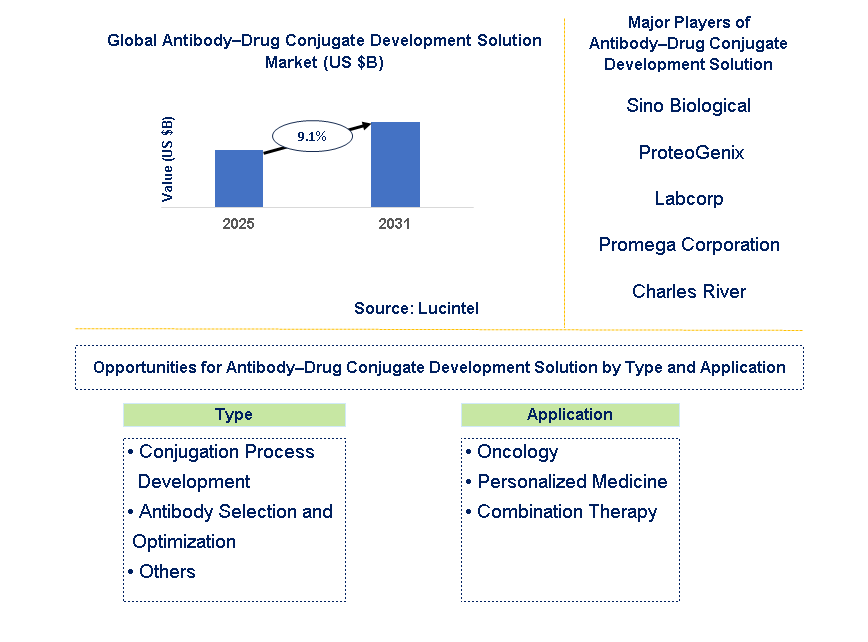
Key data points: The growth forecast = 9.1% annually for the next 7 years. Scroll below to get more insights. This market report covers Trends, opportunities and forecasts in antibody–drug conjugate development solution market to 2031 by type (conjugation process development, antibody selection and optimization, and others), application (oncology, personalized medicine, and combination therapy), and region (North America, Europe, Asia Pacific, and the Rest of the World)
We'll send your sample report shortly.
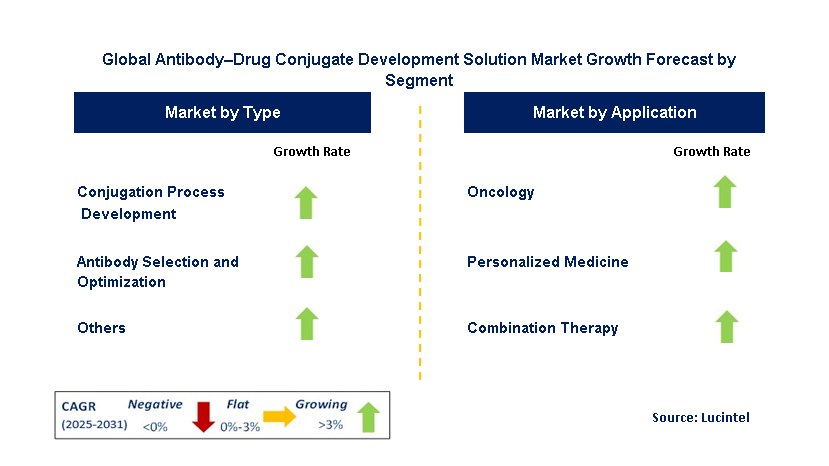
• Lucintel forecasts that, within the type category, conjugation process development is expected to witness higher growth over the forecast period.
• Within the application category, oncology is expected to witness the highest growth due to the increasing demand for targeted therapies.
• In terms of region, North America is expected to witness the highest growth over the forecast period due to the rising demand for targeted cancer therapies.
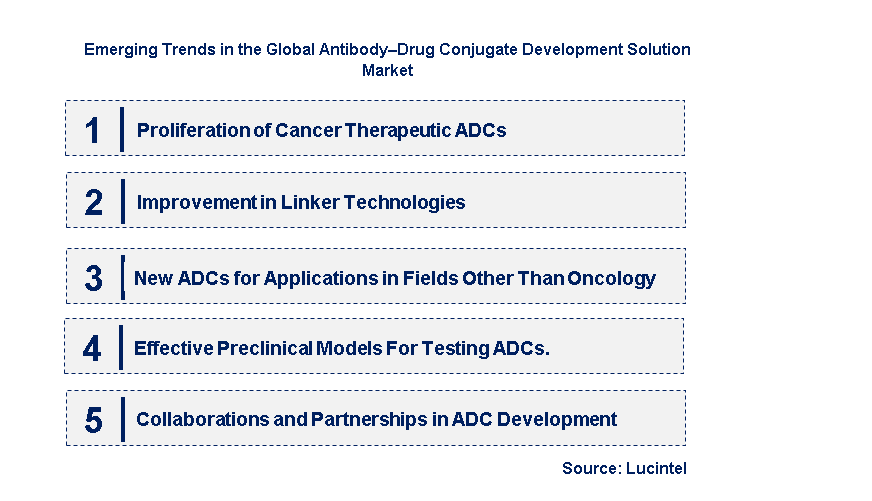
• Proliferation of Cancer Therapeutic ADCs: ADCs have emerged as a potent therapeutic option for consideration. This is fueled by the fact that cancer is the second leading cause of death globally after cardiovascular diseases According to WHO estimates, in 23 ADCs are projected to gain traction due to their higher efficacy in treating specifically identified cancer attributes like breast, lung, and blood cancers. ADCs are devised as the modern solution to targeted therapies for cancer. They fuse the usage of monoclonal antibodies with cytotoxic medications to treat tumors. They can attack tumors without affecting the other body organs.. They are predicted to revolutionize the oncology sector as the range of cancers treated with ADCs broadens.
• Improvement in Linker Technologies: Creating more sophisticated linkers is integral to ADC innovation. ADCs link the cytotoxic medication with the monoclonal antibody, and their stability and effectiveness are critical to the success of every ADC therapy. New linker technologies are making it possible to develop more precise and effective ADCs that operate properly. They provide better therapy because more cytotoxic agents can be delivered to the cancer cells while minimizing “wasting” the therapeutic agents on healthy tissues. With increased precision, the efficiency of ADCs is retained at a greater level while concentration from steady state is reduced. As linker technology improves, so will the precision and safety of ADC therapies for patients.
• New ADCs for Applications in Fields Other Than Oncology: ADCs have been developed primarily for oncology applications, but now applications in other non-oncological areas are being developed. Ad autoimmune disorders, cardiovascular diseases, and even some infectious diseases where targeted therapies are needed are now being explored. This trend is likely to shift the ADC market and broaden its scope, providing for a large number of undisserved therapeutic needs in medicine. This further suggests, that with these modifications to ADCs, there will be opening for other market opportunities for greatest benefit.
• Effective Preclinical Models For Testing ADCs.: Biomarker based targeting is a trend that is emerging that seeks to make ADCs more efficient and precise. If biomarkers are specifc to cancer, then ADCs can be constructed with such specificities in mind to enhance targeting, and thus reduce collateral damage to normal tissues of the body. This trend stems from the rapidly advancing world of genetic engineering and the new field of medicine that has developed known as "Companion Diagnostics," which permits the selection of the most appropriate patients for ADC therapy. As these approaches continue to develop, the ADC market will inevitably become more diverse through increased customization and better results for patients.
• Collaborations and Partnerships in ADC Development: Creating ADCs is quicker due to the collaboration between pharmaceutical companies, biotech companies, and universities. These alliances integrate the different skills that are required in drug development, antibody engineering, and clinical trials to enhance the effectiveness of the ADC therapies. Companies are forming strategic alliances to improve the development efficiency of ADCs, shorten the timeframes for market launch, and mitigate the financial burdens associated with research and development. These collaborations are imperative to move forward with the ADC pipeline and ensure that novel therapies reach patients in a timely manner. Developing trends of the ADC development market highlight progress in technology, targeting precision, and therapeutic focus areas. The enhancement of linker technologies, broadened disease targets, and biomarker driven tailored therapies are changing the market dynamics. As leading industry stakeholders work together more, the rate of ADC development will increase along with the availability of other beneficial therapeutic interventions for more patients, especially in cancer medicine.
• New ADC's: Recently approved ADC therapies for other types of cancer have been important achievements in the ADC development market. breast cancer, lung cancer, and hematologic malignancies have and continue to grow in popularity. The market has more confidence in ADCs, especially with new investor funding, and now there is validation in the clinical efficacy of ADCs. If these therapies work, then there is a good chance succeeding therapies will also be approved.
• Improvement In ADC Payloads: The cytotoxic drugs integrated with antibodies, also known as ADC payloads, have turned out to be an important aspect of making more effective therapies. Work is being done on designing more selective and powerful ADC payloads that would increase precision in targeting cancer while reducing harm to surrounding normal tissue. These improvements are increasing the therapeutic index of ADCs which increases their efficacy on solid tumors and hematological cancers. Next-generation payloads are anticipated to improve the clinical responses to ADC therapies.
• Enhanced Linker Technology Development: Advanced Development of ADCs are augmented by more stable and efficient linker which ADCs are expected to perform better. New innovations in linker technology enable the spatially controlled release of the cytotoxic agents at the target site, thus minimizing off-target effects and improving therapeutic efficacy. These advancements in technology also create an opportunity to design linkers which are stable in the harsh conditions of the body therefore ensuring that the drug payload is delivered to the cancer cells unchanged. These improvements are expected to positively impact the clinical performance of ADCs and promote their adoption into the market.
• Expanding Investments towards the Development of ADC: Growth of business investments from both the private and public domains are speeding up the development of ADCs. Pharmaceutical Corporations, Biotech companies, and Venture Capitalists are funding research and Development of ADCs for their potential application in Cancer and other diseases. This surge in funding fosters innovation in technologies regarding ADCs, helps in the clinical trials, and marketing of new ADCs. With the increase in funding, the speed of development will pick up resulting in many new breakthroughs in ADC therapy in the near future.
• Growing Interest in the ADCs of Solid Tumors: ADCs are now being developed for solid tumors aside from their traditionally used scope in hematologic cancers. There is now an increasing focus on overcoming challenges like the inability to accurately deliver ADCs to solid tumor sites. Preliminary advancements in drug delivery systems are being witnessed with the invention of new linker and payload technologies to create powerful ADCs for solid tumors. Consequently, ADCs are broadening their market beyond blood cancers and giving hope to patients suffering from solid tumors. The recent growth in the ADC market is tremendously aiding the advancement of cancer treatment and drug development. The improvement of payloads, linkers, and drug deliver systems are refining the specificity and potency of ADC therapies. Moreover, the new investments and approved therapies are fuelling the growth of the ADC market which has a scope to widen its applications beyond oncology to other diseases. These initiatives are improving the development of new therapies that are more effective and focused. As a result, patients are likely to receive better therapy outcomes with reduced adverse effects.
• Targeted Cancer Therapies: These are incredibly complex and advanced therapies that utilize drugs called monoclonal antibodies that have the capability to target a patient's specific tumor type. This is also known as an antibody-drug conjugate and proves to be promising in the treatment of breast cancer and lung cancer as it is highly specific and has less side effects compared to conventional ADCS. Other specific forms of cancer that have the potential to develop these specific drugs will be in high demand which include hematologic malignancies. Because of the continuous advancements in cancer treatment personalization, there will also be a higher targetobjectives for ADC’s bearing cancer types such breast, lung, and hematologic cancers.
• Regenerative Medicine and Non-Oncology Applications: Usually, ADCS are used in oncology. However, the applications that are non-specific to oncology and include regenerative medicine are also becoming apparent. These ADCS can potentially serve as a complete cure for autoimmune diseases, cardiovascular diseases, and other chronic illnesses. These new alternate uses of ADCS can help companies looking to extend their product range outside the traditional theages malignant space and access new unexploited markets.
• Partnerships and Collaborations with Research Institutions: Strategic partnerships with academic and research institutions provide promising pathways for the advancement of cutting-edge ADC therapies by analytically accelerating their growth. They can help in discovering new targets, improving drug delivery technologies, and refining patient selection methods. Partnering with leading research institutions enables companies to exploit external expertise and resources, thus fast-tracking the development and marketing of ADC therapies expanding their market reach.
• Expansion into Emerging Markets: Working towards Asia and Latin America is essential since these markets have the highest predicted growth rates for the overall ADC marketplace. With advancements in healthcare systems and a growing cancer burden in these areas, the need for advanced therapies, especially ADCs will continue to grow. Businesses targeting the ADC market with a focus on these regions will benefit from a flourishing patient population while simultaneously aiding the growth of the local healthcare industry.
• Finding Biomarkers and Companion Diagnostics: The creation of companion diagnostics to pinpoint patients that would benefit the most from ADC therapies provides an avenue for more targeted therapies. Through biomarker discovery and innovative diagnostics, companies can focus on specific subsets of patients to enhance treatment results. These trends will likely stimulate growth in the ADC market by increasing the accuracy of who would benefit from ADC therapies. The ADC development market is replete with opportunities for growth, including scaling up cancer therapies, other therapeutic areas, and venturing into new geographies. Advances in biomarker discovery and collaboration with research centers, along with the growing need for personalized medicine, will continue to drive the evolution of ADC development and the world as a whole.
• Sino Biological
• ProteoGenix
• Labcorp
• Promega Corporation
• Charles River Laboratories
• Sterling Pharma Solutions Limited
• Revvity
• WuXi Biologics
• Abzena
• Samsung Biologics
• Conjugation Process Development
• Antibody Selection and Optimization
• Others
• Oncology
• Personalized Medicine
• Combination Therapy
• North America
• Europe
• Asia Pacific
• The Rest of the World
• United States: In the United States, ADCs progress have been remarkable, especially in cancer therapeutics. Various ADCs therapies such as anti-breast and anti-hematologic cancer ADCS have attracted attention that increased interest in ADC development solutions. Major pharmaceutical companies and biotech firms are spending a fortune on research and collaboration for the betterment of ADCs. The U.S government also funded Braves for ADC researchers and there is considerable support from the regulatory side with the FDA quite active in granting approval to the Adenosine Deaminase Deficiency for clinical application. These changes are boosting the adoption of commercial ADC therapies and increasing the market opportunities in the country.
• China: Several local biotech firms are the country is positioning itself as a rapidly growing competitor for the ADC market. China's leading pharmaceutical industries are bolstered by government sponsored programs that promote innovation in biotech R and D. With the growing incidence of cancer and deficiency and the increasing need for new and therpeutic strategies, China is anticipated to emerge as the global ADC **development solutions** in the subsequent years.
• Germany: Germany is a large participant in the ADC development market considering the active involvement of its pharmaceutical and biotechnology industries in the innovation and commercialization of ADCs. German companies are working together with international biotech companies to improve the next generation of ADC therapies’ delivery systems and minimize off-target effects. Additionally, the well-established research and infrastructure in Germany, together with strong government support, allows rapid progress in ADC technologies. Also, Germany remains one of the forerunners in clinical testing of ADCs and, thus, facilitates the development of more effective cancer treatments and Germany’s position in the global ADC market.
• India: India is progressively placing more attention on ADCs with several biotech companies developing these therapies for cancer treatment. The Indian market is still nascent compared to other countries, but it has tremendous potential considering the rising number of cancer cases as well as the increasing demand for effective therapies. Government measures to strengthen biotechnology healthcare infrastructure are boosting the development of ADC solutions in India. In addition, the increasing proficiency in manufacturing generic drugs is allowing India to make its mark in the global market of ADCs by providing inexpensive ADC therapies.
• Japan: Japan is a formidable force in the ADC Development market with strong prospects in pharmaceutical and medical technology research and development. Japanese firms are at the forefront of developing ADCs for solid tumors and hematologic malignancies. Japan is supporting ADC innovations through funding and regulation, specifically for oncology research and development. Japan’s investment in the development of precision medicine and advanced healthcare system is propelling the creation of patient-specific ADCs. Japan is projected to make further substantial contributions to the global ADC market because of extensive domestic research and international cooperation.


• Sino Biological
• ProteoGenix
• Labcorp
• Promega Corporation
• Charles River Laboratories
• Sterling Pharma Solutions Limited
• Revvity
• WuXi Biologics
• Abzena
• Samsung Biologics Q5. Which antibody–drug conjugate development solution market segment will be the largest in future? Answer: Lucintel forecasts that, within the type category, conjugation process development is expected to witness higher growth over the forecast period. Q6. In antibody–drug conjugate development solution market, which region is expected to be the largest in next 5 years? Answer: In terms of region, North America is expected to witness the highest growth over the forecast period due to the rising demand for targeted cancer therapies. Q7. Do we receive customization in this report? Answer: Yes, Lucintel provides 10% customization without any additional cost.


Choose a license that fits your team. Instant PDF delivery.
Prices exclude taxes. Instant delivery. Custom licensing available on request.
Market Report · July 15, 2026
Market Report · June 26, 2026
Market Report · May 18, 2026
Trusted partner for strategic intelligence and business growth


Receive a complimentary market analysis tailored to your industry. Our analysts will identify key growth opportunities and competitive dynamics specific to your business.

Market size, growth rate, and key trend analysis for your specific sector.

Top competitor positioning and market share analysis.

Strategic recommendations backed by data-driven insights.
Get curated market intelligence and competitive moves straight to your inbox.
By subscribing, you agree to receive our monthly insights. Unsubscribe anytime.
Receive a complimentary market analysis tailored to your industry. Our analysts will identify key growth opportunities and competitive dynamics specific to your business.
Market size, growth rate, and key trend analysis for your specific sector.
Top competitor positioning and market share analysis.
Strategic recommendations backed by data-driven insights.
Get curated market intelligence, emerging trends, and competitive moves straight to your inbox each month.
By subscribing, you agree to receive our monthly insights. Unsubscribe anytime.
We'll send your sample report shortly.