
Market Report · July 31, 2026

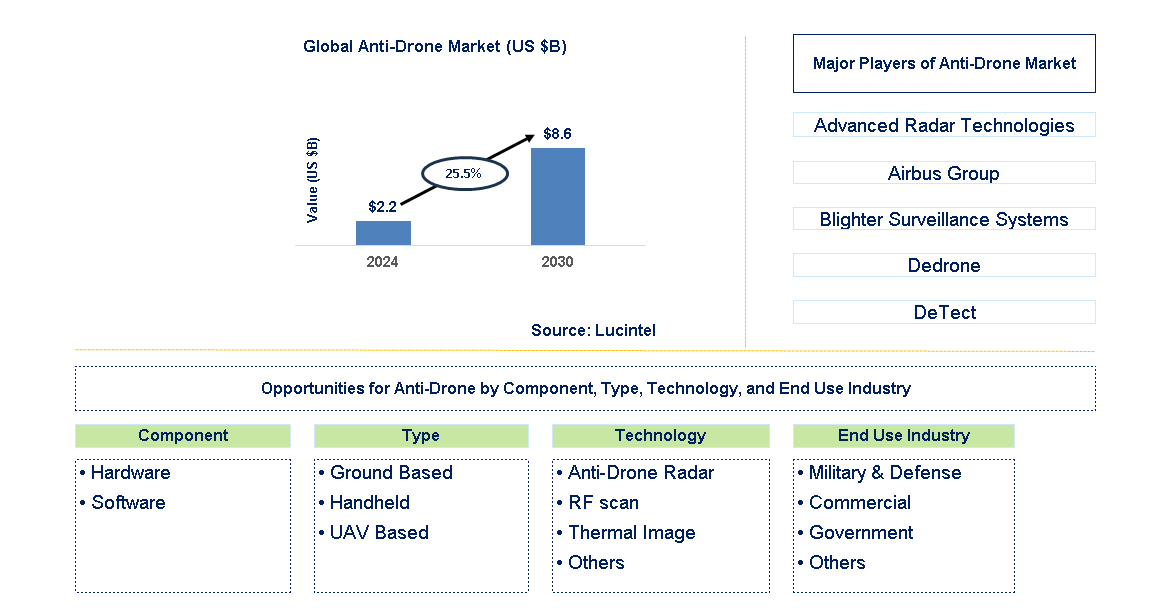
Key data points: The market size in 2030 = $8.6 billion, growth forecast = 25.5% annually next 6 years. Scroll below to get more insights. This market report covers trends, opportunities, and forecast in the global anti-drone market to 2030 by component (hardware and software), type (ground based, handheld, and UAV based), technology (anti-drone radar, RF scan, thermal image, and others), end use industry (military & defense, commercial, government, and others), and region (North America, Europe, Asia Pacific, and the Rest of the World)
We'll send your sample report shortly.
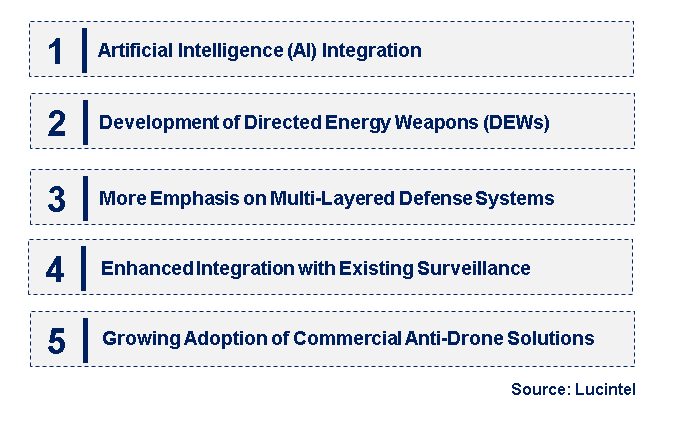
• Artificial Intelligence (AI) Integration: AI will, therefore, feature as an integral part of anti-drone systems while enhancing their detection, identification, and neutralization capabilities with greater precision. The artificial intelligence-driven systems analyze patterns, reduce response time, and minimize false positives. This trend is viewed as important given the growing sophistication of drones, which call for higher-order algorithms in managing complex airspace and distinguishing threats from benign objects.
• Development of Directed Energy Weapons (DEWs): High-energy lasers and microwave systems are two of the biggest gaining factors of prominence in the anti-drone market for directed energy weapons. For their effectiveness, there is a need for precision targeting with assured minimal collateral damage. Development will be driven by a growing need for scalable and adaptable countermeasures at different scales of drone threats.
• More Emphasis on Multi-Layered Defense Systems: There is an increased utilization of multilayered defense solutions that integrate radar, electronic warfare, and kinetic solutions. These allow for better perspectives when dealing with different types and classes of drones, besides varied threat scenarios. Multilayer systems will provide comprehensive defense by bringing various technologies together to offer protection, which is robust against a wide variety of drone-related threats.
• Enhanced Integration with Existing Surveillance Infrastructure; Anti-drone technologies are increasingly being integrated into larger surveillance and security systems. In this way, detection and response can be much more fluent and integrated into existing systems, thus extending their overall security. Integration enhances situational awareness and therefore offers better control of the drone threat within extended frames of security.
• Growing Adoption of Commercial Anti-Drone Solutions: These anti-drone solutions are finding applications in commercial sectors because of the demand to protect sensitive sites and critical infrastructure. Such applications represent wide expansion outside of its conventional military and government use. Commercial usage is driving innovation in developing and deploying cost-effective and scalable solutions that can help meet the demands of different industries. These emerging trends drive innovation within the anti-drone market, further extending the solution set. Integration of advanced technologies with comprehensive defense strategies holds the key to assurance of counter-measures against the evolving drone threat landscape.
• Advanced Radar Systems: Recent decades have seen great enhancements in drone detection and tracking with advancements related to radar technology. Newer radar systems have higher resolution and long-range capabilities that enable the early detection of small-sized, low-flying drones. Such advancement is crucial for airspace security and gives timely responses to any perceived threat.
• Electronic Countermeasures: We can also see in these respects that there is a wide range of improvements in electronic countermeasures, including jamming and spoofing technologies. Such systems interfere with communications between drones and their operators, taking them out of action-in effect, neutering them. More sophisticated electronic countermeasures are being developed to act on drone threats more precisely and effectively.
• Drone-Killing Drones: A new approach to countering the threats of UAVs would be the development of killing drones. Counter-drones may independently or remotely intercept and neutralize an enemy drone. Thus, this development could provide a dynamic, flexible solution for handling several swarms of drones and enhancing overall airspace security.
• Integration of Artificial Intelligence (AI): AI is increasingly integrated into anti-drone systems for improvements in the spheres of detection, identification, and response. AI-driven systems analyze data in real time, and with enhanced effectiveness and precision, this allows them to detect countermeasures more accurately. This will be an essential integration to take the increasing levels of complexity from drone threats forward. Protection can't be ensured unless this is dealt with.
• Improved Regulatory Frameworks: Due to these insecurities related to drones, the governments are putting in place quite strict regulatory mechanisms. These new regulations focus on the issues of registration, operational restrictions, and penalties for violation of laws. Such regulatory measures, therefore, support the minimization of risks emanating from unauthorized flying of drones and offer better airspace security. These developments mark the rapid progress of anti-drone technologies and put greater emphasis on comprehensive solutions against emerging threats. The continuous evolution of technologies and regulatory measures shapes the future in the anti-drone market.
• Defense and Military Applications: The defense and military is a huge potential for anti-drone solution growth. Advanced countermeasures will be one of the most critical factors in ensuring the safety and security of national security and military assets against the threats by drones. Strategic investment is needed in the development of radar systems, electronic warfare, and technologies that kill drones-assuring strategic advantages in addition to operational security.
• Protection of Critical Infrastructure: Another great opportunity for anti-drone technologies lies in protection against critical infrastructure, including but not limited to power plants, transport centers, and communication networks. Solutions designed for these environments can prevent disruptions and ensure protection of the essential services. Thus, high-performance anti-drone systems are used as demands for strong security in these fields increase.
• Public Safety and Law Enforcement: Anti-drone technologies are also being widely adopted in the public safety and law enforcement sectors, particularly with events involving urban area security and large public gatherings. Detection systems and electronic countermeasures are thus considered some of the very important technologies in attempting to prevent unauthorized activities of drones and ensuring public safety.
• Commercial and Industrial Applications: Commercial and Industrial-Logistics, Agriculture, Manufacturing: All these are slowly recognizing the need for anti-drone solutions to protect operations and assets. Anti-drone solutions that can help deal with problems like drone theft, surveillance, and disruption will be or are likely to become crucial as more drones enter service in these sectors.
• Aviation and Airport Security: Aviation and airport security are one of the most vital sectors in anti-drone technology because drones pose a great threat to aircraft and airport operations. For protection in airspace, detection and neutralization mechanisms need to be developed to ensure flying operations safely. This domain thus provides large scope for developing tailored anti-drones solutions. These could be potential avenues for strategic growth, given the wide utilization and further areas of influence that are coming from research into anti-drone technology. Developmentally, this is furthered as the market expands in order to bring innovation with regard to future security matters.
• Advanced Radar Technologies
• Airbus Group
• Blighter Surveillance Systems
• Dedrone
• DeTect
• Droneshield
• Enterprise Control Systems
• Israel Aerospace Industries
• Liteye Systems
• Lockheed Martin Corporation
• Hardware
• Software
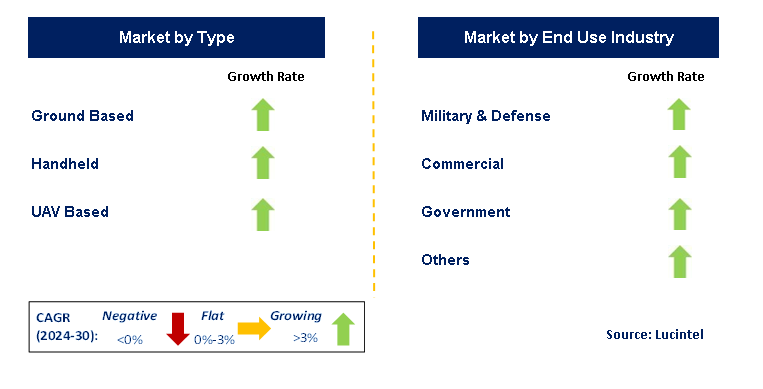
• Ground Based
• Handheld
• UAV Based
• Anti-Drone Radar
• RF scan
• Thermal Image
• Others
• Military & Defense
• Commercial
• Government
• Others
• North America
• Europe
• Asia Pacific
• The Rest of the World
• United States: The US developed wide-ranging anti-drone capabilities, with a particular focus on the integration of radar systems and advanced electronic warfare technologies. Meanwhile, the DoD has actively tested and fielded various systems, including the Coyote drone and the Directed Energy System, a laser system that neutralizes threats with high-energy lasers. There has also been an uptick in public-private partnerships to further the rapid development and fielding of new technologies. The U.S. places a priority on cybersecurity measures against anti-drone systems as a means of protecting them against possible hacking.
• China: Detection systems and electronic countermeasures, both advanced and hi-tech, were being highly developed by China. Advanced radar and jamming systems for both commercial and military drones have been set up on the ground as part of the deployed Chinese army. A number of investments are also being made by the country in AI-driven systems that beef up precision and effectiveness in the detection and neutralization of drones. In this regard, it is indicated that the People's Republic of China underlines a great integration of anti-drone systems with more general surveillance structures as a part of strategic set of operations aimed at keeping airspace under control and neutralizing an emerging threat.
• Germany: While this happens, Germany stands in the frontline of integration of so far unparalleled technologies into its anti-drone solutions, such as radar systems and drone detection algorithms. The German military and police have been purchasing complex counter-drone systems comprising both kinetic and non-kinetic measures of counters. Significantly, Germany also pursues cooperation with European partners on integrated anti-drone systems, which will support regional security and meet cross-border threats. The emphasis on research and development is pushing forward advancements in drone detection and mitigation technologies.
• India: India has been making several attempts in the development of anti-drone systems equipped with state-of-the-art detection and neutralization capabilities. From radar systems to drone-killing drones, different counter-drone technologies have been tried out by the Indian defense sector. There has also been a call for integrating the latest technologies into the existing defense setup to protect sensitive areas and important infrastructure. Further, India is also working on international partnership approaches to boost its technological capabilities and respond effectively to the growing threat from this area.
• Japan: Japan has been developing anti-drone technology by setting up a radar and electronic countermeasure system. Advanced drone detection systems, which will have artificial intelligence to increase the accuracy and speed of detection, are also under development in the country. Moreover, Japanese strategy ranges from boosting defenses against drones at coasts and critical infrastructure. The Japanese government is actively investing in research and development to ensure its anti-drone capabilities keep pace with emerging threats and technological advancements.


• Advanced Radar Technologies
• Airbus Group
• Blighter Surveillance Systems
• Dedrone
• DeTect
• Droneshield
• Enterprise Control Systems
• Israel Aerospace Industries
• Liteye Systems
• Lockheed Martin Corporation Q6. Which anti-drone market segment will be the largest in future? Answer: Lucintel forecasts that ground based is expected to witness the highest growth over the forecast period because of increasing speed of response to ground-level drone threats, including army bases and other sensitive areas. Q7. In anti-drone market, which region is expected to be the largest in next 5 years? Answer: North America will remain the largest region over the forecast period because of an increase in the frequency of terrorist attacks and security breaches caused by unknown drones, strict restrictions, safeguarding vital infrastructure, prominent occasions, and military uses. Q.8 Do we receive customization in this report? Answer: Yes, Lucintel provides 10% customization without any additional cost.


Choose a license that fits your team. Instant PDF delivery.
Prices exclude taxes. Instant delivery. Custom licensing available on request.
Market Report · July 31, 2026
Market Report · July 31, 2026
Market Report · July 31, 2026
Trusted partner for strategic intelligence and business growth


Receive a complimentary market analysis tailored to your industry. Our analysts will identify key growth opportunities and competitive dynamics specific to your business.

Market size, growth rate, and key trend analysis for your specific sector.

Top competitor positioning and market share analysis.

Strategic recommendations backed by data-driven insights.
Get curated market intelligence and competitive moves straight to your inbox.
By subscribing, you agree to receive our monthly insights. Unsubscribe anytime.
Receive a complimentary market analysis tailored to your industry. Our analysts will identify key growth opportunities and competitive dynamics specific to your business.
Market size, growth rate, and key trend analysis for your specific sector.
Top competitor positioning and market share analysis.
Strategic recommendations backed by data-driven insights.
Get curated market intelligence, emerging trends, and competitive moves straight to your inbox each month.
By subscribing, you agree to receive our monthly insights. Unsubscribe anytime.
We'll send your sample report shortly.