
'
...

The Impact of COVID-19 is included in Anti-aging Drug Market Report. Buy it today to get an advantage.

Request the impact of COVID-19 on your product or industry


Anti-aging Drug Market Trends and Forecast

The future of the global anti-aging drug market looks promising with opportunities in the hospital and beauty parlor markets. The global anti-aging drug market is expected to grow with a CAGR of 11.9% from 2025 to 2031. The major drivers for this market are the increasing demand for age related disease management, the rising focus on longevity & wellness therapies, and the growing geriatric population seeking anti aging solutions.

• Lucintel forecasts that, within the type category, dermal filler is expected to witness higher growth over the forecast period.
• Within the application category, hospital is expected to witness higher growth.
• In terms of region, APAC is expected to witness the highest growth over the forecast period.
Gain valuable insights for your business decisions with our comprehensive 150+ page report. Sample figures with some insights are shown below.
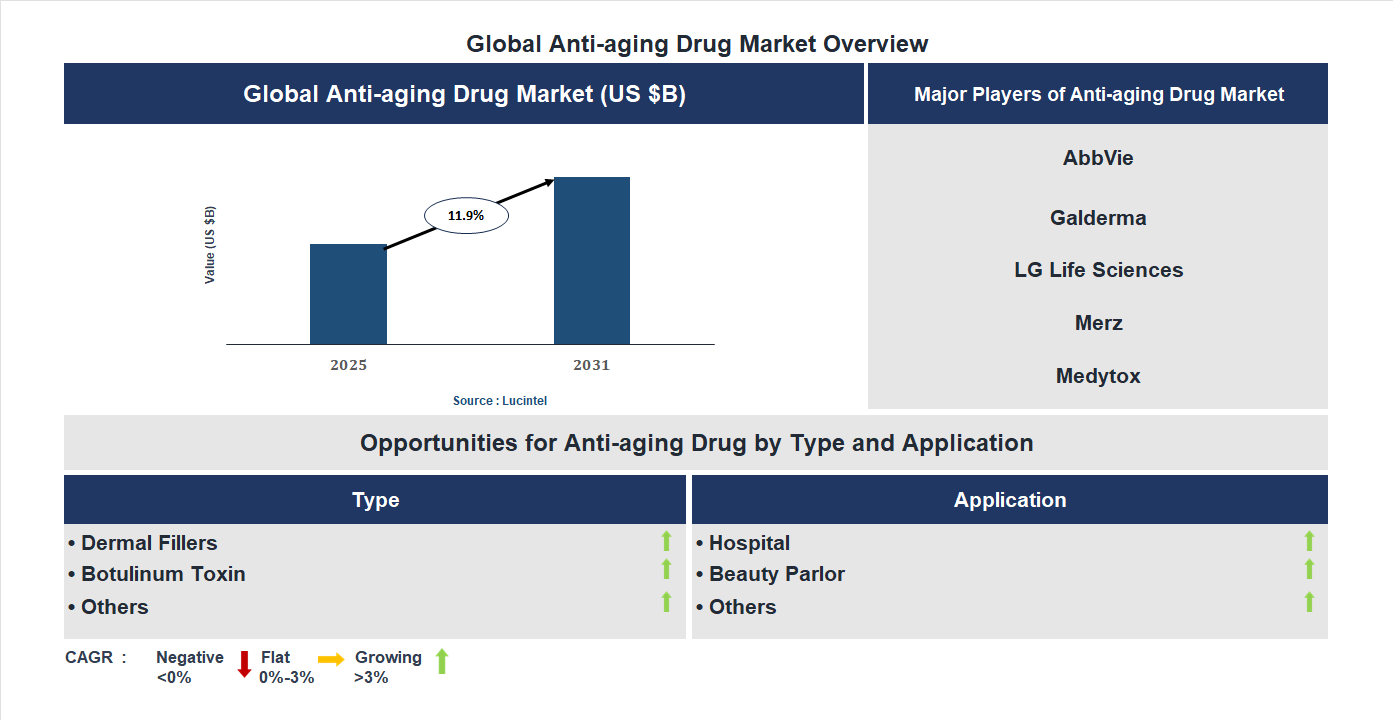
Anti-aging Drug Market Trends and Forecast

Emerging Trends in the Anti-aging Drug Market

The anti-aging drug market is experiencing rapid growth driven by increasing aging populations, technological advancements, and a rising focus on health and wellness. As consumers seek ways to extend lifespan and improve quality of life, innovative solutions are emerging. This market is characterized by a blend of scientific breakthroughs, regulatory developments, and shifting consumer preferences. The following trends highlight the key developments shaping this evolving landscape, reflecting how scientific, technological, and societal factors are converging to redefine anti-aging strategies and market opportunities.

• Personalized Anti-aging Solutions: The trend toward personalized medicine is transforming the anti-aging market by offering tailored treatments based on individual genetic profiles. Advances in genomics and biomarker research enable the development of customized therapies that target specific aging processes. This approach enhances efficacy and reduces side effects, appealing to consumers seeking more effective and individualized options. As technology becomes more accessible, personalized anti-aging solutions are expected to dominate the market, fostering a shift from generic treatments to bespoke interventions.
• Increased Investment in Regenerative Medicine: Investment in regenerative medicine, including stem cell therapy and tissue engineering, is surging within the anti-aging sector. These technologies aim to repair or replace damaged tissues and organs, addressing the root causes of aging rather than just symptoms. The growing body of research and successful clinical trials are attracting both public and private funding. This trend is likely to lead to innovative therapies that significantly slow or reverse aging effects, positioning regenerative medicine as a cornerstone of future anti-aging strategies.
• Rising Consumer Demand for Natural and Holistic Products: Consumers are increasingly favoring natural, plant-based, and holistic approaches to anti-aging. This shift is driven by concerns over synthetic chemicals and a desire for safer, more sustainable options. Market offerings now include herbal supplements, organic skincare, and lifestyle interventions such as diet and exercise programs. This trend is expanding the market beyond pharmaceuticals to include wellness and lifestyle products, emphasizing prevention and overall health, and appealing to a broader demographic seeking holistic aging solutions.
• Technological Integration and Digital Health: The integration of digital health technologies, such as wearable devices, mobile apps, and AI-driven diagnostics, is revolutionizing anti-aging care. These tools enable real-time monitoring of health metrics, personalized recommendations, and early detection of age-related issues. The data-driven approach enhances treatment precision and encourages proactive health management. As technology becomes more sophisticated and accessible, digital health is expected to play a pivotal role in preventive anti-aging strategies, making personalized care more efficient and widespread.
• Regulatory and Ethical Developments: As anti-aging therapies advance, regulatory frameworks and ethical considerations are gaining prominence. Governments and agencies are working to establish guidelines for safety, efficacy, and ethical use of emerging treatments like gene editing and stem cell therapies. This trend influences market growth by ensuring consumer protection and fostering public trust. However, it also presents challenges related to approval processes and ethical debates surrounding lifespan extension. Navigating these developments will be crucial for the responsible growth and acceptance of anti-aging innovations.

In summary, these trends are collectively reshaping the anti-aging drug market by fostering innovation, emphasizing personalization, integrating technology, and addressing ethical considerations. They are driving a shift toward more effective, safe, and holistic approaches to aging, ultimately expanding market opportunities and redefining how society approaches longevity and health.
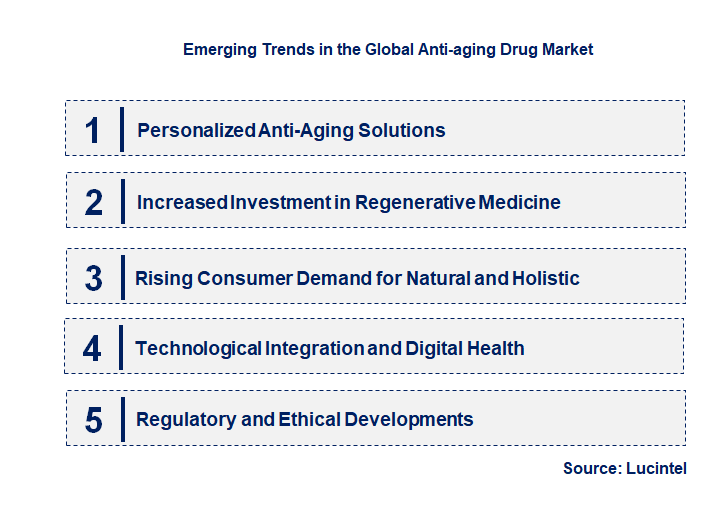
Emerging Trends in the Anti-aging Drug Market

Recent Development in the Anti-aging Drug Market

The anti-aging drug market has experienced significant growth driven by increasing aging populations, technological advancements, and rising awareness of health and wellness. As consumers seek to extend lifespan and improve quality of life, pharmaceutical companies and biotech firms are investing heavily in research and development. Recent developments reflect a shift towards personalized medicine, innovative drug formulations, and regulatory changes that facilitate faster market entry. These trends are transforming the landscape, making anti-aging solutions more accessible and effective. The following key developments highlight the current trajectory of this dynamic market and its future potential.

• Advances in Senolytic Drugs: Researchers have made progress in developing senolytic drugs that selectively eliminate senescent cells, which contribute to aging and age-related diseases. These drugs have shown promising results in preclinical trials, potentially delaying aging processes and improving healthspan. Their success could lead to new therapeutic options that target fundamental aging mechanisms, significantly impacting longevity and age-related health management.
• Personalized Anti-aging Therapies: The market is witnessing a shift towards personalized medicine, utilizing genetic and biomarker data to tailor anti-aging treatments. This approach enhances efficacy and reduces side effects, leading to more targeted interventions. Personalized therapies are expected to increase consumer confidence and adoption, fostering market growth and opening avenues for customized drug development.
• Regulatory Approvals and Policy Changes: Regulatory agencies are beginning to adapt to the anti-aging sector, providing clearer pathways for drug approval. Recent approvals of certain anti-aging compounds and supportive policies are encouraging innovation and investment. These regulatory shifts are reducing time-to-market for new drugs, accelerating availability, and boosting investor confidence in the sector.
• Growth of Natural and Supplement-Based Products: There is a rising consumer preference for natural and supplement-based anti-aging products, driven by concerns over synthetic drugs safety. Companies are expanding their portfolios to include plant-based compounds, antioxidants, and nutraceuticals. This trend broadens market reach, caters to a wider demographic, and complements pharmaceutical developments, contributing to overall market expansion.
• Integration of Digital Technologies: The incorporation of AI, big data, and wearable health devices is revolutionizing anti-aging research and treatment monitoring. These technologies enable real-time health tracking, predictive analytics, and personalized treatment adjustments. Their integration enhances treatment outcomes, improves patient engagement, and fosters innovation, positioning the market at the forefront of digital health transformation.

In summary, recent developments in the anti-aging drug market are driving innovation, improving treatment personalization, and streamlining regulatory processes. These changes are making anti-aging solutions more effective, accessible, and aligned with consumer preferences. As a result, the market is poised for sustained growth, with increased investment, technological integration, and expanded product offerings shaping its future trajectory.

Strategic Growth Opportunities in the Anti-aging Drug Market

The anti-aging drug market is experiencing rapid growth driven by increasing aging populations, technological advancements, and rising awareness of health and wellness. As consumers seek to extend lifespan and improve quality of life, pharmaceutical companies are investing in innovative solutions. This evolving landscape presents several strategic growth opportunities across various applications, each contributing to market expansion. Understanding these opportunities is essential for stakeholders aiming to capitalize on emerging trends and meet the growing demand for effective anti-aging therapies.

• Anti-aging skincare products: Expansion of topical formulations and serums targeting skin aging signs, such as wrinkles and fine lines, enhances consumer appeal and drives sales. These products benefit from technological innovations, offering more effective and longer-lasting results, thus attracting a broader customer base.
• Hormonal therapies: Development of advanced hormonal treatments, including growth hormone and estrogen therapies, addresses age-related hormonal decline. These therapies improve vitality and physical health, making them a significant growth segment with high demand among aging populations.
• Regenerative medicine: Stem cell therapy and tissue engineering offer promising solutions for age-related tissue degeneration. These innovative treatments have the potential to restore function and improve quality of life, positioning regenerative medicine as a key growth driver in the market.
• Nutraceuticals and supplements: The rising popularity of anti-aging dietary supplements, such as antioxidants and collagen boosters, provides accessible options for consumers. These products support overall health and skin vitality, fueling market growth through increased consumer adoption.
• Personalized anti-aging treatments: Customized therapies based on genetic and biomarker analysis enable targeted interventions. This approach enhances treatment efficacy and reduces side effects, attracting a premium segment and fostering market expansion.

In summary, these growth opportunities are significantly impacting the anti-aging drug market by diversifying product offerings, increasing consumer engagement, and fostering innovation. As demand for effective, personalized, and accessible anti-aging solutions grows, the market is poised for sustained expansion and technological advancement.

Anti-aging Drug Market Driver and Challenges

The anti-aging drug market is influenced by a complex interplay of technological advancements, economic factors, and regulatory frameworks. Rapid innovations in biotechnology and pharmaceuticals have propelled the development of novel anti-aging therapies, attracting significant investments. Economic growth in emerging markets has increased consumer spending on health and wellness, fueling market expansion. Additionally, evolving regulatory policies aim to facilitate the approval and commercialization of anti-aging drugs, although they also pose challenges. These factors collectively shape the market landscape, creating opportunities for growth while presenting hurdles that companies must navigate carefully to succeed in this competitive environment.

The factors responsible for driving the anti-aging drug market include:-
• Technological Innovations: The development of advanced biotechnologies, such as gene editing and regenerative medicine, has enabled the creation of more effective anti-aging therapies. These innovations improve drug efficacy and safety, attracting both investors and consumers eager for longevity solutions. As research progresses, the pipeline of potential drugs expands, fostering market growth. Moreover, digital health tools and personalized medicine approaches are enhancing treatment customization, further boosting demand. The integration of AI and big data analytics accelerates drug discovery, reducing time-to-market and costs, which benefits manufacturers and consumers alike.
• Increasing Aging Population: The global rise in the elderly demographic is a significant driver. As life expectancy increases, the demand for anti-aging solutions grows correspondingly. Older adults seek therapies to improve quality of life, reduce age-related diseases, and maintain vitality. This demographic shift creates a substantial market segment, encouraging pharmaceutical companies to invest in anti-aging research. Governments and healthcare providers are also prioritizing aging-related health issues, leading to increased funding and awareness. The expanding aging population ensures sustained demand, making anti-aging drugs a lucrative sector with long-term growth prospects.
• Rising Consumer Awareness and Preference for Wellness: Growing awareness about health and wellness among consumers is fueling demand for anti-aging products. People are increasingly proactive about aging gracefully, seeking preventive and regenerative therapies. Media, social platforms, and celebrity endorsements amplify awareness, influencing consumer behavior. This trend encourages pharmaceutical companies to develop innovative products tailored to consumer preferences, including supplements, topical treatments, and prescription drugs. The desire for a youthful appearance and improved health outcomes drives market expansion. Additionally, the shift towards holistic health approaches complements pharmaceutical solutions, creating a broader market ecosystem.
• Investment and Funding in R&D: The anti-aging drug sector benefits from substantial investments from venture capitalists, pharmaceutical giants, and government agencies. Funding accelerates research and development activities, leading to the discovery of novel compounds and therapies. Increased financial support reduces the time and costs associated with bringing new drugs to market, fostering innovation. Strategic collaborations and partnerships further enhance R&D capabilities. As investors recognize the markets potential, funding continues to grow, ensuring a steady pipeline of anti-aging solutions. This financial backing is crucial for overcoming scientific and regulatory hurdles, ultimately driving market growth.

The challenges in the anti-aging drug market are:
• Regulatory Hurdles and Approval Delays: The development of anti-aging drugs faces stringent regulatory scrutiny to ensure safety and efficacy. Regulatory agencies require extensive clinical trials, which are time-consuming and costly. Delays in approval processes can hinder market entry and reduce profitability. Moreover, the lack of standardized definitions and endpoints for aging-related therapies complicates regulatory pathways. Navigating diverse regulations across regions adds complexity, increasing costs and timeframes. These hurdles can discourage investment and slow innovation, impacting the overall growth trajectory of the market.
• Ethical and Safety Concerns: Ethical debates surrounding anti-aging treatments, such as the implications of extending human lifespan, pose challenges. Concerns about equitable access, potential misuse, and long-term safety risks hinder acceptance. Uncertainties about side effects and unintended consequences of novel therapies create apprehension among regulators and consumers. Ensuring safety requires rigorous testing, which prolongs development timelines. Ethical considerations also influence public perception and policy-making, potentially restricting market expansion. Addressing these concerns is essential for sustainable growth but remains a significant obstacle.
• High Cost and Limited Accessibility: The high costs associated with research, development, and manufacturing of anti-aging drugs translate into expensive treatments. This limits accessibility for a broad consumer base, especially in low- and middle-income countries. Cost barriers restrict market penetration and adoption, creating disparities in healthcare access. Additionally, insurance coverage for anti-aging therapies is limited, further impeding affordability. The economic burden on consumers and healthcare systems could slow market growth and lead to ethical debates about resource allocation. Making these therapies affordable and accessible remains a critical challenge for industry stakeholders.

In summary, the anti-aging drug market is driven by technological innovations, demographic shifts, consumer awareness, and substantial R&D investments. However, regulatory complexities, ethical concerns, and high costs pose significant challenges. These factors collectively influence the markets growth trajectory, requiring strategic navigation by industry players. While opportunities for expansion are substantial, addressing these hurdles is essential for sustainable development. Overall, the markets future depends on balancing innovation with regulatory compliance and affordability, ensuring that anti-aging therapies reach a broader population and contribute to healthier, longer lives.

List of Anti-aging Drug Companies

Companies in the market compete on the basis of product quality offered. Major players in this market focus on expanding their manufacturing facilities, R&D investments, infrastructural development, and leverage integration opportunities across the value chain. With these strategies anti-aging drug companies cater increasing demand, ensure competitive effectiveness, develop innovative products & technologies, reduce production costs, and expand their customer base. Some of the anti-aging drug companies profiled in this report include-
• AbbVie
• Galderma
• LG Life Sciences
• Merz
• Medytox
• Hugel
• Croma-Pharma
• Beijing IMEIK
• Bloomage Bio
• Elravie

Anti-aging Drug Market by Segment

The study includes a forecast for the global anti-aging drug market by type, application, and region.

Anti-aging Drug Market by Type [Value from 2019 to 2031]:


• Dermal Fillers
• Botulinum Toxin
• Others

Anti-aging Drug Market by Application [Value from 2019 to 2031]:


• Hospital
• Beauty Parlor
• Others

Anti-aging Drug Market by Region [Value from 2019 to 2031]:


• North America
• Europe
• Asia Pacific
• The Rest of the World

Country Wise Outlook for the Anti-aging Drug Market

The anti-aging drug market has experienced significant growth driven by increasing aging populations, technological advancements, and rising consumer demand for longevity and healthspan extension. Countries are investing heavily in research and development to create innovative solutions that address age-related decline. Regulatory landscapes are evolving to accommodate new therapies, while collaborations between biotech firms and academic institutions are accelerating progress. Market dynamics vary across regions, influenced by economic factors, healthcare infrastructure, and cultural attitudes toward aging. This global trend reflects a broader shift toward proactive health management and personalized medicine, shaping the future of anti-aging interventions worldwide.

• United States: The US market has seen rapid innovation with the approval of several novel anti-aging therapies and supplements. Major biotech firms are investing in gene therapy, senolytics, and NAD+ boosters. Regulatory agencies are working to streamline approval processes for anti-aging drugs, fostering a competitive environment. Consumer interest remains high, supported by extensive research and clinical trials. The US also witnesses increased funding for aging research, with government agencies like NIH prioritizing longevity studies. Market growth is driven by a combination of technological advancements and a large aging population seeking healthspan extension.
• China: Chinas anti-aging drug market is expanding swiftly, supported by government initiatives promoting biotech innovation. Local companies are developing herbal and traditional medicine-based anti-aging products alongside advanced biotechnologies. The government’s focus on aging population management has led to increased funding for research and development. E-commerce platforms facilitate widespread distribution of anti-aging products, boosting accessibility. Chinese consumers are increasingly adopting personalized anti-aging solutions, integrating traditional practices with modern science. The market is characterized by rapid growth, with domestic firms gaining global recognition through innovative formulations and affordable pricing.
• Germany: Germanys market emphasizes scientific validation and regulatory compliance, with a focus on clinical research and safety. Leading pharmaceutical companies are investing in research on telomeres, antioxidants, and hormonal therapies. The country’s strong healthcare infrastructure supports rigorous testing and approval processes. Consumer awareness about the importance of scientifically backed anti-aging products is high, leading to demand for premium, evidence-based solutions. Germany also collaborates with European institutions to develop innovative therapies. The aging population and increasing health consciousness are key drivers, positioning Germany as a leader in safe and effective anti-aging interventions within Europe.
• India: The Indian anti-aging market is witnessing rapid growth driven by rising disposable incomes and increasing awareness of health and wellness. Local startups and traditional medicine practitioners are integrating Ayurveda with modern biotechnology to develop affordable anti-aging products. The expanding middle class seeks accessible solutions for aging concerns, fueling demand for herbal and natural remedies. Government initiatives to promote healthcare innovation and research are supporting market development. E-commerce and digital marketing are playing vital roles in reaching rural and urban consumers. The market is characterized by a blend of traditional and modern approaches, with a focus on holistic health and longevity.
• Japan: Japans anti-aging market is highly advanced, reflecting its status as one of the worlds oldest populations. The country invests heavily in research on regenerative medicine, stem cell therapies, and anti-aging nutraceuticals. Regulatory frameworks are strict, ensuring safety and efficacy of new products. Japanese consumers prefer scientifically proven, high-quality solutions, often combining traditional practices with cutting-edge science. The government supports aging research through funding and policy initiatives. Market growth is driven by a focus on maintaining quality of life and independence among seniors. Japan remains a global leader in innovative anti-aging therapies, emphasizing longevity and healthy aging.

Lucintel Analytics Dashboard

Features of the Global Anti-aging Drug Market

Market Size Estimates: Anti-aging drug market size estimation in terms of value ($B).
Trend and Forecast Analysis: Market trends (2019 to 2024) and forecast (2025 to 2031) by various segments and regions.
Segmentation Analysis: Anti-aging drug market size by type, application, and region in terms of value ($B).
Regional Analysis: Anti-aging drug market breakdown by North America, Europe, Asia Pacific, and Rest of the World.
Growth Opportunities: Analysis of growth opportunities in different types, applications, and regions for the anti-aging drug market.
Strategic Analysis: This includes M&A, new product development, and competitive landscape of the anti-aging drug market.
Analysis of competitive intensity of the industry based on Porter’s Five Forces model.

Lucintel Consulting Services

FAQ

Q1. What is the growth forecast for anti-aging drug market?
Answer: The global anti-aging drug market is expected to grow with a CAGR of 11.9% from 2025 to 2031.
Q2. What are the major drivers influencing the growth of the anti-aging drug market?
Answer: The major drivers for this market are the increasing demand for age related disease management, the rising focus on longevity & wellness therapies, and the growing geriatric population seeking anti aging solutions.
Q3. What are the major segments for anti-aging drug market?
Answer: The future of the anti-aging drug market looks promising with opportunities in the hospital and beauty parlor markets.
Q4. Who are the key anti-aging drug market companies?
Answer: Some of the key anti-aging drug companies are as follows:
• AbbVie
• Galderma
• LG Life Sciences
• Merz
• Medytox
• Hugel
• Croma-Pharma
• Beijing IMEIK
• Bloomage Bio
• Elravie
Q5. Which anti-aging drug market segment will be the largest in future?
Answer: Lucintel forecasts that, within the type category, dermal filler is expected to witness higher growth over the forecast period.
Q6. In anti-aging drug market, which region is expected to be the largest in next 5 years?
Answer: In terms of region, APAC is expected to witness the highest growth over the forecast period.
Q7. Do we receive customization in this report?
Answer: Yes, Lucintel provides 10% customization without any additional cost.

This report answers following 11 key questions:

Q.1. What are some of the most promising, high-growth opportunities for the anti-aging drug market by type (dermal fillers, botulinum toxin, and others), application (hospital, beauty parlor, and others), and region (North America, Europe, Asia Pacific, and the Rest of the World)?
Q.2. Which segments will grow at a faster pace and why?
Q.3. Which region will grow at a faster pace and why?
Q.4. What are the key factors affecting market dynamics? What are the key challenges and business risks in this market?
Q.5. What are the business risks and competitive threats in this market?
Q.6. What are the emerging trends in this market and the reasons behind them?
Q.7. What are some of the changing demands of customers in the market?
Q.8. What are the new developments in the market? Which companies are leading these developments?
Q.9. Who are the major players in this market? What strategic initiatives are key players pursuing for business growth?
Q.10. What are some of the competing products in this market and how big of a threat do they pose for loss of market share by material or product substitution?
Q.11. What M&A activity has occurred in the last 5 years and what has its impact been on the industry?

For any questions related to Anti-aging Drug Market, Anti-aging Drug Market Size, Anti-aging Drug Market Growth, Anti-aging Drug Market Analysis, Anti-aging Drug Market Report, Anti-aging Drug Market Share, Anti-aging Drug Market Trends, Anti-aging Drug Market Forecast, Anti-aging Drug Companies, write Lucintel analyst at email: helpdesk@lucintel.com. We will be glad to get back to you soon.
                                           Table of Contents

            1. Executive Summary

            2. Market Overview

                        2.1 Background and Classifications
                        2.2 Supply Chain

            3. Market Trends & Forecast Analysis

                        3.1 Macroeconomic Trends and Forecasts
                        3.2 Industry Drivers and Challenges
                        3.3 PESTLE Analysis
                        3.4 Patent Analysis
                        3.5 Regulatory Environment
                        3.6 Global Anti-aging Drug Market Trends and Forecast

            4. Global Anti-aging Drug Market by Type

                        4.1 Overview
                        4.2 Attractiveness Analysis by Type
                        4.3 Dermal Fillers : Trends and Forecast 2019 to 2031
                        4.4 Botulinum Toxin : Trends and Forecast 2019 to 2031
                        4.5 Others : Trends and Forecast 2019 to 2031

            5. Global Anti-aging Drug Market by Application

                        5.1 Overview
                        5.2 Attractiveness Analysis by Application
                        5.3 Hospital : Trends and Forecast 2019 to 2031
                        5.4 Beauty Parlor : Trends and Forecast 2019 to 2031
                        5.5 Others : Trends and Forecast 2019 to 2031

            6. Regional Analysis

                        6.1 Overview
                        6.2 Global Anti-aging Drug Market by Region

            7. North American Anti-aging Drug Market

                        7.1 Overview
                        7.2 North American Anti-aging Drug Market by Type
                        7.3 North American Anti-aging Drug Market by Application
                        7.4 The United States Anti-aging Drug Market
                        7.5 Canadian Anti-aging Drug Market
                        7.6 Mexican Anti-aging Drug Market

            8. European Anti-aging Drug Market

                        8.1 Overview
                        8.2 European Anti-aging Drug Market by Type
                        8.3 European Anti-aging Drug Market by Application
                        8.4 German Anti-aging Drug Market
                        8.5 French Anti-aging Drug Market
                        8.6 Italian Anti-aging Drug Market
                        8.7 Spanish Anti-aging Drug Market
                        8.8 The United Kingdom Anti-aging Drug Market

            9. APAC Anti-aging Drug Market

                        9.1 Overview
                        9.2 APAC Anti-aging Drug Market by Type
                        9.3 APAC Anti-aging Drug Market by Application
                        9.4 Chinese Anti-aging Drug Market
                        9.5 Indian Anti-aging Drug Market
                        9.6 Japanese Anti-aging Drug Market
                        9.7 South Korean Anti-aging Drug Market
                        9.8 Indonesian Anti-aging Drug Market

            10. ROW Anti-aging Drug Market

                        10.1 Overview
                        10.2 ROW Anti-aging Drug Market by Type
                        10.3 ROW Anti-aging Drug Market by Application
                        10.4 Middle Eastern Anti-aging Drug Market
                        10.5 South American Anti-aging Drug Market
                        10.6 African Anti-aging Drug Market

            11. Competitor Analysis

                        11.1 Product Portfolio Analysis
                        11.2 Operational Integration
                        11.3 Porter’s Five Forces Analysis
                                    • Competitive Rivalry
                                    • Bargaining Power of Buyers
                                    • Bargaining Power of Suppliers
                                    • Threat of Substitutes
                                    • Threat of New Entrants
                        11.4 Market Share Analysis

            12. Opportunities & Strategic Analysis

                        12.1 Value Chain Analysis
                        12.2 Growth Opportunity Analysis
                                    12.2.1 Growth Opportunity by Type
                                    12.2.2 Growth Opportunity by Application
                        12.3 Emerging Trends in the Global Anti-aging Drug Market
                        12.4 Strategic Analysis
                                    12.4.1 New Product Development
                                    12.4.2 Certification and Licensing
                                    12.4.3 Mergers, Acquisitions, Agreements, Collaborations, and Joint Ventures

            13. Company Profiles of the Leading Players Across the Value Chain

                        13.1 Competitive Analysis Overview
                        13.2 AbbVie
                                    • Company Overview
                                    • Anti-aging Drug Market Business Overview
                                    • New Product Development
                                    • Merger, Acquisition, and Collaboration
                                    • Certification and Licensing
                        13.3 Galderma
                                    • Company Overview
                                    • Anti-aging Drug Market Business Overview
                                    • New Product Development
                                    • Merger, Acquisition, and Collaboration
                                    • Certification and Licensing
                        13.4 LG Life Sciences
                                    • Company Overview
                                    • Anti-aging Drug Market Business Overview
                                    • New Product Development
                                    • Merger, Acquisition, and Collaboration
                                    • Certification and Licensing
                        13.5 Merz
                                    • Company Overview
                                    • Anti-aging Drug Market Business Overview
                                    • New Product Development
                                    • Merger, Acquisition, and Collaboration
                                    • Certification and Licensing
                        13.6 Medytox
                                    • Company Overview
                                    • Anti-aging Drug Market Business Overview
                                    • New Product Development
                                    • Merger, Acquisition, and Collaboration
                                    • Certification and Licensing
                        13.7 Hugel
                                    • Company Overview
                                    • Anti-aging Drug Market Business Overview
                                    • New Product Development
                                    • Merger, Acquisition, and Collaboration
                                    • Certification and Licensing
                        13.8 Croma-Pharma
                                    • Company Overview
                                    • Anti-aging Drug Market Business Overview
                                    • New Product Development
                                    • Merger, Acquisition, and Collaboration
                                    • Certification and Licensing
                        13.9 Beijing IMEIK
                                    • Company Overview
                                    • Anti-aging Drug Market Business Overview
                                    • New Product Development
                                    • Merger, Acquisition, and Collaboration
                                    • Certification and Licensing
                        13.10 Bloomage Bio
                                    • Company Overview
                                    • Anti-aging Drug Market Business Overview
                                    • New Product Development
                                    • Merger, Acquisition, and Collaboration
                                    • Certification and Licensing
                        13.11 Elravie
                                    • Company Overview
                                    • Anti-aging Drug Market Business Overview
                                    • New Product Development
                                    • Merger, Acquisition, and Collaboration
                                    • Certification and Licensing

            14. Appendix

                        14.1 List of Figures
                        14.2 List of Tables
                        14.3 Research Methodology
                        14.4 Disclaimer
                        14.5 Copyright
                        14.6 Abbreviations and Technical Units
                        14.7 About Us
                        14.8 Contact Us

                                               List of Figures


            Chapter 1

                        Figure 1.1: Trends and Forecast for the Global Anti-aging Drug Market

            Chapter 2

                        Figure 2.1: Usage of Anti-aging Drug Market
                        Figure 2.2: Classification of the Global Anti-aging Drug Market
                        Figure 2.3: Supply Chain of the Global Anti-aging Drug Market

            Chapter 3

                        Figure 3.1: Trends of the Global GDP Growth Rate
                        Figure 3.2: Trends of the Global Population Growth Rate
                        Figure 3.3: Trends of the Global Inflation Rate
                        Figure 3.4: Trends of the Global Unemployment Rate
                        Figure 3.5: Trends of the Regional GDP Growth Rate
                        Figure 3.6: Trends of the Regional Population Growth Rate
                        Figure 3.7: Trends of the Regional Inflation Rate
                        Figure 3.8: Trends of the Regional Unemployment Rate
                        Figure 3.9: Trends of Regional Per Capita Income
                        Figure 3.10: Forecast for the Global GDP Growth Rate
                        Figure 3.11: Forecast for the Global Population Growth Rate
                        Figure 3.12: Forecast for the Global Inflation Rate
                        Figure 3.13: Forecast for the Global Unemployment Rate
                        Figure 3.14: Forecast for the Regional GDP Growth Rate
                        Figure 3.15: Forecast for the Regional Population Growth Rate
                        Figure 3.16: Forecast for the Regional Inflation Rate
                        Figure 3.17: Forecast for the Regional Unemployment Rate
                        Figure 3.18: Forecast for Regional Per Capita Income
                        Figure 3.19: Driver and Challenges of the Anti-aging Drug Market

            Chapter 4

                        Figure 4.1: Global Anti-aging Drug Market by Type in 2019, 2024, and 2031
                        Figure 4.2: Trends of the Global Anti-aging Drug Market ($B) by Type
                        Figure 4.3: Forecast for the Global Anti-aging Drug Market ($B) by Type
                        Figure 4.4: Trends and Forecast for Dermal Fillers in the Global Anti-aging Drug Market (2019-2031)
                        Figure 4.5: Trends and Forecast for Botulinum Toxin in the Global Anti-aging Drug Market (2019-2031)
                        Figure 4.6: Trends and Forecast for Others in the Global Anti-aging Drug Market (2019-2031)

            Chapter 5

                        Figure 5.1: Global Anti-aging Drug Market by Application in 2019, 2024, and 2031
                        Figure 5.2: Trends of the Global Anti-aging Drug Market ($B) by Application
                        Figure 5.3: Forecast for the Global Anti-aging Drug Market ($B) by Application
                        Figure 5.4: Trends and Forecast for Hospital in the Global Anti-aging Drug Market (2019-2031)
                        Figure 5.5: Trends and Forecast for Beauty Parlor in the Global Anti-aging Drug Market (2019-2031)
                        Figure 5.6: Trends and Forecast for Others in the Global Anti-aging Drug Market (2019-2031)

            Chapter 6

                        Figure 6.1: Trends of the Global Anti-aging Drug Market ($B) by Region (2019-2024)
                        Figure 6.2: Forecast for the Global Anti-aging Drug Market ($B) by Region (2025-2031)

            Chapter 7

                        Figure 7.1: Trends and Forecast for the North American Anti-aging Drug Market (2019-2031)
                        Figure 7.2: North American Anti-aging Drug Market by Type in 2019, 2024, and 2031
                        Figure 7.3: Trends of the North American Anti-aging Drug Market ($B) by Type (2019-2024)
                        Figure 7.4: Forecast for the North American Anti-aging Drug Market ($B) by Type (2025-2031)
                        Figure 7.5: North American Anti-aging Drug Market by Application in 2019, 2024, and 2031
                        Figure 7.6: Trends of the North American Anti-aging Drug Market ($B) by Application (2019-2024)
                        Figure 7.7: Forecast for the North American Anti-aging Drug Market ($B) by Application (2025-2031)
                        Figure 7.8: Trends and Forecast for the United States Anti-aging Drug Market ($B) (2019-2031)
                        Figure 7.9: Trends and Forecast for the Mexican Anti-aging Drug Market ($B) (2019-2031)
                        Figure 7.10: Trends and Forecast for the Canadian Anti-aging Drug Market ($B) (2019-2031)

            Chapter 8

                        Figure 8.1: Trends and Forecast for the European Anti-aging Drug Market (2019-2031)
                        Figure 8.2: European Anti-aging Drug Market by Type in 2019, 2024, and 2031
                        Figure 8.3: Trends of the European Anti-aging Drug Market ($B) by Type (2019-2024)
                        Figure 8.4: Forecast for the European Anti-aging Drug Market ($B) by Type (2025-2031)
                        Figure 8.5: European Anti-aging Drug Market by Application in 2019, 2024, and 2031
                        Figure 8.6: Trends of the European Anti-aging Drug Market ($B) by Application (2019-2024)
                        Figure 8.7: Forecast for the European Anti-aging Drug Market ($B) by Application (2025-2031)
                        Figure 8.8: Trends and Forecast for the German Anti-aging Drug Market ($B) (2019-2031)
                        Figure 8.9: Trends and Forecast for the French Anti-aging Drug Market ($B) (2019-2031)
                        Figure 8.10: Trends and Forecast for the Spanish Anti-aging Drug Market ($B) (2019-2031)
                        Figure 8.11: Trends and Forecast for the Italian Anti-aging Drug Market ($B) (2019-2031)
                        Figure 8.12: Trends and Forecast for the United Kingdom Anti-aging Drug Market ($B) (2019-2031)

            Chapter 9

                        Figure 9.1: Trends and Forecast for the APAC Anti-aging Drug Market (2019-2031)
                        Figure 9.2: APAC Anti-aging Drug Market by Type in 2019, 2024, and 2031
                        Figure 9.3: Trends of the APAC Anti-aging Drug Market ($B) by Type (2019-2024)
                        Figure 9.4: Forecast for the APAC Anti-aging Drug Market ($B) by Type (2025-2031)
                        Figure 9.5: APAC Anti-aging Drug Market by Application in 2019, 2024, and 2031
                        Figure 9.6: Trends of the APAC Anti-aging Drug Market ($B) by Application (2019-2024)
                        Figure 9.7: Forecast for the APAC Anti-aging Drug Market ($B) by Application (2025-2031)
                        Figure 9.8: Trends and Forecast for the Japanese Anti-aging Drug Market ($B) (2019-2031)
                        Figure 9.9: Trends and Forecast for the Indian Anti-aging Drug Market ($B) (2019-2031)
                        Figure 9.10: Trends and Forecast for the Chinese Anti-aging Drug Market ($B) (2019-2031)
                        Figure 9.11: Trends and Forecast for the South Korean Anti-aging Drug Market ($B) (2019-2031)
                        Figure 9.12: Trends and Forecast for the Indonesian Anti-aging Drug Market ($B) (2019-2031)

            Chapter 10

                        Figure 10.1: Trends and Forecast for the ROW Anti-aging Drug Market (2019-2031)
                        Figure 10.2: ROW Anti-aging Drug Market by Type in 2019, 2024, and 2031
                        Figure 10.3: Trends of the ROW Anti-aging Drug Market ($B) by Type (2019-2024)
                        Figure 10.4: Forecast for the ROW Anti-aging Drug Market ($B) by Type (2025-2031)
                        Figure 10.5: ROW Anti-aging Drug Market by Application in 2019, 2024, and 2031
                        Figure 10.6: Trends of the ROW Anti-aging Drug Market ($B) by Application (2019-2024)
                        Figure 10.7: Forecast for the ROW Anti-aging Drug Market ($B) by Application (2025-2031)
                        Figure 10.8: Trends and Forecast for the Middle Eastern Anti-aging Drug Market ($B) (2019-2031)
                        Figure 10.9: Trends and Forecast for the South American Anti-aging Drug Market ($B) (2019-2031)
                        Figure 10.10: Trends and Forecast for the African Anti-aging Drug Market ($B) (2019-2031)

            Chapter 11

                        Figure 11.1: Porter’s Five Forces Analysis of the Global Anti-aging Drug Market
                        Figure 11.2: Market Share (%) of Top Players in the Global Anti-aging Drug Market (2024)

            Chapter 12

                        Figure 12.1: Growth Opportunities for the Global Anti-aging Drug Market by Type
                        Figure 12.2: Growth Opportunities for the Global Anti-aging Drug Market by Application
                        Figure 12.3: Growth Opportunities for the Global Anti-aging Drug Market by Region
                        Figure 12.4: Emerging Trends in the Global Anti-aging Drug Market

                                               List of Tables


            Chapter 1

                        Table 1.1: Growth Rate (%, 2023-2024) and CAGR (%, 2025-2031) of the Anti-aging Drug Market by Type and Application
                        Table 1.2: Attractiveness Analysis for the Anti-aging Drug Market by Region
                        Table 1.3: Global Anti-aging Drug Market Parameters and Attributes

            Chapter 3

                        Table 3.1: Trends of the Global Anti-aging Drug Market (2019-2024)
                        Table 3.2: Forecast for the Global Anti-aging Drug Market (2025-2031)

            Chapter 4

                        Table 4.1: Attractiveness Analysis for the Global Anti-aging Drug Market by Type
                        Table 4.2: Market Size and CAGR of Various Type in the Global Anti-aging Drug Market (2019-2024)
                        Table 4.3: Market Size and CAGR of Various Type in the Global Anti-aging Drug Market (2025-2031)
                        Table 4.4: Trends of Dermal Fillers in the Global Anti-aging Drug Market (2019-2024)
                        Table 4.5: Forecast for Dermal Fillers in the Global Anti-aging Drug Market (2025-2031)
                        Table 4.6: Trends of Botulinum Toxin in the Global Anti-aging Drug Market (2019-2024)
                        Table 4.7: Forecast for Botulinum Toxin in the Global Anti-aging Drug Market (2025-2031)
                        Table 4.8: Trends of Others in the Global Anti-aging Drug Market (2019-2024)
                        Table 4.9: Forecast for Others in the Global Anti-aging Drug Market (2025-2031)

            Chapter 5

                        Table 5.1: Attractiveness Analysis for the Global Anti-aging Drug Market by Application
                        Table 5.2: Market Size and CAGR of Various Application in the Global Anti-aging Drug Market (2019-2024)
                        Table 5.3: Market Size and CAGR of Various Application in the Global Anti-aging Drug Market (2025-2031)
                        Table 5.4: Trends of Hospital in the Global Anti-aging Drug Market (2019-2024)
                        Table 5.5: Forecast for Hospital in the Global Anti-aging Drug Market (2025-2031)
                        Table 5.6: Trends of Beauty Parlor in the Global Anti-aging Drug Market (2019-2024)
                        Table 5.7: Forecast for Beauty Parlor in the Global Anti-aging Drug Market (2025-2031)
                        Table 5.8: Trends of Others in the Global Anti-aging Drug Market (2019-2024)
                        Table 5.9: Forecast for Others in the Global Anti-aging Drug Market (2025-2031)

            Chapter 6

                        Table 6.1: Market Size and CAGR of Various Regions in the Global Anti-aging Drug Market (2019-2024)
                        Table 6.2: Market Size and CAGR of Various Regions in the Global Anti-aging Drug Market (2025-2031)

            Chapter 7

                        Table 7.1: Trends of the North American Anti-aging Drug Market (2019-2024)
                        Table 7.2: Forecast for the North American Anti-aging Drug Market (2025-2031)
                        Table 7.3: Market Size and CAGR of Various Type in the North American Anti-aging Drug Market (2019-2024)
                        Table 7.4: Market Size and CAGR of Various Type in the North American Anti-aging Drug Market (2025-2031)
                        Table 7.5: Market Size and CAGR of Various Application in the North American Anti-aging Drug Market (2019-2024)
                        Table 7.6: Market Size and CAGR of Various Application in the North American Anti-aging Drug Market (2025-2031)
                        Table 7.7: Trends and Forecast for the United States Anti-aging Drug Market (2019-2031)
                        Table 7.8: Trends and Forecast for the Mexican Anti-aging Drug Market (2019-2031)
                        Table 7.9: Trends and Forecast for the Canadian Anti-aging Drug Market (2019-2031)

            Chapter 8

                        Table 8.1: Trends of the European Anti-aging Drug Market (2019-2024)
                        Table 8.2: Forecast for the European Anti-aging Drug Market (2025-2031)
                        Table 8.3: Market Size and CAGR of Various Type in the European Anti-aging Drug Market (2019-2024)
                        Table 8.4: Market Size and CAGR of Various Type in the European Anti-aging Drug Market (2025-2031)
                        Table 8.5: Market Size and CAGR of Various Application in the European Anti-aging Drug Market (2019-2024)
                        Table 8.6: Market Size and CAGR of Various Application in the European Anti-aging Drug Market (2025-2031)
                        Table 8.7: Trends and Forecast for the German Anti-aging Drug Market (2019-2031)
                        Table 8.8: Trends and Forecast for the French Anti-aging Drug Market (2019-2031)
                        Table 8.9: Trends and Forecast for the Spanish Anti-aging Drug Market (2019-2031)
                        Table 8.10: Trends and Forecast for the Italian Anti-aging Drug Market (2019-2031)
                        Table 8.11: Trends and Forecast for the United Kingdom Anti-aging Drug Market (2019-2031)

            Chapter 9

                        Table 9.1: Trends of the APAC Anti-aging Drug Market (2019-2024)
                        Table 9.2: Forecast for the APAC Anti-aging Drug Market (2025-2031)
                        Table 9.3: Market Size and CAGR of Various Type in the APAC Anti-aging Drug Market (2019-2024)
                        Table 9.4: Market Size and CAGR of Various Type in the APAC Anti-aging Drug Market (2025-2031)
                        Table 9.5: Market Size and CAGR of Various Application in the APAC Anti-aging Drug Market (2019-2024)
                        Table 9.6: Market Size and CAGR of Various Application in the APAC Anti-aging Drug Market (2025-2031)
                        Table 9.7: Trends and Forecast for the Japanese Anti-aging Drug Market (2019-2031)
                        Table 9.8: Trends and Forecast for the Indian Anti-aging Drug Market (2019-2031)
                        Table 9.9: Trends and Forecast for the Chinese Anti-aging Drug Market (2019-2031)
                        Table 9.10: Trends and Forecast for the South Korean Anti-aging Drug Market (2019-2031)
                        Table 9.11: Trends and Forecast for the Indonesian Anti-aging Drug Market (2019-2031)

            Chapter 10

                        Table 10.1: Trends of the ROW Anti-aging Drug Market (2019-2024)
                        Table 10.2: Forecast for the ROW Anti-aging Drug Market (2025-2031)
                        Table 10.3: Market Size and CAGR of Various Type in the ROW Anti-aging Drug Market (2019-2024)
                        Table 10.4: Market Size and CAGR of Various Type in the ROW Anti-aging Drug Market (2025-2031)
                        Table 10.5: Market Size and CAGR of Various Application in the ROW Anti-aging Drug Market (2019-2024)
                        Table 10.6: Market Size and CAGR of Various Application in the ROW Anti-aging Drug Market (2025-2031)
                        Table 10.7: Trends and Forecast for the Middle Eastern Anti-aging Drug Market (2019-2031)
                        Table 10.8: Trends and Forecast for the South American Anti-aging Drug Market (2019-2031)
                        Table 10.9: Trends and Forecast for the African Anti-aging Drug Market (2019-2031)

            Chapter 11

                        Table 11.1: Product Mapping of Anti-aging Drug Suppliers Based on Segments
                        Table 11.2: Operational Integration of Anti-aging Drug Manufacturers
                        Table 11.3: Rankings of Suppliers Based on Anti-aging Drug Revenue

            Chapter 12

                        Table 12.1: New Product Launches by Major Anti-aging Drug Producers (2019-2024)
                        Table 12.2: Certification Acquired by Major Competitor in the Global Anti-aging Drug Market

.

Buy full report or by chapter as follows

Price by License Type:
[-] Hide Chapter Details
[Chapter Number] [Chapter Name] [Chapter Number Of Pages] [Chapter Price]
Title/Chapter Name Pages Price
Full Report: Anti-aging Drug Market Report: Trends, Forecast and Competitive Analysis to 2031 Full Report $ 4,850
A 150 Page Report
Lucintel has been in the business of market research and management consulting since 2000 and has published over 1000 market intelligence reports in various markets / applications and served over 1,000 clients worldwide. This study is a culmination of four months of full-time effort performed by Lucintel's analyst team. The analysts used the following sources for the creation and completion of this valuable report:
  • In-depth interviews of the major players in this market
  • Detailed secondary research from competitors’ financial statements and published data 
  • Extensive searches of published works, market, and database information pertaining to industry news, company press releases, and customer intentions
  • A compilation of the experiences, judgments, and insights of Lucintel’s professionals, who have analyzed and tracked this market over the years.
Extensive research and interviews are conducted across the supply chain of this market to estimate market share, market size, trends, drivers, challenges, and forecasts. Below is a brief summary of the primary interviews that were conducted by job function for this report.
 
Thus, Lucintel compiles vast amounts of data from numerous sources, validates the integrity of that data, and performs a comprehensive analysis. Lucintel then organizes the data, its findings, and insights into a concise report designed to support the strategic decision-making process. The figure below is a graphical representation of Lucintel’s research process. 
 

Please sign in below to get report brochure - Anti-aging Drug Market Report.

At Lucintel, we respect your privacy and maintain the confidentiality of information / data provided by you
(Please enter your corporate email. * These fields are mandatory )

Follow us on

