
Close Lucintel Chat
Didn't Find What You're Looking for?
Call us at +1972 636 5056 or write at helpdesk@Lucintel.com
Ask an Expert Provide Custom Requirements Download Sample Report Search Available Reports
  • helpdesk@Lucintel.com
  • |
  • Call Lucintel +1 972 636 5056
  • |
  • Login
  • |
  • Register
  • |
  • Search
  • |
'
...

The Impact of COVID-19 is included in Anti-Ageing Market Report. Buy it today to get an advantage.

Request the impact of COVID-19 on your product or industry


Anti-Ageing Market Trends and Forecast

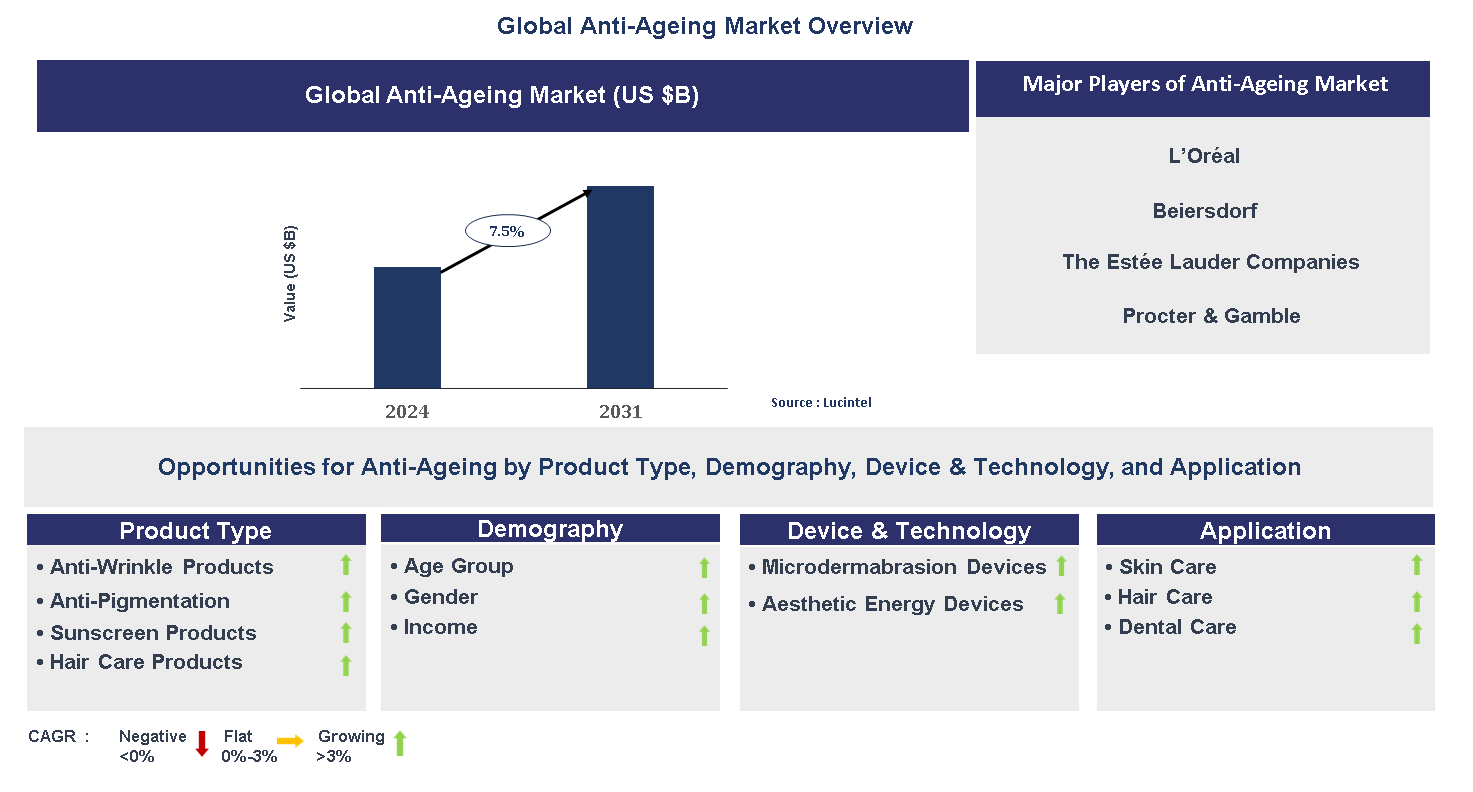
The future of the global anti-ageing market looks promising with opportunities in the skin care, hair care, and dental care markets. The global anti-ageing market is expected to grow with a CAGR of 7.5% from 2025 to 2031. The major drivers for this market are the increasing focus on youthful appearance, the rising preference for non-invasive treatments, and the growing aging population seeking solutions.

• Lucintel forecasts that, within the product type category, anti-wrinkle product is expected to witness the highest growth over the forecast period.
• Within the application category, skin care is expected to witness the highest growth.
• In terms of region, APAC is expected to witness the highest growth over the forecast period.
Gain valuable insights for your business decisions with our comprehensive 150+ page report. Sample figures with some insights are shown below.
Anti-Ageing Market Trends and Forecast

Emerging Trends in the Anti-Ageing Market

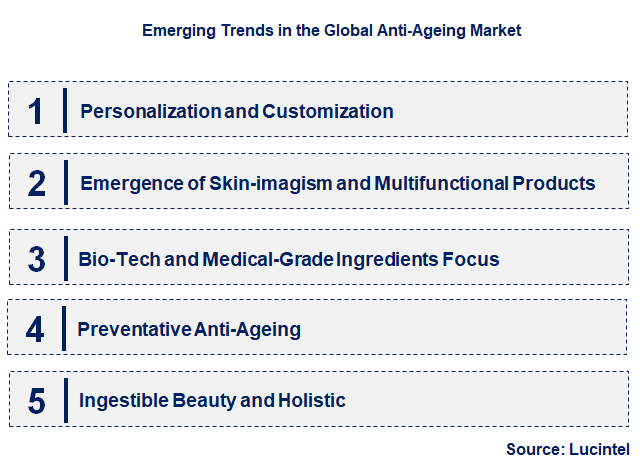
The anti-ageing market is being revolutionized by a range of emerging trends that are indicative of a more active and personalized attitude towards beauty and wellness. Wrinkle treatments are no longer enough. People are now looking for comprehensive solutions that treat the underlying causes of ageing, from damage to the environment to cellular degeneration. These trends are not only shaping product development but also how brands interact with customers, with a focus on transparency, personalization, and a science-driven approach.
• Personalization and Customization: The industry is witnessing a significant move towards personalized anti-ageing products. Companies are now leveraging technologies such as AI-based skin analysis and home genetic testing to develop bespoke products and routines. The trend enables consumers to receive product formulated exactly for their skin type, genetic makeup, and environmental vulnerabilities. The effect is substantial, as it raises the effectiveness of products and customer loyalty.
• Emergence of Skin-imagism and Multifunctional Products: Consumers are more focused on reducing the number of products in their regimen and switching to multifunctional products, popularly known as "skin-imagism." It is influenced by the aspiration for easier, better-performing routines and a concern for the environment due to excessive consumption. Brands are meeting this by designing hybrid products, which offer a combination of benefits, like an anti-ageing and sun-protection serum.
• Bio-Tech and Medical-Grade Ingredients Focus: The market is becoming more dictated by demand for science-formulated, high-performance ingredients. Advances in biotechnology have resulted in the entry of high-end peptides, growth factors, and exosomes. Consumers are increasingly educated and actively looking for clinically proven ingredients such as retinoids, hyaluronic acid, and vitamin C. This is driving brands to spend a lot on R&D and partnering with dermatologists and medical experts, thus muddling the distinction between conventional cosmetics and medical interventions.
• Preventative Anti-Ageing: The idea of anti-ageing is no longer restricted to the aged population. One of the important trends is the emergence of preventative anti-ageing, where young consumers (Gen Z and millennials) are embracing skincare regimens in order to defer the appearance of ageing. This is driven by social media and makeup influencers endorsing early skincare. The effect is a market shift to an older consumer base with products aimed at sun protection, hydration, and pollution protection.
• Ingestible Beauty and Holistic: Anti-ageing is being conceptualized as an inside-out process. This trend is not limited to just topical products but extends to ingestible beauty solutions such as collagen supplements, antioxidants, and vitamins. Customers are understanding that skin health is connected with overall health. This has helped build a new category for nutraceuticals and dietary supplements that complement skincare. The trend is fostering a wellness-oriented mindset for anti-ageing, with diet and lifestyle habits being seen as an integral part of an anti-ageing regimen.
These trends are quite literally transforming the anti-ageing industry from a reactive, repair-orientated approach to an active, preventative, and holistic one. The emphasis on personalization and bio-tech actives is forging a more result-driven and specialized product environment. The emergence of "skin-imagism" is streamlining routines, whereas the transition to "ingestible" beauty is expanding the scope of the market. In the end, these trends are embedding anti-ageing more within an integrated and holistic aspect of a consumer’s wellbeing journey.
Emerging Trends in the Anti-Ageing Market

Recent Development in the Anti-Ageing Market

The anti-ageing industry is presently facing several recent trend developments that are affecting its future growth and direction. The trend developments are not independent but are interrelated, corresponding to a wider change in consumer values and technology opportunity. The industry is increasingly becoming sophisticated under the influence of scientific advancements and concern for efficacy and safety. These advances are generating fresh opportunities for players in the market and also shaping the way consumers view and interact with anti-ageing services and products.
• AI and Diagnostic Tools for Personalized Skincare: One of the primary advances is the extensive adoption of artificial intelligence and diagnostic tools for analyzing the skin. Players are introducing apps and devices that utilize AI to analyze the state of someone’s skin and suggest targeted product recommendations. This technology assists consumers in determining their particular requirements and obtaining a customized regimen. It removes the guesswork and improves the consumer experience, resulting in greater product satisfaction and customer loyalty.
• Growth of Non-Invasive Aesthetic Procedures: The popularity of non-invasive and minimally invasive aesthetic treatments is a significant development. The consumer is becoming more inclined to seek treatments such as injectables (Botox and fillers), laser skin therapy, and microdermabrasion. This is fueled by the need for immediate effective results with minimal down time compared to surgical methods. The result of this trend is the heightened growth of the dermatology clinic and medical spa segments, which are providing sophisticated treatments that complement professional-level at-home skincare regimens.
• Rise of Prejuvenation: The development of "prejuvenation," or preventative anti-ageing, is one of the most important market trends. Young consumers are beginning their anti-ageing regimens early in order to prevent wrinkles and other age markers. Social media, with influencers championing early skincare, drives this. The effect is a widening of the consumer base, with new product categories and marketing initiatives focused on millennials and Gen Z. This trend is changing the market’s interest from correction to prevention.
• Ingestible Beauty Trend: The market is witnessing a significant trend in the form of ingestible beauty products. Consumers are understanding that skin health is linked with internal well-being. Market for such products as collagen supplements, antioxidant powders, and functional drinks is growing. This trend is an evidence of an holistic anti-ageing strategy. It provides a new category for brands to play in, with an inside-out solution, to complement topical skincare and appeal to health-conscious consumers.
• Sustainability and "Clean" Formulations: One of the key trends is growing consumer interest in sustainable and clean beauty products. Consumers are reading ingredient labels for toxic chemicals and are choosing brands that have sustainable packaging and responsible sourcing. The result is that companies are reformulating products to eliminate parabens, sulfates, and other contentious ingredients. This trend is not only a fad but a shift in the industry to more responsible and transparent business practices.
These changes are shaping the anti-ageing industry by propelling it towards a more scientifically advanced, integrated, and consumer-driven approach. The use of AI and the growth of non-invasive treatments are driving a new era of high-tech offerings. At the same time, the rise of "prejuvenation" and ingestible beauty is growing the market’s size and customer base. The emphasis on sustainability is also driving the industry towards more ethical and responsible practices, ensuring its long-term success and expansion.

Strategic Growth Opportunities in the Anti-Ageing Market

The anti-ageing industry offers a vast array of strategic growth opportunities across several key applications. With changes in consumer demand and technology breakthroughs, business organizations can exploit these opportunities to innovate and gain new market share. The opportunities go beyond conventional skincare, advancing into high-value segments such as advanced medical treatments, functional foods, and personal wellness. It will be essential for businesses to spot and exploit these strategic growth opportunities in order to stay competitive in this dynamic industry.
• Medical and Professional-Grade Skincare Opportunity: There is an enormous growth opportunity in the medical and professional-grade skincare category. Consumers are increasingly seeking out dermatologists and medical spas for sophisticated anti-ageing treatments. Brands can take advantage of this by creating and promoting products with more active ingredients, supported by clinical studies. This enables brands to establish themselves as credible, results-oriented providers and charge premium prices.
• Potential within the Preventative Skincare Space: The "prejuvenation" trend presents a significant growth potential by addressing consumers who are beginning anti-ageing habits between their 20s and 30s. Firms can develop product lines focused on prevention, including high-SPF sunscreens, antioxidant serums, and pollution-protection products. This approach develops long-term customer relationships and brand loyalty. It opens the market beyond conventional demographics and reaches a maturing consumer base influenced heavily by digital media that is ready to spend money on long-term skin health.
• Ingestible Anti-Ageing Products Opportunity: The increased interest in integrated wellness presents a strategic opportunity in the ingestible beauty sector. All such companies can formulate and sell a variety of dietary supplements, functional foods, and beverages with anti-ageing ingredients such as collagen, hyaluronic acid, and antioxidants. The application meets the inside-out beauty trend and provides an additional revenue opportunity. It enables brands to target the consumer concerns regarding overall well-being and skin health from a different perspective, thereby making their product line more complete.
• Advanced At-Home Devices: The at-home beauty device industry is a great opportunity for growth. With consumers looking for professional-level results at home, there is a need for devices such as LED masks, microcurrent devices, and radiofrequency devices. There is an opportunity for companies to create new, easy-to-use, and safe devices for at-home use that deliver effective anti-ageing benefits. This approach closes the gap between professional treatments and mainstream skincare.
• Potential in Personalized and AI-Powered Services: The trend towards personalization presents a strategic potential to develop AI-powered services that offer personalized anti-ageing regimens. Companies can design online platforms or apps based on a consumer’s information (environment, lifestyle, and skin type) to suggest a customized regimen. This creates higher engagement and trust with the customer. It offers a competitive edge through the provision of a personalized and distinct experience that conventional retailing cannot provide, thus fostering repeat business and brand loyalty.
These opportunities are greatly influencing the anti-ageing industry by forcing it into a more evolved, diversified, and consumer-focused model. With an emphasis on professional-quality products, proactive care, and edible beauty, businesses are able to break through to more consumers and develop new sources of revenue. The creation of in-home devices and AI-powered services is also transforming the way that consumers interact with anti-ageing, making it more personalized and impactful.

Anti-Ageing Market Driver and Challenges

The anti-ageing industry is being influenced by several key drivers and challenges, which are determining its growth and competitiveness. The drivers are largely associated with demographic changes and increased emphasis on individual appearance and health. Nevertheless, the market also has numerous challenges, which include high prices, regulatory issues, and threats of deceptive claims. The interaction of these influences dictates the direction of the market, and businesses must make calculated moves through both the opportunities and the challenges to achieve success.
The factors responsible for driving the anti-ageing market include:
1. Increased Geriatric Population and Longer Life Expectancy: One of the major drivers is the worldwide rise in the aging population. With people living longer, there’s more demand to enjoy a young look and quality of life. This demographic change has produced a vast and expanding base of consumers of anti-ageing products and services. The need to appear and feel younger is no longer exclusive to older consumers; it is a problem across a lifetime, fueling demand for corrective as well as preventative solutions.
2. Increasing Consumer Knowledge of Skincare and Aesthetics: One significant driver is the growing consumer knowledge regarding skincare and the advantages of anti-ageing products. Social media, beauty bloggers, and information availability have informed consumers about ingredients and skincare regimens. This is driving a forward-thinking approach, with individuals beginning anti-ageing regimens earlier in life. This driving demand for a vast range of products, from basic moisturizers to sophisticated serums and treatments.
3. Technology and Product Innovation: Technological progress is a foremost driver. Developments in areas such as biotechnology, nanotechnology, and artificial intelligence are bringing more effective and niche anti-ageing products and treatments. These involve the creation of new active ingredients, customized formulations, and non-surgical devices. Such technological innovations are advancing product performance and safety, improving consumer confidence and fueling market growth.
4. Rising Disposable Income: The growth of disposable income in emerging economies is a principal economic stimulus. When the financial abilities of people improve, they are more likely to spend money on high-end and luxury anti-ageing products and costly cosmetic treatments. The trend is enabling brands to increase their footprint in newer markets and build high-value goods to cater to a wealthier customer base.
5. Social Media and Beauty Culture: Social media and expanding beauty culture also play an important role. Instagram and TikTok have facilitated access for brands to reach consumers and for the influencer marketing channel to be used by influencers to endorse products. The need to appear good on camera and the sharing of beauty regimens have contributed to a strong visual culture that fuels demand for anti-ageing remedies, from topical creams to cosmetic treatments.
Challenges in the anti-ageing market are:
1. Premium Product and Procedure Cost: The most significant challenge lies in the expensive nature of most anti-ageing products and sophisticated treatments. As disposable incomes increase, premium products and procedures remain out of reach for the major chunk of people. The expensive research, development, and use of high-quality ingredients lead to the premium pricing, which may hinder the expansion of the market and appeal to some consumer segments.
2. Misleading Claims and Regulatory Hurdles: The absence of a cohesive regulatory system in certain areas is a major challenge. The industry is prone to untested products and false claims, leading to a loss of consumer confidence. Exaggerated claims made by brands about their product’s effectiveness can undermine the credibility of the industry as a whole. This calls for stricter regulation and an emphasis on scientific testing to provide safety for the consumer and achieve long-term trust.
3. Side Effects and Safety Issues: The market’s difficulty is that there is the potential for side effects and safety issues with some ingredients and treatments. Certain active ingredients, such as high-strength retinoids, can irritate the skin. Cosmetics treatments, although non-surgical, are still not without risks. These issues may discourage consumers, particularly those with sensitive skin or low risk tolerance. This challenge imposes on brands the need to spend on safety testing and communicating clear product usage instructions to minimize possible risks.
The anti-ageing market is driven by robust drivers such as an ageing population, increasing disposable income, and technology advancement. These drivers are forming a dynamic market with promising growth potential. Yet, the future of the market also relies on its ability to overcome major challenges. The cost of products, the potential for deceptive advertising, and safety issues are major barriers to be addressed. Companies’ capacities to innovate ethically, secure product safety, and gain consumer trust will prove to be fundamental for the market’s long-term viability and prosperity.

List of Anti-Ageing Companies

Companies in the market compete on the basis of product quality offered. Major players in this market focus on expanding their manufacturing facilities, R&D investments, infrastructural development, and leverage integration opportunities across the value chain. With these strategies anti-ageing companies cater increasing demand, ensure competitive effectiveness, develop innovative products & technologies, reduce production costs, and expand their customer base. Some of the anti-ageing companies profiled in this report include-
• L’Oréal
• Beiersdorf
• The Estée Lauder Companies
• Procter & Gamble

Anti-Ageing Market by Segment

The study includes a forecast for the global anti-ageing market by product type, demography, device & technology, application, and region.

Anti-Ageing Market by Product Type [Value from 2019 to 2031]:


• Anti-Wrinkle Products
• Anti-Pigmentation
• Sunscreen Products
• Hair Care Products

Anti-Ageing Market by Demography [Value from 2019 to 2031]:


• Age Group
• Gender
• Income

Anti-Ageing Market by Device & Technology [Value from 2019 to 2031]:


• Microdermabrasion Devices
• Aesthetic Energy Devices

Anti-Ageing Market by Application [Value from 2019 to 2031]:


• Skin Care
• Hair Care
• Dental Care

Anti-Ageing Market by Region [Value from 2019 to 2031]:


• North America
• Europe
• Asia Pacific
• The Rest of the World

Country Wise Outlook for the Anti-Ageing Market

The international anti-ageing industry is going through an era of rapid transformation, brought about by a nexus of advancing technology, demographic changes, and evolving consumer attitudes. The emphasis has shifted from conventional wrinkle creams to a comprehensive regimen comprising preventative solutions, cutting-edge medical treatments, and customized products. The market is very dynamic in nature, with advances in biotechnology and artificial intelligence giving rise to better and targeted solutions.
• United States: The US anti-ageing market is a technology-driven innovator in consumer expenditure. The market is dominated by high demand for medical-grade skin products and non-surgical cosmetic procedures such as injectables and laser therapy. An important trend is the emergence of customized anti-ageing products, wherein companies utilize genetic and skin test information to develop tailored products. The industry is also witnessing a drift towards prevention, with a younger age group embracing anti-ageing regimens at an earlier stage.
• China: China’s anti-ageing industry is growing explosively, fueled by an expanding middle class and a cultural obsession with young looks. The market is dominated by homegrown innovation, with local players committing to ingredient transparency and eco-friendliness. One trend is the high demand for anti-pigmentation products, spurred by heavy pollution and the need for an evenly colored complexion. E-commerce websites, especially live-streaming sites, have emerged as a leading sales channel, with dermatologists and influencers spurring a growth in customer demand for science-driven, high-tech skincare.
• Germany: The anti-ageing market in Germany is established and defined by a very strong focus on efficacy, safety, and scientific proof. German consumers have a preference for products that are supported by efficacy and clearly communicate clean and transparent formulations. The demand is for pharmaceutical-grade derma-cosmetics and skincare, for addressing targeted skin issues. One of the emerging trends is the increased demand for organic and natural anti-ageing products, and consumers are looking for environmentally friendly and sustainable products.
• India: India’s anti-ageing industry is growing fast, driven by increasing disposable income and a heightened awareness of personal hygiene. The industry is a mixture of traditional Ayurvedic medicine and cutting-edge, high-technology products. Recent trends include increased demand for non-invasive cosmetic treatments and high-end skincare gadgets for home use. E-commerce and social media are playing an influential role, exposing global and domestic brands to more people.
• Japan: Japan’s anti-ageing market is greatly developed and fueled by a culture of careful skincare habits and attention on premium, innovative products. The market is a world leader in product innovation, with emerging trends in ingredients such as fermented organic extracts and new delivery systems. A new trend is the attention paid to not only reducing wrinkles but also skin health and texture, with products formulated to protect against environmental stressors. The market addresses an aspirational consumer segment that demands high-performance, visually appealing products and is willing to spend on their skincare regimen.

Lucintel Analytics Dashboard

Features of the Global Anti-Ageing Market

Market Size Estimates: Anti-ageing market size estimation in terms of value ($B).
Trend and Forecast Analysis: Market trends (2019 to 2024) and forecast (2025 to 2031) by various segments and regions.
Segmentation Analysis: Anti-ageing market size by various segments, such as by product type, demography, device & technology, application, and region in terms of value ($B).
Regional Analysis: Anti-ageing market breakdown by North America, Europe, Asia Pacific, and Rest of the World.
Growth Opportunities: Analysis of growth opportunities in different product types, demography, devices & technologies, applications, and regions for the anti-ageing market.
Strategic Analysis: This includes M&A, new product development, and competitive landscape of the anti-ageing market.
Analysis of competitive intensity of the industry based on Porter’s Five Forces model.

Lucintel Consulting Services

FAQ

Q1. What is the growth forecast for anti-ageing market?
Answer: The global anti-ageing market is expected to grow with a CAGR of 7.5% from 2025 to 2031.
Q2. What are the major drivers influencing the growth of the anti-ageing market?
Answer: The major drivers for this market are the increasing focus on youthful appearance, the rising preference for non-invasive treatments, and the growing aging population seeking solutions.
Q3. What are the major segments for anti-ageing market?
Answer: The future of the anti-ageing market looks promising with opportunities in the skin care, hair care, and dental care markets.
Q4. Who are the key anti-ageing market companies?
Answer: Some of the key anti-ageing companies are as follows:
• L’Oréal
• Beiersdorf
• The Estée Lauder Companies
• Procter & Gamble
Q5. Which anti-ageing market segment will be the largest in future?
Answer: Lucintel forecasts that, within the product type category, anti-wrinkle product is expected to witness the highest growth over the forecast period.
Q6. In anti-ageing market, which region is expected to be the largest in next 5 years?
Answer: In terms of region, APAC is expected to witness the highest growth over the forecast period.
Q7. Do we receive customization in this report?
Answer: Yes, Lucintel provides 10% customization without any additional cost.

This report answers following 11 key questions:

Q.1. What are some of the most promising, high-growth opportunities for the anti-ageing market by product type (anti-wrinkle products, anti-pigmentation, sunscreen products, and hair care products), demography (age group, gender, and income), device & technology (microdermabrasion devices and aesthetic energy devices), application (skin care, hair care, and dental care), and region (North America, Europe, Asia Pacific, and the Rest of the World)?
Q.2. Which segments will grow at a faster pace and why?
Q.3. Which region will grow at a faster pace and why?
Q.4. What are the key factors affecting market dynamics? What are the key challenges and business risks in this market?
Q.5. What are the business risks and competitive threats in this market?
Q.6. What are the emerging trends in this market and the reasons behind them?
Q.7. What are some of the changing demands of customers in the market?
Q.8. What are the new developments in the market? Which companies are leading these developments?
Q.9. Who are the major players in this market? What strategic initiatives are key players pursuing for business growth?
Q.10. What are some of the competing products in this market and how big of a threat do they pose for loss of market share by material or product substitution?
Q.11. What M&A activity has occurred in the last 5 years and what has its impact been on the industry?

For any questions related to Anti-Ageing Market, Anti-Ageing Market Size, Anti-Ageing Market Growth, Anti-Ageing Market Analysis, Anti-Ageing Market Report, Anti-Ageing Market Share, Anti-Ageing Market Trends, Anti-Ageing Market Forecast, Anti-Ageing Companies, write Lucintel analyst at email: helpdesk@lucintel.com. We will be glad to get back to you soon.
                                           Table of Contents

            1. Executive Summary

            2. Market Overview

                        2.1 Background and Classifications
                        2.2 Supply Chain

            3. Market Trends & Forecast Analysis

                        3.1 Macroeconomic Trends and Forecasts
                        3.2 Industry Drivers and Challenges
                        3.3 PESTLE Analysis
                        3.4 Patent Analysis
                        3.5 Regulatory Environment
                        3.6 Global Anti-Ageing Market Trends and Forecast

            4. Global Anti-Ageing Market by Product Type

                        4.1 Overview
                        4.2 Attractiveness Analysis by Product Type
                        4.3 Anti-Wrinkle Products : Trends and Forecast 2025 to 2031
                        4.4 Anti-Pigmentation : Trends and Forecast 2025 to 2031
                        4.5 Sunscreen Products : Trends and Forecast 2025 to 2031
                        4.6 Hair Care Products : Trends and Forecast 2025 to 2031

            5. Global Anti-Ageing Market by Demography

                        5.1 Overview
                        5.2 Attractiveness Analysis by Demography
                        5.3 Age Group : Trends and Forecast 2025 to 2031
                        5.4 Gender : Trends and Forecast 2025 to 2031
                        5.5 Income : Trends and Forecast 2025 to 2031

            6. Global Anti-Ageing Market by Device & Technology

                        6.1 Overview
                        6.2 Attractiveness Analysis by Device & Technology
                        6.3 Microdermabrasion Devices : Trends and Forecast 2025 to 2031
                        6.4 Aesthetic Energy Devices : Trends and Forecast 2025 to 2031

            7. Global Anti-Ageing Market by Application

                        7.1 Overview
                        7.2 Attractiveness Analysis by Application
                        7.3 Skin Care : Trends and Forecast 2025 to 2031
                        7.4 Hair Care : Trends and Forecast 2025 to 2031
                        7.5 Dental Care : Trends and Forecast 2025 to 2031

            8. Regional Analysis

                        8.1 Overview
                        8.2 Global Anti-Ageing Market by Region

            9. North American Anti-Ageing Market

                        9.1 Overview
                        9.2 North American Anti-Ageing Market by Product Type
                        9.3 North American Anti-Ageing Market by Application
                        9.4 The United States Anti-Ageing Market
                        9.5 Canadian Anti-Ageing Market
                        9.6 Mexican Anti-Ageing Market

            10. European Anti-Ageing Market

                        10.1 Overview
                        10.2 European Anti-Ageing Market by Product Type
                        10.3 European Anti-Ageing Market by Application
                        10.4 German Anti-Ageing Market
                        10.5 French Anti-Ageing Market
                        10.6 Italian Anti-Ageing Market
                        10.7 Spanish Anti-Ageing Market
                        10.8 The United Kingdom Anti-Ageing Market

            11. APAC Anti-Ageing Market

                        11.1 Overview
                        11.2 APAC Anti-Ageing Market by Product Type
                        11.3 APAC Anti-Ageing Market by Application
                        11.4 Chinese Anti-Ageing Market
                        11.5 Indian Anti-Ageing Market
                        11.6 Japanese Anti-Ageing Market
                        11.7 South Korean Anti-Ageing Market
                        11.8 Indonesian Anti-Ageing Market

            12. ROW Anti-Ageing Market

                        12.1 Overview
                        12.2 ROW Anti-Ageing Market by Product Type
                        12.3 ROW Anti-Ageing Market by Application
                        12.4 Middle Eastern Anti-Ageing Market
                        12.5 South American Anti-Ageing Market
                        12.6 African Anti-Ageing Market

            13. Competitor Analysis

                        13.1 Product Portfolio Analysis
                        13.2 Operational Integration
                        13.3 Porter’s Five Forces Analysis
                                    • Competitive Rivalry
                                    • Bargaining Power of Buyers
                                    • Bargaining Power of Suppliers
                                    • Threat of Substitutes
                                    • Threat of New Entrants
                        13.4 Market Share Analysis

            14. Opportunities & Strategic Analysis

                        14.1 Value Chain Analysis
                        14.2 Growth Opportunity Analysis
                                    14.2.1 Growth Opportunity by Product Type
                                    14.2.2 Growth Opportunity by Demography
                                    14.2.3 Growth Opportunity by Device & Technology
                                    14.2.4 Growth Opportunity by Application
                        14.3 Emerging Trends in the Global Anti-Ageing Market
                        14.4 Strategic Analysis
                                    14.4.1 New Product Development
                                    14.4.2 Certification and Licensing
                                    14.4.3 Mergers, Acquisitions, Agreements, Collaborations, and Joint Ventures

            15. Company Profiles of the Leading Players Across the Value Chain

                        15.1 Competitive Analysis
                        15.2 L’Oréal
                                    • Company Overview
                                    • Anti-Ageing Market Business Overview
                                    • New Product Development
                                    • Merger, Acquisition, and Collaboration
                                    • Certification and Licensing
                        15.3 Beiersdorf
                                    • Company Overview
                                    • Anti-Ageing Market Business Overview
                                    • New Product Development
                                    • Merger, Acquisition, and Collaboration
                                    • Certification and Licensing
                        15.4 The Estée Lauder Companies
                                    • Company Overview
                                    • Anti-Ageing Market Business Overview
                                    • New Product Development
                                    • Merger, Acquisition, and Collaboration
                                    • Certification and Licensing
                        15.5 Procter & Gamble
                                    • Company Overview
                                    • Anti-Ageing Market Business Overview
                                    • New Product Development
                                    • Merger, Acquisition, and Collaboration
                                    • Certification and Licensing

            16. Appendix

                        16.1 List of Figures
                        16.2 List of Tables
                        16.3 Research Methodology
                        16.4 Disclaimer
                        16.5 Copyright
                        16.6 Abbreviations and Technical Units
                        16.7 About Us
                        16.8 Contact Us

                                               List of Figures


            Chapter 1

                        Figure 1.1: Trends and Forecast for the Global Anti-Ageing Market

            Chapter 2

                        Figure 2.1: Usage of Anti-Ageing Market
                        Figure 2.2: Classification of the Global Anti-Ageing Market
                        Figure 2.3: Supply Chain of the Global Anti-Ageing Market

            Chapter 3

                        Figure 3.1: Trends of the Global GDP Growth Rate
                        Figure 3.2: Trends of the Global Population Growth Rate
                        Figure 3.3: Trends of the Global Inflation Rate
                        Figure 3.4: Trends of the Global Unemployment Rate
                        Figure 3.5: Trends of the Regional GDP Growth Rate
                        Figure 3.6: Trends of the Regional Population Growth Rate
                        Figure 3.7: Trends of the Regional Inflation Rate
                        Figure 3.8: Trends of the Regional Unemployment Rate
                        Figure 3.9: Trends of Regional Per Capita Income
                        Figure 3.10: Forecast for the Global GDP Growth Rate
                        Figure 3.11: Forecast for the Global Population Growth Rate
                        Figure 3.12: Forecast for the Global Inflation Rate
                        Figure 3.13: Forecast for the Global Unemployment Rate
                        Figure 3.14: Forecast for the Regional GDP Growth Rate
                        Figure 3.15: Forecast for the Regional Population Growth Rate
                        Figure 3.16: Forecast for the Regional Inflation Rate
                        Figure 3.17: Forecast for the Regional Unemployment Rate
                        Figure 3.18: Forecast for Regional Per Capita Income
                        Figure 3.19: Driver and Challenges of the Anti-Ageing Market

            Chapter 4

                        Figure 4.1: Global Anti-Ageing Market by Product Type in 2019, 2024, and 2031
                        Figure 4.2: Trends of the Global Anti-Ageing Market ($B) by Product Type
                        Figure 4.3: Forecast for the Global Anti-Ageing Market ($B) by Product Type
                        Figure 4.4: Trends and Forecast for Anti-Wrinkle Products in the Global Anti-Ageing Market (2019-2031)
                        Figure 4.5: Trends and Forecast for Anti-Pigmentation in the Global Anti-Ageing Market (2019-2031)
                        Figure 4.6: Trends and Forecast for Sunscreen Products in the Global Anti-Ageing Market (2019-2031)
                        Figure 4.7: Trends and Forecast for Hair Care Products in the Global Anti-Ageing Market (2019-2031)

            Chapter 5

                        Figure 5.1: Global Anti-Ageing Market by Demography in 2019, 2024, and 2031
                        Figure 5.2: Trends of the Global Anti-Ageing Market ($B) by Demography
                        Figure 5.3: Forecast for the Global Anti-Ageing Market ($B) by Demography
                        Figure 5.4: Trends and Forecast for Age Group in the Global Anti-Ageing Market (2019-2031)
                        Figure 5.5: Trends and Forecast for Gender in the Global Anti-Ageing Market (2019-2031)
                        Figure 5.6: Trends and Forecast for Income in the Global Anti-Ageing Market (2019-2031)

            Chapter 6

                        Figure 6.1: Global Anti-Ageing Market by Device & Technology in 2019, 2024, and 2031
                        Figure 6.2: Trends of the Global Anti-Ageing Market ($B) by Device & Technology
                        Figure 6.3: Forecast for the Global Anti-Ageing Market ($B) by Device & Technology
                        Figure 6.4: Trends and Forecast for Microdermabrasion Devices in the Global Anti-Ageing Market (2019-2031)
                        Figure 6.5: Trends and Forecast for Aesthetic Energy Devices in the Global Anti-Ageing Market (2019-2031)

            Chapter 7

                        Figure 7.1: Global Anti-Ageing Market by Application in 2019, 2024, and 2031
                        Figure 7.2: Trends of the Global Anti-Ageing Market ($B) by Application
                        Figure 7.3: Forecast for the Global Anti-Ageing Market ($B) by Application
                        Figure 7.4: Trends and Forecast for Skin Care in the Global Anti-Ageing Market (2019-2031)
                        Figure 7.5: Trends and Forecast for Hair Care in the Global Anti-Ageing Market (2019-2031)
                        Figure 7.6: Trends and Forecast for Dental Care in the Global Anti-Ageing Market (2019-2031)

            Chapter 8

                        Figure 8.1: Trends of the Global Anti-Ageing Market ($B) by Region (2019-2024)
                        Figure 8.2: Forecast for the Global Anti-Ageing Market ($B) by Region (2025-2031)

            Chapter 9

                        Figure 9.1: Trends and Forecast for the North American Anti-Ageing Market (2019-2031)
                        Figure 9.2: North American Anti-Ageing Market by Product Type in 2019, 2024, and 2031
                        Figure 9.3: Trends of the North American Anti-Ageing Market ($B) by Product Type (2019-2024)
                        Figure 9.4: Forecast for the North American Anti-Ageing Market ($B) by Product Type (2025-2031)
                        Figure 9.5: North American Anti-Ageing Market by Demography in 2019, 2024, and 2031
                        Figure 9.6: Trends of the North American Anti-Ageing Market ($B) by Demography (2019-2024)
                        Figure 9.7: Forecast for the North American Anti-Ageing Market ($B) by Demography (2025-2031)
                        Figure 9.8: North American Anti-Ageing Market by Device & Technology in 2019, 2024, and 2031
                        Figure 9.9: Trends of the North American Anti-Ageing Market ($B) by Device & Technology (2019-2024)
                        Figure 9.10: Forecast for the North American Anti-Ageing Market ($B) by Device & Technology (2025-2031)
                        Figure 9.11: North American Anti-Ageing Market by Application in 2019, 2024, and 2031
                        Figure 9.12: Trends of the North American Anti-Ageing Market ($B) by Application (2019-2024)
                        Figure 9.13: Forecast for the North American Anti-Ageing Market ($B) by Application (2025-2031)
                        Figure 9.14: Trends and Forecast for the United States Anti-Ageing Market ($B) (2019-2031)
                        Figure 9.15: Trends and Forecast for the Mexican Anti-Ageing Market ($B) (2019-2031)
                        Figure 9.16: Trends and Forecast for the Canadian Anti-Ageing Market ($B) (2019-2031)

            Chapter 10

                        Figure 10.1: Trends and Forecast for the European Anti-Ageing Market (2019-2031)
                        Figure 10.2: European Anti-Ageing Market by Product Type in 2019, 2024, and 2031
                        Figure 10.3: Trends of the European Anti-Ageing Market ($B) by Product Type (2019-2024)
                        Figure 10.4: Forecast for the European Anti-Ageing Market ($B) by Product Type (2025-2031)
                        Figure 10.5: European Anti-Ageing Market by Demography in 2019, 2024, and 2031
                        Figure 10.6: Trends of the European Anti-Ageing Market ($B) by Demography (2019-2024)
                        Figure 10.7: Forecast for the European Anti-Ageing Market ($B) by Demography (2025-2031)
                        Figure 10.8: European Anti-Ageing Market by Device & Technology in 2019, 2024, and 2031
                        Figure 10.9: Trends of the European Anti-Ageing Market ($B) by Device & Technology (2019-2024)
                        Figure 10.10: Forecast for the European Anti-Ageing Market ($B) by Device & Technology (2025-2031)
                        Figure 10.11: European Anti-Ageing Market by Application in 2019, 2024, and 2031
                        Figure 10.12: Trends of the European Anti-Ageing Market ($B) by Application (2019-2024)
                        Figure 10.13: Forecast for the European Anti-Ageing Market ($B) by Application (2025-2031)
                        Figure 10.14: Trends and Forecast for the German Anti-Ageing Market ($B) (2019-2031)
                        Figure 10.15: Trends and Forecast for the French Anti-Ageing Market ($B) (2019-2031)
                        Figure 10.16: Trends and Forecast for the Spanish Anti-Ageing Market ($B) (2019-2031)
                        Figure 10.17: Trends and Forecast for the Italian Anti-Ageing Market ($B) (2019-2031)
                        Figure 10.18: Trends and Forecast for the United Kingdom Anti-Ageing Market ($B) (2019-2031)

            Chapter 11

                        Figure 11.1: Trends and Forecast for the APAC Anti-Ageing Market (2019-2031)
                        Figure 11.2: APAC Anti-Ageing Market by Product Type in 2019, 2024, and 2031
                        Figure 11.3: Trends of the APAC Anti-Ageing Market ($B) by Product Type (2019-2024)
                        Figure 11.4: Forecast for the APAC Anti-Ageing Market ($B) by Product Type (2025-2031)
                        Figure 11.5: APAC Anti-Ageing Market by Demography in 2019, 2024, and 2031
                        Figure 11.6: Trends of the APAC Anti-Ageing Market ($B) by Demography (2019-2024)
                        Figure 11.7: Forecast for the APAC Anti-Ageing Market ($B) by Demography (2025-2031)
                        Figure 11.8: APAC Anti-Ageing Market by Device & Technology in 2019, 2024, and 2031
                        Figure 11.9: Trends of the APAC Anti-Ageing Market ($B) by Device & Technology (2019-2024)
                        Figure 11.10: Forecast for the APAC Anti-Ageing Market ($B) by Device & Technology (2025-2031)
                        Figure 11.11: APAC Anti-Ageing Market by Application in 2019, 2024, and 2031
                        Figure 11.12: Trends of the APAC Anti-Ageing Market ($B) by Application (2019-2024)
                        Figure 11.13: Forecast for the APAC Anti-Ageing Market ($B) by Application (2025-2031)
                        Figure 11.14: Trends and Forecast for the Japanese Anti-Ageing Market ($B) (2019-2031)
                        Figure 11.15: Trends and Forecast for the Indian Anti-Ageing Market ($B) (2019-2031)
                        Figure 11.16: Trends and Forecast for the Chinese Anti-Ageing Market ($B) (2019-2031)
                        Figure 11.17: Trends and Forecast for the South Korean Anti-Ageing Market ($B) (2019-2031)
                        Figure 11.18: Trends and Forecast for the Indonesian Anti-Ageing Market ($B) (2019-2031)

            Chapter 12

                        Figure 12.1: Trends and Forecast for the ROW Anti-Ageing Market (2019-2031)
                        Figure 12.2: ROW Anti-Ageing Market by Product Type in 2019, 2024, and 2031
                        Figure 12.3: Trends of the ROW Anti-Ageing Market ($B) by Product Type (2019-2024)
                        Figure 12.4: Forecast for the ROW Anti-Ageing Market ($B) by Product Type (2025-2031)
                        Figure 12.5: ROW Anti-Ageing Market by Demography in 2019, 2024, and 2031
                        Figure 12.6: Trends of the ROW Anti-Ageing Market ($B) by Demography (2019-2024)
                        Figure 12.7: Forecast for the ROW Anti-Ageing Market ($B) by Demography (2025-2031)
                        Figure 12.8: ROW Anti-Ageing Market by Device & Technology in 2019, 2024, and 2031
                        Figure 12.9: Trends of the ROW Anti-Ageing Market ($B) by Device & Technology (2019-2024)
                        Figure 12.10: Forecast for the ROW Anti-Ageing Market ($B) by Device & Technology (2025-2031)
                        Figure 12.11: ROW Anti-Ageing Market by Application in 2019, 2024, and 2031
                        Figure 12.12: Trends of the ROW Anti-Ageing Market ($B) by Application (2019-2024)
                        Figure 12.13: Forecast for the ROW Anti-Ageing Market ($B) by Application (2025-2031)
                        Figure 12.14: Trends and Forecast for the Middle Eastern Anti-Ageing Market ($B) (2019-2031)
                        Figure 12.15: Trends and Forecast for the South American Anti-Ageing Market ($B) (2019-2031)
                        Figure 12.16: Trends and Forecast for the African Anti-Ageing Market ($B) (2019-2031)

            Chapter 13

                        Figure 13.1: Porter’s Five Forces Analysis of the Global Anti-Ageing Market
                        Figure 13.2: Market Share (%) of Top Players in the Global Anti-Ageing Market (2024)

            Chapter 14

                        Figure 14.1: Growth Opportunities for the Global Anti-Ageing Market by Product Type
                        Figure 14.2: Growth Opportunities for the Global Anti-Ageing Market by Demography
                        Figure 14.3: Growth Opportunities for the Global Anti-Ageing Market by Device & Technology
                        Figure 14.4: Growth Opportunities for the Global Anti-Ageing Market by Application
                        Figure 14.5: Growth Opportunities for the Global Anti-Ageing Market by Region
                        Figure 14.6: Emerging Trends in the Global Anti-Ageing Market

                                               List of Tables


            Chapter 1

                        Table 1.1: Growth Rate (%, 2023-2024) and CAGR (%, 2025-2031) of the Anti-Ageing Market by Product Type, Demography, Device & Technology, and Application
                        Table 1.2: Attractiveness Analysis for the Anti-Ageing Market by Region
                        Table 1.3: Global Anti-Ageing Market Parameters and Attributes

            Chapter 3

                        Table 3.1: Trends of the Global Anti-Ageing Market (2019-2024)
                        Table 3.2: Forecast for the Global Anti-Ageing Market (2025-2031)

            Chapter 4

                        Table 4.1: Attractiveness Analysis for the Global Anti-Ageing Market by Product Type
                        Table 4.2: Market Size and CAGR of Various Product Type in the Global Anti-Ageing Market (2019-2024)
                        Table 4.3: Market Size and CAGR of Various Product Type in the Global Anti-Ageing Market (2025-2031)
                        Table 4.4: Trends of Anti-Wrinkle Products in the Global Anti-Ageing Market (2019-2024)
                        Table 4.5: Forecast for Anti-Wrinkle Products in the Global Anti-Ageing Market (2025-2031)
                        Table 4.6: Trends of Anti-Pigmentation in the Global Anti-Ageing Market (2019-2024)
                        Table 4.7: Forecast for Anti-Pigmentation in the Global Anti-Ageing Market (2025-2031)
                        Table 4.8: Trends of Sunscreen Products in the Global Anti-Ageing Market (2019-2024)
                        Table 4.9: Forecast for Sunscreen Products in the Global Anti-Ageing Market (2025-2031)
                        Table 4.10: Trends of Hair Care Products in the Global Anti-Ageing Market (2019-2024)
                        Table 4.11: Forecast for Hair Care Products in the Global Anti-Ageing Market (2025-2031)

            Chapter 5

                        Table 5.1: Attractiveness Analysis for the Global Anti-Ageing Market by Demography
                        Table 5.2: Market Size and CAGR of Various Demography in the Global Anti-Ageing Market (2019-2024)
                        Table 5.3: Market Size and CAGR of Various Demography in the Global Anti-Ageing Market (2025-2031)
                        Table 5.4: Trends of Age Group in the Global Anti-Ageing Market (2019-2024)
                        Table 5.5: Forecast for Age Group in the Global Anti-Ageing Market (2025-2031)
                        Table 5.6: Trends of Gender in the Global Anti-Ageing Market (2019-2024)
                        Table 5.7: Forecast for Gender in the Global Anti-Ageing Market (2025-2031)
                        Table 5.8: Trends of Income in the Global Anti-Ageing Market (2019-2024)
                        Table 5.9: Forecast for Income in the Global Anti-Ageing Market (2025-2031)

            Chapter 6

                        Table 6.1: Attractiveness Analysis for the Global Anti-Ageing Market by Device & Technology
                        Table 6.2: Market Size and CAGR of Various Device & Technology in the Global Anti-Ageing Market (2019-2024)
                        Table 6.3: Market Size and CAGR of Various Device & Technology in the Global Anti-Ageing Market (2025-2031)
                        Table 6.4: Trends of Microdermabrasion Devices in the Global Anti-Ageing Market (2019-2024)
                        Table 6.5: Forecast for Microdermabrasion Devices in the Global Anti-Ageing Market (2025-2031)
                        Table 6.6: Trends of Aesthetic Energy Devices in the Global Anti-Ageing Market (2019-2024)
                        Table 6.7: Forecast for Aesthetic Energy Devices in the Global Anti-Ageing Market (2025-2031)

            Chapter 7

                        Table 7.1: Attractiveness Analysis for the Global Anti-Ageing Market by Application
                        Table 7.2: Market Size and CAGR of Various Application in the Global Anti-Ageing Market (2019-2024)
                        Table 7.3: Market Size and CAGR of Various Application in the Global Anti-Ageing Market (2025-2031)
                        Table 7.4: Trends of Skin Care in the Global Anti-Ageing Market (2019-2024)
                        Table 7.5: Forecast for Skin Care in the Global Anti-Ageing Market (2025-2031)
                        Table 7.6: Trends of Hair Care in the Global Anti-Ageing Market (2019-2024)
                        Table 7.7: Forecast for Hair Care in the Global Anti-Ageing Market (2025-2031)
                        Table 7.8: Trends of Dental Care in the Global Anti-Ageing Market (2019-2024)
                        Table 7.9: Forecast for Dental Care in the Global Anti-Ageing Market (2025-2031)

            Chapter 8

                        Table 8.1: Market Size and CAGR of Various Regions in the Global Anti-Ageing Market (2019-2024)
                        Table 8.2: Market Size and CAGR of Various Regions in the Global Anti-Ageing Market (2025-2031)

            Chapter 9

                        Table 9.1: Trends of the North American Anti-Ageing Market (2019-2024)
                        Table 9.2: Forecast for the North American Anti-Ageing Market (2025-2031)
                        Table 9.3: Market Size and CAGR of Various Product Type in the North American Anti-Ageing Market (2019-2024)
                        Table 9.4: Market Size and CAGR of Various Product Type in the North American Anti-Ageing Market (2025-2031)
                        Table 9.5: Market Size and CAGR of Various Demography in the North American Anti-Ageing Market (2019-2024)
                        Table 9.6: Market Size and CAGR of Various Demography in the North American Anti-Ageing Market (2025-2031)
                        Table 9.7: Market Size and CAGR of Various Device & Technology in the North American Anti-Ageing Market (2019-2024)
                        Table 9.8: Market Size and CAGR of Various Device & Technology in the North American Anti-Ageing Market (2025-2031)
                        Table 9.9: Market Size and CAGR of Various Application in the North American Anti-Ageing Market (2019-2024)
                        Table 9.10: Market Size and CAGR of Various Application in the North American Anti-Ageing Market (2025-2031)
                        Table 9.11: Trends and Forecast for the United States Anti-Ageing Market (2019-2031)
                        Table 9.12: Trends and Forecast for the Mexican Anti-Ageing Market (2019-2031)
                        Table 9.13: Trends and Forecast for the Canadian Anti-Ageing Market (2019-2031)

            Chapter 10

                        Table 10.1: Trends of the European Anti-Ageing Market (2019-2024)
                        Table 10.2: Forecast for the European Anti-Ageing Market (2025-2031)
                        Table 10.3: Market Size and CAGR of Various Product Type in the European Anti-Ageing Market (2019-2024)
                        Table 10.4: Market Size and CAGR of Various Product Type in the European Anti-Ageing Market (2025-2031)
                        Table 10.5: Market Size and CAGR of Various Demography in the European Anti-Ageing Market (2019-2024)
                        Table 10.6: Market Size and CAGR of Various Demography in the European Anti-Ageing Market (2025-2031)
                        Table 10.7: Market Size and CAGR of Various Device & Technology in the European Anti-Ageing Market (2019-2024)
                        Table 10.8: Market Size and CAGR of Various Device & Technology in the European Anti-Ageing Market (2025-2031)
                        Table 10.9: Market Size and CAGR of Various Application in the European Anti-Ageing Market (2019-2024)
                        Table 10.10: Market Size and CAGR of Various Application in the European Anti-Ageing Market (2025-2031,)
                        Table 10.11: Trends and Forecast for the German Anti-Ageing Market (2019-2031)
                        Table 10.12: Trends and Forecast for the French Anti-Ageing Market (2019-2031)
                        Table 10.13: Trends and Forecast for the Spanish Anti-Ageing Market (2019-2031)
                        Table 10.14: Trends and Forecast for the Italian Anti-Ageing Market (2019-2031)
                        Table 10.15: Trends and Forecast for the United Kingdom Anti-Ageing Market (2019-2031)

            Chapter 11

                        Table 11.1: Trends of the APAC Anti-Ageing Market (2019-2024)
                        Table 11.2: Forecast for the APAC Anti-Ageing Market (2025-2031)
                        Table 11.3: Market Size and CAGR of Various Product Type in the APAC Anti-Ageing Market (2019-2024)
                        Table 11.4: Market Size and CAGR of Various Product Type in the APAC Anti-Ageing Market (2025-2031)
                        Table 11.5: Market Size and CAGR of Various Demography in the APAC Anti-Ageing Market (2019-2024)
                        Table 11.6: Market Size and CAGR of Various Demography in the APAC Anti-Ageing Market (2025-2031)
                        Table 11.7: Market Size and CAGR of Various Device & Technology in the APAC Anti-Ageing Market (2019-2024)
                        Table 11.8: Market Size and CAGR of Various Device & Technology in the APAC Anti-Ageing Market (2025-2031)
                        Table 11.9: Market Size and CAGR of Various Application in the APAC Anti-Ageing Market (2019-2024)
                        Table 11.10: Market Size and CAGR of Various Application in the APAC Anti-Ageing Market (2025-2031)
                        Table 11.11: Trends and Forecast for the Japanese Anti-Ageing Market (2019-2031)
                        Table 11.12: Trends and Forecast for the Indian Anti-Ageing Market (2019-2031)
                        Table 11.13: Trends and Forecast for the Chinese Anti-Ageing Market (2019-2031)
                        Table 11.14: Trends and Forecast for the South Korean Anti-Ageing Market (2019-2031)
                        Table 11.15: Trends and Forecast for the Indonesian Anti-Ageing Market (2019-2031)

            Chapter 12

                        Table 12.1: Trends of the ROW Anti-Ageing Market (2019-2024)
                        Table 12.2: Forecast for the ROW Anti-Ageing Market (2025-2031)
                        Table 12.3: Market Size and CAGR of Various Product Type in the ROW Anti-Ageing Market (2019-2024)
                        Table 12.4: Market Size and CAGR of Various Product Type in the ROW Anti-Ageing Market (2025-2031)
                        Table 12.5: Market Size and CAGR of Various Demography in the ROW Anti-Ageing Market (2019-2024)
                        Table 12.6: Market Size and CAGR of Various Demography in the ROW Anti-Ageing Market (2025-2031)
                        Table 12.7: Market Size and CAGR of Various Device & Technology in the ROW Anti-Ageing Market (2019-2024)
                        Table 12.8: Market Size and CAGR of Various Device & Technology in the ROW Anti-Ageing Market (2025-2031)
                        Table 12.9: Market Size and CAGR of Various Application in the ROW Anti-Ageing Market (2019-2024)
                        Table 12.10: Market Size and CAGR of Various Application in the ROW Anti-Ageing Market (2025-2031)
                        Table 12.11: Trends and Forecast for the Middle Eastern Anti-Ageing Market (2019-2031)
                        Table 12.12: Trends and Forecast for the South American Anti-Ageing Market (2019-2031)
                        Table 12.13: Trends and Forecast for the African Anti-Ageing Market (2019-2031)

            Chapter 13

                        Table 13.1: Product Mapping of Anti-Ageing Suppliers Based on Segments
                        Table 13.2: Operational Integration of Anti-Ageing Manufacturers
                        Table 13.3: Rankings of Suppliers Based on Anti-Ageing Revenue

            Chapter 14

                        Table 14.1: New Product Launches by Major Anti-Ageing Producers (2019-2024)
                        Table 14.2: Certification Acquired by Major Competitor in the Global Anti-Ageing Market

.

Buy full report or by chapter as follows

Limited Time Offer

Price by License Type:
[-] Hide Chapter Details
[Chapter Number] [Chapter Name] [Chapter Number Of Pages] [Chapter Price]
Title/Chapter Name Pages Price
Full Report: Anti-Ageing Market Report: Trends, Forecast and Competitive Analysis to 2031 Full Report $ 2,990
A 150 Page Report
Lucintel has been in the business of market research and management consulting since 2000 and has published over 1000 market intelligence reports in various markets / applications and served over 1,000 clients worldwide. This study is a culmination of four months of full-time effort performed by Lucintel's analyst team. The analysts used the following sources for the creation and completion of this valuable report:
  • In-depth interviews of the major players in this market
  • Detailed secondary research from competitors’ financial statements and published data 
  • Extensive searches of published works, market, and database information pertaining to industry news, company press releases, and customer intentions
  • A compilation of the experiences, judgments, and insights of Lucintel’s professionals, who have analyzed and tracked this market over the years.
Extensive research and interviews are conducted across the supply chain of this market to estimate market share, market size, trends, drivers, challenges, and forecasts. Below is a brief summary of the primary interviews that were conducted by job function for this report.
 
Thus, Lucintel compiles vast amounts of data from numerous sources, validates the integrity of that data, and performs a comprehensive analysis. Lucintel then organizes the data, its findings, and insights into a concise report designed to support the strategic decision-making process. The figure below is a graphical representation of Lucintel’s research process. 
 

Please sign in below to get report brochure - Anti-Ageing Market Report.

At Lucintel, we respect your privacy and maintain the confidentiality of information / data provided by you
(Please enter your corporate email. * These fields are mandatory )

Follow us on

