
Market Report · July 31, 2026

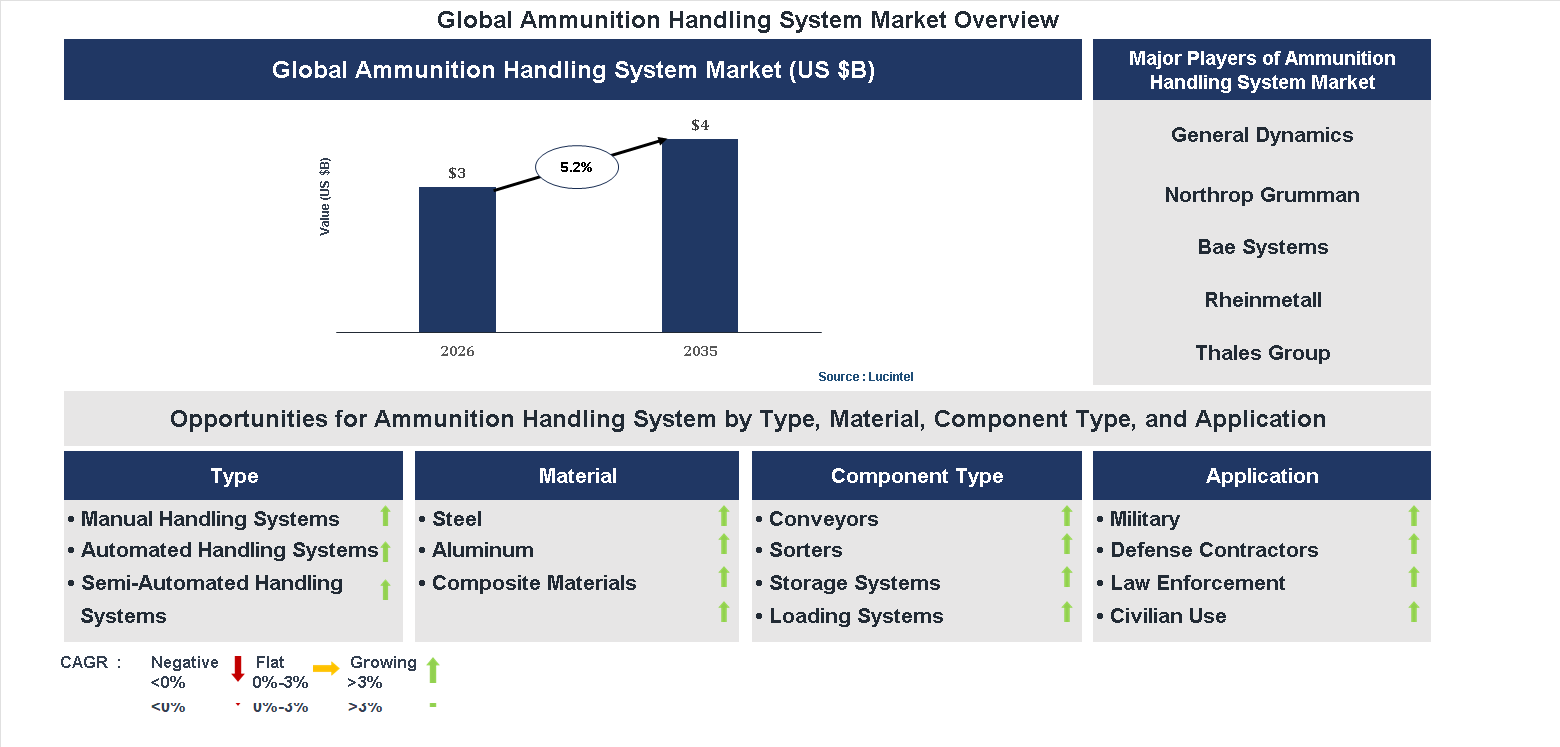
Key data points: The market size in 2035 = $4 billion, growth forecast = 5.2% annually for the next 8 years. Scroll below to get more insights. This market report covers trends, opportunities and forecasts in ammunition handling system market to 2035 by type (manual handling systems, automated handling systems, and semi-automated handling systems), material (steel, aluminum, and composite materials), component type (conveyors, sorters, storage systems, and loading systems), application (military, defense contractors, law enforcement, and civilian use), and region (North America, Europe, Asia Pacific, and the Rest of the World)
We'll send your sample report shortly.
• Lucintel forecasts that, within the type category, automated handling system is expected to witness the highest growth over the forecast period.
• Within the application category, military is expected to witness the highest growth.
• In terms of region, APAC is expected to witness the highest growth over the forecast period. Gain valuable insights for your business decisions with our comprehensive 150+ page report. Sample figures with some insights are shown below.
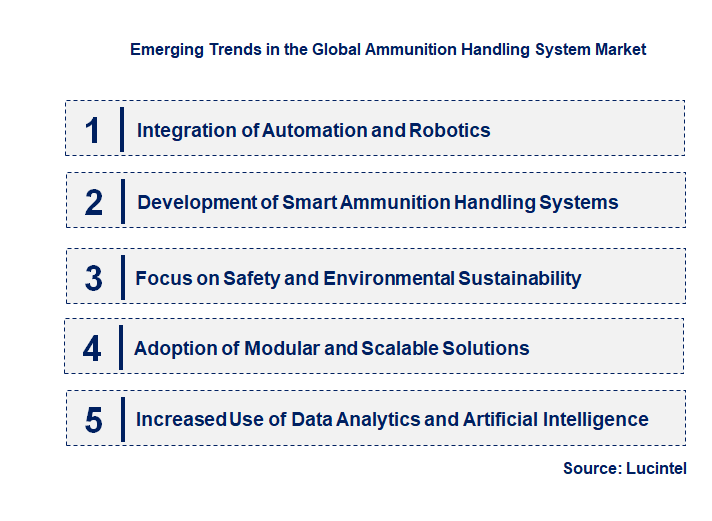
• Integration of Automation and Robotics: The adoption of automated systems and robotics is revolutionizing ammunition handling by reducing human error and increasing operational speed. Automated conveyor belts, robotic arms, and intelligent storage solutions enable faster loading, unloading, and inventory management. This trend enhances safety by minimizing human exposure to hazardous materials and improves efficiency in high-pressure environments. As military and defense organizations seek to modernize their logistics, automation is becoming a critical component, leading to smarter, more reliable ammunition handling processes that support rapid deployment and sustainment.
• Development of Smart Ammunition Handling Systems: Smart systems equipped with IoT sensors and real-time data analytics are transforming ammunition management. These systems enable precise inventory tracking, condition monitoring, and predictive maintenance, reducing waste and preventing mishandling. The integration of connectivity allows for remote operation and real-time decision-making, which is crucial during combat or emergency situations. This trend enhances operational readiness, reduces downtime, and optimizes resource utilization, making ammunition handling more efficient and responsive to dynamic battlefield conditions.
• Focus on Safety and Environmental Sustainability: Increasing emphasis on safety protocols and environmental considerations is shaping the market. Advanced handling systems now incorporate features like explosion-proof designs, spill containment, and eco-friendly materials to minimize environmental impact. Regulations and safety standards are driving innovation toward safer storage and transportation methods, reducing accidents and environmental hazards. This trend reflects a broader commitment to sustainable practices within defense logistics, ensuring that ammunition handling aligns with global safety and environmental goals while maintaining operational effectiveness.
• Adoption of Modular and Scalable Solutions: Modular ammunition handling systems offer flexibility to adapt to various operational needs and scale according to mission requirements. These systems facilitate easy upgrades, maintenance, and reconfiguration, supporting diverse military applications. Scalability ensures that defense forces can efficiently manage different calibers, quantities, and storage conditions without significant overhauls. This trend allows for cost-effective, customizable solutions that can be deployed across multiple platforms and environments, enhancing logistical agility and operational versatility in complex defense scenarios.
• Increased Use of Data Analytics and Artificial Intelligence: The integration of AI and data analytics is enabling predictive analytics, optimizing inventory levels, and streamlining supply chain management. AI-driven systems can forecast demand, identify potential failures, and suggest maintenance schedules, reducing downtime and operational costs. This trend improves decision-making accuracy and enhances overall system reliability. As data-driven approaches become more prevalent, ammunition handling systems are becoming smarter, more autonomous, and better equipped to support complex military logistics, ultimately leading to more resilient and efficient defense operations. These emerging trends are fundamentally reshaping the ammunition handling system market by fostering automation, enhancing safety, promoting sustainability, and leveraging advanced data technologies. These developments are enabling defense organizations to achieve higher operational efficiency, safety standards, and adaptability, ensuring they are better prepared for modern security challenges. The market is moving toward more intelligent, flexible, and environmentally conscious solutions that will define the future of ammunition logistics and management.
• Automation and Robotics in Ammunition Handling: This development focuses on integrating automation and robotics to streamline ammunition logistics. Automated systems reduce manual labor, minimize human error, and enhance safety during handling and transportation. These systems enable faster loading and unloading processes, improve inventory management, and ensure precise operations in combat zones. The impact is a significant increase in operational efficiency, reduced downtime, and enhanced safety standards, making military operations more effective and responsive.
• Integration of AI and IoT Technologies: The adoption of Artificial Intelligence (AI) and Internet of Things (IoT) in ammunition handling systems is revolutionizing military logistics. AI algorithms optimize inventory management, predict maintenance needs, and facilitate real-time decision-making. IoT sensors enable continuous monitoring of ammunition conditions, ensuring safety and readiness. This integration leads to smarter supply chains, reduced operational costs, and improved accuracy in ammunition deployment, ultimately enhancing overall military effectiveness and readiness.
• Development of Modular and Scalable Systems: Modular ammunition handling systems offer flexibility and adaptability to various military needs. These scalable solutions can be customized for different weapon systems and operational environments, allowing rapid deployment and easy upgrades. The impact includes increased versatility, reduced lifecycle costs, and improved interoperability among different military units. Such systems support rapid response to emerging threats and evolving battlefield requirements, strengthening defense capabilities.
• Focus on Safety and Security Enhancements: Recent developments emphasize improving safety protocols and security measures in ammunition handling. Advanced safety features, such as automated shutdowns and secure storage solutions, prevent accidents and unauthorized access. Enhanced security measures protect sensitive ammunition supplies from theft, sabotage, and cyber threats. These improvements reduce risks, ensure compliance with safety standards, and bolster confidence in military logistics, ultimately safeguarding personnel and assets.
• Adoption of Sustainable and Eco-Friendly Technologies: The market is witnessing a shift towards environmentally sustainable ammunition handling solutions. Innovations include the use of eco-friendly materials, energy-efficient systems, and waste reduction techniques. These developments aim to minimize environmental impact while maintaining operational efficiency. The impact is a more sustainable defense industry, reduced carbon footprint, and compliance with environmental regulations, which enhances the reputation and long-term viability of defense organizations. These recent developments are significantly transforming the ammunition handling system market by enhancing efficiency, safety, and sustainability. The integration of automation, AI, and modular systems is enabling smarter, faster, and more adaptable logistics solutions. Focus on safety and eco-friendly technologies further strengthens market resilience. Collectively, these advancements are driving growth, attracting investments, and positioning the market for sustained innovation and competitiveness in the global defense landscape.
• Integration of Automation and Robotics for Enhanced Efficiency: The adoption of automated ammunition handling systems improves operational speed, reduces human error, and enhances safety in military and defense applications. Robotics enable precise loading, unloading, and storage, minimizing risks during handling processes. This integration supports rapid response scenarios and logistical efficiency, especially in high-stakes environments. As defense agencies seek modernization, the demand for intelligent, automated systems is expected to grow, fostering innovation and expanding market opportunities across military and law enforcement sectors.
• Increasing Defense Budgets Driving Market Expansion: Governments worldwide are increasing defense spending to modernize their military capabilities, including ammunition handling systems. This financial commitment supports procurement of advanced logistics solutions, ensuring faster, safer, and more reliable ammunition management. Countries investing heavily in defense infrastructure and weapon modernization are key drivers, creating a robust market environment. The focus on national security and technological superiority encourages continuous development and deployment of sophisticated ammunition handling systems, broadening market scope and application diversity.
• Development of Smart and Connected Ammunition Handling Solutions: The integration of IoT and sensor technologies into ammunition handling systems enables real-time monitoring, predictive maintenance, and enhanced operational control. Smart systems improve inventory management, reduce downtime, and optimize logistics workflows. Connectivity allows seamless communication between different military units and command centers, increasing operational coordination. As defense organizations prioritize digital transformation, the demand for intelligent, connected solutions is expected to surge, opening new avenues for innovation and market growth in both military and law enforcement applications.
• Expansion in Law Enforcement and Homeland Security Applications: Ammunition handling systems are increasingly adopted by law enforcement agencies for tactical operations, training, and secure storage. These systems enhance safety, efficiency, and inventory management during critical incidents. Homeland security initiatives also drive demand for specialized handling solutions to secure and manage ammunition stockpiles. The need for reliable, rapid deployment systems in urban and border security scenarios presents significant growth opportunities. This expansion into non-military sectors broadens the market base and encourages cross-sector technological advancements.
• Advancements in Material Technologies for Durability and Safety: The development of high-performance materials enhances the durability, corrosion resistance, and safety of ammunition handling systems. Lightweight composites and advanced alloys improve portability and ease of use in field conditions. These innovations reduce maintenance costs and extend system lifespan, making them more attractive to defense and law enforcement agencies. As material science progresses, the market benefits from safer, more reliable, and cost-effective solutions, supporting widespread adoption and further technological development in ammunition logistics. The overall market outlook is positively influenced by these growth opportunities, fostering innovation, increasing adoption, and expanding application areas. As defense and security needs evolve, the ammunition handling system market is poised for sustained growth, driven by technological advancements and strategic investments. This dynamic environment encourages continuous improvement and diversification of solutions, ensuring readiness and operational excellence across global security sectors.
• Technological Innovation: The development of advanced automation, robotics, and smart systems enhances operational efficiency, safety, and reliability. These innovations reduce manual labor, minimize errors, and enable faster ammunition handling, which is critical for military and defense applications. As technology continues to evolve, manufacturers are investing heavily in R&D to stay competitive, driving market growth.
• Increasing Defense Budgets: Many countries are increasing their defense spending to modernize armed forces and enhance national security. This surge in budgets leads to higher procurement of ammunition handling systems for military applications, including combat readiness and logistical support. Governments recognize the importance of efficient ammunition management, fueling demand across regions.
• Rising Geopolitical Tensions: Escalating geopolitical conflicts and regional tensions prompt nations to bolster their defense capabilities. This heightened focus on military preparedness results in increased procurement of ammunition handling systems to support rapid deployment and sustainment of armed forces, thereby expanding market opportunities.
• Expansion of Military Modernization Programs: Countries are investing in modernizing their armed forces with advanced weaponry and support systems. Ammunition handling systems are integral to these modernization efforts, ensuring seamless logistics and operational efficiency. Such programs are particularly prominent in emerging economies, contributing significantly to market expansion. The challenges facing the ammunition handling system market are:
• Regulatory and Export Restrictions: Stringent regulations related to arms control, export policies, and international treaties restrict the sale and transfer of ammunition handling systems. These legal barriers complicate international trade, limit market access, and increase compliance costs for manufacturers, thereby hindering growth.
• High Development and Maintenance Costs: The development of sophisticated ammunition handling systems involves significant R&D investment, and maintenance costs are also substantial. These financial burdens can deter smaller players from entering the market and may slow down technological adoption, impacting overall market expansion.
• Supply Chain Disruptions: The industry relies heavily on a complex global supply chain for components and raw materials. Disruptions caused by geopolitical issues, pandemics, or logistical challenges can delay production, increase costs, and affect delivery schedules, thereby impacting market stability and growth. The ammunition handling system market is driven by technological advancements, increased defense spending, geopolitical tensions, and modernization initiatives. However, regulatory restrictions, high costs, and supply chain issues pose significant challenges. These factors collectively influence the markets growth potential, requiring stakeholders to adapt strategies accordingly. While opportunities for innovation and expansion are substantial, addressing regulatory and logistical hurdles is crucial for sustained development in this sector.
• General Dynamics
• Northrop Grumman
• Bae Systems
• Rheinmetall
• Thales Group
• Lockheed Martin
• Leonardo
• Manual Handling Systems
• Automated Handling Systems
• Semi-Automated Handling Systems
• Steel
• Aluminum
• Composite Materials
• Conveyors
• Sorters
• Storage Systems
• Loading Systems
• Military
• Defense Contractors
• Law Enforcement
• Civilian Use
• North America
• Europe
• Asia Pacific
• The Rest of the World
• United States: The U.S. has made substantial progress in developing automated and integrated ammunition handling systems, focusing on enhancing safety and efficiency. Recent innovations include robotic automation and smart storage solutions, which improve logistical operations and reduce personnel risk. The Department of Defense has increased funding for modernization projects, emphasizing interoperability with existing military platforms. The U.S. also collaborates with private industry to accelerate technological advancements, aiming to maintain strategic superiority in ammunition management.
• China: China has rapidly advanced its ammunition handling capabilities, emphasizing automation and high-capacity storage solutions. The country has invested heavily in indigenous technology development to reduce reliance on foreign systems. Recent projects include the deployment of automated storage and retrieval systems (ASRS) and integrated logistics platforms that support rapid deployment and replenishment. Chinas focus on modernization aligns with its broader military modernization efforts, aiming to enhance operational readiness and strategic mobility.
• Germany: Germany continues to innovate in ammunition handling systems by integrating digital technologies and automation. Recent developments include the adoption of smart inventory management and automated transport systems within military facilities. The German defense industry emphasizes precision, reliability, and interoperability with NATO standards. Germanys investments aim to improve logistical efficiency, safety, and rapid deployment capabilities, supporting both national defense and international peacekeeping missions.
• India: India has prioritized upgrading its ammunition handling infrastructure through automation and modernization initiatives. Recent developments include the deployment of automated storage facilities and computerized inventory management systems. The country is also focusing on indigenous technology development to enhance self-reliance. These advancements aim to improve logistical efficiency, reduce turnaround times, and strengthen Indias defense preparedness amid regional security challenges.
• Japan: Japan has advanced its ammunition handling systems by integrating automation and safety features tailored to its defense needs. Recent efforts include the development of automated storage and retrieval systems and enhanced safety protocols for ammunition storage. Japan emphasizes technological innovation to support its self-defense forces, with a focus on reliability, safety, and compatibility with allied systems. These developments are part of Japans broader strategy to modernize its military logistics infrastructure.


• General Dynamics
• Northrop Grumman
• Bae Systems
• Rheinmetall
• Thales Group
• Lockheed Martin
• Leonardo Q6. Which ammunition handling system market segment will be the largest in future? Answer: Lucintel forecasts that, within the type category, automated handling system is expected to witness the highest growth over the forecast period. Q7. In ammunition handling system market, which region is expected to be the largest in next 8 years? Answer: In terms of region, APAC is expected to witness the highest growth over the forecast period. Q8. Do we receive customization in this report? Answer: Yes, Lucintel provides 10% customization without any additional cost.


Choose a license that fits your team. Instant PDF delivery.
Prices exclude taxes. Instant delivery. Custom licensing available on request.
Market Report · July 31, 2026
Market Report · July 31, 2026
Market Report · July 31, 2026
Trusted partner for strategic intelligence and business growth


Receive a complimentary market analysis tailored to your industry. Our analysts will identify key growth opportunities and competitive dynamics specific to your business.

Market size, growth rate, and key trend analysis for your specific sector.

Top competitor positioning and market share analysis.

Strategic recommendations backed by data-driven insights.
Get curated market intelligence and competitive moves straight to your inbox.
By subscribing, you agree to receive our monthly insights. Unsubscribe anytime.
Receive a complimentary market analysis tailored to your industry. Our analysts will identify key growth opportunities and competitive dynamics specific to your business.
Market size, growth rate, and key trend analysis for your specific sector.
Top competitor positioning and market share analysis.
Strategic recommendations backed by data-driven insights.
Get curated market intelligence, emerging trends, and competitive moves straight to your inbox each month.
By subscribing, you agree to receive our monthly insights. Unsubscribe anytime.
We'll send your sample report shortly.