
Market Report · July 31, 2026

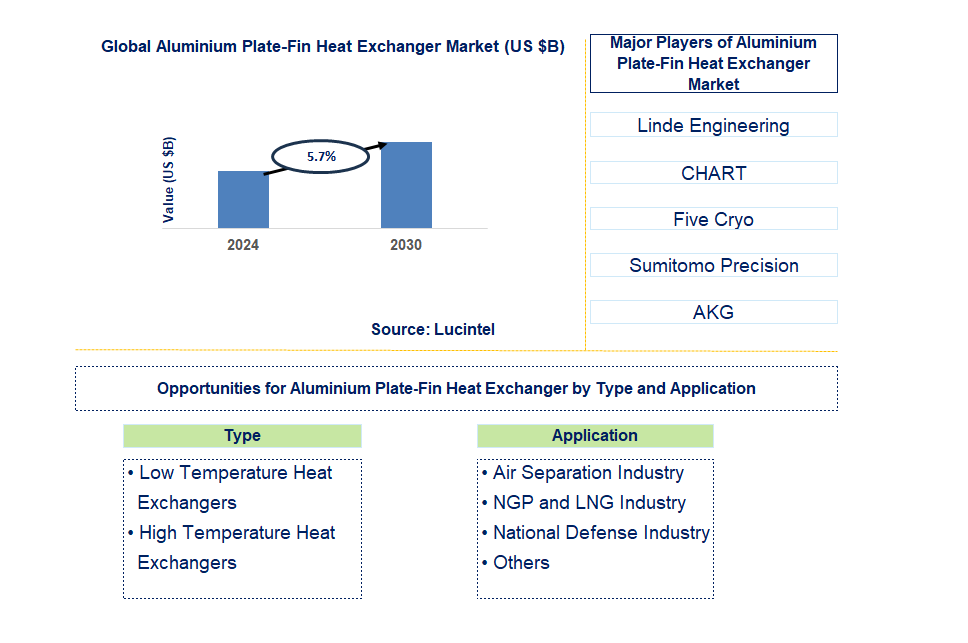
Key data points: The growth forecast = 5.7% annually for the next 6 years. Scroll below to get more insights. This market report covers trends, opportunities, and forecasts in the global aluminium plate-fin heat exchanger market to 2030 by type (low temperature heat exchanger and high temperature heat exchanger), application (air separation industry, NGP and LNG industry, national defense industry, and others), and region (North America, Europe, Asia Pacific, and the Rest of the World)
We'll send your sample report shortly.
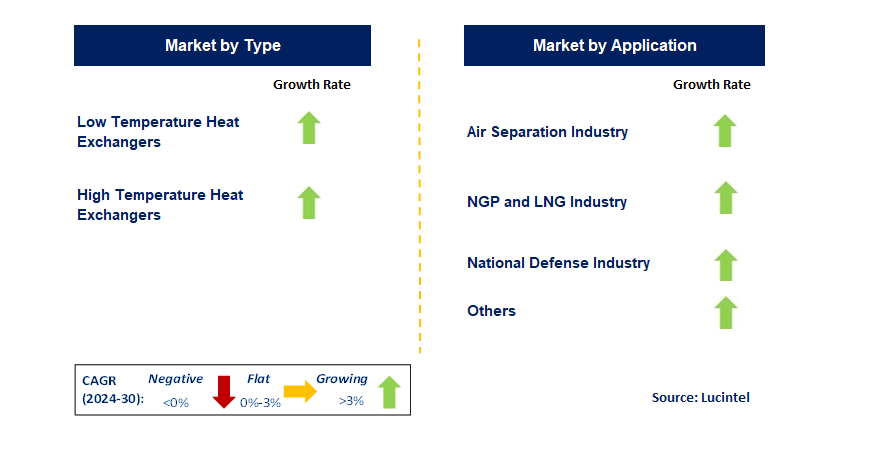
• Lucintel forecasts that, within the type category, high high-temperature heat exchanger segment is expected to witness higher growth over the forecast period.
• Within the application category, the air separation industry will remain the largest segment.
• In terms of regions, APAC is expected to witness the highest growth over the forecast period. Gain valuable insights for your business decisions with our comprehensive 150+ page report.
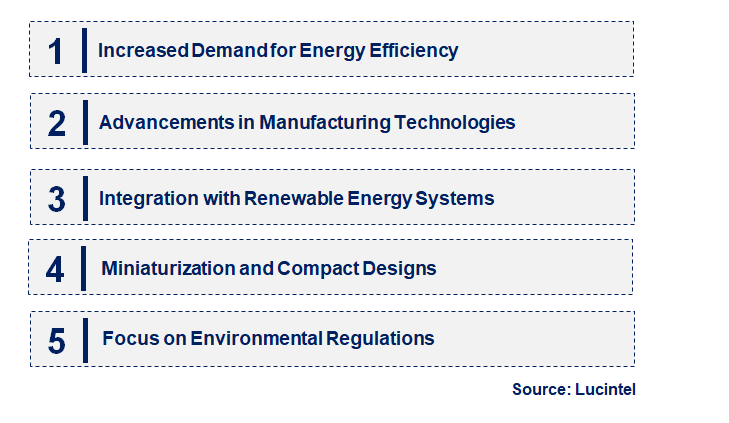
• Increased demand for energy efficiency: As industries and consumers push for greater energy efficiency, aluminum plate-fin heat exchangers are gaining popularity due to their superior thermal performance and compact design. They are increasingly used in applications where minimizing energy consumption is crucial, such as in HVAC systems, aerospace, and automotive industries.
• Advancements in manufacturing technologies: Innovations in manufacturing processes, such as improved welding techniques and enhanced heat transfer designs, are contributing to the development of more efficient and durable aluminum plate-fin heat exchangers. Additive manufacturing (3D printing) is also being explored for creating complex geometries that enhance performance.
• Integration with renewable energy systems: There is a growing integration of aluminum plate-fin heat exchangers in renewable energy systems, including solar thermal collectors and geothermal heating systems. Their ability to efficiently transfer heat makes them well-suited for these applications, which are increasingly adopted as part of sustainable energy solutions.
• Miniaturization and compact designs: The trend towards miniaturization in various industries is influencing the design of heat exchangers. Compact, lightweight aluminum plate-fin heat exchangers are being developed for use in smaller, space-constrained environments, such as in portable electronics and compact industrial machinery.
• Focus on environmental regulations: Stricter environmental regulations are pushing industries to adopt heat exchangers that reduce emissions and enhance energy recovery. Aluminum plate-fin heat exchangers, with their high efficiency and low environmental impact, are well-positioned to meet these regulatory requirements.
• Customization and application-specific solutions: There is rising demand for custom-designed heat exchangers tailored to specific applications and industries. Manufacturers are increasingly offering bespoke solutions to meet unique performance requirements and operating conditions, driving growth in the market. These trends are dynamically changing the perspective on the aluminum plate-fin heat exchanger market by pushing design, manufacturing, and application innovations for value addition toward efficiency and sustainability.
• Advanced fin designs: New fin designs, such as serrated and wavy fins, are being developed to improve heat transfer efficiency. These designs enhance thermal performance and are used in applications requiring high heat dissipation.
• Automated production processes: The adoption of automated production lines is increasing, improving consistency and reducing manufacturing costs. Automation also enables the production of complex and customized heat exchanger designs.
• Improved material coatings: Advances in material coatings are enhancing the durability and corrosion resistance of aluminum plate-fin heat exchangers. These coatings extend the service life of the exchangers and improve performance in harsh environments.
• Compact and modular designs: Developments in compact and modular heat exchanger designs are addressing the need for space-saving solutions. These designs are particularly useful in applications where space is limited, such as in electronic cooling.
• Integration with renewable energy systems: Aluminum plate-fin heat exchangers are being integrated with renewable energy systems, such as solar thermal collectors. This development supports the use of waste heat and enhances overall system efficiency. These developments are driving growth in the aluminum plate-fin heat exchanger market by improving performance, reducing costs, and expanding applications across various industries.
• HVAC systems: At present, there is more demand for high-efficiency heat exchangers in HVAC systems for a variety of functions to increase energy efficiency and improve indoor air quality. Innovations in design and materials open up opportunities for advanced solutions in residential and commercial buildings.
• Automotive: The automotive sector has significant growth opportunities in the field of aluminum plate-fin heat exchangers, especially in engine cooling and climate control applications. Miniaturization and enhancement technologies are being developed to meet the needs of modern automobiles.
• Aerospace industry: In the aerospace industry, especially for space and aircraft thermal management, lightweight along high performance are demanded for heat exchangers. There is still room for advanced material and configuration development that can fit into the strict standards of aerospace applications.
• Industrial processes: Industrial processes are seeing rising growth for heat recovery and temperature control with the use of aluminum plate-fin heat exchangers. Other huge potentials that exist for such systems include chemical processing and power generation.
• Renewable energy systems: Significant prospects for growth will come from the integration of heat exchangers with renewable energy systems such as solar thermal systems and geothermal systems. This integration will support energy efficiency and sustainability in renewable energy applications. These opportunities are the building blocks for the future of the aluminum plate-fin heat exchanger market, as they drive innovative applications in various fields.
• Technological advancements: Innovation in fin design, material, and manufacturing processes presents unparalleled opportunities in the heat exchanger market. Improved technologies ensure better efficiency, performance, and customization possibilities.
• Growing demand for energy efficiency: Higher energy efficiency and environmental awareness drive demand for high-performance heat exchangers. These demands emerge due to regulatory standards and consumer preferences for energy-saving solutions.
• Regulatory compliance: Stringent environmental and performance regulations can also impact the design and construction of heat exchangers. Staying updated with regulatory needs and compliance is another critical direction toward market success.
• Economic conditions: The overall economic cycle directly relates to demand from other industries for heat exchangers. During an economic downturn, demand is expected to decline due to a decrease in investment in technology and new projects. Challenges in the alumin9um plate-fin heat exchanger market are:
• High initial costs: The high initial cost of advanced aluminum plate-fin heat exchangers is a problem for applications with small needs. Innovation and economies of scale are required to address these cost concerns for expanded market use.
• Difficult manufacturing processes: Advanced heat exchanger manufacturing sometimes encompasses adverse factors such as longer production times and increased production costs. Such adversities should be minimized by rationalization of the manufacturing process and automation.
• Material and supply chain issues: Supply chain disruptions and surges in the price of raw materials like aluminum influence production and pricing. Material price volatility and supply chain problems can contribute to further undermining stability in this market segment.
• Market competition: High competition between manufacturers dictates pricing and innovation. Every firm has to invest regularly in research and development to make its products unique and competitive in the market. In a nutshell, the aluminium plate-fin heat exchanger market is dictated by technical changes, demand for energy efficiency, and regulatory demands. The growth of this industry will be greatly influenced by challenges related to costs, manufacturing complexity, and market competitiveness. Hence, it is important that these drivers and challenges be addressed to enable further advancements in the market to satisfy the changing needs of industries.
• Linde Engineering
• CHART
• Five Cryo
• Sumitomo Precision
• AKG
• Kobe Steel
• Triumph
• Low Temperature Heat Exchangers
• High Temperature Heat Exchangers
• Air Separation Industry
• NGP and LNG Industry
• National Defense Industry
• Others
• North America
• Europe
• Asia Pacific
• The Rest of the World
• United States: In the US, innovations target improving the thermal efficiency and life of aluminum plate-fin heat exchangers. New designs involve improved configurations for fins and coatings with better materials to enhance service life and efficiency in HVAC and aerospace applications.
• China: China is rapidly developing its manufacturing processes for aluminum plate-fin heat exchangers, with automation techniques entering the process lines. In this way, costs can be reduced, and consistent products can be provided to meet industrial and automotive sector growth.
• Germany: Germany represents the leading role in implementing high-efficiency heat exchangers together with modern systems of heat recovery. All developments correspond to the serious emphasis that Germany places on energy efficiency and environmental sustainability regarding industrial process improvement and renewable energy systems.
• India: Innovations in India are directed toward achieving economic improvements for the construction of cost-effective aluminum plate-fin heat exchangers, particularly for the cooling and refrigeration industries, to meet the increasing urban and industrial requirements.
• Japan: Japan is developing miniaturization and customization of aluminum plate-fin heat exchangers. There has been an emphasis on designing compact and high-performance units to be applied in high-technology areas such as electronics cooling and automotive systems. This reflects Japan's drive for technological precision.


• Linde Engineering
• CHART
• Five Cryo
• Sumitomo Precision
• AKG
• Kobe Steel
• Triumph Q5. Which aluminium plate-fin heat exchanger market segment will be the largest in future? Answer: Lucintel forecasts that high temperature heat exchanger segment is expected to witness higher growth over the forecast period. Q6. In aluminium plate-fin heat exchanger market, which region is expected to be the largest in next 5 years? Answer: APAC is expected to witness the highest growth over the forecast period. Q.7 Do we receive customization in this report? Answer: Yes, Lucintel provides 10% customization without any additional cost.


Choose a license that fits your team. Instant PDF delivery.
Prices exclude taxes. Instant delivery. Custom licensing available on request.
Market Report · July 31, 2026
Market Report · July 22, 2026
Market Report · July 20, 2026
Trusted partner for strategic intelligence and business growth


Receive a complimentary market analysis tailored to your industry. Our analysts will identify key growth opportunities and competitive dynamics specific to your business.

Market size, growth rate, and key trend analysis for your specific sector.

Top competitor positioning and market share analysis.

Strategic recommendations backed by data-driven insights.
Get curated market intelligence and competitive moves straight to your inbox.
By subscribing, you agree to receive our monthly insights. Unsubscribe anytime.
Receive a complimentary market analysis tailored to your industry. Our analysts will identify key growth opportunities and competitive dynamics specific to your business.
Market size, growth rate, and key trend analysis for your specific sector.
Top competitor positioning and market share analysis.
Strategic recommendations backed by data-driven insights.
Get curated market intelligence, emerging trends, and competitive moves straight to your inbox each month.
By subscribing, you agree to receive our monthly insights. Unsubscribe anytime.
We'll send your sample report shortly.