
Close Lucintel Chat
Didn't Find What You're Looking for?
Call us at +1972 636 5056 or write at helpdesk@Lucintel.com
Ask an Expert Provide Custom Requirements Download Sample Report Search Available Reports
  • helpdesk@Lucintel.com
  • |
  • Call Lucintel +1 972 636 5056
  • |
  • Login
  • |
  • Register
  • |
  • Search
  • |
'
...

The Impact of COVID-19 is included in Allyl Alcohol Market Report. Buy it today to get an advantage.

Request the impact of COVID-19 on your product or industry


Allyl Alcohol Market Trends and Forecast

The future of the global allyl alcohol market looks promising with opportunities in the pharmaceutical, paint & coating, textile, and automotive markets. The global allyl alcohol market is expected to grow with a CAGR of 5.4% from 2025 to 2031. The major drivers for this market are the rising demand in pharmaceuticals, the growing use in chemical industries, and the increase in bio-based product adoption.

• Lucintel forecasts that, within the purity category, high purity is expected to witness higher growth over the forecast period.
• Within the end use category, pharmaceutical is expected to witness the highest growth.
• In terms of region, APAC is expected to witness the highest growth over the forecast period.
Gain valuable insights for your business decisions with our comprehensive 150+ page report. Sample figures with some insights are shown below.
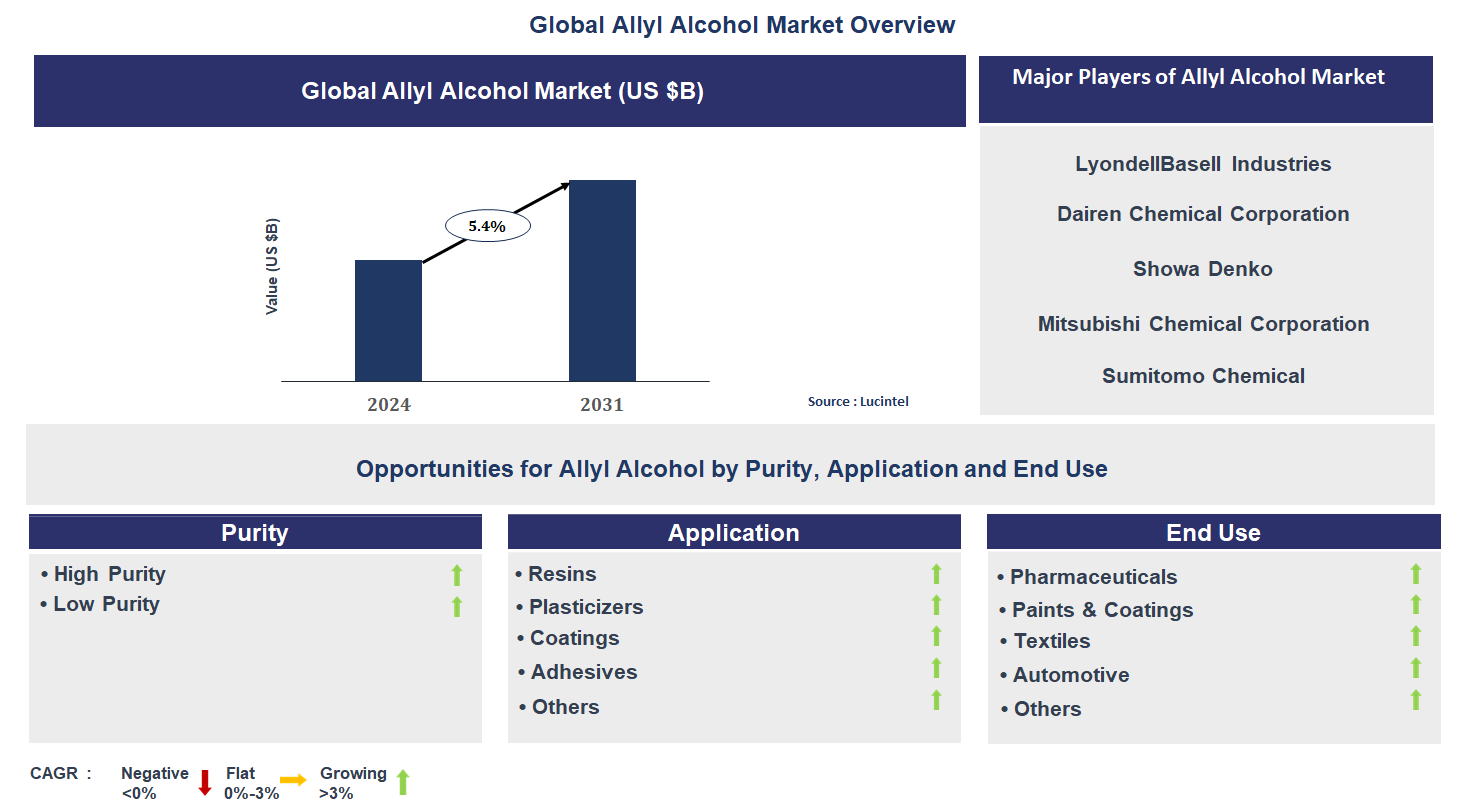
Allyl Alcohol Market Trends and Forecast

Emerging Trends in the Allyl Alcohol Market

The allyl alcohol market is experiencing a period of change, with some important trends guiding it towards the future. These trends are driving the market away from its historical position as a low-end chemical intermediate towards a higher-end and more specialized product. The transition is fueled by more focus on sustainability, technological advancement, and requirements for high-performance materials in diverse industries. Knowledge of these trends is fundamental for stakeholders to navigate the market and exploit new opportunities for growth.
• Transition to Bio-Based and Sustainable Manufacturing: There is an increasing trend to manufacture allyl alcohol from renewable raw materials, such as glycerol, a co-product of the manufacture of biodiesel. This transition is being pushed by an international movement towards sustainability and the necessity for more independence from petroleum-derived chemicals. Improving more economical and environmentally friendly manufacturing processes is a key area of interest, as it not only complies with environmental laws but also resonates with an increasing number of businesses looking to decrease their carbon footprint.
• Growing Demand for High-Purity Grades: The end-use industries in the pharmaceuticals, electronics, and specialty polymers sectors are increasingly demanding higher-purity grades of allyl alcohol. This is an important trend in that it calls for more sophisticated and expensive production and purification steps. Producers are responding with investments in new technologies to manufacture ultra-pure allyl alcohol that earns a premium price and sets up a high-value segment in the market. This trend is a major impetus for market segmentation and value creation.
• Expansion into New Niche Applications: The market is experiencing a trend of broadening beyond its conventional applications to new, niche applications. These include the application of allyl alcohol in making fragrances, flavors, and new adhesives. This trend is fueled by ongoing research for fresh growth opportunities as well as a need to diversify the products base of applications. It is stabilizing the market by lessening its reliance on a limited number of core industries.
• Technological Developments in Manufacturing: Ongoing technological advancements in manufacturing processes are a dominant trend. New process technologies and catalysts are being created to enhance the yield and efficiency of allyl alcohol manufacturing as well as decrease energy use. For instance, direct propylene-to-allyl-alcohol conversion methods are being investigated. Such developments are vital in reducing production expenses, enhancing competitiveness, and allowing companies to abide by higher quality and environmental requirements.
• Increasing Use in the Medical Industry: The use of allyl alcohol as an intermediate for the production of specialized medicines and medical devices is on the rise. Its special chemical properties make it a suitable precursor to be used in the development of complex organic molecules. This is driven by the booming global healthcare sector and the demand for high-purity, dependable chemical building blocks for drug production and medical-grade materials.
These trends collectively are redefining the market by driving it towards more specialization, sustainability, and technology. The market of the future will be less about mass production and more about producing high-value, customized solutions for a diverse and demanding group of industries.
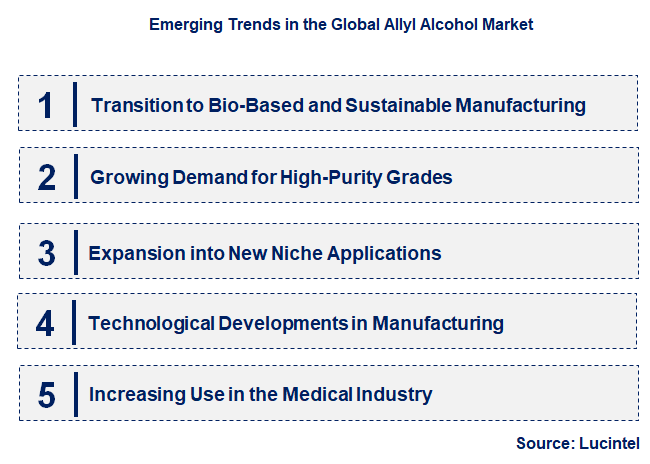
Emerging Trends in the Allyl Alcohol Market

Recent Development in the Allyl Alcohol Market

The allyl alcohol market is going through a phase of immense growth, characterized by technological innovation, strategic changes, and increased focus on new uses. These changes are bringing about a fundamental shift in the market. Companies are shifting from conventional, volume-focused approaches to a more advanced model where the focus is on product quality, innovation, and sustainability. This is allowing the market to respond to a new set of challenges and opportunities.
• Industrialization of Glycerol-Based Manufacturing: The most significant recent development has been the successful industrialization of novel manufacturing processes using glycerol as a feedstock in lieu of propylene. This is a significant step since glycerol is an ecological and available by-product of the biodiesel manufacturing process. This process is decreasing the dependence of the market on fossil fuels, decreasing manufacturing costs, and making allyl alcohol a more environmentally friendly chemical. It is a straightforward answer to the worldwide pressure for more sustainable production of chemicals.
• High-Purity Grades for Electronics: A further significant development is the growing emphasis on manufacturing ultra-high-purity grades of allyl alcohol for the electronics sector. This is because of the need for high-quality optical plastics utilized in lenses and electronic displays. Producers are committing to new quality and purification technologies to fulfill the demanding standards of this high-value end use, thereby establishing a profitable new market segment. This is an important driver of market value expansion.
• Rising R&D in Specialty Resins: There is a significant trend in research and development towards new uses of allyl alcohol in specialty resins. These resins find application in a range of high-performance automotive and aerospace parts. This growth is driving the development of new products with improved properties, including increased flame retardancy and chemical resistance. It is driving demand from industries that need advanced, lightweight, and strong materials.
• Asia Pacific Market Expansion: The Asia Pacific region, and more specifically China and India, has experienced a significant growth in the buildup of allyl alcohol production capacity. This is directly due to the rapid industrialization of the region, which is opening a huge demand for chemical intermediates. This development is shifting the global production and consumption balance, with Asia Pacific solidifying its position as a key market leader and a major hub for both production and consumption.
• Strategic Alliances and Acquisitions: Another new trend is the creation of strategic alliances and acquisitions by major market players. These partnerships are in place to integrate market share, get access to new technologies, and open up new geographic markets. This trend is causing the market to become more concentrated with fewer major players covering a greater majority of the global marketplace and stimulating innovation and investment.
These advancements are influencing the market by speeding its evolution into a more specialized, high-tech, and sustainable sector. The markets future will be marked by its capacity to keep on innovating and evolving to meet the changing needs of its end-user sectors.

Strategic Growth Opportunities in the Allyl Alcohol Market

The allyl alcohol market offers several strategic growth opportunities by capitalizing on its distinct chemical properties in key applications. The opportunities are fueled by a mix of technological innovation, new industrial requirements, and a worldwide drive towards sustainability. Focusing on these high-potential areas can provide companies with a competitive edge, enhance their market size, and create long-term value.
• Advanced Automotive Resins and Coatings: Automotive manufacturers pursuit of lighter, more efficient, and attractive cars presents an ideal growth opportunity. Allyl alcohol may be utilized in the manufacture of high-performance epoxy resins and unsaturated polyesters for coatings and composites. The strategic potential is to collaborate with vehicle manufacturers to create custom resins that provide enhanced durability, scratch resistance, and appearance, especially for electric vehicles and lightweight parts.
• Optical High-Performance Plastics: The optics and electronics business is a high-value growth segment. Allyl alcohol is a critical monomer in the formation of optical high-performance plastics for eyeglass lenses, camera parts, and electronic displays. These applications demand a highly pure material with good optical clarity and scratch resistance. The strategy should be to develop and market ultra-pure allyl alcohol grades to this high-value, specialty market segment.
• Agrochemical and Pharmaceutical Intermediates: The agrochemical and pharmaceutical sectors provide a stable and high-value growth market. Allyl alcohol is a basic building block for the production of a number of drugs, pesticides, and herbicides. The challenge is to establish allyl alcohol as a secure and high-purity chemical intermediate for these highly regulated markets. This demands a strong emphasis on quality control, regulatory compliance, and secure supply chain.
• Bio-Based Sustainable Polymers: The need for sustainable and bio-based materials is expanding at a large scale, which is one of the major strategic opportunities. Allyl alcohol can be utilized as a monomer to produce polymers from renewable feedstocks. The strategic opportunity exists to develop new bio-based polymers for use in packaging, textiles, and other consumer products. This provides companies with the potential to enter the market of green chemicals and establish differentiation on the basis of sustainability credentials.
• Specialty Fragrances and Flavors: The fragrances and flavors business is a specialty but expanding growth opportunity. Allyl alcohol and its derivatives are utilized to formulate unusual and complex flavors and fragrances. The strategic play is to produce and sell specialty grades of allyl alcohol for application in fine fragrances and gourmet foods. It is a premium-priced segment and not as vulnerable to market fluctuations.
These opportunities for strategic growth are affecting the market by propelling it towards increased specialization and diversification. The attention is moving away from a bulk chemical commodity to a high-performance, value-added material offering a competitive advantage across a broad array of technologically sophisticated applications.

Allyl Alcohol Market Driver and Challenges

The allyl alcohol industry is influenced by a multifaceted relationship of drivers and challenges. Its fundamental strengths as a multi-purpose chemical intermediate are driving demand across several high-growth sectors. These drivers are offset, however, by serious challenges to production costs, safety, and competition with substitute materials. The future direction of the market will be established by whether it can leverage its inherent strengths and successfully manage and mitigate the respective risks.
The factors responsible for driving the allyl alcohol market include:
1. High Reactivity and Versatility: The key driver is the distinctive chemical structure of allyl alcohol, which is extremely reactive and versatile. It serves as a critical building block for various derivatives such as glycerol, resins, and polymers. This versatility guarantees sustained demand across various industries ranging from chemicals to pharmaceuticals.
2. Increasing Demand from End-User Sectors: Growth in major end-user sectors is the key driver. The construction sectors demand for tough coatings and resins, the automotive sectors drive for light-weight materials, and the electronics industrys demand for high-performance optical plastics are all driving demand for allyl alcohol and its derivatives.
3. Production Technology Advances: Ongoing advances in production technology, including the application of new catalysts and improved processes, are propelling the growth of the market. These advances result in reduced production costs, increased yield, and enhanced product quality, thus making allyl alcohol an increasingly competitive and desirable choice for producers.
4. Growth of the Bio-Based Chemicals Industry: The global sustainability drive is one of the driving forces. The fact that it can be made from glycerol, an available renewable material, is a huge benefit. This makes allyl alcohol a green chemical, which is becoming ever more vital to eco-friendly business firms and customers, and provides new market opportunities.
5. Growing Demand from Emerging Economies: Emerging economies, especially in Asia Pacific, are experiencing rapid industrialization and urbanization, thus triggering huge market growth. Construction and automotive industries in these nations are growing at a rapid pace, thus fueling a huge stable demand for chemical intermediates such as allyl alcohol.
Challenges in the allyl alcohol market are:
1. Toxicity and Handling Hazards: Allyl alcohols chief challenge is its inherent toxicity and flammability. The chemical is very dangerous, warranting rigorous safety measures when handling, storing, and transporting. It adds cost and compliance burdens to operations, serving as an important barrier to entry for new entrants and an ongoing headache for existing players.
2. Substitute Competition: The industry is threatened by a range of substitutes and alternative means of production. For instance, some uses can substitute with other chemical intermediates that are easier to work with or produced in a less complicated process. The presence of these substitutes exerts pricing pressure and restricts the growth opportunities in some segments.
3. Fluctuating Raw Material Prices: The raw material prices, especially propylene and glycerol, can be unstable. This directly affects the cost of allyl alcohol production, and manufacturers have to grapple with uncertainty as it is challenging to sustain stable pricing. Mitigating this raw material price instability poses a major challenge for the industry.
The collective influence of the drivers and challenges is a market thats experiencing a phase of change. Though the high drivers, including its functional utility and increasing demand from major industries, guarantee the markets sustained utility, the hazards of toxicity and competition are compelling an evolution. The future of allyl alcohol business will be shaped by its capacity to utilize technological advancements to meet safety and sustainability issues, enabling it to migrate to high-value uses and establish itself as an important chemical intermediate.

List of Allyl Alcohol Companies

Companies in the market compete on the basis of product quality offered. Major players in this market focus on expanding their manufacturing facilities, R&D investments, infrastructural development, and leverage integration opportunities across the value chain. With these strategies allyl alcohol companies cater increasing demand, ensure competitive effectiveness, develop innovative products & technologies, reduce production costs, and expand their customer base. Some of the allyl alcohol companies profiled in this report include-
• LyondellBasell Industries
• Dairen Chemical Corporation
• Showa Denko
• Mitsubishi Chemical Corporation
• Sumitomo Chemical
• Sasol Limited
• Arkema
• BASF
• Huntsman Corporation
• INEOS Group Holdings 

Allyl Alcohol Market by Segment

The study includes a forecast for the global allyl alcohol market by purity, application, end use, and region.

Allyl Alcohol Market by Purity [Value from 2019 to 2031]:


• High Purity
• Low Purity

Allyl Alcohol Market by Application [Value from 2019 to 2031]:


• Resins
• Plasticizers
• Coatings
• Adhesives
• Others

Allyl Alcohol Market by End Use [Value from 2019 to 2031]:


• Pharmaceuticals
• Paints & Coatings
• Textiles
• Automotive
• Others

Allyl Alcohol Market by Region [Value from 2019 to 2031]:


• North America
• Europe
• Asia Pacific
• The Rest of the World

Country Wise Outlook for the Allyl Alcohol Market

Recent trends in the allyl alcohol market are influenced by its versatility as a chemical intermediate and by its applicability in a broad array of end-user sectors. Allyl alcohol is one of the major raw materials used to manufacture resins, plastics, and pharmaceuticals. The market is presently propelled by expanding demand for high-performance products in industries such as automotive and construction. In parallel, the industry is responding to new demands, such as an emphasis on sustainable production techniques and a requirement for manufacturing processes that are safer and more efficient. This has contributed to a marketplace that is more centered on technological development and strategic application deployment.
• United States: The allyl alcohol market in the United States is mainly driven by demand for advanced-performance materials in the automotive and aerospace sectors. Key trends involve concentration on the production of higher-purity grades for applications in specialty chemicals and pharmaceuticals. There is increasing focus on research and development to develop newer derivatives of allyl alcohol for high-end applications. The market is also witnessing investments in newer, more efficient manufacturing technologies to enhance yield and minimize environmental footprint, as per strict environmental regulations and corporate sustainability objectives.
• China: China is a leading power in the world allyl alcohol market, both as a producer and consumer. Current trends are driven by the countrys fast-paced industrialization and enormous infrastructure undertakings. Allyl alcohol finds strong domestic demand for use in the manufacture of epoxy resins, which find extensive use in construction and electronics. Chinese producers are increasing their capacities and enhancing their technology to serve both domestic and overseas demand, securing the nations position as a prominent global supplier.
• Germany: Germanys allyl alcohol industry is characterized by its emphasis on high-quality, specialty chemical manufacture. Recent trends are focused on the application of allyl alcohol as a feedstock for sophisticated polymers and specialty resins for use in the automotive and medical device industries. German firms are innovators in creating new production processes, such as those that are environmentally friendly. Market dynamics are dominated by strong research and development to unlock new uses and enhance product performance to meet a highly demanding industrial customer base.
• India: The Indian allyl alcohol market is witnessing rapid growth, fueled by a booming chemical production and building industry. Recent trends involve an increase in local production to cater to growing demand from industries such as polymers, plastics, and pharmaceuticals. The "Make in India" campaign by the government has promoted domestic firms to invest in manufacturing plants, weaning themselves away from reliance on imports. The market is to grow further with industrial expansion and infrastructure development, resulting in a stable and robust domestic market for allyl alcohol.
• Japan: Japans allyl alcohol industry is mature and specializes to a great extent. The recent growth is focused on its use in high-tech, niche areas like electronics and precision engineering. The high-purity allyl alcohol produced by Japanese players is utilized to make high-quality lenses and electronic components through specialized resins and optical plastics. The market is less concerned with volume production but more with producing high-value, specialized grades that can satisfy the stringent requirements of its high-tech manufacturing industries.

Lucintel Analytics Dashboard

Features of the Global Allyl Alcohol Market

Market Size Estimates: Allyl alcohol market size estimation in terms of value ($B).
Trend and Forecast Analysis: Market trends (2019 to 2024) and forecast (2025 to 2031) by various segments and regions.
Segmentation Analysis: Allyl alcohol market size by purity, application, end use, and region in terms of value ($B).
Regional Analysis: Allyl alcohol market breakdown by North America, Europe, Asia Pacific, and Rest of the World.
Growth Opportunities: Analysis of growth opportunities in different purity, applications, end uses, and regions for the allyl alcohol market.
Strategic Analysis: This includes M&A, new product development, and competitive landscape of the allyl alcohol market.
Analysis of competitive intensity of the industry based on Porter’s Five Forces model.

Lucintel Consulting Services

FAQ

Q1. What is the growth forecast for allyl alcohol market?
Answer: The global allyl alcohol market is expected to grow with a CAGR of 5.4% from 2025 to 2031.
Q2. What are the major drivers influencing the growth of the allyl alcohol market?
Answer: The major drivers for this market are the rising demand in pharmaceuticals, the growing use in chemical industries, and the increase in bio-based product adoption.
Q3. What are the major segments for allyl alcohol market?
Answer: The future of the allyl alcohol market looks promising with opportunities in the pharmaceutical, paint & coating, textile, and automotive markets.
Q4. Who are the key allyl alcohol market companies?
Answer: Some of the key allyl alcohol companies are as follows:
• LyondellBasell Industries
• Dairen Chemical Corporation
• Showa Denko
• Mitsubishi Chemical Corporation
• Sumitomo Chemical
• Sasol Limited
• Arkema
• BASF
• Huntsman Corporation
• INEOS Group Holdings 
Q5. Which allyl alcohol market segment will be the largest in future?
Answer: Lucintel forecasts that, within the purity category, high purity is expected to witness higher growth over the forecast period.
Q6. In allyl alcohol market, which region is expected to be the largest in next 5 years?
Answer: In terms of region, APAC is expected to witness the highest growth over the forecast period.
Q7. Do we receive customization in this report?
Answer: Yes, Lucintel provides 10% customization without any additional cost.

This report answers following 11 key questions:

Q.1. What are some of the most promising, high-growth opportunities for the allyl alcohol market by purity (high purity and low purity), application (resins, plasticizers, coatings, adhesives, and others), end use (pharmaceuticals, paints & coatings, textiles, automotive, and others), and region (North America, Europe, Asia Pacific, and the Rest of the World)?
Q.2. Which segments will grow at a faster pace and why?
Q.3. Which region will grow at a faster pace and why?
Q.4. What are the key factors affecting market dynamics? What are the key challenges and business risks in this market?
Q.5. What are the business risks and competitive threats in this market?
Q.6. What are the emerging trends in this market and the reasons behind them?
Q.7. What are some of the changing demands of customers in the market?
Q.8. What are the new developments in the market? Which companies are leading these developments?
Q.9. Who are the major players in this market? What strategic initiatives are key players pursuing for business growth?
Q.10. What are some of the competing products in this market and how big of a threat do they pose for loss of market share by material or product substitution?
Q.11. What M&A activity has occurred in the last 5 years and what has its impact been on the industry?

For any questions related to Allyl Alcohol Market, Allyl Alcohol Market Size, Allyl Alcohol Market Growth, Allyl Alcohol Market Analysis, Allyl Alcohol Market Report, Allyl Alcohol Market Share, Allyl Alcohol Market Trends, Allyl Alcohol Market Forecast, Allyl Alcohol Companies, write Lucintel analyst at email: helpdesk@lucintel.com. We will be glad to get back to you soon.
                                           Table of Contents

            1. Executive Summary

            2. Market Overview

                        2.1 Background and Classifications
                        2.2 Supply Chain

            3. Market Trends & Forecast Analysis

                        3.1 Macroeconomic Trends and Forecasts
                        3.2 Industry Drivers and Challenges
                        3.3 PESTLE Analysis
                        3.4 Patent Analysis
                        3.5 Regulatory Environment
                        3.6 Global Allyl Alcohol Market Trends and Forecast

            4. Global Allyl Alcohol Market by Purity

                        4.1 Overview
                        4.2 Attractiveness Analysis by Purity
                        4.3 High Purity : Trends and Forecast 2025 to 2031
                        4.4 Low Purity : Trends and Forecast 2025 to 2031

            5. Global Allyl Alcohol Market by Application

                        5.1 Overview
                        5.2 Attractiveness Analysis by Application
                        5.3 Resins : Trends and Forecast 2025 to 2031
                        5.4 Plasticizers : Trends and Forecast 2025 to 2031
                        5.5 Coatings : Trends and Forecast 2025 to 2031
                        5.6 Adhesives : Trends and Forecast 2025 to 2031
                        5.7 Others : Trends and Forecast 2025 to 2031

            6. Global Allyl Alcohol Market by End Use

                        6.1 Overview
                        6.2 Attractiveness Analysis by End Use
                        6.3 Pharmaceuticals : Trends and Forecast 2025 to 2031
                        6.4 Paints & Coatings : Trends and Forecast 2025 to 2031
                        6.5 Textiles : Trends and Forecast 2025 to 2031
                        6.6 Automotive : Trends and Forecast 2025 to 2031
                        6.7 Others : Trends and Forecast 2025 to 2031

            7. Regional Analysis

                        7.1 Overview
                        7.2 Global Allyl Alcohol Market by Region

            8. North American Allyl Alcohol Market

                        8.1 Overview
                        8.2 North American Allyl Alcohol Market by Purity
                        8.3 North American Allyl Alcohol Market by End Use
                        8.4 The United States Allyl Alcohol Market
                        8.5 Canadian Allyl Alcohol Market
                        8.6 Mexican Allyl Alcohol Market

            9. European Allyl Alcohol Market

                        9.1 Overview
                        9.2 European Allyl Alcohol Market by Purity
                        9.3 European Allyl Alcohol Market by End Use
                        9.4 German Allyl Alcohol Market
                        9.5 French Allyl Alcohol Market
                        9.6 Italian Allyl Alcohol Market
                        9.7 Spanish Allyl Alcohol Market
                        9.8 The United Kingdom Allyl Alcohol Market

            10. APAC Allyl Alcohol Market

                        10.1 Overview
                        10.2 APAC Allyl Alcohol Market by Purity
                        10.3 APAC Allyl Alcohol Market by End Use
                        10.4 Chinese Allyl Alcohol Market
                        10.5 Indian Allyl Alcohol Market
                        10.6 Japanese Allyl Alcohol Market
                        10.7 South Korean Allyl Alcohol Market
                        10.8 Indonesian Allyl Alcohol Market

            11. ROW Allyl Alcohol Market

                        11.1 Overview
                        11.2 ROW Allyl Alcohol Market by Purity
                        11.3 ROW Allyl Alcohol Market by End Use
                        11.4 Middle Eastern Allyl Alcohol Market
                        11.5 South American Allyl Alcohol Market
                        11.6 African Allyl Alcohol Market

            12. Competitor Analysis

                        12.1 Product Portfolio Analysis
                        12.2 Operational Integration
                        12.3 Porter’s Five Forces Analysis
                                    • Competitive Rivalry
                                    • Bargaining Power of Buyers
                                    • Bargaining Power of Suppliers
                                    • Threat of Substitutes
                                    • Threat of New Entrants
                        12.4 Market Share Analysis

            13. Opportunities & Strategic Analysis

                        13.1 Value Chain Analysis
                        13.2 Growth Opportunity Analysis
                                    13.2.1 Growth Opportunity by Purity
                                    13.2.2 Growth Opportunity by Application
                                    13.2.3 Growth Opportunity by End Use
                        13.3 Emerging Trends in the Global Allyl Alcohol Market
                        13.4 Strategic Analysis
                                    13.4.1 New Product Development
                                    13.4.2 Certification and Licensing
                                    13.4.3 Mergers, Acquisitions, Agreements, Collaborations, and Joint Ventures

            14. Company Profiles of the Leading Players Across the Value Chain

                        14.1 Competitive Analysis
                        14.2 LyondellBasell Industries
                                    • Company Overview
                                    • Allyl Alcohol Market Business Overview
                                    • New Product Development
                                    • Merger, Acquisition, and Collaboration
                                    • Certification and Licensing
                        14.3 Dairen Chemical Corporation
                                    • Company Overview
                                    • Allyl Alcohol Market Business Overview
                                    • New Product Development
                                    • Merger, Acquisition, and Collaboration
                                    • Certification and Licensing
                        14.4 Showa Denko
                                    • Company Overview
                                    • Allyl Alcohol Market Business Overview
                                    • New Product Development
                                    • Merger, Acquisition, and Collaboration
                                    • Certification and Licensing
                        14.5 Mitsubishi Chemical Corporation
                                    • Company Overview
                                    • Allyl Alcohol Market Business Overview
                                    • New Product Development
                                    • Merger, Acquisition, and Collaboration
                                    • Certification and Licensing
                        14.6 Sumitomo Chemical
                                    • Company Overview
                                    • Allyl Alcohol Market Business Overview
                                    • New Product Development
                                    • Merger, Acquisition, and Collaboration
                                    • Certification and Licensing
                        14.7 Sasol Limited
                                    • Company Overview
                                    • Allyl Alcohol Market Business Overview
                                    • New Product Development
                                    • Merger, Acquisition, and Collaboration
                                    • Certification and Licensing
                        14.8 Arkema
                                    • Company Overview
                                    • Allyl Alcohol Market Business Overview
                                    • New Product Development
                                    • Merger, Acquisition, and Collaboration
                                    • Certification and Licensing
                        14.9 BASF
                                    • Company Overview
                                    • Allyl Alcohol Market Business Overview
                                    • New Product Development
                                    • Merger, Acquisition, and Collaboration
                                    • Certification and Licensing
                        14.10 Huntsman Corporation
                                    • Company Overview
                                    • Allyl Alcohol Market Business Overview
                                    • New Product Development
                                    • Merger, Acquisition, and Collaboration
                                    • Certification and Licensing
                        14.11 INEOS Group Holdings Overview
                                    • Company Overview
                                    • Allyl Alcohol Market Business Overview
                                    • New Product Development
                                    • Merger, Acquisition, and Collaboration
                                    • Certification and Licensing

            15. Appendix

                        15.1 List of Figures
                        15.2 List of Tables
                        15.3 Research Methodology
                        15.4 Disclaimer
                        15.5 Copyright
                        15.6 Abbreviations and Technical Units
                        15.7 About Us
                        15.8 Contact Us

                                               List of Figures


            Chapter 1

                        Figure 1.1: Trends and Forecast for the Global Allyl Alcohol Market

            Chapter 2

                        Figure 2.1: Usage of Allyl Alcohol Market
                        Figure 2.2: Classification of the Global Allyl Alcohol Market
                        Figure 2.3: Supply Chain of the Global Allyl Alcohol Market
                        Figure 2.4: Driver and Challenges of the Allyl Alcohol Market

            Chapter 3

                        Figure 3.1: Trends of the Global GDP Growth Rate
                        Figure 3.2: Trends of the Global Population Growth Rate
                        Figure 3.3: Trends of the Global Inflation Rate
                        Figure 3.4: Trends of the Global Unemployment Rate
                        Figure 3.5: Trends of the Regional GDP Growth Rate
                        Figure 3.6: Trends of the Regional Population Growth Rate
                        Figure 3.7: Trends of the Regional Inflation Rate
                        Figure 3.8: Trends of the Regional Unemployment Rate
                        Figure 3.9: Trends of Regional Per Capita Income
                        Figure 3.10: Forecast for the Global GDP Growth Rate
                        Figure 3.11: Forecast for the Global Population Growth Rate
                        Figure 3.12: Forecast for the Global Inflation Rate
                        Figure 3.13: Forecast for the Global Unemployment Rate
                        Figure 3.14: Forecast for the Regional GDP Growth Rate
                        Figure 3.15: Forecast for the Regional Population Growth Rate
                        Figure 3.16: Forecast for the Regional Inflation Rate
                        Figure 3.17: Forecast for the Regional Unemployment Rate
                        Figure 3.18: Forecast for Regional Per Capita Income

            Chapter 4

                        Figure 4.1: Global Allyl Alcohol Market by Purity in 2019, 2024, and 2031
                        Figure 4.2: Trends of the Global Allyl Alcohol Market ($B) by Purity
                        Figure 4.3: Forecast for the Global Allyl Alcohol Market ($B) by Purity
                        Figure 4.4: Trends and Forecast for High Purity in the Global Allyl Alcohol Market (2019-2031)
                        Figure 4.5: Trends and Forecast for Low Purity in the Global Allyl Alcohol Market (2019-2031)

            Chapter 5

                        Figure 5.1: Global Allyl Alcohol Market by Application in 2019, 2024, and 2031
                        Figure 5.2: Trends of the Global Allyl Alcohol Market ($B) by Application
                        Figure 5.3: Forecast for the Global Allyl Alcohol Market ($B) by Application
                        Figure 5.4: Trends and Forecast for Resins in the Global Allyl Alcohol Market (2019-2031)
                        Figure 5.5: Trends and Forecast for Plasticizers in the Global Allyl Alcohol Market (2019-2031)
                        Figure 5.6: Trends and Forecast for Coatings in the Global Allyl Alcohol Market (2019-2031)
                        Figure 5.7: Trends and Forecast for Adhesives in the Global Allyl Alcohol Market (2019-2031)
                        Figure 5.8: Trends and Forecast for Others in the Global Allyl Alcohol Market (2019-2031)

            Chapter 6

                        Figure 6.1: Global Allyl Alcohol Market by End Use in 2019, 2024, and 2031
                        Figure 6.2: Trends of the Global Allyl Alcohol Market ($B) by End Use
                        Figure 6.3: Forecast for the Global Allyl Alcohol Market ($B) by End Use
                        Figure 6.4: Trends and Forecast for Pharmaceuticals in the Global Allyl Alcohol Market (2019-2031)
                        Figure 6.5: Trends and Forecast for Paints & Coatings in the Global Allyl Alcohol Market (2019-2031)
                        Figure 6.6: Trends and Forecast for Textiles in the Global Allyl Alcohol Market (2019-2031)
                        Figure 6.7: Trends and Forecast for Automotive in the Global Allyl Alcohol Market (2019-2031)
                        Figure 6.8: Trends and Forecast for Others in the Global Allyl Alcohol Market (2019-2031)

            Chapter 7

                        Figure 7.1: Trends of the Global Allyl Alcohol Market ($B) by Region (2019-2024)
                        Figure 7.2: Forecast for the Global Allyl Alcohol Market ($B) by Region (2025-2031)

            Chapter 8

                        Figure 8.1: Trends and Forecast for the North American Allyl Alcohol Market (2019-2031)
                        Figure 8.2: North American Allyl Alcohol Market by Purity in 2019, 2024, and 2031
                        Figure 8.3: Trends of the North American Allyl Alcohol Market ($B) by Purity (2019-2024)
                        Figure 8.4: Forecast for the North American Allyl Alcohol Market ($B) by Purity (2025-2031)
                        Figure 8.5: North American Allyl Alcohol Market by Application in 2019, 2024, and 2031
                        Figure 8.6: Trends of the North American Allyl Alcohol Market ($B) by Application (2019-2024)
                        Figure 8.7: Forecast for the North American Allyl Alcohol Market ($B) by Application (2025-2031)
                        Figure 8.8: North American Allyl Alcohol Market by End Use in 2019, 2024, and 2031
                        Figure 8.9: Trends of the North American Allyl Alcohol Market ($B) by End Use (2019-2024)
                        Figure 8.10: Forecast for the North American Allyl Alcohol Market ($B) by End Use (2025-2031)
                        Figure 8.11: Trends and Forecast for the United States Allyl Alcohol Market ($B) (2019-2031)
                        Figure 8.12: Trends and Forecast for the Mexican Allyl Alcohol Market ($B) (2019-2031)
                        Figure 8.13: Trends and Forecast for the Canadian Allyl Alcohol Market ($B) (2019-2031)

            Chapter 9

                        Figure 9.1: Trends and Forecast for the European Allyl Alcohol Market (2019-2031)
                        Figure 9.2: European Allyl Alcohol Market by Purity in 2019, 2024, and 2031
                        Figure 9.3: Trends of the European Allyl Alcohol Market ($B) by Purity (2019-2024)
                        Figure 9.4: Forecast for the European Allyl Alcohol Market ($B) by Purity (2025-2031)
                        Figure 9.5: European Allyl Alcohol Market by Application in 2019, 2024, and 2031
                        Figure 9.6: Trends of the European Allyl Alcohol Market ($B) by Application (2019-2024)
                        Figure 9.7: Forecast for the European Allyl Alcohol Market ($B) by Application (2025-2031)
                        Figure 9.8: European Allyl Alcohol Market by End Use in 2019, 2024, and 2031
                        Figure 9.9: Trends of the European Allyl Alcohol Market ($B) by End Use (2019-2024)
                        Figure 9.10: Forecast for the European Allyl Alcohol Market ($B) by End Use (2025-2031)
                        Figure 9.11: Trends and Forecast for the German Allyl Alcohol Market ($B) (2019-2031)
                        Figure 9.12: Trends and Forecast for the French Allyl Alcohol Market ($B) (2019-2031)
                        Figure 9.13: Trends and Forecast for the Spanish Allyl Alcohol Market ($B) (2019-2031)
                        Figure 9.14: Trends and Forecast for the Italian Allyl Alcohol Market ($B) (2019-2031)
                        Figure 9.15: Trends and Forecast for the United Kingdom Allyl Alcohol Market ($B) (2019-2031)

            Chapter 10

                        Figure 10.1: Trends and Forecast for the APAC Allyl Alcohol Market (2019-2031)
                        Figure 10.2: APAC Allyl Alcohol Market by Purity in 2019, 2024, and 2031
                        Figure 10.3: Trends of the APAC Allyl Alcohol Market ($B) by Purity (2019-2024)
                        Figure 10.4: Forecast for the APAC Allyl Alcohol Market ($B) by Purity (2025-2031)
                        Figure 10.5: APAC Allyl Alcohol Market by Application in 2019, 2024, and 2031
                        Figure 10.6: Trends of the APAC Allyl Alcohol Market ($B) by Application (2019-2024)
                        Figure 10.7: Forecast for the APAC Allyl Alcohol Market ($B) by Application (2025-2031)
                        Figure 10.8: APAC Allyl Alcohol Market by End Use in 2019, 2024, and 2031
                        Figure 10.9: Trends of the APAC Allyl Alcohol Market ($B) by End Use (2019-2024)
                        Figure 10.10: Forecast for the APAC Allyl Alcohol Market ($B) by End Use (2025-2031)
                        Figure 10.11: Trends and Forecast for the Japanese Allyl Alcohol Market ($B) (2019-2031)
                        Figure 10.12: Trends and Forecast for the Indian Allyl Alcohol Market ($B) (2019-2031)
                        Figure 10.13: Trends and Forecast for the Chinese Allyl Alcohol Market ($B) (2019-2031)
                        Figure 10.14: Trends and Forecast for the South Korean Allyl Alcohol Market ($B) (2019-2031)
                        Figure 10.15: Trends and Forecast for the Indonesian Allyl Alcohol Market ($B) (2019-2031)

            Chapter 11

                        Figure 11.1: Trends and Forecast for the ROW Allyl Alcohol Market (2019-2031)
                        Figure 11.2: ROW Allyl Alcohol Market by Purity in 2019, 2024, and 2031
                        Figure 11.3: Trends of the ROW Allyl Alcohol Market ($B) by Purity (2019-2024)
                        Figure 11.4: Forecast for the ROW Allyl Alcohol Market ($B) by Purity (2025-2031)
                        Figure 11.5: ROW Allyl Alcohol Market by Application in 2019, 2024, and 2031
                        Figure 11.6: Trends of the ROW Allyl Alcohol Market ($B) by Application (2019-2024)
                        Figure 11.7: Forecast for the ROW Allyl Alcohol Market ($B) by Application (2025-2031)
                        Figure 11.8: ROW Allyl Alcohol Market by End Use in 2019, 2024, and 2031
                        Figure 11.9: Trends of the ROW Allyl Alcohol Market ($B) by End Use (2019-2024)
                        Figure 11.10: Forecast for the ROW Allyl Alcohol Market ($B) by End Use (2025-2031)
                        Figure 11.11: Trends and Forecast for the Middle Eastern Allyl Alcohol Market ($B) (2019-2031)
                        Figure 11.12: Trends and Forecast for the South American Allyl Alcohol Market ($B) (2019-2031)
                        Figure 11.13: Trends and Forecast for the African Allyl Alcohol Market ($B) (2019-2031)

            Chapter 12

                        Figure 12.1: Porter’s Five Forces Analysis of the Global Allyl Alcohol Market
                        Figure 12.2: Market Share (%) of Top Players in the Global Allyl Alcohol Market (2024)

            Chapter 13

                        Figure 13.1: Growth Opportunities for the Global Allyl Alcohol Market by Purity
                        Figure 13.2: Growth Opportunities for the Global Allyl Alcohol Market by Application
                        Figure 13.3: Growth Opportunities for the Global Allyl Alcohol Market by End Use
                        Figure 13.4: Growth Opportunities for the Global Allyl Alcohol Market by Region
                        Figure 13.5: Emerging Trends in the Global Allyl Alcohol Market

                                               List of Tables


            Chapter 1

                        Table 1.1: Growth Rate (%, 2023-2024) and CAGR (%, 2025-2031) of the Allyl Alcohol Market by Purity, Application, and End Use
                        Table 1.2: Attractiveness Analysis for the Allyl Alcohol Market by Region
                        Table 1.3: Global Allyl Alcohol Market Parameters and Attributes

            Chapter 3

                        Table 3.1: Trends of the Global Allyl Alcohol Market (2019-2024)
                        Table 3.2: Forecast for the Global Allyl Alcohol Market (2025-2031)

            Chapter 4

                        Table 4.1: Attractiveness Analysis for the Global Allyl Alcohol Market by Purity
                        Table 4.2: Market Size and CAGR of Various Purity in the Global Allyl Alcohol Market (2019-2024)
                        Table 4.3: Market Size and CAGR of Various Purity in the Global Allyl Alcohol Market (2025-2031)
                        Table 4.4: Trends of High Purity in the Global Allyl Alcohol Market (2019-2024)
                        Table 4.5: Forecast for High Purity in the Global Allyl Alcohol Market (2025-2031)
                        Table 4.6: Trends of Low Purity in the Global Allyl Alcohol Market (2019-2024)
                        Table 4.7: Forecast for Low Purity in the Global Allyl Alcohol Market (2025-2031)

            Chapter 5

                        Table 5.1: Attractiveness Analysis for the Global Allyl Alcohol Market by Application
                        Table 5.2: Market Size and CAGR of Various Application in the Global Allyl Alcohol Market (2019-2024)
                        Table 5.3: Market Size and CAGR of Various Application in the Global Allyl Alcohol Market (2025-2031)
                        Table 5.4: Trends of Resins in the Global Allyl Alcohol Market (2019-2024)
                        Table 5.5: Forecast for Resins in the Global Allyl Alcohol Market (2025-2031)
                        Table 5.6: Trends of Plasticizers in the Global Allyl Alcohol Market (2019-2024)
                        Table 5.7: Forecast for Plasticizers in the Global Allyl Alcohol Market (2025-2031)
                        Table 5.8: Trends of Coatings in the Global Allyl Alcohol Market (2019-2024)
                        Table 5.9: Forecast for Coatings in the Global Allyl Alcohol Market (2025-2031)
                        Table 5.10: Trends of Adhesives in the Global Allyl Alcohol Market (2019-2024)
                        Table 5.11: Forecast for Adhesives in the Global Allyl Alcohol Market (2025-2031)
                        Table 5.12: Trends of Others in the Global Allyl Alcohol Market (2019-2024)
                        Table 5.13: Forecast for Others in the Global Allyl Alcohol Market (2025-2031)

            Chapter 6

                        Table 6.1: Attractiveness Analysis for the Global Allyl Alcohol Market by End Use
                        Table 6.2: Market Size and CAGR of Various End Use in the Global Allyl Alcohol Market (2019-2024)
                        Table 6.3: Market Size and CAGR of Various End Use in the Global Allyl Alcohol Market (2025-2031)
                        Table 6.4: Trends of Pharmaceuticals in the Global Allyl Alcohol Market (2019-2024)
                        Table 6.5: Forecast for Pharmaceuticals in the Global Allyl Alcohol Market (2025-2031)
                        Table 6.6: Trends of Paints & Coatings in the Global Allyl Alcohol Market (2019-2024)
                        Table 6.7: Forecast for Paints & Coatings in the Global Allyl Alcohol Market (2025-2031)
                        Table 6.8: Trends of Textiles in the Global Allyl Alcohol Market (2019-2024)
                        Table 6.9: Forecast for Textiles in the Global Allyl Alcohol Market (2025-2031)
                        Table 6.10: Trends of Automotive in the Global Allyl Alcohol Market (2019-2024)
                        Table 6.11: Forecast for Automotive in the Global Allyl Alcohol Market (2025-2031)
                        Table 6.12: Trends of Others in the Global Allyl Alcohol Market (2019-2024)
                        Table 6.13: Forecast for Others in the Global Allyl Alcohol Market (2025-2031)

            Chapter 7

                        Table 7.1: Market Size and CAGR of Various Regions in the Global Allyl Alcohol Market (2019-2024)
                        Table 7.2: Market Size and CAGR of Various Regions in the Global Allyl Alcohol Market (2025-2031)

            Chapter 8

                        Table 8.1: Trends of the North American Allyl Alcohol Market (2019-2024)
                        Table 8.2: Forecast for the North American Allyl Alcohol Market (2025-2031)
                        Table 8.3: Market Size and CAGR of Various Purity in the North American Allyl Alcohol Market (2019-2024)
                        Table 8.4: Market Size and CAGR of Various Purity in the North American Allyl Alcohol Market (2025-2031)
                        Table 8.5: Market Size and CAGR of Various Application in the North American Allyl Alcohol Market (2019-2024)
                        Table 8.6: Market Size and CAGR of Various Application in the North American Allyl Alcohol Market (2025-2031)
                        Table 8.7: Market Size and CAGR of Various End Use in the North American Allyl Alcohol Market (2019-2024)
                        Table 8.8: Market Size and CAGR of Various End Use in the North American Allyl Alcohol Market (2025-2031)
                        Table 8.9: Trends and Forecast for the United States Allyl Alcohol Market (2019-2031)
                        Table 8.10: Trends and Forecast for the Mexican Allyl Alcohol Market (2019-2031)
                        Table 8.11: Trends and Forecast for the Canadian Allyl Alcohol Market (2019-2031)

            Chapter 9

                        Table 9.1: Trends of the European Allyl Alcohol Market (2019-2024)
                        Table 9.2: Forecast for the European Allyl Alcohol Market (2025-2031)
                        Table 9.3: Market Size and CAGR of Various Purity in the European Allyl Alcohol Market (2019-2024)
                        Table 9.4: Market Size and CAGR of Various Purity in the European Allyl Alcohol Market (2025-2031)
                        Table 9.5: Market Size and CAGR of Various Application in the European Allyl Alcohol Market (2019-2024)
                        Table 9.6: Market Size and CAGR of Various Application in the European Allyl Alcohol Market (2025-2031)
                        Table 9.7: Market Size and CAGR of Various End Use in the European Allyl Alcohol Market (2019-2024)
                        Table 9.8: Market Size and CAGR of Various End Use in the European Allyl Alcohol Market (2025-2031)
                        Table 9.9: Trends and Forecast for the German Allyl Alcohol Market (2019-2031)
                        Table 9.10: Trends and Forecast for the French Allyl Alcohol Market (2019-2031)
                        Table 9.11: Trends and Forecast for the Spanish Allyl Alcohol Market (2019-2031)
                        Table 9.12: Trends and Forecast for the Italian Allyl Alcohol Market (2019-2031)
                        Table 9.13: Trends and Forecast for the United Kingdom Allyl Alcohol Market (2019-2031)

            Chapter 10

                        Table 10.1: Trends of the APAC Allyl Alcohol Market (2019-2024)
                        Table 10.2: Forecast for the APAC Allyl Alcohol Market (2025-2031)
                        Table 10.3: Market Size and CAGR of Various Purity in the APAC Allyl Alcohol Market (2019-2024)
                        Table 10.4: Market Size and CAGR of Various Purity in the APAC Allyl Alcohol Market (2025-2031)
                        Table 10.5: Market Size and CAGR of Various Application in the APAC Allyl Alcohol Market (2019-2024)
                        Table 10.6: Market Size and CAGR of Various Application in the APAC Allyl Alcohol Market (2025-2031)
                        Table 10.7: Market Size and CAGR of Various End Use in the APAC Allyl Alcohol Market (2019-2024)
                        Table 10.8: Market Size and CAGR of Various End Use in the APAC Allyl Alcohol Market (2025-2031)
                        Table 10.9: Trends and Forecast for the Japanese Allyl Alcohol Market (2019-2031)
                        Table 10.10: Trends and Forecast for the Indian Allyl Alcohol Market (2019-2031)
                        Table 10.11: Trends and Forecast for the Chinese Allyl Alcohol Market (2019-2031)
                        Table 10.12: Trends and Forecast for the South Korean Allyl Alcohol Market (2019-2031)
                        Table 10.13: Trends and Forecast for the Indonesian Allyl Alcohol Market (2019-2031)

            Chapter 11

                        Table 11.1: Trends of the ROW Allyl Alcohol Market (2019-2024)
                        Table 11.2: Forecast for the ROW Allyl Alcohol Market (2025-2031)
                        Table 11.3: Market Size and CAGR of Various Purity in the ROW Allyl Alcohol Market (2019-2024)
                        Table 11.4: Market Size and CAGR of Various Purity in the ROW Allyl Alcohol Market (2025-2031)
                        Table 11.5: Market Size and CAGR of Various Application in the ROW Allyl Alcohol Market (2019-2024)
                        Table 11.6: Market Size and CAGR of Various Application in the ROW Allyl Alcohol Market (2025-2031)
                        Table 11.7: Market Size and CAGR of Various End Use in the ROW Allyl Alcohol Market (2019-2024)
                        Table 11.8: Market Size and CAGR of Various End Use in the ROW Allyl Alcohol Market (2025-2031)
                        Table 11.9: Trends and Forecast for the Middle Eastern Allyl Alcohol Market (2019-2031)
                        Table 11.10: Trends and Forecast for the South American Allyl Alcohol Market (2019-2031)
                        Table 11.11: Trends and Forecast for the African Allyl Alcohol Market (2019-2031)

            Chapter 12

                        Table 12.1: Product Mapping of Allyl Alcohol Suppliers Based on Segments
                        Table 12.2: Operational Integration of Allyl Alcohol Manufacturers
                        Table 12.3: Rankings of Suppliers Based on Allyl Alcohol Revenue

            Chapter 13

                        Table 13.1: New Product Launches by Major Allyl Alcohol Producers (2019-2024)
                        Table 13.2: Certification Acquired by Major Competitor in the Global Allyl Alcohol Market

.

Buy full report or by chapter as follows

Limited Time Offer

Price by License Type:
[-] Hide Chapter Details
[Chapter Number] [Chapter Name] [Chapter Number Of Pages] [Chapter Price]
Title/Chapter Name Pages Price
Full Report: Allyl Alcohol Market Report: Trends, Forecast and Competitive Analysis to 2031 Full Report $ 2,990
A 150 Page Report
Lucintel has been in the business of market research and management consulting since 2000 and has published over 1000 market intelligence reports in various markets / applications and served over 1,000 clients worldwide. This study is a culmination of four months of full-time effort performed by Lucintel's analyst team. The analysts used the following sources for the creation and completion of this valuable report:
  • In-depth interviews of the major players in this market
  • Detailed secondary research from competitors’ financial statements and published data 
  • Extensive searches of published works, market, and database information pertaining to industry news, company press releases, and customer intentions
  • A compilation of the experiences, judgments, and insights of Lucintel’s professionals, who have analyzed and tracked this market over the years.
Extensive research and interviews are conducted across the supply chain of this market to estimate market share, market size, trends, drivers, challenges, and forecasts. Below is a brief summary of the primary interviews that were conducted by job function for this report.
 
Thus, Lucintel compiles vast amounts of data from numerous sources, validates the integrity of that data, and performs a comprehensive analysis. Lucintel then organizes the data, its findings, and insights into a concise report designed to support the strategic decision-making process. The figure below is a graphical representation of Lucintel’s research process. 
 

Please sign in below to get report brochure - Allyl Alcohol Market Report.

At Lucintel, we respect your privacy and maintain the confidentiality of information / data provided by you
(Please enter your corporate email. * These fields are mandatory )

Follow us on