
Market Report · July 31, 2026

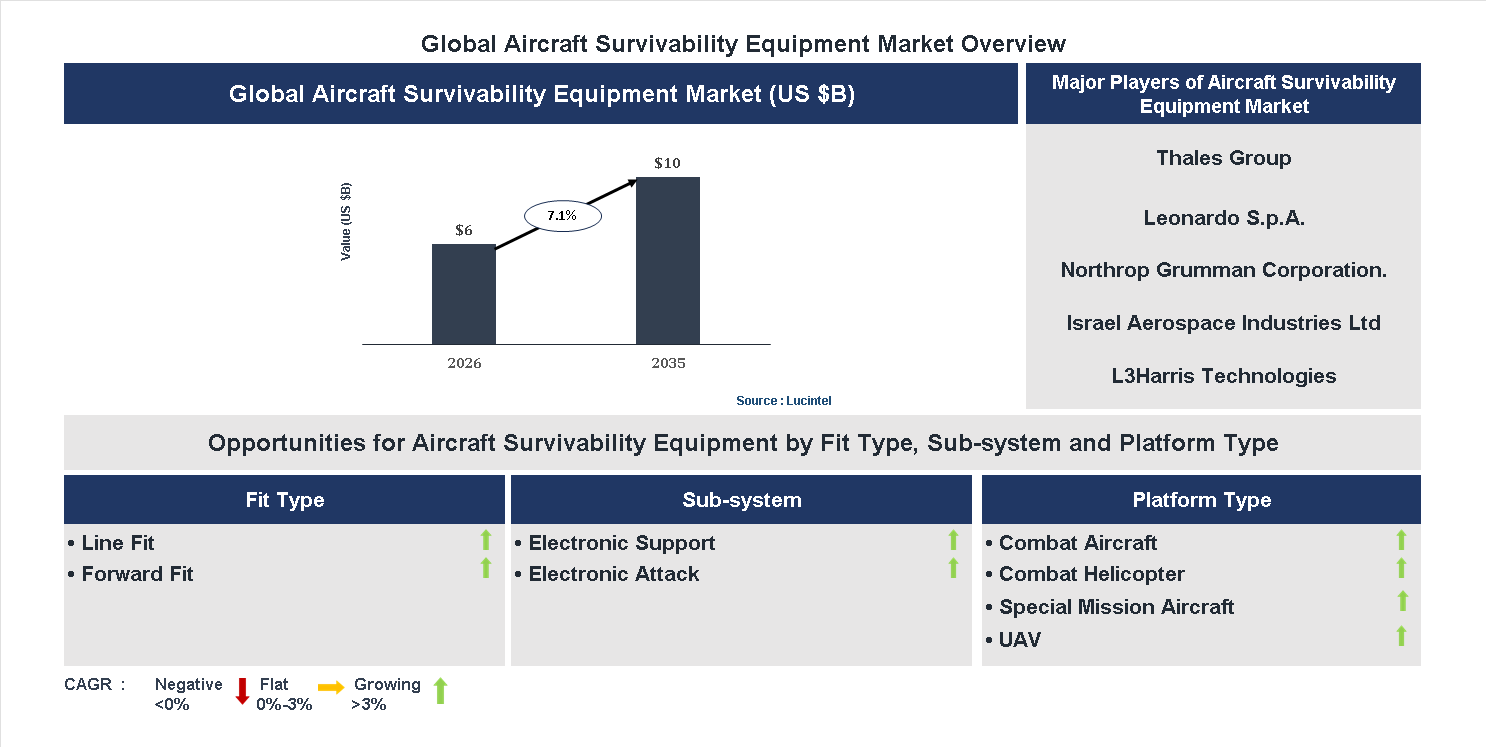
Key data points: The market size in 2035 = $10 billion, growth forecast = 7.1% annually for the next 8 years. Scroll below to get more insights. This market report covers trends, opportunities and forecasts in aircraft survivability equipment market to 2035 by fit type (line fit and forward fit), sub-system (electronic support and electronic attack), platform type (combat aircraft, combat helicopter, special mission aircraft, and UAV), and region (North America, Europe, Asia Pacific, and the Rest of the World)
We'll send your sample report shortly.
• Lucintel forecasts that, within the sub-system category, electronic attack is expected to witness higher growth over the forecast period.
• Within the platform type category, combat aircraft is expected to witness the highest growth.
• In terms of region, North America is expected to witness the highest growth over the forecast period. Gain valuable insights for your business decisions with our comprehensive 150+ page report. Sample figures with some insights are shown below.
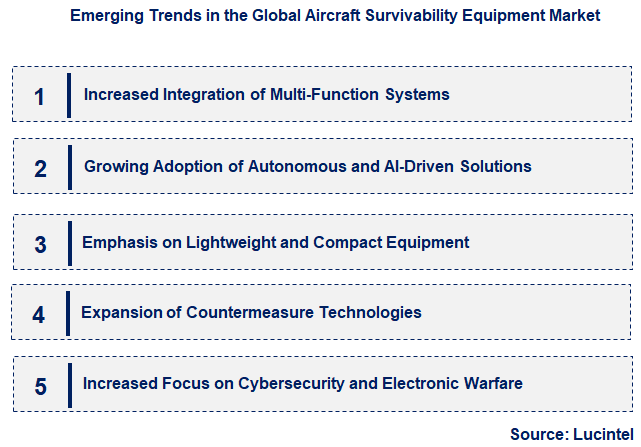
• Increased Integration of Multi-Function Systems: The trend toward integrating multiple survivability functions into single systems enhances aircraft protection efficiency. These multi-purpose systems combine radar warning, missile approach warning, and countermeasure deployment, reducing weight and maintenance needs. This integration allows for quicker response times and improved situational awareness, which are critical during combat scenarios. As aircraft become more sophisticated, the demand for streamlined, comprehensive survivability solutions grows, leading manufacturers to develop versatile systems that can adapt to various threats, ultimately improving aircraft survivability and operational effectiveness.
• Growing Adoption of Autonomous and AI-Driven Solutions: The deployment of autonomous systems and artificial intelligence (AI) is transforming survivability equipment. AI algorithms enable real-time threat detection, threat classification, and automated countermeasure deployment, reducing human response time and increasing accuracy. Autonomous drones and robotic systems are also being integrated for reconnaissance and threat neutralization, especially in high-risk environments. This trend enhances aircraft survivability by providing faster, more precise responses to complex threats, and reduces the cognitive load on crew members, allowing them to focus on mission-critical tasks.
• Emphasis on Lightweight and Compact Equipment: The need for lightweight, space-efficient survivability equipment is driving innovation in materials and design. Reducing weight improves aircraft performance, fuel efficiency, and payload capacity, which are vital for modern military and civilian aircraft. Compact systems also facilitate easier installation and maintenance, especially in aircraft with limited space. Advances in miniaturization and material science are enabling the development of smaller, more effective countermeasure devices, which contribute to overall aircraft survivability without compromising performance or adding significant weight.
• Expansion of Countermeasure Technologies: The market is witnessing significant growth in advanced countermeasure technologies such as directed energy weapons, electronic warfare (EW) systems, and decoy systems. These technologies provide more effective defense against a broad spectrum of threats, including radar-guided missiles and cyber-attacks. The development of adaptive and programmable countermeasures allows for tailored responses to evolving threats, increasing the likelihood of aircraft survival. This expansion is driven by the need for more resilient defense systems capable of countering increasingly sophisticated attack methods.
• Increased Focus on Cybersecurity and Electronic Warfare: As aircraft systems become more interconnected and reliant on digital technologies, cybersecurity and electronic warfare (EW) capabilities are gaining prominence. Protecting survivability equipment from cyber threats and electronic jamming is essential to maintain operational integrity. EW systems are being upgraded to detect, jam, or deceive enemy sensors and missile guidance systems. This focus on cybersecurity and EW enhances overall aircraft survivability by ensuring that electronic and communication systems remain functional and secure during hostile engagements, thereby safeguarding both personnel and assets. These emerging trends are fundamentally reshaping the aircraft survivability equipment market by fostering more integrated, intelligent, lightweight, and resilient systems. They enable aircraft to better detect, evade, and counter threats, ensuring higher survivability rates in increasingly complex operational environments. As these trends continue to evolve, they will drive innovation, improve mission success rates, and influence future defense procurement and strategic planning worldwide.
• Growing Demand for Electronic Warfare Systems: The increasing sophistication of enemy radar and missile systems has driven the demand for advanced electronic warfare (EW) equipment. These systems disrupt or deceive adversary targeting, significantly enhancing aircraft survivability. The proliferation of EW technology is leading to more effective countermeasures, boosting aircraft defense capabilities. This trend is expected to expand as countries modernize their fleets and invest heavily in electronic countermeasures, creating substantial market opportunities.
• Integration of Artificial Intelligence in Survivability Equipment: AI integration is revolutionizing aircraft survivability by enabling real-time threat detection, decision-making, and adaptive countermeasures. AI-powered systems improve response times and accuracy, reducing aircraft vulnerability. This technological leap enhances mission success and pilot safety, making AI a critical component of future survivability solutions. As AI technology matures, its adoption in defense systems is expected to accelerate, driving market growth and innovation.
• Development of Lightweight and Compact Equipment: The focus on reducing aircraft weight without compromising protection has led to the development of lightweight survivability equipment. These innovations improve aircraft agility, fuel efficiency, and payload capacity. Compact systems also facilitate easier installation and maintenance, making them attractive for modern aircraft designs. The demand for such equipment is rising across military and commercial sectors, fostering a competitive market landscape and encouraging technological advancements.
• Expansion of Counter-IED and Self-Protection Systems: The rise in asymmetric warfare has increased the need for effective counter-IED (Improvised Explosive Device) and self-protection systems. These systems detect, detonate, or evade threats, significantly improving aircraft survivability in hostile environments. Innovations include advanced sensors, jamming devices, and decoy systems. The growing threat landscape and military modernization efforts are fueling market expansion, with defense agencies prioritizing the integration of comprehensive protection solutions.
• Increasing Adoption of Network-Centric Warfare Technologies: Network-centric warfare enables real-time data sharing and coordination among aircraft and ground units, enhancing situational awareness and survivability. Advanced communication and sensor systems facilitate rapid threat identification and response. This interconnected approach improves mission effectiveness and reduces aircraft vulnerability. As militaries shift towards network-centric operations, the demand for compatible survivability equipment is surging, fostering innovation and expanding market opportunities. The overall impact of these developments is a more resilient, technologically advanced aircraft survivability landscape. Enhanced protection capabilities are improving mission success rates and reducing aircraft losses. The market is witnessing increased investments, innovation, and competition, which are driving growth and expanding the scope of survivability solutions across global defense sectors.
• Integration of Advanced Electronic Warfare Systems for Enhanced Aircraft Defense: The adoption of sophisticated electronic warfare (EW) systems is crucial for modern aircraft survivability. These systems detect, deceive, and jam enemy radars and missiles, significantly increasing aircraft survivability in hostile environments. The demand for lightweight, multi-functional EW solutions is rising, driven by the need for seamless integration with existing platforms. Continuous technological advancements and increasing threat complexity are fueling investments in next-generation EW equipment, creating substantial growth opportunities for defense contractors.
• Development of Lightweight, Multi-Role Survivability Equipment for Versatile Aircraft: The need for survivability equipment that balances protection with weight constraints is critical. Manufacturers are focusing on developing lightweight, multi-role systems that can be easily integrated into various aircraft types without compromising performance. These solutions include missile warning systems, countermeasure dispensers, and radar jamming devices, tailored for fighters, drones, and transport aircraft. The versatility and efficiency of such equipment are key drivers, opening avenues for innovation and market expansion.
• Expansion of Market through Regional Defense Modernization Programs: Governments worldwide are prioritizing modernization of their defense capabilities, including aircraft survivability. Countries in Asia-Pacific, the Middle East, and Africa are investing heavily in upgrading their existing fleets and acquiring new aircraft equipped with advanced survivability systems. These regional modernization initiatives create significant market opportunities for suppliers of survivability equipment, fostering strategic partnerships and local manufacturing collaborations to meet specific defense needs.
• Adoption of Autonomous and Unmanned Aircraft for Military Operations: The increasing deployment of unmanned aerial vehicles (UAVs) and autonomous aircraft necessitates specialized survivability equipment tailored for these platforms. These systems must be lightweight, highly reliable, and capable of countering emerging threats such as cyber-attacks and electronic jamming. The integration of survivability solutions into autonomous systems offers new growth avenues, driven by military strategies emphasizing unmanned operations for reconnaissance, combat, and logistics, thereby expanding the market scope.
• Focus on Cost-Effective and Modular Survivability Solutions for Budget-Conscious Markets: As defense budgets fluctuate, there is a growing demand for affordable, modular survivability equipment that can be customized and upgraded over time. Manufacturers are developing scalable solutions that provide essential protection without excessive costs, enabling broader adoption across various military and non-military aircraft. This approach facilitates rapid deployment, easier maintenance, and future upgrades, making survivability equipment accessible to emerging markets and smaller defense budgets, thus broadening market reach. The overall impact of these opportunities is a dynamic, expanding market characterized by technological innovation, regional growth, and evolving defense needs. Companies that leverage these opportunities will enhance aircraft survivability, strengthen military capabilities, and secure competitive advantages in a rapidly evolving defense landscape.
• Technological Innovation: The continuous development of advanced sensors, electronic warfare systems, and countermeasure technologies enhances aircraft survivability. These innovations improve threat detection, jamming capabilities, and defensive measures, making aircraft more resilient in hostile environments. As defense budgets increase globally, investments in cutting-edge survivability equipment are prioritized, fueling market expansion. The integration of artificial intelligence and automation further boosts operational efficiency and response times, creating a competitive edge for manufacturers. This technological evolution is crucial for maintaining air superiority and meeting modern military requirements.
• Rising Defense Expenditure: Governments worldwide are increasing their defense budgets to modernize their military fleets and address emerging threats. This surge in spending directly benefits the aircraft survivability equipment market by funding research, development, and procurement activities. Countries facing regional conflicts or geopolitical tensions are particularly aggressive in upgrading their defense capabilities, leading to higher demand for survivability solutions. Additionally, international alliances and defense pacts encourage joint procurement and technology sharing, further stimulating market growth. The sustained financial commitment from governments underscores the strategic importance of survivability equipment in national security.
• Geopolitical Tensions and Conflicts: Ongoing regional conflicts and rising geopolitical tensions drive the need for enhanced aircraft survivability. Military forces seek advanced equipment to protect assets against sophisticated threats such as surface-to-air missiles, electronic warfare, and cyber-attacks. These conflicts highlight vulnerabilities and accelerate procurement of survivability systems to ensure mission success and personnel safety. As threats evolve, so does the demand for adaptable and multi-layered defense solutions. This environment compels manufacturers to innovate continuously, ensuring their products meet the complex requirements of modern combat scenarios, thereby expanding market opportunities.
• Technological Integration and System Compatibility: The integration of survivability equipment with existing aircraft systems is vital for operational effectiveness. Modern aircraft require seamless compatibility of electronic warfare, sensors, and countermeasures, which drives the development of integrated solutions. This integration reduces weight, enhances performance, and simplifies maintenance, making survivability systems more attractive to military operators. The trend toward modular and upgradeable systems also allows for customization based on specific mission profiles. As aircraft become more sophisticated, the demand for compatible survivability equipment increases, fostering innovation and expanding the market. The challenges in the aircraft survivability equipment market are:-
• High Development and Procurement Costs: Developing advanced survivability systems involves significant investment in research, testing, and certification. These costs can be prohibitive, especially for smaller defense contractors, limiting innovation and market entry. Procurement budgets are often constrained by competing military priorities, delaying or reducing the acquisition of new equipment. Additionally, maintenance and upgrade costs add to the financial burden, impacting overall market growth. The high costs can also lead to delays in deployment, affecting the timely enhancement of aircraft survivability capabilities.
• Regulatory and Certification Barriers: Stringent regulatory standards and lengthy certification processes pose substantial hurdles for survivability equipment manufacturers. Compliance with international and national defense standards requires extensive testing and validation, which can delay product launches and increase costs. Variations in regulatory requirements across countries complicate export and procurement processes, limiting market expansion. Moreover, evolving standards necessitate continuous updates and re-certification, adding to the complexity. These barriers can hinder innovation and slow down the adoption of new technologies in the market.
• Rapidly Evolving Threat Landscape: The dynamic nature of modern threats, including cyber-attacks, electronic warfare, and advanced missile systems, challenges existing survivability solutions. Equipment that is effective today may become obsolete quickly as adversaries develop countermeasures. This necessitates continuous innovation and adaptation, increasing R&D costs and time-to-market. The unpredictability of future threats complicates planning and investment decisions for defense agencies and manufacturers. Failure to keep pace with evolving threats can compromise aircraft survivability, impacting military effectiveness and market confidence. The aircraft survivability equipment market is shaped by rapid technological advancements, increased defense spending, geopolitical tensions, and system integration needs. However, high costs, regulatory complexities, and the fast-changing threat environment pose significant challenges. These factors collectively influence market dynamics, requiring industry players to innovate strategically and adapt swiftly. The overall impact is a competitive landscape characterized by opportunities for growth amid ongoing hurdles, emphasizing the importance of agility and technological leadership in maintaining market relevance and security effectiveness.
• Thales Group
• Leonardo S.p.A.
• Northrop Grumman Corporation.
• Israel Aerospace Industries Ltd
• L3Harris Technologies
• Inc.
• Aselsan A.S.
• Saab AB
• BAE System PLC
• Chemring Group PLC
• Line Fit
• Forward Fit
• Electronic Support
• Electronic Attack
• Combat Aircraft
• Combat Helicopter
• Special Mission Aircraft
• UAV
• North America
• Europe
• Asia Pacific
• The Rest of the World
• United States: The US market is advancing with significant investments in electronic warfare and missile countermeasure systems. Recent developments include the integration of artificial intelligence for threat detection and automated response systems. The US military is also focusing on lightweight, multi-spectral sensors to improve aircraft survivability in complex combat environments. Additionally, collaborations between defense contractors and government agencies are accelerating the deployment of next-generation survivability equipment, emphasizing stealth and electronic attack capabilities.
• China: China is rapidly expanding its aircraft survivability technology, emphasizing indigenous development of electronic countermeasures and radar jamming systems. Recent advancements include the deployment of advanced infrared countermeasure systems and improved missile warning sensors. The country is also investing in stealth technology and electronic warfare platforms to enhance aircraft survivability in regional conflicts. Chinese defense initiatives aim to modernize their air force with integrated survivability solutions tailored to both offensive and defensive operations.
• Germany: Germany is focusing on enhancing electronic warfare and sensor fusion technologies for aircraft survivability. Recent developments include the integration of advanced radar warning receivers and electronic countermeasure systems into existing platforms. Germany is also investing in research to improve the interoperability of survivability equipment within NATO frameworks. The emphasis remains on lightweight, reliable systems that can be deployed across various aircraft types, supporting both national defense and multinational operations.
• India: India is making significant strides in developing indigenous aircraft survivability systems, including electronic warfare suites and missile warning sensors. Recent advancements involve the integration of advanced radar jamming and decoy systems into fighter aircraft. The country is also focusing on upgrading its existing fleet with modern survivability equipment to counter regional threats. Collaborations with international defense firms are helping India accelerate the development and deployment of next-generation survivability solutions tailored to its strategic needs.
• Japan: Japan is prioritizing the enhancement of electronic countermeasures and stealth technology to protect its aircraft from evolving threats. Recent developments include the deployment of advanced radar-absorbing materials and integrated electronic warfare systems. Japan is also investing in research to improve aircraft survivability in cyber and electronic warfare domains. The country’s efforts are aligned with its focus on regional security and maintaining technological superiority in defense systems, often collaborating with allied nations to adopt cutting-edge survivability solutions.


• Thales Group
• Leonardo S.p.A.
• Northrop Grumman Corporation.
• Israel Aerospace Industries Ltd
• L3Harris Technologies
• Inc.
• Aselsan A.S.
• Saab AB
• BAE System PLC
• Chemring Group PLC Q6. Which aircraft survivability equipment market segment will be the largest in future? Answer: Lucintel forecasts that, within the sub-system category, electronic attack is expected to witness higher growth over the forecast period. Q7. In aircraft survivability equipment market, which region is expected to be the largest in next 8 years? Answer: In terms of region, North America is expected to witness the highest growth over the forecast period. Q8. Do we receive customization in this report? Answer: Yes, Lucintel provides 10% customization without any additional cost.


Choose a license that fits your team. Instant PDF delivery.
Prices exclude taxes. Instant delivery. Custom licensing available on request.
Market Report · July 31, 2026
Market Report · July 31, 2026
Market Report · July 22, 2026
Trusted partner for strategic intelligence and business growth


Receive a complimentary market analysis tailored to your industry. Our analysts will identify key growth opportunities and competitive dynamics specific to your business.

Market size, growth rate, and key trend analysis for your specific sector.

Top competitor positioning and market share analysis.

Strategic recommendations backed by data-driven insights.
Get curated market intelligence and competitive moves straight to your inbox.
By subscribing, you agree to receive our monthly insights. Unsubscribe anytime.
Receive a complimentary market analysis tailored to your industry. Our analysts will identify key growth opportunities and competitive dynamics specific to your business.
Market size, growth rate, and key trend analysis for your specific sector.
Top competitor positioning and market share analysis.
Strategic recommendations backed by data-driven insights.
Get curated market intelligence, emerging trends, and competitive moves straight to your inbox each month.
By subscribing, you agree to receive our monthly insights. Unsubscribe anytime.
We'll send your sample report shortly.