
Market Report · July 31, 2026

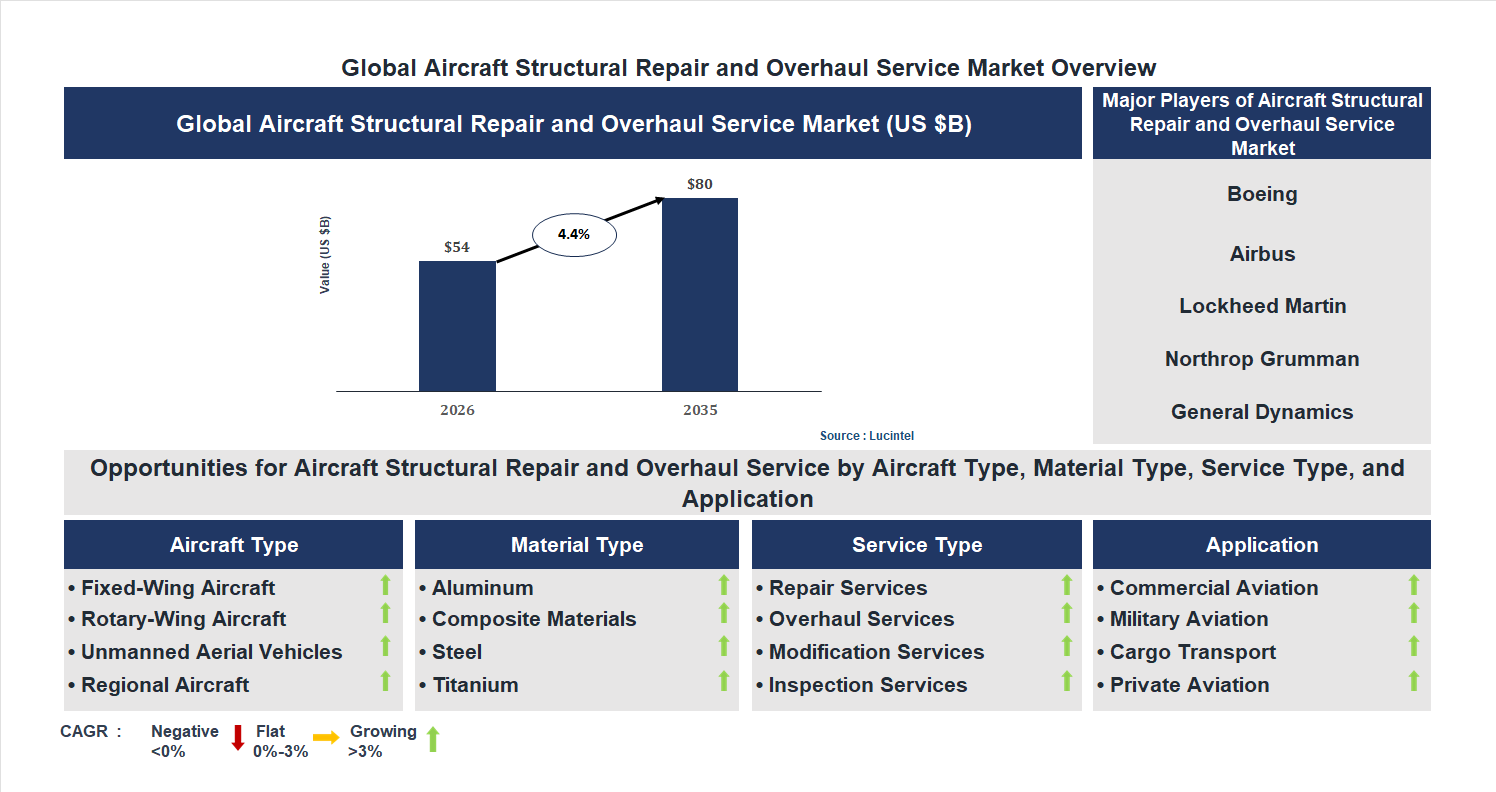
Key data points: The market size in 2035 = $80 billion, growth forecast = 4.4% annually for the next 8 years. Scroll below to get more insights. This market report covers trends, opportunities and forecasts in aircraft structural repair and overhaul service market to 2035 by aircraft type (fixed-wing aircraft, rotary-wing aircraft, unmanned aerial vehicles, and regional aircraft), material type (aluminum, composite materials, steel, and titanium), service type (repair services, overhaul services, modification services, and inspection services), application (commercial aviation, military aviation, cargo transport, and private aviation), and region (North America, Europe, Asia Pacific, and the Rest of the World)
We'll send your sample report shortly.
• Lucintel forecasts that, within the aircraft type category, fixed-wing aircraft is expected to witness the highest growth over the forecast period.
• Within the application category, commercial aviation is expected to witness the highest growth.
• In terms of region, North America is expected to witness the highest growth over the forecast period. Gain valuable insights for your business decisions with our comprehensive 150+ page report. Sample figures with some insights are shown below.
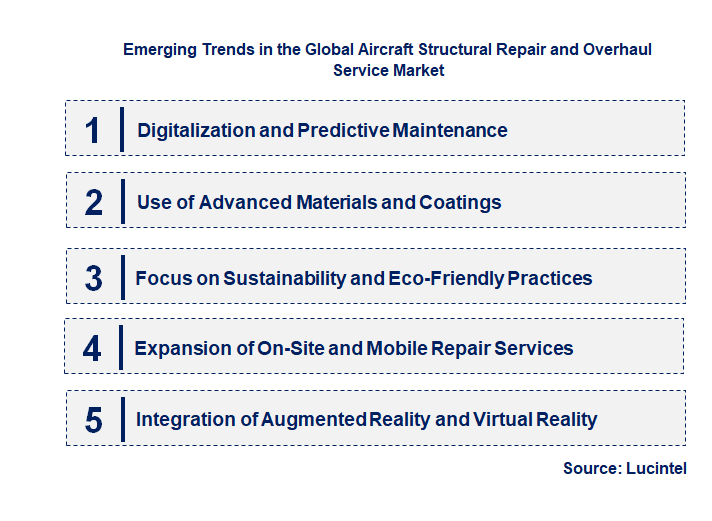
• Digitalization and Predictive Maintenance: The integration of digital technologies and data analytics is revolutionizing aircraft repair services. Predictive maintenance uses sensors and IoT devices to monitor aircraft health in real-time, enabling early detection of potential issues before they escalate. This approach reduces downtime, lowers maintenance costs, and enhances safety by preventing failures. Digital records streamline repair processes and improve traceability. As technology advances, the adoption of AI-driven diagnostics and machine learning algorithms is expected to further optimize maintenance schedules, making repairs more precise and efficient.
• Use of Advanced Materials and Coatings: The development of lightweight, durable materials such as composites and advanced alloys is transforming structural repairs. These materials improve aircraft performance by reducing weight and increasing fuel efficiency. Additionally, innovative coatings provide better corrosion resistance and extend the lifespan of repaired components. The adoption of these materials allows for more sustainable repairs, reducing the need for frequent overhauls and minimizing environmental impact. As research progresses, the market is likely to see increased use of nanomaterials and self-healing coatings, further enhancing repair quality and durability.
• Focus on Sustainability and Eco-Friendly Practices: Environmental concerns are prompting the industry to adopt greener repair and overhaul methods. This includes the use of environmentally friendly paints, solvents, and cleaning agents, as well as recycling and waste reduction initiatives. Sustainable practices not only comply with stricter regulations but also appeal to environmentally conscious consumers. Companies are investing in energy-efficient repair facilities and exploring alternative repair techniques that minimize carbon footprint. These efforts are reshaping the market by integrating sustainability into core operational strategies, aligning industry growth with global environmental goals.
• Expansion of On-Site and Mobile Repair Services: The demand for rapid turnaround times and reduced aircraft downtime is driving the growth of on-site and mobile repair services. These services enable repairs to be conducted directly at airports or on aircraft in remote locations, minimizing logistical challenges and operational disruptions. Mobile repair units equipped with advanced tools and technology provide flexibility and faster response times. This trend is particularly significant for airlines operating in remote or high-traffic regions, where quick repairs are critical. The expansion of these services enhances customer satisfaction and operational efficiency, reshaping traditional repair paradigms.
• Integration of Augmented Reality (AR) and Virtual Reality (VR): AR and VR technologies are increasingly being used for training, repair guidance, and remote assistance. These tools enable technicians to visualize complex repair procedures in 3D, improving accuracy and reducing errors. AR headsets can overlay instructions directly onto the physical components, facilitating faster and more precise repairs. VR simulations provide immersive training environments, enhancing technician skills without the need for physical aircraft. The adoption of AR and VR is streamlining repair processes, reducing training costs, and improving safety standards, thereby transforming how maintenance services are delivered. These emerging trends are collectively reshaping the aircraft structural repair and overhaul service market by enhancing efficiency, safety, and sustainability. Digital innovations, advanced materials, eco-friendly practices, on-site services, and immersive technologies are driving a more agile, cost-effective, and environmentally responsible industry. As these trends continue to evolve, they will enable market players to meet increasing demand while adhering to stricter safety and environmental standards, ensuring long-term growth and competitiveness.
• Growing Fleet Size and Aging Aircraft: The expanding global aircraft fleet, coupled with aging aircraft, creates a substantial demand for structural repairs and overhauls. Airlines seek cost-effective solutions to extend aircraft lifespan, leading to increased service opportunities. This growth is particularly prominent in emerging markets where fleet expansion is rapid. The demand for specialized repair techniques and high-quality materials is rising, fostering innovation and competition among service providers. Consequently, the market is poised for sustained growth, driven by the need to maintain safety and operational efficiency.
• Technological Advancements in Repair Techniques: Innovations such as composite repairs, robotic welding, and non-destructive testing are revolutionizing the repair process. These technologies enable faster, more precise, and cost-effective repairs, reducing aircraft downtime. The adoption of digital tools like predictive maintenance and 3D printing further enhances repair accuracy and customization. As a result, service providers can deliver higher quality repairs, improve turnaround times, and meet stringent safety standards, thereby strengthening their market position and expanding service capabilities.
• Increasing Focus on Sustainability and Eco-Friendly Solutions: The industry is shifting towards environmentally sustainable repair practices, including the use of lightweight materials and eco-friendly chemicals. These initiatives aim to reduce aircraft weight, fuel consumption, and emissions, aligning with global environmental regulations. Companies investing in green repair technologies are gaining competitive advantages and meeting customer expectations for sustainable operations. This focus on eco-friendly solutions is expected to drive innovation, reduce costs, and open new market segments focused on sustainable aircraft maintenance.
• Rising Demand for Overhaul Services in Emerging Markets: Rapid economic growth and expanding air travel in regions like Asia-Pacific and the Middle East are fueling demand for aircraft overhaul services. Airlines in these markets are modernizing fleets and seeking reliable maintenance providers to ensure safety and compliance. Local service providers are expanding capabilities to meet this demand, often forming strategic partnerships with global players. This trend is creating new revenue streams, increasing market competition, and encouraging technological transfer, ultimately boosting the global market for aircraft structural repair and overhaul services.
• Impact of Regulatory Standards and Safety Protocols: Stringent safety regulations and certification requirements are shaping the repair and overhaul landscape. Service providers must adhere to international standards such as FAA and EASA regulations, which demand high-quality materials and precise procedures. Compliance drives innovation and quality improvements, but also increases operational costs. Companies investing in certification and training are gaining trust and expanding their customer base. Overall, regulatory frameworks are elevating industry standards, ensuring safety, and fostering market growth through increased demand for certified repair services. The overall impact of these developments is a dynamic, technologically advanced, and environmentally conscious market. Increased fleet sizes, innovation, and regulatory compliance are driving growth, creating opportunities for service providers to enhance their offerings. This evolution is making aircraft maintenance more efficient, sustainable, and safer, ultimately benefiting airlines, passengers, and the industry at large.
• Digital Diagnostics and Predictive Maintenance: The integration of IoT and AI enables real-time monitoring of aircraft structures, predicting potential failures before they occur. This proactive approach reduces unscheduled repairs, minimizes downtime, and lowers maintenance costs. Advanced diagnostic tools improve accuracy and speed, allowing for targeted repairs. As airlines seek more efficient maintenance strategies, investments in digital solutions are expected to grow, creating opportunities for service providers to offer innovative, data-driven repair and overhaul services.
• Development of Advanced Repair Materials and Techniques: The adoption of lightweight, durable composite materials and rapid-curing adhesives enhances repair quality and reduces turnaround times. Innovations such as 3D printing enable on-demand manufacturing of replacement parts, decreasing inventory costs and lead times. These advanced materials and techniques improve structural integrity and extend aircraft service life. Market players investing in R&D to develop eco-friendly, high-performance repair solutions will gain competitive advantages, especially as sustainability becomes a key industry focus.
• Expansion of Service Networks in Emerging Markets: Growing aviation markets in Asia-Pacific, Middle East, and Africa present significant opportunities for service providers to establish local repair and overhaul facilities. Developing regional hubs reduces logistical costs and turnaround times, catering to increasing aircraft fleets. Strategic partnerships and joint ventures with local companies can facilitate market entry and compliance with regional regulations. Expanding service networks ensures better customer reach and supports the rising demand for aircraft maintenance in these high-growth regions.
• Focus on Sustainability and Eco-Friendly Repair Solutions: The aviation industry’s push toward reducing carbon footprint encourages the adoption of environmentally friendly repair practices. Use of recyclable materials, low-emission repair processes, and waste reduction techniques are gaining importance. Market opportunities exist in developing sustainable repair products and services that meet regulatory standards and customer expectations. Emphasizing eco-conscious solutions can enhance brand reputation and compliance, positioning companies as leaders in sustainable aviation maintenance.
• Integration of Augmented Reality (AR) and Virtual Reality (VR) in Repair Processes: AR and VR technologies facilitate remote diagnostics, training, and repair procedures, improving accuracy and reducing errors. Technicians can visualize complex repairs in 3D, enhancing understanding and efficiency. These tools enable remote expert support, decreasing downtime and travel costs. As AR/VR adoption increases, service providers can offer innovative training modules and repair guidance, expanding their service offerings and improving overall maintenance quality across the industry. These strategic growth opportunities are poised to transform the aircraft structural repair and overhaul service market by enhancing efficiency, safety, and sustainability. Embracing digital innovations, advanced materials, and expanding regional presence will enable market players to meet rising demand and regulatory standards. The integration of eco-friendly practices and cutting-edge technologies will further strengthen competitive positioning, ensuring long-term growth and resilience in a dynamic aviation landscape.
• Technological Innovation: The introduction of advanced materials like composites and improved repair techniques enhances repair quality and efficiency. Automation and digitalization, such as predictive maintenance and 3D printing, reduce turnaround times and costs, making repairs more reliable and faster. These innovations enable service providers to meet increasing safety standards and customer expectations, fostering market expansion. As aircraft designs evolve, the need for specialized repair solutions grows, further propelling technological development in the sector.
• Rising Aircraft Fleet and Aging Infrastructure: The global increase in commercial and military aircraft fleets, coupled with aging aircraft requiring extensive overhauls, significantly drives demand for repair and overhaul services. Airlines seek to extend aircraft lifespan and optimize operational costs, leading to higher service requirements. Governments and operators prioritize safety and compliance, necessitating regular inspections and structural repairs. This sustained growth in fleet size and age directly correlates with increased market opportunities for service providers.
• Stringent Regulatory Standards: International safety and environmental regulations, such as those from the FAA and EASA, mandate rigorous inspection, repair, and overhaul procedures. Compliance ensures aircraft safety, reduces liability, and maintains operational licenses. These standards compel service providers to adopt high-quality materials and processes, often increasing the complexity and cost of repairs. While challenging, regulatory compliance also creates opportunities for specialized services and certifications, fostering a competitive and quality-driven market environment.
• Economic Growth and Airline Expansion: Economic development in emerging markets boosts airline profitability and fleet expansion, leading to higher demand for structural repair and overhaul services. Increased passenger traffic and cargo volumes necessitate fleet upgrades and maintenance. Additionally, airline profitability allows for more frequent and comprehensive overhauls, supporting market growth. Economic stability also encourages investments in newer aircraft, which require advanced repair solutions, further stimulating the market.
• Strategic Mergers and Partnerships: Collaborations between OEMs, MRO providers, and airlines facilitate technology sharing, resource optimization, and expanded service offerings. Strategic alliances enable access to new markets and customer bases, enhancing competitiveness. These partnerships often lead to innovations in repair techniques and service delivery, driving market growth. Mergers also consolidate expertise and infrastructure, improving efficiency and reducing costs, which benefits the overall industry landscape. The challenges facing the aircraft structural repair and overhaul service market include:-
• High Repair and Overhaul Costs: Structural repairs involve complex procedures, specialized materials, and skilled labor, resulting in significant expenses. The high costs can limit service accessibility, especially for smaller operators or in regions with less developed infrastructure. Additionally, fluctuating raw material prices and technological upgrades can further inflate costs, impacting profitability and pricing strategies. Managing these expenses while maintaining quality standards remains a critical challenge for service providers.
• Rapid Technological Changes: While innovation drives growth, it also presents challenges in keeping pace with evolving repair techniques and materials. Continuous training and investment are required to stay compliant and competitive. The rapid pace of technological change can lead to obsolescence of existing equipment and skills, increasing operational risks and costs. Ensuring workforce adaptability and managing technological transitions are essential to sustain market relevance.
• Regulatory and Certification Complexities: Navigating diverse international standards and obtaining necessary certifications can be time-consuming and costly. Variations in regulations across regions complicate service delivery and may delay repairs or overhaul processes. Non-compliance risks include penalties, reputational damage, and operational restrictions. Staying updated with changing regulations and maintaining compliance requires significant resources, posing ongoing challenges for market participants. The aircraft structural repair and overhaul service market is shaped by technological advancements, fleet growth, regulatory standards, economic factors, and strategic collaborations. These drivers foster innovation, expand opportunities, and enhance service quality. Conversely, high costs, rapid technological shifts, and regulatory complexities pose significant hurdles. The interplay of these factors influences market stability, growth potential, and competitive dynamics. Stakeholders must navigate these drivers and challenges carefully to capitalize on emerging opportunities while mitigating risks, ensuring sustainable industry development.
• Boeing
• Airbus
• Lockheed Martin
• Northrop Grumman
• General Dynamics
• Raytheon Technologies
• BAE Systems
• Leonardo
• Safran
• MTU Aero Engines
• Fixed-Wing Aircraft
• Rotary-Wing Aircraft
• Unmanned Aerial Vehicles
• Regional Aircraft
• Aluminum
• Composite Materials
• Steel
• Titanium
• Repair Services
• Overhaul Services
• Modification Services
• Inspection Services
• Commercial Aviation
• Military Aviation
• Cargo Transport
• Private Aviation
• North America
• Europe
• Asia Pacific
• The Rest of the World
• United States: The US market has seen substantial investments in digital repair technologies and predictive maintenance solutions, improving turnaround times and safety standards. Major players are expanding their repair facilities and adopting environmentally friendly practices, such as sustainable materials and waste reduction. Regulatory agencies like the FAA are promoting advanced inspection techniques, fostering innovation. The rise of aerospace startups specializing in repair innovations is also contributing to market growth, alongside increased demand from commercial airlines and military sectors.
• China: China’s aircraft repair market is rapidly expanding due to the growth of its domestic airline industry and increased aircraft fleet size. The country is investing heavily in modern repair facilities and training programs to develop a skilled workforce. Technological adoption, including automation and digital diagnostics, is accelerating. Government initiatives aim to make China a global hub for aircraft maintenance, repair, and overhaul (MRO) services. Strategic partnerships with international firms are enhancing technical capabilities, and local companies are expanding their service offerings to meet rising domestic and international demand.
• Germany: Germany remains a key player in the European aircraft repair market, focusing on high-precision repair techniques and sustainable practices. The country’s MRO providers are adopting Industry 4.0 technologies, such as IoT and AI, to optimize maintenance processes. Germany’s strong aerospace engineering sector supports innovation in lightweight materials and advanced repair methods. Regulatory compliance with European standards ensures high safety and quality levels. The country is also investing in workforce training and digital infrastructure to maintain its competitive edge in the global market.
• India: India’s aircraft repair sector is witnessing rapid growth driven by expanding airline operations and a burgeoning aerospace industry. The government’s initiatives to promote Make in India and ease of doing business are attracting investments in MRO infrastructure. Local companies are adopting advanced repair technologies and collaborating with international firms to enhance capabilities. The focus is on developing a skilled workforce and establishing dedicated MRO zones. Increasing aircraft fleet size and rising passenger traffic are expected to sustain market growth, positioning India as a significant player in the global aircraft repair and overhaul industry.
• Japan: Japan’s aircraft repair market emphasizes technological innovation and quality assurance. The country’s MRO providers are integrating digital tools, such as augmented reality and data analytics, to improve repair accuracy and efficiency. Japan’s aerospace industry benefits from a strong research and development base, supporting advancements in lightweight materials and eco-friendly repair solutions. The government encourages sustainable practices and international collaboration to expand its market share. Additionally, Japan’s focus on safety standards and workforce training ensures high-quality services, catering to both domestic and international clients in a competitive global environment.


• Boeing
• Airbus
• Lockheed Martin
• Northrop Grumman
• General Dynamics
• Raytheon Technologies
• BAE Systems
• Leonardo
• Safran
• MTU Aero Engines Q6. Which aircraft structural repair and overhaul service market segment will be the largest in future? Answer: Lucintel forecasts that, within the aircraft type category, fixed-wing aircraft is expected to witness the highest growth over the forecast period. Q7. In aircraft structural repair and overhaul service market, which region is expected to be the largest in next 8 years? Answer: In terms of region, North America is expected to witness the highest growth over the forecast period. Q8. Do we receive customization in this report? Answer: Yes, Lucintel provides 10% customization without any additional cost.


Choose a license that fits your team. Instant PDF delivery.
Prices exclude taxes. Instant delivery. Custom licensing available on request.
Market Report · July 31, 2026
Market Report · July 31, 2026
Market Report · July 22, 2026
Trusted partner for strategic intelligence and business growth


Receive a complimentary market analysis tailored to your industry. Our analysts will identify key growth opportunities and competitive dynamics specific to your business.

Market size, growth rate, and key trend analysis for your specific sector.

Top competitor positioning and market share analysis.

Strategic recommendations backed by data-driven insights.
Get curated market intelligence and competitive moves straight to your inbox.
By subscribing, you agree to receive our monthly insights. Unsubscribe anytime.
Receive a complimentary market analysis tailored to your industry. Our analysts will identify key growth opportunities and competitive dynamics specific to your business.
Market size, growth rate, and key trend analysis for your specific sector.
Top competitor positioning and market share analysis.
Strategic recommendations backed by data-driven insights.
Get curated market intelligence, emerging trends, and competitive moves straight to your inbox each month.
By subscribing, you agree to receive our monthly insights. Unsubscribe anytime.
We'll send your sample report shortly.