
Market Report · July 31, 2026

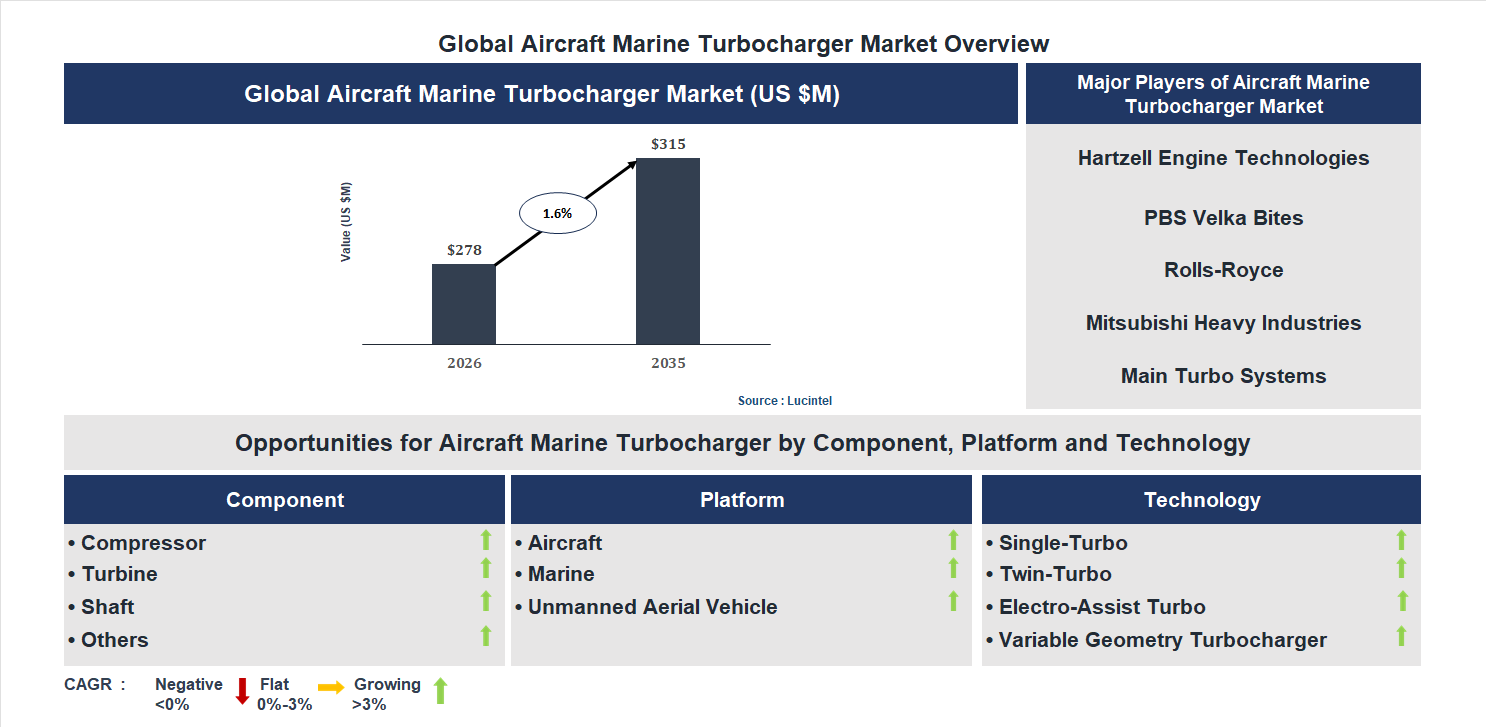
Key data points: The market size in 2035 = $315 million, growth forecast = 1.6% annually for the next 8 years. Scroll below to get more insights. This market report covers trends, opportunities and forecasts in aircraft marine turbocharger market to 2035 by component (compressor, turbine, shaft, and others), platform (aircraft, marine, and unmanned aerial vehicle), technology (single-turbo, twin-turbo, electro-assist turbo, and variable geometry turbocharger), and region (North America, Europe, Asia Pacific, and the Rest of the World)
We'll send your sample report shortly.
• Lucintel forecasts that, within the component category, compressor is expected to witness the highest growth over the forecast period.
• Within the technology category, variable geometry turbocharger is expected to witness the highest growth.
• In terms of region, APAC is expected to witness the highest growth over the forecast period. Gain valuable insights for your business decisions with our comprehensive 150+ page report. Sample figures with some insights are shown below.
• Digitalization and Smart Turbocharging: The integration of digital technologies and sensors into turbochargers is enabling real-time monitoring, predictive maintenance, and enhanced control. These smart systems improve engine efficiency, reduce downtime, and lower operational costs. Digital twin technology and IoT connectivity are facilitating better performance analytics, allowing manufacturers to optimize designs and maintenance schedules. This trend is making turbochargers more reliable and adaptable, especially in complex aircraft and marine engines, ultimately leading to increased safety and reduced lifecycle costs.
• Eco-Friendly and Emission-Reducing Technologies: Stricter environmental regulations are pushing the market toward cleaner solutions. Innovations such as variable geometry turbines, wastegate control, and advanced materials are reducing emissions and improving fuel efficiency. Hybrid turbocharging systems are also emerging, combining traditional turbochargers with electric assist to minimize pollutant output. These eco-friendly technologies are vital for compliance and corporate sustainability goals, influencing product development and market competitiveness. They are particularly impactful in regions with stringent emission standards, shaping future product offerings.
• Lightweight and Compact Designs: The demand for lightweight components is driven by the need to improve fuel efficiency and payload capacity in aircraft and marine vessels. Advanced materials like composites and high-strength alloys are being used to develop smaller, more durable turbochargers. These compact designs reduce overall weight without compromising performance, enabling better fuel economy and operational flexibility. This trend is especially significant in aerospace applications where weight savings directly translate into cost savings and increased range, while in marine sectors, it enhances vessel speed and efficiency.
• Integration of Electric and Hybrid Systems: The shift towards electrification in aviation and maritime industries is influencing turbocharger design. Electric turbochargers and hybrid systems are being developed to provide instant boost, improve throttle response, and reduce lag. These systems also facilitate engine start-stop functions and support hybrid powertrains, contributing to lower emissions and better fuel economy. The integration of electric components is creating new opportunities for innovation, especially in retrofit applications and next-generation aircraft and ships, aligning with global sustainability initiatives.
• Market Consolidation and Strategic Collaborations: The market is witnessing increased mergers, acquisitions, and strategic alliances among key players to enhance technological capabilities and expand product portfolios. Collaborations with technology firms and research institutions are accelerating innovation in turbocharging solutions. This consolidation helps companies achieve economies of scale, improve R&D efficiency, and access new markets. Such strategic moves are vital for staying competitive amid rapid technological changes and evolving regulatory landscapes, ultimately leading to a more integrated and resilient market structure. These emerging trends are fundamentally reshaping the aircraft marine turbocharger market by fostering innovation, enhancing sustainability, and improving operational efficiency. The adoption of digital, eco-friendly, lightweight, and integrated systems is driving a new era of high-performance, environmentally conscious turbocharging solutions. As these trends continue to evolve, they will open up new opportunities for growth, technological advancement, and market leadership, ensuring the industry remains aligned with global sustainability and efficiency goals.
• Technological Innovations in Turbocharger Design: Advancements in materials and aerodynamics are leading to more efficient, durable, and lightweight turbochargers, improving engine performance and fuel economy in aircraft and marine applications. These innovations reduce emissions and operational costs, making engines more environmentally friendly. Enhanced designs also enable turbochargers to operate effectively under extreme conditions, expanding their usability. The impact includes increased adoption of turbocharged engines, improved reliability, and a competitive edge for manufacturers investing in cutting-edge technology.
• Rising Demand for Fuel-Efficient Engines: Growing environmental concerns and fuel price volatility are driving the need for more fuel-efficient engines in aircraft and marine vessels. Turbochargers play a crucial role in optimizing engine performance, reducing fuel consumption, and lowering emissions. This demand is prompting OEMs to incorporate advanced turbocharging solutions, fostering innovation and market expansion. The result is a shift towards greener, cost-effective propulsion systems, which benefits operators by reducing operational costs and complying with stricter environmental regulations.
• Expansion of Maritime and Aviation Sectors: Increasing global trade and air travel are fueling the demand for advanced turbocharging systems in ships and aircraft. The maritime sector benefits from turbochargers that improve engine efficiency and reliability for long voyages, while the aviation industry seeks lightweight, high-performance solutions for fuel savings. This sector growth creates opportunities for manufacturers to develop specialized turbochargers tailored to specific vessel and aircraft types, boosting market revenue and encouraging technological collaboration across industries.
• Adoption of Digital and Smart Turbochargers: Integration of sensors, IoT, and AI in turbochargers is enabling real-time monitoring, predictive maintenance, and enhanced performance management. These smart systems reduce downtime and maintenance costs, increasing operational efficiency. The adoption of digital turbochargers is particularly prominent in commercial aviation and large maritime vessels, where reliability is critical. This technological shift is transforming the market by enabling more precise control, customization, and data-driven decision-making, ultimately improving safety and reducing lifecycle costs.
• Impact of Environmental Regulations and Sustainability Initiatives: Stricter emissions standards and sustainability goals are compelling manufacturers to develop eco-friendly turbochargers with lower emissions and higher efficiency. Innovations include wastegate control, variable geometry turbines, and hybrid systems. These developments help operators meet regulatory compliance while maintaining performance. The market is witnessing increased R&D investments focused on sustainable solutions, which are expected to drive growth and innovation. Overall, these initiatives are pushing the industry toward greener, more sustainable propulsion technologies. The overall impact of these developments is a more efficient, environmentally friendly, and technologically advanced aircraft marine turbocharger market. Increased innovation and sector expansion are fostering competitive growth, offering improved performance, cost savings, and compliance with global regulations. These trends are shaping a resilient industry poised for sustained growth and technological leadership.
• Technological Innovation in Turbocharger Design: Advancements in materials and engineering are enabling the development of more efficient, lightweight, and durable turbochargers. These innovations improve fuel economy, reduce emissions, and enhance engine performance in aircraft and marine vessels. The integration of smart sensors and IoT technology allows real-time monitoring and predictive maintenance, further boosting operational efficiency. As OEMs and aftermarket players adopt these innovations, the market is poised for substantial growth across various applications.
• Rising Demand for Fuel-Efficient Aircraft and Marine Engines: Increasing fuel costs and stringent environmental regulations are driving the need for more efficient propulsion systems. Turbochargers play a critical role in optimizing engine performance and reducing fuel consumption. Airlines and shipping companies are investing in turbocharged engines to meet sustainability goals and operational cost reductions. This demand is creating opportunities for manufacturers to develop high-performance turbochargers tailored to specific aircraft and marine engine models.
• Expansion of Commercial and Military Aviation Markets: The growth of commercial aviation, especially in emerging economies, is fueling demand for turbochargers to support larger and more fuel-efficient aircraft. Military aircraft modernization programs also require advanced turbocharging solutions for enhanced performance and reliability. This expansion opens avenues for specialized turbocharger products, including high-altitude and high-power variants, catering to diverse operational needs and increasing market share.
• Growing Marine Industry and Offshore Applications: The maritime sectors expansion, including cargo ships, cruise liners, and offshore vessels, is increasing the need for reliable turbocharging solutions. Turbochargers improve engine efficiency and power output, essential for large vessels operating in challenging conditions. The offshore oil and gas industry also relies on turbocharged engines for exploration and production activities. This growth in marine applications offers significant opportunities for product innovation and regional market penetration.
• Strategic Collaborations and Market Penetration in Emerging Economies: Partnerships between turbocharger manufacturers and local OEMs or distributors are facilitating market entry in regions like Asia-Pacific and Latin America. These collaborations help adapt products to local requirements, reduce costs, and expand aftersales services. Additionally, government initiatives promoting infrastructure development and transportation modernization are creating favorable conditions for market growth. Such strategic moves are essential for capturing new customer bases and strengthening global market presence. The overall impact of these growth opportunities is set to significantly enhance market size, diversify application segments, and foster innovation. Companies that leverage technological advancements, expand into emerging markets, and tailor products to evolving customer needs will be well-positioned for sustained success. This dynamic environment promises continued growth, increased competitiveness, and the development of more efficient, reliable turbocharging solutions across the aircraft and marine sectors.
• Technological Innovation: The continuous development of advanced turbocharger technologies, including variable geometry and wastegate systems, enhances engine efficiency and performance. These innovations allow aircraft and marine engines to operate more reliably under diverse conditions, reducing fuel consumption and emissions. As manufacturers invest in R&D, the market benefits from improved product offerings that meet stringent environmental standards and customer demands for higher efficiency. The integration of digital monitoring and control systems further optimizes turbocharger performance, making them indispensable in modern aircraft and marine engines.
• Rising Air and Marine Traffic: The global increase in air travel and marine transportation significantly drives demand for turbochargers. As passenger and cargo volumes grow, airlines and shipping companies seek more powerful and efficient engines to handle higher loads and longer routes. This surge necessitates turbochargers that can deliver enhanced performance while maintaining fuel economy. The expansion of international trade and tourism directly correlates with increased orders for aircraft and marine vessels equipped with advanced turbocharging systems, fueling market growth.
• Environmental Regulations and Emission Standards: Stricter environmental policies worldwide compel manufacturers to develop turbochargers that reduce emissions and improve fuel efficiency. Regulations such as IMO Tier III standards for ships and ICAOs CORSIA for aircraft push the industry toward cleaner technologies. Turbochargers that enable engines to operate more efficiently help companies comply with these standards, avoiding penalties and enhancing their market reputation. This regulatory landscape encourages innovation and adoption of eco-friendly turbocharging solutions, shaping the markets future trajectory.
• Growing Demand for Fuel Efficiency: The rising cost of fuel and the emphasis on sustainable operations motivate the adoption of turbochargers that optimize engine performance. In both aircraft and marine sectors, fuel efficiency translates into significant cost savings and reduced environmental impact. Manufacturers are focusing on lightweight, durable turbochargers that improve power output without increasing fuel consumption. This demand influences product development strategies and accelerates market expansion, especially in regions with high fuel prices and strict environmental policies.
• Strategic Partnerships and Mergers: Collaborations between turbocharger manufacturers, aircraft OEMs, and marine engine producers foster innovation and expand market reach. Strategic alliances facilitate the sharing of technological expertise and enable the development of customized solutions tailored to specific industry needs. Mergers and acquisitions also help companies achieve economies of scale, reduce costs, and accelerate product development. These partnerships are crucial for staying competitive in a rapidly evolving market driven by technological and regulatory changes. The challenges facing the aircraft marine turbocharger market include:
• High Manufacturing Costs: Developing advanced turbochargers involves significant investment in R&D, specialized materials, and precision manufacturing processes. These high costs can limit profitability and pose barriers for smaller players trying to enter the market. Additionally, fluctuations in raw material prices, such as turbine blades and bearings, can impact production expenses. Managing these costs while maintaining quality and performance standards is a persistent challenge, potentially hindering market growth and innovation.
• Stringent Regulatory Compliance: While regulations drive innovation, they also impose complex compliance requirements that can delay product launches and increase costs. Meeting diverse international standards necessitates extensive testing, certification, and adaptation of designs, which can be time-consuming and expensive. Non-compliance risks include legal penalties, market restrictions, and damage to brand reputation. Navigating this regulatory landscape requires significant resources and expertise, posing a barrier for new entrants and smaller firms.
• Technological Complexity and Maintenance: The sophisticated nature of modern turbochargers demands specialized knowledge for installation, operation, and maintenance. Complex systems increase the likelihood of technical failures and require skilled technicians, which can lead to higher service costs and downtime. Ensuring reliable performance over the lifespan of turbochargers is critical, especially in safety-sensitive applications like aircraft and marine vessels. Addressing these technological challenges is essential for customer satisfaction and market stability. The aircraft marine turbocharger market is shaped by rapid technological advancements, increasing global traffic, and strict environmental regulations, all of which create growth opportunities. However, high manufacturing costs, regulatory compliance complexities, and technological maintenance challenges pose significant hurdles. The markets future depends on how effectively companies innovate and adapt to these drivers and challenges, balancing performance, cost, and compliance to meet evolving industry demands.
• Hartzell Engine Technologies
• PBS Velka Bites
• Rolls-Royce
• Mitsubishi Heavy Industries
• Main Turbo Systems
• ABB
• Cummins
• Compressor
• Turbine
• Shaft
• Others
• Aircraft
• Marine
• Unmanned Aerial Vehicle
• Single-Turbo
• Twin-Turbo
• Electro-Assist Turbo
• Variable Geometry Turbocharger
• North America
• Europe
• Asia Pacific
• The Rest of the World
• United States: The U.S. market is witnessing significant innovation in turbocharger technology, with major aerospace companies investing in lightweight, fuel-efficient designs. There is a growing emphasis on integrating digital monitoring systems for predictive maintenance, which enhances reliability and reduces downtime. The government’s focus on sustainable aviation fuels and stricter emission standards are driving advancements in eco-friendly turbochargers. Additionally, the U.S. military is adopting turbocharged engines for defense applications, boosting market growth. The expansion of commercial and private aviation sectors further fuels demand for high-performance turbochargers.
• China: China is rapidly expanding its aerospace and maritime sectors, leading to increased demand for aircraft and marine turbochargers. The government’s initiatives to modernize its fleet and maritime infrastructure are fueling market growth. Chinese companies are investing in R&D to develop domestically produced turbochargers that meet international standards, reducing reliance on imports. The focus on green technologies and emission reduction is prompting innovations in turbocharger design. Additionally, China’s Belt and Road Initiative is boosting maritime activities, which in turn drives demand for marine turbochargers. The market is also benefiting from rising exports of aerospace components.
• Germany: Germany remains a key player in the aircraft and marine turbocharger market, driven by its strong aerospace manufacturing and engineering expertise. The country is focusing on developing high-efficiency, low-emission turbochargers, aligning with European environmental regulations. German companies are pioneering in integrating digital solutions for real-time performance monitoring and maintenance. The push towards sustainable aviation and maritime operations is encouraging innovation in eco-friendly turbocharger technologies. Germany’s robust industrial base and strategic partnerships within the European Union are facilitating market expansion and technological advancements in this sector.
• India: India’s aerospace and maritime industries are experiencing rapid growth, creating substantial demand for turbochargers. The government’s Make in India initiative and increased defense spending are fostering local manufacturing capabilities. There is a rising focus on developing turbochargers that improve fuel efficiency and reduce emissions, aligning with global environmental standards. The expansion of commercial airlines and maritime trade routes is further propelling market growth. Indian companies are also collaborating with international firms to adopt advanced turbocharger technologies. The market is poised for significant growth as infrastructure and technological capabilities continue to improve.
• Japan: Japan is known for its advanced engineering and innovation in aerospace and marine sectors. The country is investing in developing turbochargers that enhance engine performance while reducing environmental impact. Japan’s focus on sustainable transportation and strict emission regulations are driving technological advancements. The integration of digital diagnostics and maintenance solutions is a key trend. Japanese firms are also exploring hybrid and alternative fuel-compatible turbochargers to meet future energy needs. The country’s strong industrial base and emphasis on R&D are positioning it as a leader in high-performance, eco-friendly turbocharger solutions for aircraft and marine applications.


• Hartzell Engine Technologies
• PBS Velka Bites
• Rolls-Royce
• Mitsubishi Heavy Industries
• Main Turbo Systems
• ABB
• Cummins Q6. Which aircraft marine turbocharger market segment will be the largest in future? Answer: Lucintel forecasts that, within the component category, compressor is expected to witness the highest growth over the forecast period. Q7. In aircraft marine turbocharger market, which region is expected to be the largest in next 8 years? Answer: In terms of region, APAC is expected to witness the highest growth over the forecast period. Q8. Do we receive customization in this report? Answer: Yes, Lucintel provides 10% customization without any additional cost.


Choose a license that fits your team. Instant PDF delivery.
Prices exclude taxes. Instant delivery. Custom licensing available on request.
Market Report · July 31, 2026
Market Report · July 31, 2026
Market Report · July 22, 2026
Trusted partner for strategic intelligence and business growth


Receive a complimentary market analysis tailored to your industry. Our analysts will identify key growth opportunities and competitive dynamics specific to your business.

Market size, growth rate, and key trend analysis for your specific sector.

Top competitor positioning and market share analysis.

Strategic recommendations backed by data-driven insights.
Get curated market intelligence and competitive moves straight to your inbox.
By subscribing, you agree to receive our monthly insights. Unsubscribe anytime.
Receive a complimentary market analysis tailored to your industry. Our analysts will identify key growth opportunities and competitive dynamics specific to your business.
Market size, growth rate, and key trend analysis for your specific sector.
Top competitor positioning and market share analysis.
Strategic recommendations backed by data-driven insights.
Get curated market intelligence, emerging trends, and competitive moves straight to your inbox each month.
By subscribing, you agree to receive our monthly insights. Unsubscribe anytime.
We'll send your sample report shortly.