Aircraft Galley Equipment Market Trends and Forecast
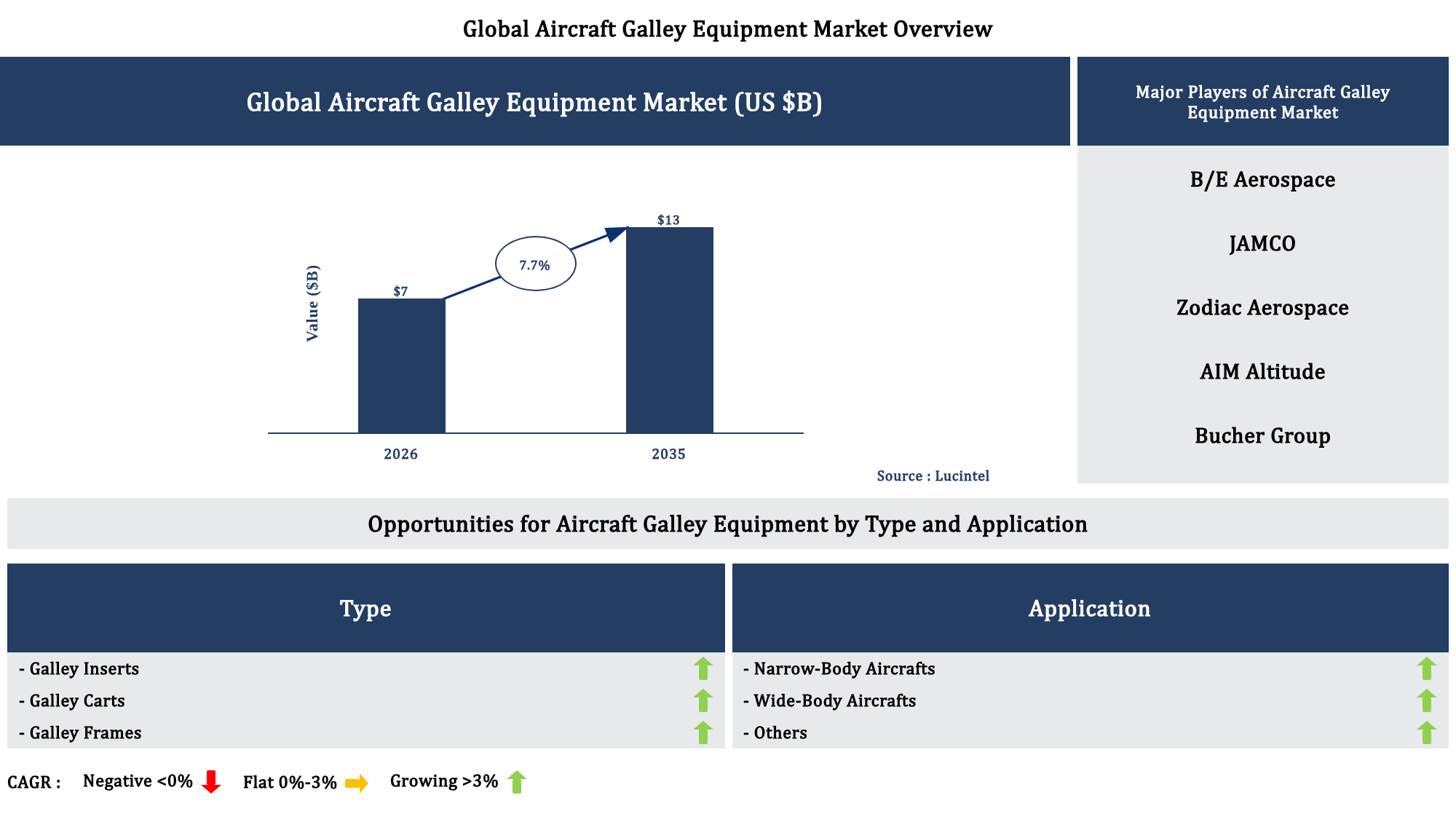
The future of the global aircraft galley equipment market looks promising with opportunities in the commercial aviation, private aviation, and cargo aviation markets. The global aircraft galley equipment market is expected to reach an estimated $13 billion by 2035 with a CAGR of 7.7% from 2026 to 2035. The major drivers for this market are the increasing demand for enhanced onboard catering systems, the rising focus on passenger comfort experience, and the growing adoption of lightweight galley equipment.
• Lucintel forecasts that, within the equipment type category, oven is expected to witness the highest growth over the forecast period.
• Within the application category, commercial aviation is expected to witness the highest growth.
• In terms of region, APAC is expected to witness the highest growth over the forecast period.
Gain valuable insights for your business decisions with our comprehensive 150+ page report. Sample figures with some insights are shown below.
Emerging Trends in the Aircraft Galley Equipment Market
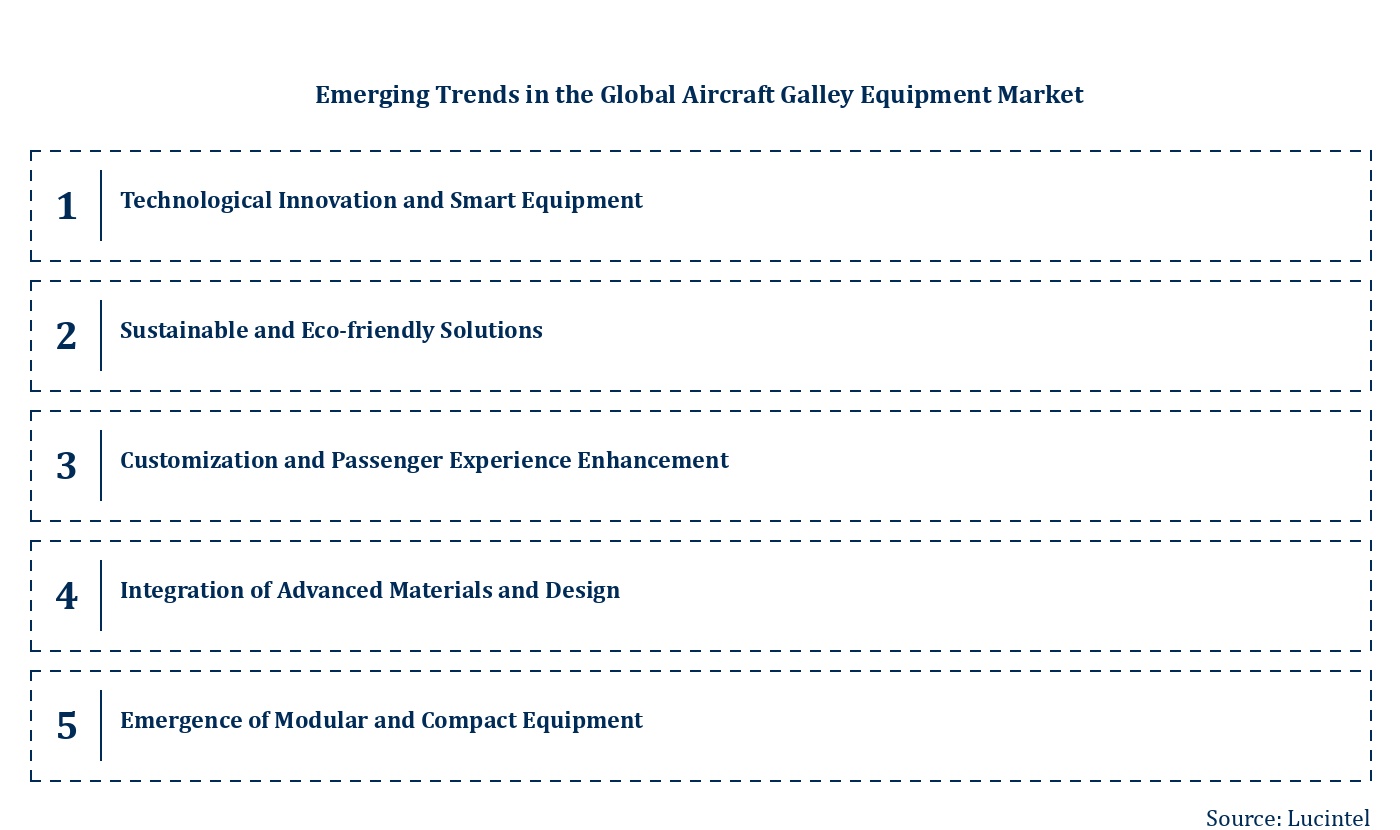
The aircraft galley equipment market is experiencing rapid evolution driven by technological advancements, changing airline passenger preferences, and increasing emphasis on sustainability. As airlines seek to enhance passenger experience while reducing operational costs, manufacturers are innovating with smarter, more efficient, and eco-friendly solutions. These developments are not only transforming the design and functionality of galley equipment but also influencing market dynamics, competitive strategies, and customer expectations. The following key trends highlight the major shifts shaping this market, reflecting a move towards more integrated, sustainable, and passenger-centric solutions that are redefining in-flight service standards.
• Digital Integration and Smart Equipment : The adoption of digital technologies in galley equipment is revolutionizing in-flight service. Smart appliances equipped with IoT connectivity enable real-time monitoring, predictive maintenance, and enhanced operational efficiency. This integration reduces downtime, minimizes maintenance costs, and improves reliability. Airlines benefit from streamlined workflows and better inventory management, while passengers enjoy faster, more personalized service. The trend towards automation and digital control systems is expected to grow, fostering a more connected and efficient galley environment that aligns with the broader digital transformation in aviation.
• Sustainability and Eco-Friendly Solutions : Environmental concerns are prompting a shift towards sustainable galley equipment. Manufacturers are developing energy-efficient appliances, lightweight materials, and water-saving devices to reduce the carbon footprint of in-flight operations. Use of recyclable materials and eco-friendly manufacturing processes are gaining prominence. Airlines are increasingly adopting these solutions to meet regulatory requirements and corporate social responsibility goals. This trend not only helps in reducing operational costs but also appeals to environmentally conscious passengers, thereby enhancing brand reputation and market competitiveness.
• Customization and Passenger Experience Enhancement : Personalization is becoming a key focus in galley equipment design. Airlines are investing in customizable layouts, modular units, and advanced catering systems that cater to diverse passenger preferences and dietary needs. Enhanced in-flight entertainment and connectivity options are integrated into galley setups to improve overall passenger experience. This trend supports premium service offerings and differentiates airlines in a competitive market. The ability to tailor in-flight services through innovative galley solutions is increasingly viewed as a strategic advantage, driving customer satisfaction and loyalty.
• Compact and Space-Efficient Designs : With the increasing demand for maximizing aircraft cabin space, compact and space-efficient galley equipment is gaining importance. Innovative design solutions enable more efficient use of limited space without compromising functionality. Foldable, multi-purpose, and modular units are being developed to optimize layout flexibility. This trend is particularly relevant for narrow-body aircraft and low-cost carriers seeking to enhance capacity and operational efficiency. The adoption of space-saving designs is reshaping the market by enabling airlines to offer better amenities within constrained environments, ultimately improving overall passenger comfort and operational productivity.
• Focus on Hygiene and Safety Standards : The COVID-19 pandemic has heightened awareness around hygiene and safety in aircraft galleys. Manufacturers are now prioritizing the development of equipment that facilitates easier cleaning, antimicrobial surfaces, and touchless operation. Enhanced safety features, such as improved fire suppression systems and ergonomic designs, are also being incorporated. These innovations help airlines meet stringent health regulations and reassure passengers about safety standards. The emphasis on hygiene and safety is driving innovation in materials and design, ensuring that galley equipment supports a safer, cleaner, and more trustworthy in-flight environment.
These emerging trends are collectively transforming the aircraft galley equipment market by fostering innovation, sustainability, and passenger-centric solutions. They are enabling airlines to deliver superior service, reduce costs, and meet evolving regulatory and consumer demands, ultimately reshaping the future landscape of in-flight catering and service delivery.
Recent Developments in the Aircraft Galley Equipment Market
The aircraft galley equipment market is experiencing rapid growth driven by technological advancements, increasing air travel demand, and the need for enhanced passenger comfort. Airlines are investing in innovative, lightweight, and energy-efficient galley solutions to improve operational efficiency and passenger experience. The markets expansion is also fueled by the rise of premium cabins and the modernization of existing fleets. These developments are shaping the future of airline catering and onboard service delivery, creating new opportunities for manufacturers and service providers worldwide.
• Technological Innovations in Galley Equipment: The integration of smart, automated systems is revolutionizing onboard service. Advanced refrigeration, touchless controls, and modular designs improve efficiency, reduce weight, and enhance passenger experience. These innovations enable airlines to offer personalized services, streamline operations, and reduce maintenance costs. As a result, manufacturers are focusing on developing intelligent galley solutions, which are expected to dominate the market, especially in premium and long-haul aircraft segments.
• Rising Demand for Lightweight Materials: The shift towards lightweight materials like composites and aluminum alloys is significantly impacting galley equipment design. Lighter galleys reduce aircraft weight, leading to fuel savings and lower emissions. This trend is driven by stricter environmental regulations and airline cost-cutting measures. Manufacturers are investing in R&D to develop durable, lightweight, and corrosion-resistant materials, which are increasingly adopted in new aircraft models, boosting market growth and enabling airlines to meet sustainability goals.
• Growing Adoption of Modular and Customizable Galleys: Airlines prefer modular galley systems for their flexibility, ease of installation, and maintenance. Customizable options allow airlines to tailor onboard services to passenger preferences, enhancing the overall travel experience. This trend is particularly prominent in premium cabins and retrofit projects. Modular galleys also facilitate quick upgrades and repairs, reducing downtime. The demand for such adaptable solutions is expected to rise, driving innovation and competition among manufacturers.
• Expansion of Aircraft Fleet and Fleet Modernization: The global increase in aircraft orders and fleet renewal programs is a key driver for the galley equipment market. New aircraft require state-of-the-art galley systems, prompting manufacturers to develop advanced solutions. Fleet modernization enhances passenger comfort, operational efficiency, and safety standards. As airlines expand and upgrade their fleets, the demand for innovative galley equipment is projected to grow, creating significant opportunities for industry players across regions.
• Focus on Sustainability and Eco-Friendly Solutions: Environmental concerns are prompting the adoption of eco-friendly galley equipment. Manufacturers are developing energy-efficient appliances, recyclable materials, and waste reduction systems. Airlines aim to reduce carbon footprints and comply with environmental regulations, which influences procurement decisions. The push for sustainability is fostering innovation in low-power, lightweight, and environmentally responsible galley solutions, shaping the future landscape of the market and encouraging industry-wide eco-conscious practices.
The overall impact of these developments is a dynamic, innovative market that is improving airline operational efficiency, passenger satisfaction, and environmental sustainability. As technological and material advancements continue, the aircraft galley equipment market is poised for sustained growth, offering new opportunities for stakeholders and transforming onboard service standards worldwide.
Strategic Growth Opportunities in the Aircraft Galley Equipment Market
The aircraft galley equipment market is experiencing significant growth driven by increasing air travel demand, technological advancements, and airline modernization efforts. Airlines seek efficient, lightweight, and innovative solutions to enhance passenger experience and operational efficiency. Emerging markets and the rise of premium cabins further fuel market expansion. Strategic investments, product innovations, and regulatory compliance are shaping the competitive landscape, creating numerous opportunities for industry players to expand their portfolios and capture new customer segments.
• Increasing Demand for Lightweight and Space-Efficient Equipment: The need for lightweight, compact galley solutions is driven by fuel efficiency and aircraft weight reduction initiatives. Innovations in materials and design enable airlines to optimize space and reduce weight, leading to cost savings. This trend opens opportunities for manufacturers to develop advanced, durable, and lightweight appliances, storage units, and catering systems tailored to modern aircraft cabins, especially in narrow-body and wide-body segments.
• Adoption of Smart and Connected Galley Systems: Integration of IoT and automation technologies in aircraft galleys enhances operational efficiency and passenger experience. Smart systems enable real-time monitoring of equipment, inventory management, and maintenance alerts, reducing downtime and operational costs. This opportunity encourages the development of connected appliances, touchless controls, and data analytics solutions, catering to airlines aiming for digital transformation and improved service delivery.
• Expansion of Premium and Business Class Offerings: The growing demand for luxury and personalized passenger experiences drives the need for high-end galley equipment in premium cabins. Customizable, stylish, and technologically advanced amenities such as premium coffee machines, wine chillers, and modular catering units are in high demand. This segment offers lucrative growth prospects for manufacturers focusing on luxury, comfort, and innovative design tailored to high-end airline clients.
• Growing Focus on Sustainability and Eco-Friendly Solutions: Environmental regulations and airline sustainability commitments promote the adoption of eco-friendly galley equipment. Opportunities exist in developing energy-efficient appliances, recyclable materials, and waste management systems. Companies investing in green technologies can differentiate themselves and meet regulatory standards, appealing to environmentally conscious airlines and passengers, thus expanding their market share in the eco-friendly segment.
• Rising Demand for Customizable and Modular Galley Solutions: Airlines seek flexible, scalable galley configurations to adapt to different aircraft types and evolving passenger needs. Modular systems allow quick reconfiguration, maintenance, and upgrades, reducing downtime and costs. This trend supports the development of versatile, easy-to-install galley units that can be tailored to specific airline requirements, fostering innovation and expanding market reach across various aircraft models and fleet sizes.
These growth opportunities collectively drive innovation, efficiency, and sustainability in the aircraft galley equipment market. By leveraging technological advancements, customization, and eco-friendly solutions, industry players can enhance their competitive edge and meet evolving airline and passenger demands. The market’s future will be shaped by strategic investments in lightweight, smart, and sustainable products, fostering long-term growth and global expansion.
Aircraft Galley Equipment Market Driver and Challenges
The aircraft galley equipment market is influenced by a variety of technological, economic, and regulatory factors that shape its growth and development. Advances in technology drive innovation in design and functionality, while economic conditions impact airline investments and passenger demand. Regulatory standards ensure safety and quality, influencing product development and compliance costs. Additionally, evolving passenger preferences and environmental considerations further impact market dynamics. Navigating these drivers and challenges is essential for industry stakeholders to capitalize on opportunities and address potential risks effectively, ensuring sustained growth and competitiveness in the global market.
The factors responsible for driving the aircraft galley equipment market include:
• Technological Innovation: The continuous development of advanced materials, lightweight components, and smart appliances enhances efficiency, safety, and passenger experience. Innovations such as touchless controls and energy-efficient systems reduce operational costs and improve sustainability. Airlines seek modern, reliable galley equipment to meet evolving passenger expectations and regulatory standards, fueling demand for cutting-edge solutions. This technological progress also enables customization and integration with in-flight entertainment systems, creating a competitive edge for manufacturers and operators.
• Increasing Air Travel Demand: The rising global middle class, urbanization, and expanding airline networks contribute to increased air travel. As passenger numbers grow, airlines invest in modernizing their fleets and upgrading galley equipment to improve service quality and operational efficiency. This surge in demand drives market expansion, especially in emerging markets where air travel is becoming more accessible. The need for high-capacity, versatile galley systems that cater to diverse routes and passenger preferences further propels market growth.
• Regulatory Compliance and Safety Standards: Stringent safety regulations and quality standards imposed by aviation authorities such as FAA and EASA necessitate the adoption of compliant galley equipment. Manufacturers must innovate to meet these standards, which often involve rigorous testing and certification processes. Compliance ensures passenger safety and operational reliability, but also increases development costs and time-to-market. These regulatory requirements influence product design, material selection, and manufacturing processes, shaping the overall market landscape.
• Focus on Sustainability and Eco-Friendly Solutions: Growing environmental concerns and regulatory pressures push airlines and manufacturers toward sustainable practices. The demand for lightweight, energy-efficient, and recyclable galley equipment is increasing. Innovations in materials and design aim to reduce aircraft weight, fuel consumption, and carbon emissions. This focus on sustainability not only aligns with global environmental goals but also offers cost savings in operations, making eco-friendly galley solutions a key driver for market growth.
• Strategic Partnerships and Mergers: Collaborations between aircraft manufacturers, equipment suppliers, and technology firms facilitate innovation and market expansion. Strategic alliances enable sharing of expertise, resources, and access to new markets. Mergers and acquisitions help companies strengthen their product portfolios and global presence. These partnerships accelerate the development of advanced galley systems and enable rapid adaptation to changing market demands, thus fueling industry growth and competitiveness.
The challenges facing the aircraft galley equipment market include:
• High Development and Certification Costs: Developing innovative galley equipment involves significant investment in research, testing, and certification processes. Meeting stringent safety and regulatory standards adds complexity and expense, often leading to longer development cycles. These high costs can act as barriers for smaller players and limit rapid product innovation, potentially slowing market growth. Additionally, the risk of product failure or delays in certification can impact profitability and market entry timelines.
• Rapid Technological Obsolescence: The fast pace of technological advancements can render existing galley equipment obsolete quickly. Manufacturers face pressure to continuously innovate, which increases R&D costs and risks of investing in solutions that may soon be outdated. This rapid obsolescence challenges companies to balance innovation with product lifecycle management, ensuring their offerings remain competitive without incurring excessive costs. It also complicates inventory management and after-sales support.
• Supply Chain Disruptions: The global supply chain for specialized components and materials used in galley equipment is vulnerable to disruptions caused by geopolitical tensions, pandemics, or logistical issues. Such disruptions can lead to delays in manufacturing, increased costs, and inventory shortages. These challenges hinder timely delivery and can impact airline operations, customer satisfaction, and overall market stability. Ensuring a resilient supply chain is critical but remains a persistent challenge for industry players.
The aircraft galley equipment market is shaped by technological advancements, rising air travel, regulatory standards, sustainability initiatives, and strategic collaborations. However, high development costs, rapid technological changes, and supply chain vulnerabilities pose significant challenges. These drivers and challenges collectively influence market growth, requiring stakeholders to innovate strategically, manage risks effectively, and adapt to evolving industry demands. The overall impact is a dynamic, competitive landscape with substantial opportunities for innovation and expansion amid ongoing challenges.
List of Aircraft Galley Equipment Companies
Companies in the market compete on the basis of product quality offered. Major players in this market focus on expanding their manufacturing facilities, R&D investments, infrastructural development, and leverage integration opportunities across the value chain. With these strategies aircraft galley equipment companies cater increasing demand, ensure competitive effectiveness, develop innovative products & technologies, reduce production costs, and expand their customer base. Some of the aircraft galley equipment companies profiled in this report include-
• Zodiac Aerospace
• B/E Aerospace
• Diehl Aviation
• Jamco Corporation
• Thales Group
• Amoji
• Satair
Aircraft Galley Equipment Market by Segment
The study includes a forecast for the global aircraft galley equipment market by equipment type, material type, application, end use, and region.
Aircraft Galley Equipment Market by Equipment Type [Value from 2019 to 2035]:
• Ovens
• Refrigerators
• Coffee Makers
• Heating Cabinets
Aircraft Galley Equipment Market by Material Type [Value from 2019 to 2035]:
• Stainless Steel
• Aluminum
• Plastic
• Composite Materials
Aircraft Galley Equipment Market by Application [Value from 2019 to 2035]:
• Food Preparation
• Beverage Service
• Storage Solutions
• Waste Management
Aircraft Galley Equipment Market by End Use [Value from 2019 to 2035]:
• Commercial Aviation
• Private Aviation
• Cargo Aviation
Aircraft Galley Equipment Market by Region [Value from 2019 to 2035]:
• North America
• Europe
• Asia Pacific
• The Rest of the World
Country Wise Outlook for the Aircraft Galley Equipment Market
The aircraft galley equipment market has experienced significant advancements driven by technological innovation, increasing airline passenger numbers, and a focus on enhanced passenger comfort and safety. As airlines seek to differentiate themselves and improve operational efficiency, manufacturers are investing in smarter, more sustainable galley solutions. Regulatory changes and evolving passenger expectations are also shaping product development, leading to a dynamic and competitive landscape across major markets. The United States, China, Germany, India, and Japan are key players in this industry, each contributing unique trends and innovations that influence global market growth and direction.
• United States: The US market has seen a surge in the adoption of lightweight, energy-efficient galley equipment, driven by airline sustainability initiatives. Major airlines are investing in modular and customizable galley solutions to improve passenger experience and operational flexibility. Technological integration, such as smart inventory management systems, is also gaining traction, enhancing efficiency and reducing waste.
• China: China’s market is rapidly expanding due to the growth of domestic and international air travel. Manufacturers are focusing on cost-effective, durable, and space-saving galley equipment to cater to the increasing volume of flights. Innovations include compact designs and multifunctional appliances that maximize limited space on aircraft.
• Germany: Germany emphasizes high-quality, innovative galley solutions with a focus on safety and sustainability. The market is characterized by the adoption of advanced materials and automation technologies to improve efficiency and reduce maintenance costs. German companies are also investing in eco-friendly designs aligned with European environmental standards.
• India: The Indian market is witnessing rapid growth driven by rising air travel demand and modernization of airline fleets. There is a strong focus on affordable yet efficient galley equipment, with an emphasis on lightweight and space-saving designs. Local manufacturers are increasingly adopting international standards to meet global quality benchmarks.
• Japan: Japan’s market is characterized by technological innovation and a focus on passenger comfort. Companies are developing advanced, ergonomic galley systems with integrated safety features. The trend toward automation and smart appliances is prominent, aiming to enhance operational efficiency and passenger satisfaction.
Features of the Global Aircraft Galley Equipment Market
Market Size Estimates: Aircraft galley equipment market size estimation in terms of value ($B).
Trend and Forecast Analysis: Market trends (2019 to 2025) and forecast (2026 to 2035) by various segments and regions.
Segmentation Analysis: Aircraft galley equipment market size by various segments, such as by equipment types, material types, applications, end uses, and region in terms of value ($B).
Regional Analysis: Aircraft galley equipment market breakdown by North America, Europe, Asia Pacific, and Rest of the World.
Growth Opportunities: Analysis of growth opportunities in different equipment types, material types, applications, end uses, and regions for the aircraft galley equipment market.
Strategic Analysis: This includes M&A, new product development, and competitive landscape of the aircraft galley equipment market.
Analysis of competitive intensity of the industry based on Porter’s Five Forces model.
FAQ
Q1. What is the aircraft galley equipment market size?
Answer: The global aircraft galley equipment market is expected to reach an estimated $13 billion by 2035.
Q2. What is the growth forecast for aircraft galley equipment market?
Answer: The global aircraft galley equipment market is expected to grow with a CAGR of 7.7% from 2026 to 2035.
Q3. What are the major drivers influencing the growth of the aircraft galley equipment market?
Answer: The major drivers for this market are the increasing demand for enhanced onboard catering systems, the rising focus on passenger comfort experience, and the growing adoption of lightweight galley equipment.
Q4. What are the major segments for aircraft galley equipment market?
Answer: The future of the aircraft galley equipment market looks promising with opportunities in the commercial aviation, private aviation, and cargo aviation markets.
Q5. Who are the key aircraft galley equipment market companies?
Answer: Some of the key aircraft galley equipment companies are as follows:
• Zodiac Aerospace
• B/E Aerospace
• Diehl Aviation
• Jamco Corporation
• Thales Group
• Amoji
• Satair
Q6. Which aircraft galley equipment market segment will be the largest in future?
Answer: Lucintel forecasts that, within the equipment type category, oven is expected to witness the highest growth over the forecast period.
Q7. In aircraft galley equipment market, which region is expected to be the largest in next 8 years?
Answer: In terms of region, APAC is expected to witness the highest growth over the forecast period.
Q8. Do we receive customization in this report?
Answer: Yes, Lucintel provides 10% customization without any additional cost.
This report answers following 11 key questions:
Q.1. What are some of the most promising, high-growth opportunities for the aircraft galley equipment market by equipment type (ovens, refrigerators, coffee makers, and heating cabinets), material type (stainless steel, aluminum, plastic, and composite materials), application (food preparation, beverage service, storage solutions, and waste management), end use (commercial aviation, private aviation, and cargo aviation), and region (North America, Europe, Asia Pacific, and the Rest of the World)?
Q.2. Which segments will grow at a faster pace and why?
Q.3. Which region will grow at a faster pace and why?
Q.4. What are the key factors affecting market dynamics? What are the key challenges and business risks in this market?
Q.5. What are the business risks and competitive threats in this market?
Q.6. What are the emerging trends in this market and the reasons behind them?
Q.7. What are some of the changing demands of customers in the market?
Q.8. What are the new developments in the market? Which companies are leading these developments?
Q.9. Who are the major players in this market? What strategic initiatives are key players pursuing for business growth?
Q.10. What are some of the competing products in this market and how big of a threat do they pose for loss of market share by material or product substitution?
Q.11. What M&A activity has occurred in the last 5 years and what has its impact been on the industry?
For any questions related to Aircraft Galley Equipment Market, Aircraft Galley Equipment Market Size, Aircraft Galley Equipment Market Growth, Aircraft Galley Equipment Market Analysis, Aircraft Galley Equipment Market Report, Aircraft Galley Equipment Market Share, Aircraft Galley Equipment Market Trends, Aircraft Galley Equipment Market Forecast, Aircraft Galley Equipment Companies, write Lucintel analyst at email: helpdesk@lucintel.com. We will be glad to get back to you soon.