
Aircraft Carbon Brake System Market
The future of the global aircraft carbon brake system market looks promising with opportunities in the commercial aircraft, business jets, regional aircraft and military aircraft markets. The global aircraft carbon brake system market is expected to reach an estimated $2.3 billion by 2035 with a CAGR of 3.3% from 2026 to 2035. The major drivers for this market are the increasing aircraft production drives market growth, the rising air travel boosts demand and the growing fleet modernization accelerates adoption.
• Lucintel forecasts that, within the fit type category, line fit will remain the largest segment over the forecast period as the rising new aircraft deliveries strengthen line fit demand.
• Within the aircraft type category, commercial aircraft will remain the largest segment due to the the increasing commercial aircraft deliveries boost carbon brake demand.
• In terms of regions, North America will remain the largest region over the forecast period due to the the rising fleet modernization drives carbon brake adoption.
Gain valuable insights for your business decisions with our comprehensive 150+ page report.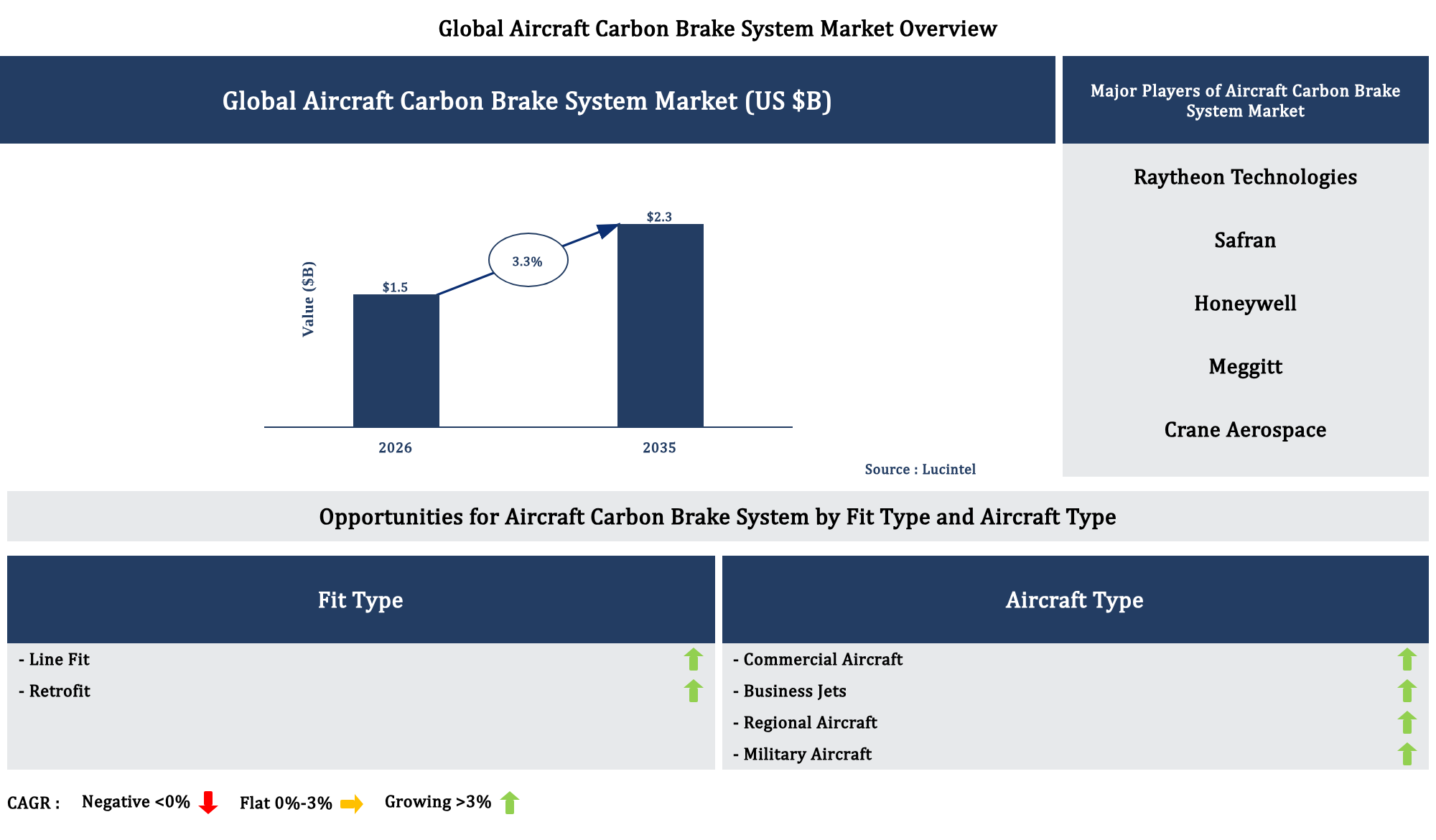
Emerging Trends in the Aircraft Carbon Brake System Market
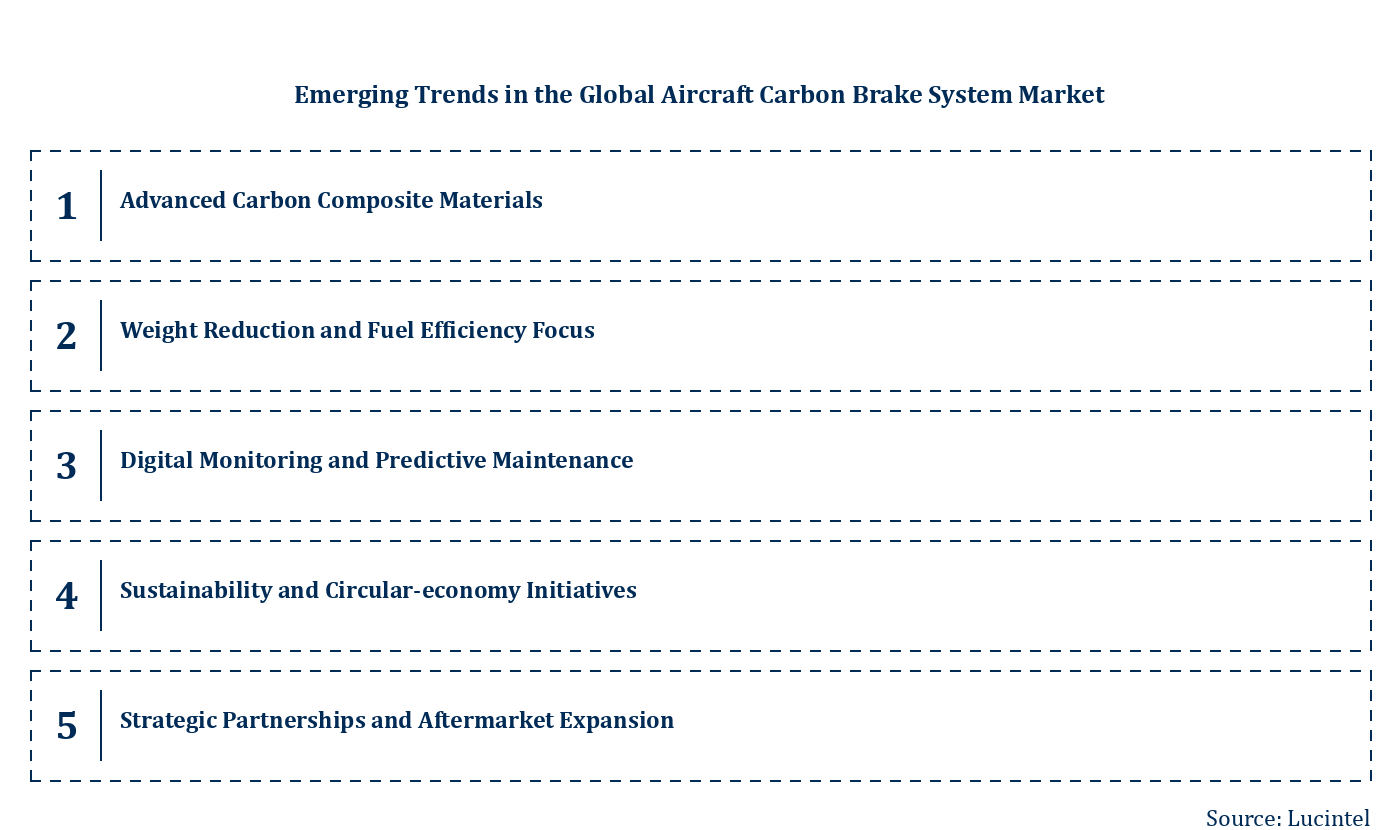
The aircraft carbon brake system market is evolving rapidly as airlines, OEMs, and maintenance providers seek lighter, more durable, and environmentally responsible braking solutions. Carbon brakes are increasingly favored over steel due to superior heat management, weight savings, and lifecycle cost benefits, aligning with airlines’ focus on fuel efficiency and operational reliability. Meanwhile, rising air traffic, fleet modernization, and stricter safety and emissions regulations are accelerating innovation in materials, manufacturing, and digital monitoring. These forces are reshaping competitive dynamics, spurring collaborations across the value chain, and driving the adoption of advanced carbon brake systems across commercial, military, and business aviation fleets.
Recent Developments in the Aircraft Carbon Brake System Market
The aircraft carbon brake system market is undergoing significant change as airlines, OEMs, and suppliers respond to higher traffic volumes, fleet modernization, and stricter sustainability targets. Carbon brakes are increasingly favored over steel alternatives due to their lower weight, superior performance, and reduced lifecycle costs. At the same time, manufacturers are investing heavily in materials science, digital monitoring, and production efficiency to meet growing demand while controlling costs. Strategic partnerships and consolidation are reshaping the competitive landscape, while aftermarket service models are evolving to prioritize uptime and predictable maintenance budgets for operators worldwide.
Strategic Growth Opportunities in the Aircraft Carbon Brake System Market
The aircraft carbon brake system market is evolving as airlines and operators prioritize fuel efficiency, lifecycle cost reduction, and lower environmental impact. Carbon brakes offer lighter weight, superior heat management, and longer service life compared with traditional steel brakes, making them attractive across commercial, military, business, and regional aviation segments. Growth opportunities are emerging as fleets modernize, traffic rebounds, and operators seek higher utilization rates with fewer maintenance events. Advancements in materials science, digital monitoring, and retrofit solutions are expanding adoption. Companies that align product design and services with application-specific needs can capture significant long-term value.
Aircraft Carbon Brake System Market Drivers and Challenges
The global aircraft carbon brake system market is shaped by a dynamic mix of technological innovation, fleet expansion, sustainability goals, cost pressures, and evolving safety regulations. Airlines and OEMs are increasingly turning to carbon brakes to improve performance, reduce weight, and cut lifecycle costs, especially on newer commercial and military platforms. At the same time, volatile raw material prices, certification complexity, and supply chain risks can constrain adoption and margins. Understanding the interplay of these drivers and challenges is essential for manufacturers, maintenance providers, and operators seeking to optimize aircraft braking performance and capture future growth opportunities worldwide.
The factors responsible for driving the aircraft carbon brake system market include:
The challenges in the aircraft carbon brake system market are:
The aircraft carbon brake system market is propelled by fleet renewal, efficiency gains, and stricter safety expectations, which collectively favor advanced braking technologies. Carbon brakes offer compelling advantages in lifecycle cost, weight, and performance, reinforcing their adoption on new and in-service aircraft. However, high initial investment needs, complex production dynamics, and demanding certification pathways constrain how quickly capacity can scale and new entrants can compete. Stakeholders that strategically manage supply chains, invest in process innovation, and collaborate closely with OEMs and regulators will be best positioned to capture growth while mitigating the structural risks embedded in this specialized market.
List of Aircraft Carbon Brake System Market Companies
Companies in the market compete on the basis of product quality offered. Major players in this market focus on expanding their manufacturing facilities, R&D investments, infrastructural development, and leverage integration opportunities across the value chain. Through these strategies aircraft carbon brake system market companies cater increasing demand, ensure competitive effectiveness, develop innovative products & technologies, reduce production costs, and expand their customer base. Some of the aircraft carbon brake system market companies profiled in this report include-
Aircraft Carbon Brake System Market by Segment
The study includes a forecast for the global aircraft carbon brake system market by fit type, aircraft type, and region.
Country Wise Outlook for the Aircraft Carbon Brake System Market
The aircraft carbon brake system market is evolving rapidly as airlines and defense operators prioritize lighter components, lower lifecycle costs, and sustainability. Carbon brakes offer significant weight savings and improved heat dissipation versus steel, translating into fuel efficiency and reduced emissions. Across major aviation hubs, regulatory pressure, fleet modernization, and rising traffic are accelerating retrofit and line-fit adoption. At the same time, manufacturers are optimizing carbon composite formulations and digital monitoring for longer service intervals. Recent developments in the United States, China, Germany, India, and Japan demonstrate differentiated strategies shaped by domestic aerospace capabilities and policy priorities.
Features of the Aircraft Carbon Brake System Market
Article
Aircraft Carbon Brake System Market: Which Forces Are Quietly Redefining Braking Performance?
Dallas, July 17, 2026 – The aircraft carbon brake system market is entering a decisive phase of reinvention as airlines, OEMs, and technology players converge around efficiency, sustainability, and digitalization. Carbon brakes, once a premium feature limited to flagship widebodies, are now becoming a strategic lever for cost reduction, decarbonization, and operational resilience across commercial, military, and business aviation fleets. Behind the scenes, breakthroughs in materials science, sensor integration, and data-driven maintenance are reshaping competitive dynamics and opening the door to new business models across the broader technology ecosystem.
How Are Advanced Materials and Design Innovations Changing the Economics of Carbon Brakes?
A key trend reshaping the aircraft carbon brake system market is the rapid improvement in carbon composite formulations and disc architecture. Manufacturers are moving beyond legacy carbon-carbon solutions to enhanced carbon matrix designs that deliver higher energy absorption, reduced wear, and better resistance to oxidation. These improvements are critical for high-utilization fleets that demand more landing cycles per brake set, especially on narrowbody aircraft serving dense short-haul networks.
Commercial airlines are poised to benefit significantly as improved carbon brakes can lower direct operating costs through longer service intervals, reduced aircraft downtime, and lighter weight compared with steel alternatives. The weight savings translate into fuel burn reductions and lower CO₂ emissions, aligning directly with airline sustainability objectives and emerging regulatory scrutiny. In military aviation, where high-energy stops, carrier operations, and rugged environments are common, new carbon formulations also promise greater reliability and performance margins under extreme thermal loads.
Why Is the Shift to Predictive and Condition-Based Maintenance a Game Changer?
Another defining development is the integration of sensors, edge analytics, and connectivity into carbon brake systems to enable condition-based and predictive maintenance. Traditional brake maintenance has often relied on time-based schedules or visual inspections, which can either trigger premature replacements or miss emerging failure modes. Embedded temperature, pressure, and wear sensors are now feeding into aircraft health monitoring systems, with data analyzed both onboard and in cloud environments.
This shift has major implications for the aftermarket and for technology providers. Airlines can move from reactive to predictive maintenance strategies, optimizing brake life, minimizing unexpected ground events, and synchronizing brake overhauls with other scheduled checks. Data-rich brake systems are creating new use cases for analytics platforms, AI-driven anomaly detection, and digital twins. Technology firms specializing in industrial IoT, onboard computing, and secure connectivity are finding new partnership opportunities with brake OEMs and airframers to co-develop integrated health monitoring solutions.
Where Will Additive Manufacturing and Digital Engineering Disrupt the Supply Chain?
As aerospace supply chains come under pressure from higher build rates and more complex platforms, additive manufacturing and advanced digital engineering tools are beginning to reshape how carbon brake components and associated hardware are designed and produced. Though the core friction materials still rely on specialized carbon processing, non-friction elements like torque tubes, heat shields, and housings are increasingly candidates for additive manufacturing, lightweight alloys, and topology-optimized geometries.
For the aircraft carbon brake system market, this evolution could reduce lead times, enable more localized production, and allow rapid design iterations tailored to new aircraft variants. It also opens the door for closer integration between brake design and landing gear, wheel, and actuation systems. Technology suppliers offering simulation software, generative design tools, and production-grade 3D printing platforms are becoming strategic partners, as brake manufacturers seek to improve manufacturability, reduce waste, and capture cost efficiencies.
How Is the Sustainability Agenda Reframing Value Propositions in the Market?
Sustainability is no longer a peripheral talking point; it is increasingly central to how carbon brake systems are specified and evaluated. Airlines and lessors are quantifying not only in-service emissions reductions through lighter brakes but also the lifecycle environmental footprint of brake production, overhaul, and end-of-life handling. This shift is prompting brake providers to refine manufacturing processes, improve energy efficiency in carbonization and heat treatment, and explore recycling paths for end-of-life discs.
The net effect is that carbon brakes are turning into a visible lever in broader ESG strategies. By enabling fuel savings and lower emissions, they contribute to climate targets, while new recycling and refurbishment models help address circularity expectations. Environmental performance metrics are becoming part of airline procurement criteria, which could disrupt incumbent supply positions and create room for innovators that can demonstrate reduced lifecycle impact and credible decarbonization roadmaps.
What Role Will Electrification and More Electric Aircraft Architectures Play?
As aircraft architectures move steadily toward more electric systems, brake-by-wire and electronically controlled braking solutions are gaining prominence. Although hydraulic actuation remains widespread, new-generation narrowbodies, regional jets, and business aircraft are adopting more electric configurations that integrate electronic braking controls, anti-skid systems, and advanced actuation technologies. Carbon brakes are naturally aligned with this shift, given their thermal characteristics and ability to handle higher performance envelopes.
More electric architectures create opportunities for tighter integration between brake control units, flight control computers, and landing gear monitoring systems. Technology vendors specializing in power electronics, real-time control software, and cybersecurity are increasingly involved in the value chain, helping ensure that the coordination between carbon brakes and other critical systems is both safe and highly optimized. This integration can improve stopping performance, reduce wear through smarter brake modulation, and enable new features such as runway condition-adaptive braking profiles.
Which Market Segments Will Capture the Strongest Impact from These Innovations?
Commercial narrowbody fleets are expected to be the most immediate beneficiaries of carbon brake innovations, as rising air travel demand pushes utilization higher and puts cost-per-cycle metrics under intense scrutiny. Carbon brakes with longer life and predictive maintenance capabilities directly enhance fleet efficiency and aircraft availability, especially for low-cost carriers and network airlines operating intensive schedules.
Widebody and long-haul operators will also see material gains, particularly where weight savings from carbon systems translate into substantial fuel burn reductions over long sectors. Military aviation will benefit from higher energy capacity and thermal robustness in mission-critical operations, while business aviation will adopt advanced carbon brake systems as premium features associated with performance, durability, and safety. Emerging markets with fast-growing fleets may leapfrog legacy steel brakes altogether on new deliveries, accelerating the diffusion of carbon technology and altering long-term aftermarket dynamics.
What Key Challenges Could Slow the Adoption of Next-Generation Carbon Brake Systems?
Where Do the Most Attractive Opportunities Emerge for Industry and Technology Players?
How Is the Technology Industry Leveraging Use Cases Around Aircraft Carbon Brake Systems?
The technology industry is increasingly embedding aircraft carbon brake systems into broader digital and industrial platforms. Brake performance data is becoming an important input for predictive maintenance engines that cover entire aircraft systems, from engines and avionics to landing gear and environmental controls. Cloud and edge computing providers are enabling real-time data ingestion, on-wing analytics, and secure data streaming to airline operations centers and OEM support hubs.
Use cases range from AI-driven anomaly detection that flags unusual temperature patterns or wear rates, to digital twin models that simulate brake performance across diverse runway conditions and operational scenarios. Cybersecurity firms are engaging to safeguard brake-related data and control commands, particularly as brake-by-wire systems converge with critical avionics and flight control networks. Meanwhile, industrial software providers are integrating brake lifecycle data into asset management, planning, and supply chain tools, helping airlines and MROs optimize inventory and maintenance slot allocation.
What Recent Developments Signal Where the aircraft carbon brake system market Is Headed?
Recent years have seen a series of strategic moves, technology launches, and ecosystem collaborations that underscore the accelerating pace of change in the aircraft carbon brake system market. Major brake OEMs have announced upgraded carbon disc technologies designed for newer single-aisle platforms, promising extended life and improved heat dissipation to cope with higher landing frequencies. These products are often paired with enhanced electronic control units and new software algorithms that optimize braking profiles.
Digitalization initiatives are also gaining momentum, with leading players rolling out connected brake services that bundle hardware, monitoring, and analytics into integrated offerings. Airlines are beginning to sign long-term service agreements that link payment to performance metrics such as brake life, on-time performance, and unplanned removal rates. On the regulatory front, authorities are engaging more deeply with issues around data use, software updates to critical braking functions, and the cybersecurity of more electric aircraft braking architectures.
How Should Stakeholders Position Themselves for the Next Phase of Market Disruption?
The aircraft carbon brake system market is moving from incremental engineering improvements to a more systemic shift that blends advanced materials, digital intelligence, and sustainability metrics. Stakeholders that treat brakes purely as a consumable will find themselves at a disadvantage compared with those that view braking as a strategic platform for operational excellence, data-driven services, and environmental performance. Manufacturers that can combine superior friction technology with integrated digital offerings and credible sustainability narratives will be best positioned to capture value.
For airlines, lessors, and operators, the strategic choice lies in how aggressively to adopt sensorized, predictive, and service-based models that rethink total cost of ownership. For technology firms, the opportunity is to embed their capabilities deep into the lifecycle of carbon brakes, from design and simulation through in-service analytics and circular end-of-life solutions. As these forces converge, aircraft carbon brake systems are set to evolve from a largely mechanical subsystem into a digitally enabled, performance-critical asset that plays a visible role in the broader transformation of aviation.
Top 5 Companies
1. Raytheon Technologies
Raytheon Technologies, now operating under the brand RTX, is a major aerospace and defense conglomerate formed through the merger of Raytheon Company and United Technologies Corporation in 2020. Headquartered in Arlington, Virginia, the company employs well over 180,000 people across North America, Europe, Asia-Pacific, and the Middle East, serving commercial aviation, defense, and space markets. In the aircraft carbon brake system market, Raytheon Technologies participates primarily through its Collins Aerospace business, which supplies advanced carbon brake assemblies, wheels, and related control systems for commercial, regional, and military aircraft platforms. The portfolio encompasses carbon brake packs, heat sinks, wheel and brake monitoring systems, and lifecycle services including overhaul and repair tailored to extend brake life and reduce operating costs for airline and defense customers. Collins Aerospace carbon brakes are featured on a wide range of narrow-body and wide-body aircraft families. While large scale geographic expansion specific to carbon brakes has centered on strengthening maintenance, repair, and overhaul capabilities in North America, Europe, and Asia, the broader company continues to invest in production and engineering facilities that support brake technologies as part of integrated landing systems. Since the 2020 merger that created Raytheon Technologies, the group has focused more on internal integration and portfolio optimization than large new mergers and acquisitions directly tied to carbon brakes, although legacy acquisitions on both Raytheon and United Technologies sides historically expanded the installed base and service footprint for aircraft wheels and brakes.
2. Safran
Safran is a leading French aerospace and defense group with a strong position in landing systems and aircraft braking technology, including carbon brake systems for commercial, regional, and military aircraft. Headquartered in Paris, the company employs more than 90,000 people and maintains a broad geographic presence spanning Europe, North America, Asia-Pacific, Latin America, and the Middle East. Within the aircraft carbon brake system market, Safran Landing Systems is one of the principal global suppliers, offering carbon brake packs, wheels, electro-hydraulic and brake control units, as well as associated sensors and monitoring solutions. Safran’s carbon brake technologies are used widely on major aircraft platforms, helping airlines reduce weight and improve braking efficiency and durability. The company supports its installed base through a global MRO network with facilities and service centers strategically located near key airline hubs, reinforcing its geographic reach in North America, Europe, China, and other Asian markets. Safran has expanded its carbon brake footprint through new equipment selections on next-generation aircraft and by extending long-term support agreements with airlines and leasing companies. In terms of mergers and acquisitions relevant to aircraft landing and braking systems, the creation of Safran itself resulted from the merger of SNECMA and SAGEM in 2005, consolidating aerospace capabilities, while subsequent portfolio streamlining and joint ventures have reinforced its specialization in landing gear and advanced carbon composite materials used in aircraft brakes.
3. Honeywell
Honeywell is a diversified technology and manufacturing company with a significant aerospace business that includes avionics, propulsion, and mechanical systems for commercial and military aircraft. Headquartered in Charlotte, North Carolina, Honeywell has roughly 100,000 employees and operates across North America, Europe, Asia-Pacific, Latin America, and the Middle East. In the context of the aircraft carbon brake system market, Honeywell participates primarily through integration of braking and landing systems, brake control electronics, and related sensors and software, while historically having capabilities in wheel and brake technologies for certain aircraft categories. The company’s product portfolio related to this market includes brake control systems, anti-skid units, autobrake modules, and system-level integration that ensures optimal performance of carbon brake hardware supplied by itself or partners. Honeywell’s global aerospace engineering and service centers provide support, upgrades, and retrofits that often involve brake system optimization for airlines and defense operators seeking improved stopping performance and lower maintenance costs. Geographic expansion relevant to carbon brake systems has largely involved scaling its aerospace engineering centers and customer support operations in Europe, India, China, and other Asian locations to serve airframers and operators more closely. In terms of mergers and acquisitions, Honeywell has carried out multiple aerospace-focused deals over decades that enhanced its systems integration and mechanical systems capabilities, indirectly strengthening its position in integrated brake and landing systems, although no recent high-profile acquisition has been solely focused on carbon brake manufacturing.
4. Meggitt
Meggitt is a United Kingdom based aerospace, defense, and energy engineering group recognized for its strong niche positions in braking systems, wheels, and related components for aircraft. Headquartered in Coventry, the company employs several thousand people across the UK, continental Europe, North America, and Asia, with manufacturing and service facilities close to major airframe and airline customers. Meggitt’s portfolio in the aircraft carbon brake system market is significant, including carbon brake packs, wheels, integrated brake control systems, and monitoring solutions for commercial, regional, business jet, and military aircraft platforms. Its carbon brake technology emphasizes high energy absorption, long life, and reduced weight, contributing to lower fuel burn and lifecycle costs for operators. Meggitt has pursued geographic expansion related to aircraft brakes through new manufacturing and service capacity in regions such as North America and Asia, along with long term support agreements with airlines and original equipment manufacturers. In aerospace, Meggitt has historically expanded capabilities through targeted acquisitions in braking systems and composites, building its technology base for carbon and high temperature materials used in brakes. A major corporate development affecting the company and its brake business was the acquisition of Meggitt by Parker-Hannifin, which closed in 2022 and integrated Meggitt into a larger motion and control technology group; this transaction increased global reach and resources for its aircraft braking systems operations, though Meggitt continues to operate as a recognizable brand in braking solutions.
5. Crane Aerospace
Crane Aerospace is a business segment of Crane Company that provides highly engineered components and systems for commercial and military aircraft, including solutions closely associated with aircraft brake operation and control. Headquartered in Lynnwood, Washington, Crane Aerospace has several thousand employees spread across facilities in North America, Europe, and Asia, supporting major airframers, tier one system integrators, and airlines. While Crane Aerospace is not a primary manufacturer of carbon brake discs themselves, it plays a vital role in the aircraft carbon brake system market through brake control systems, hydraulic components, landing gear subsystems, proximity sensors, fluid management equipment, and electronic control units that interface with carbon brakes supplied by other manufacturers. Its products enable precise brake pressure modulation, anti-skid functionality, and health monitoring, which are all critical to maximizing the performance and service life of carbon brake assemblies. Crane Aerospace’s geographic presence has been reinforced by expanding engineering, manufacturing, and customer support sites closer to key customers in Europe and Asia-Pacific, enabling more responsive design collaboration and aftermarket service. In terms of mergers and acquisitions related to its role in aircraft braking and landing systems, Crane Company has historically completed targeted acquisitions in aerospace electronics, sensing, and fluid management technologies, thereby enhancing the integration level and reliability of the systems Crane Aerospace provides around aircraft landing and braking operations.
Table of Contents
List of Figures
List of Tables
Methodology
Lucintel has been in the business of market research and management consulting since 2000 and has published over 1000 market intelligence reports in various markets / applications and served over 1,000 clients worldwide. This study is a culmination of four months of full-time effort performed by Lucintel's analyst team. The analysts used the following sources for the creation and completion of this valuable report:
- In-depth interviews of the major players in this market
- Detailed secondary research from competitors' financial statements and published data
- Extensive searches of published works, market, and database information pertaining to industry news, company press releases, and customer intentions
- A compilation of the experiences, judgments, and insights of Lucintel's professionals, who have analyzed and tracked this market over the years.
Extensive research and interviews are conducted across the supply chain of this market to estimate market share, market size, trends, drivers, challenges, and forecasts. Below is a brief summary of the primary interviews that were conducted by job function for this report.

Thus, Lucintel compiles vast amounts of data from numerous sources, validates the integrity of that data, and performs a comprehensive analysis. Lucintel then organizes the data, its findings, and insights into a concise report designed to support the strategic decision-making process. The figure below is a graphical representation of Lucintel's research process.

Buy Now
Choose a license that fits your team. Instant PDF delivery.
Prices exclude taxes. Instant delivery. Custom licensing available on request.
Frequently Asked Questions
What is the Aircraft Carbon Brake System Market size?
What is the growth forecast for Aircraft Carbon Brake System Market?
What are the major drivers influencing the growth of the Aircraft Carbon Brake System Market?
What are the major segments for Aircraft Carbon Brake System Market?
Who are the key Aircraft Carbon Brake System Market companies?
Which Aircraft Carbon Brake System Market segment will be the largest in future?
In Aircraft Carbon Brake System Market, which region is expected to be the largest in next 9 years?
Do we receive customization in this report?
Key Questions
- • What are some of the most promising, high-growth opportunities for the Aircraft Carbon Brake System Market by Fit Type (Line Fit and Retrofit), Aircraft Type (Commercial Aircraft, Business Jets, Regional Aircraft, and Military Aircraft), and region (North America, Europe, Asia Pacific, and the Rest of the World)?
- • Which segments will grow at a faster pace and why?
- • Which region will grow at a faster pace and why?
- • What are the key factors affecting market dynamics? What are the key challenges and business risks in this market?
- • What are the business risks and competitive threats in this market?
- • What are the emerging trends in this market and the reasons behind them?
- • What are some of the changing demands of customers in the market?
- • What are the new developments in the market? Which companies are leading these developments?
- • Who are the major players in this market? What strategic initiatives are key players pursuing for business growth?
- • What are some of the competing products in this market and how big of a threat do they pose for loss of market share by material or product substitution?
- • What M&A activity has occurred in the last 9 years, and what has its impact been on the industry?


